Social-Emotional Development: Stages, Strategies, and What Teachers Need to Know
|
March 5, 2026
A comprehensive guide to social-emotional development for UK teachers. Covers developmental stages, Erikson, Bowlby, Vygotsky, Bandura, and Bronfenbrenner, with practical strategies for SEL, PSHE, and supporting children with SEND.
When we talk about learning in our classrooms, we often focus on academic progress. We measure reading levels, mark maths papers, and track progress towards curriculum targets. But the children sitting in front of us need far more than subject knowledge. They need to understand themselves. They need to manage their feelings when things go wrong. They need to build friendships, read social situations, and develop empathy for others. These abilities are not extras or soft skills bolted onto the side of real education. They are the foundation that everything else rests on.
Social-emotional development is the process through which children learn to recognise, understand, and manage their emotions. It encompasses the ability to form secure relationships, recognise social norms, develop empathy, and regulate behaviour in response to the world around them. Without progress in this area, children struggle to learn effectively, regardless of how good our teaching is.
Key Takeaways
Social-emotional development is foundational: Children cannot access academic learning effectively without the ability to manage emotions, form relationships, and regulate behaviour.
Development progresses through predictable stages: From infancy through adolescence, children move through distinct social-emotional phases, each with characteristic challenges and achievements.
Theory informs practice: Understanding Erikson, Bowlby, Vygotsky, Bandura, and Bronfenbrenner helps us create classroom environments that support healthy social-emotional growth.
Practical strategies matter: Emotion coaching, circle time, restorative practice, and explicit teaching of emotional regulation directly improve behaviour, mental health, and academic outcomes.
What Is Social-Emotional Development?
Social-emotional development refers to a child's growing ability to understand and manage their own emotions, form and maintain relationships, show empathy and compassion for others, and make responsible decisions. It is the capacity to recognise emotions (in themselves and others), express feelings appropriately, regulate behaviour, and navigate social situations competently.
This is not psychology jargon. It is what we see when a Year 2 child shares a crayon without being asked. It is what we hear when a primary school pupil says, "I notice you look sad, would you like to sit with me?" It is what we recognise when a secondary student takes a moment to calm down before responding to a peer who has upset them. These moments are social-emotional development in action.
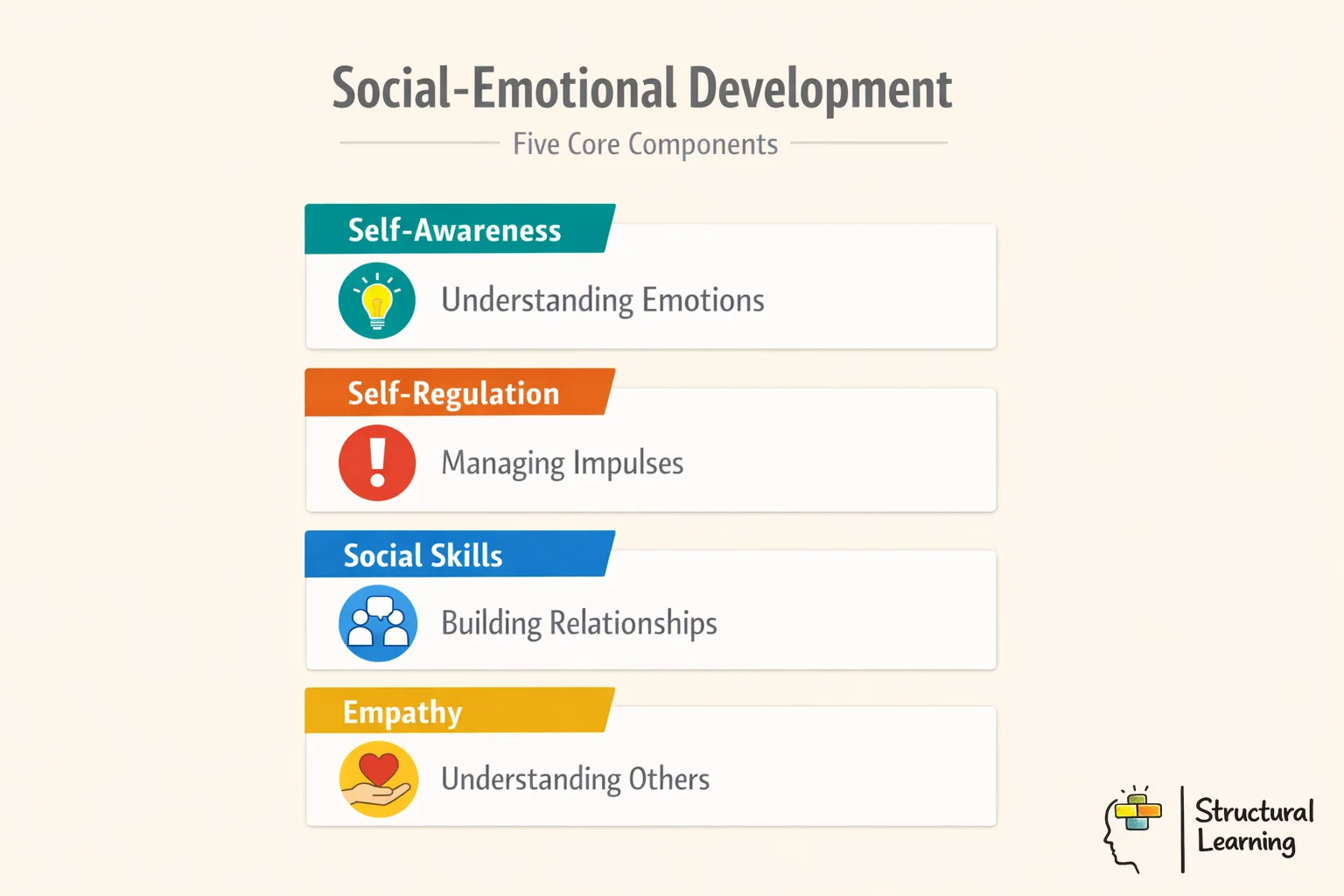
Social-emotional development has five core components: self-awareness (knowing your feelings and strengths), self-management (controlling impulses and managing stress), social awareness (understanding others' perspectives), relationship skills (working with others, communicating, cooperating), and responsible decision-making (making ethical choices that consider others' wellbeing).
Why Social-Emotional Development Matters in Schools
The case for prioritising social-emotional development is compelling. Research from the Collaborative for Academic, Social, and Emotional Learning (CASEL) shows that students with strong social-emotional skills have higher academic achievement, improved attendance, better behaviour, and lower rates of mental health difficulties.
Consider the practical reality of our classrooms. A child who cannot regulate their emotions becomes dysregulated under pressure. They cannot access retrieval practice effectively because their nervous system is in fight-or-flight mode. As Maslow's hierarchy reminds us, safety and belonging needs must be met before higher-order learning can happen. A child who lacks empathy or cannot read social signals will struggle to participate in collaborative learning activities. A young person struggling with their identity or worried about peer relationships cannot concentrate on algebra or Shakespeare.
The mental health crisis affecting young people in the UK is undeniable. According to the NHS, one in four young people now experience mental health difficulties. Schools are not counselling services, but we are the single institution that reaches all children every day. Our classrooms are the frontline for early intervention, support, and prevention. This is not a distraction from teaching. It is the precondition for it.
From an Ofsted perspective, inspectors now look closely at how well schools support pupils' personal development and wellbeing. SMSC (spiritual, moral, social and cultural development) is statutory in all schools, with moral development forming a key strand. This is not a trend. It is a permanent shift in what is considered effective education.
Stages of Social-Emotional Development by Age
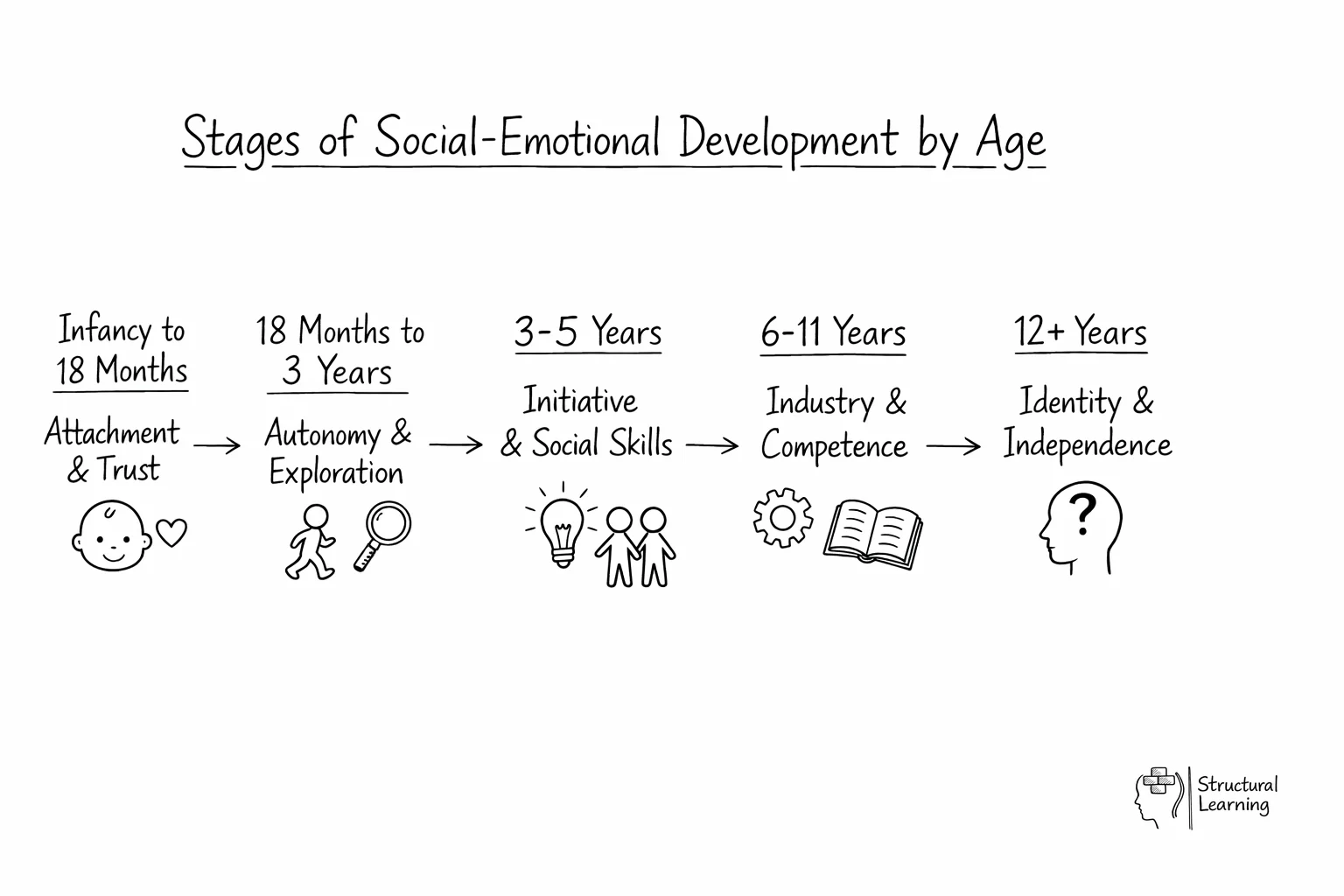
Social-emotional development is not uniform. Children move through distinct phases, each with characteristic tasks and challenges. Understanding these stages helps us pitch our support appropriately.
Infancy to 18 Months: Attachment and Trust
In the earliest months, social-emotional development is almost entirely relational. Babies are learning whether the world is safe, whether their needs will be met, and whether they can trust their primary caregivers. This period is crucial. The quality of early attachment shapes development across all subsequent stages.
In school settings (for those children in nurseries), this means understanding that separation anxiety is not a problem to eliminate. It is a sign of healthy attachment to parents. Key persons in EYFS settings take on an attachment role, and children's confidence depends on having consistent, warm relationships with these adults.
18 Months to 3 Years: Autonomy and Exploration
Toddlers are beginning to see themselves as separate beings. They want to do things independently ("Me do it"). This is healthy. They are developing autonomy and a sense of agency. Simultaneously, they are still learning to manage their emotions. They cannot yet regulate frustration, so tantrums are developmentally normal.
In early years settings, this stage requires patient adults who set clear boundaries while respecting children's drive for independence. The goal is not to eliminate emotional outbursts but to model calm, to help children name their feelings ("You're frustrated because you wanted to pour the water yourself"), and to coach them through big emotions.
3 to 5 Years: Play and Friendship
By age 3, children are moving into more complex social play. They are interested in other children, though they still play largely alongside rather than with peers. By age 5, most are beginning genuine collaborative play, sharing, negotiating roles ("You be the doctor, I'll be the patient"), and simple turn-taking.
Emotionally, they are becoming more aware that others have feelings and perspectives different from their own. They show emerging empathy, though it is still concrete and inconsistent. They are beginning to understand social rules, though enforcement still relies heavily on adult guidance.
In EYFS and early primary, supporting this stage means facilitating play-based learning where children practise social interaction in low-stakes, enjoyable contexts. Circle time, emotion cards, and structured turn-taking games teach social awareness and regulate emotion in safe, age-appropriate ways.
6 to 11 Years: Competence, Peer Relationships, and Empathy
Primary-aged children are increasingly peer-focused. Friendships become central to their social-emotional world. They are concerned with belonging, with being included in groups, and with their status among peers. They want to be competent and to be recognised as capable.
Emotionally, they are developing greater self-awareness and emotional regulation capacity, though this is still inconsistent under stress. They are developing a more realistic understanding of their own abilities. They show more genuine empathy and can understand multiple perspectives, though their thinking is still concrete.
The primary years are critical for building positive relationships with peers and developing a sense of competence. Peer rejection or constant academic failure in this period can have lasting effects on self-esteem and social development. Supporting this means recognising that playground dynamics matter educationally, that collaborative group work teaches social skills, and that celebrating small successes builds the sense of competence children need.
11 to 18 Years: Identity, Intimacy, and Independence
Adolescence brings profound social-emotional change. Young people are developing their identity, figuring out who they are separate from their families. They are becoming more emotionally intense, more focused on peer relationships, and more aware of social status. Romantic relationships become salient. They are developing independence whilst still needing adult guidance.
Emotionally, adolescents are moving towards adult emotional capacity, but their brains are not yet fully mature. The prefrontal cortex (responsible for impulse control, planning, and emotional regulation) is still developing. This can lead to risk-taking, emotional volatility, and difficulty predicting consequences. This is not a character flaw. It is biology.
Supporting adolescents means respecting their growing autonomy whilst maintaining firm, consistent boundaries. It means recognising that peer relationships are not a distraction from learning but a central part of their development. It means creating school cultures where young people can explore identity safely, where differences are respected, and where adults model emotional literacy.
Erikson's Psychosocial Stages and the Classroom
Erik Erikson's theory of psychosocial development remains one of the most useful frameworks for understanding social-emotional development across the lifespan. Erikson proposed that development proceeds through eight stages, each characterised by a central conflict or tension that must be resolved. How each conflict is resolved shapes personality and capability.
The table below maps Erikson's stages to UK school phases.
Erikson's Stage
Age Range
Central Conflict
School Phase
What Teachers Can Do
Trust vs Mistrust
0–18 months
Can I trust adults to meet my needs?
Nursery, early EYFS
Be consistent, predictable, warm. Respond to cues. Build secure attachment with key person.
Autonomy vs Shame/Doubt
18 months–3 years
Can I do things myself?
EYFS, Reception
Provide choices, encourage independence, set firm boundaries, allow safe exploration.
Initiative vs Guilt
3–5 years
Can I make things happen?
EYFS, Reception, Year 1
Support play-based learning, encourage ideas, balance freedom with gentle guidance.
Industry vs Inferiority
5–12 years
Am I competent and capable?
Primary (Years 1–6)
Provide achievable challenges, celebrate effort, offer specific praise, teach new skills systematically.
Identity vs Role Confusion
12–18 years
Who am I?
Secondary (Years 7–13)
Allow exploration of interests, respect individuality, provide safe spaces for identity work, model adult identity.
The theory helps us understand why particular things matter at particular times. A Year 5 child primarily needs to experience competence and success. If they have spent their entire primary career feeling incompetent in literacy, by age 11 they may develop a deep sense of inferiority that affects their willingness to try new challenges. A secondary student is internally focused on identity and peer relationships. Attempts to control behaviour through shame or public humiliation trigger the exact conflict Erikson identified as central to this stage.
Understanding Erikson's stages in detail allows us to pitch our classroom culture appropriately. It helps us recognise that behaviour problems often signal unresolved conflicts from earlier stages. It shows us why relationships matter so profoundly in secondary school.
Bowlby and Attachment: The Foundation of Social-Emotional Growth
John Bowlby's attachment theory is foundational to understanding social-emotional development. Bowlby argued that children are biologically programmed to form attachments to caregivers, and that the quality of these early attachments shapes development across all subsequent domains.
Secure attachment creates what Bowlby called a "secure base" from which children can explore the world. A securely attached child feels safe enough to take risks, try new things, and venture into new social situations, knowing that the attachment figure is there if needed. An insecurely attached child is either anxiously clinging or avoidantly dismissive, and in either case, they have fewer psychological resources available for learning and social engagement.
In school settings, teachers function as attachment figures. This is not a metaphor. For many children, their relationship with their class teacher may be the most consistent, safe relationship in their life. This is particularly true for children who have experienced early adversity, loss, or inconsistent parenting.
The implications for classroom practice are profound. Children need to know that we are genuinely interested in them as people. They need consistency and predictability. They need to experience us as someone who notices them when they are struggling and who provides support without shame. They need to know that we believe in them even when they have made mistakes.
Bowlby's attachment theory also helps us understand why some children struggle with separation and transitions. It explains why a child with an insecure attachment history might push us away just when they most need connection. It shows us why building strong classroom relationships is not a luxury but an educational imperative.
Vygotsky's Social Learning and Emotional Development
Lev Vygotsky's work is often referenced for his concept of the zone of proximal development, but his theory extends far beyond cognitive learning. Vygotsky argued that social interaction is the fundamental driver of development. We do not develop first and then apply our abilities in social contexts. We develop through social participation.
This applies to emotional development just as much as cognitive development. Children learn to regulate their emotions by watching adults regulate theirs. They learn to manage conflict by being coached through conflict by more skilled others. They learn to empathise by being in relationships where empathy is modelled and expected.
Vygotsky's theory of social learning emphasises that development is mediated through language and cultural tools. We scaffold children's emotional development through language: we name feelings ("You look frustrated"), we coach through conflict ("What do you think happened? How could you solve this?"), we model self-talk ("I'm feeling stressed. I'm going to take three deep breaths.").
The classroom implication is that peer interaction is not incidental to learning. Structured dialogue, collaborative problem-solving, and peer teaching are not nice additions to learning. They are the mechanism through which development happens. A classroom that prioritises teacher-directed instruction over peer interaction is neglecting a critical driver of social-emotional growth.
Bandura's Role: Modelling and Self-Efficacy
Albert Bandura's social learning theory emphasises the role of observation and imitation in learning. We do not learn only through direct experience. We learn by watching others, particularly those we respect or who are similar to us. This is critical for social-emotional development.
Children learn emotional regulation by watching how adults regulate their own emotions. Do you stay calm under stress, or do you lose your temper? Do you acknowledge mistakes, or do you blame others? Do you treat people with kindness even when you are frustrated? Children are watching and internalising these patterns.
Bandura also developed the concept of self-efficacy: the belief in one's ability to succeed at specific tasks. Self-efficacy is crucial for social-emotional development. A child who believes they cannot make friends will not try, creating a self-fulfilling prophecy. A young person who believes they are bad at managing emotions will not practise strategies that could help them.
Bandura's theory of social learning shows us that we build self-efficacy through mastery experiences (doing things and succeeding), vicarious experiences (watching similar others succeed), social persuasion (people telling us we can do it), and emotional arousal (managing anxiety and stress responses).
In classroom practice, this means deliberately creating success experiences, helping children see themselves reflected in people they admire, offering encouragement, and teaching techniques for managing emotional responses. It means noticing when a child successfully handles a difficult situation and explicitly naming what they did well.
Attachment security is the foundation of social-emotional growth. For a detailed guide to applying attachment research in schools, see attachment theory in education.
Urie Bronfenbrenner's ecological systems model reminds us that children do not develop in isolation. Development is shaped by multiple layers of context: the microsystem (family, school, peers), the mesosystem (connections between microsystems), the exosystem (wider community influences), and the macrosystem (culture, values, social structures).
A child cannot develop secure emotional attachments if home is chaotic and unpredictable. A young person cannot develop a positive identity if they are constantly discriminated against based on their ethnicity or religion. A learner cannot feel competent if the curriculum is entirely disconnected from their life and culture.
Bronfenbrenner's ecological model emphasises that supporting social-emotional development requires attention to the whole ecology. Schools cannot work in isolation from families. We cannot support a child's emotional wellbeing without understanding their home context. We cannot build inclusive cultures without examining the values and power structures we are transmitting.
This model also highlights the importance of transitions. Moving between microsystems (starting school, moving year groups, changing schools) is inherently stressful. Supporting transitions well is part of our role in supporting social-emotional development.
Social-Emotional Learning (SEL) in UK Schools
Social-Emotional Learning (SEL) refers to the deliberate teaching and coaching of social-emotional skills and competencies. It has moved from being a specialist addition to mainstream education policy in the UK.
The concept of SEL was formalised by the Collaborative for Academic, Social, and Emotional Learning (CASEL), which identified five core competencies: self-awareness, self-management, social awareness, relationship skills, and responsible decision-making. UK frameworks incorporate these competencies under different names, but the underlying priorities are consistent.
Evidence for SEL is strong. Large-scale reviews show that students who participate in evidence-based SEL programmes show improvements in social-emotional skills, attitudes towards self and others, academic performance, and mental health. There is also evidence that SEL reduces conduct problems and emotional distress. This is not fringe psychology. This is what comprehensive, effective education looks like.
However, SEL is not purely an add-on curriculum. It requires whole-school change. SEL is most effective when it is embedded in school culture, when adults model social-emotional competence, and when the curriculum integrates these competencies rather than treating them as a separate subject.
PSHE and the National Curriculum
PSHE (Personal, Social, Health and Economic education) is statutory in all UK secondary schools from September 2020 and strongly recommended in primary schools. PSHE provides a structured framework for developing social-emotional skills, alongside health literacy, economic understanding, and citizenship.
The PSHE curriculum explicitly addresses relationships and health, including topics like emotional wellbeing, managing conflict, respecting differences, and understanding healthy relationships. For primary schools, the Early Learning Goals and Key Stage 1 and 2 curriculum embed personal development across multiple areas of learning.
However, PSHE lessons alone are not sufficient. They provide time and space for explicit teaching, but social-emotional development happens throughout the school day. It happens in how we respond when a child makes a mistake. It happens in how we manage disagreements between pupils. It happens in whether we create space for children to express their ideas and feel heard.
The most effective schools take a whole-curriculum approach. They recognise that every subject area offers opportunities to develop social-emotional skills. Literature and history teach perspective-taking and empathy. Team sports teach collaboration and persistence. Even maths can teach growth mindset if we frame challenge appropriately.
Practical Strategies for Supporting Social-Emotional Development
Theory is useful, but teachers need practical strategies. Below are evidence-based approaches you can implement immediately.
Emotion Coaching
Emotion coaching is a framework developed by John Gottman for helping children develop emotional literacy and regulation. The approach has five core steps: notice the emotion, label the emotion, validate the emotion, set boundaries on behaviour, and problem-solve.
In practice, this looks like: a child is frustrated because they have lost their pencil. Instead of telling them to "calm down" or ignoring the emotion, you might say: "I can see you're really frustrated. You can't find your pencil and you need it for your work. That makes sense that you're upset. Your feelings matter to me. But I need you to use words, not hitting the table. Let's problem-solve this together. Where do you think your pencil might be?"
This approach takes perhaps one minute but teaches the child that their emotions are valid, helps them develop language for feelings, models how to stay calm yourself, and solves the problem collaboratively. Over time, children internalise this framework and begin to coach themselves.
Circle Time and Group Reflection
Circle time is a structured group activity where children sit together and discuss themes relevant to their lives: friendships, feelings, conflict, fairness. Done well, circle time builds community, develops perspective-taking, and gives children regular opportunities to express themselves and listen to others.
Effective circle time requires careful management. Ground rules are essential (one person speaks at a time, listen without interrupting, what is shared in circle stays in circle). Use a talking object so children know whose turn it is. Keep activities short, focused, and age-appropriate. End with celebration or connection.
Circle time is not therapy, and it is not a forum for addressing specific children's problems. It is a structure for building classroom community and teaching social-emotional competencies through discussion and reflection.
Growth Mindset Language and Framing Challenge
How we talk about challenge and failure profoundly shapes children's emotional responses to difficulty. If we praise children for being clever ("You're so smart at maths"), they come to see ability as fixed. When they encounter something difficult, they conclude they are not smart at that thing and give up. If instead we praise effort and strategy ("You worked really hard on that problem. You tried a different approach when the first one didn't work"), children learn that difficulty is a signal to try harder, not a sign of inadequacy.
Using growth mindset language throughout the day, across all subjects, builds emotional resilience. "You haven't learned this yet" instead of "You can't do it." "That's tricky. Let's try a different strategy" instead of "You got it wrong." "I notice you're finding this challenging" instead of ignoring struggle.
Restorative Practice
Restorative approaches to behaviour management prioritise relationship-building and repairing harm over punishment. When conflict or wrongdoing occurs, the focus is on understanding what happened, how people were affected, and how to put things right.
Restorative conversations might involve: "What happened? Who was affected? How were they affected? What needs to happen to put things right?" This develops empathy, accountability, and problem-solving skills. Children learn that hurting others matters, that their actions have consequences, but also that mistakes can be repaired and relationships restored.
This approach aligns with Carl Rogers' person-centred philosophy, which emphasises unconditional positive regard and genuine empathy as conditions for growth. Restorative practice requires a significant shift in school culture, but the evidence for its effectiveness is strong. Schools that implement it comprehensively see improvements in behaviour, relationships, and student wellbeing.
Zones of Regulation
Zones of Regulation is a framework developed by Leah Kuypers that helps children understand their current emotional state and choose strategies to regulate. The four zones are: Blue Zone (low energy, sad, tired), Green Zone (calm and focused, ready to learn), Yellow Zone (heightened energy, excited, frustrated, anxious), and Red Zone (extremely heightened state, out of control, aggressive).
Using this framework in class, children learn to identify which zone they are in and to select strategies appropriate to their needs. If you are in the Red Zone, calming strategies are needed. If you are in the Blue Zone, energising activities help. The Green Zone is where learning happens best. The Yellow Zone requires different strategies depending on whether the emotion is positive or challenging.
Teaching this explicitly, using visual supports, and referring to it consistently helps children develop the self-awareness and regulation skills that are foundational to learning and positive relationships.
Collaborative Learning and Structured Peer Interaction
Peer relationships are central to social-emotional development. Children learn social skills, practise conflict resolution, develop empathy, and build a sense of belonging through relationships with other children. Structured collaborative learning gives them safe opportunities to practise these skills with teacher support.
Think-pair-share activities, group projects with clear roles, peer tutoring, and structured dialogue all develop social-emotional competence alongside academic learning. The key is being deliberate: don't just put children in groups and hope they work well together. Teach explicitly how to listen to each other, how to share ideas, how to disagree respectfully, and how to help others learn.
Teaching Emotion and Social Understanding Explicitly
Some children do not naturally develop accurate understanding of emotions and social situations. Children with autism spectrum conditions, for instance, may struggle to read facial expressions or understand unwritten social rules. Children who have experienced trauma may misinterpret neutral situations as threatening. Children with ADHD may struggle with impulse control regardless of their understanding of the situation.
For these children, explicit teaching of emotion recognition, social rules, and regulation strategies is essential. This might involve using photos or videos to teach emotion recognition, using social stories to teach specific situations, direct instruction in turn-taking or conversation skills, or detailed feedback on social interactions.
Social-Emotional Development and SEND
Many children and young people with special educational needs and disabilities (SEND) experience significant challenges with social-emotional development. These challenges are not behavioural problems. They are developmental differences that require specific understanding and support. The interplay between biological predisposition and environmental experience, central to the nature vs nurture debate, is especially visible in social-emotional development.
Autism and Social Communication
Children with autism often struggle with social communication and understanding unwritten social rules. They may not naturally understand that others have thoughts and feelings different from their own (theory of mind). They may struggle to interpret facial expressions, body language, and tone of voice.
Support strategies include: explicit teaching of social rules and conventions, use of social stories and visual supports, direct instruction in emotion recognition and understanding others' perspectives, patience with repetitive or unusual behaviours (which often serve a regulatory function), and accepting that social interactions may be more effortful for autistic children than for neurotypical peers.
ADHD and Emotional Regulation
Children with ADHD often experience significant difficulty with emotional regulation, despite understanding the social situation. Emotional dysregulation in ADHD is not about being naughty. It reflects difficulty controlling impulses and managing intense emotions, alongside possible difficulty reading social cues (particularly in the secondary form of ADHD in girls, which is often missed).
Support strategies include: clear, consistent consequences delivered with calm, movement breaks and physical activity to support regulation, allowing children to have alternatives to sitting still, scaffolding organisation and planning, accepting that shame-based discipline is counterproductive, and recognising that children with ADHD often have lower frustration tolerance regardless of their intellectual ability.
Attachment Difficulties and Developmental Trauma
Children who have experienced early adversity, loss, or neglect often develop insecure or disorganised attachments. These children may show extreme behaviours: indiscriminate friendliness to strangers, difficulty trusting adults, explosive emotional responses, or withdrawn and anxious patterns.
These behaviours are adaptive responses to earlier circumstances. A child who learned not to trust adults because their needs were not met is not being difficult. They are protecting themselves. Supporting children with attachment difficulties means: building a secure relationship over time, being patient with emotional dysregulation, creating predictable routines, offering choice within boundaries, and avoiding power struggles.
Schools should have access to trauma-informed training and support. Teachers alone cannot treat trauma, but we can create environments that do not re-traumatise children and that begin to repair trust.
Key Takeaways for Teachers
Social-emotional development is foundational: Children need secure relationships, emotional regulation, and social understanding to access academic learning. This is not optional or extra. It is the foundation that everything else is built on.
Relationships matter more than anything else: Your relationship with each child is the single most important factor in their social-emotional development. Be consistent, warm, genuinely interested, and willing to repair when things go wrong. Be the secure base children need.
Emotion is information, not behaviour to eliminate: When a child is dysregulated, there is a reason. Their behaviour is communicating something. Emotion coaching helps them understand and manage their feelings. Shame-based discipline teaches children to hide feelings, not manage them.
Peer relationships are curriculum: Children learn social-emotional skills through peer interaction. Structured collaborative learning, circle time, and deliberate teaching of friendship and social skills are not extras. They are how children develop.
Model what you want to see: Children learn emotional regulation, empathy, and social competence by watching you. How you manage your own emotions, how you treat people, how you handle mistakes and conflict—these are the most powerful lessons you teach.
Whole-school culture matters more than individual programmes: A excellent PSHE curriculum taught by a teacher who shames children for emotions teaches the opposite of what the curriculum intends. Build school cultures where emotional expression is safe, where relationships are prioritised, and where adults genuinely care about children's wellbeing.
SEND requires specialised understanding: Many difficulties with social-emotional development in children with SEND are not behavioural choices. They reflect developmental differences. Learn about the specific needs of children in your setting. Access training. Build understanding rather than judgment.
Social-emotional development is not a distraction from teaching. It is what teaching is for. The child who cannot manage their emotions cannot access their own learning. The young person who has no one who believes in them will not take the risks required to grow. The classroom community that runs on fear rather than relationships will not produce learners who think deeply or care about others.
For a broader overview of the developmental frameworks that inform this area, explore our guide to child development theories. This week, notice one moment when a child showed social-emotional growth. Maybe they managed their frustration instead of exploding. Maybe they showed kindness to someone who was left out. Maybe they tried something new despite being worried about failure. Notice it. Name it specifically. Build it. This is your real work.
When we talk about learning in our classrooms, we often focus on academic progress. We measure reading levels, mark maths papers, and track progress towards curriculum targets. But the children sitting in front of us need far more than subject knowledge. They need to understand themselves. They need to manage their feelings when things go wrong. They need to build friendships, read social situations, and develop empathy for others. These abilities are not extras or soft skills bolted onto the side of real education. They are the foundation that everything else rests on.
Social-emotional development is the process through which children learn to recognise, understand, and manage their emotions. It encompasses the ability to form secure relationships, recognise social norms, develop empathy, and regulate behaviour in response to the world around them. Without progress in this area, children struggle to learn effectively, regardless of how good our teaching is.
Key Takeaways
Social-emotional development is foundational: Children cannot access academic learning effectively without the ability to manage emotions, form relationships, and regulate behaviour.
Development progresses through predictable stages: From infancy through adolescence, children move through distinct social-emotional phases, each with characteristic challenges and achievements.
Theory informs practice: Understanding Erikson, Bowlby, Vygotsky, Bandura, and Bronfenbrenner helps us create classroom environments that support healthy social-emotional growth.
Practical strategies matter: Emotion coaching, circle time, restorative practice, and explicit teaching of emotional regulation directly improve behaviour, mental health, and academic outcomes.
What Is Social-Emotional Development?
Social-emotional development refers to a child's growing ability to understand and manage their own emotions, form and maintain relationships, show empathy and compassion for others, and make responsible decisions. It is the capacity to recognise emotions (in themselves and others), express feelings appropriately, regulate behaviour, and navigate social situations competently.
This is not psychology jargon. It is what we see when a Year 2 child shares a crayon without being asked. It is what we hear when a primary school pupil says, "I notice you look sad, would you like to sit with me?" It is what we recognise when a secondary student takes a moment to calm down before responding to a peer who has upset them. These moments are social-emotional development in action.
Social-emotional development has five core components: self-awareness (knowing your feelings and strengths), self-management (controlling impulses and managing stress), social awareness (understanding others' perspectives), relationship skills (working with others, communicating, cooperating), and responsible decision-making (making ethical choices that consider others' wellbeing).
Why Social-Emotional Development Matters in Schools
The case for prioritising social-emotional development is compelling. Research from the Collaborative for Academic, Social, and Emotional Learning (CASEL) shows that students with strong social-emotional skills have higher academic achievement, improved attendance, better behaviour, and lower rates of mental health difficulties.
Consider the practical reality of our classrooms. A child who cannot regulate their emotions becomes dysregulated under pressure. They cannot access retrieval practice effectively because their nervous system is in fight-or-flight mode. As Maslow's hierarchy reminds us, safety and belonging needs must be met before higher-order learning can happen. A child who lacks empathy or cannot read social signals will struggle to participate in collaborative learning activities. A young person struggling with their identity or worried about peer relationships cannot concentrate on algebra or Shakespeare.
The mental health crisis affecting young people in the UK is undeniable. According to the NHS, one in four young people now experience mental health difficulties. Schools are not counselling services, but we are the single institution that reaches all children every day. Our classrooms are the frontline for early intervention, support, and prevention. This is not a distraction from teaching. It is the precondition for it.
From an Ofsted perspective, inspectors now look closely at how well schools support pupils' personal development and wellbeing. SMSC (spiritual, moral, social and cultural development) is statutory in all schools, with moral development forming a key strand. This is not a trend. It is a permanent shift in what is considered effective education.
Stages of Social-Emotional Development by Age
Social-emotional development is not uniform. Children move through distinct phases, each with characteristic tasks and challenges. Understanding these stages helps us pitch our support appropriately.
Infancy to 18 Months: Attachment and Trust
In the earliest months, social-emotional development is almost entirely relational. Babies are learning whether the world is safe, whether their needs will be met, and whether they can trust their primary caregivers. This period is crucial. The quality of early attachment shapes development across all subsequent stages.
In school settings (for those children in nurseries), this means understanding that separation anxiety is not a problem to eliminate. It is a sign of healthy attachment to parents. Key persons in EYFS settings take on an attachment role, and children's confidence depends on having consistent, warm relationships with these adults.
18 Months to 3 Years: Autonomy and Exploration
Toddlers are beginning to see themselves as separate beings. They want to do things independently ("Me do it"). This is healthy. They are developing autonomy and a sense of agency. Simultaneously, they are still learning to manage their emotions. They cannot yet regulate frustration, so tantrums are developmentally normal.
In early years settings, this stage requires patient adults who set clear boundaries while respecting children's drive for independence. The goal is not to eliminate emotional outbursts but to model calm, to help children name their feelings ("You're frustrated because you wanted to pour the water yourself"), and to coach them through big emotions.
3 to 5 Years: Play and Friendship
By age 3, children are moving into more complex social play. They are interested in other children, though they still play largely alongside rather than with peers. By age 5, most are beginning genuine collaborative play, sharing, negotiating roles ("You be the doctor, I'll be the patient"), and simple turn-taking.
Emotionally, they are becoming more aware that others have feelings and perspectives different from their own. They show emerging empathy, though it is still concrete and inconsistent. They are beginning to understand social rules, though enforcement still relies heavily on adult guidance.
In EYFS and early primary, supporting this stage means facilitating play-based learning where children practise social interaction in low-stakes, enjoyable contexts. Circle time, emotion cards, and structured turn-taking games teach social awareness and regulate emotion in safe, age-appropriate ways.
6 to 11 Years: Competence, Peer Relationships, and Empathy
Primary-aged children are increasingly peer-focused. Friendships become central to their social-emotional world. They are concerned with belonging, with being included in groups, and with their status among peers. They want to be competent and to be recognised as capable.
Emotionally, they are developing greater self-awareness and emotional regulation capacity, though this is still inconsistent under stress. They are developing a more realistic understanding of their own abilities. They show more genuine empathy and can understand multiple perspectives, though their thinking is still concrete.
The primary years are critical for building positive relationships with peers and developing a sense of competence. Peer rejection or constant academic failure in this period can have lasting effects on self-esteem and social development. Supporting this means recognising that playground dynamics matter educationally, that collaborative group work teaches social skills, and that celebrating small successes builds the sense of competence children need.
11 to 18 Years: Identity, Intimacy, and Independence
Adolescence brings profound social-emotional change. Young people are developing their identity, figuring out who they are separate from their families. They are becoming more emotionally intense, more focused on peer relationships, and more aware of social status. Romantic relationships become salient. They are developing independence whilst still needing adult guidance.
Emotionally, adolescents are moving towards adult emotional capacity, but their brains are not yet fully mature. The prefrontal cortex (responsible for impulse control, planning, and emotional regulation) is still developing. This can lead to risk-taking, emotional volatility, and difficulty predicting consequences. This is not a character flaw. It is biology.
Supporting adolescents means respecting their growing autonomy whilst maintaining firm, consistent boundaries. It means recognising that peer relationships are not a distraction from learning but a central part of their development. It means creating school cultures where young people can explore identity safely, where differences are respected, and where adults model emotional literacy.
Erikson's Psychosocial Stages and the Classroom
Erik Erikson's theory of psychosocial development remains one of the most useful frameworks for understanding social-emotional development across the lifespan. Erikson proposed that development proceeds through eight stages, each characterised by a central conflict or tension that must be resolved. How each conflict is resolved shapes personality and capability.
The table below maps Erikson's stages to UK school phases.
Erikson's Stage
Age Range
Central Conflict
School Phase
What Teachers Can Do
Trust vs Mistrust
0–18 months
Can I trust adults to meet my needs?
Nursery, early EYFS
Be consistent, predictable, warm. Respond to cues. Build secure attachment with key person.
Autonomy vs Shame/Doubt
18 months–3 years
Can I do things myself?
EYFS, Reception
Provide choices, encourage independence, set firm boundaries, allow safe exploration.
Initiative vs Guilt
3–5 years
Can I make things happen?
EYFS, Reception, Year 1
Support play-based learning, encourage ideas, balance freedom with gentle guidance.
Industry vs Inferiority
5–12 years
Am I competent and capable?
Primary (Years 1–6)
Provide achievable challenges, celebrate effort, offer specific praise, teach new skills systematically.
Identity vs Role Confusion
12–18 years
Who am I?
Secondary (Years 7–13)
Allow exploration of interests, respect individuality, provide safe spaces for identity work, model adult identity.
The theory helps us understand why particular things matter at particular times. A Year 5 child primarily needs to experience competence and success. If they have spent their entire primary career feeling incompetent in literacy, by age 11 they may develop a deep sense of inferiority that affects their willingness to try new challenges. A secondary student is internally focused on identity and peer relationships. Attempts to control behaviour through shame or public humiliation trigger the exact conflict Erikson identified as central to this stage.
Understanding Erikson's stages in detail allows us to pitch our classroom culture appropriately. It helps us recognise that behaviour problems often signal unresolved conflicts from earlier stages. It shows us why relationships matter so profoundly in secondary school.
Bowlby and Attachment: The Foundation of Social-Emotional Growth
John Bowlby's attachment theory is foundational to understanding social-emotional development. Bowlby argued that children are biologically programmed to form attachments to caregivers, and that the quality of these early attachments shapes development across all subsequent domains.
Secure attachment creates what Bowlby called a "secure base" from which children can explore the world. A securely attached child feels safe enough to take risks, try new things, and venture into new social situations, knowing that the attachment figure is there if needed. An insecurely attached child is either anxiously clinging or avoidantly dismissive, and in either case, they have fewer psychological resources available for learning and social engagement.
In school settings, teachers function as attachment figures. This is not a metaphor. For many children, their relationship with their class teacher may be the most consistent, safe relationship in their life. This is particularly true for children who have experienced early adversity, loss, or inconsistent parenting.
The implications for classroom practice are profound. Children need to know that we are genuinely interested in them as people. They need consistency and predictability. They need to experience us as someone who notices them when they are struggling and who provides support without shame. They need to know that we believe in them even when they have made mistakes.
Bowlby's attachment theory also helps us understand why some children struggle with separation and transitions. It explains why a child with an insecure attachment history might push us away just when they most need connection. It shows us why building strong classroom relationships is not a luxury but an educational imperative.
Vygotsky's Social Learning and Emotional Development
Lev Vygotsky's work is often referenced for his concept of the zone of proximal development, but his theory extends far beyond cognitive learning. Vygotsky argued that social interaction is the fundamental driver of development. We do not develop first and then apply our abilities in social contexts. We develop through social participation.
This applies to emotional development just as much as cognitive development. Children learn to regulate their emotions by watching adults regulate theirs. They learn to manage conflict by being coached through conflict by more skilled others. They learn to empathise by being in relationships where empathy is modelled and expected.
Vygotsky's theory of social learning emphasises that development is mediated through language and cultural tools. We scaffold children's emotional development through language: we name feelings ("You look frustrated"), we coach through conflict ("What do you think happened? How could you solve this?"), we model self-talk ("I'm feeling stressed. I'm going to take three deep breaths.").
The classroom implication is that peer interaction is not incidental to learning. Structured dialogue, collaborative problem-solving, and peer teaching are not nice additions to learning. They are the mechanism through which development happens. A classroom that prioritises teacher-directed instruction over peer interaction is neglecting a critical driver of social-emotional growth.
Bandura's Role: Modelling and Self-Efficacy
Albert Bandura's social learning theory emphasises the role of observation and imitation in learning. We do not learn only through direct experience. We learn by watching others, particularly those we respect or who are similar to us. This is critical for social-emotional development.
Children learn emotional regulation by watching how adults regulate their own emotions. Do you stay calm under stress, or do you lose your temper? Do you acknowledge mistakes, or do you blame others? Do you treat people with kindness even when you are frustrated? Children are watching and internalising these patterns.
Bandura also developed the concept of self-efficacy: the belief in one's ability to succeed at specific tasks. Self-efficacy is crucial for social-emotional development. A child who believes they cannot make friends will not try, creating a self-fulfilling prophecy. A young person who believes they are bad at managing emotions will not practise strategies that could help them.
Bandura's theory of social learning shows us that we build self-efficacy through mastery experiences (doing things and succeeding), vicarious experiences (watching similar others succeed), social persuasion (people telling us we can do it), and emotional arousal (managing anxiety and stress responses).
In classroom practice, this means deliberately creating success experiences, helping children see themselves reflected in people they admire, offering encouragement, and teaching techniques for managing emotional responses. It means noticing when a child successfully handles a difficult situation and explicitly naming what they did well.
Attachment security is the foundation of social-emotional growth. For a detailed guide to applying attachment research in schools, see attachment theory in education.
Urie Bronfenbrenner's ecological systems model reminds us that children do not develop in isolation. Development is shaped by multiple layers of context: the microsystem (family, school, peers), the mesosystem (connections between microsystems), the exosystem (wider community influences), and the macrosystem (culture, values, social structures).
A child cannot develop secure emotional attachments if home is chaotic and unpredictable. A young person cannot develop a positive identity if they are constantly discriminated against based on their ethnicity or religion. A learner cannot feel competent if the curriculum is entirely disconnected from their life and culture.
Bronfenbrenner's ecological model emphasises that supporting social-emotional development requires attention to the whole ecology. Schools cannot work in isolation from families. We cannot support a child's emotional wellbeing without understanding their home context. We cannot build inclusive cultures without examining the values and power structures we are transmitting.
This model also highlights the importance of transitions. Moving between microsystems (starting school, moving year groups, changing schools) is inherently stressful. Supporting transitions well is part of our role in supporting social-emotional development.
Social-Emotional Learning (SEL) in UK Schools
Social-Emotional Learning (SEL) refers to the deliberate teaching and coaching of social-emotional skills and competencies. It has moved from being a specialist addition to mainstream education policy in the UK.
The concept of SEL was formalised by the Collaborative for Academic, Social, and Emotional Learning (CASEL), which identified five core competencies: self-awareness, self-management, social awareness, relationship skills, and responsible decision-making. UK frameworks incorporate these competencies under different names, but the underlying priorities are consistent.
Evidence for SEL is strong. Large-scale reviews show that students who participate in evidence-based SEL programmes show improvements in social-emotional skills, attitudes towards self and others, academic performance, and mental health. There is also evidence that SEL reduces conduct problems and emotional distress. This is not fringe psychology. This is what comprehensive, effective education looks like.
However, SEL is not purely an add-on curriculum. It requires whole-school change. SEL is most effective when it is embedded in school culture, when adults model social-emotional competence, and when the curriculum integrates these competencies rather than treating them as a separate subject.
PSHE and the National Curriculum
PSHE (Personal, Social, Health and Economic education) is statutory in all UK secondary schools from September 2020 and strongly recommended in primary schools. PSHE provides a structured framework for developing social-emotional skills, alongside health literacy, economic understanding, and citizenship.
The PSHE curriculum explicitly addresses relationships and health, including topics like emotional wellbeing, managing conflict, respecting differences, and understanding healthy relationships. For primary schools, the Early Learning Goals and Key Stage 1 and 2 curriculum embed personal development across multiple areas of learning.
However, PSHE lessons alone are not sufficient. They provide time and space for explicit teaching, but social-emotional development happens throughout the school day. It happens in how we respond when a child makes a mistake. It happens in how we manage disagreements between pupils. It happens in whether we create space for children to express their ideas and feel heard.
The most effective schools take a whole-curriculum approach. They recognise that every subject area offers opportunities to develop social-emotional skills. Literature and history teach perspective-taking and empathy. Team sports teach collaboration and persistence. Even maths can teach growth mindset if we frame challenge appropriately.
Practical Strategies for Supporting Social-Emotional Development
Theory is useful, but teachers need practical strategies. Below are evidence-based approaches you can implement immediately.
Emotion Coaching
Emotion coaching is a framework developed by John Gottman for helping children develop emotional literacy and regulation. The approach has five core steps: notice the emotion, label the emotion, validate the emotion, set boundaries on behaviour, and problem-solve.
In practice, this looks like: a child is frustrated because they have lost their pencil. Instead of telling them to "calm down" or ignoring the emotion, you might say: "I can see you're really frustrated. You can't find your pencil and you need it for your work. That makes sense that you're upset. Your feelings matter to me. But I need you to use words, not hitting the table. Let's problem-solve this together. Where do you think your pencil might be?"
This approach takes perhaps one minute but teaches the child that their emotions are valid, helps them develop language for feelings, models how to stay calm yourself, and solves the problem collaboratively. Over time, children internalise this framework and begin to coach themselves.
Circle Time and Group Reflection
Circle time is a structured group activity where children sit together and discuss themes relevant to their lives: friendships, feelings, conflict, fairness. Done well, circle time builds community, develops perspective-taking, and gives children regular opportunities to express themselves and listen to others.
Effective circle time requires careful management. Ground rules are essential (one person speaks at a time, listen without interrupting, what is shared in circle stays in circle). Use a talking object so children know whose turn it is. Keep activities short, focused, and age-appropriate. End with celebration or connection.
Circle time is not therapy, and it is not a forum for addressing specific children's problems. It is a structure for building classroom community and teaching social-emotional competencies through discussion and reflection.
Growth Mindset Language and Framing Challenge
How we talk about challenge and failure profoundly shapes children's emotional responses to difficulty. If we praise children for being clever ("You're so smart at maths"), they come to see ability as fixed. When they encounter something difficult, they conclude they are not smart at that thing and give up. If instead we praise effort and strategy ("You worked really hard on that problem. You tried a different approach when the first one didn't work"), children learn that difficulty is a signal to try harder, not a sign of inadequacy.
Using growth mindset language throughout the day, across all subjects, builds emotional resilience. "You haven't learned this yet" instead of "You can't do it." "That's tricky. Let's try a different strategy" instead of "You got it wrong." "I notice you're finding this challenging" instead of ignoring struggle.
Restorative Practice
Restorative approaches to behaviour management prioritise relationship-building and repairing harm over punishment. When conflict or wrongdoing occurs, the focus is on understanding what happened, how people were affected, and how to put things right.
Restorative conversations might involve: "What happened? Who was affected? How were they affected? What needs to happen to put things right?" This develops empathy, accountability, and problem-solving skills. Children learn that hurting others matters, that their actions have consequences, but also that mistakes can be repaired and relationships restored.
This approach aligns with Carl Rogers' person-centred philosophy, which emphasises unconditional positive regard and genuine empathy as conditions for growth. Restorative practice requires a significant shift in school culture, but the evidence for its effectiveness is strong. Schools that implement it comprehensively see improvements in behaviour, relationships, and student wellbeing.
Zones of Regulation
Zones of Regulation is a framework developed by Leah Kuypers that helps children understand their current emotional state and choose strategies to regulate. The four zones are: Blue Zone (low energy, sad, tired), Green Zone (calm and focused, ready to learn), Yellow Zone (heightened energy, excited, frustrated, anxious), and Red Zone (extremely heightened state, out of control, aggressive).
Using this framework in class, children learn to identify which zone they are in and to select strategies appropriate to their needs. If you are in the Red Zone, calming strategies are needed. If you are in the Blue Zone, energising activities help. The Green Zone is where learning happens best. The Yellow Zone requires different strategies depending on whether the emotion is positive or challenging.
Teaching this explicitly, using visual supports, and referring to it consistently helps children develop the self-awareness and regulation skills that are foundational to learning and positive relationships.
Collaborative Learning and Structured Peer Interaction
Peer relationships are central to social-emotional development. Children learn social skills, practise conflict resolution, develop empathy, and build a sense of belonging through relationships with other children. Structured collaborative learning gives them safe opportunities to practise these skills with teacher support.
Think-pair-share activities, group projects with clear roles, peer tutoring, and structured dialogue all develop social-emotional competence alongside academic learning. The key is being deliberate: don't just put children in groups and hope they work well together. Teach explicitly how to listen to each other, how to share ideas, how to disagree respectfully, and how to help others learn.
Teaching Emotion and Social Understanding Explicitly
Some children do not naturally develop accurate understanding of emotions and social situations. Children with autism spectrum conditions, for instance, may struggle to read facial expressions or understand unwritten social rules. Children who have experienced trauma may misinterpret neutral situations as threatening. Children with ADHD may struggle with impulse control regardless of their understanding of the situation.
For these children, explicit teaching of emotion recognition, social rules, and regulation strategies is essential. This might involve using photos or videos to teach emotion recognition, using social stories to teach specific situations, direct instruction in turn-taking or conversation skills, or detailed feedback on social interactions.
Social-Emotional Development and SEND
Many children and young people with special educational needs and disabilities (SEND) experience significant challenges with social-emotional development. These challenges are not behavioural problems. They are developmental differences that require specific understanding and support. The interplay between biological predisposition and environmental experience, central to the nature vs nurture debate, is especially visible in social-emotional development.
Autism and Social Communication
Children with autism often struggle with social communication and understanding unwritten social rules. They may not naturally understand that others have thoughts and feelings different from their own (theory of mind). They may struggle to interpret facial expressions, body language, and tone of voice.
Support strategies include: explicit teaching of social rules and conventions, use of social stories and visual supports, direct instruction in emotion recognition and understanding others' perspectives, patience with repetitive or unusual behaviours (which often serve a regulatory function), and accepting that social interactions may be more effortful for autistic children than for neurotypical peers.
ADHD and Emotional Regulation
Children with ADHD often experience significant difficulty with emotional regulation, despite understanding the social situation. Emotional dysregulation in ADHD is not about being naughty. It reflects difficulty controlling impulses and managing intense emotions, alongside possible difficulty reading social cues (particularly in the secondary form of ADHD in girls, which is often missed).
Support strategies include: clear, consistent consequences delivered with calm, movement breaks and physical activity to support regulation, allowing children to have alternatives to sitting still, scaffolding organisation and planning, accepting that shame-based discipline is counterproductive, and recognising that children with ADHD often have lower frustration tolerance regardless of their intellectual ability.
Attachment Difficulties and Developmental Trauma
Children who have experienced early adversity, loss, or neglect often develop insecure or disorganised attachments. These children may show extreme behaviours: indiscriminate friendliness to strangers, difficulty trusting adults, explosive emotional responses, or withdrawn and anxious patterns.
These behaviours are adaptive responses to earlier circumstances. A child who learned not to trust adults because their needs were not met is not being difficult. They are protecting themselves. Supporting children with attachment difficulties means: building a secure relationship over time, being patient with emotional dysregulation, creating predictable routines, offering choice within boundaries, and avoiding power struggles.
Schools should have access to trauma-informed training and support. Teachers alone cannot treat trauma, but we can create environments that do not re-traumatise children and that begin to repair trust.
Key Takeaways for Teachers
Social-emotional development is foundational: Children need secure relationships, emotional regulation, and social understanding to access academic learning. This is not optional or extra. It is the foundation that everything else is built on.
Relationships matter more than anything else: Your relationship with each child is the single most important factor in their social-emotional development. Be consistent, warm, genuinely interested, and willing to repair when things go wrong. Be the secure base children need.
Emotion is information, not behaviour to eliminate: When a child is dysregulated, there is a reason. Their behaviour is communicating something. Emotion coaching helps them understand and manage their feelings. Shame-based discipline teaches children to hide feelings, not manage them.
Peer relationships are curriculum: Children learn social-emotional skills through peer interaction. Structured collaborative learning, circle time, and deliberate teaching of friendship and social skills are not extras. They are how children develop.
Model what you want to see: Children learn emotional regulation, empathy, and social competence by watching you. How you manage your own emotions, how you treat people, how you handle mistakes and conflict—these are the most powerful lessons you teach.
Whole-school culture matters more than individual programmes: A excellent PSHE curriculum taught by a teacher who shames children for emotions teaches the opposite of what the curriculum intends. Build school cultures where emotional expression is safe, where relationships are prioritised, and where adults genuinely care about children's wellbeing.
SEND requires specialised understanding: Many difficulties with social-emotional development in children with SEND are not behavioural choices. They reflect developmental differences. Learn about the specific needs of children in your setting. Access training. Build understanding rather than judgment.
Social-emotional development is not a distraction from teaching. It is what teaching is for. The child who cannot manage their emotions cannot access their own learning. The young person who has no one who believes in them will not take the risks required to grow. The classroom community that runs on fear rather than relationships will not produce learners who think deeply or care about others.
For a broader overview of the developmental frameworks that inform this area, explore our guide to child development theories. This week, notice one moment when a child showed social-emotional growth. Maybe they managed their frustration instead of exploding. Maybe they showed kindness to someone who was left out. Maybe they tried something new despite being worried about failure. Notice it. Name it specifically. Build it. This is your real work.