Updated on
October 2, 2026
Language Development Theories: 5 Key Perspectives
Compare the main language development theories and theorists, from Skinner and Chomsky to Bruner's LASS, with a key-terms table and classroom examples.

Updated on
October 2, 2026
Compare the main language development theories and theorists, from Skinner and Chomsky to Bruner's LASS, with a key-terms table and classroom examples.
What are the main theories of language development?
The main theories of language development are behaviourist, nativist, cognitive, social interactionist and usage-based. They emphasise different mechanisms: consequences and shaping, biological preparedness, conceptual development, responsive social interaction, and pattern learning from meaningful input. No single theory explains the whole process.
In every classroom a child says something that shows how they are learning to talk. A toddler says "more juice". A Year 1 learner says "I runned". A learner new to English uses "Can I have" before every request. Each moment fits a different theory, and each theory points to a different next move.
No single theory explains it all. Each one answers a different question, so teachers get the most from using them together. The best-supported classroom message is simple: plan for back-and-forth conversation, teach new words on purpose, and respond to what a child means before you correct how they said it.
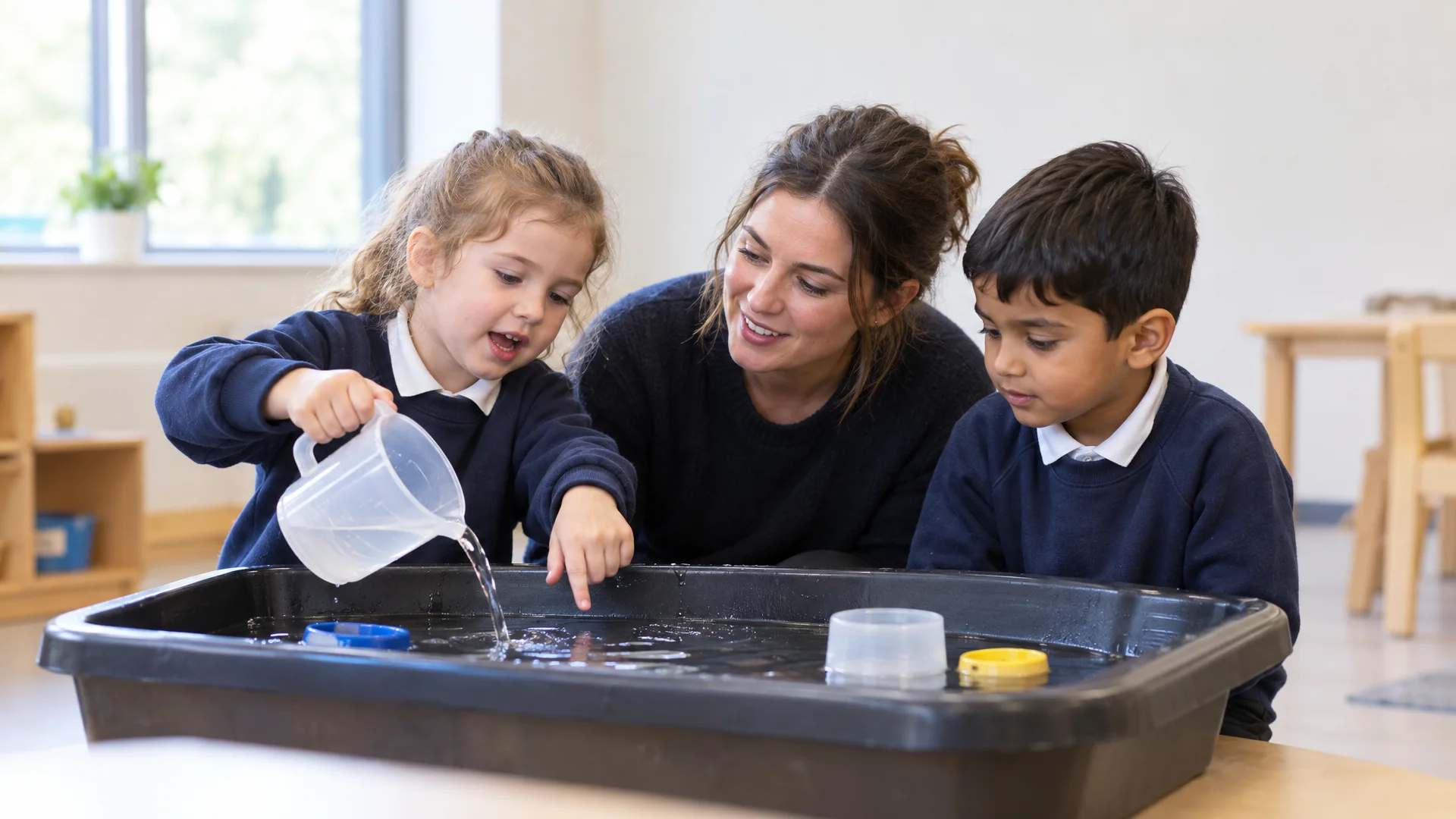
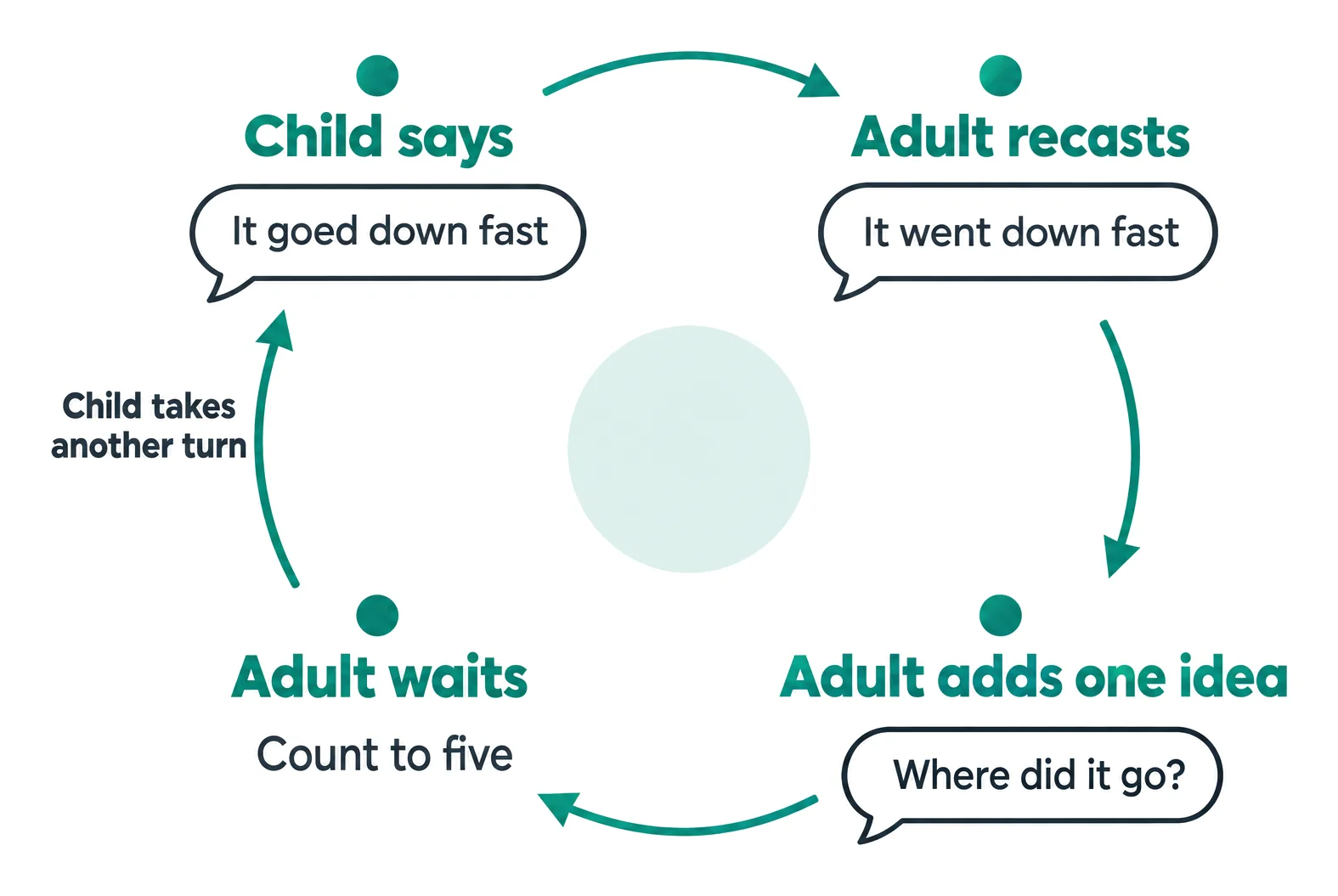
Reception, communication and language, water tray. When a child says "it goed down fast", reply with the right form and add one idea: "It went down fast. Where did it go?" Then count to five in your head before you speak again.
Year 12, English Language, transcripts. Give pairs a ten-line transcript of a child talking with an adult. Ask them to find one feature each theory explains well and one it leaves open.
Look for: the child adding a new word or a longer sentence in the next turn, and learners pointing to evidence in the transcript before they name a theorist.
Learning to talk and learning to read are different jobs. Children pick up spoken language through use, but reading needs explicit teaching of how letters stand for sounds (Castles, Rastle and Nation, 2018).
At a glance · Who proposed each theory · Stages · Behaviourist · Nativist · Cognitive · Social interactionist · Usage-based · Child-directed speech · Limitations · For teachers · Second language · Worked examples · FAQ
Language development covers four things: speech sounds, words, grammar, and how we use language with other people. The theories differ in where they think the main push comes from. For some it is the child's biology or thinking. For others it is the feedback children get, or the people they talk with.
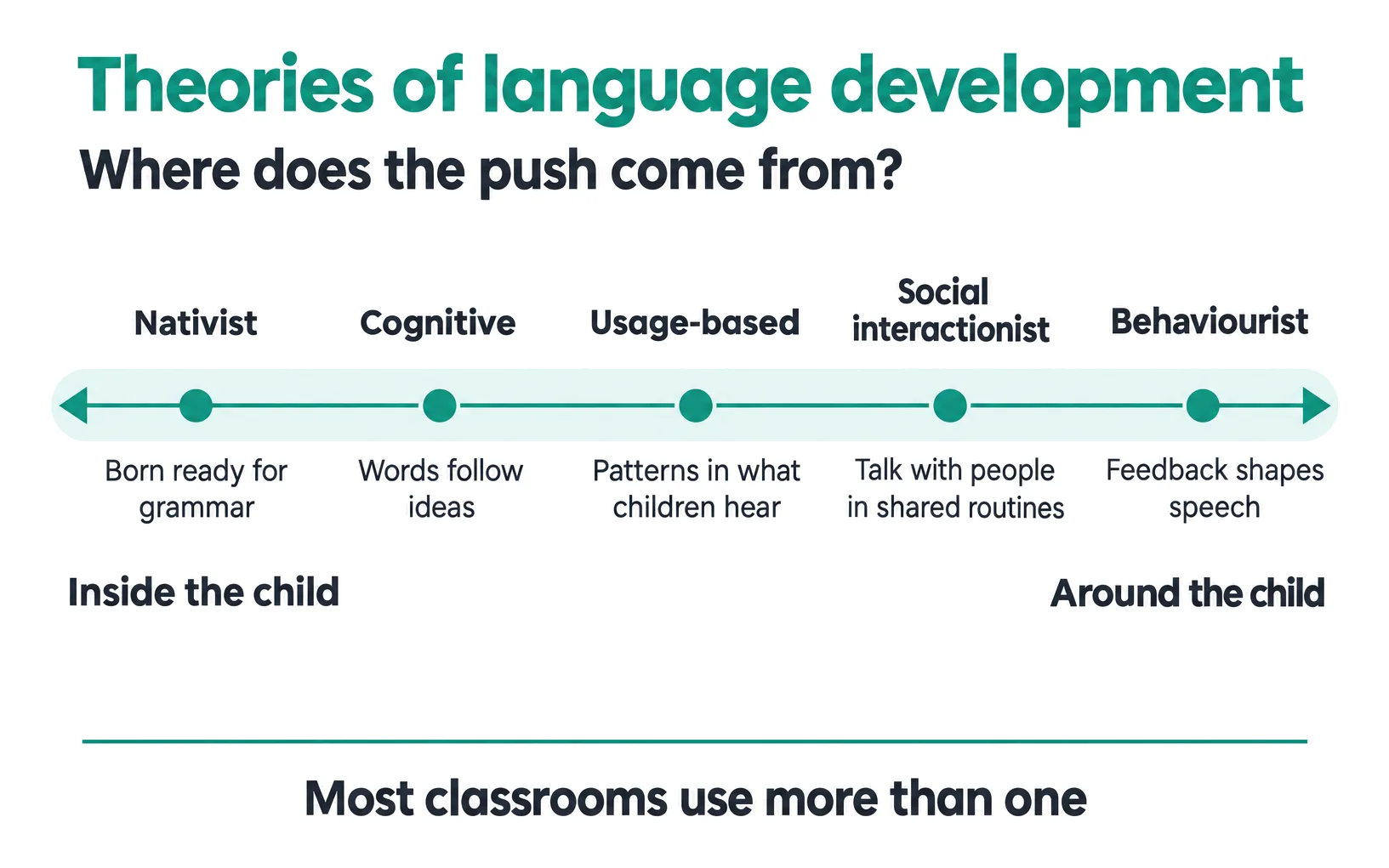
Read each row of the table as an answer to one question: what moves a child's language forward? The key terms column lists the words you will meet in teacher training, psychology courses and A level English Language.
| Perspective | Key theorists | Main driver | Key terms | Main caution |
|---|---|---|---|---|
| Behaviourist | B. F. Skinner (1957) | Feedback: talk that gets a result is used again. | Operant conditioning, reinforcement, imitation, shaping | Does not fully explain new sentences or errors that no adult models. |
| Nativist | Noam Chomsky (1965); Eric Lenneberg (1967) | An inborn readiness to learn grammar. | Language Acquisition Device (LAD), Universal Grammar, poverty of the stimulus, critical period | What exactly is inborn is still disputed. |
| Cognitive | Jean Piaget | The child's growing thinking. Words follow ideas. | Schemas, egocentric speech, language follows thought | Says little about how the forms of grammar are learned. |
| Social interactionist | Lev Vygotsky (1934); Jerome Bruner (1983) | Talk with more expert people in shared routines. | Language Acquisition Support System (LASS), formats, scaffolding, private speech, zone of proximal development | Does not say exactly how shared talk becomes grammar. |
| Usage-based | Michael Tomasello (2003) | Patterns in the language children hear, plus working out what people mean. | Intention reading, item-based constructions, statistical learning | Pattern learning may not explain every part of grammar. |
For the wider picture, our guide to fundamental theories of learning covers the main learning theories in education, and child development theories sets language beside social, emotional and cognitive growth. Use them when you need language set against the rest of a child's learning.
No single person gave us the theory of language development. It is a set of rival answers, each tied to one or two thinkers. If a quiz or exam asks who proposed a particular view, these are the usual answers.
| The view | Who proposed it |
|---|---|
| Language is learned through reinforcement and imitation | B. F. Skinner (1957), who treated speech as behaviour shaped by its results. |
| Children are born with a Language Acquisition Device | Noam Chomsky (1965). |
| Language is acquired through the process of development | Jean Piaget, who argued that language follows the growth of thinking. |
| Language develops through social interaction | Lev Vygotsky (1934) and Jerome Bruner (1983). |
| There is a critical period for learning a first language | Eric Lenneberg (1967). |
| Grammar is built from patterns in use | Michael Tomasello (2003). |
Two mix-ups come up often. The enactive, iconic and symbolic modes come from Bruner's account of how children represent what they know (Bruner, 1966), although quiz answers often file them under his theory of language. The "active construction of grammar" view says children work out grammar rules for themselves, and errors such as "I runned" are the usual evidence.
The timeline below puts the main theories in order. It shows what each theory added and what it left for later work.
Cognitive · Jean Piaget
Language grows out of thinking. Children talk about ideas they have already begun to grasp.
Left open: how children learn the forms of grammar.
Social · Lev Vygotsky
Talk starts between people, then turns inward as private speech that guides thinking.
Left open: how shared talk becomes a grammar.
Behaviourist · B. F. Skinner
Language is behaviour shaped by what follows it, such as a request that gets a result.
Left open: new sentences, and errors like "runned" that nobody models.
Nativist · Noam Chomsky
Children are born ready for grammar. He called this readiness the Language Acquisition Device.
Left open: what exactly is inborn, and how to test it.
Critical period · Eric Lenneberg
A first language is easiest to acquire during a sensitive window in childhood.
Left open: how sharp that window is. The evidence is still debated.
Interactionist · Jerome Bruner
Adults supply a Language Acquisition Support System: routines such as book sharing and games.
Left open: how a routine turns into grammar.
Statistical learning · Saffran, Aslin and Newport
Eight-month-olds track which sounds follow which, and use this to find word edges.
Left open: how far pattern tracking can reach.
Usage-based · Michael Tomasello
Children read what people mean and build grammar from the patterns they hear and use.
Left open: whether some inborn limits are still needed.
Conversational turns · Donnelly and Kidd
In toddlers, back-and-forth turns and vocabulary growth feed each other over time.
Now: most researchers combine these lenses rather than pick one.
Reading the theories this way helps with evaluation. A theory rarely wins outright. It usually survives in part, and later work narrows what it can claim. Most researchers now combine biology, thinking, input and people, but they still argue about how much each one does.
Children usually move through the same broad sequence of stages in the first five years: cooing, babbling, first words, two-word phrases, short sentences, then longer and more complex ones. The timing varies a great deal from child to child, so read the ages below as typical ranges.
Each theory reads these stages in its own way. Behaviourist theory points to the adult feedback that turns babble into words. Nativist theory points to the speed of the sequence and its similar order across languages. Usage-based theory points to the fixed phrases children use before they split them into parts. In England, the Early Years Foundation Stage (EYFS) treats communication and language as a prime area of learning.
Our article on language development goes through the stages and milestones in more detail. If you are worried about a child, the section on multilingual learners and SEND (special educational needs and disabilities) below sets out the next step.
B. F. Skinner treated language as behaviour shaped by what follows it. A toddler who says "juice" and gets a drink is more likely to say it again.
Over time, adults shape rough attempts into clearer speech. This is operant conditioning, and it is more precise than the common summary that children simply copy adults.
The useful lesson for teachers is about response. When an adult understands a learner's attempt and builds on it, the learner has a reason to keep talking. Carefully designed behavioural methods can also support specific communication goals.
The weakness is grammar. Children say new sentences and make errors nobody models, such as "I runned" or "two mouses". Chomsky's 1959 review of Skinner's book argued that feedback alone falls short of explaining this. Modern theories keep learning from experience, but not behaviourism as a learning theory in its pure form. Our article on Skinner's theories covers his wider work.
Noam Chomsky argued that children learn a complex grammar quickly, from speech that is limited and often messy. He concluded that humans must be born ready for language. This is the poverty of the stimulus argument: the speech children hear looks too thin to explain all they come to know. Universal Grammar is his name for the shared principles he thought all human languages follow. It is a family of changing proposals, not one fixed rulebook.
The Language Acquisition Device, or LAD, is Chomsky's name for the inborn ability that lets children take in the grammar of whatever language they hear. It is textbook shorthand for this readiness, and a theoretical idea rather than a part of the brain you can point to. Nor does it mean children are born knowing English. The safe claim is that human biology prepares children to learn language in ways that copying alone fails to explain.
Eric Lenneberg (1967) added the idea of a critical period: a window in childhood when a first language is easiest to acquire. The idea is still debated. It concerns a first language, so it should not be read as a deadline for learners who are new to English.
Nativism explains why fast, creative language learning became a big scientific question. It is contested because usage-based and statistical learning research shows how much children can take from the speech they hear. For the full debate, including principles and parameters, read our guide to Chomsky's theory of language acquisition.
Piaget wrote no full theory of language learning. His view was that language grows alongside thinking. A child first grasps objects, actions and relations through play and activity, and words gain meaning inside those ideas. That is why he is the usual answer when a quiz asks who said language is acquired through development.
This view explains why a child can repeat a word without understanding it. A learner may say "more than" fluently and still misjudge which pile holds more. So check the idea with objects, examples and a short explanation, rather than trusting fluent speech.
Avoid rigid age-and-stage rules. How a learner performs depends on the task, their experience and the support on offer. Use the theory to link words with meaning, not to hold back rich talk until a stage is "complete". Vygotsky disagreed with Piaget about whether thought or talk comes first, and our comparison of Piaget and Vygotsky sets the two side by side. For the stages themselves, see our guide to Piaget's theory of cognitive development.
Social interactionist theories place language inside shared activity. Vygotsky saw language as a cultural tool. It starts between people, then turns inward as private speech, the talk young children use to guide themselves, and later becomes silent thought. Our guide to Vygotsky's theory covers his wider ideas, including the zone of proximal development.
Kuhl, Tsao and Liu (2003) found that nine-month-old infants learned a new speech sound from live sessions with a speaker, but not from the same input on video. That was one sound-learning task. It shows that social contact can matter, not that screens never help.
In class, good interaction is contingent. The adult responds to what the learner means, adds a little more language, and leaves space for another turn. A string of test questions is a different thing from a conversation. The same logic sits behind scaffolding: support that fades as the learner takes over (Wood, Bruner and Ross, 1976).
The Language Acquisition Support System, or LASS, is Bruner's term for the help adults give around a child's early language (Bruner, 1983). It includes predictable routines, shared attention and talk tuned to the child. Bruner offered it as a partner to Chomsky's LAD: the LAD names what the child brings, and the LASS names what adults add. The LASS section of our guide to Jerome Bruner's theories goes further.
In a nursery, a LASS looks like the same song at tidy-up time, the same question at the start of story time, and an adult who waits for the child's turn. Bruner called these routines formats. Each one is a frame the child can step into before they could manage the words alone.
The social-pragmatic theory says children learn language by working out what other people mean and want, starting with shared attention to the same thing at the same time. This starts with joint attention. A baby and an adult both look at a toy, and each knows the other is looking. When the adult says "ball", the baby can link the word to the object.
Tomasello (2003) treats this skill as the base for learning words. Because the child is reading the speaker's purpose, the theory sits between the interactionist and usage-based accounts.
Michael Halliday added a functional view. He described how a child's early sounds and words do jobs, such as asking for things, joining in with others, exploring and pretending (Halliday, 1975). In class, follow what the child is looking at, name it, and respond to the job their words are doing.
Usage-based theories say children build language from real use. Michael Tomasello gives two skills the main role: working out what other people mean, and spotting patterns across what they say. Children often start with fixed phrases such as "Where's the..." and only later build flexible, general rules.
Statistical learning research shows that babies track patterns in speech. Saffran, Aslin and Newport (1996) found that eight-month-olds noticed which syllables tend to follow each other, and used this to find word boundaries in a stream of made-up speech. Later work shows that children combine these patterns with cues such as stress, gaze and objects.
This makes the speech children hear much more than a list of sentences to copy. But showing that children can learn patterns falls short of showing that all of language comes from one general learning skill. A 2023 scoping review by Abreu and colleagues found early links between statistical learning and children's vocabulary. It also warned that the tasks varied and that longer studies are needed.
Michael Tomasello and other usage-based researchers describe early speech as slot-and-frame patterns, such as "more ___" or "Where's the ___", in which one word changes and the rest stays fixed. Tomasello (2000) showed that young children's first sentences are built around specific words rather than general grammar rules.
An earlier idea from the 1960s, pivot grammar, also described a small set of fixed words with open slots. In class, you can use frames on purpose: give learners "When we stirred the ___" and let them fill the slot with new words.
Connectionism and emergentism say that the structure of language emerges as a learner, or a computer network, picks up patterns in experience, with no built-in grammar module. Connectionist models are computer networks that adjust their links as they meet examples. One well-known early model learned English past tenses and made "goed"-style errors on the way, much as children do. Critics argued that it captured only part of the system.
Emergentism, linked to Brian MacWhinney and Nick Ellis, adds that many pressures work together: what children hear, what they can remember, what they want to say and who they are talking to. Both views sit close to usage-based theory, and both challenge the idea of an inborn grammar.
Large language models show that a system can learn much of English grammar from patterns in text alone, which gives weight to pattern-based accounts without settling the debate. A child learns very differently. Children hear far fewer words, and they learn while sharing attention, goals and play with real people. A text-only model has no body and no shared world to link words to.
So treat these models as a test of what pattern learning can achieve, and as a poor copy of how a child learns. Researchers still argue about what they show for the poverty of the stimulus argument.
Child-directed speech is the way adults naturally talk to young children. It is slower and more tuneful, with short sentences and lots of repetition, and is sometimes called parentese. Interactionist and usage-based theories both predict that this kind of talk, and above all the back-and-forth turns around it, should help language grow.
The evidence mostly agrees, with limits. Zimmerman and colleagues (2009) found that two-way conversation predicted language scores better than the number of adult words a child heard. Donnelly and Kidd (2021) followed 122 children from 9 to 24 months and found that conversational turns and vocabulary growth fed each other. In a randomised trial with 71 families, coaching parents raised their use of parentese and turn-taking, and children's language grew faster (Ferjan Ramírez, Lytle and Kuhl, 2020).
Quality seems to matter more than quantity. A meta-analysis found that varied words and complex sentences in parents' talk were more closely linked to children's language (r = .33) than the sheer amount of talk (r = .20) (Anderson et al., 2021). Here r shows how closely two things go together, from 0 for no link to 1 for a perfect one.
The caution is that most studies are correlational. A review of 942 papers found only 20 that compared learning of words or grammar from child-directed and adult-directed talk (Kempe, Ota and Schaeffler, 2024). One recent trial with 372 families found no significant effect of a parent-led programme on language (g = −0.05 to 0.11), after earlier evaluations gave mixed results (Burgoyne et al., 2026). The g figure is an effect size: the gap between groups in standard deviations, so values near zero mean no real difference.
In classrooms, the strongest trial evidence comes from structured oral language programmes. A whole-class version of the Nuffield Early Language Intervention, run in 65 nursery settings in England, gave small gains in oral language (d = 0.26) (West et al., 2024). The pattern across this work is steady, well-planned talk rather than quick fixes. The d figure is the same kind of effect size as g, and 0.26 counts as small.
Two more studies cover the primary years. A systematic review of 31 studies found promising but limited evidence for interactive book reading, structured vocabulary programmes and structured curricula, and for involving speech and language therapists (Dobinson and Dockrell, 2021). In a trial in 33 schools, a targeted oral language programme gave the weakest-language 8 to 9 year olds gains of d = 0.38 in oral language and d = 0.42 in written expression (Esposito, Lervåg and Hulme, 2025).
No theory wins outright. Current research looks at several forces at once: the child's biology and hearing, general thinking skills, patterns in the speech they hear, and the people they talk with. Each theory survives in part.
| Theory | What survives, and what is missing |
|---|---|
| Behaviourism | feedback changes what children say, but it does not fully explain new sentences. |
| Nativism | humans are unusually well prepared for language, but the content of Universal Grammar is disputed. |
| Cognitive theory | ideas matter, but language also reshapes thinking. |
| Social interactionism | talk with adults helps, but the theory does not say exactly how talk becomes grammar. |
| Usage-based theory | children learn from patterns, but lab studies of pattern learning show only part of the process. |
The evidence has three limits worth keeping in mind. Most studies of talk and vocabulary are correlational, so they show links and cannot show cause. Much of the research comes from English-speaking families, so findings may differ for other languages and settings. And classroom trials report small average gains, which can hide big differences between learners.
The theories also differ in what counts as evidence. Behaviourism rests on experiments with feedback, nativism on arguments about what children could not learn from the speech they hear, and usage-based theory on detailed records of what children say. A claim that suits one kind of evidence can look weak against another. That is one more reason to treat the theories as lenses.
Most of these theories were built to explain how a child learns one first language. They say less about children who grow up with two or more languages, which is common in UK classrooms. The second language theories below fill part of that gap. Read them as accounts of the process, not as a full picture of every learner you teach.
The practical conclusion is to use the theories as lenses, not as rival teams. A strategy that works in class does not prove that any one theory is true.
Five moves follow from the theories and the evidence. Each is simple to plan, and each can be checked in a single lesson.
Be honest about effect sizes. A 2023 meta-analysis of oral language interventions for children with neurodevelopmental disorders found a mean effect of d = 0.27 straight after teaching, with signs of publication bias (Donolato et al., 2023). That supports steady, structured work, not promises of a quick fix. For whole-class talk routines, see our guide to oracy and language development.
Use the mini app below to practise reading classroom moments through each lens. It works as a staff meeting starter, or as revision for trainees and sixth formers.
Notice that several moments point to the same move: respond to the meaning first, then add a little more language. More than one theory supports that move, which is part of why it is worth making a habit. The one-page study notes below put the whole comparison on a single sheet.
The note compares five perspectives. Behaviourism emphasises consequences and shaping but is insufficient as a complete account of grammar. Nativism proposes biological preparedness; Universal Grammar remains influential and contested. The cognitive perspective links language with broader concepts and representation.
Social interactionism emphasises responsive joint activity and adult support. Usage-based theory emphasises patterns and communicative intentions in meaningful input.
Teacher moves are to model and expand meaningful talk, use responsive back-and-forth interaction, teach vocabulary and decoding explicitly, treat multilingualism as a resource, observe over time and follow local referral pathways when concerned. The cautions are that no single theory explains everything, LAD is shorthand rather than a located brain organ, spoken language acquisition differs from learning to read, and variation is not automatically disorder. The memory line is: one child, several mechanisms.
Second language acquisition theories ask how learners add a new language after their first. Many of the first-language ideas above have a second-language version, and two matter most in school: Krashen's input theory and interlanguage.
Stephen Krashen's theory says learners acquire a second language mainly by understanding messages that sit just beyond their current level, in a low-stress setting. Krashen (1982) set out five linked ideas.
Critics say the ideas are hard to test, and that speaking and getting feedback in conversation matter too. The practical messages are still easy to use. Give learners language they can follow, make it safe to speak, and plan talk as well as listening.
Larry Selinker (1972) used the word interlanguage for a learner's own developing system, which sits between the first language and the target language. It follows rules of its own, so a form such as Sofia's "It go in the water" in the Year 5 example below is a sign of a system being built, and a prompt for the teacher to model the next step.
Research points to a gradual decline in how easily people reach native-like pronunciation and grammar the later they start, rather than a sharp cutoff at one age. Younger children often sound more native-like in the long run. Older learners can move faster at first, because they bring more knowledge of language and the world.
This is separate from the first-language critical period that Lenneberg proposed, covered earlier in this guide. Teenagers and adults learn new languages successfully every day. A learner who arrives in Year 7 still has every reason to make progress with good teaching.
Treat multilingualism as a strength, not a sign of disorder. Find out how a child communicates in all their languages and in different settings. The current statutory Early Years Foundation Stage (EYFS) framework for England asks staff to explore a child's skills in their home language with parents or carers when English is not yet secure. The aim is to avoid mistaking a language difference for a delay.
The Royal College of Speech and Language Therapists reports that Developmental Language Disorder affects about 7.6% of school-aged children, or about two in every class of 30. That figure describes a population and cannot diagnose any one learner.
Watch how a learner understands and speaks across different activities. Reduce unnecessary language load. Teach the target language explicitly. Use your setting's speech and language pathway when concerns persist.
No theory replaces assessment. Raise these promptly through local professional routes: loss of skills a child already had, concern from the family, or a pattern that limits taking part. Our guide to Developmental Language Disorder covers classroom identification and support, and the separate language development article covers stages and milestones.
Here is how the lenses turn into moves in two classrooms. The words are examples to adapt, not scripts.
Four-year-old Amir pours water through a funnel and says, "It goed down fast!" His teacher kneels beside him.
Teacher: "It went down fast! Where did it go?" Amir: "In the bottle."
Teacher: "Into the bottle. What will happen if we pour it slowly?" Then she waits.
"Goed" is a rule applied too widely, which nativist and usage-based accounts both expect. The recast ("went") models the form and keeps the talk going. The question and the wait create another turn, which is the interactionist move. "Slowly" is a new word, so she uses it again at snack time, which is planned vocabulary teaching.
In a lesson on dissolving, Sofia, who is new to English, says, "Sugar is gone. It go in the water."
Teacher: "Yes, the sugar has gone into the water. Scientists say it has dissolved. Can you use dissolved to tell Kai what happened?"
Sofia: "The sugar dissolved in the water." The teacher then gives the pair a sentence frame for their write-up: "When we stirred the ___, it ___ because ___."
Each move maps to a lens. The recast and the new word come from an interactionist reading of talk. The sentence frame is a usage-based move: a pattern Sofia can reuse with new words. Asking her to predict what happens to sand, which stays whole in water, is the Piagetian move, because it tests the idea and not just the word.
Take the recast, expand and wait moves from these two examples into your next talk moment with the one-page Talk Turns cheat sheet. It fits on one A4 page, so it can sit beside you during the lesson.
Teachers sharing early language work on social media this month describe routines, and they rarely name a theorist. The theories still sit underneath those routines. The table below links three of them to the part of the evidence each one draws on.
Teachers sharing their classrooms on social media rarely name Chomsky, Skinner or Bruner. They post routines. Here are three from this month, what you would notice when they work, and which part of the evidence they connect to.
| Routine, as teachers describe it | What you would notice | What the evidence says |
|---|---|---|
| One word from the week's story, taught on purpose | ||
In Word Aware, our new word is ‘tiptoed’. |
Learners using the new word in play and retelling, not only repeating it back. | Every theory here supports planned vocabulary teaching. Varied, rich adult talk predicts vocabulary more strongly than the amount of talk (Anderson et al., 2021). |
| Drawing Club: draw the story, then talk about the picture | ||
We loved discussing all the different fillings and decorations we could add |
Learners taking longer turns about their own drawing than in whole-class questioning. | Talk around a shared, concrete activity is the interactionist core. More conversational turns go with faster vocabulary growth (Donnelly and Kidd, 2021). |
| Year 1 stepping into role from the class text, with a school talk framework | ||
using Marshfield’s 4Ps of Oracy to develop purposeful talk, active listening and confidence |
Learners listening and answering in character, not waiting for their own turn to speak. | Structured whole-class oral language work gives small but real gains; in nursery classes the effect was d = 0.26 (West et al., 2024). |
Each routine creates turns around something shared: a word, a drawing or a character. That is the common ground between the interactionist and usage-based theories, and it is where the classroom evidence is strongest.
Three short accounts from social media: a reader on children talking themselves through a task, an allied health practice on serve and return, and a P1 teacher on new words from stories.
thinking out loud is not noise, it’s a tool.
Language grows through serve-and-return with a real person.
discovering new ‘WOW’ words in the stories we read and learning what they mean.
The idea that talk shapes thinking runs from Vygotsky's private speech to current advice on serve and return. In class, it comes back to the same moves: respond to meaning, add a little language, and leave room for the next turn.
Child language acquisition is a common topic in A level English Language, and the same theorists appear again and again. Learners gain most when they test each theory against real speech rather than learn one-line summaries.
A simple routine works well. Give learners a short transcript of a child talking with an adult. Ask them to find one feature each theory explains well, such as an overgeneralised past tense for Chomsky or an adult expansion for Bruner, and one feature it leaves unexplained. The theory lens mini app above makes a quick warm-up for the same skill.
Try one change this week. In one lesson, notice your exchanges with two learners and add one more turn to each by waiting, then asking a follow-up question. To see how language fits the rest of the field, explore our overview of learning theories for teachers.
Short answers to the questions teachers and trainees ask most often about language development theories. Each answer starts with the short version.
Answer each question before opening its explanation. The quiz checks the theories; it does not assess a child.
The behaviourist theory. Skinner called this operant conditioning: behaviour is shaped by what follows it.
Chomsky's name for an inborn readiness to learn grammar. It is not a place in the brain.
A rule applied too widely, which nativist and usage-based accounts both expect. Recast it (“went”) and keep the talk going.
Jean Piaget. Children talk about ideas they have already begun to grasp through activity.
No. Rich talk builds vocabulary, but learners still need to be taught how writing represents speech.
No single person. The main theorists are B. F. Skinner (behaviourist), Noam Chomsky (nativist), Jean Piaget (cognitive), Lev Vygotsky and Jerome Bruner (social interactionist) and Michael Tomasello (usage-based). Each explains a different part of how children learn to talk.
Most introductory courses name four: behaviourist, nativist, cognitive and interactionist. Newer comparisons add usage-based and statistical learning accounts, because they explain how children learn patterns from the speech they hear.
Jean Piaget. He argued that language follows the growth of thinking, so children talk about ideas they have already begun to grasp through activity.
It says language comes from both nature and nurture. Children are born ready to learn, but they need responsive talk with more expert speakers. Vygotsky and Bruner are its best-known figures.
The LAD is Chomsky's name for an inborn readiness to learn grammar. Bruner's LASS is the support adults give, such as routines and shared attention. Neither is a place in the brain or a classroom programme.
No. He argued that imitation and reinforcement could not explain how children produce new sentences, and that changed the question. What exactly is inborn is still an open debate.
It is the simpler, slower and more tuneful way adults talk to young children, sometimes called parentese. Studies link it, and especially back-and-forth turns, with faster vocabulary growth.
No. Rich talk and shared reading build vocabulary, understanding and motivation. Learners still need to be taught how an alphabetic writing system represents speech (Castles, Rastle and Nation, 2018).
Piaget saw language growing out of thinking: a child first grasps ideas through play and activity, then words attach to them. Vygotsky put talk first. Language starts between people, turns inward as private speech and becomes a tool for thinking. In class, Piaget points you to hands-on experience before new words, and Vygotsky to talk with a more skilled partner.
Piaget's theory says children build knowledge through activity and pass through four broad stages: sensorimotor (birth to about 2), preoperational (about 2 to 7), concrete operational (about 7 to 11) and formal operational (about 11 onwards). Language grows alongside this thinking rather than driving it. The ages are rough guides, not labels. Our guide to Piaget's theory of cognitive development covers each stage.
Yes for PDFs: this page has two free A4 downloads, the one-page study note and the Talk Turns cheat sheet. We have not published a slide deck. The comparison table near the top works as a single slide for a staff session or a trainee seminar.
Use the lens that fits the decision. Behaviourist ideas help with feedback, interactionist ideas with dialogue, cognitive ideas with checking understanding, and usage-based ideas with planning varied, repeated practice. Avoid treating one useful strategy as proof that one theory explains every learner.
Abreu, R., Postarnak, S., Vulchanov, V., Baggio, G., & Vulchanova, M. (2023). The association between statistical learning and language development during childhood: A scoping review. Heliyon, 9(8), e18693. https://doi.org/10.1016/j.heliyon.2023.e18693
Anderson, N. J., Graham, S. A., Prime, H., Jenkins, J. M., & Madigan, S. (2021). Linking quality and quantity of parental linguistic input to child language skills: A meta-analysis. Child Development, 92(2), 484-501. https://doi.org/10.1111/cdev.13508
Bruner, J. S. (1966). Toward a Theory of Instruction. Belknap Press of Harvard University Press.
Bruner, J. S. (1983). Child's Talk: Learning to Use Language. Oxford University Press.
Burgoyne, K., Boundy, L., Eerola, P., Zhang, Q., Einbeck, J., Cramman, H., & Menzies, V. (2026). Failure to replicate effects of parent-delivered early language intervention: Evidence from a randomised controlled trial with implications for universal language intervention. JCPP Advances, 6(3), e70064. https://doi.org/10.1002/jcv2.70064
Castles, A., Rastle, K., & Nation, K. (2018). Ending the Reading Wars: Reading acquisition from novice to expert. Psychological Science in the Public Interest, 19(1), 5-51. https://doi.org/10.1177/1529100618772271
Chomsky, N. (1959). A review of B. F. Skinner's Verbal Behavior. Language, 35(1), 26-58. JSTOR record.
Chomsky, N. (1965). Aspects of the Theory of Syntax. MIT Press.
Dobinson, K. L., & Dockrell, J. E. (2021). Universal strategies for the improvement of expressive language skills in the primary classroom: A systematic review. First Language, 41(5), 527-554. https://doi.org/10.1177/0142723721989471
Donnelly, S., & Kidd, E. (2021). The longitudinal relationship between conversational turn-taking and vocabulary growth in early language development. Child Development, 92(2), 609-625. https://doi.org/10.1111/cdev.13511
Donolato, E., Toffalini, E., Rogde, K., Nordahl-Hansen, A., Lervåg, A., Norbury, C., & Melby-Lervåg, M. (2023). Oral language interventions can improve language outcomes in children with neurodevelopmental disorders. Campbell Systematic Reviews, 19(4), e1368. https://doi.org/10.1002/cl2.1368
Esposito, R., Lervåg, A., & Hulme, C. (2025). Oral language intervention in the late primary school years is effective: Evidence from a randomised control trial. Journal of Child Psychology and Psychiatry, 66(6), 775-784. https://doi.org/10.1111/jcpp.14084
Ferjan Ramírez, N., Lytle, S. R., & Kuhl, P. K. (2020). Parent coaching increases conversational turns and advances infant language development. Proceedings of the National Academy of Sciences, 117(7), 3484-3491. https://doi.org/10.1073/pnas.1921653117
Halliday, M. A. K. (1975). Learning How to Mean: Explorations in the Development of Language. Edward Arnold.
Kempe, V., Ota, M., & Schaeffler, S. (2024). Does child-directed speech facilitate language development in all domains? A study space analysis of the existing evidence. Developmental Review, 72, 101121. https://doi.org/10.1016/j.dr.2024.101121
Krashen, S. D. (1982). Principles and Practice in Second Language Acquisition. Pergamon Press.
Kuhl, P. K., Tsao, F.-M., & Liu, H.-M. (2003). Foreign-language experience in infancy: Effects of short-term exposure and social interaction on phonetic learning. Proceedings of the National Academy of Sciences, 100(15), 9096-9101. https://doi.org/10.1073/pnas.1532872100
Lenneberg, E. H. (1967). Biological Foundations of Language. Wiley.
Piaget, J. (1952). The Origins of Intelligence in Children. International Universities Press.
Saffran, J. R., Aslin, R. N., & Newport, E. L. (1996). Statistical learning by 8-month-old infants. Science, 274(5294), 1926-1928. https://doi.org/10.1126/science.274.5294.1926
Selinker, L. (1972). Interlanguage. International Review of Applied Linguistics in Language Teaching, 10(1-4), 209-231. https://doi.org/10.1515/iral.1972.10.1-4.209
Skinner, B. F. (1957). Verbal Behavior. Appleton-Century-Crofts.
Tomasello, M. (2000). The item-based nature of children's early syntactic development. Trends in Cognitive Sciences, 4(4), 156-163. https://doi.org/10.1016/s1364-6613(00)01462-5
Tomasello, M. (2003; this edition 2005). Constructing a Language: A Usage-Based Theory of Language Acquisition. Harvard University Press. https://doi.org/10.2307/j.ctv26070v8
Vygotsky, L. S. (1986). Thought and Language. MIT Press. (Original work published 1934.)
West, G., Lervåg, A., Birchenough, J. M. H., Korell, C., Rios Diaz, M., Duta, M., Cripps, D., Gardner, R., Fairhurst, C., & Hulme, C. (2024). Oral language enrichment in preschool improves children's language skills: A cluster randomised controlled trial. Journal of Child Psychology and Psychiatry, 65(8), 1087-1097. https://doi.org/10.1111/jcpp.13947
Wood, D., Bruner, J. S., & Ross, G. (1976). The role of tutoring in problem solving. Journal of Child Psychology and Psychiatry, 17(2), 89-100. https://doi.org/10.1111/j.1469-7610.1976.tb00381.x
Zimmerman, F. J., Gilkerson, J., Richards, J. A., Christakis, D. A., Xu, D., Gray, S., & Yapanel, U. (2009). Teaching by listening: The importance of adult-child conversations to language development. Pediatrics, 124(1), 342-349. https://doi.org/10.1542/peds.2008-2267