Updated on
October 8, 2026
John B. Watson: Behaviourism, Theory and Little Albert
Explore John B. Watson's behaviourism, the Little Albert study and its limits, with his original ideas, later criticisms and comparisons with other theorists.


Updated on
October 8, 2026
Explore John B. Watson's behaviourism, the Little Albert study and its limits, with his original ideas, later criticisms and comparisons with other theorists.
What was John B. Watson's theory?
John B. Watson argued in 1913 that psychology should be an objective science of observable behaviour, aiming to predict and control it, with no essential role for introspection. His manifesto helped launch behaviourism as a movement. He stressed learning and environment but accepted inherited and unlearned responses, and his later claims about shaping children went beyond the evidence.
After this guide you can separate what John B. Watson argued from what the evidence supports, and keep the part that carries into a classroom. The best-known claims, from the Little Albert study to his boast about shaping infants, each carry limits that short summaries leave out.
Year 3 (US Grade 2), literacy, the move from carpet to tables. Teach one entry routine: a signal, a task on the board and a start within one minute. In the first week, say what each learner did the moment they do it, such as "Maya, pencil out and started, thank you".
Year 9 (US Grade 8), maths, a five-question starter. Put five questions on the board as learners enter. Answers go up on mini whiteboards, and you tell each learner within seconds which one to fix.
Look for: learners starting without a second prompt, and corrections made while the question is still fresh.
Routines and fast, specific feedback come from the wider behaviourist tradition of Thorndike and Skinner more than from Watson himself. The ethical lesson from Little Albert is to change the routine and the feedback, never to cause a learner distress to test an idea.
Watson is most often called the father of behaviourism. The 1913 paper, first given as a lecture at Columbia University, set out what the movement stood for. That is why 1913 is the usual answer to when behaviourism was founded. Historians add that others studied behaviour before him, so he is best seen as its loudest founder rather than its only one (Malone, 2014).
His stated goals were the prediction and control of behaviour. That was a programme for psychology, and his claims about the environment ran ahead of his evidence.
Watson is also linked with the Little Albert report, conducted with Rosalie Rayner. They reported a fear-like response in one infant. This followed the pairing of a white rat with a loud noise.
The study matters to the history of psychology. With one infant and no control group, though, it supports only narrow claims (Watson & Rayner, 1920; Harris, 1979).
For teachers, Watson's clearest legacy is his method. Describe what happened, examine the conditions and test an adjustment. A learner who avoids a task may have formed a negative link.
Yet behaviour alone leaves the reason open. Prior knowledge, language, stress and motivation may also matter.
Watson's theory was set out in one place: his 1913 manifesto. It defined psychology as an objective branch of natural science, rejected introspection as an essential method and asked psychology to predict behaviour and study the conditions around it (Watson, 1913).
Watson believed that psychology should study observable behaviour, and that habits and emotions are largely learned from the environment. He gave learning and environment a much larger role than many psychologists of his time. He studied habits, learned emotional responses and the links between settings and actions.
Yet the claim that he saw people as blank slates goes too far. He accepted inherited structures and unlearned responses. Even so, his claims about the power of the environment grew stronger. Among the main theories of learning, his is the one that looks only at what can be seen.
There is no single official list. These five ideas capture the core of the approach.
Watson stated the first and last of these in 1913. Reinforcement, a consequence that makes a behaviour more likely, belongs to Thorndike and Skinner.
John Broadus Watson (1878 to 1958) was an American psychologist who helped organise and promote behaviourism as a research movement. He was born on 9 January 1878 in Travelers Rest, South Carolina. He completed his doctorate at the University of Chicago in 1903.
His field was animal psychology. His thesis linked brain development to learning in rats. At Chicago he came under the influence of the philosopher John Dewey, the psychologist James Rowland Angell, the neurologist Henry Donaldson and the physiologist Jacques Loeb. Pavlov's work on conditioned reflexes later gave him a way to study learned responses.
John B. Watson did four main things. He launched behaviourism with the 1913 manifesto. He ran the Little Albert study of 1920 with Rosalie Rayner. He wrote best-selling advice on raising children. After he left university life, he built a second career as a senior figure in American advertising.
His main writings are Psychology as the Behaviorist Views It (1913), Psychology from the Standpoint of a Behaviorist (1919), "Conditioned Emotional Reactions" with Rosalie Rayner (1920), Behaviorism (1925) and Psychological Care of Infant and Child (1928).
In 1908, he moved to Johns Hopkins University. His work joined animal psychology, lab methods and a bold view of psychology's purpose.
The label "father of behaviourism" is useful but incomplete. Watson was a forceful advocate. He gave a growing set of ideas a clear public programme.
Earlier researchers had already challenged introspection and studied behaviour in ways others could check. Malone therefore presents Watson as a strong organiser and promoter, one of several who built behaviourism (Malone, 2014).
Watson left Johns Hopkins in 1920. This followed publicity about his relationship with Rosalie Rayner and his divorce. He then moved into advertising. He also kept writing for the public about psychology, parenting and behaviour.
John B. Watson died on 25 September 1958, aged 80, in New York. He retired from advertising in 1945 and lived in rural Connecticut. In 1957 the American Psychological Association gave him its Gold Medal. He had four children: two with his first wife, Mary Ickes, and two sons with Rosalie Rayner, whom he married in 1920. Late in life he burned his letters and personal papers, so historians have fewer sources on his own story.
Watson's 1913 paper, Psychology as the Behaviorist Views It, proposed a new research programme. He argued that psychology should use objective experiments. It should treat animal and human behaviour as one continuous field of study. Its main goal should be the prediction and control of behaviour.
This position rejected introspection as an essential method. Introspection was the method of Wilhelm Wundt and Edward Titchener, in which trained observers report their own experience. Watson's reason was simple. Reports of inner experience could not be checked by anyone else, so they could not settle a disagreement. Responses that people could see were easier to check.
He wanted psychologists to study what living things did and where they acted. He also wanted them to study change under controlled conditions.
The manifesto was more cautious than later summaries suggest. Watson accepted that behaviourists could not yet explain complex thought through tests. This included reasoning, judgement and imagination.
He set out a programme for future research. Chains of stimulus and response were a hope for that research, with the case still to be made.
Watson's early research focused on animals, sensory development and habit. His behaviourism then drew on work with conditioned reflexes, including Pavlov's research. Neutral signals could gain new effects when linked with events that have biological importance. Watson tried to apply this approach to human habits, language and emotion.
His views changed over time. Watson accepted what he called hereditary equipment. This included body structures and some unlearned responses.
At the same time, he placed more weight on training and controlled settings. This tension matters. Textbooks often quote his strongest claim about the environment but leave out its limit.
Watson's programme also differed from later radical behaviourism. B. F. Skinner built a different system, with its own account of operant behaviour. Operant behaviour is behaviour that changes because of what follows it.
Skinner also treated private events, such as thoughts and feelings, as behaviour to be explained, which is what the word radical refers to. The ideas share a history but differ in detail.
Watson and Rayner first showed an infant known as Albert B. several objects. At first, the white rat drew none of the strong negative response reported later. Albert was about 11 months old when the main test began.
The researchers showed him the rat and struck a steel bar behind him. This made a loud noise.
Across two sessions, Watson and Rayner reported seven rat-noise pairings. Albert then withdrew, cried and avoided the rat more often. These responses occurred when the rat appeared without the noise. The researchers called this a conditioned emotional response (Watson & Rayner, 1920).
They also tested other objects, but the responses varied. A rabbit and a seal-fur coat caused marked avoidance. Cotton wool caused a weaker response.
Watson's hair and a Santa Claus mask caused negative reactions. The dog result was partly confused because it barked. Later, the dog and rabbit were paired directly with the noise. The result is a messy story, far from fear moving neatly to every white, furry object.
The timeline below sets out each session in order, using the ages Watson and Rayner gave in their notes.
Two details are often left out of textbook versions. By the following week the fear had faded enough that the researchers paired the rat with the noise again. And the plan to remove the fear never happened, because Albert left the hospital on the day of the last tests (Watson & Rayner, 1920).
The report gave evidence that an infant's response changed after pairings with a loud noise. The infant had accepted the object before the pairings. The change supports a narrow claim about one child. The wider claims go beyond the data: that emotional conditioning works the same way for all children, that all fears are learned or that one process explains personality.
The study had one participant and no control group. Its sequence was uneven, with no separate repeat of the test. A later review of the film found little evidence of conditioning. It also raised sensitisation or maturation as other possible causes (Powell & Schmaltz, 2021).
Albert left the hospital before Watson and Rayner could try their planned fear-removal work. They reported no later outcome. Researchers have since suggested two possible identities: Douglas Merritte and Albert Barger.
The first claim came in 2009. Hall Beck and colleagues traced letters, census data and birth and death records. They named Douglas Merritte, the son of a wet nurse at the hospital, who died in 1925 (Beck et al., 2009; Powell et al., 2014). In 2012 the same group argued that Douglas had a neurological condition almost from birth and that Watson may have known (Fridlund et al., 2012).
In 2014 a second team put forward a different child, Albert Barger. Russell Powell and colleagues argued that his name, age and weight fit the published notes better than Douglas does. They also looked for evidence on whether he grew up afraid of furry animals (Powell et al., 2014). A companion paper questioned the claim that the baby in the film was impaired (Digdon et al., 2014).
The dispute has since been summarised for teachers and for historians. Griggs (2015) compares the evidence for each child and judges Barger the more likely Albert. Harris (2020) describes how the argument was fought out in journals and peer review between 2009 and 2014. Both cases rest on archive records, and the 1920 paper names the baby only as Albert B. Neither side has won the argument outright, so the identity of Little Albert is best taught as a live historical dispute.
The study also falls far below modern ethical standards. It exposed an infant to distress on purpose. Its safeguards would not be enough today.
The researchers never completed their plan to remove the fear. Teachers can use the study to examine evidence and ethics. Its method is a warning for education, never a model.
The card below sets the study against five rules that research with children has to meet today. Each row ends with a question a class studying the case can discuss.
"At first there was considerable hesitation upon our part in making the attempt to set up fear reactions experimentally. A certain responsibility attaches to such a procedure."
The same test works for other famous studies. The Milgram obedience experiment raises some of the same questions about harm and the right to stop.
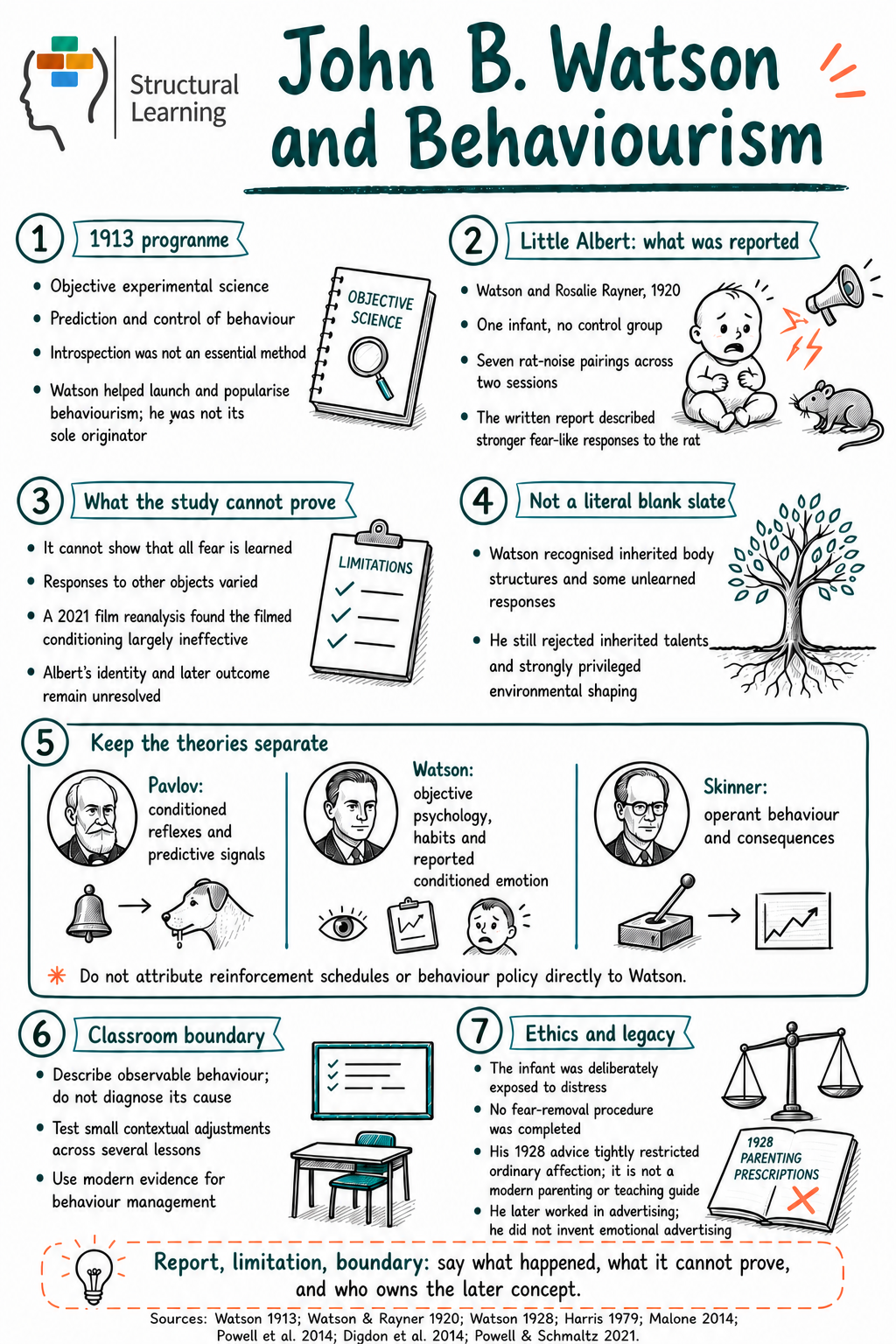
1913 programme: Watson argued that psychology should become an objective experimental science. Prediction and control were its goals, and introspection was not an essential method. He helped organise and popularise behaviourism, but was not its sole originator.
What Watson emphasised: observable action, experimental conditions, habit and learning. He gave environment a powerful role while still recognising hereditary equipment and unlearned responses.
Little Albert: Watson and Rosalie Rayner reported seven rat-noise pairings across two sessions with one infant. Albert later showed stronger withdrawal and distress to the rat. Responses to other objects varied, and some later tests were confounded.
What the study cannot establish: it was an uncontrolled single case. It cannot show that all fear is learned, that conditioning works identically for every child or that later outcomes were known. A 2021 analysis found the filmed conditioning largely ineffective. Albert's identity and subsequent life remain disputed.
Nature and nurture: Watson's famous dozen-infants statement was followed by an admission that he was going beyond the facts. His environmental rhetoric should not be treated as evidence that biology, cognition and context do not matter.
Historical caution: Watson's 1928 parenting advice discouraged ordinary affection and is not a blueprint for modern teaching. In advertising, he helped promote research-informed persuasion but did not invent emotional advertising.
Classroom boundary: teachers can describe observable behaviour and examine context without diagnosing its cause. Reinforcement, schedules and behaviour policy belong to later operant and classroom-management evidence.
Sources: Watson (1913); Watson and Rayner (1920); Harris (1979); Malone (2014); Powell et al. (2014); Digdon et al. (2014); Powell and Schmaltz (2021).
Watson never removed Albert's fear. Four years later, a researcher working with his advice showed how it might be done. Mary Cover Jones studied Peter, a boy of 2 years and 10 months. He was afraid of a white rat, a rabbit, a fur coat, feathers and cotton wool (Jones, 1924).
Jones chose the rabbit, which Peter feared most. At first Peter played each day alongside three children who had no fear of it. Later he sat in a high chair eating food he liked. The rabbit, in a cage, was brought only as close as it could come without putting him off his food.
Jones recorded 17 steps. At the start, the rabbit anywhere in the room caused fear. By the end, Peter held it on his lap and let it nibble his fingers. His fear of cotton wool, the fur coat and feathers had gone as well.
Progress was uneven. Peter caught scarlet fever and missed two months. On his way back, a large dog jumped at him and his nurse, and his fear dropped back to where it began. A scratch from the rabbit set him back again, but he regained the lost ground quickly.
Like Albert, Peter was one child with no comparison group. The case shows what is possible, not what always happens. Its method, small steps paired with something pleasant, is close to what later became behaviour therapy for fears. For teachers, its lessons are small steps, a calm setting and peers who do the task without fuss.
Watson made a famous claim about a dozen healthy infants. He said he could train any one of them for a chosen job. People often quote this as a blank-slate claim. Here is the passage from his book Behaviorism:
“Give me a dozen healthy infants, well-formed, and my own specified world to bring them up in and I’ll guarantee to take any one at random and train him to become any type of specialist I might select [...] regardless of his talents, penchants, tendencies, abilities, vocations, and race of his ancestors. I am going beyond my facts and I admit it, but so have the advocates of the contrary and they have been doing it for many thousands of years.”
Watson (1925), Behaviorism, p. 82
The part cut here is his list of jobs, from doctor and lawyer to beggar-man and thief. The second sentence is the one most quotations leave out. Watson admitted that he was going beyond his facts (Watson, 1925). Elsewhere, he accepted inherited body structures and unlearned responses.
His position gave strong weight to the environment. It stopped short of denying that inheritance exists. The wider nature and nurture debate in education has moved a long way since.
His 1928 parenting advice was much harsher than a call for steady routines. Watson opposed ordinary hugging, kissing and lap-sitting. He allowed only tightly rationed affection.
Good evidence lay behind none of these rules. They make a poor early model of warm, responsive teaching.
The historical lesson concerns authority, not behaviour policy. It shows how a confident expert can turn limited research into firm advice about children. Teachers should ask what evidence supports an approach, whose outcomes were measured and which ethical ideas it carries.
After he left university life, Watson joined the J. Walter Thompson advertising agency. He used his research skills to study buyers and test campaigns. This gave advertisers a new way to talk about their work.
He later became a senior executive. His fame as a professor made planned, scientific selling sound credible.
Historians show that emotional appeals, testimonials and scientific methods in advertising all existed before him. Watson helped to organise and explain them.
He gave market research the weight of science. He also tied behaviourist ideas to selling (Buckley, 1982; Kreshel, 1990).
Watson helped shape early behaviourism, Pavlov studied conditioned reflexes, and Skinner later developed a distinct account of operant behaviour. These traditions overlap historically, but they describe different learning processes. This table keeps each researcher's main contribution and terminology with the right article.
On a smaller screen, swipe across to read all columns.
| Researcher | Main contribution | Important boundary |
|---|---|---|
| Ivan Pavlov | Experimental work on conditioned reflexes using several kinds of signals. | Detailed US, UR, CS, CR, acquisition and extinction terminology belongs to the Pavlov article. |
| John B. Watson | A 1913 programme for objective psychology, comparative research and a behaviourist account of learned habits and emotion. | His claims changed over time and should not be treated as proof of total environmental control. |
| B. F. Skinner | A distinct radical behaviourism and experimental analysis of operant behaviour. | Reinforcement, punishment and schedules belong to operant conditioning, not the Little Albert account. |
Keep the one-page cheat sheet beside you to tell Watson, Pavlov and Skinner apart when you plan or read about behaviourism.
Watson helped make behaviour a valid subject for careful study. He pushed psychology towards evidence people could see, clear methods and testable questions. His writing also brought psychology to a much wider public.
In short, these were his main contributions to psychology:
Watson was controversial for four reasons. The Little Albert study caused an infant distress on purpose and never removed the fear. His claims about the environment, such as the dozen-infants boast, went beyond his evidence. His 1928 parenting advice discouraged ordinary affection. And he left Johns Hopkins in 1920 after publicity about his relationship with Rosalie Rayner.
His programme left out or delayed some vital questions. Simple links with the environment cannot fully explain thought, language or memory. They cannot fully explain biological development or social meaning either.
Later cognitive, developmental and social theories addressed these gaps. They did more than add detail to behaviourism. Noam Chomsky argued that conditioning alone cannot explain how children acquire language (see Chomsky's theory). Bruner's theories show how learners build and revisit ideas, a process that routines alone do not teach.
Watson also went beyond his evidence. His dozen-infants claim was too strong. Textbook accounts made the Little Albert report seem firmer than its design allowed.
His parenting advice treated children as objects to control. His career shows the value of better research methods. It also shows the risk of using one approach to explain all human development.
Watson's most useful idea for teachers is that feelings about a task can be learned. A learner who has failed a timed test many times may dread the next one before it starts. Researchers see maths anxiety as more than a conditioned fear. Reviews link it to many causes, including weaker number skills, the attitudes of adults around the learner and past experiences of failure (Dowker et al., 2016).
Still, the conditioning lens gives a teacher two useful questions. What is this task paired with, week after week? And how could that pairing change?
Imagine a Year 4 learner, Sam, who freezes at the Friday times tables test. Each week the test is timed, scores are read out and Sam comes near the bottom. Over a term, the test, the timer and even the word Friday become linked with embarrassment. By spring, Sam says he feels sick on Fridays.
A fix in the spirit of Jones changes the pairing, not the child. The teacher keeps the practice but removes the audience. Answers go on mini whiteboards only the teacher sees, scores stay private and Sam tracks his own best score. The first questions each week are facts he already knows. Only when he has managed this calmly for a few weeks does a soft timer come back.
In Year 10, dread often shows up as avoidance. A learner leaves the non-calculator section blank, or is absent on mock days. Here the ladder starts with one question type, untimed, in an ordinary lesson. Next comes a short timed section in class with a private mark. Then a full paper, with a plan for the first ten minutes.
Skill teaching runs alongside every step. In one study with learners aged about nine, training in maths strategies lowered anxiety and raised attainment, while training in handling feelings lowered anxiety only (Passolunghi et al., 2020).
The builder below does this planning for four tasks learners often dread, from a quick maths test to reading aloud or answering in front of the class.
Treat the ladder as a planning prompt rather than a treatment. Where a learner's distress is severe or reaches beyond maths lessons, bring in your SENCO or pastoral lead rather than running the ladder alone.
What do teachers try in practice? Two posts from the last two months describe small routines of this kind.
Few teachers on social media link maths dread to Watson, but some describe routines that change what the subject is paired with. The routine and notice columns are our summary of each post; the evidence column is the research, not the post.
| Routine, as teachers describe it | What you would notice | What the evidence says |
|---|---|---|
| Ask a new class how they feel about maths before the first topic | ||
At the start of a new year, ask your new classes how they're feeling about Maths. It's simple, but I find it's powerful, particularly for those prone to Maths Anxiety. |
Learners who dread the subject say so early, in a low-stakes moment, before a test pairs maths with failure again. You learn who needs the gentler first steps. | Learners who saw their teacher as sensitive to their difficulties reported falling maths anxiety over three school years (Aldrup et al., 2020). The design cannot prove the teacher caused the change. |
| A short write about maths, then a reasoning warm-up instead of a speed drill | ||
allowing students to write about their experiences with math and using engaging warm-up activities that focus on reasoning rather than computation. |
The lesson opens with thinking that has no single fast answer, so a slow calculator is not shown up in the first five minutes. The post summarises an interventionist's article rather than one teacher's lesson. | In one controlled study with learners aged about nine, both emotion training and maths strategy training lowered anxiety, but only strategy training also raised attainment (Passolunghi et al., 2020). A short writing task on its own before a test did not help in a preregistered trial (Cho, 2026). |
Neither routine has been tested on its own, so treat both as reported practice rather than proven methods. Other posts show how the dread is learned in the first place, and how it can reach teachers too.
Three short posts from social media. A former learner remembers a weekly test, a physics teacher says knowing how learning works removes the fear, and a teacher recalls being frightened when she was asked to lead maths.
I was bad at maths & she refused to help me & scheduled times tables for Fridays. I’d just sit there and stare at the test, get 0/10 every week.
If they know how to learn, how learning happens, and know how to get to know things then anxiety disappears.
I remember agreeing but then going home and crying, because I was terrified.
The first post has the same shape as Watson's procedure: one task, paired again and again with the same bad experience. The last is a reminder that adults carry the feeling too. In one study of young classes, female teachers' maths anxiety was linked with lower maths attainment among the girls they taught (Beilock et al., 2010).
What does the research say about reducing maths anxiety? The evidence check below summarises six studies of classroom approaches.
Two points matter most for planning. Across 50 studies, longer programmes did better than short ones (Sammallahti et al., 2023). Once study quality was taken into account, skill teaching and calming approaches did about as well as each other (Codding et al., 2023). A teacher seen as sensitive to learners' difficulties was also linked with falling anxiety over three school years, though the design of that study leaves cause open (Aldrup et al., 2020).
Begin with description, not diagnosis. Record what happened, examine the conditions around it and test one small, ethical change. Visible behaviour alone rarely reveals its cause. Prior knowledge, language, stress, motivation and relationships may also shape what a learner does.
Note when the task began, what instruction came before it and what the learner did. Then note what changed next. This follows Watson's focus on what people could see without accepting his wider theory.
Next, test a small and ethical change. Suppose participation drops after spoken instructions with several steps. Give the steps in writing and compare several lessons.
A pattern like this remains a clue rather than a proven conditioned response. It helps the teacher tell a repeated pattern from an impression.
Use modern evidence when dealing with consequences, reinforcement schedules or school behaviour policy. Cite Thorndike, Skinner and later research for these ideas, rather than Watson. The behaviourism learning theory overview explains the wider family of approaches. The Learning Theories hub compares behaviourism with cognitive, developmental and social accounts. For the contrast most teachers meet in training, see behaviourism and constructivism compared.
He often receives that title because his 1913 manifesto helped organise and promote the movement. Yet "sole founder" is too strong. Earlier researchers and others from his time also shaped the study of behaviour (Malone, 2014).
Most histories date behaviourism to 1913, when Watson published Psychology as the Behaviorist Views It. Earlier animal research had prepared the ground. So 1913 marks the start of the named movement, not the first study of behaviour (Watson, 1913; Malone, 2014).
Watson and Rayner reported stronger distress and avoidance in one infant. The change followed seven rat-noise pairings across two sessions. This uncontrolled case falls short of a general law. Albert's identity and later outcome also remain disputed.
Albert left the hospital on the day of the last tests, so no one tried to remove his fear. Who he was is still argued over. One team named Douglas Merritte, who died in 1925. Another named Albert Barger, who grew up. Neither claim is settled (Beck et al., 2009; Powell et al., 2014).
No, not by today's standards. There is no record of consent, distress was caused on purpose, crying never ended a session and the fear was never removed. Watson and Rayner themselves wrote of "considerable hesitation" before they began (Watson & Rayner, 1920).
Watson made extreme claims about the power of the environment. Yet he also accepted inherited structures and unlearned responses. His famous infant-training statement came with an immediate admission. He said it went beyond the evidence.
Watson promoted an early behaviourist programme. He studied habits and conditioned emotional responses. Skinner later developed radical behaviourism and a separate analysis of operant behaviour. Modern reinforcement schedules should not be linked directly to Watson.
He turned behaviourism into a named programme and made behaviour others could see the main evidence. He applied conditioning to human emotion and took psychology to a mass audience and into advertising. Many of his strongest claims went beyond his evidence, which is part of his legacy too.
John B. Watson was born on 9 January 1878 in Travelers Rest, South Carolina, and died on 25 September 1958 in New York, aged 80.
He believed that psychology should study observable behaviour and that habits and emotions are largely learned from the environment. He also accepted inherited structures and unlearned responses.
Behaviour is the evidence, learning is a change in behaviour, the environment shapes behaviour, stimulus and response form links, and behaviour can be predicted and changed. The numbered list near the top of this page explains each one.
The Little Albert study caused an infant distress on purpose, his claims about the environment outran his evidence, his 1928 parenting advice discouraged ordinary affection and he left Johns Hopkins in 1920 after publicity about his private life.
Watson is usually called the father of behaviourism. Ivan Pavlov, Edward Thorndike and B. F. Skinner stand behind it too: Pavlov for conditioned reflexes, Thorndike for the law of effect and Skinner for operant conditioning. "Godfather" is a looser title than "father", so it helps to teach the roles rather than the labels.
These pages separate Watson from the wider behaviourist family. Use them to explore the detailed ideas that belong elsewhere. These include conditioned reflexes, operant learning and social learning.