Updated on
October 5, 2026
Piaget vs Vygotsky: Key Similarities and Differences
Piaget vs Vygotsky compared for teachers: five shared beliefs, the key differences, a Venn diagram and two worked lesson examples, primary and secondary.

Updated on
October 5, 2026
Piaget vs Vygotsky compared for teachers: five shared beliefs, the key differences, a Venn diagram and two worked lesson examples, primary and secondary.
What is the difference between Piaget and Vygotsky?
Piaget vs Vygotsky is a comparison of two accounts of how children build understanding. Piaget emphasised how they reorganise ideas through action and experience, with broad stages of reasoning. Vygotsky emphasised how culture, language and shared activity shape thinking. Both saw children as active learners. The key differences concern the origins of new thinking, speech and supported performance.
A learner may solve a problem with a partner, then struggle when the prompt is removed. In class, that gap makes the difference between shared success and secure understanding worth studying. For revision, compare what each theory says about reasoning, language and help. Then ask which claim the research actually tested.
The two theories agree on more than the textbook contrast suggests. Both reject the idea that learning is information copied into an empty mind. Both see talk with others as part of how thinking grows. Lourenço (2012) places the real divide in where new thinking comes from. It comes from the child's own reworking of ideas, or ways of thinking that others share first.
On this page
Read each row as a difference in emphasis. Both accounts give the learner an active role, while explaining how new thinking grows in different ways.
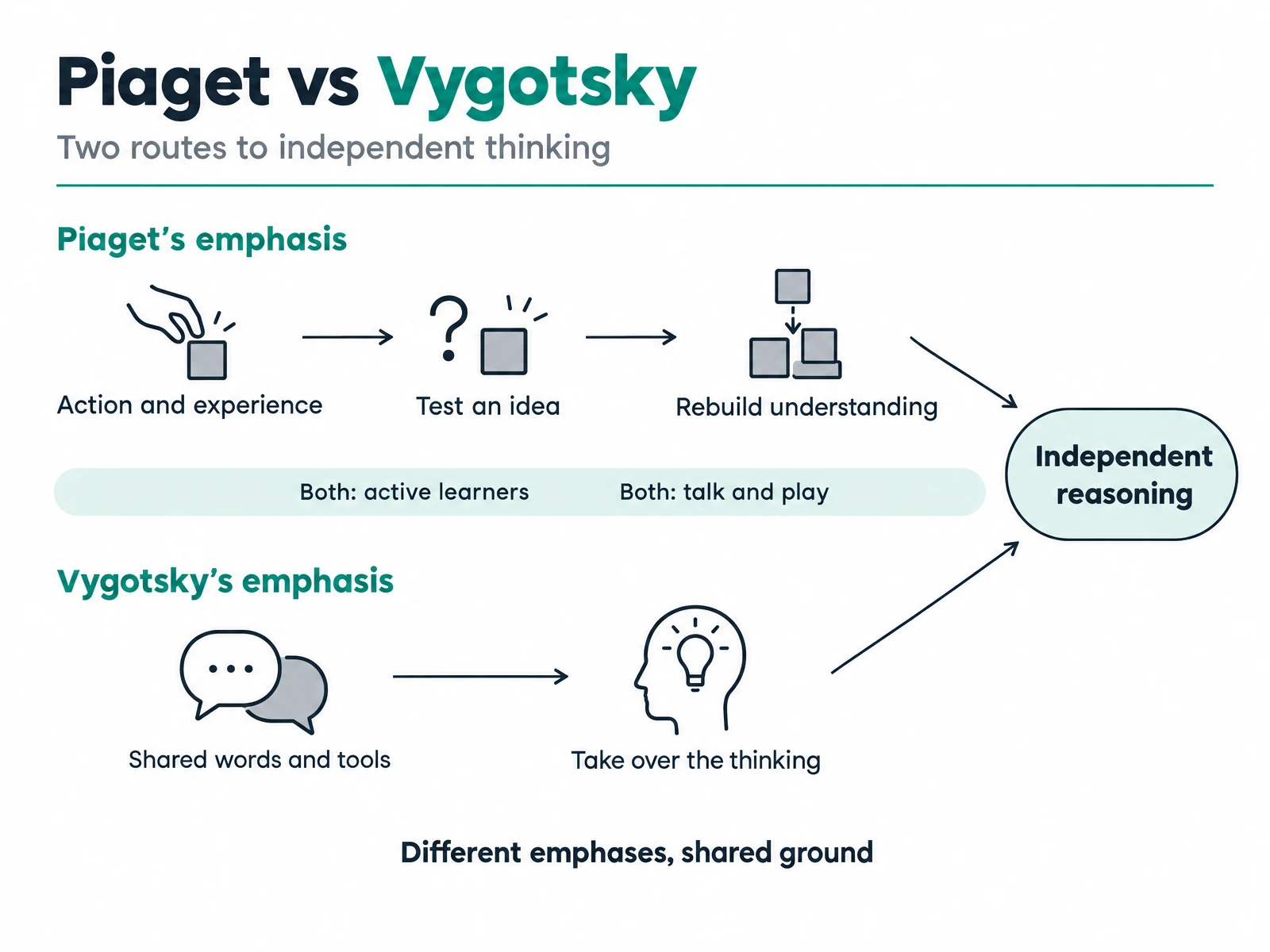
Read the table one row at a time. Each row asks the same question of both theorists, so you can see where they differ in emphasis rather than in kind.
| Term | Meaning |
|---|---|
| Constructivism | Learners build understanding through their own activity. |
| Schema | A pattern of action or thought used to make sense of experience. |
| Assimilation | Making sense of new experience through an existing schema. |
| Accommodation | Changing a schema to fit new experience. |
| Equilibration | Reworking ideas when experience challenges the learner's current understanding. |
| Mediation | Using shared tools and signs, such as words or numbers, to shape thought. |
| Internalisation | Making ways of thinking used with others part of one's own thinking. |
| Zone of proximal development (ZPD) | The gap between independent performance and emerging skills shown with help. |
On a phone, each question appears with both theorists below it.
| Question | Piaget | Vygotsky |
|---|---|---|
| Core process | Learners act, test ideas and rebuild their understanding. | Learners use shared words, signs and tools to develop new ways of thinking. |
| Development | Thinking changes through broad stages with a proposed common order. | Thinking changes as learners take over ways of acting and thinking first used with others. |
| Language | Language expresses growing thought and helps children share their views. | Language helps shape thought, becoming self-talk and then inner speech. |
| Social relations | Peers compare views, challenge ideas and learn to reason for themselves. | Guidance and shared work help learners do more than they can yet do alone. |
| Assessment | Ask how the learner reached the answer and what their explanation reveals. | Compare performance alone, with help and after help is reduced. |
| Teacher implication | Choose tasks that reveal reasoning and challenge an existing idea. | Offer a useful tool or model, then give the learner more control. |
For depth, use the dedicated accounts of Piaget's cognitive development theory and Vygotsky's sociocultural theory. The wider field sits in fundamental theories of learning and child development theories.
Jean Piaget (1896 to 1980) was a Swiss psychologist who spent most of his working life in Geneva. He watched and questioned children as they solved problems. His account proposed four broad stages, from infancy to the teenage years. The Origins of Intelligence in Children appeared in English in 1952. For the full account of adaptation, see assimilation and accommodation.
Lev Vygotsky (1896 to 1934) was a Soviet psychologist, born in the same year as Piaget. He studied how children use words, signs and cultural tools with others, then on their own. His approach is now called sociocultural theory. Thought and Language was first published in 1934. The 1978 collection Mind in Society brought more of his work to English readers after his death.
Put simply, Piaget pictured the child as a young scientist, testing ideas against the world. Vygotsky pictured the child as an apprentice, taking over ways of thinking that others first share. These are useful images for revision. Read the studies below to see how far each image explains the evidence.
Exam questions often ask for two beliefs the theorists share. These five points provide a starting place for a comparison, before you explain the differences.
| Shared belief | What it means |
|---|---|
| Both are constructivists. | Learners build understanding through their own activity and experience. |
| Both see the child as active. | Children learn by doing, asking and trying out ideas, not by waiting to be filled. |
| Both see development as a change in kind. | Thinking changes in form as well as in the number of facts known. |
| Both give talk with others a role. | Piaget stressed argument between equals. Vygotsky stressed help from someone more expert. |
| Both take play seriously. | Play lets children practise rules, symbols and self-control. |
The Venn diagram puts the shared ground in the middle and each theory's emphasis at the sides. For revision, cover one side and explain it from memory. Then check your answer against the other side and the shared middle.
Calling Piaget an individual constructivist and Vygotsky a social constructivist helps a beginner remember the contrast. Both men described an active child whose thinking changes through work with objects and with people. The labels point to each account's main focus.
Piaget's cognitive constructivism stresses how learners rebuild their own ideas through experience. Vygotsky's social constructivism stresses how shared language and cultural tools shape that rebuilding. These are common labels for the contrast. Both theories give activity and other people a role.
DeVries (2000) lists what they share, including a central role for social factors and the transformative nature of internalisation. Glassman (1994) argues that both start from much the same place and could be integrated. So state the similarities first, then the divide.
Lourenço (2012) puts the central difference like this. For Piaget, development aims at autonomy: the child rebuilds ideas and learns to reason for themselves. For Vygotsky, development depends on culture and on other people: ways of thinking are shared first, then taken over. An exam answer should explain that contrast while keeping their shared ground in view.
Vygotsky's theory remains relevant as a way to study how dialogue, shared tasks and cultural tools support thinking, including the gap between independent and supported performance. Rubtsov's 2020 comparison revisits this social-to-individual account beside Piaget's individual-to-social account. It is a theoretical analysis, rather than a trial of a teaching method.
Many test questions begin "Unlike Piaget, Vygotsky believed that...". These five endings capture the differences of emphasis and help you choose an answer with care.
| Vygotsky emphasised | The comparison with Piaget |
|---|---|
| ...culture and language shape how thinking develops. | So development can look different from one culture to another. Piaget described one broad order of stages for all children. |
| ...good teaching can lead development. | Teaching aimed at the zone of proximal development pulls new abilities forward. Piaget put more weight on readiness: a child takes in what their current thinking allows. |
| ...a more expert helper is a main source of new thinking. | The helper can be an adult or a more able classmate. Piaget gave more weight to argument between equals. |
| ...language starts as talk with others, then turns inward to guide thought. | Piaget saw thought as leading, with language expressing it. |
| ...self-talk is a tool for planning, not a sign of immature thinking. | Piaget first read it as a stage that fades. |
Read these as differences of emphasis. Vygotsky also wrote about age periods, while Piaget also discussed culture and social life. The contrast lies in what each account puts at its centre.
Piaget described four broad periods: sensorimotor, preoperational, concrete operational and formal operational; the full Piaget guide explains them in detail. A stage account asks about the form of a child's reasoning. Task wording, familiarity and prior knowledge also shape the answer a child gives.
McGarrigle and Donaldson (1974) found that a number conservation task made more sense to young children when a "naughty teddy" changed the counters by accident. The Piaget guide's critique covers the study. Here, the key point is that task context changes what an answer reveals.
Vygotsky's zone of proximal development focuses on emerging skills revealed in joint work. A supported answer matters when the learner takes an active part in reaching it. The linked guide explains how to distinguish that emerging skill from a helper completing the task.
The two ideas answer different planning questions. A stage account asks how the learner's reasoning is organised now. The ZPD asks what the learner could do next with the right help. So watch the learner's current strategy first, then test which prompt, picture or partner moves it on.
Three short posts from social media. A kindergarten teacher questions how the stages are taught; a home educator and an assistant principal argue over whether one lesson can reach every learner's zone.
We need to stop teaching Piaget’s stages in school as though they are objectively true.
maybe 40%+ of a mixed-ability class are not in the Zone of Proximal Development on any task
How would you mitigate against this so-called “one-pace” classroom?
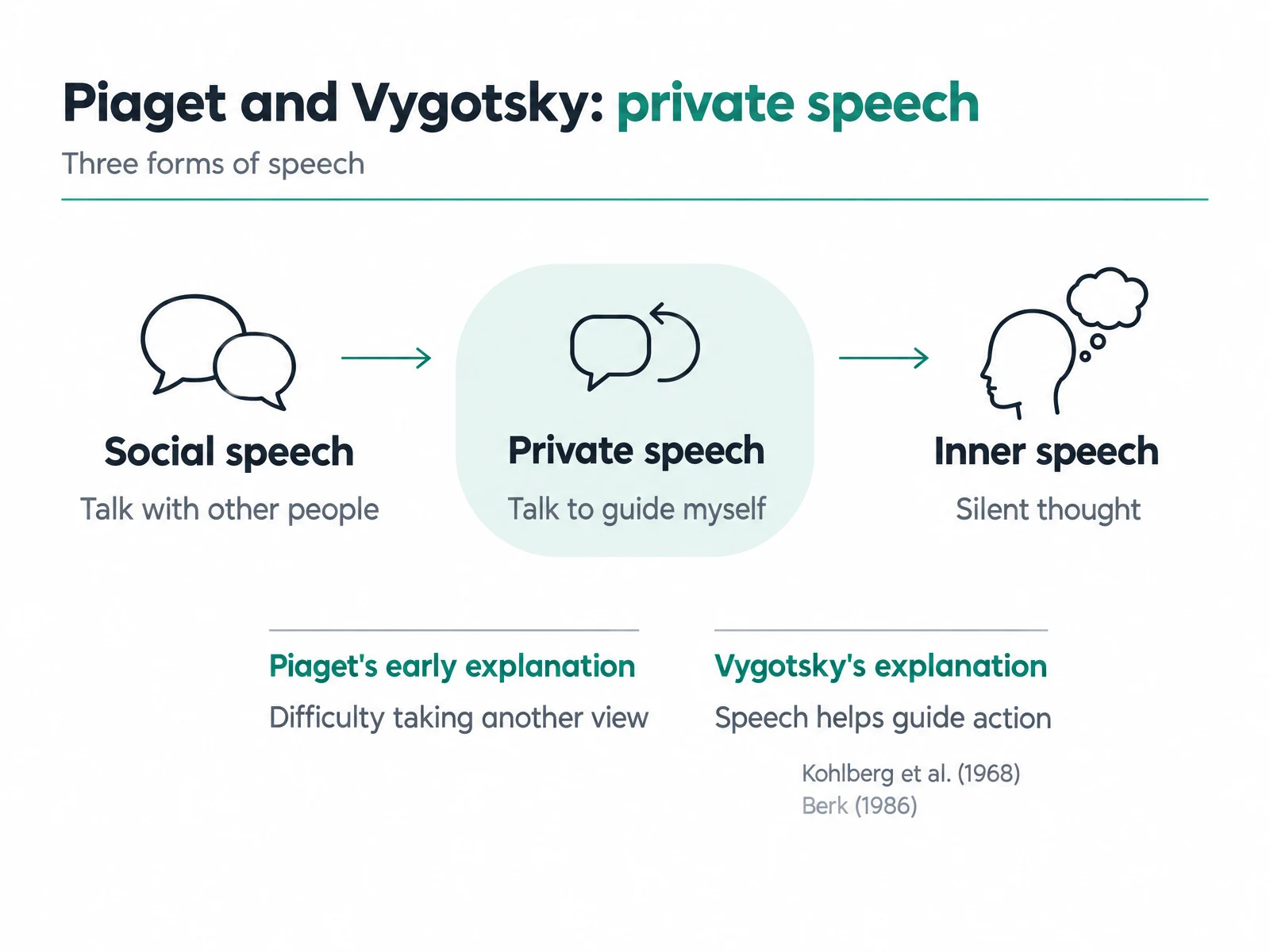
Piaget's early account saw private speech as a sign of difficulty taking another person's view, while Vygotsky saw it as speech children use to guide their actions. Piaget called it egocentric speech. For Vygotsky, this self-talk develops from talk with others and later becomes silent inner speech.
The three forms are social speech used with other people, private speech spoken to guide one's own actions, and inner speech used silently as part of thought. A child might ask someone how to start, talk through the next step, then plan it quietly. The contrast is about the role speech plays.
| Claim tested | What the evidence shows |
|---|---|
| Developmental course | Research on private speech gave stronger support to Vygotsky's account of its social origins and changing role than to Piaget's early explanation in terms of egocentrism. Kohlberg, Yaeger and Hjertholm (1968) reported a curved developmental course. Audible self-talk rose and then fell, rather than simply fading from the start. |
| Social origins | Berk (1986) observed 93 children aged three to five in nursery and day-care settings. The results supported the social origins of private speech. They challenged Piaget's explanation of it as difficulty taking another person's view. This tests a specific speech claim, rather than settling every difference between the theories. |
Research has mostly backed Vygotsky here. In one study, an adult first helped preschool children with a task. Those who then talked themselves through it were more likely to get the next item right than children who stayed silent (Winsler et al., 1997). Self-talk is also most common on tasks that are hard but not impossible (Fernyhough and Fradley, 2005).
The distinction is between speech addressed to someone else and speech used to guide oneself. A learner whispering the steps of a calculation may be steering their attention. That makes the function of the words more useful to study than their volume alone.
Language also carries a culture's tools for thinking. Number notation, diagrams, timelines and subject words shape what learners can notice and do. Our guide to language development theories covers the wider debate about how children learn language itself.
| Theory | Social interaction |
|---|---|
| Piaget | Piaget valued cooperation between peers. Disagreement can unsettle a weak explanation and make children weigh another view. His account therefore gives talk, shared rules and reasons a role in development alongside action with objects. |
| Vygotsky | Vygotsky gave other people a bigger role. Working with a more capable person can bring in a culture's ways of remembering, showing and solving problems. The shared activity changes as the learner takes over more of the thinking. Responsibility moves step by step to the learner. |
Studies that test the two accounts side by side suggest both are partly right. Fawcett and Garton (2005) studied 100 children aged 6 and 7. Only lower-attaining children who worked with a more able partner improved on their own afterwards. They improved only when they had to explain their thinking aloud.
In group science work with 8 to 12-year-olds, the learning that followed was consistent with disagreements left open during the talk (Howe, 2009). A review of 71 studies found that working with peers helped more than most other conditions, but not more than working with an adult (Tenenbaum et al., 2020).
Both men also saw play as important, though they explained it differently. Play can create demanding spaces for symbols, rules and self-control. Its value depends on what the activity asks the child to think through, and on how any help changes that thinking.
| Myth | Correction |
|---|---|
| Myth: Piaget ignored culture and interaction. | He put the child's own reworking of ideas first. He also studied how peers talk, cooperate and learn to weigh each other's views. |
| Myth: Vygotsky invented scaffolding. | Wood, Bruner and Ross named it in 1976. It can fit the ZPD, but the term is not Vygotsky's own. |
| Myth: learning always follows development for Piaget. | A child's current thinking shapes what they can learn. Teaching, experience and conflict can also help that thinking change. |
| Myth: learning always leads development for Vygotsky. | Help needs to engage skills that are forming. Presenting advanced work alone is not enough. |
| Myth: group work is automatically Vygotskian. | Shared work matters when talk and tools help learners think. Check what each learner can then do alone. |
Both theories have limits of history and evidence. Piaget's tasks sometimes hid what children could do because of their wording and context. Vygotsky died before he could complete much of his work. Later writers have read it in different ways. Neither account alone explains all that is now known about memory, prior knowledge or how to teach a subject.
The main criticisms are that some tasks underestimated children's skills, the stages can look too rigid, and culture and language receive less weight than in Vygotsky's account. These are limits on how the theory explains development.
The full critique of Piaget's theory explains the studies and their limits. Use this short list to frame a comparison, rather than to assign a learner a stage. For a side-by-side comparison, see behaviourism versus constructivism.
Vygotsky's theory offers a fuller account of how language, culture and shared activity shape thinking, which makes it especially useful for questions about supported learning. Private-speech studies also favour his account of self-talk (Kohlberg et al., 1968; Berk, 1986). That is a reason to prefer it for those questions, not proof that it explains every aspect of development better.
Evidence from private-speech studies favours Vygotsky's explanation of self-directed talk, while Piaget's account still helps explain how learners test ideas and change their current reasoning. A fair verdict depends on the claim being tested. DeVries (2000) and Lourenço (2012) show why treating the theories as complete opposites loses much of their shared ground.
Piaget asks how a child's thought changes, Vygotsky asks how shared life shapes thought, and Erikson asks how a person grows within relationships across a lifetime. These accounts ask different questions about development. State that difference before listing what each claims.
Erikson's psychosocial theory links a person's needs with the social world. Psychosocial refers to that link. His proposed stages concern trust, identity and other themes in life. Piaget's stages concern forms of thought. Vygotsky puts shared tools and activity at the centre of how thought grows.
Montessori set out a way to teach using a prepared environment, clear materials and guided choice, while Piaget and Vygotsky explained how a child's thinking grows. Her focus was on what adults set up and how children use it. The Montessori method guide explains how adults introduce materials, observe and then step back.
Bruner focused on how teaching helps learners grasp ideas through actions, pictures and symbols, linking Piaget's interest in thought with Vygotsky's interest in shared learning. His modes are called enactive, iconic and symbolic. They can be used together, rather than assigned to fixed ages.
Read Bruner's theory for the modes in full. The Vygotsky vs Bruner comparison explains how the ZPD relates to later scaffolding. Each guide keeps those ideas distinct.
Neither theory maps onto a single teaching method. "Piaget means discovery learning" and "Vygotsky means direct instruction" are crude translations. Fuson (2009) argues that reading Piaget as learning without teaching has held back struggling learners in maths. Teachers can explain, model, question and set up group work, and still expect learners to build and explain the meaning.
This sequence joins Piaget's concern that learners rebuild ideas for themselves with Vygotsky's concern for guided participation. It also keeps help accountable. For the detailed techniques, see our guide to scaffolding in education. For how Bruner's scaffolding relates to the ZPD, read Vygotsky vs Bruner.
The theories are easiest to see in a real lesson. Here are two, one primary and one secondary. Each uses a Piagetian move to bring out the learners' current idea. A Vygotskian move gives them a better tool. A final check shows what each learner can do alone.
In both lessons the order matters: a first attempt, a surprise, a shared tool, fading help, then a check alone. Put the tool first with no prediction, and learners may copy the method without changing their idea.
Teachers online rarely plan with Piaget's or Vygotsky's names. They argue about telling versus discovering. The routine and notice columns are our summary of each post; the evidence column is the research, not the post.
| Routine, as teachers describe it | What you would notice | What the evidence says |
|---|---|---|
| Explain and show a worked example before independent work | ||
Direct Instruction, for example, gives an explanation and a worked example before asking students to take on the work on their own. |
Novices can follow the order: watch it done, try it with the example in view, then work alone. The teacher does the first thinking out loud. | Fuson (2009) argues that reading Piaget as learning without teaching has held back struggling learners in maths. For Vygotsky, new thinking starts in shared work with a more expert person. |
| Save discovery for learners who already have a base | ||
Discovery learning as an intro, to unskilled students, can be a huge waste of time. |
In the thread, discovery maths went well at a gifted school where learners had a baseline. As a first introduction for everyone else, the writer saw it waste time. | Piagetian conflict needs an idea to push against. In Fawcett and Garton (2005), lower-attaining children gained only when paired with a more able partner and asked to explain. |
| Catch the error, then give the smallest hint that lets the learner make the next move | ||
they catch the error, stay in the ZPD, and scaffold just enough so the learner can produce the next move themselves. |
The helper does not finish the sentence. Help is sized so the learner still produces the next step. This post comes from one-to-one language tutoring, not a school class. | Wood, Bruner and Ross (1976) described a tutor who kept the task manageable and marked what mattered, while leaving the learner to do all they could. After help, children who talked themselves through the next item succeeded more often (Winsler et al., 1997). |
A correct answer can hide copying, and a wrong answer can hide a promising strategy. Piaget's clinical method used flexible questions to find the reasoning behind an answer. Ask how a learner reached the answer and what their explanation reveals.
Vygotsky adds a second reading: what the learner can do with help. Vary a cue, diagram or example and watch what changes. Then reduce the help and ask the learner to carry on. Record both attempts so the check shows who now controls the thinking.
Use formative assessment strategies to gather both kinds of evidence. Record what was done alone, what help changed the result and whether the change lasted. That stops supported success being mistaken for secure learning.
Start with the learning problem. If learners repeat a method but struggle to explain it, set up a contrast that exposes their current idea. If they struggle to start, give a tool, example or talk structure. If they succeed only with help, remove one prompt and check again.
The cycle is short: first attempt, diagnosis, just enough help, explanation, fading and transfer. It protects two ideas. Learners must do the rebuilding themselves, and the people and tools around them can make new thinking possible. Both ideas sit within the wider set of main theories of learning that teachers draw on.
Try it in your next lesson. Before you teach a new idea, ask every learner to predict or explain first. Note who is stuck and who is close, then plan one tool to offer and one moment to take it away.
Year 5, maths, multiplying by one half. Ask learners to predict 6 × 0.5, then test it with a bar model. Give a short explanation stem, then remove it for 12 × 0.5.
Look for: learners explain why the result is half the starting number and solve the new example alone.
You can compare and contrast Piaget and Vygotsky using the free A4 study note below, which summarises their differences, shared ground and classroom decision cycle. Use it beside the comparison table, then test your recall with the questions that follow.
Piaget and Vygotsky shared the view that children actively construct understanding and that development changes the organisation of thinking. Piaget emphasised equilibration, assimilation and accommodation, broad developmental sequences, peer cooperation and personal reconstruction. Vygotsky emphasised cultural mediation, tools and signs, the zone of proximal development, and the movement from social to private and inner speech.
The main contrast is how new thinking grows: through the child's own reworking of ideas, or through tools and ways of thinking first shared with others. A teacher cycle is to check what learners can do alone, choose a challenge and give the least support that helps. Ask for an explanation, fade prompts and check independence again. Keep the limits in view: Piaget studied peer learning, stage ages are broad guides, and supported work should reveal emerging skills. Wood, Bruner and Ross coined scaffolding in 1976.
Piaget vs Vygotsky: compare, plan and check. Use the theory to ask a better question about learning.
Compare the emphasis. What changes? Piaget: learners test and rebuild their own ideas. Vygotsky: learners take over ways of thinking first used with others.
What does language do? Piaget: it expresses growing thought and helps compare views. Vygotsky: it shapes thought and can guide action through self-talk.
What should I check? Piaget: how the learner reasons and explains an answer. Vygotsky: what the learner does alone, with help and after help fades. Shared ground: both see the learner as active and give other people a role.
Worked example, Year 5 maths. Question: does multiplying always make a number bigger? First idea: predict the result of 6 × 0.5 and explain why. Challenge: test the prediction with a bar model.
Shared tool: “Multiplying by 0.5 means finding half of the number.” Check alone: remove the stem and ask for 12 × 0.5 with an explanation. Look for: the learner explains the halving and uses it in the new example.
Plan the next check. Each prompt has a blank space for your lesson record: Year group, subject and question. What can the learner explain before help?
Which task or contrast will test that idea? What help changes the learner's next step? What will you remove, and what will you check alone?
Compare and explain. Write one shared belief and one difference in emphasis. Point to the first attempt and the final explanation as evidence. Keep the claim specific: success with help and success alone show different things.
Evidence and limits. This is a planning record, not a test of developmental stage. Piaget (1952); Vygotsky (1978); Wood, Bruner and Ross (1976).
A strong Piaget and Vygotsky exam answer states one shared belief, explains a difference in how thinking develops, and uses a study to evaluate that difference. The model below answers: identify one similarity and one difference. It also adds a brief strength and limit.
Both Piaget and Vygotsky saw children as active learners whose thinking changes through development. Piaget emphasised how children rebuild ideas through action and experience. Vygotsky emphasised how shared language and cultural tools shape new thinking. Both valued other people, but explained their role differently.
Berk's 1986 study of preschool private speech supported Vygotsky's account of its social origins. This gives evidence for one of his claims about language. It also challenges Piaget's early reading of self-talk as egocentrism. The result concerns private speech, so a verdict on the whole of either theory needs wider evidence.
These five practice questions test shared beliefs, differences in language, teaching roles and evidence, with answers you can reveal after explaining your choice in your own words. They are revision questions written for this guide. They cover comparison skills rather than a named exam board's mark scheme.
Read the prompt and say or write your answer. Open each row to check it, then explain any change you would make.
True. Both describe children building understanding through activity. They differ in the role given to the child's own reconstruction and to shared cultural tools.
Vygotsky's sociocultural theory. It explains how ways of thinking first used with others become part of the learner's own thinking. Piaget also studied social interaction.
False. Wood, Bruner and Ross named scaffolding in 1976. Its later link with the ZPD brings two related ideas together, while each retains its own meaning.
Reduce the prompt and check a new task alone. The supported attempt shows what help made possible. The next attempt checks whether the learner can now control the thinking.
Vygotsky's account of the social origins of private speech. Berk observed preschool children and tested competing explanations of their self-talk. The finding concerns that claim, rather than every part of either theory.
These short answers deal with the contrasts most often reduced to slogans. Each keeps the comparison within its proper limits and points to the guide that covers the detail.
| Account | Emphasis |
|---|---|
| Piaget | Piaget stressed how each child rebuilds knowledge through action and through conflicts in their own thinking. |
| Vygotsky | Vygotsky stressed how culture, language and shared activity shape higher thinking. |
| Both | Both saw the learner as active, and both valued working with others. |
Both were constructivists who saw the child as an active learner. Both held that development changes the kind of thinking a child can do. Both gave talk with others and play a part in that change. They differ mainly in emphasis, not in these basics.
No. Piaget studied cooperation, disagreement between peers and how children learn to see another point of view. "Solo explorer" is a classroom caricature, not a fair summary of his theory.
No. Wood, Bruner and Ross named scaffolding in their 1976 study of tutoring. Teachers often link it with Vygotsky's ZPD, but the two terms are not the same.
Vygotsky died of tuberculosis in 1934, aged 37, after about ten years of research. In 1936 the Soviet authorities banned pedology, the field his work belonged to, and his books were rarely reprinted for about twenty years. English translations arrived in 1962 and 1978, long after Piaget's stage theory had reached the textbooks.
Piaget would want groups of equals who disagree and have to justify their ideas. Vygotsky would want a group where someone, often the teacher, offers a better tool that the others can take over. Research supports both when learners have to explain their reasoning. Check each learner alone afterwards.
Neither is a complete teaching programme. Piaget sharpens attention to how learners currently organise an idea and to useful conflict. Vygotsky sharpens attention to language, cultural tools, guidance and handing over control. Use each where it improves a specific decision.
Ask for independent reasoning first, then set a meaningful challenge. Give the least help that changes what the learner can do, and ask them to explain. Fade the help and check transfer. This respects both personal rebuilding and guided learning.