Behaviourism vs Constructivism: A Teacher's Guide to Two Big Ideas in Education
|
March 5, 2026
A practical comparison of behaviourism and constructivism for UK teachers. When to use each approach, how they overlap, the role of social constructivism, and guidance for blending both in your classroom.
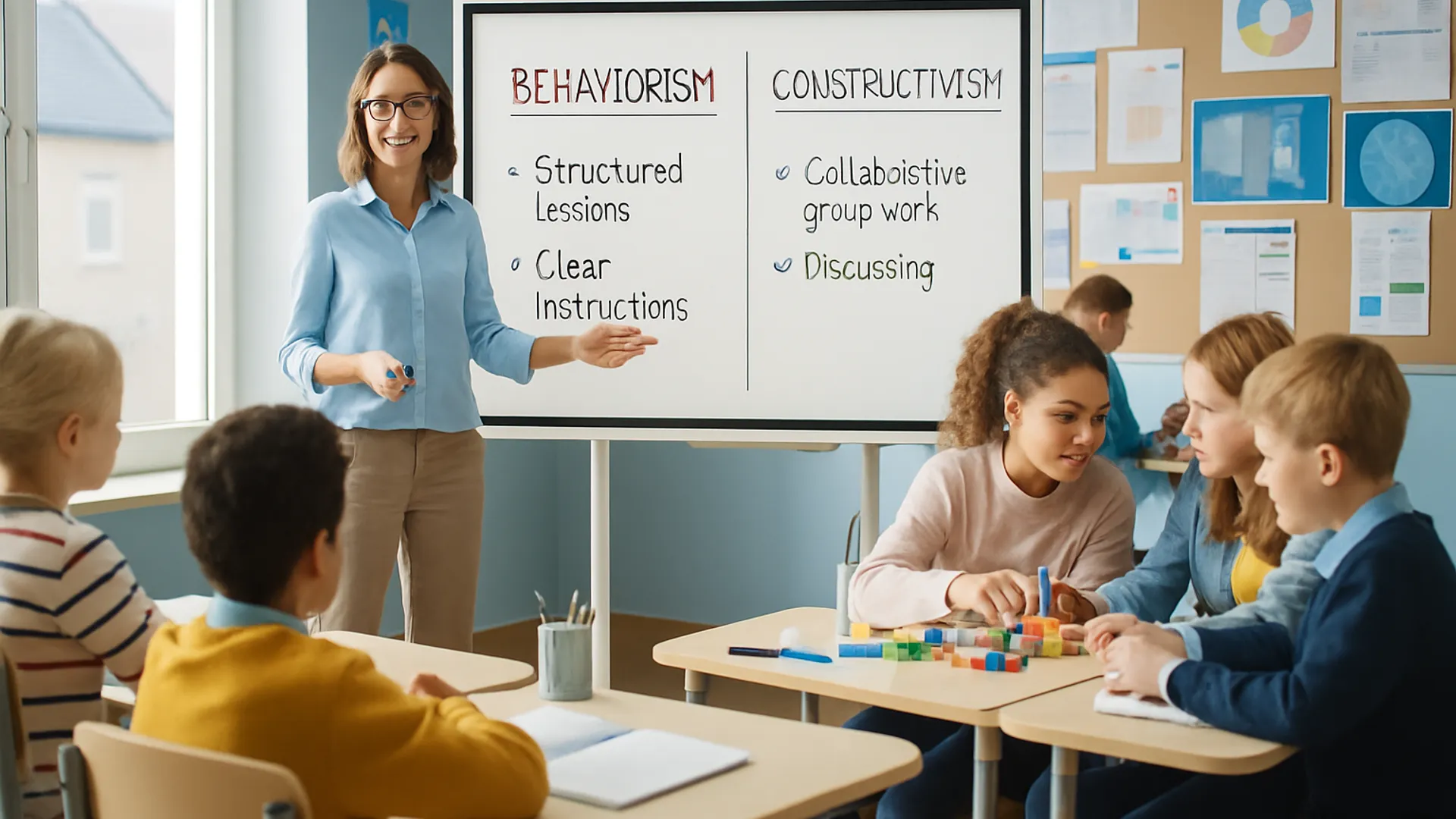
You walk into the staffroom and overhear two experienced teachers debating how best to teach reading. One swears by systematic phonics drills with immediate reward stickers. The other favours letting children explore texts and discover letter patterns for themselves. Neither is wrong. They're working from different understandings of how learning happens, and those understandings are rooted in two fundamentally different theories: behaviourism and constructivism.
Most of us use elements of both approaches without knowing it. A Year 3 teacher might use behaviourist techniques to establish whole-class behaviour routines in September, then switch to constructivist methods when exploring fractions through investigation. Understanding what these two approaches actually are, and when each works best, gives you clarity about your own practice and confidence to explain your choices to parents, governors, and Ofsted.
Key Takeaways
Behaviourism focuses on observable behaviour and external rewards: Rooted in Pavlov and Skinner, this approach assumes learning happens through stimulus-response cycles. It works brilliantly for teaching routines, phonics, and behaviour management.
Constructivism emphasises active learning and meaning-making: Built on Piaget and Vygotsky's work, it assumes learners build understanding by doing, discovering, and talking. It excels at developing critical thinking and problem-solving.
Neither approach is "better": The most effective teachers blend both depending on context. Use behaviourism for foundational skills and habits. Use constructivism for deep understanding and transfer.
Social constructivism bridges the two: Vygotsky's scaffolding uses structure (behaviourist-like) to support discovery (constructivist), making it the most classroom-ready model for most teaching scenarios.
What Is Behaviourism?
Behaviourism starts with a simple idea: learning is a change in observable behaviour. It doesn't concern itself with what happens inside the learner's head (the "black box"). It only cares about what you can measure: what the learner does, what stimulus triggered it, and what consequence followed.
The theory emerged in the early 1900s from psychologists like John Watson and Ivan Pavlov, but it was B.F. Skinner who built the practical framework that most teachers still use today. Skinner showed that behaviour is shaped by its consequences. Positive reinforcement (a reward following desired behaviour) makes behaviour more likely to happen again. Punishment or lack of reinforcement makes behaviour less likely.
In the classroom, behaviourism looks like this: You want children to line up quietly. You establish a clear rule, model the expected behaviour, and reward the class with house points when they line up in silence (stimulus: the bell rings; response: children line up; consequence: house points awarded). Over time, most children learn to line up without needing the reward.
What Is Constructivism?
Constructivism tells a different story about learning. It says learners aren't passive receivers of information. Instead, they actively construct understanding by interacting with their environment, manipulating objects, asking questions, and making connections with what they already know.
Jean Piaget, a Swiss psychologist who observed children intensively, proposed that learning happens when children encounter something that doesn't fit their current understanding. When a Year 1 child learns that 2 + 5 and 5 + 2 both equal 7, they're not just memorising facts. They're reconstructing their mental models of addition and discovering the commutative property for themselves.
This approach assumes that knowledge can't simply be handed over from teacher to learner. It must be built by the learner through active engagement. The teacher's job shifts from presenter to facilitator. You set up experiences, ask probing questions, and let children discover principles rather than telling them the answer.
Constructivism takes many forms. Discovery learning emphasises exploration without teacher direction. Problem-based learning gives children authentic problems to solve. Project-based learning lets them investigate real-world questions over weeks or months. All share the belief that understanding emerges from doing, not from listening.
Key Differences at a Glance
Dimension
Behaviourism
Constructivism
View of the learner
Passive recipient shaped by environment
Active constructor of meaning
Role of the teacher
Transmitter of knowledge and controller of rewards
Facilitator and guide who creates opportunities
Nature of knowledge
External facts to be acquired
Internal understanding built through experience
What motivates learners
External rewards and punishments
Curiosity, intrinsic interest, challenge
How assessment works
Test observable behaviours and recall
Observe how learners solve novel problems and apply knowledge
Classroom example
Phonics flashcards with immediate feedback and stickers
Children investigate CVC words by manipulating letter cards and building patterns
Strengths
Efficient for teaching routines, facts, and specific skills
Builds deeper understanding and transfer of learning
Limitations
Doesn't explain how knowledge transfers or builds
Slow, inefficient for building foundational knowledge
How Each Approach Views the Learner
This is where the philosophical divide becomes clearest. Behaviourism and constructivism make fundamentally different assumptions about what a learner is.
In behaviourism, the learner is a bundle of instincts and habits waiting to be shaped. Environment and experience are the architects. Your role as a teacher is to engineer that environment carefully, controlling what stimuli the child encounters and what consequences follow their responses. This view comes from observing animals in labs. A rat in a box learns to press a lever if pressing it delivers food. The rat doesn't think about pressing the lever. It simply learns the association. Behaviourists see human learning similarly, especially in young children.
Constructivism flips this. The learner is curious, active, sense-making. Even a Year 1 child isn't a blank slate. She comes to school with schemas (mental models) about how the world works. She's already figured out that if you drop something, it falls. If you push your friend, they push back. These aren't taught. They're discovered through countless interactions. School learning, constructivists argue, should work the same way. You don't tell children what gravity is. You create experiences where they notice patterns and name them.
Here's what this looks like in practice. A behaviourist teaching fractions might say: "These are quarters. Look at this quarter here. Now look at this quarter. See? Same size. We call four quarters one whole." The child is shown the relationship explicitly. A constructivist might say: "Here are some brownies and four children. How could you share them so everyone gets the same amount?" The child discovers that four equal pieces make one whole, and the label "quarter" becomes meaningful because it solves a real problem.
The Role of the Teacher: Instructor vs Facilitator
The teacher's job looks utterly different depending on which approach you favour. Understanding this tension helps explain why some teachers love behaviourism and others find it stifling.
In behaviourism, you're an instructor and an architect of consequences. You decide what knowledge matters, you structure how it's presented (in small steps, with clear examples), you model the exact response you want, and you engineer rewards so children are motivated to respond correctly. This requires explicit planning. You know your learning objectives in advance. You scaffold skilfully, moving from concrete (pointing to a quarter of a pie) to abstract (the mathematical symbol ¼). This is direct instruction at its most systematic. It's not boring or joyless when done well. Children feel successful because they understand what you expect and they get immediate feedback.
In constructivism, you're a guide, facilitator, or co-explorer. You don't tell children the answer. You create problems, ask questions that provoke thinking, and respond to their discoveries by helping them formalise patterns they're noticing. This requires different skills. You need to improvise based on what children actually say and do. You can't follow a rigid script. When a child finds an unexpected way to solve a problem, you have to decide quickly whether to pursue it or steer back to your original plan. You trust that this messier approach builds more robust understanding because children own the discoveries.
Both roles are skilled. A behaviourist teacher planning systematic phonics lessons is doing something sophisticated. A constructivist teacher responding to children's tangential questions and weaving them into deeper learning is also doing something sophisticated. The difference is in how they're organised: one is scripted and linear, the other is responsive and emergent.
Assessment Under Each Model
How you measure learning reveals what you believe learning is. Behaviourism and constructivism assess almost opposite things.
Behaviourism focuses on observable, measurable outcomes. Can the child recite the alphabet? Can they spell these ten words correctly? Can they add two-digit numbers? These are testable, unambiguous. You can mark them right or wrong. This approach produces comparable data across learners and schools, which is why it dominates standardised testing. The phonics screening check, for example, is pure behaviourism. Children read 44 words aloud and you mark whether they decode correctly. The test is efficient and shows clearly who's learned the code.
Constructivism values open-ended assessment of thinking and problem-solving. You observe how children approach novel problems they've never seen before. Can they apply addition strategies to a new context? Can they explain why their method works? Can they justify their thinking to peers? These assessments are richer but harder to standardise and compare. There's more room for interpretation. A child's explanation of why 2 + 5 = 5 + 2 might be wonderfully creative and mathematically sound, but it doesn't fit into a simple right/wrong binary.
The tension is real in UK schools. Statutory assessment (KS1 phonics, KS2 maths and English tests) uses behaviourist logic. Ofsted observations value constructivist thinking (collaborative problem-solving, open questioning, children explaining their reasoning). Many teachers feel caught between these competing demands. The smartest approach? Use both assessment types. Use behaviourist assessments to check foundational knowledge efficiently. Use constructivist assessments to understand deeper learning and thinking skills.
Behaviourism in Practice: When It Works Best
Behaviourism isn't a relic of 1950s education. It remains phenomenally effective for certain types of learning, and pretending otherwise is educationally naive.
It works brilliantly for establishing routines and behaviour. You want children to hang their coats on entry, line up quietly, and put hands up before speaking. These are habits you want automatic. Behaviourist methods are efficient here. You model the behaviour, praise children who do it correctly, and after a few weeks it becomes the default. Trying to help children "discover" why lining up matters through investigation is wasteful. You just need the behaviour established so learning time isn't disrupted.
It works for foundational skills that require automaticity. Number bonds, phonetically regular words, basic facts, times tables, spelling patterns. These form the bedrock on which more complex thinking rests. A child who has to consciously decode every letter in "that" can't pay attention to meaning. Practice, feedback, and repetition until the skill is automatic, is behaviourism at its most useful. The National Curriculum's emphasis on phonics (particularly for EYFS and Key Stage 1) reflects this. Pavlov's work on habit formation has more explanatory power here than Piaget's.
It works for learners with specific needs who require explicit structure. Many children with autism spectrum conditions, ADHD, or language difficulties respond well to clear, predictable rules and immediate feedback. The explicitness that might feel restrictive to a curious Year 4 child is actually liberating for a child whose processing is chaotic. Skinner's operant conditioning principles are widely used in SEND support precisely because they work for children who don't naturally pick up social or academic patterns.
It works for behaviour management and discipline. If a child is unsafe or showing challenging behaviour, behaviourist strategies are direct and effective. You don't pause to help them "construct meaning about why hitting is wrong." You remove the reinforcement (if the behaviour is attention-seeking), or apply a consequence (time out, loss of privilege), and the behaviour typically stops. Constructivism would suggest exploring why they're hitting, and that has value for deeper change. But sometimes you need the behaviour stopped now.
Behaviourism works less well for transfer and reasoning. If children learn "add the ones, then add the tens" by rote and reward, they often can't explain why the method works or apply it flexibly. If you change the context slightly (now add money, or add three-digit numbers), they freeze. They've learned a response to a specific stimulus, not a principle. That's the limitation.
Constructivism in Practice: When It Works Best
Constructivism excels where behaviourism struggles: at building flexible, transferable understanding and developing thinking.
It works for developing conceptual understanding, especially in mathematics and science. When children investigate fractions through folding paper, sharing objects, and discovering patterns, they build a visceral, flexible understanding of what a fraction is. They can then transfer that understanding to new contexts (finding half of any quantity, comparing fractions, adding fractions) because they understand the principle, not just the procedure. Piaget's work on concrete and formal operational thinking explains why this works. Children need to manipulate and interact with concepts before abstract symbols make sense.
It works for critical thinking and problem-solving. If you want children to analyse a text, evaluate sources, or solve an unfamiliar problem, you need them thinking, not recalling procedure. Constructivist approaches force this. You're not teaching the answer. You're asking: "What evidence supports your interpretation?" or "How did you figure that out?" The struggle is productive.
It works for motivation and engagement, at least for some learners. Many children respond strongly to autonomy and choice. When they can investigate a question that genuinely interests them, or solve a problem they care about, intrinsic motivation kicks in. Bandura's social learning theory shows that self-efficacy (belief in your own capability) grows when you've succeeded at something challenging through your own effort. Children who rarely struggle (because work is pre-scaffolded or delivered by direct instruction) sometimes don't develop resilience or confidence in their own problem-solving.
It works for collaborative learning and communication. When children have to explain their thinking to peers, listen to alternative approaches, and defend their reasoning, they're developing language and social skills alongside academic learning. Behaviourism doesn't naturally create these opportunities. Constructivism, especially Vygotsky's social constructivism, treats collaboration as central.
It works for deeper retention. Knowledge built through discovery and application tends to stick longer than knowledge acquired through passive instruction. If you discovered that 3 + 4 = 4 + 3 by building patterns with blocks, you're unlikely to forget it. If you were told it once and tested the next day, you might pass that test but forget within weeks.
Constructivism works less well for efficiency and breadth. Discovering everything is slow. You can't cover as much content. If you need children to learn a large body of knowledge in a limited time, behaviourist methods are faster. This is why most science curricula mix both. Children discover key concepts through investigation (constructivism) but learn factual content through instruction and practice (behaviourism).
Where the Two Approaches Overlap
Despite their theoretical differences, behaviourism and constructivism aren't as opposed as they first appear. In real classrooms, they overlap constantly.
Both assume that practice matters. A behaviourist wants you to practise the correct response so it becomes habitual. A constructivist wants you to practise applying a concept in different contexts so you build flexible understanding. The mechanism is different (habit formation vs deepening schemas), but both require engagement and repetition.
Both recognise that feedback accelerates learning. A behaviourist uses feedback as a consequence that shapes behaviour ("correct, well done"). A constructivist uses it as information that helps you refine your model ("that's an interesting attempt, but let's think about why it didn't work"). Same feature, different frame.
Both acknowledge that clear objectives and scaffolding help. A behaviourist scaffolds by breaking skills into steps and modelling each one explicitly. A constructivist scaffolds by carefully selecting problems that are just beyond current understanding, asking questions that prompt thinking, and removing support as competence grows. Scaffolding itself, though most strongly associated with constructivism, draws heavily on behaviourist principles of guided practice.
Both can be misapplied. A behaviourist classroom that uses only worksheets and external rewards becomes mindless and demotivating. A constructivist classroom that never explains anything and leaves children floundering in confusion wastes time. Good practitioners in both camps know this and adjust.
Social Constructivism: A Middle Ground?
Social constructivism, particularly Vygotsky's version, offers a bridge between behaviourism and constructivism that many teachers find most useful.
Vygotsky agreed with Piaget that children actively construct understanding. But he emphasised something Piaget downplayed: the role of social interaction and language. Children learn most powerfully when working with more capable others (a teacher or older peer). The teacher provides structure, guidance, and language to help the child internalise new concepts. This is scaffolding.
Scaffolding in practice looks like this: A Year 2 child is learning to add two-digit numbers. The teacher first models the strategy explicitly (behaviourist element: clear instruction). Then they do it together, with the child practising while the teacher guides ("What do we do with the ones first?"). Then the child tries independently while the teacher asks prompting questions. Finally, the child works alone. Gradually, the teacher removes support as the child becomes capable.
This is brilliant because it combines the best of both worlds. It uses behaviourist clarity and structure (explicit modelling, guided practice, clear steps). But it aims at constructivist goals (deep understanding, independent problem-solving, conceptual flexibility). The child isn't just performing the behaviour. They're understanding why the method works. And they're getting there through social interaction with a more capable guide, not through solitary discovery or isolated practice.
Bruner's concept of scaffolding became so popular precisely because it offered this middle path. You're not a distant transmitter (pure behaviourism) or an absent facilitator (pure constructivism). You're an active guide who structures experience carefully and gradually releases responsibility to the learner.
Social constructivism also explains why explicit instruction isn't the opposite of active learning. A teacher giving a clear explanation of place value, followed by children investigating numbers using base-ten blocks, is using both. The explanation activates prior knowledge and provides language. The investigation lets children consolidate and deepen understanding through interaction with materials and peers.
Which Approach Suits Your Classroom?
The honest answer is both. But your context matters. Here's a practical framework for deciding when to emphasise each.
Lean more behaviourist if you're teaching foundational skills (phonics, number fluency, core facts), establishing routines and behaviour expectations, working with children who need explicit structure (many with SEND), introducing new content where children have zero prior knowledge, or working under tight time pressure to cover a specific curriculum.
Lean more constructivist if you're deepening understanding of concepts already partially known, developing reasoning and problem-solving, working with mixed-ability groups where children need flexible strategies, building collaborative skills, trying to engage children's intrinsic motivation, or helping children transfer learning to new contexts.
Most experienced teachers do this instinctively. You might teach phonics through systematic behaviourist methods (phoneme to grapheme, rapid feedback, high repetition) in the autumn term. Then in spring, once children know the code, you switch to more constructivist reading activities where they investigate how words work, why texts have particular patterns, and how they can decode unknown words flexibly.
Age and stage matter too. EYFS and Key Stage 1 typically need more explicit structure and guided practice. Behaviourist scaffolding (clear routines, immediate feedback, lots of repetition) sets strong foundations. Key Stage 2 and beyond benefit increasingly from constructivist approaches. Children's working memory is developing, abstract thinking is emerging, and they're ready to grapple with complexity and multiple representations of concepts.
Behaviourism vs Constructivism in UK Policy
UK education policy doesn't sit cleanly in either camp. Both approaches have been influential, sometimes in tension.
The phonics screening check reflects behaviourist thinking. It tests whether children can decode phonetically regular words accurately. The assumption is that if you can decode, you've learned the code. The check is efficient and comparative, showing clearly who's succeeded and who's struggling. Most schools teach phonics through behaviourist methods (systematic, synthetic phonics with high repetition and feedback) because it works. Classical conditioning and habit formation explain why.
But Key Stage 2 reading expectations, asking children to infer, analyse, and explain their interpretation, reflect constructivist thinking. You can't reach these outcomes through behaviourism alone. Children need to think deeply about texts, construct meaning, and justify their reasoning.
The National Curriculum for mathematics emphasises conceptual understanding alongside procedural fluency. This is a constructivist principle. Children should understand why algorithms work, not just follow steps. Yet the pressure to cover content quickly sometimes pushes schools toward behaviourist worksheets and practice, which is faster but shallower.
Montessori education, which has influenced UK early years practice, is constructivist. Children are given carefully prepared environments and freedom to explore, with adult guidance when needed. Yet successful Montessori schools also use structures and routines that look behaviourist (bell rings, children return to places, expectations are clear).
The tension in UK policy between "traditional" (often behaviourist) and "progressive" (often constructivist) teaching is partly political. Conservative voices worry that constructivism leaves children without foundational knowledge. Progressive voices, drawing on Dewey's experiential philosophy, worry that behaviourism produces compliant but uncritical thinkers. The evidence suggests both voices are partly right. You need both approaches, sequenced thoughtfully.
Behaviourism and Constructivism: A False Choice
The real insight, one that connects to the broader nature vs nurture debate, is that behaviourism and constructivism aren't opposing views. They're complementary answers to different questions. Behaviourism answers: "How do habits and automatic responses form?" Constructivism answers: "How does deep understanding and flexible thinking develop?"
Both processes happen in learning. When you teach phonics, you're creating automatic decoding responses (behaviourism). When you teach reading comprehension, you're building conceptual understanding (constructivism). When you establish classroom routines, you're creating habits (behaviourism). When you ask children to explain their mathematical reasoning, you're supporting meaning-making (constructivism).
The wise teacher doesn't choose one. You diagnose what kind of learning you're aiming for, then select methods accordingly. Are you building automaticity? Use behaviourist practice and feedback. Are you developing understanding? Use constructivist discovery and questioning. Teaching both explicitly, layering them intentionally, gives children the strongest foundation.
This is also why Bandura's social learning theory, which bridges behaviourism and cognitivism, has become so influential. It explains how observing others (modelling), self-efficacy (belief in capability), and interaction all shape learning. It's more comprehensive than either pure behaviourism or pure constructivism alone. For a broader view of how these paradigms fit into developmental psychology, see our guide to child development theories.
Key Takeaways for Teachers
Behaviourism builds automaticity efficiently: Use stimulus-response-consequence cycles for routines, foundational skills, and behaviour. It works. Don't dismiss it as outdated because you saw it caricatured once.
Constructivism builds flexible understanding: Use discovery, exploration, and active problem-solving to develop deep conceptual knowledge and transfer. It takes longer but reaches further.
Social constructivism offers the middle path: Combine explicit instruction with guided exploration. You model and explain, then gradually release responsibility as children become capable. This is scaffolding, and it's the most flexible approach for mixed-ability classrooms.
Diagnose, don't philosophise: Ask what kind of learning outcome you're aiming for. Automaticity? Go behaviourist. Understanding and transfer? Go constructivist. Most quality teaching does both, just in different proportions for different objectives.
Age and stage shape the balance: Early years and Key Stage 1 typically need more explicit structure and guided practice. Key Stage 2 upward can increasingly handle discovery and open-ended problem-solving. But this is a spectrum, not a binary.
Further Reading: Key Research Papers
Understanding the research behind these theories helps you defend your practice and spot good ideas in education journalism and conferences.
Sweller, J., Ayres, P., & Kalyuga, S. (2011). Cognitive Load Theory.View study ↗
This foundational text bridges behaviourism and constructivism by explaining how working memory limits affect learning. Sweller shows why some constructivist activities fail (they overload working memory) and why explicit instruction sometimes works better. It's the theoretical basis for understanding when each approach is effective.
Hmelo-Silver, C. E., Duncan, R. G., & Chinn, C. A. (2007). Scaffolding and achievement in problem-based and inquiry learning: A response to Kirschner, Sweller, and Clark.View study ↗
This paper defends constructivist inquiry-based learning against the charge that it's too unstructured, arguing that proper scaffolding (the social constructivist approach) creates conditions for deep learning. It's essential reading if you're torn between explicit instruction and discovery learning.
Dunlosky, J., Rawson, K. A., Marsh, E. J., Nathan, M. J., & Willingham, D. T. (2013). Improving students' learning with effective learning techniques: Promising directions from cognitive and educational psychology.View study ↗
This comprehensive review of evidence-based learning techniques shows which practices actually improve retention and transfer. It's grounded in cognitive science and explains why some behaviourist techniques (spacing, retrieval) and constructivist approaches (elaboration, interleaving) both work.
Kirschner, P. A., Sweller, J., & Clark, R. E. (2006). Why minimal guidance during instruction does not work: An analysis of the failure of constructivist, discovery, problem-based, experiential, and inquiry-based teaching.View study ↗
This provocative paper argues that pure discovery learning (constructivism without scaffolding) wastes cognitive resources. It's controversial but makes a compelling case for why explicit instruction matters, especially for novices. Understanding both this paper and Hmelo-Silver's response gives you a balanced view.
Hattie, J. A., & Yates, G. C. (2014). Visible Learning and the Science of How We Learn.View study ↗
Hattie synthesises decades of learning research and shows that effective teaching includes elements of both behaviourism (feedback, clear objectives, deliberate practice) and constructivism (understanding, problem-solving, active engagement). This book is a practical guide for evidence-based teaching that isn't dogmatically committed to either approach.
You walk into the staffroom and overhear two experienced teachers debating how best to teach reading. One swears by systematic phonics drills with immediate reward stickers. The other favours letting children explore texts and discover letter patterns for themselves. Neither is wrong. They're working from different understandings of how learning happens, and those understandings are rooted in two fundamentally different theories: behaviourism and constructivism.
Most of us use elements of both approaches without knowing it. A Year 3 teacher might use behaviourist techniques to establish whole-class behaviour routines in September, then switch to constructivist methods when exploring fractions through investigation. Understanding what these two approaches actually are, and when each works best, gives you clarity about your own practice and confidence to explain your choices to parents, governors, and Ofsted.
Key Takeaways
Behaviourism focuses on observable behaviour and external rewards: Rooted in Pavlov and Skinner, this approach assumes learning happens through stimulus-response cycles. It works brilliantly for teaching routines, phonics, and behaviour management.
Constructivism emphasises active learning and meaning-making: Built on Piaget and Vygotsky's work, it assumes learners build understanding by doing, discovering, and talking. It excels at developing critical thinking and problem-solving.
Neither approach is "better": The most effective teachers blend both depending on context. Use behaviourism for foundational skills and habits. Use constructivism for deep understanding and transfer.
Social constructivism bridges the two: Vygotsky's scaffolding uses structure (behaviourist-like) to support discovery (constructivist), making it the most classroom-ready model for most teaching scenarios.
What Is Behaviourism?
Behaviourism starts with a simple idea: learning is a change in observable behaviour. It doesn't concern itself with what happens inside the learner's head (the "black box"). It only cares about what you can measure: what the learner does, what stimulus triggered it, and what consequence followed.
The theory emerged in the early 1900s from psychologists like John Watson and Ivan Pavlov, but it was B.F. Skinner who built the practical framework that most teachers still use today. Skinner showed that behaviour is shaped by its consequences. Positive reinforcement (a reward following desired behaviour) makes behaviour more likely to happen again. Punishment or lack of reinforcement makes behaviour less likely.
In the classroom, behaviourism looks like this: You want children to line up quietly. You establish a clear rule, model the expected behaviour, and reward the class with house points when they line up in silence (stimulus: the bell rings; response: children line up; consequence: house points awarded). Over time, most children learn to line up without needing the reward.
What Is Constructivism?
Constructivism tells a different story about learning. It says learners aren't passive receivers of information. Instead, they actively construct understanding by interacting with their environment, manipulating objects, asking questions, and making connections with what they already know.
Jean Piaget, a Swiss psychologist who observed children intensively, proposed that learning happens when children encounter something that doesn't fit their current understanding. When a Year 1 child learns that 2 + 5 and 5 + 2 both equal 7, they're not just memorising facts. They're reconstructing their mental models of addition and discovering the commutative property for themselves.
This approach assumes that knowledge can't simply be handed over from teacher to learner. It must be built by the learner through active engagement. The teacher's job shifts from presenter to facilitator. You set up experiences, ask probing questions, and let children discover principles rather than telling them the answer.
Constructivism takes many forms. Discovery learning emphasises exploration without teacher direction. Problem-based learning gives children authentic problems to solve. Project-based learning lets them investigate real-world questions over weeks or months. All share the belief that understanding emerges from doing, not from listening.
Key Differences at a Glance
Dimension
Behaviourism
Constructivism
View of the learner
Passive recipient shaped by environment
Active constructor of meaning
Role of the teacher
Transmitter of knowledge and controller of rewards
Facilitator and guide who creates opportunities
Nature of knowledge
External facts to be acquired
Internal understanding built through experience
What motivates learners
External rewards and punishments
Curiosity, intrinsic interest, challenge
How assessment works
Test observable behaviours and recall
Observe how learners solve novel problems and apply knowledge
Classroom example
Phonics flashcards with immediate feedback and stickers
Children investigate CVC words by manipulating letter cards and building patterns
Strengths
Efficient for teaching routines, facts, and specific skills
Builds deeper understanding and transfer of learning
Limitations
Doesn't explain how knowledge transfers or builds
Slow, inefficient for building foundational knowledge
How Each Approach Views the Learner
This is where the philosophical divide becomes clearest. Behaviourism and constructivism make fundamentally different assumptions about what a learner is.
In behaviourism, the learner is a bundle of instincts and habits waiting to be shaped. Environment and experience are the architects. Your role as a teacher is to engineer that environment carefully, controlling what stimuli the child encounters and what consequences follow their responses. This view comes from observing animals in labs. A rat in a box learns to press a lever if pressing it delivers food. The rat doesn't think about pressing the lever. It simply learns the association. Behaviourists see human learning similarly, especially in young children.
Constructivism flips this. The learner is curious, active, sense-making. Even a Year 1 child isn't a blank slate. She comes to school with schemas (mental models) about how the world works. She's already figured out that if you drop something, it falls. If you push your friend, they push back. These aren't taught. They're discovered through countless interactions. School learning, constructivists argue, should work the same way. You don't tell children what gravity is. You create experiences where they notice patterns and name them.
Here's what this looks like in practice. A behaviourist teaching fractions might say: "These are quarters. Look at this quarter here. Now look at this quarter. See? Same size. We call four quarters one whole." The child is shown the relationship explicitly. A constructivist might say: "Here are some brownies and four children. How could you share them so everyone gets the same amount?" The child discovers that four equal pieces make one whole, and the label "quarter" becomes meaningful because it solves a real problem.
The Role of the Teacher: Instructor vs Facilitator
The teacher's job looks utterly different depending on which approach you favour. Understanding this tension helps explain why some teachers love behaviourism and others find it stifling.
In behaviourism, you're an instructor and an architect of consequences. You decide what knowledge matters, you structure how it's presented (in small steps, with clear examples), you model the exact response you want, and you engineer rewards so children are motivated to respond correctly. This requires explicit planning. You know your learning objectives in advance. You scaffold skilfully, moving from concrete (pointing to a quarter of a pie) to abstract (the mathematical symbol ¼). This is direct instruction at its most systematic. It's not boring or joyless when done well. Children feel successful because they understand what you expect and they get immediate feedback.
In constructivism, you're a guide, facilitator, or co-explorer. You don't tell children the answer. You create problems, ask questions that provoke thinking, and respond to their discoveries by helping them formalise patterns they're noticing. This requires different skills. You need to improvise based on what children actually say and do. You can't follow a rigid script. When a child finds an unexpected way to solve a problem, you have to decide quickly whether to pursue it or steer back to your original plan. You trust that this messier approach builds more robust understanding because children own the discoveries.
Both roles are skilled. A behaviourist teacher planning systematic phonics lessons is doing something sophisticated. A constructivist teacher responding to children's tangential questions and weaving them into deeper learning is also doing something sophisticated. The difference is in how they're organised: one is scripted and linear, the other is responsive and emergent.
Assessment Under Each Model
How you measure learning reveals what you believe learning is. Behaviourism and constructivism assess almost opposite things.
Behaviourism focuses on observable, measurable outcomes. Can the child recite the alphabet? Can they spell these ten words correctly? Can they add two-digit numbers? These are testable, unambiguous. You can mark them right or wrong. This approach produces comparable data across learners and schools, which is why it dominates standardised testing. The phonics screening check, for example, is pure behaviourism. Children read 44 words aloud and you mark whether they decode correctly. The test is efficient and shows clearly who's learned the code.
Constructivism values open-ended assessment of thinking and problem-solving. You observe how children approach novel problems they've never seen before. Can they apply addition strategies to a new context? Can they explain why their method works? Can they justify their thinking to peers? These assessments are richer but harder to standardise and compare. There's more room for interpretation. A child's explanation of why 2 + 5 = 5 + 2 might be wonderfully creative and mathematically sound, but it doesn't fit into a simple right/wrong binary.
The tension is real in UK schools. Statutory assessment (KS1 phonics, KS2 maths and English tests) uses behaviourist logic. Ofsted observations value constructivist thinking (collaborative problem-solving, open questioning, children explaining their reasoning). Many teachers feel caught between these competing demands. The smartest approach? Use both assessment types. Use behaviourist assessments to check foundational knowledge efficiently. Use constructivist assessments to understand deeper learning and thinking skills.
Behaviourism in Practice: When It Works Best
Behaviourism isn't a relic of 1950s education. It remains phenomenally effective for certain types of learning, and pretending otherwise is educationally naive.
It works brilliantly for establishing routines and behaviour. You want children to hang their coats on entry, line up quietly, and put hands up before speaking. These are habits you want automatic. Behaviourist methods are efficient here. You model the behaviour, praise children who do it correctly, and after a few weeks it becomes the default. Trying to help children "discover" why lining up matters through investigation is wasteful. You just need the behaviour established so learning time isn't disrupted.
It works for foundational skills that require automaticity. Number bonds, phonetically regular words, basic facts, times tables, spelling patterns. These form the bedrock on which more complex thinking rests. A child who has to consciously decode every letter in "that" can't pay attention to meaning. Practice, feedback, and repetition until the skill is automatic, is behaviourism at its most useful. The National Curriculum's emphasis on phonics (particularly for EYFS and Key Stage 1) reflects this. Pavlov's work on habit formation has more explanatory power here than Piaget's.
It works for learners with specific needs who require explicit structure. Many children with autism spectrum conditions, ADHD, or language difficulties respond well to clear, predictable rules and immediate feedback. The explicitness that might feel restrictive to a curious Year 4 child is actually liberating for a child whose processing is chaotic. Skinner's operant conditioning principles are widely used in SEND support precisely because they work for children who don't naturally pick up social or academic patterns.
It works for behaviour management and discipline. If a child is unsafe or showing challenging behaviour, behaviourist strategies are direct and effective. You don't pause to help them "construct meaning about why hitting is wrong." You remove the reinforcement (if the behaviour is attention-seeking), or apply a consequence (time out, loss of privilege), and the behaviour typically stops. Constructivism would suggest exploring why they're hitting, and that has value for deeper change. But sometimes you need the behaviour stopped now.
Behaviourism works less well for transfer and reasoning. If children learn "add the ones, then add the tens" by rote and reward, they often can't explain why the method works or apply it flexibly. If you change the context slightly (now add money, or add three-digit numbers), they freeze. They've learned a response to a specific stimulus, not a principle. That's the limitation.
Constructivism in Practice: When It Works Best
Constructivism excels where behaviourism struggles: at building flexible, transferable understanding and developing thinking.
It works for developing conceptual understanding, especially in mathematics and science. When children investigate fractions through folding paper, sharing objects, and discovering patterns, they build a visceral, flexible understanding of what a fraction is. They can then transfer that understanding to new contexts (finding half of any quantity, comparing fractions, adding fractions) because they understand the principle, not just the procedure. Piaget's work on concrete and formal operational thinking explains why this works. Children need to manipulate and interact with concepts before abstract symbols make sense.
It works for critical thinking and problem-solving. If you want children to analyse a text, evaluate sources, or solve an unfamiliar problem, you need them thinking, not recalling procedure. Constructivist approaches force this. You're not teaching the answer. You're asking: "What evidence supports your interpretation?" or "How did you figure that out?" The struggle is productive.
It works for motivation and engagement, at least for some learners. Many children respond strongly to autonomy and choice. When they can investigate a question that genuinely interests them, or solve a problem they care about, intrinsic motivation kicks in. Bandura's social learning theory shows that self-efficacy (belief in your own capability) grows when you've succeeded at something challenging through your own effort. Children who rarely struggle (because work is pre-scaffolded or delivered by direct instruction) sometimes don't develop resilience or confidence in their own problem-solving.
It works for collaborative learning and communication. When children have to explain their thinking to peers, listen to alternative approaches, and defend their reasoning, they're developing language and social skills alongside academic learning. Behaviourism doesn't naturally create these opportunities. Constructivism, especially Vygotsky's social constructivism, treats collaboration as central.
It works for deeper retention. Knowledge built through discovery and application tends to stick longer than knowledge acquired through passive instruction. If you discovered that 3 + 4 = 4 + 3 by building patterns with blocks, you're unlikely to forget it. If you were told it once and tested the next day, you might pass that test but forget within weeks.
Constructivism works less well for efficiency and breadth. Discovering everything is slow. You can't cover as much content. If you need children to learn a large body of knowledge in a limited time, behaviourist methods are faster. This is why most science curricula mix both. Children discover key concepts through investigation (constructivism) but learn factual content through instruction and practice (behaviourism).
Where the Two Approaches Overlap
Despite their theoretical differences, behaviourism and constructivism aren't as opposed as they first appear. In real classrooms, they overlap constantly.
Both assume that practice matters. A behaviourist wants you to practise the correct response so it becomes habitual. A constructivist wants you to practise applying a concept in different contexts so you build flexible understanding. The mechanism is different (habit formation vs deepening schemas), but both require engagement and repetition.
Both recognise that feedback accelerates learning. A behaviourist uses feedback as a consequence that shapes behaviour ("correct, well done"). A constructivist uses it as information that helps you refine your model ("that's an interesting attempt, but let's think about why it didn't work"). Same feature, different frame.
Both acknowledge that clear objectives and scaffolding help. A behaviourist scaffolds by breaking skills into steps and modelling each one explicitly. A constructivist scaffolds by carefully selecting problems that are just beyond current understanding, asking questions that prompt thinking, and removing support as competence grows. Scaffolding itself, though most strongly associated with constructivism, draws heavily on behaviourist principles of guided practice.
Both can be misapplied. A behaviourist classroom that uses only worksheets and external rewards becomes mindless and demotivating. A constructivist classroom that never explains anything and leaves children floundering in confusion wastes time. Good practitioners in both camps know this and adjust.
Social Constructivism: A Middle Ground?
Social constructivism, particularly Vygotsky's version, offers a bridge between behaviourism and constructivism that many teachers find most useful.
Vygotsky agreed with Piaget that children actively construct understanding. But he emphasised something Piaget downplayed: the role of social interaction and language. Children learn most powerfully when working with more capable others (a teacher or older peer). The teacher provides structure, guidance, and language to help the child internalise new concepts. This is scaffolding.
Scaffolding in practice looks like this: A Year 2 child is learning to add two-digit numbers. The teacher first models the strategy explicitly (behaviourist element: clear instruction). Then they do it together, with the child practising while the teacher guides ("What do we do with the ones first?"). Then the child tries independently while the teacher asks prompting questions. Finally, the child works alone. Gradually, the teacher removes support as the child becomes capable.
This is brilliant because it combines the best of both worlds. It uses behaviourist clarity and structure (explicit modelling, guided practice, clear steps). But it aims at constructivist goals (deep understanding, independent problem-solving, conceptual flexibility). The child isn't just performing the behaviour. They're understanding why the method works. And they're getting there through social interaction with a more capable guide, not through solitary discovery or isolated practice.
Bruner's concept of scaffolding became so popular precisely because it offered this middle path. You're not a distant transmitter (pure behaviourism) or an absent facilitator (pure constructivism). You're an active guide who structures experience carefully and gradually releases responsibility to the learner.
Social constructivism also explains why explicit instruction isn't the opposite of active learning. A teacher giving a clear explanation of place value, followed by children investigating numbers using base-ten blocks, is using both. The explanation activates prior knowledge and provides language. The investigation lets children consolidate and deepen understanding through interaction with materials and peers.
Which Approach Suits Your Classroom?
The honest answer is both. But your context matters. Here's a practical framework for deciding when to emphasise each.
Lean more behaviourist if you're teaching foundational skills (phonics, number fluency, core facts), establishing routines and behaviour expectations, working with children who need explicit structure (many with SEND), introducing new content where children have zero prior knowledge, or working under tight time pressure to cover a specific curriculum.
Lean more constructivist if you're deepening understanding of concepts already partially known, developing reasoning and problem-solving, working with mixed-ability groups where children need flexible strategies, building collaborative skills, trying to engage children's intrinsic motivation, or helping children transfer learning to new contexts.
Most experienced teachers do this instinctively. You might teach phonics through systematic behaviourist methods (phoneme to grapheme, rapid feedback, high repetition) in the autumn term. Then in spring, once children know the code, you switch to more constructivist reading activities where they investigate how words work, why texts have particular patterns, and how they can decode unknown words flexibly.
Age and stage matter too. EYFS and Key Stage 1 typically need more explicit structure and guided practice. Behaviourist scaffolding (clear routines, immediate feedback, lots of repetition) sets strong foundations. Key Stage 2 and beyond benefit increasingly from constructivist approaches. Children's working memory is developing, abstract thinking is emerging, and they're ready to grapple with complexity and multiple representations of concepts.
Behaviourism vs Constructivism in UK Policy
UK education policy doesn't sit cleanly in either camp. Both approaches have been influential, sometimes in tension.
The phonics screening check reflects behaviourist thinking. It tests whether children can decode phonetically regular words accurately. The assumption is that if you can decode, you've learned the code. The check is efficient and comparative, showing clearly who's succeeded and who's struggling. Most schools teach phonics through behaviourist methods (systematic, synthetic phonics with high repetition and feedback) because it works. Classical conditioning and habit formation explain why.
But Key Stage 2 reading expectations, asking children to infer, analyse, and explain their interpretation, reflect constructivist thinking. You can't reach these outcomes through behaviourism alone. Children need to think deeply about texts, construct meaning, and justify their reasoning.
The National Curriculum for mathematics emphasises conceptual understanding alongside procedural fluency. This is a constructivist principle. Children should understand why algorithms work, not just follow steps. Yet the pressure to cover content quickly sometimes pushes schools toward behaviourist worksheets and practice, which is faster but shallower.
Montessori education, which has influenced UK early years practice, is constructivist. Children are given carefully prepared environments and freedom to explore, with adult guidance when needed. Yet successful Montessori schools also use structures and routines that look behaviourist (bell rings, children return to places, expectations are clear).
The tension in UK policy between "traditional" (often behaviourist) and "progressive" (often constructivist) teaching is partly political. Conservative voices worry that constructivism leaves children without foundational knowledge. Progressive voices, drawing on Dewey's experiential philosophy, worry that behaviourism produces compliant but uncritical thinkers. The evidence suggests both voices are partly right. You need both approaches, sequenced thoughtfully.
Behaviourism and Constructivism: A False Choice
The real insight, one that connects to the broader nature vs nurture debate, is that behaviourism and constructivism aren't opposing views. They're complementary answers to different questions. Behaviourism answers: "How do habits and automatic responses form?" Constructivism answers: "How does deep understanding and flexible thinking develop?"
Both processes happen in learning. When you teach phonics, you're creating automatic decoding responses (behaviourism). When you teach reading comprehension, you're building conceptual understanding (constructivism). When you establish classroom routines, you're creating habits (behaviourism). When you ask children to explain their mathematical reasoning, you're supporting meaning-making (constructivism).
The wise teacher doesn't choose one. You diagnose what kind of learning you're aiming for, then select methods accordingly. Are you building automaticity? Use behaviourist practice and feedback. Are you developing understanding? Use constructivist discovery and questioning. Teaching both explicitly, layering them intentionally, gives children the strongest foundation.
This is also why Bandura's social learning theory, which bridges behaviourism and cognitivism, has become so influential. It explains how observing others (modelling), self-efficacy (belief in capability), and interaction all shape learning. It's more comprehensive than either pure behaviourism or pure constructivism alone. For a broader view of how these paradigms fit into developmental psychology, see our guide to child development theories.
Key Takeaways for Teachers
Behaviourism builds automaticity efficiently: Use stimulus-response-consequence cycles for routines, foundational skills, and behaviour. It works. Don't dismiss it as outdated because you saw it caricatured once.
Constructivism builds flexible understanding: Use discovery, exploration, and active problem-solving to develop deep conceptual knowledge and transfer. It takes longer but reaches further.
Social constructivism offers the middle path: Combine explicit instruction with guided exploration. You model and explain, then gradually release responsibility as children become capable. This is scaffolding, and it's the most flexible approach for mixed-ability classrooms.
Diagnose, don't philosophise: Ask what kind of learning outcome you're aiming for. Automaticity? Go behaviourist. Understanding and transfer? Go constructivist. Most quality teaching does both, just in different proportions for different objectives.
Age and stage shape the balance: Early years and Key Stage 1 typically need more explicit structure and guided practice. Key Stage 2 upward can increasingly handle discovery and open-ended problem-solving. But this is a spectrum, not a binary.
Further Reading: Key Research Papers
Understanding the research behind these theories helps you defend your practice and spot good ideas in education journalism and conferences.
Sweller, J., Ayres, P., & Kalyuga, S. (2011). Cognitive Load Theory.View study ↗
This foundational text bridges behaviourism and constructivism by explaining how working memory limits affect learning. Sweller shows why some constructivist activities fail (they overload working memory) and why explicit instruction sometimes works better. It's the theoretical basis for understanding when each approach is effective.
Hmelo-Silver, C. E., Duncan, R. G., & Chinn, C. A. (2007). Scaffolding and achievement in problem-based and inquiry learning: A response to Kirschner, Sweller, and Clark.View study ↗
This paper defends constructivist inquiry-based learning against the charge that it's too unstructured, arguing that proper scaffolding (the social constructivist approach) creates conditions for deep learning. It's essential reading if you're torn between explicit instruction and discovery learning.
Dunlosky, J., Rawson, K. A., Marsh, E. J., Nathan, M. J., & Willingham, D. T. (2013). Improving students' learning with effective learning techniques: Promising directions from cognitive and educational psychology.View study ↗
This comprehensive review of evidence-based learning techniques shows which practices actually improve retention and transfer. It's grounded in cognitive science and explains why some behaviourist techniques (spacing, retrieval) and constructivist approaches (elaboration, interleaving) both work.
Kirschner, P. A., Sweller, J., & Clark, R. E. (2006). Why minimal guidance during instruction does not work: An analysis of the failure of constructivist, discovery, problem-based, experiential, and inquiry-based teaching.View study ↗
This provocative paper argues that pure discovery learning (constructivism without scaffolding) wastes cognitive resources. It's controversial but makes a compelling case for why explicit instruction matters, especially for novices. Understanding both this paper and Hmelo-Silver's response gives you a balanced view.
Hattie, J. A., & Yates, G. C. (2014). Visible Learning and the Science of How We Learn.View study ↗
Hattie synthesises decades of learning research and shows that effective teaching includes elements of both behaviourism (feedback, clear objectives, deliberate practice) and constructivism (understanding, problem-solving, active engagement). This book is a practical guide for evidence-based teaching that isn't dogmatically committed to either approach.