A practical, evidence-aware guide to character education in early childhood, with an England phase guide, inclusive routines, a worked example and printable planning resources.
Kumaree Padayichie, D. (2026, February 23). Character Education in Early Childhood: A Preschool Curriculum Guide. Structural Learning. https://www.structural-learning.com/post/character-education-in-early-childhood
What is character education in early childhood?
Character education in early childhood is the deliberate, age-appropriate work of helping children notice ethical questions, consider other people, practise helpful action and repair harm. It happens through relationships, adult modelling, stories, play, dialogue and repeated opportunities to act. It is not a behaviour score or a method for rewarding quiet compliance. In England, it should complement the EYFS, especially personal, social and emotional development, while remaining distinct from the statutory framework and from social and emotional learning.
Character education in early childhood is planned, age-suitable work that helps children spot ethical questions, think about others, choose helpful acts and mend harm. Adults support it through close relationships, modelling, stories, play, talk and many chances to act. It is not a behaviour score or a way to reward quiet compliance, and the evidence is mixed. In England, it should add to the EYFS, chiefly PSED, while staying separate from the statutory framework and from social and emotional learning.
Character education is defined here as education for ethical understanding, motivation, judgement and action. This broad definition is consistent with the multi-part programmes reviewed by Berkowitz and Bier (2007). It also places the topic within Structural Learning's wider guide to fundamental theories of learning, while keeping moral, social and developmental claims separate.
What Is Character Education in Early Childhood?
This work helps children learn how to live well with others, perhaps through fairness when two children want one block. It may explore courage when a child joins new play, or honesty after an accident. The goal is not a perfect display. It is a growing ability to notice, choose, act and repair.
This meaning goes beyond a list of good words. A child may know that adults praise sharing. They may still need words, time, adult help or a fair turn system in a busy play area. Ethical action rests on the case, other people's needs and what the child can do then.
It is also narrower than all forms of personal growth. Awareness of feelings, communication, self-regulation, relationships, citizenship and behaviour support may all help. Yet each field has its own aim and evidence. Treating them as one subject makes strong claims easy and sound choices hard.
In one sentence: good early-years character work makes values open to talk and action. It then helps children think and repair, without letting one response define who they are.
EYFS, Reception and Key Stage 1: The England Boundary
In England, the EYFS sets statutory standards for learning, care and growth from birth to age five. Statutory means required by law. The EYFS covers registered early-years providers and school Reception classes. Year 1 and Year 2 sit in Key Stage 1, so a guide for ages three to seven crosses two phases.
The Department for Education maintains separate statutory frameworks for childminders and for group or school-based providers. Its current portal also distinguishes the framework in force from the version that applies from 1 September 2026 (DfE, 2026). A setting should use the current version for its provider type, not rely on a blog summary for statutory detail.
Personal, social and emotional development, or PSED, is one of the seven EYFS areas. The official overview also states that young children are mainly taught through play and games. This makes relationships, talk, modelling and carefully planned play relevant to character work, but it does not turn character education into a separate statutory EYFS subject.
The DfE Character Education Framework is different. It is non-statutory guidance for school leaders and teachers, structured around six questions for reflection and self-evaluation (DfE, 2019). It can inform thinking in schools, but it is not an early-years programme and does not require nurseries to adopt a fixed virtue list.
For readers outside England: map these ideas to your own early-childhood curriculum, equality law, safeguarding duties and local culture before use. EYFS, Reception and Key Stage 1 are phase labels used in England.
Character Is Not Compliance
Compliance means doing what a request or rule asks. Character is about how a person reads a case, weighs what matters and decides what to do. The two can look alike. Yet a quiet, quick or adult-approved response cannot reveal a child's inner virtue.
One child may hand over a toy because an adult is near. They may grasp fairness, find the noise too much or struggle to speak up. Another may refuse because the request is unfair, a rule changed, the object helps them cope or they cannot negotiate. Behaviour alone cannot tell us which account is true.
Rewards can make this doubt worse. A sticker for "kindness" may show that a child did the act an adult saw. It does not show why the child acted, whether they saw another view or whether they felt safe. Nor does it show if the act will appear in a new setting.
For this reason, public virtue charts and character leaderboards are poor tools. The same is true of labels such as "our honest children". They invite comparison and turn a few moments into fixed traits. They may reward masking, eye contact, stillness or quick speech instead of ethical thought.
Rules still matter in early-years settings. Children need clear safety limits, and adults must act when harm is likely. A behaviour process deals with what is happening now. Character work asks about reasons, ties, choices and repair.
Structural Learning's guide to behaviourism in learning shows how results can shape visible acts. That school of thought cannot, on its own, show what a child values. Nor can it show why a choice was morally right.
How Character, PSED and SEL Differ
These fields overlap in work on relationships, self-regulation, other points of view and social acts. Yet they ask different questions. Clear terms help a team choose its aim and find the right evidence. They also stop success in one field being used as proof in another.
Swipe sideways to compare all columns.
Approach
Main concern
Early-years example
Important boundary
Character education
Ethical thought, reasons, judgement, action and habits over time.
Weighing fairness, trying ways to join play and mending a damaged tie.
One act does not show a fixed trait.
Moral education
Thought and action about harm, care, rights, justice and duties.
Asking what makes a turn rule fair when needs differ.
It is more than learning adult customs.
Values education
Study of ideas or traits that a group sees as important.
Using tales and family cases to talk about care or honesty.
Values may clash and are not free from culture.
PSED
An EYFS area on self-regulation, managing self and building relationships.
Naming feelings, waiting with help, sharing needs and keeping play going.
It is statutory content, not another name for character.
SEL
Teaching social and emotional knowledge and skills in lessons or daily work.
Spotting feelings, using a way to calm and solving a peer problem.
SEL evidence does not prove an effect from a character programme.
Behaviour support
Making rules, spaces, teaching and adult responses safe and workable.
Changing a crowded routine, teaching a help sign and replying in a set way.
Seen compliance is not a character test.
EEF's early-years SEL toolkit reports a positive average for academic outcomes, but rates the evidence security as very low. It identified only 19 studies, mostly from the United States, and notes that combined interventions make it difficult to isolate active components (EEF, 2023). Those findings can guide cautious SEL choices. They do not prove that a preschool virtue curriculum works.
Durlak and colleagues' influential meta-analysis included 213 universal school-based SEL programmes from kindergarten to high school (2011). It is useful evidence about SEL in a broad school-age population. It is not evidence that 82 per cent of character programmes improve behaviour, and it should not be presented as a preschool character study.
Choose a small set of clear aims that staff can discuss. Do not claim that the list is true for all people. Care, fairness, honesty, courage and responsibility can be useful starting words. Their meaning still shifts with the case, culture, access and the other values at stake.
The Jubilee Centre's 2022 framework is one influential UK model. It groups virtues as moral, civic, intellectual and performance virtues, with practical wisdom helping a person judge what matters in a particular situation. The framework is a neo-Aristotelian educational position. Its categories organise thought, but they are not an early-years impact trial or a culturally neutral fact.
Moral virtues concern how people treat each other, such as honesty, care and justice. Civic virtues concern taking part in shared life. Intellectual virtues guide how people seek and use knowledge. Performance virtues, such as perseverance, can help a person act.
These groups can clash. It may be good to keep trying, but wiser to stop and listen. Loyalty to a friend may clash with honesty about harm. Confidence can aid a group, yet careful doubt may be right when the evidence is weak.
Practical wisdom cannot be a sticker for following a rule. It means weighing reasons in the case at hand. Adults can help young children by asking clear questions.
Who is affected? What does each person need? Is the rule fair here? What could repair the harm?
Use three checks before you add a virtue to the setting's plan:
Meaning: Can staff explain the word through clear examples without turning it into obedience?
Access: Can children take part through speech, gesture, AAC, objects, play, models and supported acts?
Contestability: Can children, families and staff discuss tensions, cultural cases and times when another value matters more?
The DfE framework connects character with school ethos and wider provision, while Jerome and Kisby criticise UK character policy for individualising social problems and narrowing citizenship (2019). A balanced curriculum should include care and agency, but also the fairness of rules, shared decision-making and the conditions that make action possible.
What Does the Evidence Show?
The evidence calls for care. Some programmes and practices report gains, but results vary and direct early-years evidence is scarce. Reviews also use different meanings, ages, measures and designs. A setting should not claim that one virtue word, story or display will bring a lasting change.
Berkowitz and Bier reviewed experimental and quasi-experimental pre-K to 12 initiatives and identified 33 programmes judged effective across 64 studies and five earlier reviews (2007). Common features included explicit focus, interactive teaching, adult modelling, staff development and alignment across school practice. This is useful design evidence, but it does not establish one preschool recipe.
Jeynes' meta-analysis of 52 studies reported positive average relationships with academic, behavioural and character outcomes, with larger effects for high-school than elementary samples (2019). The wide age range and varied outcomes limit any preschool inference. Meta-analytic averages also cannot tell a setting which component will work in its context.
A large independent US evaluation provides an important counterweight. The Social and Character Development Research Consortium followed seven universal schoolwide programmes for three years, beginning with about 6,600 Grade 3 learners. The combined year-by-year and growth analyses found no evidence that the seven programmes improved the measured social and character outcomes (SACD Research Consortium, 2010).
The treatment schools did report greater use of relevant activities and professional development. That matters because it separates implementation activity from learner outcomes. Doing more lessons, buying a programme or displaying more values does not show that the intended change occurred.
A recent thematic review found that empirical character-education research remains conceptually scattered. Measurement-validation studies were a small share of the field, and most interventions had been examined only once rather than independently replicated (Oldham and McLoughlin, 2025). This does not mean that no useful evidence exists. It means schools should resist certainty that the field has not earned.
Early-childhood studies are often small or qualitative. Lee interviewed five Taiwanese teachers working with children aged five to six about music and integrated character activities (2016). Their reports can illustrate implementation and local meaning, but they do not establish causal effects or transfer to English settings.
Evidence summary: use research to choose work that is likely to be safe and sound, then review what happens in your setting. Do not turn nearby SEL evidence, teacher reports or a good programme review into a claim that holds for all preschool character work.
Developmentally Appropriate Character Education
Young children need real cases, warm relationships and more than one way to take part. Link words to lived events, show adults what to model and let children practise in a safe way. Return to the idea in more than one setting. Leave room for children to spot what adults missed.
Adult modelling matters because children observe how adults use power, handle mistakes and respond to difference. A teacher who says, "I interrupted you. I will stop and listen," models repair more clearly than a poster about respect. Lickona's conceptual account places the teacher as caregiver, model and mentor within a broader classroom community (1997).
Stories can put some space around a hard event and open more than one view. Ask what each person knows, wants or fears. Ask where a rule came from and what can mend the harm. Do not turn the story into a hunt for the adult's hidden lesson.
Gasser and colleagues reviewed sociomoral learning through narrative fiction and found weak, inconsistent evidence for direct transfer of a story's moral message to behaviour (Gasser et al., 2022). Younger children may focus on plot details or interpret the same story differently. Dialogue, experience and context matter.
Play and role rehearsal let children try words and acts without a public confession. Puppets can dispute a turn, while blocks can pose a shared plan. Role play can test how to join, refuse, ask or repair. Adults should offer several ways to communicate and avoid one ideal script.
Real participation turns values into lived choices. Children can help decide how to share scarce items. They can check if a quiet space can be used and suggest ways to welcome someone into play. Learner agency means having real influence, not just picking from adult-approved options.
Repair is more useful than a forced apology. A child may need time to feel calm, grasp what happened and hear the other person. They can then choose an act that helps. Saying sorry may form part of repair, but it does not prove regret and must not be the only form.
Developmental research shows that helping, sharing and comforting can appear early, but these behaviours have different pathways and are sensitive to context (Paulus and Moore, 2012). Adults should notice growth without treating an isolated action as a settled trait or a universal milestone.
A Five-Part Character Routine
Start this five-part routine with one event that keeps coming up, not a vague value of the month. It joins adult models, fair access, other points of view, practice, action and review. Children get more than one chance to take part. Their inner character stays outside the assessment system.
Name the case and ethical question. Choose a real event, such as joining block play, taking turns at the water tray or dealing with harmed work. Ask a clear question: "How can someone join when the group has begun?"
Model and make access possible. Show more than one helpful reply through speech, objects, gesture, picture symbols or AAC. Change noise, wait time, group size and adult words so children can use the choices.
Rehearse views and words. Use puppets, photos, a short tale or role play. Ask what each person may see or need. Practise how to join, refuse, bargain, pause and seek help.
Act and repair. Help children in the real event. If a problem occurs, make things safe and help them feel calm. Name the impact without a trait label, then offer a real way to mend the harm.
Review the work and other reasons. Note which chances and support adults gave, what children shared and who could not use the routine. Ask what else may explain the response. Then continue, adapt, stop or escalate based on benefit and burden.
The routine can be brief. Try a two-minute model before play, one prompt during play and a short review after it. This may help more than a weekly assembly cut off from children's lives. Repeat the work to deepen judgement, not just a slogan.
Keep the ethical question open enough for choice but firm enough for safety. "What could make this fair?" allows more than one answer. "Who is the kind child?" ranks children in public. It also implies that an adult can read character from one moment.
A Worked Early-Years Example
Three children are building a bridge when Sam picks up a long block and the bridge falls. One child says, "You can't play," and Sam pushes the blocks away. The goal is not to pick the kind or unkind child. It is to help the group show how to join, protect shared work and mend harm.
1: Context and question. Later, the adult uses two figures and blocks to make a neutral version.
"The builders have a plan, and someone else wants to join. How could they find out what to do?" The adult does not name a real child as the problem.
2: Access. Children can say, "Can I join?" or "What job can I do?" They can also use a join-play symbol, point to a choice card or bring a spare block. A small plan board shows the group's current idea, and a child may watch before joining.
3: Points of view and rehearsal. One figure fears that the bridge will break. One cannot find words fast, while a third wants control of each block. Children try several replies, including a fair refusal when the space is unsafe or a plan to join after one more part.
4: Action and repair. In the real area, the adult prompts the agreed sign and keeps people safe. If work is harmed, the children can rebuild, find new blocks, ask if help is wanted or give space before they return. The adult does not force an apology.
5: Review. Staff note if the entry choices were present, used or changed, and if the area was too full. They ask the children what felt fair. They also test other reasons, such as language load, noise, impulse control, worry, past conflict and where the adult stood.
The same example can explore care, fairness, courage and practical judgement without treating those words as separate weekly topics. It also exposes a structural question: if one popular area allows only three children, how does the setting make entry, waiting and refusal fair?
The adult still sets limits. Pushing people or throwing hard objects requires a prompt safety response. Character education begins after and around that response, when the group can understand impact, consider needs and restore participation.
Character Education for SEND and Inclusion
Inclusive character education keeps an ethical aim separate from one preferred display. A child can show care without eye contact, honesty without fluent speech and courage without bearing sensory pain. They can also take responsibility with adult or technical help. Fair access may require different support for different children.
Communication comes first. Give children time, concrete referents and access to their usual communication system. Accept speech, sign, gesture, symbols, objects, drawing, movement and supported choice where these are meaningful for the child. Do not use lack of speech as lack of empathy or understanding.
Regulation also affects access. A child in pain, overload, fear or high arousal may not use a response that is available when calm. Co-regulation, a quieter space, a shorter interaction or a delayed repair conversation can preserve both safety and dignity.
Executive functions affect waiting, stopping, remembering a plan and shifting perspective. These are not moral excuses or moral failures. They are access conditions that adults should consider when teaching, prompting and reviewing a routine.
Culture shapes examples, language, adult-child relations and how values are expressed. Invite family and community knowledge without asking one person to represent a whole group. Make room for respectful disagreement, while keeping safeguarding, equality and children's rights non-negotiable.
Trauma and adversity require particular care. Do not ask children to disclose a painful event for a lesson, use shame to demonstrate harm or interpret protective behaviour as weak character. Follow the setting's safeguarding and support procedures when a concern arises.
The SENCO can help staff distinguish an ethical aim from its access demands, coordinate adjustments and challenge trait language in records. Structural Learning's guides to the SENCO role and inclusive education cover those wider responsibilities. Character work must sit inside them, not override them.
Do not write: "Alex is not resilient" or "Mina lacks empathy." Note the context, adult help, what the child did or shared, the impact, other possible reasons and the next choice about support.
What Teachers, SENCOs and Leaders Do
Each adult role has a clear job. Teachers plan and model daily chances to act. SENCOs guard access and help staff read what they see with care. Leaders align words, curriculum, staff learning, family views and review, but do not create a new score for each child.
Teachers choose one real case and name the ethical question. They offer more than one way to take part. They model doubt and repair, use stories for talk and practise useful words. They also keep people safe and check if the room makes the hoped-for act possible.
SENCOs and inclusion leaders review communication, sensory, executive-function and regulation demands. They help staff distinguish a reasonable adjustment from lowered expectation, test whether records contain trait inference, and connect patterns to the graduated approach or specialist advice where needed.
Setting and school leaders define the purpose and boundaries of provision. They ask whose values are represented, how families and children contribute, what staff need to learn, whether routines conflict across rooms and how benefit or harm will be reviewed. They also stop virtue language becoming a proxy for attendance, attainment or employability.
Families and communities bring examples, words, concerns and other views. Partnership does not mean asking families to approve a finished list. It is a planned talk about shared life, fair difference and the duties that the setting must meet.
Children need real chances to read, question and shape the work. They may show that a turn rule always helps the fastest speaker. They may say that a repair feels false, or that an adult missed the main issue. Hearing this evidence is part of an ethical setting.
Do not ask only, "Did staff teach this month's value?" Ask, "Did our routines help more children grasp the issue, take part, think of others and repair?" Then ask, "What burden or form of exclusion did we create?"
How to Review Provision Without Scoring Children
Review the quality, reach and effects of the work, not each child's level of character. A setting can check chances to act, adult models, access, child voice, seen acts and repair. It must still accept one key limit. Inner motives and fixed virtue cannot be read straight from behaviour.
Start with an intended outcome tied to a context: "Children have an accessible way to join and negotiate construction play." Record whether staff modelled the options, whether communication supports were present and whether the environment allowed waiting, refusal and repair.
Use low-inference observations. "Four of six observed entry attempts used the picture or spoken join prompt" is more defensible than "the group became kinder." Add what happened next, whether the response transferred to another context and what children said about fairness.
Gather more than one view. Children, families and staff may notice different needs or effects. If their accounts clash, keep the clash in the record. Do not blend it into a virtue score.
Look for harm as well as benefit. A routine may raise public correction, adult prompts, masking, withdrawal, delay or conflict. It may place more load on children who use AAC or need time to think. A gain in one visible measure does not wipe out those costs.
Character-strength measurement is difficult even with older children. A 96-item self-report inventory was tested with 2,061 Israeli children aged seven to twelve, and the authors called for multiple informants and methods (Shoshani & Shwartz, 2018). That preliminary instrument is not suitable for preschool classroom scoring or diagnosis.
Make one clear choice when the review ends:
Continue when access and the hoped-for act improve without a serious burden.
Adapt when the aim is sound but the examples, words, timing or space shut children out.
Stop when the routine brings shame, force, ranking or no useful change.
Escalate when the evidence points to safeguarding, SEND, health, equality or expert support.
This method gives teachers useful evidence and lets scholars see the limits. It makes room for doubt without making review impossible.
Limitations and Criticisms
Character education is open to dispute because it involves moral, social, cultural and political choices. The core questions are whose virtues count and whether the work builds agency or mere compliance. Critics also ask if it hides social causes, transfers to real life or can be measured without harm.
Selection and culture. Every virtue list reflects a tradition and purpose. Broad words such as respect or responsibility can hide disagreement about authority, protest, care, independence and collective obligation. Settings should state their rationale and invite scrutiny rather than label one list universal.
Agency and indoctrination. Teaching only adult-approved answers can turn ethics into conformity. Children need age-appropriate opportunities to give reasons, hear other perspectives and question rules. The adult remains responsible for safety and rights, but authority should not be disguised as the child's free moral choice.
Individualising social problems. A focus on resilience, self-control or aspiration can place responsibility on children while leaving poverty, discrimination, inaccessible routines or unequal power untouched. Jerome and Kisby's critique is especially relevant here. Character education should not make structural barriers into personal deficits.
Transfer. Knowing a word, choosing a story ending or acting during an adult-led task does not guarantee action elsewhere. Context, relationships, competing aims and access change. Revisit ideas in varied real situations and avoid claiming a stable trait from a rehearsed response.
Measurement. Adult ratings can reflect halo effects, cultural expectations, opportunity and compliance. Child self-report has language and self-awareness demands. Alexander argues that virtue assessment needs an expansive view that includes agency and qualitative evidence rather than narrow indicators alone (2016).
Evidence and implementation. Positive reviews sit beside null evaluations, sparse independent replication and limited direct early-years research. A programme label is not a mechanism. Staff learning, relationships, access, curriculum time, fidelity and local context all shape what children experience.
The answer is not to drop ethical education. Make its aims, evidence, values and risks clear. Use a small, fair routine that adults can explain, test and change. This is more sound than a grand promise to build character for life.
Character Education Study Note, Routine Record and Scenario Cards
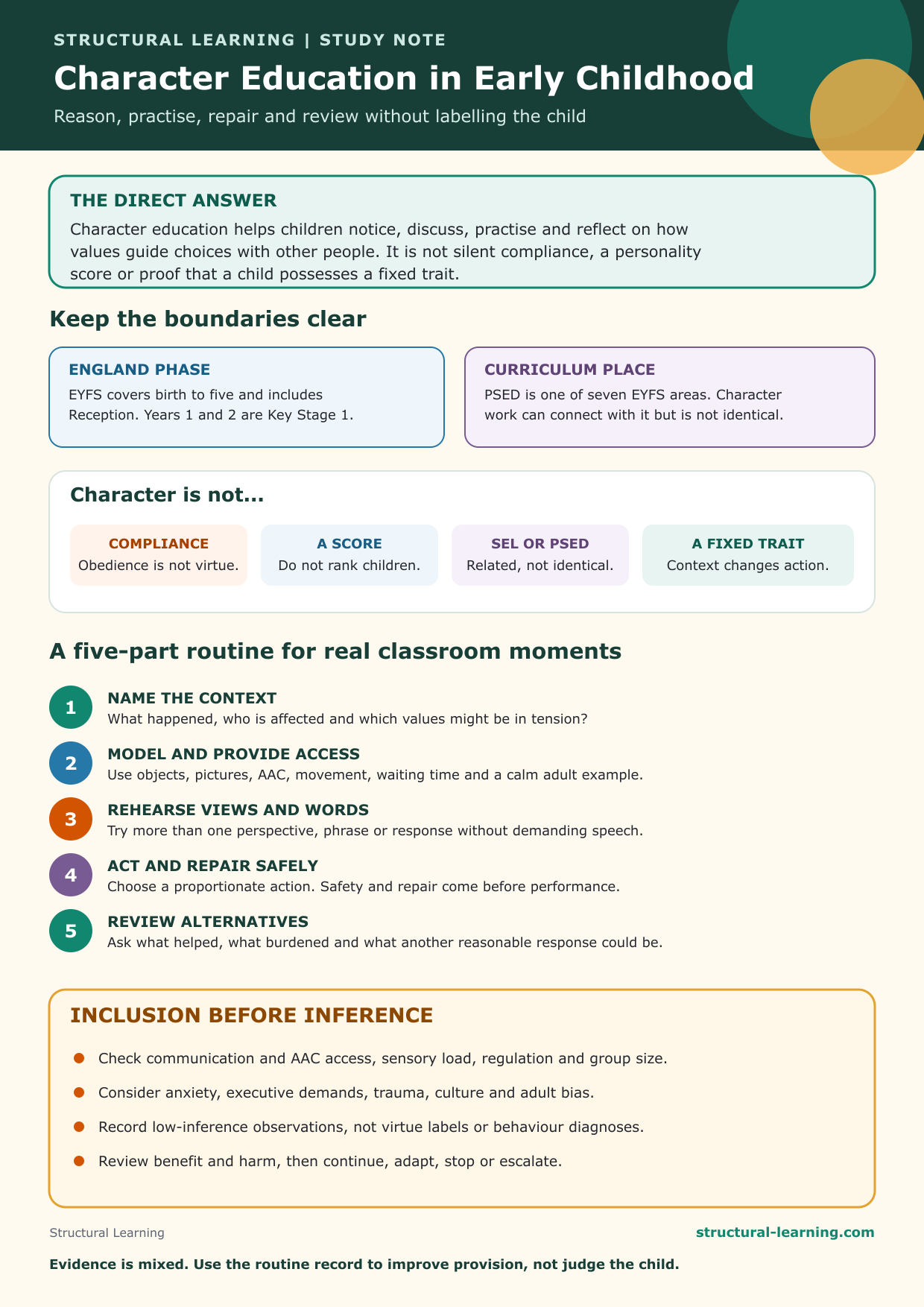
These three printable resources turn the guide into an inclusive classroom and SENCO process. The study note gives the key boundaries on one page. The two-page record helps staff plan and review one routine. The 12 cards open discussion and role play without hiding one approved answer.
Study note: reason, practise, repair and review without labelling the child.Read the study note as text
Direct answer: character education helps children notice, discuss, practise and reflect on how values guide choices with other people. It is not silent compliance, a personality score or proof that a child possesses a fixed trait.
England boundary: the EYFS covers birth to five and includes Reception. Years 1 and 2 are Key Stage 1. PSED is one of seven EYFS areas. Character work can connect with PSED but is not identical to it.
Five-part routine: name the context and values in tension; model and provide access; rehearse different views and words; act and repair safely; then review what helped, what burdened and what another reasonable response could be.
Inclusion before inference: check communication and AAC access, sensory load, regulation and group size. Consider anxiety, executive demands, trauma, culture and adult bias. Record low-inference observations, not virtue labels or behaviour diagnoses. Review benefit and harm, then continue, adapt, stop or escalate.
Evidence limit: the research is mixed. Improve the routine and provision; do not use these materials to assess or diagnose a child.
Character Routine and Review Record
Use page one to plan the ethical question, access, adult model, rehearsal and safety boundary. Use page two to record what happened, test alternative explanations and decide whether to continue, adapt, stop or escalate.
Use the 12 situations for story talk, role play or staff discussion. Each reverse offers perspective, value, access, safety and repair prompts rather than a hidden correct-child response. Print double-sided and flip on the long edge.
None of these downloads scores a child's virtue or acts as an assessment or diagnostic instrument. They keep communication alternatives, child and family perspectives, reasonable adjustments and routes for further support open.
Frequently Asked Questions
These answers cover the choices that early-years teams often face. They keep ethical education, statutory curriculum, behaviour support and child assessment apart. Each answer follows one core rule. Review the work and access on offer, but do not turn a child's behaviour into a character diagnosis.
Is character education part of the EYFS?
Character education is not a separate statutory EYFS area. Relevant work can complement PSED, communication and language, understanding the world and the wider life of a setting. Providers must still follow the current statutory framework for their type and should not replace EYFS assessment or duties with a virtue curriculum.
What age should character education begin?
There is no proven age at which a formal character programme must begin. Infants and young children already take part in relationships and show emerging helping, sharing and comforting. Early provision should be relational, concrete, playful and accessible, without claiming that preschool is a critical window that fixes lifelong character.
Which character trait should preschool teach first?
Start with a case that keeps coming up and ask an ethical question. Do not start with a trait on its own. Conflict when children join play may raise care, fairness, speech and repair at once. Choose words with children, families and staff, then check that each child can take part.
Do rewards build good character?
Rewards can influence observable behaviour, but they do not show why a child acted or whether the action will transfer. Public rewards can also create ranking and performance for adult approval. Use clear expectations and feedback where needed, while keeping character discussion focused on reasons, effects, choices and repair.
How should a SENCO support character education?
The SENCO should examine the communication, sensory, regulation and executive-function demands of each routine. They can help staff build reasonable adjustments, challenge trait labels, connect concerns to proper support routes and check whether virtue language disguises an access barrier or adult bias.
How can a setting measure progress?
Measure provision and context-specific participation, not inner virtue. Record opportunities, adult modelling, access supports, low-inference observations, child and family views, transfer and adverse effects. Use the evidence to continue, adapt, stop or escalate provision rather than create a character score.
References
The list below separates policy, frameworks, reviews, programme studies and research on child growth. Each source is used only within the limits of its design, age group and setting. This stops broad or nearby evidence from standing in for direct early-years evidence.
Berkowitz, M. W., and Bier, M. C. (2007). What Works In Character Education. Journal of Research in Character Education, 5(1), 29 to 48.
Article boundary: this guide supports curriculum and professional reflection. It does not assess or diagnose an individual child, replace statutory guidance, or establish that one named character programme will work in a particular setting.
About the Author
Dr Kumaree Padayichie
Lecturer in Education
Meet a passionate educator with 17 years of experience, specializing in Early Childhood Development. Discover her insights on learning through play and value-based curriculum in her Structural Learning blog articles.