Updated on
November 5, 2026
Kagan Cooperative Learning: Free Printable Planner
Plan a Kagan cooperative learning routine with this free printable planner. Choose a structure, check PIES and decide how every learner will show understanding.


Updated on
November 5, 2026
Plan a Kagan cooperative learning routine with this free printable planner. Choose a structure, check PIES and decide how every learner will show understanding.
Kagan cooperative learning structures give a teacher repeatable ways to organise peer interaction around a learning goal. Their value depends on what learners do and learn, not on putting desks in groups. Use the PIES principles to plan participation, then check what every learner can explain or apply afterwards.
Free printable Kagan cooperative learning planner: choose one structure, plan fair turns and decide how each learner will show understanding. Print this table from your browser or copy it into your lesson plan.
| Plan | Write or check |
|---|---|
| Learning goal | What should every learner know or be able to explain? |
| Task and prompt | What question, text or problem will learners work on? |
| Structure and turns | Which routine will you use? Who speaks, listens, records or reports? |
| PIES check | Positive interdependence ☐ Individual accountability ☐ Equal participation ☐ Simultaneous interaction ☐ |
| Access and language | What vocabulary, model, sentence starter or response option may help? |
| Individual check | What will each learner answer or produce? |
| Review | What did the evidence show, and what will you adjust next time? |
Kagan structures are step-by-step patterns for organising social interaction in a lesson. A teacher can use the same pattern with different subject matter, questions or texts. For example, a paired explanation routine could help learners compare shapes in mathematics, explain a character's decision in English or rehearse a science prediction. The content changes; the interaction pattern remains recognisable.
This differs from an activity such as making a poster. A poster has a particular product and purpose. A structure describes who speaks, listens, records or responds, and in what order. The distinction helps you choose a routine without confusing an enjoyable group task with a learning method. Spencer Kagan's original account describes structures as content-free ways of organising classroom interaction.
Cooperative learning is wider than any one named set of routines. Research traditions differ in how they organise goals, interaction, assessment and group roles. A Kagan structure can be one practical way to make some parts of cooperation visible. It does not replace a clear explanation, well-chosen content, practice or assessment.
When learners sit together but one person completes the work, participation is not shared. When everyone talks but the conversation does not address the learning goal, activity is not evidence of understanding. A useful structure makes the intended contribution clear and gives you a way to notice whether it happened.
PIES is a planning lens associated with Kagan's structural approach. It refers to Positive Interdependence, Individual Accountability, Equal Participation and Simultaneous Interaction. These principles help a teacher inspect a routine before using it. They are not a score that certifies a lesson, and their presence alone cannot guarantee learning.
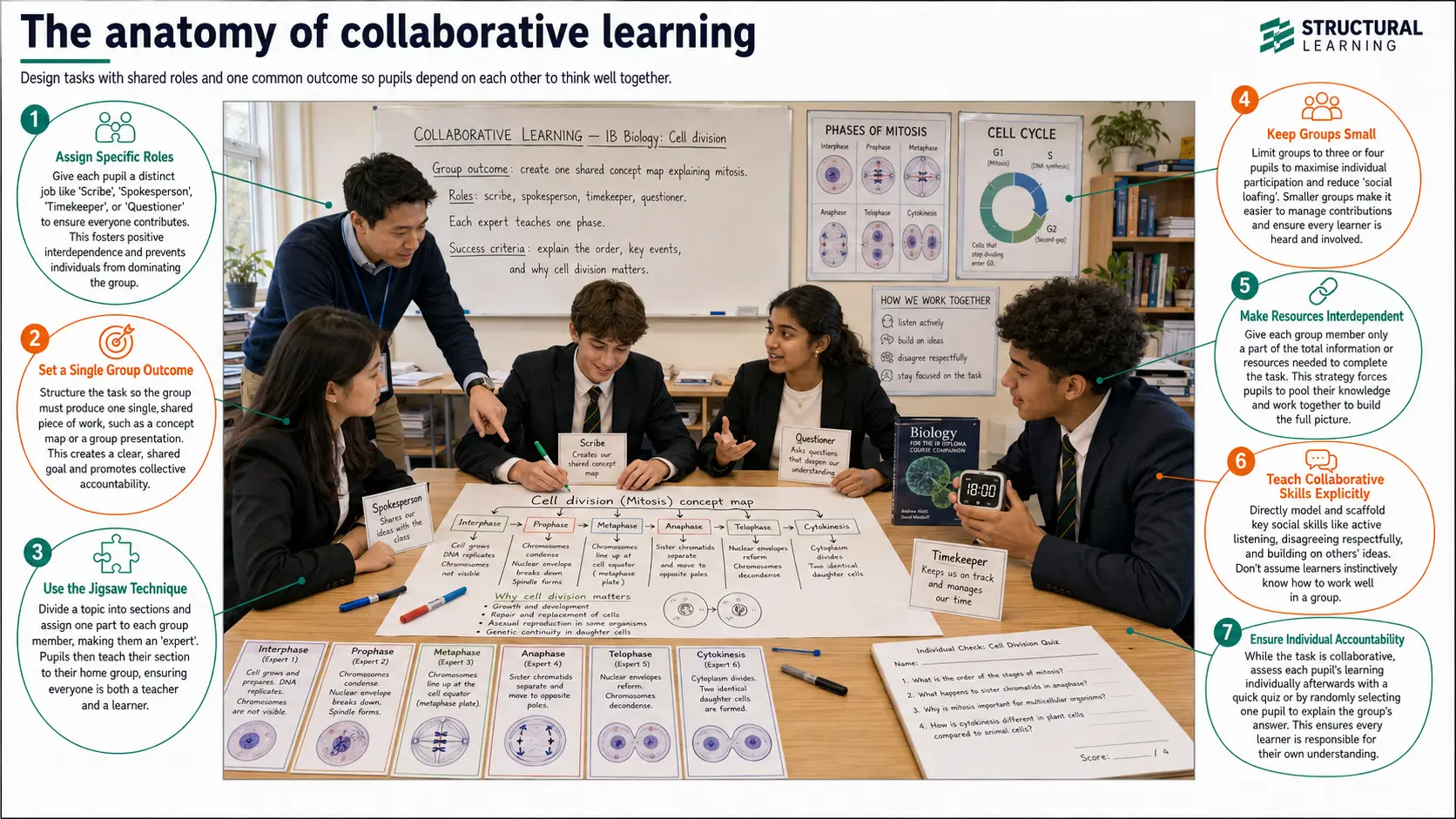
Ask whether learners have a reason to help one another reach the goal. A shared answer, linked roles or a sequence that relies on each contribution can create interdependence. Simply placing four learners around one worksheet does not. The task should make the relationship between contributions and the common goal understandable.
Interdependence should not mean that one learner carries the task for everyone. Divide the thinking, not just the materials. If each learner is responsible for a different example, make sure the final explanation requires the class to connect those examples. Avoid assigning a permanent “writer” or “expert” role that lets others disengage.
Ask how you will know what each learner has understood. A brief individual response, a randomly selected explanation, or a short exit question can show whether learning has reached beyond the group spokesperson. Tell learners in advance that everyone may need to explain the group's reasoning.
Accountability is not the same as public pressure. Give learners time to think, rehearse and use notes where appropriate. The purpose is to make each learner's understanding visible enough to guide teaching, not to catch someone out.
Ask whether the routine gives every learner a meaningful opportunity to contribute. Equal does not always mean identical speaking time. One learner may point to evidence, another may build on an explanation, and another may record a comparison. The contributions should still matter to the learning.
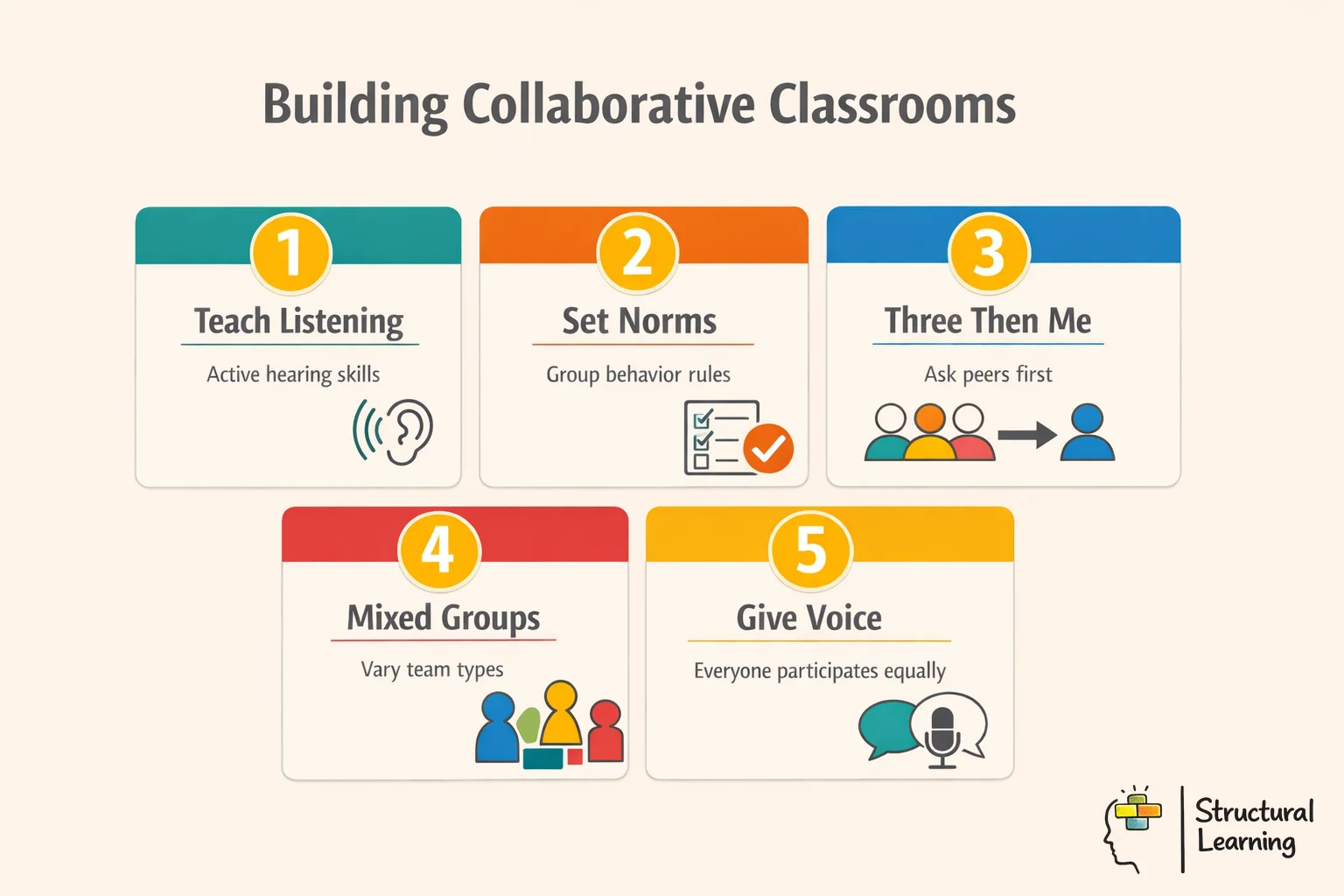
Notice whose voices dominate and who is waiting. Roles can help at first, but rotate them so learners do not become fixed as the reader, helper or recorder. Provide a sentence stem or a quiet rehearsal before whole-class sharing when the language demand is high.
Ask how many learners are thinking or responding at the same time. A whole-class question followed by one answer gives most learners little opportunity to rehearse. A paired discussion, response card or short written commitment can increase the number of learners actively retrieving or explaining at once.
More simultaneous talk is not automatically better. Set a focused prompt, a short time limit and a signal for stopping. Then sample responses or inspect individual work. Noise level alone cannot tell you whether the thinking is relevant.
Use these examples as adaptable interaction patterns. The task, question and expected answer still need to match your curriculum and learners. Start with one routine, explain the steps, model a short example and practise the transitions before expecting a fluent discussion.
Give every learner a short prompt that requires an explanation, not a one-word answer. Allow silent thinking first. Partner A speaks for a brief turn while Partner B listens for one key idea. Partners swap, then each writes a one-sentence summary independently. In a Year 5 mathematics lesson, learners might explain which of two fraction representations is equivalent to a given value and why.
The listening role needs a purpose. Ask the listener to restate the reasoning, identify a useful example or ask one clarifying question. After the pair talk, inspect the independent sentence. If it repeats a misconception, model the reasoning again before moving on. This routine creates practice, but your check determines whether the practice was accurate.
Give a small team one question with several possible contributions, such as examples of how a character responds to a challenge. Each learner contributes one idea in turn. A recorder captures the ideas without judging them immediately. The team then sorts the contributions against a clear criterion, such as which examples are supported by the text.
Set a pass option when a learner needs more thinking time, and let the turn return after another contribution. Do not force a learner to invent an answer on demand. The teacher can circulate, listen for evidence use and choose one misconception to address. Finish with an individual response so the team list is not mistaken for each learner's understanding.
Prepare short question cards on knowledge learners have already met. One learner asks, the partner answers, and both compare the response with a prepared answer or source. They discuss any difference, then swap roles with a new card. The design gives both learners a turn asking and answering.
Choose questions that require recall or a brief explanation, not a search for obscure facts. Start with familiar examples while learners learn the routine. If the cards reveal repeated errors, pause the activity and reteach. A lively exchange cannot make an inaccurate answer useful.
Begin with what learners should know or be able to do by the end. If they need to retrieve vocabulary, use a short question-and-answer pattern. If they need to compare interpretations, allow time for explanation and evidence. If they need to solve a multi-step problem, decide which parts benefit from discussion and which need independent practice.
Then ask what a peer can contribute. Some tasks benefit from hearing another explanation or testing an idea. Other tasks require quiet concentration, direct modelling or individual practice. Group work is one option in a lesson sequence, not a default for every phase.
Keep the content cognitively worthwhile. A structure cannot rescue a vague task. “Discuss the topic” gives little guidance. “Choose the stronger claim, find one piece of evidence, and explain why it supports the claim” gives learners a shared destination and something concrete to say.
Plan the check before the interaction. Decide what you will listen for, what learners will record and how the next teaching step will change if responses show uncertainty. This keeps the routine connected to assessment for learning rather than treating participation as the outcome.
A useful sequence might be: model a worked example, give learners quiet time to attempt a similar item, use a paired explanation to compare methods, then ask each learner to complete a fresh item independently. The structure supports an exchange, while the independent item helps you decide whether to continue or revisit the explanation.
For more on how structured peer talk fits within broader collaborative learning, compare the approaches before choosing one. Where the outcome is oral explanation, our oracy strategies guide offers routines and purposes for classroom talk.
Explain the routine in a few steps and show learners what each step sounds like. Model both a useful response and a response that needs improving. For example, demonstrate how to disagree with an idea by returning to the evidence, rather than criticising the person who offered it.
Keep the first practice short. Use a familiar topic so learners can focus on the interaction pattern rather than struggling with new content and new directions at the same time. Afterwards, ask what helped each partner contribute and what made the transition confusing. Adjust one instruction at a time.
Make movement and materials predictable. State where learners should look, where resources go and what signal ends the talk. If the room layout makes movement difficult, use the routine with existing partners or adapt it to written exchanges. A structure should fit the classroom rather than create unnecessary disruption.
Routines become smoother through repeated, brief use. That does not mean every lesson needs a named structure. Use one when it serves the learning, and switch back to teacher modelling, independent work or whole-class explanation when those better meet the need.
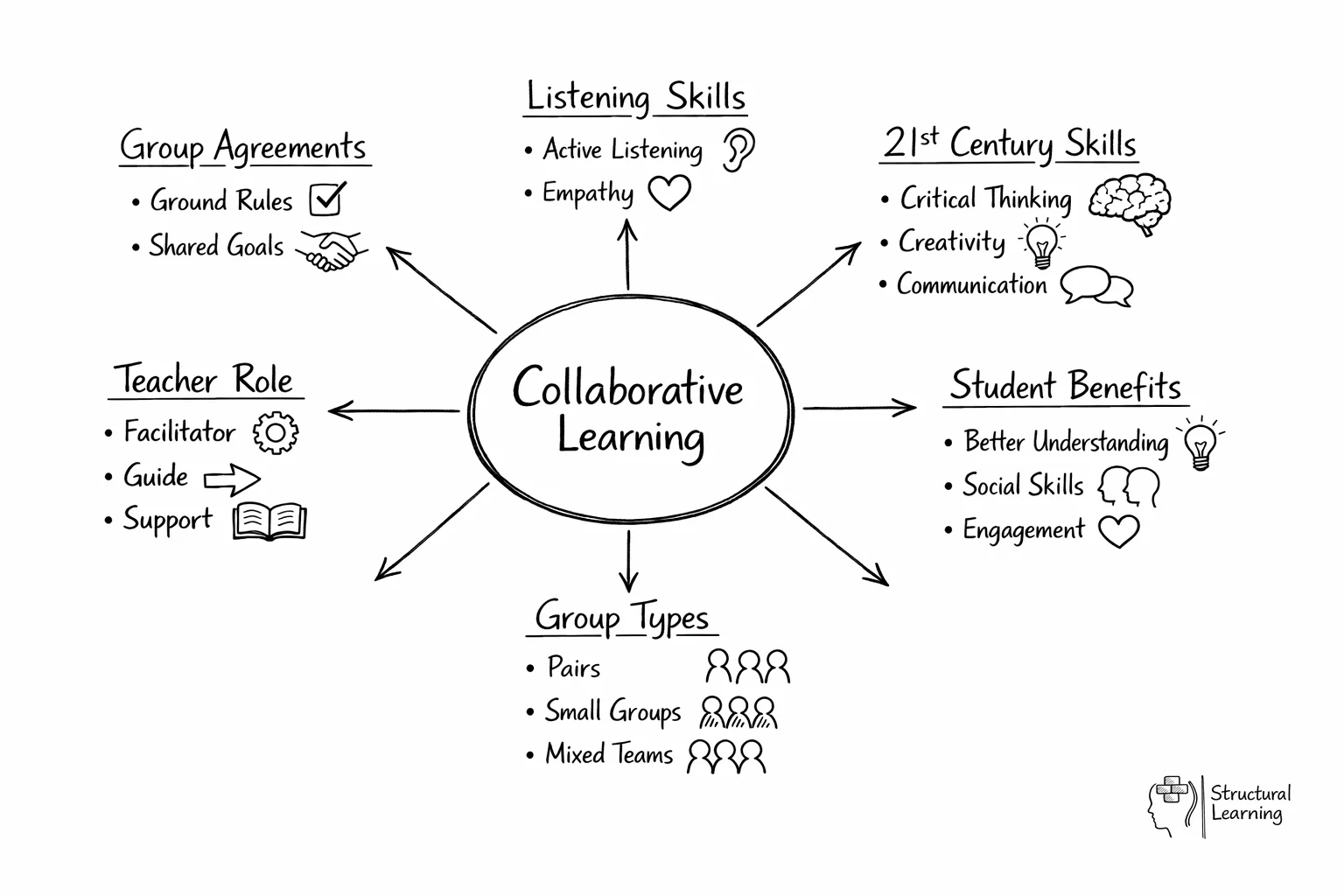
Plan access before the lesson. Give learners the prompt in writing as well as aloud. Display key vocabulary and provide a sentence stem when language formulation is part of the challenge. A learner may need extra processing time, a predictable turn order, a visual cue or the option to contribute in writing.
Offer more than one way to contribute. Learners might speak, point to a prepared response, annotate a shared example or pass a written note to a partner. These options should still connect to the learning goal. Do not assume that frequent speech is the only sign of thinking or that every learner will want the same role.
Check whether the room, sound and pace are manageable. Several simultaneous conversations can make listening difficult. Reduce the number of groups speaking at once, use a quieter written exchange or keep the task in pairs. Give a clear stop signal and allow learners to move to independent work if the interaction is not supporting the task.
Use roles carefully. Roles can clarify the steps, but they should not limit who reads, reasons or reports. Rotate roles and teach the language needed for each one. Where a learner has a known communication, sensory, mobility or support need, follow the agreed classroom adjustments and check privately what helps them take part.
For ideas on matching support to a learning barrier, see the guide to scaffolding in education. A scaffold should help a learner do the thinking, then be adjusted as the learner becomes more able to manage the step independently.
During the task, listen for the thinking you planned to hear. Are learners using evidence, explaining a method or revising an idea? Are they taking turns in a way that gives more than one learner access to the work? If not, pause and make the instruction or model clearer.
Collect evidence from individuals as well as groups. Ask each learner to answer a short question, annotate an example or explain one decision in writing. Compare responses with the lesson goal. If only the confident speaker can explain the answer, the group result does not show that everyone has understood.
Review the interaction and the learning separately. A group may work cooperatively yet still hold a misconception. A learner may make strong progress after hearing a peer's explanation even if the discussion was brief. Use the evidence to decide whether to reteach, provide another example, extend the task or move on.
Assessment for learning works best when the evidence changes the next step. You could use an exit question after a paired routine, then sort responses into secure, developing and revisit groups for tomorrow's starter. Keep the categories temporary and tied to the specific learning, rather than treating one answer as a fixed judgement about a learner.
Research on cooperative learning is broader than research on any one branded or named routine. Reviews report positive average effects across some achievement, attitude and perception measures, while also showing that programmes, learners, subjects and study designs vary. These findings support careful use of structured cooperation. They do not prove that every named structure works in every context.
Slavin's review explains that achievement gains are most consistently supported when group goals are linked to individual accountability. This matters for classroom planning: the task should give learners a reason to help each other, and the teacher should still check what each learner can do. A shared product alone may not reveal who has learned the content.
Research also points to the teacher's role. Learners may need explicit modelling of how to explain, listen, ask a question or challenge an idea. Studies of implementation find a gap between endorsing cooperative learning and consistently using its core features. Treat the structure as something to teach and refine, not a script that runs itself.
Small studies of Kagan structures can illustrate possible classroom applications, but they do not establish universal effects. Some focus on one subject, school or short period. Larger reviews of cooperative learning combine diverse approaches and cannot be used as a precise estimate for one Kagan routine. Be clear about this distinction when discussing evidence with colleagues.
Use claims that match your own observations. You can say that a routine gives learners structured opportunities to explain and respond. To say it improved understanding, check the work learners produce. To claim longer-term attainment gains, you would need evidence that measures those outcomes over time and accounts for other differences in teaching and context.
Before the lesson, write down the learning goal, the exact prompt, the turns each learner will take, the support they may need and the individual check that follows. Keep the first attempt short enough to observe. After the lesson, note who contributed, what explanations revealed and what you would change next time.
Kagan structures are most useful when they make a purposeful interaction easier to plan and teach. Their names matter less than the design choices beneath them: learners know the goal, have a reason to attend to one another, get a fair chance to contribute and show what they learned for themselves.
For more lesson-planning approaches, explore inquiry-based learning when learners need to investigate a question, and assessment for learning when you need to decide what to teach next. Choose the interaction that serves the objective and make the evidence of learning visible.
These sources describe the structural approach, broader evidence and classroom conditions that shape cooperative learning. Read them as complementary perspectives, not as proof that any one routine guarantees an outcome.