Updated on
September 24, 2026
Nature vs Nurture in Education: What Teachers Need to Know
The nature vs nurture debate shapes how we view intelligence, behaviour, and potential. A balanced guide to genetics, environment, and the research.


Updated on
September 24, 2026
The nature vs nurture debate shapes how we view intelligence, behaviour, and potential. A balanced guide to genetics, environment, and the research.
Nature and nurture both contribute to learning, but neither gives a teacher a fixed reading of a learner. "Nature" covers inherited differences, while "nurture" covers the settings and experiences that shape growth. They work together, so their effects cannot be split into a personal percentage.
Studies can estimate sources of differences across groups. They cannot reveal one learner's ceiling or prescribe support. In school, assess the present task, remove access barriers, teach well, listen to the learner and family, and review progress over time.
Nature nurture education examines how inherited genetic differences and environmental influences shape learning and child development. Environmental influences include teaching, family relationships and early experiences. Heritability estimates genetic variation across a population. It does not predict an individual learner’s potential (Plomin and von Stumm, 2018).
The debate matters less as a contest and more as a warning against two errors. Genetic fatalism says, "this learner was born this way, so progress is limited". Environmental blame says, "the right teaching or parenting should remove every difference".
Neither claim follows from the data. A review of more than 600,000 people found that more time in school improved scores on tests of thinking skills (Ritchie and Tucker-Drob, 2018).
In one sentence: group data can help explain why school outcomes vary, but a single learner needs well-tested teaching and support, not a nature or nurture label.
In this guide
Nature means inherited differences and the biological processes involved. Nurture means the physical, social and cultural settings where growth takes place. In school, nurture includes language, food, relationships, teaching, the curriculum, practice, culture, access and material conditions.
These terms are useful, but they do not describe two separate forces. Genes work in cells and bodies that develop in real settings. Each person meets those settings with their own history, interests and responses.
A learner also acts on the world around them. They may seek a book, avoid a task, ask for help or prompt a new response from an adult. Bronfenbrenner (1979)'s ecological model can map layers of context, though it is not a genetic model.
The familiar question "which matters more?" is therefore incomplete. The answer depends on the outcome, age, group, measure and range of settings being studied. It may also change over time.
Consider reading. Learners differ in language, teaching, attention, hearing, memory, prior knowledge, health and many other traits. Some measured differences are statistically associated with inherited variation. Teaching still changes what learners know and can do.
A gene link does not make teaching optional. A teaching effect does not make learners the same.
This both-and view fits several accounts of growth, but it is not one simple process. Child development theories differ in what they explain and how they treat the body, action, relationships and culture. A broad claim that nature and nurture work together is not the same as a statistical gene-environment interaction.
This distinction also helps teachers avoid fixed language. "Innate", "natural", "hardwired", "gifted", "low ability" and "not academic" may sound descriptive. However, they often suggest an untested forecast. A learner's current attainment shows their performance in particular conditions. It is not a direct measure of future potential.
Language boundary: describe what the learner can do now, the task setting and the support available. Do not treat a score, diagnosis, family history or early difference as proof of fixed capacity.
Heritability is one of the most misunderstood terms in the nature and nurture debate. In behavioural genetics, it is a statistic about a group. It estimates how far genetic variation is linked to differences in a measured trait, within a specific population and environment.
It does not mean that a set share of one learner's attainment came from genes. It does not divide a person into inherited and setting-based shares. It does not show that a trait is fixed, natural, inevitable or resistant to teaching. It does not identify the biological pathway behind a difference.
A simple thought test helps. If every learner in a group had much the same teaching, differences in teaching would add little to the spread of scores in that group. A heritability figure could be high even though teaching was vital for all.
If access to teaching varied a great deal, the setting could account for more of the score gaps. The figure changes with the group and the setting.
Visscher, Hill and Wray explain these limits in their review of heritability. They also separate heritability from genetic determination. A trait may be highly heritable but still change when the environment changes. Likewise, a low heritability figure does not tell a teacher which intervention will work.
Twin studies often compare identical and non-identical twins. Identical twins share nearly all inherited DNA variants. Non-identical twins share about half, on average. Researchers compare how similar each pair is to model genetic, shared-environment and non-shared-environment components.
That figure depends on several assumptions. Researchers must consider how settings are shared, how twins are selected and how the trait is measured. They must also ask whether the findings transfer to another place or age. "Non-shared environment" includes measurement error rather than identifying experiences unique to each twin.
De Zeeuw and colleagues reviewed 61 twin studies from 11 cohorts on primary-school results. They found substantial genetic and setting components in the included measures. This is valuable group evidence. It does not tell a Year 4 teacher why one learner is struggling with inference, spelling or number facts.
Reviews across many human traits find links with both genes and settings. Cross-trait means are even further from a single school choice. They cannot support a "50% rule" for IQ, personality or attainment.
For a teacher, the correct translation is modest: learners will differ even after similar instruction, and those differences can have many related sources. Continue to teach, assess access, look for patterns over time and adapt provision. Do not calculate a learner's heritability.
Saying "genes and environment interact" can hide several ideas. Scholars need the distinction because each idea needs a different study design. Teachers need it because none of these terms reveals the cause of one learner's needs.
Swipe sideways to compare all columns.
| Concept | Meaning in research | Education example | What it does not show |
|---|---|---|---|
| Heritability. | Variation in a group associated with genetic variation. | Variation in a measured achievement score within a defined sample. | The genetic percentage, cause or ceiling of one learner. |
| Gene-environment correlation. | Genetic differences and measured environments are correlated. | A child's traits may evoke responses or shape the activities they select. | That the environment is unreal, unimportant or entirely genetic. |
| Gene-environment interaction. | The link between gene differences and an outcome varies across measured settings, or vice versa. | A polygenic link with scores varies across school contexts in a study. | A universal process, a single trigger or a teaching plan. |
| Genetic nurture. | Parental genetic variants not transmitted to a child correlate with the child's outcome through settings parents help create. | Non-transmitted education-linked variants are linked with offspring school outcomes. | A gene for good parenting, a family judgement or a purely household process. |
| Epigenetic regulation. | Processes that affect gene activity without changing DNA sequence. | A research topic in molecular growth. | Evidence that classroom safety, displays, lighting or teaching switch a learner's genes on or off. |
Classic accounts describe passive, evocative and active gene-environment correlation. Parents provide genes and settings. A learner's traits may prompt responses or lead them to choose certain activities.
These are research patterns, not judgements about a child or family. A reluctant reader did not "create" a poor reading environment, and family input cannot be called genetically caused.
Hart, Little and van Bergen explain why studies of environments need genetically sensitive designs. Home reading, household order and parental education may relate to children's outcomes. These links can share genetic and social causes. An observed association cannot show how much comes from a direct environmental effect.
That caution cuts in both directions. Genetic confounding does not prove that books, routines, relationships or income do not matter. It means the causal question needs a stronger design.
Genetic nurture is another reminder that genes are not sealed instructions inside the learner. Wang and colleagues reviewed family studies that used passed-on and non-passed-on variants. They found a small mean indirect link with school outcomes.
Parent education and social position explained much of that link. Nivard and colleagues later found that some indirect links reflected social patterns across generations. They did not arise only from life within the immediate family.
This evidence makes simple labels less credible. What looks like "nature" can contain social structure. What looks like "nurture" can be correlated with inherited traits. The practical need in school remains observable: what is the learner being asked to learn, what access do they have, and what happens when support changes?
School studies show that measured outcomes have links with both genes and settings. No one design can split the causes for a learner. Twin, family and genome studies describe group patterns. Trials and natural experiments are often more useful when a school wants to know whether a change in teaching or policy works.
Twin and family studies model sources of score gaps by comparing relatives with differing degrees of genetic similarity. They are useful for describing groups and testing models. They do not assign causes to one learner.
Adoption and sibling designs can separate some inherited and rearing pathways. Adoption is not random, conditions before birth still matter, and adoptive families are often selected. A resemblance is therefore not a pure genetic or setting readout.
Genome-wide association studies find statistical links between many genetic variants and an outcome. Each link is usually very small. A polygenic score combines many of these weighted variants. It predicts from a particular research sample; it does not explain a biological process.
Within-family genomic designs compare siblings. They can also compare parental variants that were passed on with those that were not. This can reduce some effects of population differences, partner similarity and shared family factors. Limits in measurement, statistical power and interpretation remain.
Quasi-experiments and trials are often more useful for school action because they test changes in schooling or teaching. They answer what happened under the studied conditions, not whether every learner began with the same traits.
School-level findings are mixed and depend on context. Stienstra and colleagues analysed Dutch data from 18,384 same-sex twin pairs and 11,050 opposite-sex twin pairs. After accounting for socioeconomic moderation, measured school quality did not change the genetic and shared-environment estimates. The pattern for a school's socioeconomic mix was more complex.
A Norwegian study of the whole population found a compensatory pattern. In higher-performing schools, the link between an education polygenic index and scores was weaker. The authors compared children within families. However, they could not identify the school practice that caused this pattern.
These results do not support the slogan that good teaching makes genes matter more, or the opposite slogan that good teaching makes genes matter less. The answer varies with the measure, model and context. Direct studies of instruction remain necessary.
The distinction is central to learning theories. Behavioural, cognitive, social and constructivist accounts offer processes that can be studied in teaching and learning. A gene link does not replace those accounts, and a learning theory does not erase inherited differences.
IQ test scores and school results are related, but they are not the same construct. Achievement reflects what a learner has learned in specific domains. Cognitive tests sample performance on selected tasks. Both are affected by test design, access and context.
Genetic links with cognitive and school measures are well established at group level. That does not mean that IQ is a fixed substance passed from parent to child. Nor does it mean that an IQ score contains an untouched measure of "nature". The learner reached the test through growth, language, culture, health and education.
Ritchie and Tucker-Drob reviewed quasi-experimental studies of education and cognitive-test results. The review covered 142 effect sizes, 42 data sets and more than 600,000 participants. An extra year of education was linked with an estimated gain of about one to five IQ points. Policy changes and school-entry cut-offs made the evidence for an effect stronger than a simple correlation.
The figure is an average across designs. It does not promise a fixed gain for a learner or show which part of schooling caused it. It does show why "highly heritable" and "affected by education" can both be true.
The same restraint applies to the Flynn effect, which describes historical changes in average test scores across cohorts. Group scores changed too quickly for genetic evolution alone to explain them. Researchers still debate the causes, size, reversals and wider meaning. The pattern does not prove that nutrition, schooling or epigenetics caused a set gain each decade.
Teachers should avoid fixed-IQ thinking and claims that drive or mindset always matters more than test results. Theories of intelligence use several constructs and types of data. Current subject knowledge, errors, task demands and access provide a better teaching starting point than a global label. Cognitive load theory can help analyse a task, but it cannot reveal a genetic learning type.
The data support a clear school stance. Learners differ, and some differences can persist. Teaching and access still matter. No group statistic tells a teacher what one learner can ultimately learn.
Swipe sideways to compare all columns.
| Evidence boundary | Unsafe inference | Useful school action | Evidence to review |
|---|---|---|---|
| Learners differ before and during schooling. | Current difference reveals fixed potential. | Keep an ambitious goal. Vary access, explanation, practice and time. | Work samples, prerequisite knowledge and progress over repeated tasks. |
| Achievement has genetic and environmental links. | A family history explains this learner's difficulty. | Assess the present learning profile and follow normal SEND routes where indicated. | Learner and family voice, teaching history, assessment and specialist evidence. |
| Measured settings may be genetically confounded. | Home or school settings do not cause outcomes. | Prefer stronger causal evidence when selecting programmes. | Trials, quasi-experiments, implementation data and local outcomes. |
| School effects can vary across learners and contexts. | Every learner needs a genetically personalised method. | Use responsive teaching and check whether support improves access and learning. | Errors, independence, retention, transfer, participation and workload. |
| Polygenic scores predict some variation in group outcomes. | A score can guide an individual school decision. | Do not collect or use learner genetic data for routine teaching choices. | Current attainment and ordinary school evidence. |
High expectations do not mean pretending that every learner will reach the same point at the same time. They mean keeping curriculum entitlement in place when a learner's limits have not been tested. Teachers can make an ambitious curriculum accessible through careful sequencing, explanation, modelling, practice, feedback and scaffolding.
Adaptive teaching is not genetic personalisation. It responds to evidence from learning. A teacher may re-explain a concept, reduce an unnecessary language demand, provide a worked example or change the amount of guided practice. The reason is observable need, not a presumed genetic profile.
Support should also be checked against a clear goal. More adult help can increase task completion while reducing independence. A different worksheet can improve access while narrowing the curriculum. Record both benefit and cost.
Good formative assessment makes the cycle faster. It identifies what the learner understood, not just whether an answer was correct. It then links the error to a teaching response and checks again. This is more useful than deciding whether the error came from nature or nurture.
The following sequence turns the evidence boundary into everyday practice. It can sit inside normal classroom planning or the SEND graduated approach. It does not require a diagnosis before support begins, and it does not make response to support the only evidence considered.
This sequence resembles assess, plan, do and review because the practical question is the same: what is the learner experiencing now, what support is reasonable, and what does the next evidence show? It avoids a false choice between "the child" and "the environment".
SEND boundary: a learner does not need to fail a favoured intervention before adults hear a concern. Response to teaching is one source of evidence. It sits alongside evidence about development, health, communication, sensory needs, family and specialists.
Primary classroom: early reading. A Year 2 learner reads slowly and guesses unfamiliar words. "It runs in the family" and "they missed practice at home" are both causal stories, not sound data. The teacher checks hearing, attendance, taught sound-letter links, decoding, language and response to clear practice.
The learner says print can blur when tired; the family reports a similar problem in another language. The teacher makes access changes, involves the SENCO and follows the right vision and literacy routes. Support starts without deciding whether nature or nurture is the cause.
Secondary classroom: algebra. A Year 9 learner does well in talk but finds symbol use hard. A global "not mathematical" label hides the task. The teacher checks prior number and equation knowledge, models worked examples, cuts the copying load and checks independent work one week later.
The learner improves when each step has a note but still loses accuracy under time pressure. The next plan targets fluency and notation. No IQ or genetic claim is needed.
SENCO review: behaviour and communication. A learner often leaves noisy group work. Staff views shift between "temperament" and "learned avoidance". The SENCO maps when this occurs, asks the learner, checks sound and speech demands, reviews the lesson plan and seeks family knowledge.
A quiet workspace and clear group role help, but distress remains in free transitions. The school keeps the change, adds a transition plan and may seek more assessment. The pattern is data, not proof of an inherited trait or a parenting cause.
Leadership decision: attainment grouping. A school sees weak progress and debates stricter sets versus mixed groups. Leaders do not call either model natural or fair by default. They review curriculum gaps, teacher allocation, learner movement, group placement, the timetable and current scores.
They consult learners and staff, state the hoped-for gains and check for misplacement and loss of course access. This is a school choice under uncertainty, not a test of genetic ability.
Across all four cases, the pattern is the same. Name the concern. Collect data that can change a choice. Give support that is justified now.
Then review its effect. Keep the learner's rights and normal school routes in place.
Nature and nurture language can quietly turn attainment groups into "ability" groups. The terms are not interchangeable. Attainment is current results on selected measures. Ability suggests a broader and often more stable capacity.
The Education Endowment Foundation's current review reports zero extra months of progress for setting or streaming on average. It rates the data as very limited and includes 58 studies. The mean pattern is a small loss for low-attaining learners and a small gain for high-attaining learners, with mixed results among studies.
This does not prove that mixed-attainment teaching is always better. It means the average attainment case for setting or streaming is weak and the risks deserve attention.
If a school uses sets, leaders should allow learners to move between them. They should review allocation regularly, protect an ambitious curriculum and consider teacher distribution. They should check whether disadvantage, race, language, SEND, relative age or prior access is linked with placement after considering current attainment.
If a school uses mixed-attainment classes, leaders still need a credible plan for variation in prior knowledge, practice, explanation, pace and support. Simply placing learners together does not guarantee access or challenge.
The nature and nurture lesson is not "never group". It is "do not mistake a grouping decision for a discovery of fixed potential".
A polygenic score combines links from many genetic variants into one number. Researchers build each score for a defined outcome and sample. It can include direct genetic links, indirect family and social effects, population structure and measurement choices. It does not identify how learning happens.
Morris and colleagues tested an education polygenic score in a UK cohort. They concluded that it was not suitable for routine use by teachers or schools. Prediction can also transfer poorly to ancestry groups that are less represented in the original data. This creates a risk of systematic inequality.
Even an improved prediction would not answer the school question on its own. Prediction is not explanation. A score linked with later attainment does not say which concept to teach, which barrier to remove or which support a learner prefers.
Genetic details are special-category personal data under UK rules. Any use needs a lawful purpose, a clear need, safeguards, transparent notice and a named owner. The existence of a research tool does not give a school a sound reason or lawful basis to collect learner DNA.
Schools should not use a genetic test or polygenic score for entry, sets, predicted grades, SEND, behaviour, seating, lighting, sensory support or course access. They should also be wary of direct-to-consumer reports brought into school. A family may need health or clinical genetics advice; the teacher should not read the report as a school plan.
This boundary is not anti-science. Genome methods can help scholars test mixed causes, study group patterns and improve cause-and-effect designs. Routine use for one learner needs a different standard: valid action, fair use, consent, data care and proof that the choice helps more than it harms.
No single design settles the nature and nurture question. Twin studies rely on model assumptions. Adoption studies involve selection and events before birth. Genome-wide studies are sensitive to ancestry, population structure and the outcome used.
Polygenic scores can combine social and direct genetic pathways. Studies of settings can also mix genetic and social causes.
School measures also change. Years of education, examination grades, reading tests, teacher judgements and cognitive tasks are not interchangeable. A finding from one country, cohort or policy may not transfer to another.
Gene-environment interaction studies need large samples and repeat tests. Candidate-gene findings from small samples have often been weak. The much-discussed MAOA and maltreatment work is not a classroom model of aggression. It cannot explain a single learner and has no role in support.
Epigenetics is a real field of molecular biology. However, classroom claims about it often go far beyond the evidence. It is not accurate to say that a calm room, teacher relationship, wall display or intervention switches a learner's genes on or off. Learning and wellbeing evidence can justify responsive teaching without an epigenetic story.
Research also cannot set one right goal for every learner. High aims should sit with honest review, fair support and real learner involvement. A claim of limitless growth can become blame when progress is slow.
A claim of fixed nature can take access away. Well-tested support avoids both traps.
The one-page study note keeps the key terms, study limits and professional red lines in one place. The two-page starting-point, support and review record helps a teacher or SENCO capture the task, access, teaching, learner and family view, support tried, success signs, review date and next route.
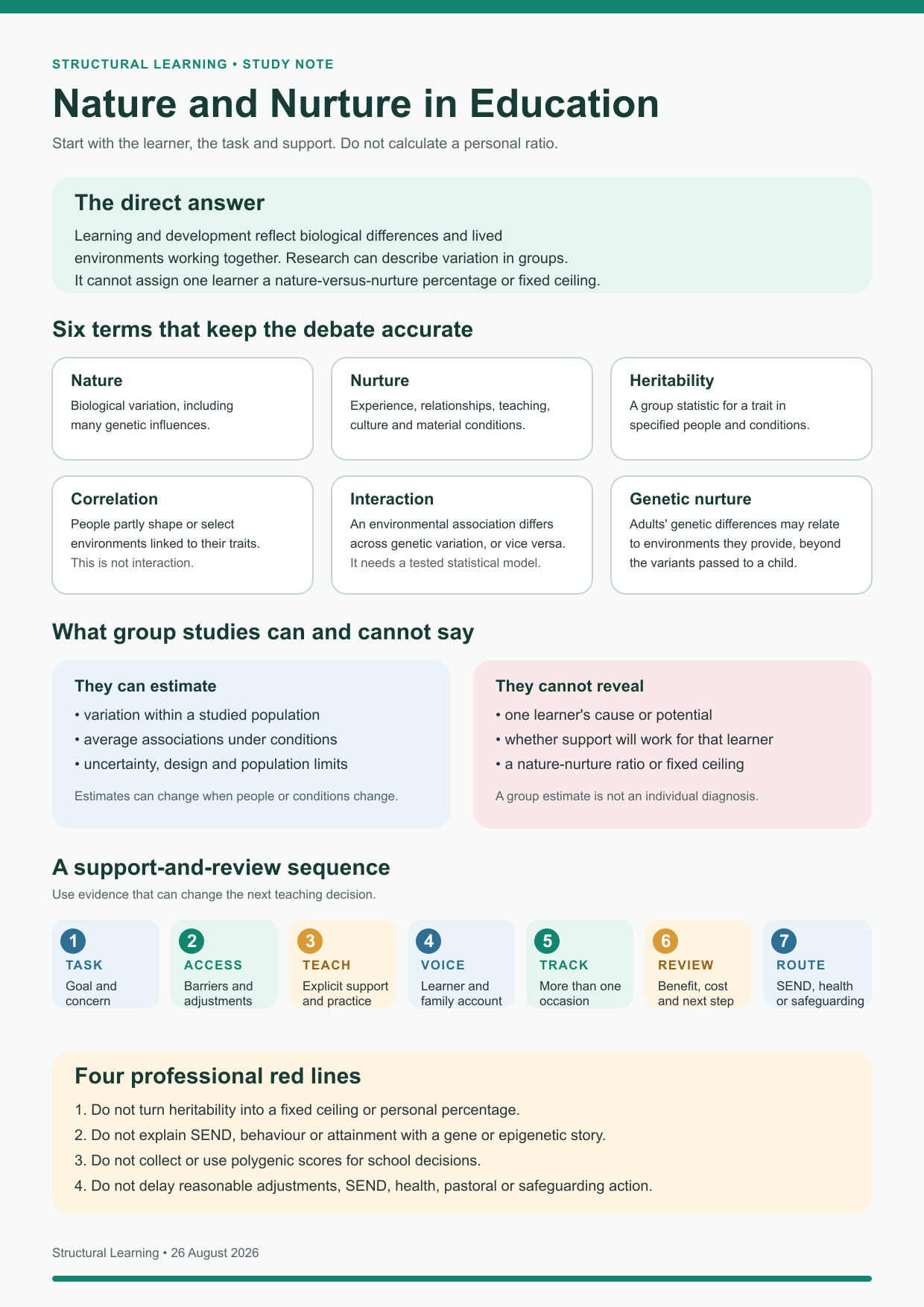
Direct answer: nature and nurture work together. Group research cannot give one learner a personal ratio, cause or fixed ceiling. Heritability is a group statistic, not a diagnosis.
Use in school: define the task. Check access. Teach clearly. Listen to the learner and family.
Track more than one occasion. Review benefit and burden. Follow SEND, health, pastoral or safeguarding routes when needed.
Red lines: gene-environment correlation, interaction and genetic nurture are different research ideas. None can tell a teacher what caused one learner's need. Do not use a gene, epigenetic story or polygenic score to explain attainment, allocate support or delay reasonable adjustments.
Printable starting-point, support and review record
Use the two pages to plan one proportionate response and record how you implement it. Include the learner's and family's views. Then choose the next school route without making a genetic inference.
Genes and settings both matter. No group study can give one learner a personal percentage or fixed ceiling. Teachers should use current school evidence to choose support, review progress and keep the right professional routes open.
Scores on thinking tasks reflect both inherited differences and the setting. Heritability figures apply to groups, not one person. Schooling can improve test scores, and no figure reveals one learner's ceiling. For teaching, assess subject knowledge, task demands and access rather than assigning a nature and nurture ratio.
No. Heritability describes range under current settings. A condition shared by everyone may be essential while explaining little of the range between people. Education can affect a highly heritable outcome, and the figure can change when settings change.
Both have genetic links, but neither is explained by one gene or one nature percentage. A school should not infer a diagnosis or provision from family history. Listen to the concern, assess need and access, make reasonable adjustments, use the SEND graduated approach and involve appropriate professionals.
Teachers change learners' daily life and chances to learn. Claims that a classroom practice switches particular genes on or off are not sound school guidance. Use direct learning, participation and wellbeing data to justify practice.
No routine school use is supported. Current polygenic scores do not provide a single teaching plan and can work less well across some groups. Genetic details are also specially protected personal data. Use current school data and normal school routes.
Describe the current learning need precisely, keep the curriculum goal ambitious, improve access and teaching, involve the learner and family, and review evidence over time. Do not turn a group finding into a learner label.
Bronfenbrenner’s model is often taught as a set of nested circles, yet this presentation can flatten its central claim. The later bioecological theory placed proximal processes, such as sustained teacher feedback, peer interaction and family routines, at the centre of development. Tudge et al. (2009) argue that many applications use the labels of the systems while neglecting these processes, the person, the context and time. A school cannot therefore infer developmental influence simply by listing home, classroom and community factors.
The theory also raises difficult methodological questions. Its systems are broad and connected. Researchers can therefore struggle to identify which relationship, event or institutional condition caused a change. Neal and Neal (2013) argue that the nested-circle image can hide networked relationships across settings, including friendships, online communities and professional services. This matters when a learner’s support is spread across school, family and health provision.
Cultural limits need equal care. Bronfenbrenner’s early examples largely reflected Western assumptions about family roles, schooling and individual development. Without local knowledge, the framework can treat one model of development and family life as universal. Researchers must not use ecological explanations to individualise structural inequality. Childhood trauma, poverty, racism and exclusion involve material and political conditions, not simply influences around a child.
These critiques do not remove the theory’s value. When we consider process, time, culture and power, it remains a strong framework. It helps us examine how teaching, relationships and wider conditions shape development.
These peer-reviewed studies provide the evidence base for the strategies discussed above.
Optimizing the management of Kindergarten Teachers View study ↗
Song (2019)
This paper highlights the critical role of early years educators in shaping a nurturing environment that supports children's developmental trajectories. For teachers, it emphasises that effective management and professional support directly influence teaching quality and the positive 'nurture' children receive.
Ecological Identity: Becoming a Reflective Environmentalist View study ↗
163 citations
Thomashow (1995)
Thomashow explores how individuals develop their identity in relation to their environment, a key aspect of the 'nurture' side of education. Teachers can use these insights to develop reflective practices, helping learners connect their innate abilities with their broader surroundings.
Democratic Education: Does It Exist--Especially for Mathematics Education?. View study ↗
25 citations
Woodrow (1997)
This research questions inclusive structures in subjects like mathematics, which are often mistakenly viewed as relying purely on innate 'natural' ability. It challenges teachers to create democratic, nurturing classrooms that support all learners, proving that mathematical competence is cultivated.
The School Superintendency: New Responsibilities, New Leadership View study ↗
79 citations
Norton et al. (1996)
While focused on leadership, this work illustrates how school-wide policies and administrative environments shape the daily 'nurture' learners experience. It reminds teachers that classroom practices are supported by broader school cultures, which collectively influence how innate learner potential is maximised.
Professional Growth and Renewal for Mid-Career Faculty. View study ↗
20 citations
Strage et al. (2014)
Examining the continuous development of educators, this study shows that a teacher's own professional 'nurturing' is vital for maintaining high-quality instruction. It suggests that teachers must actively seek renewal to sustain the energy required to develop learners' cognitive and emotional growth.