Attachment Theory in Education: What Every Teacher Should Know
|
March 5, 2026
A practical guide to attachment theory for UK teachers. Covers Bowlby, Ainsworth, attachment styles, recognising attachment difficulties, becoming a secondary attachment figure, attachment-aware schools, ACEs, and SEND.
As we open our classroom doors each morning, we're managing more than 30 distinct nervous systems. Some arrive calm and ready; others are already in crisis mode before the bell has rung. The difference often comes down to one invisible factor: attachment.
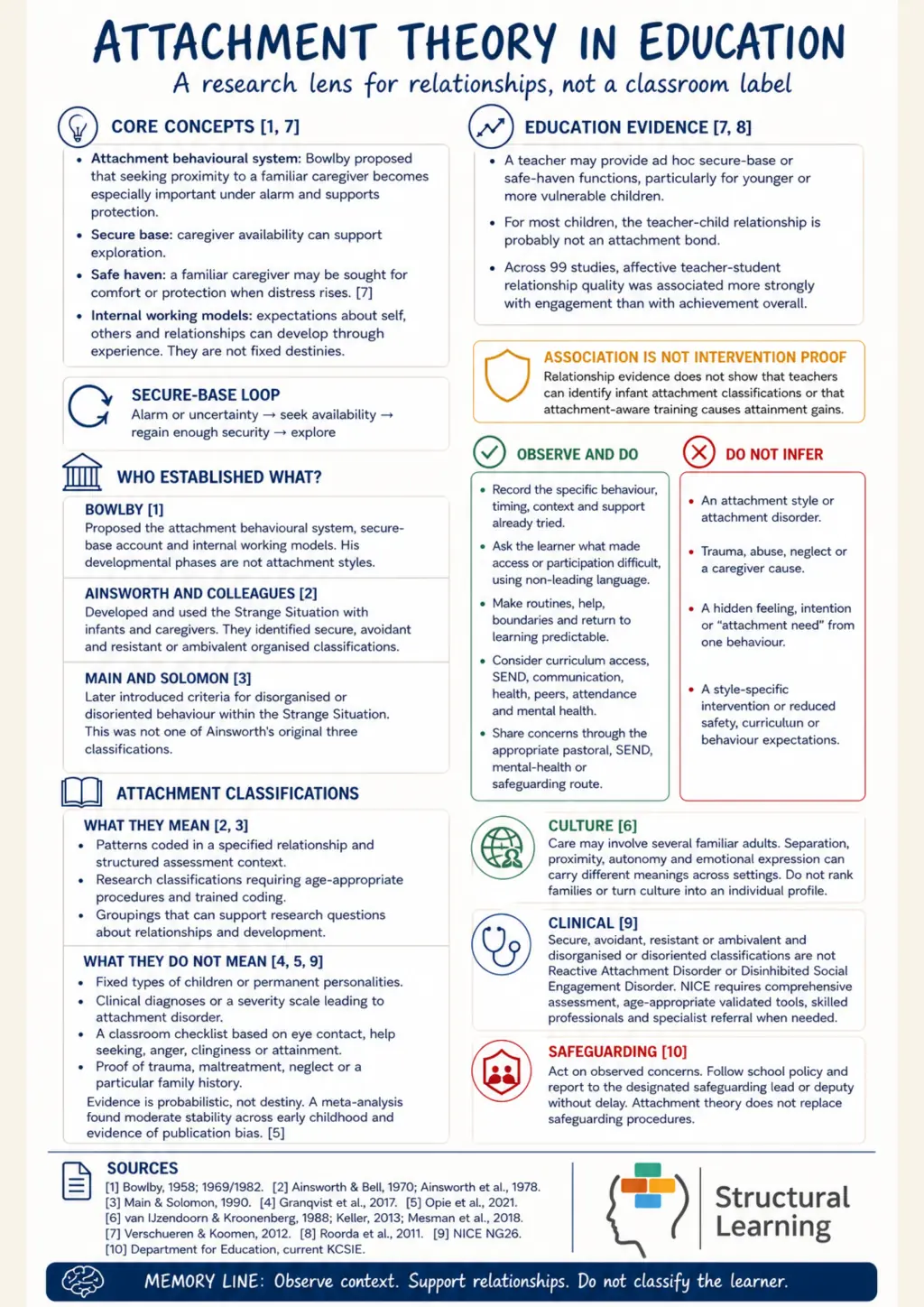
Attachment theory—the study of how early relationships shape a child's ability to learn, regulate emotion, and form healthy connections with others—is no longer just a topic for child psychologists or EYFS practitioners. It is the foundation of behaviour management, emotional wellbeing, and ultimately, whether learning can take place at all. Yet many of us receive little formal training in attachment during teacher training. We notice the symptoms (the clingy child, the withdrawn pupil, the aggressive responder) but often misinterpret them as character flaws or attention-seeking, when they are actually survival strategies.
What Is Attachment Theory?
At its core, attachment theory proposes a simple but profound truth: human beings are wired to seek proximity to a primary caregiver, because doing so increases our chances of survival. This isn't sentimental. From an evolutionary perspective, a child separated from their caregiver is a child in mortal danger. Our brains have therefore evolved with an invisible tether, keeping us close to the adults responsible for our care.
John Bowlby, the British psychiatrist who developed attachment theory in the 1950s, noticed something critical while observing children who had been separated from their families during the Second World War and housed in institutions. Despite having their physical needs met,they were fed, clothed, and sheltered,many exhibited profound distress, developmental delays, and emotional dysfunction. Bowlby realised that the absence of a consistent emotional relationship had caused psychological damage that no amount of material provision could repair.
This foundational insight has shaped decades of research and now underpins practice across schools, social work, and mental health provision in the UK and beyond. The Department for Education recognises attachment as a key principle in supporting looked-after children, trainee teachers are increasingly taught about attachment-aware practice, and many schools now explicitly describe themselves as "attachment-aware" or "attachment-informed."
But what does attachment actually do in the brain? Attachment is not primarily about love or affection, although those feelings often accompany it. Instead, attachment is about the regulation of the nervous system. When a caregiver responds consistently and predictably to a child's needs, the child's brain learns that the world is safe and that they can trust adults to help them. This creates what neuroscientists call "co-regulation",the child's stressed nervous system is calmed by the caregiver's calm presence. Over time, the child internalises this calming presence and develops the ability to regulate their own nervous system. This process is called auto-regulation, and it is essential for learning.
A securely attached child can therefore step into a classroom, make mistakes, ask for help, and sit with uncomfortable emotions without their survival instincts being activated. A child without secure attachment cannot easily do any of these things, because their brain is continuously scanning for threat.
Bowlby's Four Stages of Attachment
Bowlby identified a progression through which typical attachment develops. Understanding these stages helps us recognise where a child might be stuck and what experiences they may need to move forward.
Stage 1: Pre-attachment (0-6 weeks). Newborns produce behaviours such as crying, sucking, and grasping that encourage adults to respond to them. However, they do not yet show a preference for a particular caregiver. Any adult can soothe them.
Stage 2: Attachment-in-the-making (6 weeks-6 months). The infant begins to prefer familiar caregivers but will still accept comfort from others. They produce more directed smiling and show reduced crying when handled by people they know.
Stage 3: Clear-cut attachment (6 months-3 years). The child now shows obvious preference for their primary attachment figure and becomes distressed when separated from them. They use the caregiver as a "secure base" from which to explore the world. If the caregiver is present, the child feels confident enough to play, investigate, and take (safe) risks. When the caregiver leaves, the child becomes anxious.
Stage 4: Goal-corrected partnership (3 years onwards). The child develops an understanding that their caregiver has their own thoughts, feelings, and plans. They can therefore negotiate and compromise rather than simply protesting separation. They develop what psychologists call "internal working models",mental representations of themselves, others, and relationships that guide their behaviour and expectations.
Most children in primary and secondary school are solidly in stage 4. However, children who have experienced inconsistent or neglectful care may remain emotionally stuck in earlier stages, showing behaviours more typical of stage 2 or 3 (clinginess, distress at routine separations) even when chronologically they should have moved forward. Understanding this helps us respond with patience rather than frustration.
Ainsworth's Strange Situation and Attachment Styles
Mary Ainsworth, a psychologist who worked closely with Bowlby, conducted a series of carefully controlled observations to understand how differently children respond when their attachment figure leaves and returns. Her methodology, called the "Strange Situation," has become foundational to how we classify attachment styles.
In the Strange Situation, an infant is observed in an unfamiliar room with their caregiver, then with a stranger, and alone with a stranger. Most crucially, the observation focuses on how the child responds when the caregiver returns after separation. Ainsworth's analysis of hundreds of children revealed three distinct patterns, later expanded to four. These patterns reflect the child's learned expectations about whether their caregiver will be available and responsive to their needs.
What Ainsworth discovered is that it is not separation itself that defines attachment quality; it is reunion. A securely attached child may show distress when their caregiver leaves, but when the caregiver returns, they actively seek contact and are quickly soothed. An insecurely attached child, by contrast, may show a confusing mix of approach and avoidance, protest without consolation, or apparent indifference.
Ainsworth's work is crucial for teachers because we see these same patterns every single day in our classrooms. A child's attachment style colours their relationship with us, their peers, and their willingness to engage in learning.
Secure, Anxious, Avoidant, and Disorganised Attachment
Attachment researchers have identified four primary patterns of attachment. It is important to note that these are not fixed diagnoses or character traits. Rather, they are adaptive strategies a child has developed based on their experience of caregiving. With consistent, attuned relationships, a child can move from insecure to more secure patterns. Understanding these categories helps us recognise what a child is communicating through their behaviour.
Secure Attachment occurs when a caregiver is consistently available, responsive, and attuned to the child's emotional needs. Securely attached children show confidence in exploration, trust in adults, and the ability to self-soothe over time. In the classroom, securely attached children are more likely to ask for help, take intellectual risks, form positive relationships with peers, and recover quickly from setbacks.
Anxious/Ambivalent Attachment develops when caregiving is inconsistent or unpredictable. The child cannot predict whether the parent will be warm or rejecting, present or absent. As a result, they become hypervigilant to adult emotions and overly focused on maintaining proximity. In school, these children often appear clingy with teachers, seek constant reassurance, struggle with transitions, and may show intense reactions to perceived rejection. They worry about abandonment and struggle to trust that an adult will return after separation, even when separation is routine (like the end of a lesson).
Avoidant Attachment typically emerges when caregivers are consistently emotionally unavailable or dismissive of the child's needs. The child learns that seeking comfort is futile, so they suppress their attachment behaviours and attempt independence prematurely. In the classroom, avoidantly attached children often appear unusually self-contained. They may refuse help, avoid eye contact, show little emotional expression, and seem indifferent to adult approval. They may resist comfort after an upset and seem disconnected from their peers. This is not confidence; it is a defensive strategy.
Disorganised Attachment typically results from frightening or abusive caregiving, where the person meant to provide safety is instead the source of fear. The child's attachment system is thrown into conflict: they need the caregiver for survival, but the caregiver is dangerous. The result is contradictory and sometimes bizarre behaviour. A disorganised child might freeze, show fear of their caregiver, approach them in a dazed manner, or suddenly become aggressive without apparent trigger. In school, these children often present with the most challenging behaviours,aggression that escalates unexpectedly, self-harm, dissociation, or apparent lack of cause-and-effect understanding between their actions and consequences. Disorganised attachment is closely linked to early trauma and is frequently seen in children who have experienced abuse or multiple care placements.
Attachment Style
Typical Classroom Behaviour
What the Child Needs
Teacher Response
Secure
Confident, cooperative, seeks help appropriately, recovers from setbacks
Consistent warmth, high expectations, clear boundaries
Maintain relationship, provide appropriate challenge, model resilience
Anxious
Clingy, needs frequent reassurance, struggles with transitions, fears abandonment, may act out to maintain attention
Predictability, frequent connection, clear communication about comings and goings
Narrate transitions explicitly, offer brief check-ins, repair ruptures immediately, use specific praise ("I noticed you...") not vague ("Good job")
Avoidant
Appears independent or aloof, refuses help, avoids eye contact, shows little emotional expression, resistant to praise
Low-pressure connection, acceptance of their autonomy, reassurance of non-rejection
Don't force contact; offer presence without demand, offer help in matter-of-fact way without making it a big deal, normalise asking for support
Disorganised
Aggressive or frightened responses, contradictory behaviour, dissociation, difficulty understanding cause and effect, may fear familiar adults
Stay calm and non-threatening, reduce stimulation during dysregulation, use quiet, slow voice, avoid corner/confined spaces, allow space, seek trauma training
How Attachment Affects Learning
The link between attachment and academic achievement is not mysterious. It runs through the nervous system.
A securely attached child's brain is free to focus on the curriculum. Their prefrontal cortex,the part responsible for reasoning, problem-solving, and working memory,can be fully engaged because the more primitive brain regions (the amygdala and hippocampus) are not in constant threat-detection mode. They can hold new information, tolerate the discomfort of not knowing the answer, persist through difficulty, and learn from feedback.
A child without secure attachment, by contrast, is operating with a significant cognitive handicap. Even in a safe classroom, their threat-detection system remains hyperactive. They may perceive a neutral look from a teacher as rejection, or hear a instruction as criticism. Their amygdala is primed to react before the reasoning brain has engaged. The energy that should go into learning goes instead into monitoring the social and emotional environment.
This is why attachment difficulties so often manifest as behaviour problems rather than learning difficulties per se. A child with insecure attachment may be intellectually capable but unable to access that capability because their nervous system is in the way.
Secure attachment also enables risk-taking, which is essential for learning. To learn, we must try things we are unsure about, make mistakes, and adjust. This requires psychological safety,a trust that mistakes are not catastrophic and that the adult will not withdraw care if we fail. Children with insecure attachment patterns struggle with this permission. Anxiously attached children may avoid any task they cannot do perfectly, fearing loss of affection if they underperform. Avoidantly attached children may avoid trying altogether, as the defence against potential rejection. Disorganised children may engage in self-sabotage to preempt failure.
Insecure attachment also affects peer relationships, which are central to both social development and learning. Anxiously attached children may overwhelm or alienate peers through neediness. Avoidantly attached children may struggle to form friendships. Disorganised children may frighten or confuse peers through unpredictable behaviour. In group work, collaborative learning, and playground interactions, insecure attachment places a child at a significant disadvantage.
Recognising Attachment Difficulties in the Classroom
You do not need a psychology degree to recognise when a child is struggling with attachment. The classroom provides daily opportunities to observe attachment-related behaviour.
Watch for patterns. Does a child follow you around the classroom, constantly seeking your attention or reassurance? Do they become distressed when you are unavailable, even momentarily? Do they struggle disproportionately with transitions (leaving the lesson, changing activity, going to lunch)? These may indicate anxious attachment.
Alternatively, does a child avoid eye contact and seem indifferent to your presence? Do they refuse help or become defensive when supported? Do they seem socially disconnected, preferring to be alone even in a busy classroom? Do they show little emotional response to praise or criticism? These patterns may indicate avoidant attachment.
Does a child show contradictory responses,approaching you with a fearful or tense body, or suddenly becoming aggressive without apparent cause? Do they seem to "zone out" or dissociate, staring blankly or moving in a dazed manner? Do they struggle to understand the connection between their behaviour and its consequences? Do they show aggression that is disproportionate to the trigger? These are red flags for disorganised attachment, particularly if the child has experienced known trauma, neglect, or multiple placement changes.
Some children also show age-inappropriate clinginess or extreme reluctance to separate from a parent at drop-off, even in reception or year 1. Others show unexplained aggression towards adults who are kind to them, or freeze when comforted. These are not character flaws or "difficult" behaviour; they are signals that the child's attachment system has not had its needs met.
It is also worth noting that attachment difficulties often co-occur with other challenges. A child with disorganised attachment may also have an autism diagnosis, ADHD, speech and language delay, or selective mutism. Attachment insecurity does not replace other diagnoses; it often runs alongside them and can make them more complex to manage.
The Teacher as a Secondary Attachment Figure
One of the most important and frequently misunderstood concepts in attachment theory is the notion of the "secondary attachment figure." Teachers often worry that if they become too close to a child, they will undermine the child's relationship with their parents, or that they will somehow be "mothering" in a way that is inappropriate.
In fact, the opposite is true. Research shows that children benefit enormously from multiple secure attachments. A child does not have a limited capacity for attachment; they can be securely attached to a parent and also to a teacher, a grandparent, or another trusted adult. These relationships serve different functions and do not diminish one another.
Your role as a secondary attachment figure is not to replace the parent. Rather, you provide something specific and valuable: a secure base within the school environment. You offer six hours of predictability, consistency, and attuned responsiveness. For a child whose home environment is chaotic, neglectful, or frightening, this may be the most reliable source of safety in their life.
Becoming a secondary attachment figure does not require grand gestures. It requires the persistent micro-moments of connection. It is learning a child's name and using it consistently. It is greeting them warmly every morning, even (especially) on the day after they have been rude or aggressive to you. It is noticing small details about their lives and asking genuine questions. It is keeping your promises,if you say you will read to them after lunch, you do it. It is repairing ruptures when you lose your patience or respond harshly.
For children with anxious attachment, your reliability becomes gradually internalised. Over time, they learn that this particular adult can be trusted, and their hypervigilance begins to ease. For avoidantly attached children, your consistent, non-threatening presence may be the first experience they have of an adult who does not require them to achieve in order to receive care.
This role is only possible if you are protected within the school system. Teachers cannot be secure attachment figures if they are themselves dysregulated, constantly stressed, or unsupported. If you are teaching in a high-pressure, blame-driven environment with excessive demands, your nervous system will be in survival mode. Children pick up on this, and your capacity to regulate them is diminished. This is why whole-school, attachment-aware approaches are far more effective than individual teachers working in isolation.
Attachment-Aware Schools: What Does This Look Like?
In recent years, the concept of "attachment-aware schools" has gained traction in the UK, with particular support from the Department for Education and the Virtual School heads who oversee looked-after children.
An attachment-aware school is not a specialist setting. It is a mainstream school that has made a deliberate, whole-system commitment to understanding and supporting children's attachment needs. What does this look like in practice?
First, attachment-aware schools recognise that behaviour is communication. Rather than viewing challenging behaviour as simple defiance, they ask: what is this child's nervous system trying to tell us? What need is underneath this behaviour? This reframing moves the school from a punitive model to a restorative, relational one.
Second, attachment-aware schools prioritise consistency and predictability. Teachers greet children by name at the start of the day. Routines are explicit and narrated. Transitions are signposted and unhurried. Children know what is expected of them because expectations have been made visible.
Third, attachment-aware schools recognise the central importance of a named adult. Often, this adult is not the main teacher but rather a teaching assistant, mentor, or key person. This adult's role is to build a consistent relationship with the child, to check in with them regularly, and to notice subtle shifts in wellbeing or behaviour that might otherwise be missed.
Fourth, attachment-aware schools build time for connection into the school day. This might look like a "settling circle" at the start, a quiet check-in time during lunch, or structured one-to-one time with key adults. These moments of focused, attuned attention are not luxuries; they are essential for children with attachment difficulties.
Fifth, attachment-aware schools use "emotion coaching",a technique where adults help children name and process their feelings in real time. Rather than saying "don't cry," an emotion coach says "I can see you're feeling sad about leaving the activity. That's a big feeling. Let's take some deep breaths together." Over time, children learn that feelings are normal, manageable, and not something to be ashamed of.
Finally, attachment-aware schools understand that staff wellbeing is essential. If staff are burned out, anxious, or traumatised themselves, they cannot be secure attachment figures for children. Schools that prioritise supervision, staff training, and psychological safety for adults create an environment where children can thrive.
Practical Strategies for Supporting Insecurely Attached Children
If you teach a child with attachment difficulties, you are not powerless. Whilst you cannot "fix" a child's early history, you can provide experiences that gradually reshape their internal working models and nervous system responses.
Create a consistent welcome ritual. Greet the child by name every single morning. The consistency matters more than the words. Some teachers use a handshake, a specific greeting, or a five-second one-to-one check-in. This tells the child: I notice you, I'm glad you're here, and you're safe with me.
Narrate transitions explicitly. Anxiously attached children particularly struggle with transitions because they experience every change as a threat to their safety. Instead of saying "time for PE," say: "We've finished phonics. I'm putting the phonics books away. In two minutes, we're going to walk to the PE lesson. Mrs Chen will be there waiting for us. After PE, we'll come back here and I'll read to you at 2pm." This detailed narration reduces anxiety by making the invisible visible.
Use "connection before correction." Before addressing a behaviour, make a brief emotional connection. Get down to the child's eye level if safely possible. Use a calm tone. Acknowledge what you see: "I can see you're feeling really frustrated right now. I want to help." This simple act of recognition and attunement often stops escalation in its tracks.
Embrace the power of repair. You will sometimes lose your temper, snap at a child, or respond harshly. Rather than pretending it didn't happen, repair it. Find the child later and say: "I'm sorry I raised my voice earlier. I was frustrated, but that wasn't okay. I'm glad you're in my class, and I care about you." This is not weakness; it is profoundly teaching. For a child with insecure attachment, experiencing a rupture that is successfully repaired is deeply significant. It teaches them that relationships can survive conflict, that adults take responsibility for their behaviour, and that they are valued even when imperfect.
Use low-demand time. Scheduled, non-evaluative time with the child builds relationship. This might be colouring together, building with blocks, or sitting quietly with a book,activities where there is no performance pressure. During this time, you are simply being present, following the child's lead, and showing unconditional interest. For avoidantly attached children, this low-pressure connection is essential to building trust.
Meet dysregulation with calm. When a child is dysregulated,screaming, hitting, or having a meltdown,their nervous system has shifted into survival mode. Reasoning, punishment, or raised voices will not work; they will only confirm the child's fear that adults are threatening. Instead, stay calm, keep your voice quiet and slow, and focus on safety. The goal is not to punish the behaviour in that moment; it is to help the child's nervous system return to a state where learning is possible. Repair and reflection can happen later, when the child is regulated.
Build in "predictable surprises." Whilst predictability is crucial, a small amount of planned novelty can be positive. If a child knows they might get a special treat or do something fun on Fridays, this creates positive anticipation rather than anxiety about the unknown. The surprise is predictable because the child has learned: good things happen sometimes, and that's safe.
Attachment Theory and Behaviour Policies
Much of traditional behaviour management is fundamentally at odds with attachment theory. Zero-tolerance policies, heavy use of exclusion, and shame-based consequences may work for securely attached children, who can separate a mistake from their sense of self-worth. But for insecurely attached children, they are counterproductive and often harmful.
When a child with anxious attachment is excluded from school for breaking a rule, the message their nervous system receives is: "You are unsafe, you have been rejected, and the adult has withdrawn care." This confirms their deepest fear and makes their attachment system even more dysregulated. They return to school more anxious, more clingy, or more aggressive,not less.
Similarly, when a disorganised child is harshly punished for behaviour driven by trauma responses, the punishment does not teach cause and effect. Instead, it re-traumatises. The child does not think, "I won't do that again." The child thinks, "Adults are scary, and I need to protect myself."
Attachment-informed behaviour policies, by contrast, use relational approaches. Rather than removing the child, the focus is on restoring relationship and understanding the function of the behaviour. Restorative justice practices,where the child is supported to repair harm and understand the impact of their actions,are far more effective for insecurely attached children than punishment.
This is not permissiveness. Boundaries remain clear, and consequences still exist. But the consequence is designed to teach, reconnect, and help the child develop better strategies. A child who hits a peer is not sent out of the room; instead, a trusted adult sits with them, helps them understand what triggered the response, and coaches them through what they could do differently next time. Over time, this builds capacity and resilience far more effectively than exclusion ever could.
Attachment, Trauma, and Adverse Childhood Experiences (ACEs)
The UK has become increasingly aware of Adverse Childhood Experiences (ACEs) and their role in shaping child development and adult outcomes. ACEs include experiences such as abuse, neglect, witnessing domestic violence, parental substance misuse, parental mental illness, and parental incarceration. The higher a person's ACE score, the greater their risk of poor health, behavioural, and learning outcomes.
Attachment is the lens through which we must understand ACEs. Many ACEs directly disrupt attachment formation. A child who has experienced abuse or neglect has not learned that adults are safe. A child who has been moved through multiple care placements has experienced repeated severing of attachment bonds. A child whose parent is addicted or mentally ill may have experienced profound inconsistency and unpredictability.
In the UK context, this is particularly relevant to two groups: looked-after children and children exposed to significant adversity in their home environments. Looked-after children have specific legal protections and entitlements. Virtual School heads oversee their education, designated teachers provide them with additional support, and Pupil Premium funding is specifically allocated to improve their outcomes. However, attachment theory tells us why this investment is necessary: these children are working from a fundamentally insecure internal working model and require specialist, sustained support to rebuild trust in adults.
Teachers working with looked-after children benefit from explicit training in trauma-informed practice. This includes understanding that hypervigilance, dissociation, and seemingly unprovoked aggression are trauma responses, not character flaws. It means recognising that moving house, changing schools, or even small environmental changes can be deeply destabilising for a child whose sense of safety is fragile.
It also means communicating closely with the child's carers and the Virtual School. Looked-after children benefit from high consistency across settings. A behaviour strategy that works at school should be replicated at home, and vice versa. Frequent, brief communication between school and home prevents the child from managing very different sets of expectations and safety signals in different places.
Criticisms and Limitations of Attachment Theory in Education
Attachment theory is influential and well-supported by research, but it is not without limitations or valid criticisms. Teachers should be aware of these.
First, there is a risk of overdiagnosis. Not every clingy child has attachment disorder, and not every withdrawn child has attachment difficulties. Some children are temperamentally shy or sensitive, and this is within the normal range. Some children are simply processing a temporary loss (moving house, parental separation, the death of a pet) and will return to their baseline once the transition is integrated. The danger is that teachers, having learned about attachment, begin to pathologise normal childhood experiences and behaviours.
Second, attachment theory has been criticised for cultural bias. The theory was developed in Western, predominantly white, middle-class contexts. The patterns identified by Ainsworth and others may not map directly onto children from other cultural backgrounds, where caregiving practices, concepts of the self, and relationships with authority figures are different. For example, in some cultures, interdependence rather than independence is the developmental goal, and proximity to multiple carers rather than a single primary caregiver is normal and valued. Teachers should be cautious about applying attachment classifications to children from diverse cultural backgrounds without understanding the cultural context of their family's caregiving practices.
Third, there is a risk of teacher burden. If teachers are expected to be "attachment-informed" or to provide therapeutic support to deeply traumatised children, this raises a fundamental question: are we asking schools and teachers to do the work of social work, child mental health, and family support? The answer should be no. Teachers can be attachment-aware and relationally responsive, but they are not therapists. A school that has multiple children with complex trauma and attachment disorders requires specialist multi-agency support,CAMHS, social work, educational psychology,not just better teacher training. The risk of attachment theory in education is that schools use it to justify expanding teacher responsibility without expanding resources or bringing in actual specialists.
Fourth, whilst attachment theory usefully explains the roots of many behavioural and learning difficulties, it does not provide a complete picture. A child may have secure attachment but still have significant learning difficulties due to neurological differences (dyslexia, dyscalculia, language processing disorder). A child may be securely attached but still develop anxiety, depression, or other mental health difficulties. Attachment is one important factor among many; understanding it does not replace comprehensive assessment of a child's needs across multiple domains.
Key Takeaways for Teachers
Attachment is about nervous system safety, not just emotion or affection. A securely attached child is one whose brain has learned that the world is predictable and that adults can be trusted to help. This allows them to focus their cognitive energy on learning rather than threat-detection.
Attachment difficulties are not character flaws; they are adaptive survival strategies. The clingy child, the withdrawn child, the aggressive child,each is using the best strategy they learned to stay safe given their early experiences. Understanding this allows us to respond with compassion rather than blame.
Teachers can become secondary attachment figures, providing a secure base for learning. This does not require grand gestures, expensive interventions, or therapeutic training. It requires consistency, attention, and the persistence of small moments of connection. Your reliable presence matters.
Insecure attachment shows up as behaviour problems, not just learning problems. A child who appears to be "misbehaving" may actually be dysregulated and unable to access their learning because their nervous system is in threat mode. Behaviour management that ignores attachment will be ineffective.
Whole-school approaches work better than individual effort. If only one teacher is attachment-aware while others are punitive, children receive mixed messages. Attachment-aware practice is most effective when the entire school culture prioritises relational approaches, staff wellbeing, and understanding behaviour as communication.
Attachment theory has limitations and should be applied thoughtfully. Not all difficult behaviour is attachment-related; not all children from the same cultural background will show patterns identical to Western attachment research. Use attachment understanding as a lens, not as a prescription.
Teachers are not therapists. Whilst you can be attachment-aware and supportive, children with significant trauma or attachment disorder require specialist mental health support. Know your limits and seek help from CAMHS, educational psychology, or social work when needed.
Conclusion: The Teacher as Safe Harbour
You open your classroom doors knowing that some children arrive already in crisis. Their nervous systems are primed for threat, their expectations shaped by experiences you may never know. Yet for six hours a day, you have the opportunity to offer something profoundly important: a consistent, attuned presence that tells them: you are safe, you belong here, your feelings matter, and I will be here tomorrow too.
This is not a small thing. For a child who has not experienced this elsewhere, it can be profoundly important. It may not erase their trauma or rewrite their history, but it provides a powerful counter-narrative. It teaches their nervous system that safety is possible. It creates the foundation on which learning can stand.
Attachment theory gives us a language for understanding why a particular child struggles and a framework for how to help. But at its heart, attachment is about the profound human need for connection and the quiet power of a trusted adult who shows up, day after day, in the small moments that matter most.
Further Reading and Resources
Child Development Theories: For a broader understanding of child development, read our comprehensive guide to child development theories, which contextualises attachment within the wider landscape of developmental research.
Foundation for Secure Learning: Attachment builds on Erik Erikson's concept of trust versus mistrust in early development,a stage where secure attachment is foundational.
The Family System: Bronfenbrenner's ecological model reminds us that the child's family microsystem is the primary context for attachment formation.
Unconditional Positive Regard: Carl Rogers' concept of unconditional positive regard aligns closely with secure attachment and the teacher's role in supporting emotional development.
Nature Versus Nurture: Attachment is a key argument in the nature versus nurture debate, showing how early relational experiences shape development.
The Secure Base and Learning: Vygotsky's concept of the Zone of Proximal Development relies on a secure relationship with a more knowledgeable other,attachment theory explains why this relationship matters.
As we open our classroom doors each morning, we're managing more than 30 distinct nervous systems. Some arrive calm and ready; others are already in crisis mode before the bell has rung. The difference often comes down to one invisible factor: attachment.
Attachment theory—the study of how early relationships shape a child's ability to learn, regulate emotion, and form healthy connections with others—is no longer just a topic for child psychologists or EYFS practitioners. It is the foundation of behaviour management, emotional wellbeing, and ultimately, whether learning can take place at all. Yet many of us receive little formal training in attachment during teacher training. We notice the symptoms (the clingy child, the withdrawn pupil, the aggressive responder) but often misinterpret them as character flaws or attention-seeking, when they are actually survival strategies.
What Is Attachment Theory?
At its core, attachment theory proposes a simple but profound truth: human beings are wired to seek proximity to a primary caregiver, because doing so increases our chances of survival. This isn't sentimental. From an evolutionary perspective, a child separated from their caregiver is a child in mortal danger. Our brains have therefore evolved with an invisible tether, keeping us close to the adults responsible for our care.
John Bowlby, the British psychiatrist who developed attachment theory in the 1950s, noticed something critical while observing children who had been separated from their families during the Second World War and housed in institutions. Despite having their physical needs met,they were fed, clothed, and sheltered,many exhibited profound distress, developmental delays, and emotional dysfunction. Bowlby realised that the absence of a consistent emotional relationship had caused psychological damage that no amount of material provision could repair.
This foundational insight has shaped decades of research and now underpins practice across schools, social work, and mental health provision in the UK and beyond. The Department for Education recognises attachment as a key principle in supporting looked-after children, trainee teachers are increasingly taught about attachment-aware practice, and many schools now explicitly describe themselves as "attachment-aware" or "attachment-informed."
But what does attachment actually do in the brain? Attachment is not primarily about love or affection, although those feelings often accompany it. Instead, attachment is about the regulation of the nervous system. When a caregiver responds consistently and predictably to a child's needs, the child's brain learns that the world is safe and that they can trust adults to help them. This creates what neuroscientists call "co-regulation",the child's stressed nervous system is calmed by the caregiver's calm presence. Over time, the child internalises this calming presence and develops the ability to regulate their own nervous system. This process is called auto-regulation, and it is essential for learning.
A securely attached child can therefore step into a classroom, make mistakes, ask for help, and sit with uncomfortable emotions without their survival instincts being activated. A child without secure attachment cannot easily do any of these things, because their brain is continuously scanning for threat.
Bowlby's Four Stages of Attachment
Bowlby identified a progression through which typical attachment develops. Understanding these stages helps us recognise where a child might be stuck and what experiences they may need to move forward.
Stage 1: Pre-attachment (0-6 weeks). Newborns produce behaviours such as crying, sucking, and grasping that encourage adults to respond to them. However, they do not yet show a preference for a particular caregiver. Any adult can soothe them.
Stage 2: Attachment-in-the-making (6 weeks-6 months). The infant begins to prefer familiar caregivers but will still accept comfort from others. They produce more directed smiling and show reduced crying when handled by people they know.
Stage 3: Clear-cut attachment (6 months-3 years). The child now shows obvious preference for their primary attachment figure and becomes distressed when separated from them. They use the caregiver as a "secure base" from which to explore the world. If the caregiver is present, the child feels confident enough to play, investigate, and take (safe) risks. When the caregiver leaves, the child becomes anxious.
Stage 4: Goal-corrected partnership (3 years onwards). The child develops an understanding that their caregiver has their own thoughts, feelings, and plans. They can therefore negotiate and compromise rather than simply protesting separation. They develop what psychologists call "internal working models",mental representations of themselves, others, and relationships that guide their behaviour and expectations.
Most children in primary and secondary school are solidly in stage 4. However, children who have experienced inconsistent or neglectful care may remain emotionally stuck in earlier stages, showing behaviours more typical of stage 2 or 3 (clinginess, distress at routine separations) even when chronologically they should have moved forward. Understanding this helps us respond with patience rather than frustration.
Ainsworth's Strange Situation and Attachment Styles
Mary Ainsworth, a psychologist who worked closely with Bowlby, conducted a series of carefully controlled observations to understand how differently children respond when their attachment figure leaves and returns. Her methodology, called the "Strange Situation," has become foundational to how we classify attachment styles.
In the Strange Situation, an infant is observed in an unfamiliar room with their caregiver, then with a stranger, and alone with a stranger. Most crucially, the observation focuses on how the child responds when the caregiver returns after separation. Ainsworth's analysis of hundreds of children revealed three distinct patterns, later expanded to four. These patterns reflect the child's learned expectations about whether their caregiver will be available and responsive to their needs.
What Ainsworth discovered is that it is not separation itself that defines attachment quality; it is reunion. A securely attached child may show distress when their caregiver leaves, but when the caregiver returns, they actively seek contact and are quickly soothed. An insecurely attached child, by contrast, may show a confusing mix of approach and avoidance, protest without consolation, or apparent indifference.
Ainsworth's work is crucial for teachers because we see these same patterns every single day in our classrooms. A child's attachment style colours their relationship with us, their peers, and their willingness to engage in learning.
Secure, Anxious, Avoidant, and Disorganised Attachment
Attachment researchers have identified four primary patterns of attachment. It is important to note that these are not fixed diagnoses or character traits. Rather, they are adaptive strategies a child has developed based on their experience of caregiving. With consistent, attuned relationships, a child can move from insecure to more secure patterns. Understanding these categories helps us recognise what a child is communicating through their behaviour.
Secure Attachment occurs when a caregiver is consistently available, responsive, and attuned to the child's emotional needs. Securely attached children show confidence in exploration, trust in adults, and the ability to self-soothe over time. In the classroom, securely attached children are more likely to ask for help, take intellectual risks, form positive relationships with peers, and recover quickly from setbacks.
Anxious/Ambivalent Attachment develops when caregiving is inconsistent or unpredictable. The child cannot predict whether the parent will be warm or rejecting, present or absent. As a result, they become hypervigilant to adult emotions and overly focused on maintaining proximity. In school, these children often appear clingy with teachers, seek constant reassurance, struggle with transitions, and may show intense reactions to perceived rejection. They worry about abandonment and struggle to trust that an adult will return after separation, even when separation is routine (like the end of a lesson).
Avoidant Attachment typically emerges when caregivers are consistently emotionally unavailable or dismissive of the child's needs. The child learns that seeking comfort is futile, so they suppress their attachment behaviours and attempt independence prematurely. In the classroom, avoidantly attached children often appear unusually self-contained. They may refuse help, avoid eye contact, show little emotional expression, and seem indifferent to adult approval. They may resist comfort after an upset and seem disconnected from their peers. This is not confidence; it is a defensive strategy.
Disorganised Attachment typically results from frightening or abusive caregiving, where the person meant to provide safety is instead the source of fear. The child's attachment system is thrown into conflict: they need the caregiver for survival, but the caregiver is dangerous. The result is contradictory and sometimes bizarre behaviour. A disorganised child might freeze, show fear of their caregiver, approach them in a dazed manner, or suddenly become aggressive without apparent trigger. In school, these children often present with the most challenging behaviours,aggression that escalates unexpectedly, self-harm, dissociation, or apparent lack of cause-and-effect understanding between their actions and consequences. Disorganised attachment is closely linked to early trauma and is frequently seen in children who have experienced abuse or multiple care placements.
Attachment Style
Typical Classroom Behaviour
What the Child Needs
Teacher Response
Secure
Confident, cooperative, seeks help appropriately, recovers from setbacks
Consistent warmth, high expectations, clear boundaries
Maintain relationship, provide appropriate challenge, model resilience
Anxious
Clingy, needs frequent reassurance, struggles with transitions, fears abandonment, may act out to maintain attention
Predictability, frequent connection, clear communication about comings and goings
Narrate transitions explicitly, offer brief check-ins, repair ruptures immediately, use specific praise ("I noticed you...") not vague ("Good job")
Avoidant
Appears independent or aloof, refuses help, avoids eye contact, shows little emotional expression, resistant to praise
Low-pressure connection, acceptance of their autonomy, reassurance of non-rejection
Don't force contact; offer presence without demand, offer help in matter-of-fact way without making it a big deal, normalise asking for support
Disorganised
Aggressive or frightened responses, contradictory behaviour, dissociation, difficulty understanding cause and effect, may fear familiar adults
Stay calm and non-threatening, reduce stimulation during dysregulation, use quiet, slow voice, avoid corner/confined spaces, allow space, seek trauma training
How Attachment Affects Learning
The link between attachment and academic achievement is not mysterious. It runs through the nervous system.
A securely attached child's brain is free to focus on the curriculum. Their prefrontal cortex,the part responsible for reasoning, problem-solving, and working memory,can be fully engaged because the more primitive brain regions (the amygdala and hippocampus) are not in constant threat-detection mode. They can hold new information, tolerate the discomfort of not knowing the answer, persist through difficulty, and learn from feedback.
A child without secure attachment, by contrast, is operating with a significant cognitive handicap. Even in a safe classroom, their threat-detection system remains hyperactive. They may perceive a neutral look from a teacher as rejection, or hear a instruction as criticism. Their amygdala is primed to react before the reasoning brain has engaged. The energy that should go into learning goes instead into monitoring the social and emotional environment.
This is why attachment difficulties so often manifest as behaviour problems rather than learning difficulties per se. A child with insecure attachment may be intellectually capable but unable to access that capability because their nervous system is in the way.
Secure attachment also enables risk-taking, which is essential for learning. To learn, we must try things we are unsure about, make mistakes, and adjust. This requires psychological safety,a trust that mistakes are not catastrophic and that the adult will not withdraw care if we fail. Children with insecure attachment patterns struggle with this permission. Anxiously attached children may avoid any task they cannot do perfectly, fearing loss of affection if they underperform. Avoidantly attached children may avoid trying altogether, as the defence against potential rejection. Disorganised children may engage in self-sabotage to preempt failure.
Insecure attachment also affects peer relationships, which are central to both social development and learning. Anxiously attached children may overwhelm or alienate peers through neediness. Avoidantly attached children may struggle to form friendships. Disorganised children may frighten or confuse peers through unpredictable behaviour. In group work, collaborative learning, and playground interactions, insecure attachment places a child at a significant disadvantage.
Recognising Attachment Difficulties in the Classroom
You do not need a psychology degree to recognise when a child is struggling with attachment. The classroom provides daily opportunities to observe attachment-related behaviour.
Watch for patterns. Does a child follow you around the classroom, constantly seeking your attention or reassurance? Do they become distressed when you are unavailable, even momentarily? Do they struggle disproportionately with transitions (leaving the lesson, changing activity, going to lunch)? These may indicate anxious attachment.
Alternatively, does a child avoid eye contact and seem indifferent to your presence? Do they refuse help or become defensive when supported? Do they seem socially disconnected, preferring to be alone even in a busy classroom? Do they show little emotional response to praise or criticism? These patterns may indicate avoidant attachment.
Does a child show contradictory responses,approaching you with a fearful or tense body, or suddenly becoming aggressive without apparent cause? Do they seem to "zone out" or dissociate, staring blankly or moving in a dazed manner? Do they struggle to understand the connection between their behaviour and its consequences? Do they show aggression that is disproportionate to the trigger? These are red flags for disorganised attachment, particularly if the child has experienced known trauma, neglect, or multiple placement changes.
Some children also show age-inappropriate clinginess or extreme reluctance to separate from a parent at drop-off, even in reception or year 1. Others show unexplained aggression towards adults who are kind to them, or freeze when comforted. These are not character flaws or "difficult" behaviour; they are signals that the child's attachment system has not had its needs met.
It is also worth noting that attachment difficulties often co-occur with other challenges. A child with disorganised attachment may also have an autism diagnosis, ADHD, speech and language delay, or selective mutism. Attachment insecurity does not replace other diagnoses; it often runs alongside them and can make them more complex to manage.
The Teacher as a Secondary Attachment Figure
One of the most important and frequently misunderstood concepts in attachment theory is the notion of the "secondary attachment figure." Teachers often worry that if they become too close to a child, they will undermine the child's relationship with their parents, or that they will somehow be "mothering" in a way that is inappropriate.
In fact, the opposite is true. Research shows that children benefit enormously from multiple secure attachments. A child does not have a limited capacity for attachment; they can be securely attached to a parent and also to a teacher, a grandparent, or another trusted adult. These relationships serve different functions and do not diminish one another.
Your role as a secondary attachment figure is not to replace the parent. Rather, you provide something specific and valuable: a secure base within the school environment. You offer six hours of predictability, consistency, and attuned responsiveness. For a child whose home environment is chaotic, neglectful, or frightening, this may be the most reliable source of safety in their life.
Becoming a secondary attachment figure does not require grand gestures. It requires the persistent micro-moments of connection. It is learning a child's name and using it consistently. It is greeting them warmly every morning, even (especially) on the day after they have been rude or aggressive to you. It is noticing small details about their lives and asking genuine questions. It is keeping your promises,if you say you will read to them after lunch, you do it. It is repairing ruptures when you lose your patience or respond harshly.
For children with anxious attachment, your reliability becomes gradually internalised. Over time, they learn that this particular adult can be trusted, and their hypervigilance begins to ease. For avoidantly attached children, your consistent, non-threatening presence may be the first experience they have of an adult who does not require them to achieve in order to receive care.
This role is only possible if you are protected within the school system. Teachers cannot be secure attachment figures if they are themselves dysregulated, constantly stressed, or unsupported. If you are teaching in a high-pressure, blame-driven environment with excessive demands, your nervous system will be in survival mode. Children pick up on this, and your capacity to regulate them is diminished. This is why whole-school, attachment-aware approaches are far more effective than individual teachers working in isolation.
Attachment-Aware Schools: What Does This Look Like?
In recent years, the concept of "attachment-aware schools" has gained traction in the UK, with particular support from the Department for Education and the Virtual School heads who oversee looked-after children.
An attachment-aware school is not a specialist setting. It is a mainstream school that has made a deliberate, whole-system commitment to understanding and supporting children's attachment needs. What does this look like in practice?
First, attachment-aware schools recognise that behaviour is communication. Rather than viewing challenging behaviour as simple defiance, they ask: what is this child's nervous system trying to tell us? What need is underneath this behaviour? This reframing moves the school from a punitive model to a restorative, relational one.
Second, attachment-aware schools prioritise consistency and predictability. Teachers greet children by name at the start of the day. Routines are explicit and narrated. Transitions are signposted and unhurried. Children know what is expected of them because expectations have been made visible.
Third, attachment-aware schools recognise the central importance of a named adult. Often, this adult is not the main teacher but rather a teaching assistant, mentor, or key person. This adult's role is to build a consistent relationship with the child, to check in with them regularly, and to notice subtle shifts in wellbeing or behaviour that might otherwise be missed.
Fourth, attachment-aware schools build time for connection into the school day. This might look like a "settling circle" at the start, a quiet check-in time during lunch, or structured one-to-one time with key adults. These moments of focused, attuned attention are not luxuries; they are essential for children with attachment difficulties.
Fifth, attachment-aware schools use "emotion coaching",a technique where adults help children name and process their feelings in real time. Rather than saying "don't cry," an emotion coach says "I can see you're feeling sad about leaving the activity. That's a big feeling. Let's take some deep breaths together." Over time, children learn that feelings are normal, manageable, and not something to be ashamed of.
Finally, attachment-aware schools understand that staff wellbeing is essential. If staff are burned out, anxious, or traumatised themselves, they cannot be secure attachment figures for children. Schools that prioritise supervision, staff training, and psychological safety for adults create an environment where children can thrive.
Practical Strategies for Supporting Insecurely Attached Children
If you teach a child with attachment difficulties, you are not powerless. Whilst you cannot "fix" a child's early history, you can provide experiences that gradually reshape their internal working models and nervous system responses.
Create a consistent welcome ritual. Greet the child by name every single morning. The consistency matters more than the words. Some teachers use a handshake, a specific greeting, or a five-second one-to-one check-in. This tells the child: I notice you, I'm glad you're here, and you're safe with me.
Narrate transitions explicitly. Anxiously attached children particularly struggle with transitions because they experience every change as a threat to their safety. Instead of saying "time for PE," say: "We've finished phonics. I'm putting the phonics books away. In two minutes, we're going to walk to the PE lesson. Mrs Chen will be there waiting for us. After PE, we'll come back here and I'll read to you at 2pm." This detailed narration reduces anxiety by making the invisible visible.
Use "connection before correction." Before addressing a behaviour, make a brief emotional connection. Get down to the child's eye level if safely possible. Use a calm tone. Acknowledge what you see: "I can see you're feeling really frustrated right now. I want to help." This simple act of recognition and attunement often stops escalation in its tracks.
Embrace the power of repair. You will sometimes lose your temper, snap at a child, or respond harshly. Rather than pretending it didn't happen, repair it. Find the child later and say: "I'm sorry I raised my voice earlier. I was frustrated, but that wasn't okay. I'm glad you're in my class, and I care about you." This is not weakness; it is profoundly teaching. For a child with insecure attachment, experiencing a rupture that is successfully repaired is deeply significant. It teaches them that relationships can survive conflict, that adults take responsibility for their behaviour, and that they are valued even when imperfect.
Use low-demand time. Scheduled, non-evaluative time with the child builds relationship. This might be colouring together, building with blocks, or sitting quietly with a book,activities where there is no performance pressure. During this time, you are simply being present, following the child's lead, and showing unconditional interest. For avoidantly attached children, this low-pressure connection is essential to building trust.
Meet dysregulation with calm. When a child is dysregulated,screaming, hitting, or having a meltdown,their nervous system has shifted into survival mode. Reasoning, punishment, or raised voices will not work; they will only confirm the child's fear that adults are threatening. Instead, stay calm, keep your voice quiet and slow, and focus on safety. The goal is not to punish the behaviour in that moment; it is to help the child's nervous system return to a state where learning is possible. Repair and reflection can happen later, when the child is regulated.
Build in "predictable surprises." Whilst predictability is crucial, a small amount of planned novelty can be positive. If a child knows they might get a special treat or do something fun on Fridays, this creates positive anticipation rather than anxiety about the unknown. The surprise is predictable because the child has learned: good things happen sometimes, and that's safe.
Attachment Theory and Behaviour Policies
Much of traditional behaviour management is fundamentally at odds with attachment theory. Zero-tolerance policies, heavy use of exclusion, and shame-based consequences may work for securely attached children, who can separate a mistake from their sense of self-worth. But for insecurely attached children, they are counterproductive and often harmful.
When a child with anxious attachment is excluded from school for breaking a rule, the message their nervous system receives is: "You are unsafe, you have been rejected, and the adult has withdrawn care." This confirms their deepest fear and makes their attachment system even more dysregulated. They return to school more anxious, more clingy, or more aggressive,not less.
Similarly, when a disorganised child is harshly punished for behaviour driven by trauma responses, the punishment does not teach cause and effect. Instead, it re-traumatises. The child does not think, "I won't do that again." The child thinks, "Adults are scary, and I need to protect myself."
Attachment-informed behaviour policies, by contrast, use relational approaches. Rather than removing the child, the focus is on restoring relationship and understanding the function of the behaviour. Restorative justice practices,where the child is supported to repair harm and understand the impact of their actions,are far more effective for insecurely attached children than punishment.
This is not permissiveness. Boundaries remain clear, and consequences still exist. But the consequence is designed to teach, reconnect, and help the child develop better strategies. A child who hits a peer is not sent out of the room; instead, a trusted adult sits with them, helps them understand what triggered the response, and coaches them through what they could do differently next time. Over time, this builds capacity and resilience far more effectively than exclusion ever could.
Attachment, Trauma, and Adverse Childhood Experiences (ACEs)
The UK has become increasingly aware of Adverse Childhood Experiences (ACEs) and their role in shaping child development and adult outcomes. ACEs include experiences such as abuse, neglect, witnessing domestic violence, parental substance misuse, parental mental illness, and parental incarceration. The higher a person's ACE score, the greater their risk of poor health, behavioural, and learning outcomes.
Attachment is the lens through which we must understand ACEs. Many ACEs directly disrupt attachment formation. A child who has experienced abuse or neglect has not learned that adults are safe. A child who has been moved through multiple care placements has experienced repeated severing of attachment bonds. A child whose parent is addicted or mentally ill may have experienced profound inconsistency and unpredictability.
In the UK context, this is particularly relevant to two groups: looked-after children and children exposed to significant adversity in their home environments. Looked-after children have specific legal protections and entitlements. Virtual School heads oversee their education, designated teachers provide them with additional support, and Pupil Premium funding is specifically allocated to improve their outcomes. However, attachment theory tells us why this investment is necessary: these children are working from a fundamentally insecure internal working model and require specialist, sustained support to rebuild trust in adults.
Teachers working with looked-after children benefit from explicit training in trauma-informed practice. This includes understanding that hypervigilance, dissociation, and seemingly unprovoked aggression are trauma responses, not character flaws. It means recognising that moving house, changing schools, or even small environmental changes can be deeply destabilising for a child whose sense of safety is fragile.
It also means communicating closely with the child's carers and the Virtual School. Looked-after children benefit from high consistency across settings. A behaviour strategy that works at school should be replicated at home, and vice versa. Frequent, brief communication between school and home prevents the child from managing very different sets of expectations and safety signals in different places.
Criticisms and Limitations of Attachment Theory in Education
Attachment theory is influential and well-supported by research, but it is not without limitations or valid criticisms. Teachers should be aware of these.
First, there is a risk of overdiagnosis. Not every clingy child has attachment disorder, and not every withdrawn child has attachment difficulties. Some children are temperamentally shy or sensitive, and this is within the normal range. Some children are simply processing a temporary loss (moving house, parental separation, the death of a pet) and will return to their baseline once the transition is integrated. The danger is that teachers, having learned about attachment, begin to pathologise normal childhood experiences and behaviours.
Second, attachment theory has been criticised for cultural bias. The theory was developed in Western, predominantly white, middle-class contexts. The patterns identified by Ainsworth and others may not map directly onto children from other cultural backgrounds, where caregiving practices, concepts of the self, and relationships with authority figures are different. For example, in some cultures, interdependence rather than independence is the developmental goal, and proximity to multiple carers rather than a single primary caregiver is normal and valued. Teachers should be cautious about applying attachment classifications to children from diverse cultural backgrounds without understanding the cultural context of their family's caregiving practices.
Third, there is a risk of teacher burden. If teachers are expected to be "attachment-informed" or to provide therapeutic support to deeply traumatised children, this raises a fundamental question: are we asking schools and teachers to do the work of social work, child mental health, and family support? The answer should be no. Teachers can be attachment-aware and relationally responsive, but they are not therapists. A school that has multiple children with complex trauma and attachment disorders requires specialist multi-agency support,CAMHS, social work, educational psychology,not just better teacher training. The risk of attachment theory in education is that schools use it to justify expanding teacher responsibility without expanding resources or bringing in actual specialists.
Fourth, whilst attachment theory usefully explains the roots of many behavioural and learning difficulties, it does not provide a complete picture. A child may have secure attachment but still have significant learning difficulties due to neurological differences (dyslexia, dyscalculia, language processing disorder). A child may be securely attached but still develop anxiety, depression, or other mental health difficulties. Attachment is one important factor among many; understanding it does not replace comprehensive assessment of a child's needs across multiple domains.
Key Takeaways for Teachers
Attachment is about nervous system safety, not just emotion or affection. A securely attached child is one whose brain has learned that the world is predictable and that adults can be trusted to help. This allows them to focus their cognitive energy on learning rather than threat-detection.
Attachment difficulties are not character flaws; they are adaptive survival strategies. The clingy child, the withdrawn child, the aggressive child,each is using the best strategy they learned to stay safe given their early experiences. Understanding this allows us to respond with compassion rather than blame.
Teachers can become secondary attachment figures, providing a secure base for learning. This does not require grand gestures, expensive interventions, or therapeutic training. It requires consistency, attention, and the persistence of small moments of connection. Your reliable presence matters.
Insecure attachment shows up as behaviour problems, not just learning problems. A child who appears to be "misbehaving" may actually be dysregulated and unable to access their learning because their nervous system is in threat mode. Behaviour management that ignores attachment will be ineffective.
Whole-school approaches work better than individual effort. If only one teacher is attachment-aware while others are punitive, children receive mixed messages. Attachment-aware practice is most effective when the entire school culture prioritises relational approaches, staff wellbeing, and understanding behaviour as communication.
Attachment theory has limitations and should be applied thoughtfully. Not all difficult behaviour is attachment-related; not all children from the same cultural background will show patterns identical to Western attachment research. Use attachment understanding as a lens, not as a prescription.
Teachers are not therapists. Whilst you can be attachment-aware and supportive, children with significant trauma or attachment disorder require specialist mental health support. Know your limits and seek help from CAMHS, educational psychology, or social work when needed.
Conclusion: The Teacher as Safe Harbour
You open your classroom doors knowing that some children arrive already in crisis. Their nervous systems are primed for threat, their expectations shaped by experiences you may never know. Yet for six hours a day, you have the opportunity to offer something profoundly important: a consistent, attuned presence that tells them: you are safe, you belong here, your feelings matter, and I will be here tomorrow too.
This is not a small thing. For a child who has not experienced this elsewhere, it can be profoundly important. It may not erase their trauma or rewrite their history, but it provides a powerful counter-narrative. It teaches their nervous system that safety is possible. It creates the foundation on which learning can stand.
Attachment theory gives us a language for understanding why a particular child struggles and a framework for how to help. But at its heart, attachment is about the profound human need for connection and the quiet power of a trusted adult who shows up, day after day, in the small moments that matter most.
Further Reading and Resources
Child Development Theories: For a broader understanding of child development, read our comprehensive guide to child development theories, which contextualises attachment within the wider landscape of developmental research.
Foundation for Secure Learning: Attachment builds on Erik Erikson's concept of trust versus mistrust in early development,a stage where secure attachment is foundational.
The Family System: Bronfenbrenner's ecological model reminds us that the child's family microsystem is the primary context for attachment formation.
Unconditional Positive Regard: Carl Rogers' concept of unconditional positive regard aligns closely with secure attachment and the teacher's role in supporting emotional development.
Nature Versus Nurture: Attachment is a key argument in the nature versus nurture debate, showing how early relational experiences shape development.
The Secure Base and Learning: Vygotsky's concept of the Zone of Proximal Development relies on a secure relationship with a more knowledgeable other,attachment theory explains why this relationship matters.