Updated on
October 9, 2026
Sternberg's Triarchic Theory of Intelligence, With Examples
Sternberg's triarchic theory of intelligence explained through analytical, creative and practical intelligence, with examples, research and key criticisms.


Updated on
October 9, 2026
Sternberg's triarchic theory of intelligence explained through analytical, creative and practical intelligence, with examples, research and key criticisms.
What is Sternberg's triarchic theory of intelligence?
Robert J. Sternberg set out the triarchic theory of intelligence in Beyond IQ (1985). It explains intelligence through three linked abilities: analytical (judging ideas), creative (handling new problems) and practical (making ideas work in real settings). Teachers can use these abilities to vary tasks while keeping the same learning goal.
A learner may explain a science idea well yet struggle to use it in a new setting. Varying the task lets you see both the knowledge and how it is used. Keep one content goal, then ask the whole class to analyse, create and apply.
Year 4, science, habitats. Ask pairs to explain why a pond animal needs its habitat, sketch one useful change to a school pond and explain how it would help.
Look for: learners link each feature to a need, such as shelter or food, and use that link to justify their change.
Year 8, history, causes of a war. Ask learners to rank two causes, draft a newspaper headline about one and explain how that headline might shape public opinion.
Look for: learners use the same historical facts in all three answers and explain the likely effect of their choice of words.
Use the examples, three-task planner and study note below to plan across these demands. The approach sits within the wider family of learning theories and thinking frameworks that teachers use to plan for thinking.
The same task can draw on all three abilities (Sternberg, 1985). A learner may check the facts, think of a new approach and choose a way to use it. The balance shifts with the task and the setting. That is why a shared content goal matters.

An academic test gives one view of what a learner can do. A design task or a real problem may reveal more. In Sternberg's account, each draws on skills worth teaching. The habitat example below keeps the knowledge the same while changing what learners do with it.

An adult teacher prepares natural twigs, leaves and a simple shelter model on a tray beside a blank planning card. This is preparation of a shared shelter-and-habitat task. No learner product, ability label, animal or observed outcome is shown.
Year 4 science: ask learners to carry the same idea, shelter, through all three tasks.
The three subtheories of Sternberg's triarchic theory (Sternberg, 1985)
The table links each ability to its subtheory name. Use it to check the wording in a textbook or exam question, where the two sets of names can easily get mixed up.
Triarchic means having three parts, so Sternberg uses the word to link three ways of thinking about a task: how we reason, handle new problems and act in a setting. The formal names are componential, experiential and contextual. Use the table to check which name goes with each ability.
To pronounce triarchic, listen to the short dictionary recording below, then say the word aloud and use it to name Sternberg's three-part theory of intelligence. Pause and replay the clip if you need to. It is the same word that appears in the theory's name. Read the table one row at a time. The first name is the formal term for that part of the theory. The next name is the ability it helps to explain. Check both names before you answer a question about the model.
Hear triarchic in the Howjsay dictionary
| Subtheory | Intelligence it explains | Other name you may meet | What it covers |
|---|---|---|---|
| Componential | Analytical intelligence | Componential intelligence | Planning, carrying out and checking reasoning |
| Experiential | Creative intelligence | Synthetic intelligence | Coping with new problems and making skills automatic |
| Contextual | Practical intelligence | Street smarts, in everyday speech | Adapting to, shaping or selecting a setting |
So a quiz item that lists "practical, experiential and creative intelligences" mixes the two sets. Experiential is the subtheory behind creative intelligence, not a fourth kind. All three intelligences draw on the same mental components.
They are not separate talents but different ways of using the same mental machinery. The rest of this guide takes each in turn.
Componential intelligence is another name for analytical intelligence. It covers the steps used to plan a task, do it and check the result. Sternberg gave these steps three names. Metacomponents plan and check. Performance components carry out the plan. Knowledge-acquisition components help us learn new material.
Picture a learner solving a maths problem. They choose a method, use it and check if the answer makes sense. If the method is new, they also need to work out which parts to learn and how those parts fit together.
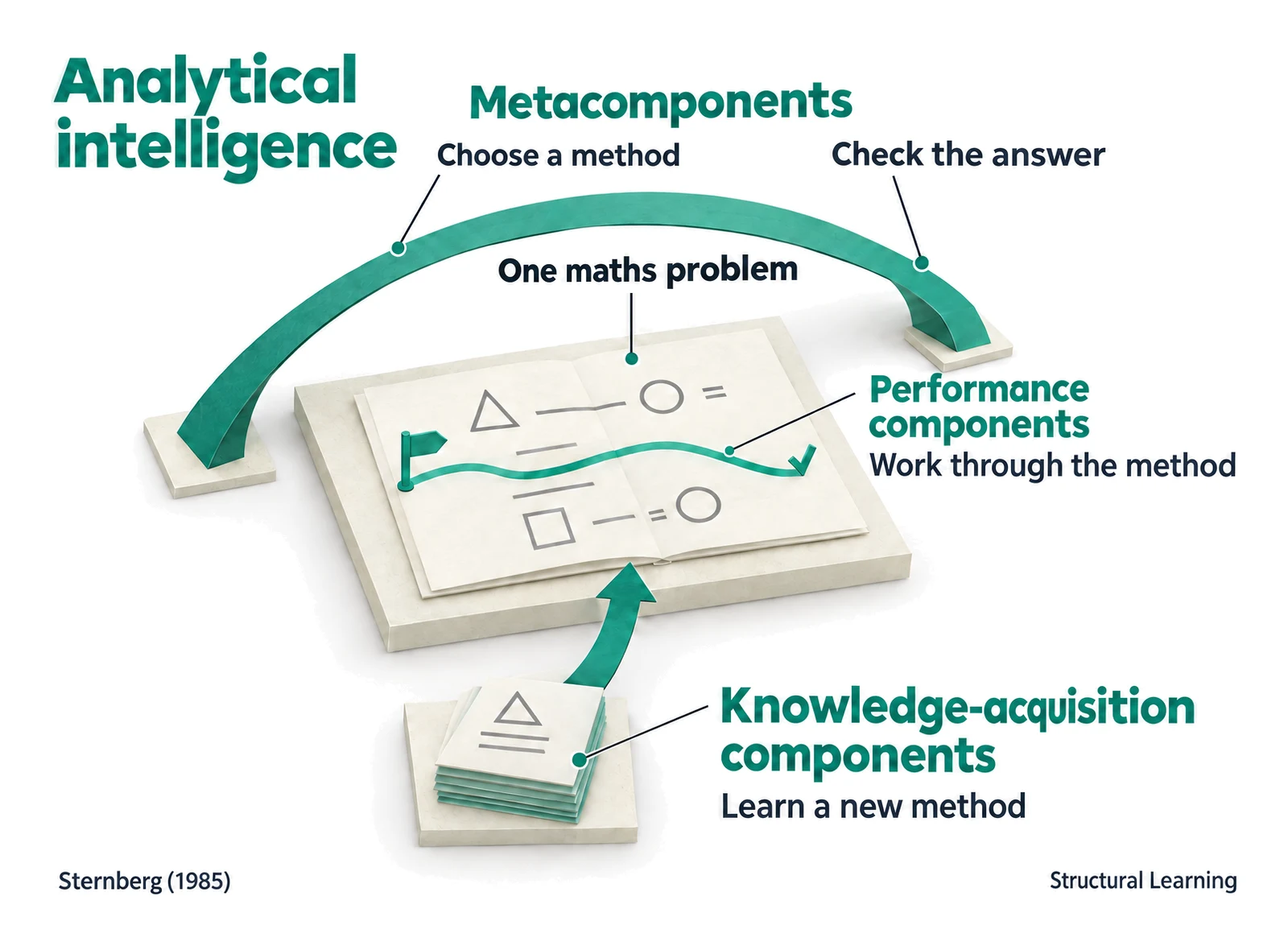
These steps help a learner judge an idea or break a problem into parts (Sternberg, 1985). Look for the plan as well as the answer. A correct answer gives stronger evidence when the learner can explain how they reached it.
Metacomponents are the executive controls. They decide what the problem is, choose a strategy, allocate attention and check the result. In classroom terms, they are the planning and self-monitoring behind good work. When a learner rereads a question before answering, a metacomponent is at work.
Performance components do the actual thinking once the plan is set. They encode information, compare options, draw inferences and apply rules. These are the moves behind analogies, comprehension and calculation.
Knowledge-acquisition components learn new material in the first place. They sort relevant information from noise and connect it to what is already known. Strong analytical intelligence overlaps heavily with higher-order thinking and with critical thinking, which both lean on the same components.
The experiential subtheory explains creative intelligence, how people handle experience along a scale from new to familiar. It has two poles. Novelty concerns problems not met before, while automatisation concerns making a well-practised process fluent.
Automatisation is making a well-practised skill run without conscious effort. Sternberg placed true insight near the novel end of that scale.
Creative intelligence lives at two ends of experience. At one end sits novelty, coping with a task you have never faced. At the other sits automatisation, turning a hard skill into an easy one (Sternberg, 1985).
Novelty is where insight shows. A learner meets an unfamiliar problem and finds a workable route without a template. Sternberg saw this as a truer test of intelligence than repeating a drilled procedure. The situation gives no ready-made answer, so the learner must generate one.
Automatisation matters just as much. When basic skills such as decoding or number bonds run automatically, working memory is freed for harder thinking. A fluent reader can focus on meaning because the decoding no longer costs effort.
Both poles can be trained. Give learners genuinely new problems to build novelty, and enough spaced practice to build automatisation.
The contextual subtheory explains practical intelligence, the ability to succeed in real settings. It works in three ways. Learners adapt to their environment, shape it to fit them, or select a better one. Sternberg linked this to tacit knowledge, the unwritten know-how that experience teaches but tests rarely measure.
Practical intelligence is the theory's most distinctive claim. Sternberg described it as the ability to solve everyday problems, the kind that have no single correct answer (Sternberg, 1985). People do this in three ways.
Adaptation means changing yourself to fit the situation, such as learning the unwritten rules of a new school. Shaping means changing the situation to fit you, such as reorganising a group task to play to your strengths. Selection means leaving a poor fit for a better one when adaptation and shaping both fail.
The fuel for practical intelligence is tacit knowledge, the know-how that is rarely taught directly. A skilled teacher reads a room without a script. An experienced nurse triages without a checklist.
Sternberg argued that this ability is real, valuable and largely absent from standard cognitive ability tests. That claim, as we will see, is also the theory's most contested.
The three intelligences are easiest to see in everyday examples. The same person can be strong in one and ordinary in another. The balance can also change with practice and with the setting.
Analytical intelligence is at work when someone judges or explains. A learner who spots the flaw in a maths argument is using it. So is a reader who compares two poems and says which works better, and why. It is the book-smart side that most school tests measure.
Creative intelligence shows when someone meets something new and finds a way through. A learner who invents a fair rule for a playground game uses it. So does one who designs an experiment nobody showed them. Joining ideas into something new, often called synthesis, belongs here too.
Practical intelligence is what people mean by street smart. A new learner who works out the unwritten rules of the lunch queue in a week is using it. So is a Year 10 who reorganises a group task so the quiet expert gets heard. Someone described as street smart rather than book smart is being credited with this ability.
Successful intelligence is Sternberg's later, broader theory, published in the late 1990s. It reframes the three abilities around a goal, reaching the life you value within your culture. Intelligent people, he argued, know their strengths, correct their weaknesses, and balance analytical, creative and practical skills to fit the task.
By the late 1990s Sternberg had widened the model. The theory of successful intelligence kept the three abilities but gave them a purpose (Sternberg, 1997). Intelligence, on this view, is using your strengths to reach goals that matter to you.
The key word is balance. A successful thinker knows when to analyse, when to invent and when to act practically, then switches between them (Sternberg, 1999). Raw ability matters less than the judgement to apply the right ability at the right time.
This shift carried a teaching message too. Schooling could give all three abilities a place. Sternberg, Torff and Grigorenko (1998) reported gains when lessons and assessments included all three kinds of task. Their studies tested a wider range of teaching and assessment. The limits of those findings are set out below.
WICS stands for wisdom, intelligence and creativity synthesised, a later model in which Sternberg brings these qualities together so that useful ideas can be judged, put into practice and directed towards a common good.
In this model, creativity produces ideas, intelligence helps test and carry them out, and wisdom asks whose interests they serve. A class can explore this by asking who would benefit from a proposed change to the school grounds. WICS extends the discussion beyond the original three-part theory. See Sternberg's WICS explanation
For teaching, the triarchic theory has one core message: teach and assess in all three ways. Plan tasks that ask learners to analyse, create and apply. Give every learner experience of all three demands and vary the route through shared content. The aim is a wider range of thinking.
The practical value of the theory is simple. Most lessons and tests reward analytical ability alone. Sternberg argued that adding creative and practical tasks lets more learners show what they can do, and builds abilities that matter beyond school (Sternberg, 1997).
That means two moves. First, teach for all three abilities. Set analysis tasks, open-ended creative tasks and real-world application tasks in the same unit. Second, assess in more than one way, so learners can show how they use knowledge as well as how they explain it.
A narrow task can hide useful thinking. If every outcome is judged through timed written analysis, teachers see less evidence of how learners generate ideas or apply knowledge. A quick way to check the range is to read the cue words in each question. The table shows the words that signal each intelligence, in lessons and in exam questions, and what a strong answer shows.
| Intelligence | Cue words in a question | What a strong answer shows |
|---|---|---|
| Analytical | Compare, contrast, evaluate, critique, explain why | A judgement with reasons, not just an answer. |
| Creative | Invent, design, imagine, suppose, create | More than one route tried, and a new idea that still fits the facts. |
| Practical | Apply, use, plan, put into practice | A plan that would work for a real person or place. |
Used this way, the theory becomes a planning checklist rather than a test. It nudges each unit to stretch analysis, creativity and application, instead of resting on recall alone.
In the classroom, plan three tasks on one topic. Learners analyse it, create with it, then apply it. Keep the key knowledge and success checks clear across all three tasks. Two worked examples, one primary and one secondary, show how the demands can change.
Take a Year 4 science topic on habitats. The analytical task asks learners to sort animals by where they live and explain the rule. The creative task asks them to design a new animal suited to a chosen habitat. A completed answer might read: "My pond animal has webbed feet to swim and a dark back to hide from birds." Both features need a reason tied to the habitat.
The practical task asks them to plan a small change to the school grounds that would help local wildlife. One topic, three abilities.
A Year 8 history lesson on the causes of a war works the same way. Learners rank two causes and defend the order, then turn one event into a newspaper headline. For the practical task, they explain how a choice of words could sway readers at the time. Keep each answer tied to the facts taught in the lesson.
| Learner signal | Next teaching move |
|---|---|
| Names a habitat but gives no reason. | Model one link: "The frog needs cover because birds may eat it." Ask for a second link. |
| Draws an unusual animal with no useful features. | Ask which feature helps it meet one need. Let the learner change the design and explain why. |
| Suggests a pond change without checking the site. | Ask where it would go and what the animal needs there. Compare the plan with the actual space. |
To plan the same move in another subject, use the planner below. It gives a worked set of three tasks for five subjects at two phases, with what to look for in each answer, and prints as a card.
Notice what the pattern does. It keeps the content constant and varies the demand, so everyone practises all three ways of thinking. It also widens the evidence available to the teacher. Pairing these tasks with clear thinking skills assessments reveals thinking that a single essay may miss.
The study note below is a one-page A4 PDF on triarchic theory, with the three abilities, classroom examples and key limits, plus a text version you can read on the page.
Use it to recap the model before planning a lesson. Keep the planner's printed task card beside it so the theory and the classroom moves stay linked. Print the note, read one part at a time and choose an example you can explain to a colleague.
Sternberg's Triarchic Theory. Intelligence involves analytical, creative and practical abilities working together. Analytical or componential ability uses metacomponents to plan and check, performance components to carry out a plan, and knowledge-acquisition components to learn.
Creative or experiential ability concerns novelty and automatisation. Practical or contextual ability concerns adapting to, shaping or selecting an environment, plus tacit knowledge gained through experience. Teachers can keep one content goal stable while asking learners to analyse, create and apply, then check evidence.
The three abilities are not fixed learner types. Do not match every lesson to a supposed strength. Practical intelligence and the theory's factor structure remain contested. Use the model to widen tasks, not to diagnose learners.
You can build a short triarchic theory presentation from the six-slide outline below, using one idea per slide and the habitat example to show how the three abilities work together.
Three models ask different questions. The g-factor view asks why people who do well on one mental task often do well on others. Gardner names talents in different areas. Sternberg asks how people analyse, create and act within a task. Each model needs its own evidence.
Tests of mental ability often find a shared pattern called g, the general intelligence factor (Neisser et al., 1996). Scores on different tasks tend to rise together. A CAT4 assessment measures several related abilities. Sternberg argued for a broader view that includes creating ideas and using them in real life. The dispute about how distinct those abilities are belongs in the limitations below.
Other models sit either side of this debate. The Cattell-Horn-Carroll theory keeps g at the top and places broad abilities beneath it. Guilford's structure of intellect went the other way, splitting intellect into many separate abilities with no general factor.
Gardner's multiple intelligences theory names abilities in different areas, such as music or space, while Sternberg's theory names three linked ways of handling tasks through analysis, creativity and practical action. One model names content areas. The other asks how a task is handled.
One model is about separate content domains. The other is about how any task is handled.
For teachers the contrast raises a useful question: what does this task let a learner show? Test scores give evidence about performance on the tasks tested. A practical task gives a further view of how knowledge is used. Compare the work and the reasons learners give, rather than drawing a broad conclusion from one answer.
Practical intelligence grows when learners reflect on how they used a strategy. Our guide to metacognition in the classroom shows how to build that reflection into everyday lessons.
Sternberg built his own test to check the theory. The Sternberg Triarchic Abilities Test (STAT) sets multiple-choice items for each ability in words, numbers and pictures, plus short essays. Level-H is the version for high school learners (Sternberg et al., 2001). The US SAT named below is a separate university admissions test.
The results cut both ways. In 3,278 learners from the USA, Finland and Spain, a three-ability model fitted the scores best, though the fit was far from perfect (Sternberg et al., 2001). Other teams found that one general factor explained the same kind of data (Koke & Vernon, 2003; Chooi et al., 2014).
The Rainbow Project took the idea to university admissions. Sternberg's team added creative and practical tasks, such as writing captions for cartoons, to the US SAT. The extra measures improved the prediction of first-year college grades and narrowed gaps between ethnic groups (Sternberg, 2006).
For teachers, the useful move is to gather work across all three demands. Compare explanations, designs and applied solutions on the same content. The measurement debate is set out in the limitations below, alongside the risk of treating abilities as fixed types, as in the learning styles myth.
Triarchic approaches to gifted identification use varied tasks to look at how learners judge ideas, create new ones and use knowledge, adding evidence beyond a score on an academic test.
Sternberg and colleagues (1996) studied gifted education. They looked at how learners were selected, taught and assessed. Results were better when teaching and assessment matched the patterns of ability measured by the study. That finding is part of the matching debate discussed below. A task shows what someone did in that setting. A claim about the learner as a whole needs stronger support.
Triarchic theory treats practical success as shaped by cultural context, and studies in different countries and an Alaskan Yup'ik setting suggest that local knowledge matters when designing tasks and interpreting performance.
In a sixth-grade mathematics study in a Yup'ik cultural setting, culturally based triarchic teaching outperformed conventional textbook teaching (Sternberg et al., 2006). It combined the teaching approach with local cultural content. The result therefore supports that combined package. It leaves open which part made the difference and how the approach would transfer elsewhere.
The international test study already described used samples from the USA, Finland and Spain (Sternberg et al., 2001). Its findings and the later reanalyses show why measures need checking in each setting. For a lesson, start with knowledge the class has been taught and make the task's assumptions clear.
The triarchic theory faces serious criticism, most of it aimed at practical intelligence. Critics argue it lacks independent evidence and overlaps heavily with g. The Sternberg Triarchic Abilities Test has been questioned on construct validity.
Attempts to replicate its teaching benefits have been mixed. Teachers should treat the theory as a lens, not a diagnostic tool.
The strongest challenge targets practical intelligence. Gottfredson reviewed Sternberg's evidence and argued that practical intelligence is not a separate ability at all (Gottfredson, 2003). She held that the data do not show it working independently of g, and that some claims outran the results.
A second critique concerns measurement. Brody examined the Sternberg Triarchic Abilities Test and questioned its construct validity, finding that the three abilities did not separate as cleanly as the theory predicts (Brody, 2003). If a test cannot distinguish analytical, creative and practical ability, the three-part structure is hard to confirm.
Third, the teaching evidence does not justify fixed matching. Sternberg and colleagues reported benefits when curriculum and assessment included all three kinds of demand (Sternberg et al., 1998, 2004). A 2021 meta-analysis of 24 studies also found gains, though the effect fell from g = 0.63 to g = 0.35 after adjusting for publication bias (Saw & Han, 2021). That is different from diagnosing a learner as analytical, creative or practical and teaching only through that supposed strength. The wider theory, its measures and aptitude-treatment claims remain contested.
None of this makes the theory useless. It is a rich way to think about the range of ability in a room, and it rightly reminds us that tests are narrow. But teachers should use it to widen tasks, not to label a child as a creative or a practical learner.
As a planning tool it earns its place among the thinking frameworks we already use. As a lens, not a diagnostic tool, it stays within the evidence.
This five-question triarchic theory quiz checks your grasp of the three ability names, the linked subtheories and the kinds of task they describe, using examples drawn from the classroom sections above. Try each answer before opening it. These are study questions about the theory, rather than a test of your intelligence.
Answer: Robert J. Sternberg. He later developed the theory of successful intelligence.
Answer: analytical, creative and practical, in that order. Componential concerns mental steps, experiential concerns new and familiar tasks, and contextual concerns the setting.
Answer: analytical intelligence. The task asks the learner to judge an idea using reasons. Other abilities can also contribute.
Answer: creative and practical. Producing the new design is creative. Checking how it would work in the actual space is practical.
Answer: give everyone a range of tasks. A result on one task gives evidence about that performance. The limitations section explains why fixed labels and matching claims need caution.
Choose one unit you will teach this half term. Keep the content goal the same and add one analytical, one creative and one practical task. Give each a short success check, then notice who shone in which task.
For secondary science, try the Year 8 friction card. Learners compare two shoe soles for grip on a wet floor, design a device that uses friction to slow a falling egg, and advise the site team on making the front steps safer in icy weather.
Start with one lesson next week: pick your subject in the planner above, print the card and set all three tasks. Our guide to the main theories of learning shows where Sternberg sits beside Piaget, Vygotsky and Gardner.
Robert J. Sternberg developed the triarchic theory of intelligence, setting it out in his 1985 book Beyond IQ while working at Yale University in the United States. He later built on the model in his theory of successful intelligence.
Analytical intelligence judges and explains. Creative intelligence copes with new problems and invents. Practical intelligence gets things done in real settings. Sternberg saw them as three sides of one intelligence, used together on most tasks.
Triarchic is the theory of intelligence. The triangular theory is Sternberg's separate theory of love, built from intimacy, passion and commitment (Sternberg, 1986). The similar names cause frequent mix-ups in searches and exams.
Both reject the idea that one IQ score captures everything that matters. They differ in how they split intelligence: Gardner names separate content areas, while Sternberg names three processes that work together.
It is the 1990s extension of the triarchic model. Intelligence becomes the skill of reaching goals you value by choosing when to analyse, create or act, rather than a score on a test (Sternberg, 1999).
The triarchic theory remains useful in education but debated in psychology, where researchers question whether its three abilities are distinct or share a common basis in general intelligence. Teachers can still use it to vary tasks. Each task gives a view of what a learner can do with the content taught. The debate concerns what those results tell us about intelligence as a whole.
Set analytical, creative and practical tasks on the same content for the whole class, and mark all three. Talk about the kind of thinking a task needs, never about the kind of learner someone is.
Start with Beyond IQ for the original model. The school studies ask what happens when teaching includes all three kinds of task. The test studies ask whether the three abilities can be measured as distinct. Read those two questions separately. A gain in school work gives evidence about teaching. It leaves the model's structure open to further tests.
Use these links to check the model and its limits. The university pages explain the research and teaching approach. The dictionary gives a short account of the theory. The final paper sets out a major critique of practical intelligence. Read it alongside the teaching studies above.