Sigmund Freud's Theories
Uncover Sigmund Freud’s theory of the unconscious mind, psychosexual stages, and their lasting influence on modern psychology.


Sigmund Freud was an Austrian neurologist who founded psychoanalysis in the early 20th century. He revolutionized psychology by introducing theories about the unconscious mind, dream analysis, and how childhood experiences shape adult behavior. His work established the foundation for modern psychotherapy and influenced countless therapists and researchers.

Sigmund Freud, often called the father of psychoanalysis, was an Austrian neurologist whose theories revolutionised how we think about the mind. He founded the Psychoanalytic Movement in the early 20th century, drawing together like-minded thinkers in the Vienna Psychoanalytic Society to explore ideas about unconscious processes, childhood development, and the hidden motivations behind human behaviour.
Freud’s central belief was that much of what drives our thoughts and actions lies beneath conscious awareness. He argued that repressed desires, memories, and conflicts shape our personalities and can resurface in dreams, slips of the tongue, or neurotic symptoms. This idea shifted psychology away from simply studying observable behaviour and towards investigating the deeper layers of the psyche.
One of Freud’s most influential contributions was his theory of psychosexual development, which proposed that early childhood experiences leave lasting impressions on our adult lives. He also introduced groundbreaking ideas about dream analysis, suggesting that dreams are symbolic expressions of our innermost wishes and fears. While many aspects of his work have sparked controversy, especially his emphasis on sexuality and the subjective nature of psychoanalysis, his ideas laid the foundation for modern psychotherapy and inspired thinkers like Carl Jung to build their own psychological frameworks.
Key Points:
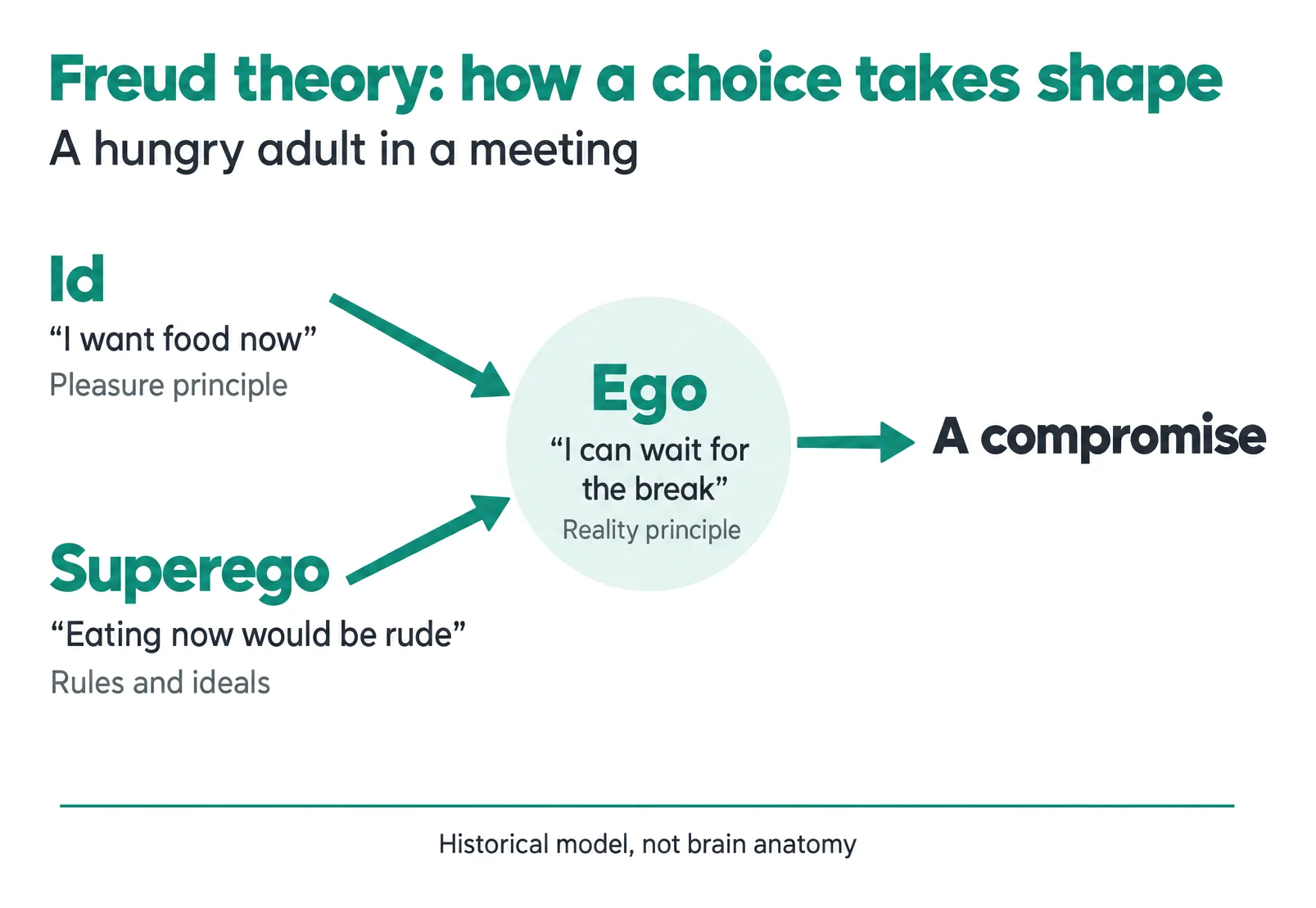
Freud's structural model divides the human psyche into three components: the id (primitive desires), the ego (rational mediator), and the superego (moral conscience). These three systems constantly interact to shape human behaviour and personality development.
The id, ego, and superego are three parts of the human psyche according to Freud's structural model. The id represents primitive desires and impulses, the ego manages reality and mediates between desires and social expectations, while the superego acts as the moral conscience. These three components constantly interact to shape our thoughts, behaviors, and personality.

According to Sigmund Freud, the human psyche consists of three components: the id, ego, and superego. The id represents our primitive, instinctual drives, including our desire for food, sex, and pleasure.
The ego represents our rational, conscious self that mediates between the id and the external world. And the superego represents our moral and ethical sense, as well as our sense of right and wrong.
Together, these three components create complex human behavioras they interact and influence each other. The id is impulsive and seeks immediate gratification while the superego is concerned with social norms and moral values.
This creates a constant internal conflict between our instinctual desires and our moral ideals. The ego tries to find a balance between the two, but this is not always easy.
Furthermore, each individual's id, ego, and superego are uniquely shaped by their childhood experiences and environment. This can lead to complex variations in personality and behavior. Understanding the workings of the id, ego, and superego is a powerful tool for gaining insight into the human mind and behavior.
Personality Theory" id="" width="auto" height="auto">
Freud's psychosexual development theory proposes five stages: oral, anal, phallic, latency, and genital. Each stage focuses on different erogenous zones and presents specific psychological challenges that shape adult personality if unresolved.
Freud's five psychosexual stages are oral (0-18 months), anal (18-36 months), phallic (3-6 years), latency (6-puberty), and genital (puberty onward). Each stage focuses on pleasure from different body areas, and unresolved conflicts at any stage can lead to fixations affecting adult personality. Successfully navigating these stages results in a healthy, mature personality.
Sigmund Freud's Theory of Psychosexual Development suggests that human personality develops through a series of stages, each of which is centered around the satisfaction of certain physical or psychic needs. There are five stages in this theory, oral, anal, phallic, latent, and genital.
In the oral stage, the focus is on sucking and biting, which eventually develops into the child's dependency on caretakers and the incorporation of different foods and objects.
In the anal stage, the focus shifts to toilet training and associated control issues, which contributes to the development of the superego and personality traits such as orderliness, cleanliness, and stinginess.
The phallic stage is the most critical stage in terms of personality development and centers around the child's sexual desire, especially towards his or her parent of the opposite gender. Oedipus complex is a crucial component of the phallic stage, where boys have a sexual longing for their mothers and hostility towards their fathers, which contributes to the emergence of superego through resolution.
In the latent phase, sexual desires are repressed, and energies are focused on developing skills. Finally, in the genital phase, the individual's core interest returns to sexual satisfaction outside the family context.
The conflicts arising during the stages can cause various disorders and sexual malfunctions influencing the development of personality. The theory can help to identify the origins of psychological problems and guide us towards the proper treatment of psychosexual disorders.

Freud's dream analysis theory suggests that dreams represent the unconscious mind's attempt to fulfil repressed wishes and desires. He distinguished between manifest content (what we remember) and latent content (hidden psychological meaning).
Freud believed dreams were the 'royal road to the unconscious' and contained hidden wishes and repressed desires in symbolic form. He distinguished between manifest content (what you remember) and latent content (the hidden psychological meaning). Dream analysis involves uncovering these hidden meanings through free association and symbol interpretation.
Freud's theory of dream interpretation posits that dreams are the "royal road to the unconscious mind." Dreams, according to Freud, are a manifestation of repressed desires and thoughts that the conscious mind is unable to process.
The unconscious mind communicates symbolically, and the dream is a manifestation of these symbols. Freud introduced the concept of the dreamwork, which are the four basic activities that transform unconscious desires into the manifest content of a dream: condensation, displacement, symbolism, and secondary revision.
Condensation occurs when multiple unconscious desires are combined into a single dream symbol. Displacement occurs when an unconscious desire is represented indirectly by something else. Symbolism is the use of objects or events to represent something else. Secondary revision is the process by which the dream is transformed into a coherent narrative by the conscious mind.
Decoding dreams is important because it uncovers these repressed desires and helps individuals understand their unconscious motives. Through dreams, individuals can explore their unresolved issues and uncover the origins of their psychological conflicts. Therefore, dream interpretation is a useful tool for uncovering the hidden workings of the unconscious mind.
Freud's defence mechanisms are unconscious psychological strategies that protect the ego from anxiety and emotional pain. Common mechanisms include repression, projection, denial, displacement, and sublimation, which distort reality to maintain psychological stability.
Defense mechanismsare unconscious psychological strategies people use to protect themselves from anxiety and uncomfortable thoughts or feelings. Common examples include denial (refusing to accept reality), projection (attributing your feelings to others), and repression (pushing traumatic memories into the unconscious). These mechanisms operate automatically to maintain psychological equilibrium.
Freud's concept of defense mechanisms proposes that individuals adopt various strategies to defend themselves against unpleasant emotions and experiences. These mechanisms are used to maintain psychological balance and avoid anxiety. There are several defense mechanisms, each with its unique function and purpose.
Repression involves pushing unpleasant or traumatic experiences into the unconscious mind to avoid painful emotions. Denial, on the other hand, involves refusing to acknowledge one's actions or behavior to avoid guilt and anxiety.
Projection is when individuals attribute their own unacceptable thoughts, feelings, or impulses to others, usually those closest to them. Displacement involves redirecting one's aggressive or negative emotions towards a less threatening target. Sublimation, on the other hand, is transforming negative emotions and desires into positive actions that benefit oneself and society.
These defense mechanisms are critical for preserving psychological stability and protecting individuals from overwhelming anxiety. However, extensive use of these mechanisms can cause psychological and emotional disruption.
Therefore, it is essential to maintain a balance between the use of defense mechanisms and consciously acknowledging one's emotions and experiences to ensure a healthy emotional and mental state.

The Oedipus complex describes a child's unconscious desire for the opposite-sex parent and rivalry with the same-sex parent during the phallic stage. Freud considered successful resolution of this complex essential for healthy psychological development.
The Oedipus complex describes a child's unconscious desire for the opposite-sex parent and rivalry with the same-sex parent, typically occurring during the phallic stage (ages 3-6). Freud believed successful resolution of this complex was crucial for developing a mature sexual identity and moral conscience. Unresolved Oedipal conflicts could lead to neuroses and relationship difficulties in adulthood.
The Oedipus complex is a psychological concept introduced by Sigmund Freud in his theory of psychoanalysis. It refers to a child's sexual desire for their opposite-sex parent and a sense of rivalry towards their same-sex parent.
The term is derived from the Greek tragedy of Oedipus, who unknowingly killed his father and married his mother.
According to Freud, the Oedipus complex starts around the age of three and continues until the age of five or six. It is a normal part of a child's psychosexual development but can lead to feelings of guilt and anxiety if unresolved. The resolution of this complex involves identifying with the same-sex parent and suppressing sexual desires for the opposite-sex parent.
The Oedipus complex is significant in psychoanalysis because it highlights the influence of unconscious motivations on human behavior. Freud believed that this complex shapes our early experiences and influences our relationships in later life.
For example, unresolved Oedipal conflicts can lead to the development of neuroses or psychological disorders.
The Oedipus complex is a crucial concept in psychoanalysis as it highlights the role of unconscious motivations in human behavior and relationships. Understanding this complex can provide insight into our early experiences and help in resolving any unresolved conflicts that may affect our mental health in later life.

Freud viewed religion as a collective neurosis and wishful thinking, arguing it arose from humanity's need for protection against nature and fate. He believed religious beliefs were illusions based on childhood needs for a protective father figure. In his work 'The Future of an Illusion,' he predicted religion would eventually be replaced by scientific reasoning.
Freud's theory on religion is outlined in his book, The Future of an Illusion. He argues that religion is a form of wish fulfillment, where people project their desires onto a higher power. According to him, religion serves to comfort us by creating a false sense of security and protection against life's uncertainties.
Furthermore, Freud believes that religion functions to control individuals through guilt and fear. Religion teaches us to suppress our natural desires, leading to feelings of guilt and anxiety. It also uses fear of punishment to maintain social order and control behavior.
His Jewish upbringing may have influenced his views on religion. Growing up in a religious household, he was exposed to the significant amount of guilt and fear surrounding religious practice. It's possible that his childhood experiences may have led him to view religion as a tool of social control.
Freud's theory on religion suggests that it is a manifestation of our deepest desires and fears, a means of coping with the uncertainties of life. Ultimately, it serves to maintain social structure and control behavior through guilt and fear while simultaneously comforting individuals.

Major criticisms include the lack of scientific evidence, overemphasis on sexuality, gender bias, and unfalsifiable claims that cannot be tested empirically. Critics argue his theories were based on limited case studies of wealthy Victorian women rather than diverse populations. Many concepts like penis envy and the Oedipus complex are considered outdated and culturally biased.
Freudian theory has been criticized and contested on several grounds. Firstly, the disregarding of falsifiability, Freud's theory offers no clear means for experiment that would lead to its disproving. Hence, the constant rejection of any challenges to the theory leads to a philosophical question in the scientific community.
Additionally, critics point out the lack of generalizability in the theory and they argue it is only applicable to certain societies and cultures.
Furthermore, Freud is often accused of sexist attitudes in his work. His ideas regarding women's psychology were met with resistance by some of his female colleagues who believed his theories were based on paternalistic stereotypes. Additionally, Freudian theory has been challenged on its coherence and scientific nature. The social scientific nature of his work implies difficulty in the reliability of his theories.
Lastly, critics have claimed that psychoanalysis has never been scientifically proven to be an effective form of therapy for neurotic illnesses. The outcomes of assessments show conflicting results as there are many variables that could determine the success of psychoanalysis.

Despite these criticisms, Freud's work remains a fundamental theory in the field of psychology offering contributions that have been central to understanding the human mind.
7 controversial ideas from Freud's theories that sparked debate
Sigmund Freud's theories, particularly in the realms of psychoanalytic therapy and psychodynamic theory, have been the subject of intense debate and controversy since their inception. Here are seven controversial ideas that continue to spark discussion:
A relevant statistic that encapsulates the controversy is that only about 15% of therapists in the United States identify with psychodynamic therapy, reflecting the ongoing debate over Freud's legacy.
Freud's theories revolutionized psychology but also ignited controversies that continue to resonate. His ideas challenged conventional wisdom, opened new avenues for understanding the human mind, and left a lasting impact that continues to be felt in both psychology and everyday life.
Freud established the talking cure and the therapeutic relationship as central to healing psychological distress. His emphasis on unconscious processes, early childhood experiences, and defense mechanisms continues to influence many therapy approaches including psychodynamic therapy. Modern therapists still use adapted versions of free association, dream analysis, and transference interpretation.
Sigmund Freud's work has had a significant impact on modern psychotherapy. His ideas regarding the unconscious mind, the importance of early childhood experiences, and the therapeutic relationship have endured and continue to shape psychological treatment today.
The concept of free association, where clients are encouraged to freely express their thoughts and feelings, is a technique still used in therapy. Additionally, the analysis of dreams as a means of uncovering unconscious desires and conflicts remains a valuable tool.
The therapeutic relationship itself has become crucial to the success of therapy, with empathetic listening and a strong rapport between therapist and client being widely accepted as essential. However, Freud's theories are not without criticism.
Some have accused him of lacking empirical evidence, while others argue that his emphasis on sexual and aggressive drives is detrimental. Nevertheless, Freud's impact on the field of psychology remains undeniable and continues to shape modern psychotherapy.

Freud's legacy includes founding psychoanalysis, introducing the concept of the unconscious mind, and establishing therapy as a treatment for mental illness. His work influenced fields beyond psychology including literature, art, and popular culture. While many specific theories are disputed, his emphasis on early experiences and unconscious motivation remains influential.
Sigmund Freud's contributions to the field of psychology and psychotherapy are still relevant today, over a century after he developed his theories.
His most famous concepts, including the Oedipus complex and dream analysis, have shaped the way that psychologists and psychotherapists approach their work.
Freud's legacy can be seen in the ongoing use of psychoanalysis today, as well as the many schools of thought that have been influenced by his ideas. He fundamentally changed the way that we understand human behavior and mental health, by focusing on the role of the unconscious mind and the impact of early childhood experiences on the development of the personality.
Despite some criticisms of his theories, Freud's work continues to be a topic of discussion and debate within the field of psychology.
Through his innovative thinking and groundbreaking research, he has firmly established himself as one of the most influential figures in the history of psychology. It is clear that his legacy will continue to impact the field of psychotherapy for many years to come.
Freud's 7 most significant Legacies:
For further reading, consider these academic sources: Abstracts of the standard edition of the complete psychological works of Sigmund Freud and The scientific legacy of Sigmund Freud: Toward a psychodynamically informed psychological science.

While pure Freudian psychoanalysis is rarely practiced today, many core concepts remain relevant in modified forms. Modern psychodynamic therapy incorporates Freudian ideas about unconscious processes, defense mechanisms, and the therapeutic relationship with contemporary research. Neuroscience has actually validated some Freudian concepts like the existence of unconscious mental processes.
The debate on the relevance of Sigmund Freud's theories in contemporary mental health practice remains lively. With advancements in psychological research and therapeutic techniques, it's crucial to examine whether Freud's psychoanalytic theory still holds a place in modern clinical practice.
Freud's concept of unconscious processes remains influential. Many therapists acknowledge that unconscious thoughts and feelings can significantly impact behavior and mental health. However, contemporary approaches often integrate these ideas with cognitive-behavioral methods, which are more structured and evidence-based. For instance, while Freud's theory of repression explains how distressing memories are pushed out of conscious awareness, modern therapists might use techniques like cognitive restructuring to address these issues more directly.
In private practice, some clinicians continue to use psychoanalytic techniques, such as free association and dream analysis, to explore patients' unconscious minds. The influence of Anna Freud, who extended her father's work into child psychology, remains evident in how some therapists approach the treatment of children and adolescents. Yet, the effectiveness of these techniques is often debated. While some studies support their benefits, others question their efficiency compared to newer methods like dialectical behavior therapy (DBT) or eye movement desensitization and reprocessing (EMDR).
Freud's psychosexual theory, particularly the oral stage and other components of personality development, has faced significant criticism. Modern research, such as studies published by Harvard University Press and Yale University Press, often challenges the scientific validity of these stages. Critics argue that Freud's focus on sexual development and Female Sexuality reflects the cultural context of his time rather than universal psychological principles. Nonetheless, some therapists find value in considering these stages as metaphorical rather than literal truths, helping to uncover deep-seated emotional conflicts.
Object relations theory, a derivative of Freud's work, continues to be relevant in understanding interpersonal relationships and attachments. This theory's focus on early childhood experiences and their impact on adult relationships is a cornerstone of many therapeutic approaches. However, integration with other models, such as attachment theory and family systems therapy, provides a more comprehensive understanding of these dynamics.
When discussing sexual orientation, Freud's views are often seen as outdated. His theories, which pathologized non-heterosexual orientations, have been widely discredited. Modern psychology, supported by institutions like Oxford University Press, recognizes sexual orientation as a natural variation of human sexuality. This shift reflects broader societal changes and a more inclusive understanding of mental health.
The psychoanalytic movement, despite its controversies, has undeniably shaped the field of psychology. Freud's emphasis on the complexity of the human psyche and the importance of early experiences paved the way for more nuanced understandings of mental illness. Contemporary clinical practice often blends these insights with newer, evidence-based treatments, aiming for a holistic approach to mental health.
In conclusion, while Freud's theories may not dominate modern clinical practice as they once did, elements of his work continue to inform and enrich the field. The challenge lies in discerning which aspects of psychoanalytic theory are still useful and integrating them with contemporary knowledge and techniques. This nuanced approach allows for a more flexible and effective practice, reflecting the diverse needs of today's patients.

Freud's development of the "talking cure" transformed mental health treatment from physical interventions to verbal exploration. Unlike his medical contemporaries who relied on hypnosis, cold baths, or restraints, Freud discovered that allowing patients to speak freely about their thoughts could uncover repressed memories and resolve psychological conflicts. This revolutionary approach emerged from his work with patient Anna O., whose physical symptoms disappeared when she verbally expressed traumatic memories. The technique, which Freud termed "free association," required patients to voice whatever came to mind without censorship, revealing unconscious patterns through seemingly random connections.
The mechanics of free association operate on Freud's principle that the unconscious mind constantly influences conscious thought through symbolic links and emotional associations. When a patient relaxes their mental guard and speaks without filtering, repressed material surfaces through verbal chains that appear unrelated but share unconscious connections. For instance, a patient discussing their morning commute might suddenly recall a childhood argument with a sibling, revealing unresolved competitive feelings affecting current workplace relationships. Freud positioned himself behind the patient on his famous couch to minimise visual distractions and reduce the patient's tendency to monitor the therapist's reactions, thereby encouraging more authentic expression.
Teachers can adapt Freudian free association principles to unlock student creativity and emotional expression without venturing into therapeutic territory. Stream-of-consciousness writing exercises, where pupils write continuously for five minutes without stopping to edit or judge their thoughts, often reveal surprising connections between academic concepts and personal experiences. This technique proves particularly effective in helping reluctant writers overcome perfectionism and access authentic voice. Similarly, word association games during vocabulary lessons can expose conceptual misunderstandings, as students' spontaneous connections often reveal how they truly categorise and relate new information to existing knowledge.
The therapeutic distance Freud maintained translates into classroom management through strategic positioning and neutral responses. When addressing emotional outbursts or conflicts, sitting beside rather than directly facing an upset pupil reduces confrontational dynamics, echoing Freud's therapeutic arrangement. Encouraging students to "think aloud" whilst solving problems mirrors free association's revelatory process, making invisible thought patterns visible for both teacher and student. This verbalisation technique proves especially valuable for identifying where mathematical reasoning breaks down or why certain reading comprehension strategiesfail. By creating spaces for unstructured verbal expression, whether through journal prompts, discussion circles, or problem-solving narratives, educators tap into the same unconscious revelations that made Freud's talking cure so transformative, whilst maintaining appropriate educational boundaries.
Freud's most controversial theory centres on the Oedipus complex, a developmental phase he believed all children experience between ages 3-6. Named after the Greek myth where Oedipus unknowingly kills his father and marries his mother, Freud proposed that young boys develop unconscious desires for their mothers whilst viewing their fathers as rivals. This creates profound anxiety, as the child simultaneously loves and fears the father figure. The resolution of this complex, through identification with the same-sex parent, supposedly forms the foundation of gender identity and moral development.
Carl Jung, Freud's contemporary, later coined the term "Electra complex" to describe the female equivalent, though Freud himself rejected this terminology, preferring "feminine Oedipus complex." In this formulation, girls allegedly experience penis envy and blame their mothers for their perceived anatomical deficiency, whilst developing attraction to their fathers. Modern psychology has largely discredited these theories as culturally biased and lacking empirical support, yet understanding them remains crucial for educators encountering Freudian terminology in child development literature.
Whilst the sexual aspects of these complexes are rightfully dismissed, the underlying observations about attachment patterns and identification processes offer valuable classroom insights. Children between 3-6 often display intensified preferences for one parent or teacher, experience jealousy when attentionis diverted, and struggle with sharing authority figures. Rather than viewing these through Freud's lens, contemporary educators recognise them as normal attachment behaviours reflecting children's growing awareness of relationships and their place within social hierarchies.
Recent research on attachment and development provides more nuanced understanding of these dynamics. Studies examining quality of life after significant disruptions, such as Krenz et al.'s (2023) research on traumatic brain injury recovery, demonstrate how early attachment patterns influence resilience and adaptation throughout life. Similarly, research into complex health conditions requiring multidisciplinary care, like Chau et al.'s (2025) census of motor neuron disease support networks, highlights how early relationship templates affect how individuals seek and receive support in crisis.
For educators, recognising these attachment patterns without Freudian baggage proves invaluable. A Year 1 pupil who becomes possessive of their teacher or acts out when a teaching assistant joins the class isn't experiencing an "Oedipal crisis" but rather navigating normal developmental challenges around sharing, trust, and expanding their social world. Understanding that children naturally form intense attachments and experience jealousy helps teachers respond with patience rather than concern, validating emotions whilst maintaining appropriate boundaries and gradually encouraging broader social connections.
Freud's life and death instincts theory proposes two fundamental drives: Eros (life instinct) seeks survival and reproduction, whilst Thanatos (death instinct) drives towards destruction and return to inorganic state. These opposing forces govern human behaviour.
Beyond his structural model of the mind, Freud proposed a fundamental theory about the opposing forces that drive all human behaviour: the life instinct (Eros) and the death instinct (Thanatos). Introduced in his 1920 work "Beyond the Pleasure Principle", this dual-drive theory suggests that humans are motivated by two conflicting unconscious forces, one pushing towards growth, connection, and creation, whilst the other pulls towards destruction, aggression, and a return to an inorganic state.
The life instinct encompasses all drives that promote survival, reproduction, and pleasure. It includes hunger, thirst, and sexual desires, but extends beyond basic needs to encompass creativity, social bonding, and the drive to build and preserve. In contrast, the death instinct manifests as aggression, self-destructive behaviours, and an unconscious desire to return to a state of calm non-existence. Freud observed that whilst the death instinct is typically directed outward as aggression towards others, it can turn inward, resulting in self-harm, excessive risk-taking, or self-sabotage.
Recent research demonstrates how these opposing forces manifest in educational contexts. Minderop and Hidayat's (2022) analysis reveals how internal conflicts between constructive and destructive impulses can create profound psychological tension, affecting behaviour and learning capacity. In the classroom, pupils exhibiting sudden aggressive outbursts during creative activities may be experiencing this fundamental conflict between their drive to create and unconscious destructive impulses.
Understanding this theory transforms how educators interpret challenging behaviours. A pupil who repeatedly destroys their own artwork or tears up completed homework isn't simply being defiant; they may be unconsciously expressing the death instinct's pull towards destruction. Similarly, pupils who engage in self-defeating patterns, such as deliberately failing exams they're capable of passing or sabotaging friendships, may be manifesting inwardly-directed aggression. Recognising these patterns allows teachers to address the underlying conflict rather than merely punishing the behaviour.
The practical application extends to classroom management strategies. Creating structured opportunities for controlled aggression, such as competitive debates, contact sports, or even tearing up scrap paper during stress-relief activities, can provide healthy outlets for the death instinct. Simultaneously, channelling the life instinct through collaborative projects, peer mentoring programmes, and creative expression helps pupils develop constructive coping mechanisms. By acknowledging both forces and providing appropriate outlets, educators can help pupils navigate their internal conflicts more effectively, reducing disruptive behaviours whilst promoting psychological wellbeing and academic achievement.
Essential reads include Freud's own 'The Interpretation of Dreams' and 'Three Essays on the Theory of Sexuality' for primary sources. For accessible introductions, try Peter Gay's 'Freud: A Life for Our Time' or 'Freud' by Jonathan Lear. Modern perspectives can be found in Mark Solms' 'The Hidden Spring' which connects Freud to neuroscience.
These papers offer a comprehensive view of Freud's theories and their lasting impact on psychology and related disciplines.
Freudian complexes shape personality by creating unconscious emotional patterns formed during childhood development. Unresolved complexes influence adult relationships, behaviours, and psychological functioning throughout life, affecting decision-making and interpersonal dynamics.
Among Freud's most controversial yet influential theories are the Oedipus and Electra complexes, which describe how children navigate intense emotional attachments to their opposite-sex parents during the phallic stage of psychosexual development (ages 3-6). The Oedipus complex, named after the Greek mythological figure who unknowingly killed his father and married his mother, refers to a boy's unconscious desire for his mother and rivalry with his father. Freud theorised that boys experience castration anxiety, fearing their fathers will punish them for these forbidden desires, ultimately leading them to identify with their fathers to resolve the conflict.
The Electra complex, a term coined by Carl Jung rather than Freud himself, describes a parallel process in girls who supposedly develop an unconscious attraction to their fathers and compete with their mothers. Freud's own explanation differed, proposing that girls experience "penis envy" and blame their mothers for their perceived anatomical deficiency. This theory has faced substantial criticism for its sexist assumptions and lack of empirical support, yet it remains significant for understanding how Freud viewed personality formation and gender identity development.
While modern psychology has largely moved beyond these literal interpretations, understanding these concepts helps educators recognise certain behavioural patterns that may emerge during early primary years. Children between ages 4-6 often display intense preferences for one parent or teacher, become possessive of adult attention, or show jealousy towards siblings or peers who receive affection from favoured adults. Rather than viewing these through Freud's sexual lens, contemporary educators can see them as normal developmental phases where children learn about relationships, boundaries, and emotional regulation.
In classroom settings, you might observe pupils who constantly seek approval from teachers of a particular gender, become upset when their favourite teacher gives attention to other students, or struggle with authority figures who remind them of the same-sex parent. These behaviours reflect children's attempts to understand their place in social hierarchies and form their identities, not unconscious sexual desires. By recognising these patterns without pathologising them, educators can provide appropriate support, helping children develop healthy relationships with authority figures and peers. Setting clear boundaries while remaining warm and supportive helps children navigate these complex emotions safely, fostering their ability to form multiple secure attachments rather than fixating on a single adult figure.
These peer-reviewed studies provide deeper insights into the research behind this topic:
Using Habits of Mind, Intelligent Behaviors, and Educational Theories to Create a Conceptual Framework for Developing Effective Teaching Dispositions View study ↗
71 citations
Servet Altan et al. (2019)
This paper develops a conceptual framework linking habits of mind and intelligent behaviours to effective teaching dispositions. It provides teachers with a structured approach to developing professional attitudes and thinking patterns that enhance classroom effectiveness.
Flipped classroom model applications in computing courses: Peer‐assisted groups, collaborative group and individual learning View study ↗
17 citations
H. Y. Durak (2022)
This study examines three different approaches to implementing flipped classroom models in computing courses, comparing peer-assisted groups, collaborative groups, and individual learning methods. The research offers teachers practical insights into which flipped classroom structure works best for different learning objectives in technology subjects.
Effectiveness of mind mapping for learning in a real educational setting View study ↗
17 citations
Nathalie Gavens et al. (2020)
This research tests whether mind mapping actually improves student learning compared to other study techniques in real classroom settings with secondary school students. The findings help teachers determine whether mind mapping is worth incorporating into their lesson plans or if other methods might be more effective.
Communication Theories Applied in Mentimeter to Improve Educational Communication and Teaching Effectiveness View study ↗
9 citations
Xi Lin & Chen Lin (2020)
This paper explores how communication theories can be applied using Mentimeter, an interactive presentation tool, to enhance educational communication and teaching effectiveness. It provides teachers with theoretical backing for using digital polling and engagement tools to improve classroom interaction.
Teaching information literacyin online psychology courses: Effects on student performance and self-reported confidence View study ↗
4 citations
Paul C. Campbell & Dominik Mischkowski (2025)
This study investigates the impact of teaching information literacy skills within online psychology courses on student academic performance and confidence levels. The research offers valuable insights for teachers delivering online courses about how explicitly teaching research and information skills affects student outcomes.
The id represents primitive desires and impulses seeking immediate gratification, the ego manages reality and mediates between desires and social expectations, whilst the superego acts as the moral conscience. Understanding these three components helps educators decode puzzling student behaviours and emotional outbursts by recognising the internal conflicts between instinctual desires and moral ideals that shape classroom dynamics.
Teachers can use Freud's unconscious mind theory to understand that much of what drives student thoughts and actions lies beneath conscious awareness, including repressed memories and conflicts. By recognising that challenging behaviours may stem from unconscious motivations rather than deliberate defiance, educators can respond more empathetically and effectively to difficult classroom situations.
Freud's five stages are oral (0-18 months), anal (18-36 months), phallic (3-6 years), latency (6-puberty), and genital (puberty onward), with unresolved conflicts at any stage potentially causing fixations affecting adult personality. Understanding these stages helps educators recognise why some pupils struggle with control issues, independence, and peer relationships, as these difficulties may stem from early childhood developmental experiences.
Defence mechanisms such as projection (attributing one's feelings to others) and denial (refusing to acknowledge reality) are unconscious strategies students use to protect themselves from anxiety or conflict. Recognising these patterns allows teachers to respond more therapeutically to challenging classroom dynamics, addressing underlying emotional needs rather than simply managing surface behaviours.
Teachers may struggle with the subjective nature of psychoanalytic interpretation and the controversy surrounding Freud's emphasis on sexuality in development. Additionally, educators must be cautious not to over-analyse student behaviour or attempt therapeutic interventions beyond their professional scope, instead using Freudian insights to inform their understanding whilst referring serious concerns to qualified mental health professionals.
Freud viewed dreams as the 'royal road to the unconscious,' containing hidden wishes and symbolic representations of repressed desires and fears. Teachers can apply this understanding by recognising that student creative work, stories, and expressed concerns may contain symbolic elements that reveal underlying anxieties, helping educators provide more targeted emotional support and identify students who may need additional help.
Sigmund Freud was an Austrian neurologist who founded psychoanalysis in the early 20th century. He revolutionized psychology by introducing theories about the unconscious mind, dream analysis, and how childhood experiences shape adult behavior. His work established the foundation for modern psychotherapy and influenced countless therapists and researchers.

Sigmund Freud, often called the father of psychoanalysis, was an Austrian neurologist whose theories revolutionised how we think about the mind. He founded the Psychoanalytic Movement in the early 20th century, drawing together like-minded thinkers in the Vienna Psychoanalytic Society to explore ideas about unconscious processes, childhood development, and the hidden motivations behind human behaviour.
Freud’s central belief was that much of what drives our thoughts and actions lies beneath conscious awareness. He argued that repressed desires, memories, and conflicts shape our personalities and can resurface in dreams, slips of the tongue, or neurotic symptoms. This idea shifted psychology away from simply studying observable behaviour and towards investigating the deeper layers of the psyche.
One of Freud’s most influential contributions was his theory of psychosexual development, which proposed that early childhood experiences leave lasting impressions on our adult lives. He also introduced groundbreaking ideas about dream analysis, suggesting that dreams are symbolic expressions of our innermost wishes and fears. While many aspects of his work have sparked controversy, especially his emphasis on sexuality and the subjective nature of psychoanalysis, his ideas laid the foundation for modern psychotherapy and inspired thinkers like Carl Jung to build their own psychological frameworks.
Key Points:
Freud's structural model divides the human psyche into three components: the id (primitive desires), the ego (rational mediator), and the superego (moral conscience). These three systems constantly interact to shape human behaviour and personality development.
The id, ego, and superego are three parts of the human psyche according to Freud's structural model. The id represents primitive desires and impulses, the ego manages reality and mediates between desires and social expectations, while the superego acts as the moral conscience. These three components constantly interact to shape our thoughts, behaviors, and personality.

According to Sigmund Freud, the human psyche consists of three components: the id, ego, and superego. The id represents our primitive, instinctual drives, including our desire for food, sex, and pleasure.
The ego represents our rational, conscious self that mediates between the id and the external world. And the superego represents our moral and ethical sense, as well as our sense of right and wrong.
Together, these three components create complex human behavioras they interact and influence each other. The id is impulsive and seeks immediate gratification while the superego is concerned with social norms and moral values.
This creates a constant internal conflict between our instinctual desires and our moral ideals. The ego tries to find a balance between the two, but this is not always easy.
Furthermore, each individual's id, ego, and superego are uniquely shaped by their childhood experiences and environment. This can lead to complex variations in personality and behavior. Understanding the workings of the id, ego, and superego is a powerful tool for gaining insight into the human mind and behavior.
Personality Theory" id="" width="auto" height="auto">
Freud's psychosexual development theory proposes five stages: oral, anal, phallic, latency, and genital. Each stage focuses on different erogenous zones and presents specific psychological challenges that shape adult personality if unresolved.
Freud's five psychosexual stages are oral (0-18 months), anal (18-36 months), phallic (3-6 years), latency (6-puberty), and genital (puberty onward). Each stage focuses on pleasure from different body areas, and unresolved conflicts at any stage can lead to fixations affecting adult personality. Successfully navigating these stages results in a healthy, mature personality.
Sigmund Freud's Theory of Psychosexual Development suggests that human personality develops through a series of stages, each of which is centered around the satisfaction of certain physical or psychic needs. There are five stages in this theory, oral, anal, phallic, latent, and genital.
In the oral stage, the focus is on sucking and biting, which eventually develops into the child's dependency on caretakers and the incorporation of different foods and objects.
In the anal stage, the focus shifts to toilet training and associated control issues, which contributes to the development of the superego and personality traits such as orderliness, cleanliness, and stinginess.
The phallic stage is the most critical stage in terms of personality development and centers around the child's sexual desire, especially towards his or her parent of the opposite gender. Oedipus complex is a crucial component of the phallic stage, where boys have a sexual longing for their mothers and hostility towards their fathers, which contributes to the emergence of superego through resolution.
In the latent phase, sexual desires are repressed, and energies are focused on developing skills. Finally, in the genital phase, the individual's core interest returns to sexual satisfaction outside the family context.
The conflicts arising during the stages can cause various disorders and sexual malfunctions influencing the development of personality. The theory can help to identify the origins of psychological problems and guide us towards the proper treatment of psychosexual disorders.

Freud's dream analysis theory suggests that dreams represent the unconscious mind's attempt to fulfil repressed wishes and desires. He distinguished between manifest content (what we remember) and latent content (hidden psychological meaning).
Freud believed dreams were the 'royal road to the unconscious' and contained hidden wishes and repressed desires in symbolic form. He distinguished between manifest content (what you remember) and latent content (the hidden psychological meaning). Dream analysis involves uncovering these hidden meanings through free association and symbol interpretation.
Freud's theory of dream interpretation posits that dreams are the "royal road to the unconscious mind." Dreams, according to Freud, are a manifestation of repressed desires and thoughts that the conscious mind is unable to process.
The unconscious mind communicates symbolically, and the dream is a manifestation of these symbols. Freud introduced the concept of the dreamwork, which are the four basic activities that transform unconscious desires into the manifest content of a dream: condensation, displacement, symbolism, and secondary revision.
Condensation occurs when multiple unconscious desires are combined into a single dream symbol. Displacement occurs when an unconscious desire is represented indirectly by something else. Symbolism is the use of objects or events to represent something else. Secondary revision is the process by which the dream is transformed into a coherent narrative by the conscious mind.
Decoding dreams is important because it uncovers these repressed desires and helps individuals understand their unconscious motives. Through dreams, individuals can explore their unresolved issues and uncover the origins of their psychological conflicts. Therefore, dream interpretation is a useful tool for uncovering the hidden workings of the unconscious mind.
Freud's defence mechanisms are unconscious psychological strategies that protect the ego from anxiety and emotional pain. Common mechanisms include repression, projection, denial, displacement, and sublimation, which distort reality to maintain psychological stability.
Defense mechanismsare unconscious psychological strategies people use to protect themselves from anxiety and uncomfortable thoughts or feelings. Common examples include denial (refusing to accept reality), projection (attributing your feelings to others), and repression (pushing traumatic memories into the unconscious). These mechanisms operate automatically to maintain psychological equilibrium.
Freud's concept of defense mechanisms proposes that individuals adopt various strategies to defend themselves against unpleasant emotions and experiences. These mechanisms are used to maintain psychological balance and avoid anxiety. There are several defense mechanisms, each with its unique function and purpose.
Repression involves pushing unpleasant or traumatic experiences into the unconscious mind to avoid painful emotions. Denial, on the other hand, involves refusing to acknowledge one's actions or behavior to avoid guilt and anxiety.
Projection is when individuals attribute their own unacceptable thoughts, feelings, or impulses to others, usually those closest to them. Displacement involves redirecting one's aggressive or negative emotions towards a less threatening target. Sublimation, on the other hand, is transforming negative emotions and desires into positive actions that benefit oneself and society.
These defense mechanisms are critical for preserving psychological stability and protecting individuals from overwhelming anxiety. However, extensive use of these mechanisms can cause psychological and emotional disruption.
Therefore, it is essential to maintain a balance between the use of defense mechanisms and consciously acknowledging one's emotions and experiences to ensure a healthy emotional and mental state.

The Oedipus complex describes a child's unconscious desire for the opposite-sex parent and rivalry with the same-sex parent during the phallic stage. Freud considered successful resolution of this complex essential for healthy psychological development.
The Oedipus complex describes a child's unconscious desire for the opposite-sex parent and rivalry with the same-sex parent, typically occurring during the phallic stage (ages 3-6). Freud believed successful resolution of this complex was crucial for developing a mature sexual identity and moral conscience. Unresolved Oedipal conflicts could lead to neuroses and relationship difficulties in adulthood.
The Oedipus complex is a psychological concept introduced by Sigmund Freud in his theory of psychoanalysis. It refers to a child's sexual desire for their opposite-sex parent and a sense of rivalry towards their same-sex parent.
The term is derived from the Greek tragedy of Oedipus, who unknowingly killed his father and married his mother.
According to Freud, the Oedipus complex starts around the age of three and continues until the age of five or six. It is a normal part of a child's psychosexual development but can lead to feelings of guilt and anxiety if unresolved. The resolution of this complex involves identifying with the same-sex parent and suppressing sexual desires for the opposite-sex parent.
The Oedipus complex is significant in psychoanalysis because it highlights the influence of unconscious motivations on human behavior. Freud believed that this complex shapes our early experiences and influences our relationships in later life.
For example, unresolved Oedipal conflicts can lead to the development of neuroses or psychological disorders.
The Oedipus complex is a crucial concept in psychoanalysis as it highlights the role of unconscious motivations in human behavior and relationships. Understanding this complex can provide insight into our early experiences and help in resolving any unresolved conflicts that may affect our mental health in later life.

Freud viewed religion as a collective neurosis and wishful thinking, arguing it arose from humanity's need for protection against nature and fate. He believed religious beliefs were illusions based on childhood needs for a protective father figure. In his work 'The Future of an Illusion,' he predicted religion would eventually be replaced by scientific reasoning.
Freud's theory on religion is outlined in his book, The Future of an Illusion. He argues that religion is a form of wish fulfillment, where people project their desires onto a higher power. According to him, religion serves to comfort us by creating a false sense of security and protection against life's uncertainties.
Furthermore, Freud believes that religion functions to control individuals through guilt and fear. Religion teaches us to suppress our natural desires, leading to feelings of guilt and anxiety. It also uses fear of punishment to maintain social order and control behavior.
His Jewish upbringing may have influenced his views on religion. Growing up in a religious household, he was exposed to the significant amount of guilt and fear surrounding religious practice. It's possible that his childhood experiences may have led him to view religion as a tool of social control.
Freud's theory on religion suggests that it is a manifestation of our deepest desires and fears, a means of coping with the uncertainties of life. Ultimately, it serves to maintain social structure and control behavior through guilt and fear while simultaneously comforting individuals.

Major criticisms include the lack of scientific evidence, overemphasis on sexuality, gender bias, and unfalsifiable claims that cannot be tested empirically. Critics argue his theories were based on limited case studies of wealthy Victorian women rather than diverse populations. Many concepts like penis envy and the Oedipus complex are considered outdated and culturally biased.
Freudian theory has been criticized and contested on several grounds. Firstly, the disregarding of falsifiability, Freud's theory offers no clear means for experiment that would lead to its disproving. Hence, the constant rejection of any challenges to the theory leads to a philosophical question in the scientific community.
Additionally, critics point out the lack of generalizability in the theory and they argue it is only applicable to certain societies and cultures.
Furthermore, Freud is often accused of sexist attitudes in his work. His ideas regarding women's psychology were met with resistance by some of his female colleagues who believed his theories were based on paternalistic stereotypes. Additionally, Freudian theory has been challenged on its coherence and scientific nature. The social scientific nature of his work implies difficulty in the reliability of his theories.
Lastly, critics have claimed that psychoanalysis has never been scientifically proven to be an effective form of therapy for neurotic illnesses. The outcomes of assessments show conflicting results as there are many variables that could determine the success of psychoanalysis.

Despite these criticisms, Freud's work remains a fundamental theory in the field of psychology offering contributions that have been central to understanding the human mind.
7 controversial ideas from Freud's theories that sparked debate
Sigmund Freud's theories, particularly in the realms of psychoanalytic therapy and psychodynamic theory, have been the subject of intense debate and controversy since their inception. Here are seven controversial ideas that continue to spark discussion:
A relevant statistic that encapsulates the controversy is that only about 15% of therapists in the United States identify with psychodynamic therapy, reflecting the ongoing debate over Freud's legacy.
Freud's theories revolutionized psychology but also ignited controversies that continue to resonate. His ideas challenged conventional wisdom, opened new avenues for understanding the human mind, and left a lasting impact that continues to be felt in both psychology and everyday life.
Freud established the talking cure and the therapeutic relationship as central to healing psychological distress. His emphasis on unconscious processes, early childhood experiences, and defense mechanisms continues to influence many therapy approaches including psychodynamic therapy. Modern therapists still use adapted versions of free association, dream analysis, and transference interpretation.
Sigmund Freud's work has had a significant impact on modern psychotherapy. His ideas regarding the unconscious mind, the importance of early childhood experiences, and the therapeutic relationship have endured and continue to shape psychological treatment today.
The concept of free association, where clients are encouraged to freely express their thoughts and feelings, is a technique still used in therapy. Additionally, the analysis of dreams as a means of uncovering unconscious desires and conflicts remains a valuable tool.
The therapeutic relationship itself has become crucial to the success of therapy, with empathetic listening and a strong rapport between therapist and client being widely accepted as essential. However, Freud's theories are not without criticism.
Some have accused him of lacking empirical evidence, while others argue that his emphasis on sexual and aggressive drives is detrimental. Nevertheless, Freud's impact on the field of psychology remains undeniable and continues to shape modern psychotherapy.

Freud's legacy includes founding psychoanalysis, introducing the concept of the unconscious mind, and establishing therapy as a treatment for mental illness. His work influenced fields beyond psychology including literature, art, and popular culture. While many specific theories are disputed, his emphasis on early experiences and unconscious motivation remains influential.
Sigmund Freud's contributions to the field of psychology and psychotherapy are still relevant today, over a century after he developed his theories.
His most famous concepts, including the Oedipus complex and dream analysis, have shaped the way that psychologists and psychotherapists approach their work.
Freud's legacy can be seen in the ongoing use of psychoanalysis today, as well as the many schools of thought that have been influenced by his ideas. He fundamentally changed the way that we understand human behavior and mental health, by focusing on the role of the unconscious mind and the impact of early childhood experiences on the development of the personality.
Despite some criticisms of his theories, Freud's work continues to be a topic of discussion and debate within the field of psychology.
Through his innovative thinking and groundbreaking research, he has firmly established himself as one of the most influential figures in the history of psychology. It is clear that his legacy will continue to impact the field of psychotherapy for many years to come.
Freud's 7 most significant Legacies:
For further reading, consider these academic sources: Abstracts of the standard edition of the complete psychological works of Sigmund Freud and The scientific legacy of Sigmund Freud: Toward a psychodynamically informed psychological science.

While pure Freudian psychoanalysis is rarely practiced today, many core concepts remain relevant in modified forms. Modern psychodynamic therapy incorporates Freudian ideas about unconscious processes, defense mechanisms, and the therapeutic relationship with contemporary research. Neuroscience has actually validated some Freudian concepts like the existence of unconscious mental processes.
The debate on the relevance of Sigmund Freud's theories in contemporary mental health practice remains lively. With advancements in psychological research and therapeutic techniques, it's crucial to examine whether Freud's psychoanalytic theory still holds a place in modern clinical practice.
Freud's concept of unconscious processes remains influential. Many therapists acknowledge that unconscious thoughts and feelings can significantly impact behavior and mental health. However, contemporary approaches often integrate these ideas with cognitive-behavioral methods, which are more structured and evidence-based. For instance, while Freud's theory of repression explains how distressing memories are pushed out of conscious awareness, modern therapists might use techniques like cognitive restructuring to address these issues more directly.
In private practice, some clinicians continue to use psychoanalytic techniques, such as free association and dream analysis, to explore patients' unconscious minds. The influence of Anna Freud, who extended her father's work into child psychology, remains evident in how some therapists approach the treatment of children and adolescents. Yet, the effectiveness of these techniques is often debated. While some studies support their benefits, others question their efficiency compared to newer methods like dialectical behavior therapy (DBT) or eye movement desensitization and reprocessing (EMDR).
Freud's psychosexual theory, particularly the oral stage and other components of personality development, has faced significant criticism. Modern research, such as studies published by Harvard University Press and Yale University Press, often challenges the scientific validity of these stages. Critics argue that Freud's focus on sexual development and Female Sexuality reflects the cultural context of his time rather than universal psychological principles. Nonetheless, some therapists find value in considering these stages as metaphorical rather than literal truths, helping to uncover deep-seated emotional conflicts.
Object relations theory, a derivative of Freud's work, continues to be relevant in understanding interpersonal relationships and attachments. This theory's focus on early childhood experiences and their impact on adult relationships is a cornerstone of many therapeutic approaches. However, integration with other models, such as attachment theory and family systems therapy, provides a more comprehensive understanding of these dynamics.
When discussing sexual orientation, Freud's views are often seen as outdated. His theories, which pathologized non-heterosexual orientations, have been widely discredited. Modern psychology, supported by institutions like Oxford University Press, recognizes sexual orientation as a natural variation of human sexuality. This shift reflects broader societal changes and a more inclusive understanding of mental health.
The psychoanalytic movement, despite its controversies, has undeniably shaped the field of psychology. Freud's emphasis on the complexity of the human psyche and the importance of early experiences paved the way for more nuanced understandings of mental illness. Contemporary clinical practice often blends these insights with newer, evidence-based treatments, aiming for a holistic approach to mental health.
In conclusion, while Freud's theories may not dominate modern clinical practice as they once did, elements of his work continue to inform and enrich the field. The challenge lies in discerning which aspects of psychoanalytic theory are still useful and integrating them with contemporary knowledge and techniques. This nuanced approach allows for a more flexible and effective practice, reflecting the diverse needs of today's patients.

Freud's development of the "talking cure" transformed mental health treatment from physical interventions to verbal exploration. Unlike his medical contemporaries who relied on hypnosis, cold baths, or restraints, Freud discovered that allowing patients to speak freely about their thoughts could uncover repressed memories and resolve psychological conflicts. This revolutionary approach emerged from his work with patient Anna O., whose physical symptoms disappeared when she verbally expressed traumatic memories. The technique, which Freud termed "free association," required patients to voice whatever came to mind without censorship, revealing unconscious patterns through seemingly random connections.
The mechanics of free association operate on Freud's principle that the unconscious mind constantly influences conscious thought through symbolic links and emotional associations. When a patient relaxes their mental guard and speaks without filtering, repressed material surfaces through verbal chains that appear unrelated but share unconscious connections. For instance, a patient discussing their morning commute might suddenly recall a childhood argument with a sibling, revealing unresolved competitive feelings affecting current workplace relationships. Freud positioned himself behind the patient on his famous couch to minimise visual distractions and reduce the patient's tendency to monitor the therapist's reactions, thereby encouraging more authentic expression.
Teachers can adapt Freudian free association principles to unlock student creativity and emotional expression without venturing into therapeutic territory. Stream-of-consciousness writing exercises, where pupils write continuously for five minutes without stopping to edit or judge their thoughts, often reveal surprising connections between academic concepts and personal experiences. This technique proves particularly effective in helping reluctant writers overcome perfectionism and access authentic voice. Similarly, word association games during vocabulary lessons can expose conceptual misunderstandings, as students' spontaneous connections often reveal how they truly categorise and relate new information to existing knowledge.
The therapeutic distance Freud maintained translates into classroom management through strategic positioning and neutral responses. When addressing emotional outbursts or conflicts, sitting beside rather than directly facing an upset pupil reduces confrontational dynamics, echoing Freud's therapeutic arrangement. Encouraging students to "think aloud" whilst solving problems mirrors free association's revelatory process, making invisible thought patterns visible for both teacher and student. This verbalisation technique proves especially valuable for identifying where mathematical reasoning breaks down or why certain reading comprehension strategiesfail. By creating spaces for unstructured verbal expression, whether through journal prompts, discussion circles, or problem-solving narratives, educators tap into the same unconscious revelations that made Freud's talking cure so transformative, whilst maintaining appropriate educational boundaries.
Freud's most controversial theory centres on the Oedipus complex, a developmental phase he believed all children experience between ages 3-6. Named after the Greek myth where Oedipus unknowingly kills his father and marries his mother, Freud proposed that young boys develop unconscious desires for their mothers whilst viewing their fathers as rivals. This creates profound anxiety, as the child simultaneously loves and fears the father figure. The resolution of this complex, through identification with the same-sex parent, supposedly forms the foundation of gender identity and moral development.
Carl Jung, Freud's contemporary, later coined the term "Electra complex" to describe the female equivalent, though Freud himself rejected this terminology, preferring "feminine Oedipus complex." In this formulation, girls allegedly experience penis envy and blame their mothers for their perceived anatomical deficiency, whilst developing attraction to their fathers. Modern psychology has largely discredited these theories as culturally biased and lacking empirical support, yet understanding them remains crucial for educators encountering Freudian terminology in child development literature.
Whilst the sexual aspects of these complexes are rightfully dismissed, the underlying observations about attachment patterns and identification processes offer valuable classroom insights. Children between 3-6 often display intensified preferences for one parent or teacher, experience jealousy when attentionis diverted, and struggle with sharing authority figures. Rather than viewing these through Freud's lens, contemporary educators recognise them as normal attachment behaviours reflecting children's growing awareness of relationships and their place within social hierarchies.
Recent research on attachment and development provides more nuanced understanding of these dynamics. Studies examining quality of life after significant disruptions, such as Krenz et al.'s (2023) research on traumatic brain injury recovery, demonstrate how early attachment patterns influence resilience and adaptation throughout life. Similarly, research into complex health conditions requiring multidisciplinary care, like Chau et al.'s (2025) census of motor neuron disease support networks, highlights how early relationship templates affect how individuals seek and receive support in crisis.
For educators, recognising these attachment patterns without Freudian baggage proves invaluable. A Year 1 pupil who becomes possessive of their teacher or acts out when a teaching assistant joins the class isn't experiencing an "Oedipal crisis" but rather navigating normal developmental challenges around sharing, trust, and expanding their social world. Understanding that children naturally form intense attachments and experience jealousy helps teachers respond with patience rather than concern, validating emotions whilst maintaining appropriate boundaries and gradually encouraging broader social connections.
Freud's life and death instincts theory proposes two fundamental drives: Eros (life instinct) seeks survival and reproduction, whilst Thanatos (death instinct) drives towards destruction and return to inorganic state. These opposing forces govern human behaviour.
Beyond his structural model of the mind, Freud proposed a fundamental theory about the opposing forces that drive all human behaviour: the life instinct (Eros) and the death instinct (Thanatos). Introduced in his 1920 work "Beyond the Pleasure Principle", this dual-drive theory suggests that humans are motivated by two conflicting unconscious forces, one pushing towards growth, connection, and creation, whilst the other pulls towards destruction, aggression, and a return to an inorganic state.
The life instinct encompasses all drives that promote survival, reproduction, and pleasure. It includes hunger, thirst, and sexual desires, but extends beyond basic needs to encompass creativity, social bonding, and the drive to build and preserve. In contrast, the death instinct manifests as aggression, self-destructive behaviours, and an unconscious desire to return to a state of calm non-existence. Freud observed that whilst the death instinct is typically directed outward as aggression towards others, it can turn inward, resulting in self-harm, excessive risk-taking, or self-sabotage.
Recent research demonstrates how these opposing forces manifest in educational contexts. Minderop and Hidayat's (2022) analysis reveals how internal conflicts between constructive and destructive impulses can create profound psychological tension, affecting behaviour and learning capacity. In the classroom, pupils exhibiting sudden aggressive outbursts during creative activities may be experiencing this fundamental conflict between their drive to create and unconscious destructive impulses.
Understanding this theory transforms how educators interpret challenging behaviours. A pupil who repeatedly destroys their own artwork or tears up completed homework isn't simply being defiant; they may be unconsciously expressing the death instinct's pull towards destruction. Similarly, pupils who engage in self-defeating patterns, such as deliberately failing exams they're capable of passing or sabotaging friendships, may be manifesting inwardly-directed aggression. Recognising these patterns allows teachers to address the underlying conflict rather than merely punishing the behaviour.
The practical application extends to classroom management strategies. Creating structured opportunities for controlled aggression, such as competitive debates, contact sports, or even tearing up scrap paper during stress-relief activities, can provide healthy outlets for the death instinct. Simultaneously, channelling the life instinct through collaborative projects, peer mentoring programmes, and creative expression helps pupils develop constructive coping mechanisms. By acknowledging both forces and providing appropriate outlets, educators can help pupils navigate their internal conflicts more effectively, reducing disruptive behaviours whilst promoting psychological wellbeing and academic achievement.
Essential reads include Freud's own 'The Interpretation of Dreams' and 'Three Essays on the Theory of Sexuality' for primary sources. For accessible introductions, try Peter Gay's 'Freud: A Life for Our Time' or 'Freud' by Jonathan Lear. Modern perspectives can be found in Mark Solms' 'The Hidden Spring' which connects Freud to neuroscience.
These papers offer a comprehensive view of Freud's theories and their lasting impact on psychology and related disciplines.
Freudian complexes shape personality by creating unconscious emotional patterns formed during childhood development. Unresolved complexes influence adult relationships, behaviours, and psychological functioning throughout life, affecting decision-making and interpersonal dynamics.
Among Freud's most controversial yet influential theories are the Oedipus and Electra complexes, which describe how children navigate intense emotional attachments to their opposite-sex parents during the phallic stage of psychosexual development (ages 3-6). The Oedipus complex, named after the Greek mythological figure who unknowingly killed his father and married his mother, refers to a boy's unconscious desire for his mother and rivalry with his father. Freud theorised that boys experience castration anxiety, fearing their fathers will punish them for these forbidden desires, ultimately leading them to identify with their fathers to resolve the conflict.
The Electra complex, a term coined by Carl Jung rather than Freud himself, describes a parallel process in girls who supposedly develop an unconscious attraction to their fathers and compete with their mothers. Freud's own explanation differed, proposing that girls experience "penis envy" and blame their mothers for their perceived anatomical deficiency. This theory has faced substantial criticism for its sexist assumptions and lack of empirical support, yet it remains significant for understanding how Freud viewed personality formation and gender identity development.
While modern psychology has largely moved beyond these literal interpretations, understanding these concepts helps educators recognise certain behavioural patterns that may emerge during early primary years. Children between ages 4-6 often display intense preferences for one parent or teacher, become possessive of adult attention, or show jealousy towards siblings or peers who receive affection from favoured adults. Rather than viewing these through Freud's sexual lens, contemporary educators can see them as normal developmental phases where children learn about relationships, boundaries, and emotional regulation.
In classroom settings, you might observe pupils who constantly seek approval from teachers of a particular gender, become upset when their favourite teacher gives attention to other students, or struggle with authority figures who remind them of the same-sex parent. These behaviours reflect children's attempts to understand their place in social hierarchies and form their identities, not unconscious sexual desires. By recognising these patterns without pathologising them, educators can provide appropriate support, helping children develop healthy relationships with authority figures and peers. Setting clear boundaries while remaining warm and supportive helps children navigate these complex emotions safely, fostering their ability to form multiple secure attachments rather than fixating on a single adult figure.
These peer-reviewed studies provide deeper insights into the research behind this topic:
Using Habits of Mind, Intelligent Behaviors, and Educational Theories to Create a Conceptual Framework for Developing Effective Teaching Dispositions View study ↗
71 citations
Servet Altan et al. (2019)
This paper develops a conceptual framework linking habits of mind and intelligent behaviours to effective teaching dispositions. It provides teachers with a structured approach to developing professional attitudes and thinking patterns that enhance classroom effectiveness.
Flipped classroom model applications in computing courses: Peer‐assisted groups, collaborative group and individual learning View study ↗
17 citations
H. Y. Durak (2022)
This study examines three different approaches to implementing flipped classroom models in computing courses, comparing peer-assisted groups, collaborative groups, and individual learning methods. The research offers teachers practical insights into which flipped classroom structure works best for different learning objectives in technology subjects.
Effectiveness of mind mapping for learning in a real educational setting View study ↗
17 citations
Nathalie Gavens et al. (2020)
This research tests whether mind mapping actually improves student learning compared to other study techniques in real classroom settings with secondary school students. The findings help teachers determine whether mind mapping is worth incorporating into their lesson plans or if other methods might be more effective.
Communication Theories Applied in Mentimeter to Improve Educational Communication and Teaching Effectiveness View study ↗
9 citations
Xi Lin & Chen Lin (2020)
This paper explores how communication theories can be applied using Mentimeter, an interactive presentation tool, to enhance educational communication and teaching effectiveness. It provides teachers with theoretical backing for using digital polling and engagement tools to improve classroom interaction.
Teaching information literacyin online psychology courses: Effects on student performance and self-reported confidence View study ↗
4 citations
Paul C. Campbell & Dominik Mischkowski (2025)
This study investigates the impact of teaching information literacy skills within online psychology courses on student academic performance and confidence levels. The research offers valuable insights for teachers delivering online courses about how explicitly teaching research and information skills affects student outcomes.
The id represents primitive desires and impulses seeking immediate gratification, the ego manages reality and mediates between desires and social expectations, whilst the superego acts as the moral conscience. Understanding these three components helps educators decode puzzling student behaviours and emotional outbursts by recognising the internal conflicts between instinctual desires and moral ideals that shape classroom dynamics.
Teachers can use Freud's unconscious mind theory to understand that much of what drives student thoughts and actions lies beneath conscious awareness, including repressed memories and conflicts. By recognising that challenging behaviours may stem from unconscious motivations rather than deliberate defiance, educators can respond more empathetically and effectively to difficult classroom situations.
Freud's five stages are oral (0-18 months), anal (18-36 months), phallic (3-6 years), latency (6-puberty), and genital (puberty onward), with unresolved conflicts at any stage potentially causing fixations affecting adult personality. Understanding these stages helps educators recognise why some pupils struggle with control issues, independence, and peer relationships, as these difficulties may stem from early childhood developmental experiences.
Defence mechanisms such as projection (attributing one's feelings to others) and denial (refusing to acknowledge reality) are unconscious strategies students use to protect themselves from anxiety or conflict. Recognising these patterns allows teachers to respond more therapeutically to challenging classroom dynamics, addressing underlying emotional needs rather than simply managing surface behaviours.
Teachers may struggle with the subjective nature of psychoanalytic interpretation and the controversy surrounding Freud's emphasis on sexuality in development. Additionally, educators must be cautious not to over-analyse student behaviour or attempt therapeutic interventions beyond their professional scope, instead using Freudian insights to inform their understanding whilst referring serious concerns to qualified mental health professionals.
Freud viewed dreams as the 'royal road to the unconscious,' containing hidden wishes and symbolic representations of repressed desires and fears. Teachers can apply this understanding by recognising that student creative work, stories, and expressed concerns may contain symbolic elements that reveal underlying anxieties, helping educators provide more targeted emotional support and identify students who may need additional help.
{"@context":"https://schema.org","@graph":[{"@type":"Article","@id":"https://www.structural-learning.com/post/sigmund-freuds-theories#article","headline":"Sigmund Freud's Theories","description":"Uncover Sigmund Freud’s theory of the unconscious mind, psychosexual stages, and their lasting influence on modern psychology.","datePublished":"2023-06-26T15:19:35.909Z","dateModified":"2026-01-26T10:09:32.212Z","author":{"@type":"Person","name":"Paul Main","url":"https://www.structural-learning.com/team/paulmain","jobTitle":"Founder & Educational Consultant"},"publisher":{"@type":"Organization","name":"Structural Learning","url":"https://www.structural-learning.com","logo":{"@type":"ImageObject","url":"https://cdn.prod.website-files.com/5b69a01ba2e409e5d5e055c6/6040bf0426cb415ba2fc7882_newlogoblue.svg"}},"mainEntityOfPage":{"@type":"WebPage","@id":"https://www.structural-learning.com/post/sigmund-freuds-theories"},"image":"https://cdn.prod.website-files.com/5b69a01ba2e409501de055d1/69524ff4f7eac78ee2bfefcd_69524ff22d35fe96768c58f9_sigmund-freuds-theories-infographic.webp","wordCount":6745},{"@type":"BreadcrumbList","@id":"https://www.structural-learning.com/post/sigmund-freuds-theories#breadcrumb","itemListElement":[{"@type":"ListItem","position":1,"name":"Home","item":"https://www.structural-learning.com/"},{"@type":"ListItem","position":2,"name":"Blog","item":"https://www.structural-learning.com/blog"},{"@type":"ListItem","position":3,"name":"Sigmund Freud's Theories","item":"https://www.structural-learning.com/post/sigmund-freuds-theories"}]}]}