Updated on
October 7, 2026
PDA Strategies for Teachers: Classroom Guide and Free Pack
PDA strategies for teachers: recognising demand avoidance in class, what works, what not to do, strategies by symptom, and a free classroom resource pack.


Updated on
October 7, 2026
PDA strategies for teachers: recognising demand avoidance in class, what works, what not to do, strategies by symptom, and a free classroom resource pack.
Persistent demand avoidance can disrupt learning and everyday activities. The PDA label is contested, and its prevalence is not reliably established. National Autistic Society guidance recommends support tailored to the individual. Start by recording what happens, listening to the learner and family, and reviewing the demands and environment.
Key Takeaways
Elizabeth Newson first described Pathological Demand Avoidance (PDA) in autism during the 1980s. Learners with PDA actively avoid everyday demands. Newson, Le Maréchal, and David (2003) reported that many learners are given the wrong diagnosis. O'Nions and colleagues built the Extreme Demand Avoidance Questionnaire and studied the PDA profile in clinical groups (O'Nions et al., 2014).
The term PDA does not establish why an individual learner avoids a demand. Anxiety may be relevant, but teachers should also consider communication, sensory needs, pain and the setting. Do not infer motive or diagnosis from refusal alone.
Think of it this way: most of us feel a mild resistance when asked to do something we do not want to do. For a child with PDA, that resistance grows to the point where it triggers a real fight-or-flight response. The demand itself, however reasonable, becomes the threat.
PDA is not a standalone diagnosis in DSM or ICD diagnostic manuals. Some autism assessments record a PDA or demand-avoidant profile, but there is no standard PDA assessment. Use the learner’s assessed needs to plan support, rather than treating the label as a fixed set of instructions.
Recognition varies across the UK. Clinicians often diagnose autism and note demand avoidance alongside it. Other learners get a diagnosis of ODD or anxiety, or none at all.
Teachers face the practical reality of learners who show this profile. Strategies stay the same, regardless of a "PDA" diagnosis. Understand underlying anxiety first, not just the behaviour (O'Nions et al., 2014). This links to broader SEND provision in schools (Norwich & Nash, 2011).
One of the biggest problems with PDA is that it looks like other things. On a bad day, a child with PDA can look oppositional. On a good day, they can look neurotypical. This chameleon quality is exactly what makes PDA so difficult to identify and so easy to respond to with the wrong strategies.
Knowing the differences between PDA, other autism presentations and Oppositional Defiant Disorder is not an academic exercise. It directly decides which approaches will help and which will cause harm.
A reward chart that works well for a child with ODD may trigger a severe meltdown in a child with PDA. A structured visual timetable that supports most autistic learners may feel like a wall of demands to a child with a PDA profile. Getting the distinction right matters.
Misdiagnosis makes the clinical picture complex. Christie et al. (2012) describe how often the profile is missed or mislabelled as ODD, ADHD or anxiety. Green et al. (2018) argue that demand avoidance is best understood as a dimension of anxiety-driven behaviour within autism rather than a separate syndrome. That is why teachers struggle: the usual strategies can make things worse.
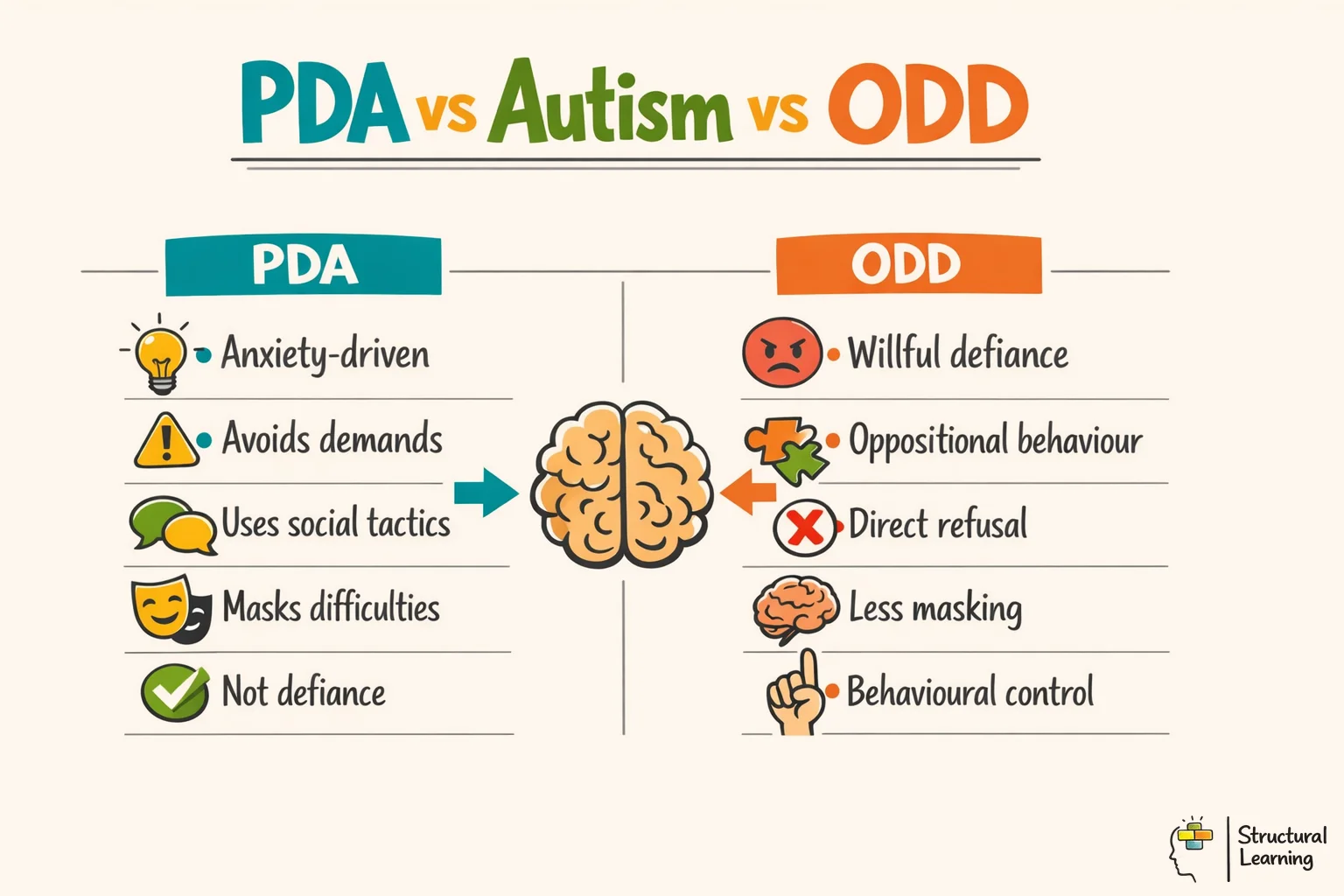
Notice the pattern in that table. Firm boundaries, clear consequences and consistent expectations work well for ODD. Yet these same approaches tend to escalate a child with PDA.
The structured, predictable environment that supports most autistic learners can itself become a source of demand for a child with a PDA profile. Every item on a visual timetable is another thing they are expected to do.
This is why accurate identification matters so much. The wrong strategy does not just fail to help; it actively causes harm. For a broader view of how different conditions present in the classroom, see our guide to social, emotional and mental health needs.
| Dimension | PDA Profile | Autism (without PDA) | ODD |
|---|---|---|---|
| Root cause of avoidance | Anxiety triggered by perceived demands | Difficulty with change, sensory overload, communication barriers | Anger, resentment or a pattern of hostile behaviour toward authority |
| Social understanding | Often appears socially capable; uses social strategies to avoid demands | Typically struggles with social reciprocity and reading social cues | Social understanding usually intact; defiance is targeted at authority figures |
| Response to praise and rewards | Often resists; praise itself can feel like a demand to perform again | Generally responds well to structured reward systems | Responds to clear, consistent reward/consequence systems |
| Response to direct demands | Escalation through excuses, distraction, withdrawal or meltdown | May comply with support; difficulty is often with understanding, not avoidance | Active refusal, arguing, blaming others |
| Role play and imagination | Often highly imaginative; may adopt personas to cope | Imaginative play may be limited or repetitive | Not a distinguishing feature |
| Variability | Highly variable day to day and even hour to hour | More consistent presentation, though anxiety can fluctuate | Relatively consistent pattern of defiant behaviour |
| Effective approaches | Indirect language, flexibility, low arousal, genuine choice | Structure, predictability, visual supports, clear expectations | Consistent boundaries, clear consequences, positive reinforcement |
Spotting PDA is harder than spotting most other special educational needs. These children are often the ones who slip through the net, precisely because their social surface can be so convincing. Here is what to look for and what teachers commonly get wrong.
The core feature is an extreme resistance to ordinary, everyday demands. This goes well beyond "I don't want to do maths." It includes demands that most children would not even register as demands: lining up, putting on a coat, answering the register, transitioning from one activity to the next. The child may use a wide repertoire of avoidance strategies. These range from distraction and negotiation ("Can I just finish this first?") through to excuses ("My hand hurts"), physical symptoms (genuine nausea or pain triggered by anxiety) and, when all else fails, explosive meltdowns or complete shutdown.
Cage and Troxell-Whitman (2019) found masking linked to worse mental health in autistic adults. Their study of autistic adults linked heavier masking with poorer wellbeing and exhaustion. The PDA Society's own survey of families reports that severe anxiety is common among children with a PDA profile, with school demands a frequent trigger.
What makes PDA especially tricky is the masking. Many children with a PDA profile present with what Newson called "surface sociability." They can appear chatty, engaged, even charming. They may make good eye contact and seem socially confident, traits that often lead teachers to conclude the child is not autistic.
But look more carefully. That sociability is often a tool for managing situations and controlling interactions. The child may dominate conversations, steer activities or adopt roles and personas. They might be the class clown, the storyteller, the one who always has an elaborate reason for not doing what was asked.
One of the most damaging misreadings is the idea that children with PDA "can do it when they want to." This is almost always wrong. What varies is not their willingness but their capacity.
On a low-anxiety day, the child has enough bandwidth to cope with demands. On a high-anxiety day, they do not. This variability is a hallmark of PDA, and it catches teachers out because it looks like choice. Understanding executive function can help you see why a child's capacity to comply changes so much from day to day.
Pay attention to what happens after school. Many children with a PDA profile hold it together all day through exhausting masking, then fall apart the moment they get home. Parents describe explosive behaviour, tears and complete withdrawal.
If a parent tells you their child is a different person at home, take that seriously. It does not mean the parent is doing something wrong. It means the child has spent all their energy managing demands at school and has nothing left. This pattern of emotional depletion connects closely to what we know about self-regulation and its limits.
Use different communication and task structures to support learners with PDA. Christie et al. (2011) and Gillberg (2014) documented these helpful methods. Reduce perceived demands, yet keep learning central (Newson et al., 2003; O'Nions et al., 2016).
The single most powerful change you can make is in how you phrase things. Direct demands ("Sit down," "Open your book," "Write three sentences") feel like a wall closing in for a child with a PDA profile. Indirect language reduces the sense of pressure while still communicating what needs to happen.
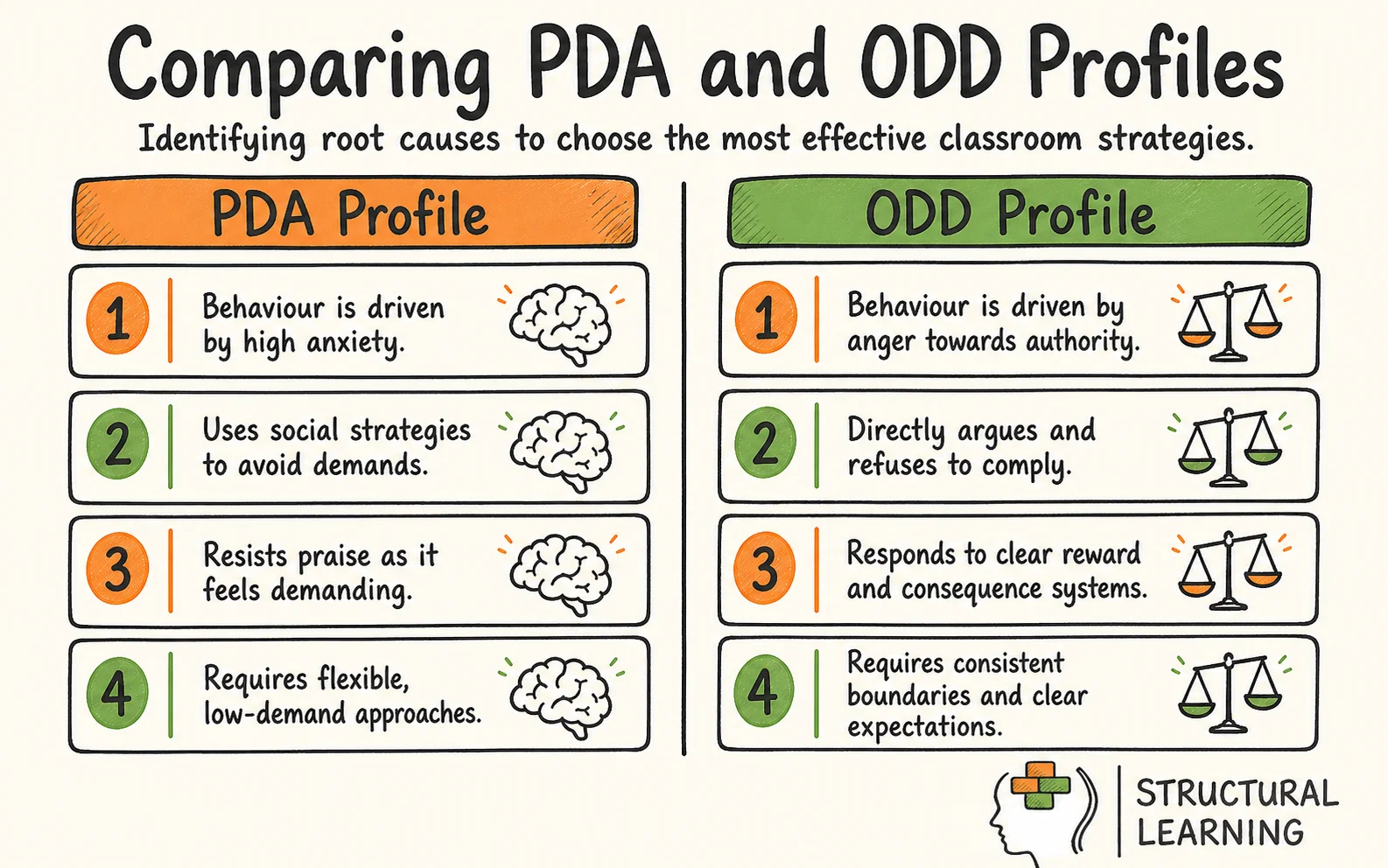
Instead of "Get your reading book out," try "I wonder if the reading books are on the shelf today." Instead of "You need to finish this by break," try "Some people like to finish before break so they have more free time." Instead of "Sit in your seat," try "I've put something interesting on your table." The shift is from instruction to invitation. You are removing yourself as the authority figure issuing the demand and reframing the activity as something the child might choose. This approach draws on the principles of emotion coaching, meeting the child where they are rather than where you want them to be.
Offering genuine choices is equally important. "Would you rather write your answer or record it?" gives the child a sense of control. But the choices must be real. Children with a PDA profile can detect a false choice instantly. "You can do it now or at break" is not a choice; it is a delayed demand, and they know it.
A low arousal approach supports learners with a PDA profile, so stay calm and keep your own manner relaxed. Reduce clutter in the room and limit the number of transitions the learner faces. Aim for a daily rhythm that is predictable but flexible.
Predictability helps autistic learners, but avoid routines that are rigid. Rigid routines can themselves become demands (Christie et al., 2012). Offer structure that can adapt to the child's day.
McDonnell and colleagues describe the low-arousal approach as a way of reducing the physical and emotional demands on a learner in crisis, and the PDA Society reports that schools using PDA-informed methods see fewer crises. Christie et al. (2012) state it aims to reduce anxiety to support learner engagement, not lower expectations.
Create a safe space in or near the classroom where the child can go when anxiety levels rise. This is not a punishment or a "time out." It is a proactive, agreed-upon strategy that gives the child an exit route before they reach crisis point. Having that escape available, even if they rarely use it, reduces background anxiety significantly. This connects to the broader principle of scaffolding: providing the right level of support at the right moment.
The thread running through all these strategies is the same: reduce the sense of demand, offer real control and stay calm. This is not about lowering your expectations for the child's learning. It is about finding a different route to the same destination.
Differentiation is not just about task difficulty. It is also about how you present, frame and communicate the learning.
Role play deserves special mention. Children with a PDA profile are often highly imaginative and comfortable taking on characters or personas. This is not attention-seeking; it is a coping mechanism.
A child who cannot comply as themselves may be perfectly able to comply as "Professor Science" or "the classroom inspector." Use this. Let the child adopt a role when they need to, and use drama-based approaches to teach content.
If the demand comes through a character, it can bypass the anxiety altogether. This connects to the broader value of oracy and spoken language as a route into learning.
| Situation | What Triggers Anxiety | Strategies |
|---|---|---|
| Transitions | Being told to stop one activity and start another; the new activity is an unknown demand | Give advance notice without pressure ("In a little while we'll be moving on"). Use a visual countdown if the child responds to it. Allow the child to finish their current activity or bring it with them. Frame the transition as their idea: "Do you want to be first or second to go through?" |
| Task demands | Being presented with a piece of work to complete; worksheets, writing tasks and timed activities are especially triggering | Break tasks into very small steps and present one at a time, not the whole sheet. Offer choice of task, order or method. Use novelty ("This is a bit different today"). Incorporate the child's interests wherever possible. Accept alternative ways of showing understanding: verbal, drawn, recorded, typed. |
| Social situations | Group work, unstructured social time (break, lunch), being expected to share, take turns or cooperate | Allow the child to choose their group or work alone. Use social stories to prepare for specific situations. Create structured activities during break times if unstructured time is difficult. Use role play to practise social scenarios. Children with a PDA profile often engage well with drama and character work. |
| Meltdowns | Accumulated demand overload; a final trigger that exceeds the child's remaining capacity | Stay calm, reduce non-essential demands and give space where safe. Keep communication calm and follow the agreed support plan. Follow the agreed safety, recording and safeguarding procedures. Offer a calm conversation later when the learner is ready. Identify what led up to it and adjust the plan. |
| Morning arrival | The transition from home to school; the weight of the whole day ahead | Allow a soft start: the child enters at their own pace and begins with a preferred activity. Avoid the demand of registration if possible (mark them in quietly). Keep greetings warm but low-pressure. Do not front-load the day with expectations ("Today we have a test"). |
| Homework | Schoolwork extending into the child's safe space (home); the demand follows them | Consider reducing or removing homework requirements. If homework must be set, make it genuinely optional or interest-led. Communicate clearly with parents so they are not adding pressure at home. Accept that home may need to be demand-free for the child to recover. |
Knowing what to avoid is just as important as knowing what to do. Many well-intentioned approaches, strategies that work perfectly well for most children, can be actively harmful for a child with PDA.
Direct demands and ultimatums. "You need to do this now" or "If you don't do X, then Y will happen" is the fastest route to escalation. The child's nervous system reads the demand as a threat, and they will fight, flee or freeze. This is not a conscious choice. Increasing the pressure will not produce compliance; it will produce crisis.
Even well-meaning encouragement like "Come on, you can do this!" can feel like demand. The intention is supportive, but the child hears "I expect you to perform."
Reward systems are common in primary schools, and sticker charts and house points are typical. These systems often fail for learners with PDA. Rewards put pressure on the learner to earn them.
Consequences make learners anxious about failing. So adapt these systems, or quietly exempt the learner from them (Christie et al., 2012).
Challenging behaviour prompts tighter control, like fewer choices. For learners with a PDA profile, this increases anxiety and avoidance, say Christie et al. (2011). More autonomy, with safe limits, helps, according to Gillberg et al. (2015) and O'Nions et al. (2016).
Public confrontation. Never deal with a child's demand avoidance in front of the class. Public attention raises the demand and the anxiety at the same time.
Deal with it quietly, in private and with no sense of urgency. A calm aside ("No rush, I'll come back to you") does far more good than a public order to get on with it.
Treating good days as the baseline. "But they managed it yesterday!" is perhaps the most common response, and the most damaging. What a child could do yesterday is not what they can do today. PDA goes up and down.
If you hold a child to their best day, you set a standard they cannot meet. It also tells the child that you do not understand what they are going through. This links to the wider principles of quality first teaching: meet learners where they actually are, not where you wish they were.
PDA does not stop at the school gate. Strategies work best when home and school use them in the same way. That means a real partnership with parents and carers.
Many parents of children with a PDA profile have spent years being blamed for their child's behaviour. They have been told their child "is fine at school", so the problem must be their parenting. By the time they reach you, they may be exhausted, defensive and doubtful that school will listen.
Families prefer brief daily messages to formal meetings, and schools that keep up that daily contact often report fewer crises (Gore Langton & Frederickson, 2016). PDA Society (2022) suggests a keyworker for each learner. This person talks with families and adjusts support quickly, with no senior leader approval needed for small changes.
Take families’ reports seriously, including differences between home and school. Record those differences and discuss possible explanations together. They do not, on their own, establish masking or a diagnosis.
Work together to identify which demands are most triggering and which strategies are working at home. Parents often have insights into their child's avoidance patterns that are invisible in the classroom.
Regular, informal communication works better than formal meetings for most PDA families. A quick message at the end of the day ("Good morning today, chose to do the maths activity, found the afternoon harder") helps parents prepare for what might come when the child walks through the door. It also builds the trust that makes more difficult conversations possible later.
| What the Teacher Sees | What the Teacher Thinks | What May Actually Be Happening (PDA) |
|---|---|---|
| Child refuses to start a task | "They're being lazy or defiant" | The demand has triggered a freeze response; the child cannot begin |
| Child makes excuses and distracts | "They're manipulating me" | The child is using the only strategies available to reduce unbearable anxiety |
| Child completes work at home but not at school | "They can do it when they want to" | The school environment has more perceived demands; home may offer more autonomy |
| Child is chatty and socially confident | "They can't be autistic" | Surface sociability is a PDA characteristic; the child uses social skill to control and manage interactions |
| Child has a meltdown over something small | "That was a massive overreaction" | Accumulated demand throughout the day has reached a tipping point; the small thing was the last straw |
| Child behaves well on Monday, refuses everything on Tuesday | "They're choosing to be difficult" | PDA capacity fluctuates significantly; anxiety levels vary day to day and even hour to hour |
| Child takes on a persona or character | "They're attention-seeking" | Adopting a role reduces anxiety; the character can comply even when the child cannot |
For outside agencies, the PDA Society (pdasociety.org.uk) is the main UK resource. They offer training, guidance for schools and information packs. These are worth sharing with your SENCO and senior leadership.
Ask the SENCO or the learner’s GP about the appropriate local assessment route. Share specific observations across settings and any existing reports. Do not promise that an assessment will provide a standalone PDA diagnosis.
Work with the SENCO, learner and family to record agreed support, the situations it addresses and when it will be reviewed. Share relevant information with the adults who need it to support the learner, following the school’s information-sharing procedures.
Include supply teachers, lunchtime supervisors and teaching assistants in the relevant support arrangements. Explain which approaches have helped this learner and which have increased distress, without assuming every direct request will be harmful.
Write the plan with the SENCO and the parents, keep it to one page, and share it with every adult the learner meets, including supply staff and lunchtime supervisors. It names what the learner looks like at each stage and what the adult does. In a Year 5 class the teacher keeps the plan taped inside the register; when a learner's jokes turn sharp during a maths starter, the teacher drops the demand, mentions the quiet corner in passing, and the learner takes the whiteboard there and finishes two questions unprompted.
Learners with PDA show an intense need to avoid normal demands. Common PDA signs, classroom presentations, and strategies appear below. A flexible, calm approach helps support learners with PDA, research by Newson et al (2003) suggests.
PDA is anxiety driven; strategies should cut demands and build trust. Work with specialists and the family. Consider the learner's needs (O'Nions et al., 2014). Relationships with learners are central to any PDA-informed approach.
| Symptom | How It Presents | Recommended Strategy |
|---|---|---|
| Resistance to Ordinary Demands | Extreme avoidance of tasks, procrastination, refusal to engage with routine requests | Use indirect requests, offer choices, maintain a calm environment |
| Social Manipulation | Surface sociability, controlling behaviour, may use charm or distraction to avoid tasks | Build trust, use creative engagement, provide consistency |
| Excessive Mood Swings | Emotional outbursts, low frustration tolerance, rapid shifts between moods | Teach relaxation techniques, provide a safe space, maintain a predictable routine |
| Comfort in Role Play and Pretend | Enjoys imaginative play, adopts personas, may use fantasy to avoid reality | Encourage role play in controlled settings, use it as a vehicle to teach social norms |
| Difficulty with Social Boundaries | Intrusive behaviour, struggles with peer relationships, may not respect personal space | Use social stories, teach social boundaries explicitly, create opportunities for guided social interactions |
| Obsessive Behaviour | focussed interests that dominate attention, routine-driven behaviour | Incorporate interests into learning, use visual supports to manage routines |
| High Levels of Anxiety | Overwhelmed by pressure, meltdowns when expectations feel unmanageable | Minimise surprises, provide clear expectations, use calming techniques |
| Understanding and Acceptance | PDA is often misunderstood as deliberate defiance rather than an anxiety-driven response | Educate yourself about PDA, validate feelings, maintain an understanding attitude |
| Adapted Communication | Direct instructions can trigger avoidance; language framing is critical | Phrase demands as suggestions or invitations, offer options rather than instructions |
| Low Arousal Approach | Learners escalate quickly in high-pressure or confrontational environments | Maintain a calm, low-stress atmosphere, minimise surprises, create a predictable environment |
| Flexible Approach | Rigid plans and non-negotiable rules increase demand avoidance | Be adaptable and creative, adjust plans as needed, implement creative solutions |
| Supportive Strategies | Learners benefit from visual and narrative-based scaffolding rather than verbal instruction alone | Use visual schedules and reminders, explain expectations through social stories |
| Professional Support | PDA requires specialist understanding beyond standard ASD approaches | Engage with therapists experienced in PDA, work with educators, implement school-based accommodations |
| Managing Anxiety | Anxiety underpins most PDA behaviours and must be addressed as the root cause | Teach relaxation and mindfulness techniques, establish safe retreats for when the learner is overwhelmed |
This pack provides classroom management resources. You can download posters, desk cards, and CPD materials. These resources support behaviour and positive relationships. Use them in classrooms and staff rooms.
Interoception detects internal body signals like hunger and emotions. Research by researchers such as Garfinkel et al. (2015) shows interoceptive variations in autism. Learners with a PDA profile may struggle to read internal states. A learner unable to sense rising anxiety cannot seek help, according to researchers such as Hanley et al. (2017).
Demand avoidance affects learners in ways that are easy to misread. A refusal may come from interoceptive differences, meaning trouble sensing signals inside the body, rather than defiance (Garfinkel et al., 2015). Learners feel anxious but struggle to show it.
Body-mapping helps learners name feelings early. This links to managing emotions, because knowing what is happening inside the body supports coping.
PDA is described as a profile within autism (Newson et al., 2003). ADHD and anxiety often occur alongside it. Hypermobility (very flexible joints) and pain make sensory problems worse (Eccles et al., 2015).
PDA may also appear alongside dyslexia or language difficulties. Each added difficulty raises the learner's anxiety and their need to avoid demands (Christie et al., 2011).
Token economies aid learners with ADHD, but might hinder learners with PDA (Christie et al., 2011). Plans should be adaptable, so teachers, psychologists, and therapists need to work together.
Additional UK guidance on EBSA and autism: Lincolnshire County Council EBSA guidance, PDA Society guidance on PDA and EBSA, Cognus EBSA guidance for schools and professionals.
Pathological demand avoidance is a profile in which a learner avoids everyday demands because they trigger anxiety. This makes teaching hard, and understanding the cause helps. Anxiety often drives learners to avoid demands (Newson et al., 2003). Learners may distract others to mask their fear.
Old behaviour plans may worsen learner anxiety. Use indirect language and give learners choices. Porges (2011) found calm classrooms help learners engage. Shanker (2016) and Perry (2006) noted less pressure helps regulate systems.
A teacher cannot distinguish PDA, autism or Oppositional Defiant Disorder from refusal alone. Record the context and the learner’s account, and discuss concerns with the SENCO and appropriate assessment team. Avoid assigning an assumed motive such as anger or a need for control.
The most common mistake is using rigid reward charts or strict consequences. Direct praise can also backfire, as it often feels like an expectation to perform well again in the future. Attempting to force compliance will usually result in a severe meltdown or complete withdrawal.
Newson noted demand avoidance in the 1980s. Studies suggest that a sizeable minority of autistic learners show the profile (Gillberg et al., 2015). Whether it is a distinct syndrome is still debated (Green et al., 2018). What researchers and practitioners do agree on is that lowering demands and offering choice reduces distress for anxious learners, whatever the label.
PDA is not a recognised diagnosis in DSM-5-TR or ICD-11, and that is the first thing a SENCO should say in any meeting where the label is used. The profile rests largely on parent-report questionnaires such as the Extreme Demand Avoidance Questionnaire, and Green et al. (2018), reviewing the literature in The Lancet Child and Adolescent Health, conclude that the evidence does not support PDA as an independent syndrome and that demand avoidance is better understood as a range of co-occurring difficulties within autism. Milton (2013) goes further, questioning whether the construct describes the child at all or mainly describes how adults experience the child.
The strategies themselves are better supported by practitioner consensus than by controlled trials. The main UK study of school experiences with extreme demand avoidance is a parent survey (Truman, Crane, Howlin and Pellicano, 2021), and the strategies families and staff rate as helpful, such as indirect language, choice and humour, are reported experience, not measured outcomes. Woods (2017) makes a sharper point: if avoidance is a rational response to an environment that issues demands the learner cannot meet, then the fault lies partly with the setting, and a within-child label lets schools off the hook.
There is a fairness problem too. The evidence base is almost entirely UK-based, white and middle-class in its samples, and the Timpson Review (2019) found that Black Caribbean and disadvantaged children are far more likely to be excluded, so the same behaviour is more likely to be read as defiance and answered with exclusion than reframed as anxiety. Post-pandemic rises in emotionally based school avoidance also get folded into PDA, when the two need different triage.
None of this makes the classroom advice wrong. Lowering demand, offering choice and avoiding public confrontation reduce distress for a wide range of anxious learners, whatever the label. The caution is about certainty: treat PDA as a useful working description, not a settled diagnosis, and keep the environment in the picture.
Christie et al. (2011).
Christie et al. (2012).
Eccles et al. (2015).
Garfinkel et al. (2015).
Gillberg et al. (2015).
Newson et al. (2003).
Newson et al. (1986).
O'Nions et al. (2014).
These peer-reviewed studies and authoritative texts form the evidence base for PDA support in schools.
Newson, Le Marechal, and David (2003) researched Pathological Demand Avoidance. Their 2003 paper, cited 312 times, asks if it's a separate developmental condition. Understanding this can help teachers support each learner.
Newson described the profile from 150 referred children seen over two decades. The paper lists six key PDA features still used in clinics. Newson suggested different strategies are needed for learners with PDA compared to other autisms.
Green, Absoud, Grahame, Malik, Simonoff, Le Couteur and Baird (2018) reviewed the evidence on extreme demand avoidance in autistic children and took a dimensional approach. The paper appeared in The Lancet Child and Adolescent Health, 2(6), 455 to 464.
Green et al. (2018) conclude that the evidence does not support PDA as an independent syndrome, and that the difficulties the term describes are best understood through the social, sensory and cognitive sensitivities of autism, common co-occurring conditions, and the child's environment.
Christie et al. (2012) wrote a book about Pathological Demand Avoidance. The book is widely used in UK special education. It helps teachers understand this syndrome in learners. It is published by Jessica Kingsley Publishers.
Christie et al. give teachers practical advice for supporting learners with PDA. They offer clear descriptions from a clinical perspective. Their analysis of children referred for PDA assessment highlights how frequently the profile is missed in earlier evaluations, which is useful context for SENCOs (Christie et al., 2012).
Masking and mental health in autism
Cage, E. and Troxell-Whitman, Z. (2019). Journal of Autism and Developmental Disorders. 262 autistic adults
Cage and Troxell-Whitman found that camouflaging heavily across settings, and switching between camouflaging and not, both went with poorer mental health. Teachers can see why learners with a PDA profile "cope" at school but struggle at home. Masking without safe downtime causes psychological harm (Cage & Troxell-Whitman).
Structural Learning's blog supports learners with special needs. It covers executive function and emotion coaching techniques. Scaffolding and self-regulation strategies are also explained. These resources will help you support learners .
PDA is not going away, and the number of children receiving this profile is growing as awareness improves. You do not need to be a specialist to make a difference. What you need is a willingness to see beyond the behaviour, an understanding that anxiety, not defiance, is driving what you observe, and the flexibility to adapt your practice accordingly. The child who cannot respond to "Sit down and open your book" may respond beautifully to "I've left something interesting on your desk. Take a look when you're ready." That shift in language costs you nothing. For the child, it changes everything.