Updated on
October 2, 2026
Learning Theories: The 8 Models Every Teacher Should Know
Learning theories explained for teachers: compare eight models, see where each came from and use a free planner to match a theory to your classroom problem.


Updated on
October 2, 2026
Learning theories explained for teachers: compare eight models, see where each came from and use a free planner to match a theory to your classroom problem.
What are learning theories?
Learning theories are evidence-informed explanations of how people learn. Teacher training usually groups them into four families: behaviourism, cognitivism, constructivism and humanistic learning. Four later views add social, experiential, transformative and networked learning, giving the eight covered here. Published lists run longer or shorter, depending on what each writer counts.
When a lesson stalls, a learning theory gives you a place to look. A weak routine, a heavy memory load, a clash with earlier ideas or a loss of confidence each points to a different fix, and each comes from a different tradition.
No single theory explains every learner, subject or lesson. Treat each one as a lens. It helps you ask a sharper question about why learning stalled, choose one change and check whether it worked.
This guide compares all eight, maps where each one came from and gives you a planner that matches a classroom problem to a lens. Each section ends with a route to a specialist guide, so you can go deeper on the theory you need. The Learning Theories collection brings every specialist guide together in one place.
Year 6 maths, comparing fractions. Model one comparison aloud and link it to what learners already know about equivalent fractions. Then give a new pair and ask each learner to say which is larger and why, with no prompt from you.
Year 9 science, forces. Ask learners to predict which of two balls of different mass lands first, test it, then explain any surprise. Follow with a short explanation from you and a second prediction.
Look for: learners who give the reason as well as the answer, and who succeed on the new case without waiting for your cue. If they struggle, go back to the model and take a smaller step.
The first example uses a behavioural and cognitive lens: a clear model, then practice with the prompt taken away. The second uses a constructivist lens: a prediction, a test and a clear explanation. Different theories explain the cue, the thought and the learner's own reading of the task. Modern research also treats learning as an interaction between the learner, the task and the wider setting (National Academies, 2018).
Start with the task, check what learners know, pick one useful change and then test it.
Learning theories propose processes through which experience produces lasting change. That change may affect knowledge, skill, understanding or action. Some theories focus on visible behaviour, while others look at mental models, personal meaning, social contact or the links that help people find facts.
A learning theory and a teaching method are different things. Retrieval practice, direct explanation, group enquiry and feedback are activities that a theory may support. Their classroom value also depends on the subject, task, prior knowledge and quality of teaching.
The boundaries between theories are often untidy. Cognitivism includes several accounts of memory and thought. Constructivist traditions differ in how they treat individual and social learning. Humanistic education is a broad view rather than a tightly defined experimental model.
Connectivism is influential in digital education, but scholars still debate whether it is a distinct learning theory.
This range can help teachers when the differences are clear. Imagine that a learner is stuck on an equation. A teacher could check earlier responses and working-memory demand. They could also check prior concepts, motivation and classroom relationships.
The learner may need more chances to rehearse the method, and each question comes from a different tradition that calls for different evidence.
Learning theory, educational theory and teaching method are three different things. A learning theory explains how learning happens inside a person. An educational theory is broader, because it can cover the aims of schooling, the curriculum and how schools should be run. A teaching method, such as retrieval practice or guided enquiry, is a choice a teacher makes. It may draw on several learning theories at once.
Theories are grouped by family and by the era they emerged. Shaded bands mark later views that bridge two families or grow from one.
Read the map from top to bottom. Behaviourism and early constructivist ideas both date from the first decades of the twentieth century, while cognitive models of memory grew in the 1950s and 1960s. The shaded bands show that the later views mostly grow from, or bridge, the older families rather than replace them.
The four foundational families give broad accounts of learning, while the four later views focus on set contexts or processes. The table compares each central question with a limited classroom use; it neither ranks the theories nor suggests that every lesson needs all eight.
On a smaller screen, swipe across to read all columns.
| Theory | Status in this guide | View of learning | Useful teacher question |
|---|---|---|---|
| Behaviourism | Foundational family | Experience changes visible responses through conditioning and consequences. | Which cue, response and consequence are shaping this routine? |
| Cognitivism | Foundational family | Learning changes mental models, knowledge and ways of processing information. | What must learners notice, connect, remember and retrieve? |
| Constructivism | Foundational family | Learners actively interpret experience through existing knowledge and social resources. | What prior idea will learners use, test or revise? |
| Humanistic learning | Foundational family | Learning involves the whole person, including purpose, choice, emotion and relationships. | What supports meaningful participation and responsible choice? |
| Connectivism | Later network perspective | Knowing includes forming and using links across people, information and tools. | Which source or connection is trustworthy and useful? |
| Transformative learning | Adult-learning perspective | Careful reflection and discussion can change a person's frame of reference. | Which assumption is evidence asking the learner to reconsider? |
| Social learning | Social and observational perspective | People can gain information by watching models and consequences. | What should learners notice in the model before they try? |
| Experiential learning | Experience and reflection perspective | Knowledge develops through experience, reflection, forming ideas and testing. | How will experience be examined and linked to a general idea? |
Open the full-size study note (PNG)
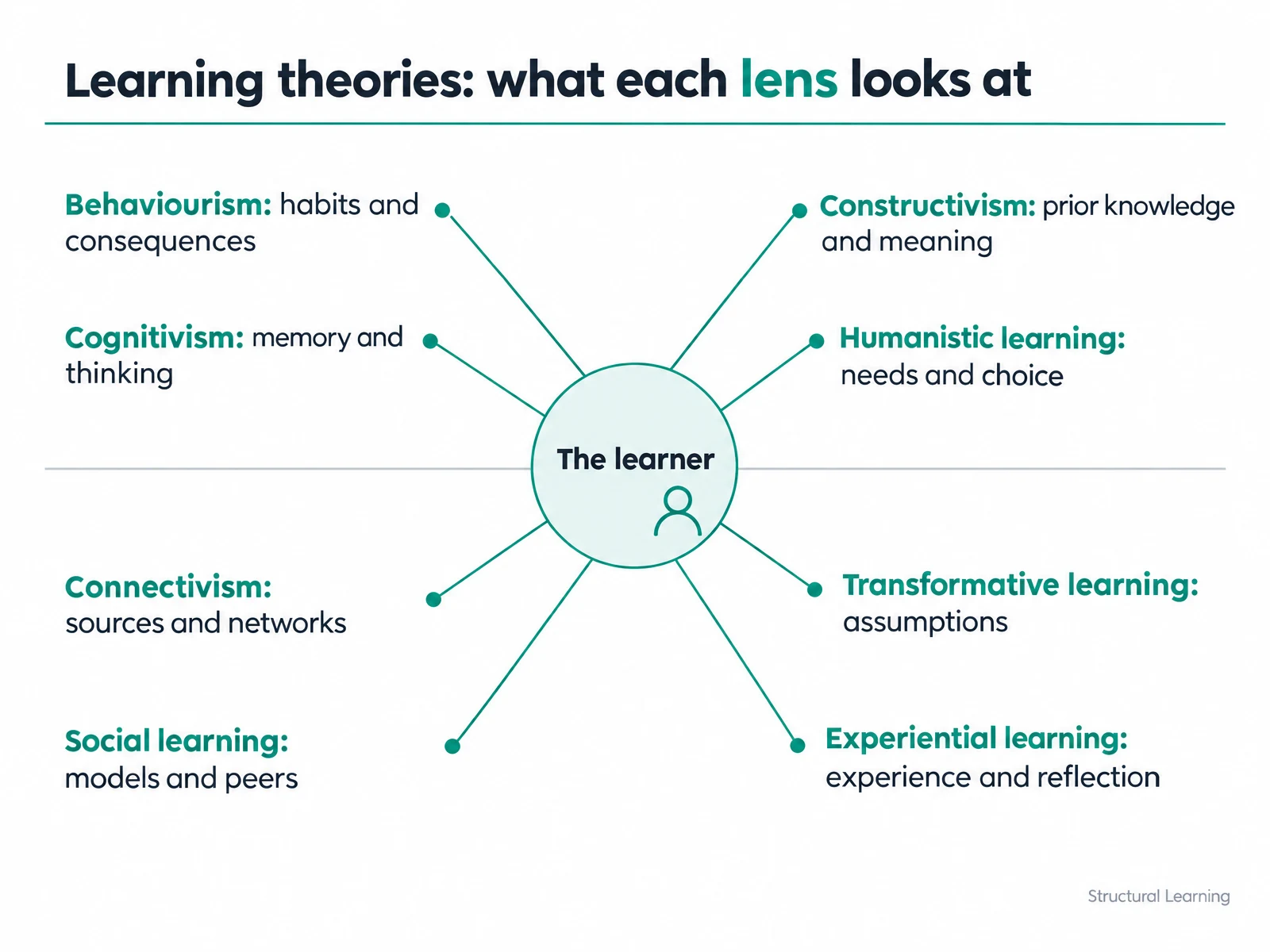
Four foundational families: Behaviourism focuses on observable behaviour and the effects of antecedents and consequences. Cognitivism focuses on attention, working memory, schemas and long-term memory. Constructivism focuses on how learners interpret new ideas through prior knowledge and activity. Humanistic learning focuses on agency, needs, identity, self-concept and growth.
Four further perspectives: Connectivism concerns learning through connections among people, information and digital networks, although its status as a distinct theory is debated. Transformative learning concerns adults critically examining and revising frames of reference. Social learning concerns observation, modelling and consequences. Experiential learning connects experience, reflection, conceptualisation and experimentation.
Match the lens to the question: Use behaviourism for a habit or routine, cognitivism for memory or explanation, constructivism for prior knowledge or meaning, humanistic learning for agency or belonging, connectivism for sources or networks, transformative learning for assumptions or perspective, social learning for models or peers, and experiential learning for experience or reflection.
Limits and safeguards: Theories overlap and simplify complex learning. They describe perspectives, not fixed learner types. Evidence varies by claim, age, subject, task and setting. A theory does not prove that every associated teaching method works.
Teacher decision: Name the learning goal, choose a useful lens, check the learner's response, then adjust.
Behaviourism explains learning through links between the environment and visible responses. It includes several traditions. Pavlov studied classical conditioning, in which a signal comes to trigger a response. Thorndike and Skinner studied how consequences change the chance of future behaviour. John B. Watson gave the movement its name, arguing that psychology should study behaviour rather than the mind.
These differences matter. Rewards in class belong to Skinner's operant account, which covers reinforcement and punishment. Pavlov's work on conditioned reflexes covers links between stimuli (Pavlov, 1927; Skinner, 1953).
In class, a teacher could use a clear visual cue before silent reading, teach the expected response and notice it accurately. They can then reduce prompts as the routine becomes secure. Practice, feedback and clear consequences can make routines more reliable, yet understanding needs more than rewards.
Rewards also have a known side effect. Nursery children who already liked drawing and were promised a certificate for it later chose to draw less in free play than children offered no reward (Lepper, Greene and Nisbett, 1973). This is the overjustification effect: an expected reward for something a learner already enjoys can reduce their interest once the reward stops. Use rewards to start routines learners have yet to value, and avoid promising them for work learners already enjoy.
A behaviourist analysis works best when the target response and conditions are visible. It says less about meaning, memory, identity or how a learner reads the task. Our guide to behaviourism in learning covers classical and operant conditioning, reinforcement and classroom cautions in depth. For the research behind reinforcement, see our guide to Skinner's operant conditioning.
Cognitivism treats learning as a change in what learners know and how they handle information. It looks past visible responses to attention, perception, memory, problem solving and language. It also covers metacognition, which means thinking about and managing your own learning.
There is no single cognitive learning theory. Models of memory, schemas and cognitive load answer different questions. A schema is an organised pattern of knowledge. Atkinson and Shiffrin's memory model proposed linked stores and control processes.
The model matters in the history of the field. Later work has refined it, so it gives only a partial map of memory today (Atkinson & Shiffrin, 1968).
A teacher with a cognitive lens asks what learners already know and what they must hold in mind. The next question is which practice will help them recall it. Worked examples may cut needless load for a novice. Retrieval shows whether knowledge is there without the first prompt. A concept map can show a missing link.
Emotion, behaviour and context still matter. Safety, motivation and the task all affect attention. Our guides to cognitivism, cognitive load theory and metacognition cover these topics in depth.
Constructivism says learners actively read experience and build or revise knowledge. Each learner builds a personal version of events, because existing ideas shape both what they notice and how they understand new facts.
Constructivism is a family, not one method. Piaget centred his account on changes in individual structures of thought. Sociocultural accounts stress language, cultural tools and taking part with others (Piaget, 1952; Vygotsky, 1978). These views overlap, yet each answers a different question.
In a science lesson, a teacher could ask learners which objects will float. Learners make a prediction, test it and explain a result that clashes with their prediction. The experience becomes instruction when the teacher points to the relevant link. The teacher must also make the new explanation clear.
Constructivism leaves room for direct teaching, so learners need not discover everything alone. Discovery with little guidance can overload novices. Models, prompts and worked examples can support the building of knowledge (Kirschner et al., 2006). Wood, Bruner and Ross (1976) introduced the term scaffolding.
Vygotsky never used that term. Read the specialist guides to constructivist learning, Vygotsky, Piaget and Bruner for their distinct topics. If you need to choose between the two most cited constructivists, Piaget and Vygotsky compared sets out their key differences side by side.
Humanistic learning places personal meaning, choice, emotion and relationships within learning. In education, Carl Rogers argued for helpful relationships. In these settings, learners can take responsible ownership of purposeful work (Rogers, 1969).
A humanistic lens asks whether learners feel respected and know the purpose of the work. It also asks whether they have a real degree of choice. A teacher could offer two valid ways to present an explanation. Both routes keep the same standard for the subject.
Choice stays within the learning goal and comes with guidance.
Maslow's account of human motivation has shaped humanistic education. People often show his hierarchy as a fixed pyramid. In that version, one need must be fully met before the next begins. This strict classroom reading goes beyond the original account.
That strict reading is a weak way to diagnose one learner.
Humanistic ideas remind teachers that a person experiences learning. Yet broad claims about self-actualisation are hard to test. They also leave open how subject knowledge grows. The humanistic psychology guide covers Rogers and Maslow in more depth.
For the person behind these ideas, our guide to Carl Rogers' theory shows where empathy helps in class and where it falls short on its own. Our guide to theories of motivation compares the wider motivation frameworks.
Connectivism says digital-age learning involves making, keeping and using connections across people, sources and digital systems. Siemens (2005) argued that finding current knowledge can matter alongside what a person already knows.
This view helps teachers examine how learners choose sources. A learner who compares two answers made by an AI tool needs enough subject knowledge to spot an error, check the claim and explain why one source deserves trust. Access to a network is one thing and understanding is another.
A useful task could ask learners to trace a claim to its first source, record how the source changed their judgement and explain what should stay in long-term memory. The network supports thought, yet the learner still needs knowledge and the skill to judge sources.
People often describe connectivism as a theory for the digital age, yet its status as a distinct theory remains debated. Some claims resemble distributed cognition, social learning or earlier accounts of knowledge networks. It is useful as a view of networked learning, not as proof that remembering is no longer needed.
Transformative learning describes a change in an adult learner's frame of reference. Careful reflection, discussion and revised action can support that change. Mezirow developed the account through research with adults returning to education, so its main focus is adult learning rather than routine classroom skill building (Mezirow, 1991).
An unsettling experience may reveal an assumption that no longer fits the evidence. Reflection alone gives no guarantee of change; the learner also needs time to examine reasons, hear other views and act on a revised judgement.
In teacher education, a participant could study examples that challenge a belief about ability grouping. They compare explanations, discuss the setting and plan a change that they can review. The goal is to review a frame that affects action, rather than to create discomfort or demand a set identity.
The theory concerns a change in perspective. Teachers should not use it for every moment when a learner changes their mind. Work with children and young people needs extra care. Their stage of development, power and safety all need attention.
Social learning theory explains how people can gain information by watching models and noting the results linked to action. Watching alone gives no guarantee of copying. Learners must attend to useful details, keep a mental record and be able to produce the action, while motivation affects whether they perform it (Bandura, 1977).
People often compress the history in the wrong way. The 1961 Bobo study used live adult models, while Bandura's 1965 study changed the consequences and helped separate learning an action from performing it. These were different studies, not stages in one event.
In class, a teacher can model how to check a calculation, name each decision point and then ask learners to try with feedback. A peer model may help when the comparison feels credible, but it can be no better than a teacher; the task and model quality matter.
The four component processes interact with each other. They work as a flexible set rather than a fixed order or a certain recipe. The Bandura social learning guide covers the study history and classroom modelling. Reciprocal causation, self-efficacy, self-regulation and agency belong to the later social cognitive theory account.
Experiential learning links direct experience with reflection, forming ideas and active testing. Kolb's model presents these as linked modes in a repeated process. It treats them as four linked modes rather than four lessons in one fixed order (Kolb, 1984).
Experience alone falls short. A learner can repeat a practical task without seeing the link that matters. Reflection helps when it points towards evidence and connects with a concept. Learners then need a chance to test the revised idea.
Consider a bridge-building task. Learners could compare where each design bent, link the pattern to force and structure, then change one feature in a second design. The task provides evidence, while teacher explanation and subject language help turn it into knowledge.
Kolb also proposed learning-style groups. Teachers should separate these groups from the cycle. Evidence offers no support for matching teaching to a learner's supposed fixed style (Pashler et al., 2008). Our Kolb learning cycle guide covers the model and its limits in depth.
Start from what you can see in the room, not from a favourite theory. The same class can need a behavioural fix for a routine and a cognitive fix for a topic in the same week. Choose the problem below that sounds most like yours. The planner names a lens, a question and one move to try next lesson.
Pick the problem that sounds most like your class. You get the lens to try, the question to ask and one move for your next lesson.
Your plan appears here once you choose a problem.
Treat the plan as a first test that the evidence can overturn. If the change brings no gain after two or three lessons, look again at the evidence and try another lens. A problem that looks behavioural, such as learners refusing to start, can turn out to be cognitive, because the task asks them to hold too much in mind at once.
Use a learning theory to make a problem clear, not to decorate a lesson plan. Start with the knowledge, skill or action that learners need and gather evidence about the current gap. Then choose the process most likely to explain it and select a response that you can check.
Combining theories means giving each idea one clear job, rather than piling on activities. A teacher could first model a procedure clearly. Learners could then explain the link beneath it and recall it alone. Behavioural, cognitive and constructivist ideas each guide a different part of that sequence.
Take a Year 8 maths class that can state a rule for expanding brackets but fails to use it in a new task. A cognitive lens asks what the class can recall and where the task adds load. A constructivist lens asks which old idea clashes with the new case. A social lens asks what the model made clear and what it hid.
The teacher can avoid choosing one camp. They can show the next step, ask learners to name why it works, then give a fresh case. The new work shows whether the change helped. If it failed, the teacher has clear signs for the next plan.
A second worked example, Year 4 history. Take a primary class that knows facts about the Romans but struggles to explain the link between them. More praise will not teach the link, and more free talk may not help either. The teacher can show one clear case, ask the class to compare it with a near case, then let each learner say what stays the same.
A short check at the end can show if the key link is now known. Here, theory picked no brand or fun task. It helped the teacher find the gap, choose a step and judge the result.
Here are the signals from these two examples, each paired with a next move:
| Learners state the rule but fail on a new case: | show one worked example, ask them to explain why each step works, then give a fresh case. |
|---|---|
| Learners know the facts but struggle to link them: | compare one clear case with a near case and ask what stays the same. |
| Learners copy the model but lose the method once prompts go: | remove the prompts one at a time and let them practise alone. |
| Learners lose interest in work they used to enjoy: | check whether a promised reward has replaced the reason for the work, and drop the reward. |
Some nearby theories answer different questions from learning theory. Use child development theories for change across childhood, personality theories for common patterns and social identity theories for group membership. Counselling theories cover therapeutic frameworks, while the education theorists guide covers named thinkers and their history.
When teachers describe their lessons on social media, they name routines, not theorists. Posts from the last two months, from teachers on both sides of the Atlantic, talk about predictable layouts, retrieval, worked examples and quick checks. Piaget, Kolb and Bandura rarely come up as planning tools, and scaffolding is discussed as a move without anyone naming Vygotsky. One quoted shorthand below, MWB, means mini whiteboard.
Teachers on social media describe routines rather than theorists. Each row gives a routine in their words, what you would see in the room and how far the research backs it.
| Routine, as teachers describe it | What you would notice | What the evidence says |
|---|---|---|
| Open with retrieval | ||
Start every lesson with retrieval practice |
Learners recall last lesson's content from memory before any notes come out. This is a cognitive routine. | Retrieval is among the best-supported findings in cognitive psychology. The benefit comes from effortful recall, not from the quiz format itself. |
| Worked examples on paper | ||
all of the worked examples and questions are provided on paper which stays in the room. |
Novices copy the structure of a worked example, then try a similar problem with the example removed. | Worked examples reduce the load on novices, and the advantage fades as learners gain expertise (Kirschner et al., 2006). |
| A predictable layout | ||
Predictable layouts lower cognitive load. |
The same page layout every lesson, so learners spend attention on the content, not on finding their way round the sheet. | Cognitive load theory predicts this gain. Classroom trials of layout alone are few, so treat it as a sensible default rather than a proven effect. |
| Quick checks for every learner | ||
Not Rosenshine per se, but basic classroom pedagogical skills like Name at End, Staggered Instructions, MWB Hover and Show |
Every learner answers on a mini whiteboard and the teacher scans the room before moving on. | Frequent checks are central to explicit instruction. They show the teacher who needs reteaching before misconceptions settle. |
| Scaffold the thinking | ||
It's not a right or wrong - the teacher is trying to scaffold the thinking. |
The teacher prompts and models during talk, then withdraws support as learners take over the reasoning. | Scaffolding comes from Wood, Bruner and Ross (1976). Its value depends on the support being removed as competence grows. |
Read the table as accounts of practice, not as proof. Most of the routines trace back to cognitivism, and the right-hand column says how far research supports each one. The theory is still doing the work: it explains why a routine helps, and when it stops helping.
Teachers and teacher educators on social media, on what learning theory is for. Their words, unedited.
I wrote the word Piaget dozens of times on multiple classes on many essays. Did it help me be a better teacher? Of course not
The generic principles of cog sci must be applied in subject sensitive ways.
Asking novices to discover everything for themselves confuses how experts work with the process through which expertise is built.
When people wrestle with concepts *before* direct instruction, the lesson sticks better.
If we have learned anything from the learning styles myth, it's that the content determines the form.
the toll on the teacher's working memory. Cognitive load theory should not just be a concern for students.
Two threads run through these posts. Teachers want each theory turned into a move they can make next week, and they want the myths, learning styles above all, cleared away early in training rather than years into the job.
For learners who are new to a topic, guided instruction usually beats discovery with little guidance. This is the sharpest debate the learning theories raise, because it sets cognitive and constructivist views against each other. A meta-analysis of 164 studies found that explicit instruction outperformed unassisted discovery, while discovery with feedback, worked examples or prompts outperformed other methods (Alfieri et al., 2011).
The same pattern appears in inquiry learning. Across 72 studies, guidance during inquiry improved what learners did, how well they performed and what they learned (Lazonder and Harmsen, 2016). Kirschner, Sweller and Clark (2006) explain the result through working memory: a novice searching for a solution has little capacity left to learn from it, so the advantage of guidance fades as prior knowledge grows.
Even so, a problem-first lesson can work well. Learners who tried a problem before being taught later understood the concept better than learners taught first, as long as the explanation still followed (Loibl and Rummel, 2014). So guide novices closely, and use a problem-first start only when a clear explanation comes straight after it.
The bar counts only the studies checked for this guide, so read it as a summary of those papers, rather than a vote across the whole field. In practice, a Year 8 science teacher could demonstrate how to control one variable, give a partly worked plan for a second test and only then set an open investigation.
Four more ideas turn up in training courses and in search results. Each is worth knowing, though none is one of the eight lenses above.
Multiple intelligences is a theory about the structure of ability, so it sits beside learning theories rather than inside them. Gardner (1983) proposed several relatively independent intelligences, such as linguistic, logical-mathematical, spatial and musical. Many teachers find it a useful reminder to offer more than one way into a topic.
The evidence is thinner than the popularity suggests. Researchers who study intelligence mostly find that mental abilities are related to one another. Little controlled research shows that teaching to a learner's strongest intelligence raises results. Use the idea to vary how you present content, and avoid labelling learners.
Situated learning says that people learn by taking part in real activity within a community, so knowledge is tied to the setting where it is used. Lave and Wenger (1991) described novices starting at the edge of a community of practice and taking on more of the work as their skill grows. It belongs to the sociocultural family alongside Vygotsky.
In school it shows up as apprenticeship, project work for a real audience and collaborative learning, where learners work towards a shared goal. A Year 10 design and technology class that builds a product for a real client is one example. A useful check is whether each learner has a real part in the task, rather than watching others do it.
Andragogy is Knowles's term for the teaching of adults, set against pedagogy, which originally meant the teaching of children. Knowles (1980) listed assumptions about adult learners: they direct their own learning, bring experience, want a reason to learn and prefer tasks that apply to real problems. It sits close to transformative and experiential learning.
Critics note that many of these traits describe good learning at any age, so treat andragogy as a planning checklist for adult groups. Staff training is a common place to use it. Start from what the group already knows and let people choose how to apply the idea.
No. Learning styles are a claim about personal preferences, and there is no evidence that teaching to them helps. The claim is that a "visual" or "auditory" learner learns best when lessons match that style. Pashler et al. (2008) set out the test this claim must pass and found almost no studies that met it.
Later work points the same way. A review of 17 meta-analyses found an average effect close to zero in the studies that tested matching directly (Hattie and O'Leary, 2025). Belief in matching is still common: across 37 studies of educators, a weighted 89% agreed with it (Newton and Salvi, 2020).
The useful question is what the content needs, whatever style a learner claims. A diagram suits a structure, a demonstration suits a skill and talk suits an argument, whoever is in the room.
Learning theories simplify complex processes. Their value depends on the question and the limits placed on the answer. A broad label can hide disagreements within a tradition. A simple diagram can also turn a careful account into a false classroom rule.
| Explanation is not effectiveness. | A method that fits a theory still needs relevant evidence. Age, subject, outcome and setting all matter. |
|---|---|
| Categories overlap. | Memory, motivation, social setting and behaviour interact. Their place in different theories does not make them separate systems. |
| Historical reach varies. | Classic studies may use animals, lab tasks, adults or narrow cultural settings. Teachers should take care when applying them more widely. |
| Popular versions can distort. | Pavlovian conditioning becomes rewards. Constructivism becomes discovery without guidance. Maslow becomes a fixed pyramid. Kolb becomes a learner label. |
| Individual differences are not learning styles. | Learners differ in knowledge, language, disability, interest and experience. Evidence does not support matching lessons to fixed visual, auditory or kinaesthetic types. |
A sound use of theory is therefore provisional. State what it can help explain, what it leaves open and which evidence would change the teaching choice. Modern summaries stress the joint role of prior knowledge, culture, motivation, setting and the design of practice rather than one universal process (National Academies, 2018).
Theories seldom predict what works in class. Most explain learning after the event, and few say which method will win in a particular room. Classroom studies usually compare whole programmes, so a good result for one method shows little about which theory is right. Use a theory to choose what to test, then let your learners' responses decide. Treat every classroom suggestion in this guide as a hypothesis, and keep it only if your own learners' work improves after a few lessons.
The evidence varies by claim. Findings from a lab task may not carry over to a classroom, and results for one age group or subject may not carry over to another. The evidence check above counts only the studies reviewed for this guide. Read the original papers before you build a policy on them.
Some popular ideas have weak support. The learning styles myth, matching teaching to fixed styles, has almost no backing. A strict Maslow pyramid goes beyond what Maslow wrote. Teaching to a learner's strongest intelligence has little controlled evidence behind it. Treat all three as reasons to vary your teaching, and avoid labelling learners.
Most theories on this page, and many related ones, have their own specialist guide. They are grouped by family below, with a line on what each one covers, so you can go straight to the guide behind your question.
Start with the guide for the problem you noticed this week. Try one change it suggests in your next lesson, then check whether the learning moved before you reach for another theory.
Useful answers define the scope before naming a model. Lists differ because some writers group broad families, while others include specialised views. Compare the process each theory explains, the evidence behind the method and the limits on its classroom use.
Behaviourism, cognitivism, constructivism and humanistic learning are four common foundational families in education. This list organises the field usefully without covering every view. Social, experiential, transformative and connectivist views add questions about models, experience, changing assumptions and knowledge networks.
No learning theory is best for every outcome. Behavioural analysis may explain a weak routine, while cognitive analysis may explain a memory problem. The useful choice depends on the goal, the learner's current knowledge, the task and the evidence for the proposed method.
Teachers can use ideas from more than one theory when each has a clear job. Combining theories should make the sequence clearer, not crowd the lesson. Model what matters, link it to prior knowledge, give useful practice and then check whether learners can act without support.
Many university guides list five: behaviourism, cognitivism, constructivism, humanism and connectivism. This guide keeps the first four as the foundations and treats connectivism as a newer view whose status is still debated. It adds social, experiential and transformative learning because teachers meet them often in training.
There is no fixed number, because each writer decides what counts as a theory and how to group related views. Published lists vary in length for that reason. This guide uses four foundational families and eight lenses. The figure below shows how the five- and seven-theory lists relate to it.
Lists differ because writers count differently. Check what a list includes before you compare it with another.
Lists of seven differ, so check what each one includes. A common version takes behaviourism, cognitivism, constructivism, humanism and connectivism, then adds social learning and experiential learning. Adding transformative learning gives the eight in this guide.
A learning theory is an explanation of how people come to know or do something new. It tells you what to look at when learning stalls, such as habits, memory, earlier ideas or motivation. It gives no instruction on which activity to run, so check it against what your learners actually do.
Adults learn through the same basic processes as children, so memory, practice and feedback still matter. Transformative and experiential learning were developed with adults in mind. They help most when the goal is to change a belief or a professional habit, as in teacher training. Andragogy, covered under other theories above, adds a planning checklist for adult groups.
No. Learning theories explain processes that change knowledge, skill or behaviour, while child development theories examine wider patterns of change across childhood. The fields overlap, yet a developmental claim gives a teacher no method and a learning method gives no proof of a stage.
Bloom's taxonomy classifies learning objectives by the thinking they demand, from remembering facts to creating something new in its revised form (Bloom et al., 1956; Anderson and Krathwohl, 2001). It sorts goals and says little about how learning happens, so it works as a planning tool beside the theories. Use it to pitch questions and tasks, then use a learning theory to explain why a task worked or failed. The wider taxonomy family also covers affective and psychomotor domains, which deal with feelings and physical skill.
Vygotsky is usually placed with constructivism, in its sociocultural branch, rather than with cognitivism. He studied how thinking develops through language, tools and other people. Cognitivists focus more on processes inside the individual, such as attention and memory. The two traditions overlap, so some writers place him in both.
A learning perspective is the angle a theory takes on learning: the process it treats as central and the evidence it looks for. Behaviourism looks at behaviour and its consequences, cognitivism at memory and thinking, and constructivism at how learners build meaning. Picking a perspective means picking a question to ask about your class.
Most of the classic learning theories grew out of psychology. Skinner, Piaget and Bandura were all psychologists. Education research then tested and reshaped them for classrooms and added views such as connectivism and transformative learning. Read them as psychological accounts that need checking against what happens in real lessons.
A learning theory helps you ask what an AI tool is doing for learning. A tool that gives instant answers may support practice and feedback, yet it can remove the effortful recall that the cognitive view says builds memory. A tool that explains step by step can lower the load for novices, though learners still need enough knowledge to check what it says. Ask which process the tool supports, then test it with a learner response.
Vygotsky's theory says that learning begins between people and then becomes part of how an individual thinks, so social interaction drives development (Vygotsky, 1978). Talk, shared tools and help from a more skilled partner come first. The learner then takes over the thinking alone. The zone of proximal development is the gap between what a learner can do alone and what they can do with support. In class, that means modelling, prompting and then withdrawing help as skill grows.
Piaget's theory says that children build knowledge by acting on the world and adjusting their mental structures, called schemas, as new experience arrives (Piaget, 1952). Assimilation fits new information into an existing schema. Accommodation changes the schema when it no longer fits. Piaget also proposed four stages of cognitive development. Teachers use the theory to offer concrete experience and to notice when a learner's current schema blocks a new idea.
Yes for printables: the cheat sheet and the question stems sheet on this page are free A4 PDFs, and the study note above comes with a text version. We have not published a slide deck, but the comparison table works as a single slide for a staff session. For a book, start with How People Learn II (National Academies, 2018), then read the original source for any one theory, such as Bandura (1977) or Kolb (1984).
Alfieri, L., Brooks, P. J., Aldrich, N. J., and Tenenbaum, H. R. (2011). Does discovery-based instruction enhance learning? Journal of Educational Psychology, 103(1), 1-18.
Human memory: A proposed system and its control processes
Atkinson, R. C., and Shiffrin, R. M. (1968). In The Psychology of Learning and Motivation, 2, 89-195.
Hattie, J., and O'Leary, T. (2025). Learning Styles, Preferences, or Strategies? An Explanation for the Resurgence of Styles Across Many Meta-analyses. Educational Psychology Review, 37(2), 31.
Kirschner, P. A., Sweller, J., and Clark, R. E. (2006). Why minimal guidance during instruction does not work: An analysis of the failure of constructivist, discovery, problem-based, experiential, and inquiry-based teaching. Educational Psychologist, 41, 75-86.
Lazonder, A. W., and Harmsen, R. (2016). Meta-Analysis of Inquiry-Based Learning. Review of Educational Research, 86(3), 681-718.
Lepper, M. R., Greene, D., and Nisbett, R. E. (1973). Undermining children's intrinsic interest with extrinsic reward: A test of the "overjustification" hypothesis. Journal of Personality and Social Psychology, 28(1), 129-137.
Loibl, K., and Rummel, N. (2014). The impact of guidance during problem-solving prior to instruction on students’ inventions and learning outcomes. Instructional Science, 42(3), 305-326.
National Academies of Sciences, Engineering, and Medicine. (2018). How People Learn II: Learners, Contexts, and Cultures. National Academies Press.
Newton, P. M., and Salvi, A. (2020). How Common Is Belief in the Learning Styles Neuromyth, and Does It Matter? A Pragmatic Systematic Review. Frontiers in Education, 5, 602451.
Learning styles: Concepts and evidence
Pashler, H., McDaniel, M., Rohrer, D., and Bjork, R. (2008). Psychological Science in the Public Interest, 9, 105-119.
The role of tutoring in problem solving
Wood, D., Bruner, J. S., and Ross, G. (1976). Journal of Child Psychology and Psychiatry, 17, 89-100.