Updated on
September 24, 2026
What Are Learning Styles? Models, Evidence and Alternatives
Learning styles theory says learners prefer a visual, auditory or kinaesthetic mode. What the models claim, what the evidence found, and what to do instead.


Updated on
September 24, 2026
Learning styles theory says learners prefer a visual, auditory or kinaesthetic mode. What the models claim, what the evidence found, and what to do instead.
Learning styles theory suggests that people learn best when information is presented in their preferred format, whether visual, auditory, or kinaesthetic. However, decades of scientific research reveal a surprising truth: there's virtually no evidence that matching teaching methods to supposed learning styles improves educational outcomes. Despite being widely embraced by educators and students alike, multiple systematic reviews and controlled studies consistently show that learning styles have no meaningful impact on learning effectiveness. So why does this persistent educational myth continue to thrive in classrooms worldwide, and what does actually work for helping people learn better?
However, Pashler et al. (2008) found little evidence supports tailoring teaching to match learners' preferred styles. Willingham et al. (2015) also questioned this approach. Many learners may do well regardless of how they are taught. Riener and Willingham (2010) suggest educators use strategies proven effective for most learners.
Learning styles are popular, but lack strong proof. Studies (e.g. Pashler et al., 2008) show matching styles and teaching does not improve learning. Labelling a learner may limit them (Kirschner, 2017). Many now view learning styles as a neuromyth (Howard-Jones, 2014).
Dual coding and oracy learning show promise (Paivio, 1971). These methods boost memory and understanding through varied experiences. They avoid learner labelling, unlike learning styles. Instead, they enrich learning by engaging different brain pathways.
In this article, we aim to unpack the theory of learning styles, explore the origins of its appeal, and clarify where it stands in light of current evidence. While some elements of the theory may overlap with sen, separate what feels intuitively right from what research supports.
Pashler et al. (2008) found little proof that matching teaching to learning styles helps learners. Coffield et al. (2004) saw that many learning style models were unreliable. Hattie (2009) showed varied teaching (visual, verbal, kinaesthetic) benefits all learners.
Learning styles suggest learners prefer visual, auditory or kinesthetic methods. Proponents claim teaching matched to this boosts engagement and learning. Despite research (circa 2000s) showing little support, this became popular in UK schools. (Coffield et al., 2004; Pashler et al., 2008).
Teachers often believe in learning styles, despite the research. Pashler et al. (2008) and Kirschner (2017) found little evidence for this theory. Willingham et al. (2015) say matching teaching to learning styles doesn't improve learner engagement.
However, Pashler et al. (2008) found little evidence for learning styles. The concept suggests learners retain material best through specific methods. Riener and Willingham (2010) argue educators should use evidence-based strategies.
Remove recommendations to use learning styles in practice, or clearly frame them as debunked approaches. Kinesthetic learners may prefer practical work and active lessons (Dunn and Dunn, 1978). Use varied methods to reach all learners, said Fleming and Mills (1992).
Learning Style Inventories help learners identify their preferred learning style. These tools assess how learners prefer to learn (Kolb, 1984). The inventories ask about study environments, information processing, and enjoyable activities (Honey & Mumford, 1986; Felder & Silverman, 1988).
Once you know your learning style, you can tailor your study strategies to better suit your individual needs and preferences. The theory being that this can lead to more effective learningand better.
Learning styles inform some teaching. For example, use visuals with visual learners. Kinesthetic learners like hands-on work, auditory learners discussions. Knowing learning styles helps teachers meet diverse learner needs (Pashler et al., 2008; Riener & Willingham, 2010).
The VARK Model of Learning Styles
Neil Fleming created the VARK model of learning styles in 1987. The VARK model says learners learn in four ways. These are auditory, visual, kinaesthetic and through reading/writing. For phase-specific guidance, see our guide on why learning styles have been debunked.
Visual learnerstend to learn the best through pictures and other forms of vi suals. Teachers were encouraged to teach according to the students 'preferred Personal Preference' using graphic displays like diagrams, charts, videos, handouts, and illustrations.
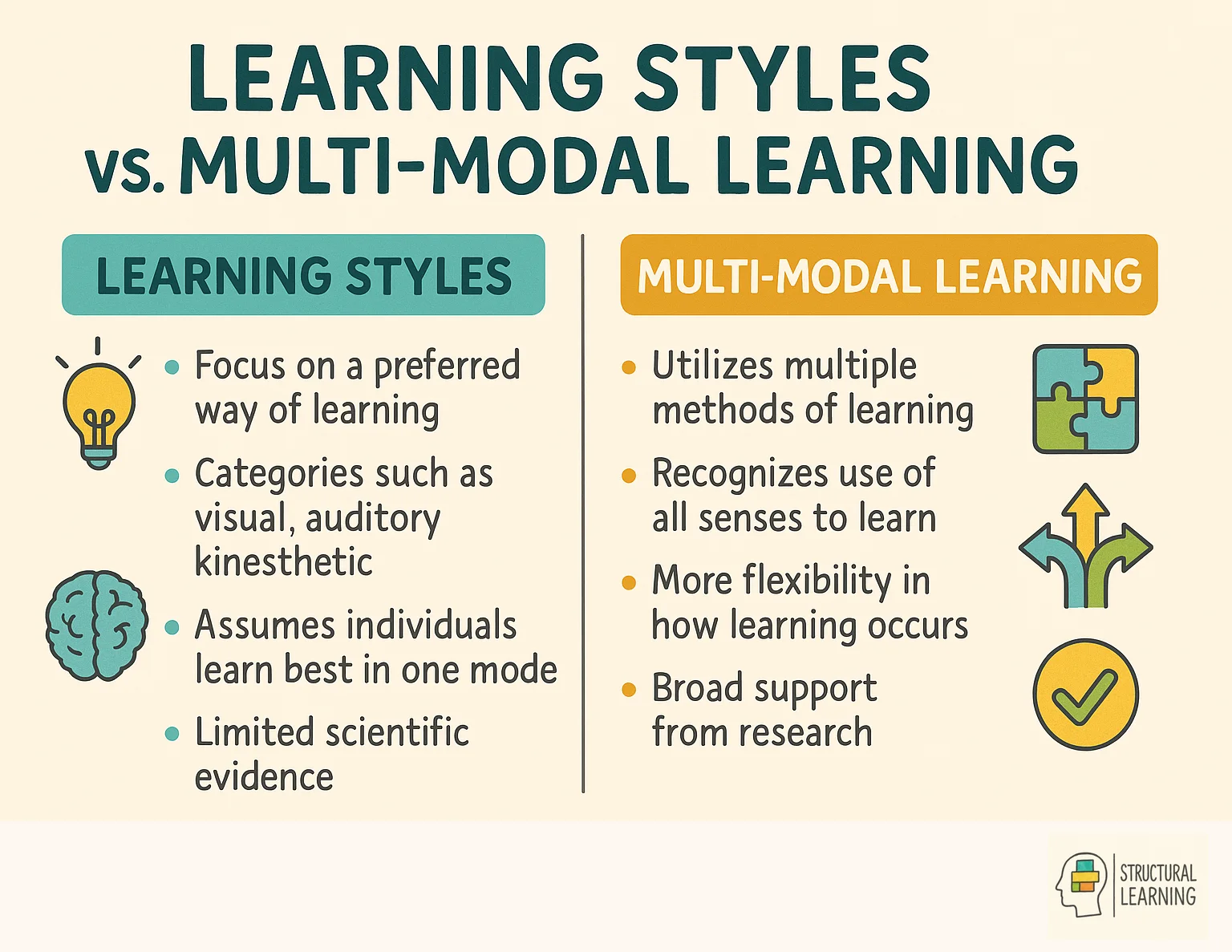
Paivio's (1971) dual coding theory suggests that combining verbal and visual information enhances learning for all individuals, not that some learners are inherently 'visual learners'. These learners prefer seeing information over hearing or reading it, like findings from Dwyer (1978) show.
The learner reviews any pictures or visual material, visualises information, rewrites or copies notes, and studies diagrams (Pritchard, 2009). They prefer material in a visual format (Husmann & O’Loughlin, 2018). Visual learners may draw pictures and diagrams, and are organised (Park, 2016). Teachers can identify study habits (Pritchard, 2005).
Proponents of the theory claimed that the most effective teaching and retention of material occurred through these Visual Learning methods.
Auditory learners learn best through sound and music. They retain information better when using recordings (VARK model). Teachers should identify auditory learners and let them record lessons. (Fleming, 1995) This helps their learning.
Teachers assess learner behaviour. They may also move learners beyond learning style tests (Pashler et al., 2008). Teachers then spot habits (Duckworth, 2016; Clear, 2018).
Kinaesthetic learners learn best by touching and doing. Teachers see kinaesthetic learning when learners use role-play (Kolb, 1984). Hands-on tasks and physical movement also help these learners (Gilstrap & Dupree, 2008).
Research shows physical movement helps learners remember information better. VARK model indicates kinesthetic learners prefer physical activity to lectures or videos. (Fleming & Mills, 1992; Fleming, 2001)
Researchers explore how teachers judge learner behaviour. They also examine factors beyond learning style assessments. This helps determine useful habits.
Focus on varied learning activities as there is limited support for learning styles. Cater to different learner preferences, but avoid labelling learners. (Pashler et al., 2008; Kirschner, 2017; Coffield et al., 2004).
Use varied methods like visuals and activities. Let learners explore learning strategies that suit them. Avoid labelling them by "style". Encourage flexible learning habits; these will help learners more (Kirschner, 2017).
Research shows diverse methods work best, not fixed "learning styles". Visuals help learners grasp maths, (Willingham, 2005). Auditory exercises boost listening skills (Pashler et al., 2008). Match teaching to content needs, not learner type (Riener & Willingham, 2010).
Consider: 'How best to teach this topic?', not 'What's the learner's style?'. This changes focus to flexible teaching for each subject. Daniel Willingham's research shows matching methods to content works better than matching to learner preference. (Willingham, 2005).
Focus on instruction, not learning styles, when learners struggle. Check for sufficient practise, clear explanations, and proper scaffolding. Research shows this helps all learners more than categorisation (Pashler et al., 2008; Willingham et al., 2015).
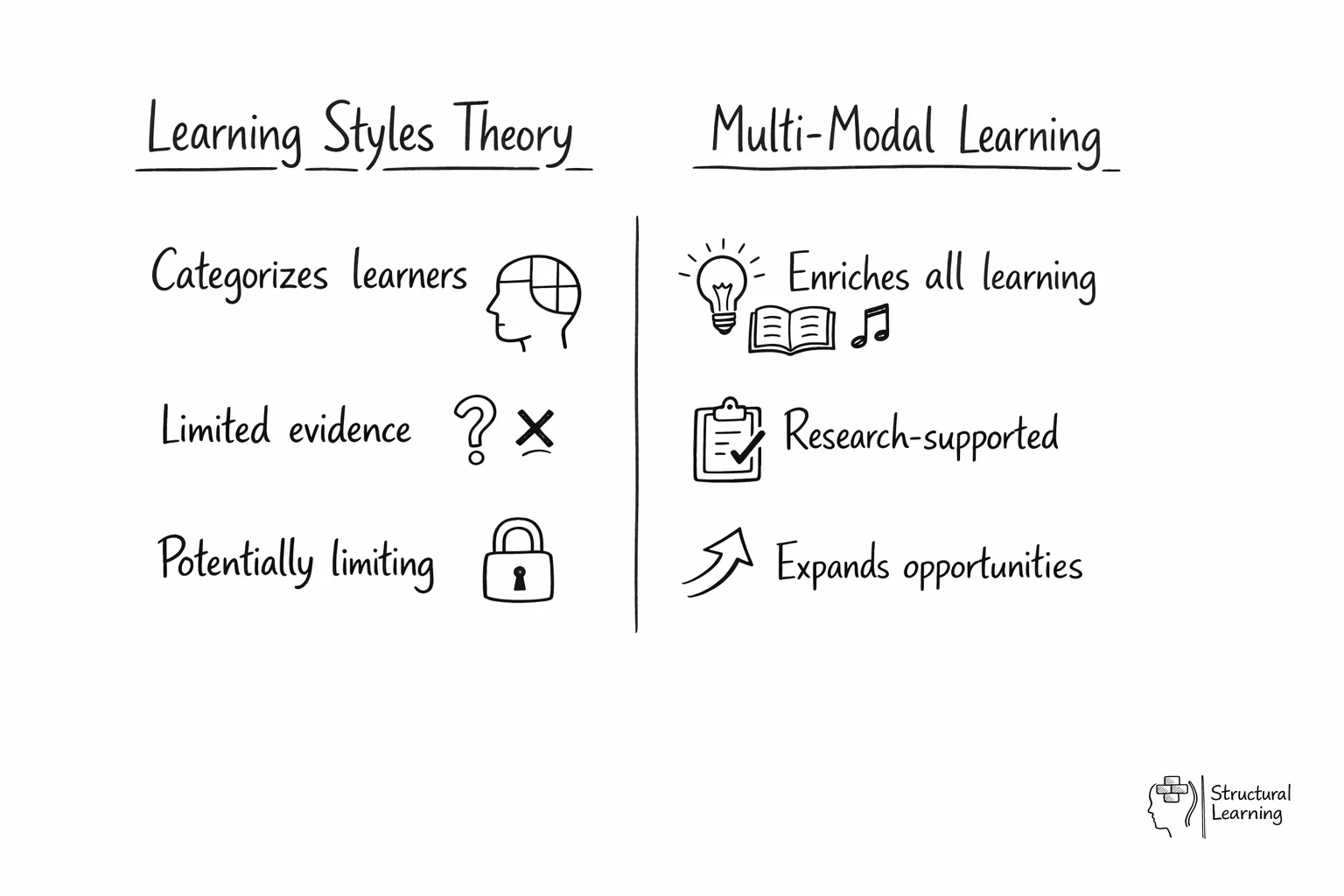
AI-powered adaptive learning systems now provide research-backed personalisation that sidesteps the flawed assumptions of traditional learning styles theory. These platforms use machine learning algorithms to analyse real-time analytics from learner interactions, creating dynamic personalisation based on actual performance data rather than self-reported preferences. Unlike static learning style classifications, algorithmic differentiation adjusts continuously as learners demonstrate mastery or struggle with specific concepts.
Consider a Year 7 maths teacher using an adaptive platform during fraction work. While traditional learning styles might label Sarah as a "visual learner" and restrict her to diagrams, the AI system tracks her response patterns across multiple modalities. The learning analytics reveal she actually performs best with numerical examples followed by word problems, prompting the algorithm to sequence content accordingly for her next session.
Research by Walkington and Bernacki (2020) demonstrates that adaptive learning systems significantly outperform fixed instructional approaches because they respond to evidence of learning rather than assumptions about preference. The DfE's 2024 AI in Education strategy explicitly supports this data-driven instruction model, recognising that effective personalisation requires continuous assessment rather than upfront categorisation.
However, teachers must remain critical consumers of these technologies. While AI adaptive learning offers promising alternatives to learning styles theory, the algorithms require careful monitoring to ensure they promote genuine understanding rather than simply optimising for task completion. Data-driven instruction works best when teachers understand both the technology's capabilities and its limitations in supporting meaningful learning outcomes.
Meta-analyses provide the most comprehensive picture of learning styles research by combining results from hundreds of individual studies. These large-scale reviews consistently reveal a troubling pattern: when researchers test whether matching teaching to learning styles improves outcomes, they find no significant benefit. A landmark meta-analysis by Kavale and Forness (1987) examined 39 studies and found that matching instruction to learning styles produced negligible effects on student achievement.
More recent meta-analyses have reinforced these findings. Newton and Salvi (2020) reviewed studies from higher education settings and discovered that 89% of recent research papers still promoted learning styles despite the lack of supporting evidence. Perhaps most telling, they found that studies with better research designs, such as randomised controlled trials, were more likely to show no benefit from learning styles approaches. This suggests that when we control for other factors, the supposed advantages of learning styles disappear.
What should teachers take from these findings? Rather than spending time assessing individual learning styles, focus on scientifically supported strategies that benefit all learners. For instance, combining visual diagrams with verbal explanations helps everyone understand complex concepts better, regardless of their supposed style. Similarly, giving students opportunities to practise new skills actively engages all learners more effectively than passive listening or reading alone.
The meta-analyses point towards a more practical approach: use varied teaching methods not because students have fixed styles, but because different content demands different presentations. When teaching the water cycle, combine diagrams, discussions, and hands-on experiments. This multimodal approach ensures all students encounter the material in ways that reinforce understanding, without the need to categorise learners or limit teaching methods based on questionable style assessments.
Willingham (2009) says cognitive science shows how learners learn in 'Why Don't Learners Like School?' The Education Endowment Foundation reviews teaching, including learning styles. Ratings help teachers pick methods that improve learner outcomes.
Pashler et al. (2008) reviewed learning styles research critically. Sweller's cognitive load theory gives useful instructional frameworks. Retrieval practice and spaced repetition help learners succeed. Dual coding theory also supports learning in classrooms.
Learning styles are popular, but Pashler et al. (2008) found little proof they work. Willingham's analysis showed learners prefer certain presentations. These preferences don't mean learners learn better with tailored teaching.
Learning styles persist due to their simple appeal, not scientific proof. Research shows teaching methods should match content, not the learner. Visuals work for spatial information. Verbal steps aid sequential processes (Kirschner, 2017). This is regardless of supposed learning preferences.
Kirschner and De Bruyckere (2017) suggest research-backed teaching strategies. Avoid categorising learners by supposed "learning styles." Vary teaching methods to match the curriculum instead. Use formative assessment to adjust teaching based on learning, (Willingham, 2009).
John Sweller's cognitive load theory shows how to improve learning. Teachers can manage learners' mental effort by presenting information well. Break down tasks and use worked examples before learners work alone, suggests Sweller.
Retrieval practice and spaced repetition help learners remember more long term. Ebbinghaus showed recall improves memory. Roediger and others found recalling benefits learners more than re-reading. Teachers, use tests and flashcards (Ebbinghaus, Roediger).
Allan Paivio showed that dual coding, using words and visuals, improves learner understanding. Instead of tailoring to learning styles, give varied examples. Have learners explain their reasoning; this boosts comprehension (Kirschner, Sweller & Clark, 2006).
Learning style myths persist in classrooms, despite years of study. Teachers often think learners learn best when teaching matches their style. Yet, research by Pashler et al. (2008) shows matching styles does not improve learner results. Their review found no real proof to support this idea.
Some believe fixed learning styles determine a learner's ability. This belief limits chances and creates issues. Sweller's (1988) theory shows information structure matters most. Research supports scientifically supported methods over style accommodations (Pashler et al., 2008).
Effective teaching uses varied methods. Teachers should present content in diverse ways to support each learner. This approach benefits all, regardless of "learning styles" (Pashler et al., 2008). Do not restrict learners to preferred methods, Willingham et al. (2015) advise.
The meshing hypothesis is the core claim behind learning styles: if you match instruction to a learner's preferred style, they learn better. Pashler et al. (2008) conducted the definitive systematic review of this idea. They found that almost no studies used the research design needed to test it properly, and those that did found no support.
Coffield et al. (2004) reviewed 71 different learning style models. Their conclusion was damning: none of the 13 most influential models met adequate standards of reliability and validity. The models could not even consistently identify which "style" a person had, let alone demonstrate that matching instruction to it improved outcomes.
Husmann and O'Loughlin (2019) tested the hypothesis with medical students. Learners identified their preferred styles and were given strategies matching those preferences. The result: study strategies did not correlate with better grades. Learners who studied in their "preferred" style performed no better than those who did not.
Despite the evidence, learning styles remain the most persistent neuromyth in education. Newton and Miah (2017) surveyed UK higher education teachers and found 93% believed learners learn better when taught in their preferred style. Dekker et al. (2012) found it was the number one neuromyth among teachers internationally.
| Approach | Based On | Evidence |
|---|---|---|
| Learning styles | Learner preference | No support (Pashler, 2008) |
| UDL | Flexible access for all | Strong (CAST research) |
| Prior knowledge differentiation | Cognitive load theory | Very strong (Sweller, 1988) |
| Rosenshine's Principles | Cognitive science | Very strong (Rosenshine, 2012) |
Howard-Jones (2014) explains why: the idea feels intuitively right. Teachers observe that learners differ, and the explanation that they have different "styles" provides a neat, simple framework. The problem is that the real explanation is more complex. Learners differ in prior knowledge, working memory capacity, motivation, and interest, not in fixed "styles".
There is also a confirmation bias problem. Multimodal teaching genuinely helps learners. When a teacher uses visual aids alongside verbal explanation, most learners benefit. But this works because multiple representations reduce cognitive load (Sweller, 1988), not because some learners are "visual" and others are "auditory".
If not learning styles, what should teachers use to differentiate? The evidence points to three approaches with strong support.
Universal Design for Learning (UDL). Meyer, Rose and Gordon (2014) developed UDL as a framework for flexible instruction. Rather than labelling learners by "style", UDL provides multiple means of engagement, representation, and action. Every learner gets options, not a label.
Differentiation by prior knowledge. Cognitive load theory shows that the most important variable is what learners already know (Sweller, 1988). A learner with strong prior knowledge in a topic benefits from problem-solving tasks. A novice benefits from worked examples. This is differentiation that works, because it is based on what learners actually need, not what "type" they supposedly are.
Rosenshine's Principles. Rosenshine (2012) identified 10 principles of effective instruction grounded in cognitive science. These include starting with worked examples, scaffolding new material, checking understanding frequently, and using retrieval practice. None of these require knowing a learner's "style".
The EEF differentiation guidance is clear: differentiate by challenge level and support, not by learner "type". Assign tasks based on what learners know and can do right now, then adjust scaffolding accordingly.
The claim that matching teaching to styles improves learning is not supported by evidence (Pashler et al., 2008). However, learners do have genuine preferences. The issue is that acting on those preferences does not improve outcomes.
Yes. Multimodal teaching benefits all learners because it reduces cognitive load and provides multiple representations. The key difference: use these strategies for everyone, not just "visual" or "kinaesthetic" learners.
Assess prior knowledge. A 5-minute diagnostic quiz at the start of a topic tells you more about what a learner needs than any learning styles inventory. Use that information to pitch challenge level and scaffolding.
Newton and Miah (2017) found 93% of UK teachers still believe in them. The idea persists because it is intuitive, widely taught, and rarely challenged. Many initial teacher education programmes have not yet updated their content to reflect the research.
Focus on what works instead. Rather than attacking the idea, show colleagues the evidence for metacognitive strategies (+7 months, EEF) and cognitive load management. When teachers see better results from evidence-based approaches, the shift happens naturally.
These peer-reviewed studies provide the research foundation for the strategies discussed in this article:
The neuroscience literacy of teachers in Greece
74 citations
Karolina Deligiannidi & P. Howard-Jones (2015)
This survey of over 200 Greek teachers reveals how widespread neuromyths are in education, including misconceptions about brain hemispheres and learning styles that mirror patterns seen across Europe. The research highlights a critical gap between what neuroscience actually tells us about learning and what many educators believe to be true about how the brain works. Understanding these misconceptions is crucial for teachers who want to base their practise on solid scientific evidence rather than appealing but unfounded brain-based theories.
Impact of Dual Coding Strategy to Enhance Students' Retention of Scientific Concepts in Middle Schools
11 citations
Kanza Junaid Mir et al. (2023)
This study demonstrates that combining verbal explanations with visual elements significantly improves middle school students' ability to remember scientific concepts over time. Unlike learning styles theory, dual coding is based on solid research showing that our brains process verbal and visual information through different but connected pathways, making lessons more memorable when both are engaged. This approach offers teachers a research-backed strategy for improving long-term retention by thoughtfully integrating words and images rather than trying to match individual learning preferences.
Learning styles suggest learners gain most from preferred sensory input (visual, auditory, kinaesthetic). Matching teaching to this input should boost outcomes. However, research (eg, Pashler et al., 2008; Kirschner, 2017) considers it a neuromyth.
Multimodal teaching uses images, words, and activities for one concept. This lets all learners understand topics in different ways, avoiding labels. Teachers should choose instruction based on what they teach (Kress, 2003).
Using a variety of teaching methods helps to build stronger memory pathways by engaging different parts of the brain at once. This approach avoids the risk of limiting a student potential by categorising them as only one type of learner. It makes lessons more engaging and ensures that all children can access the curriculum in several different ways.
Reviews of evidence show no link between preferred learning styles and improved performance. Cognitive science-backed strategies, like dual coding (Paivio, 1971) and retrieval practice (Karpicke & Roediger, 2008), are recommended. Learners' preferences do not dictate how their brains learn (Willingham, 2005).
A frequent mistake is to assume that a student cannot learn effectively if a task does not match their supposed style. This can lead to teachers simplifying materials too much or avoiding important types of work that are required for the subject. It is more effective to use the most appropriate teaching tool for the specific lesson being taught.
The theory offers teachers a straightforward way to consider learner differences. Many find it intuitively appealing and useful for lesson planning. Despite lacking strong evidence, the desire to personalise learning motivates teachers (Willingham et al., 2015).
Does matching teaching to learning styles improve student outcomes?
Researchers, like Coffield (2004), found no real gains in tailoring lessons. Pashler et al. (2008) also showed matching instruction to a learner's style does not improve results.
Classroom Takeaway
Pashler et al. (2008) question learning styles; avoid labelling learners. Provide multi-modal teaching for all learners instead.
Evidence-Based Higher Education: Is the Learning Styles ‘Myth’ Important? 186 cited
Newton, P., Miah, M. (2017) · Frontiers in Psychology ·
The Learning Styles Neuromyth Is Still Thriving in Medical Education 20 cited
Furthermore, the study sheds light on current assessment practices, as explored by researchers Newton, Najabat-Lattif, and Santiago (2021). Their work in Frontiers in Human Neuroscience examined these practices. Teachers can view this study for insights.
Is learning styles-based instruction effective 158 cited
Cuevas, J. (2015) · Theory and Research in Education ·
Providing Instruction Based on Students Learning Style Preferences Does Not Improve Learning 90 cited
Rogowsky, B., Calhoun, B., Tallal, P. (2020) · Frontiers in Psychology ·
How Common Is Belief in the Learning Styles Neuromyth and Does It Matter 79 cited
Newton, P., Salvi, A. (2020) · Frontiers in Education ·
Evidence from peer-reviewed journals. All links to original publishers. Checked 25 Mar 2026.