Updated on
September 1, 2026
Information Processing Theory: How the Brain Stores Memory
How sensory memory, working memory and long-term memory shape learning. A teacher's guide to the information processing model with classroom strategies.


Updated on
September 1, 2026
How sensory memory, working memory and long-term memory shape learning. A teacher's guide to the information processing model with classroom strategies.
What is information processing theory?
Information processing theory is a cognitive approach that explains learning through attention, working memory, encoding, long-term memory and retrieval. For teachers, it helps identify where a learning sequence may be breaking down and which task demand needs changing.
Information processing theory explains learning through the linked processes of attention, working memory, encoding, long-term memory and retrieval. It is best treated as a family of cognitive models, not a literal description of the brain as a computer. For teachers, its practical question is simple: what must a learner notice, think about, connect and later retrieve?
A learner can copy a definition accurately without learning it. The visual form may reach working memory, but the meaning may never connect to prior knowledge or become retrievable. The information processing approach helps teachers locate that break in the learning sequence.
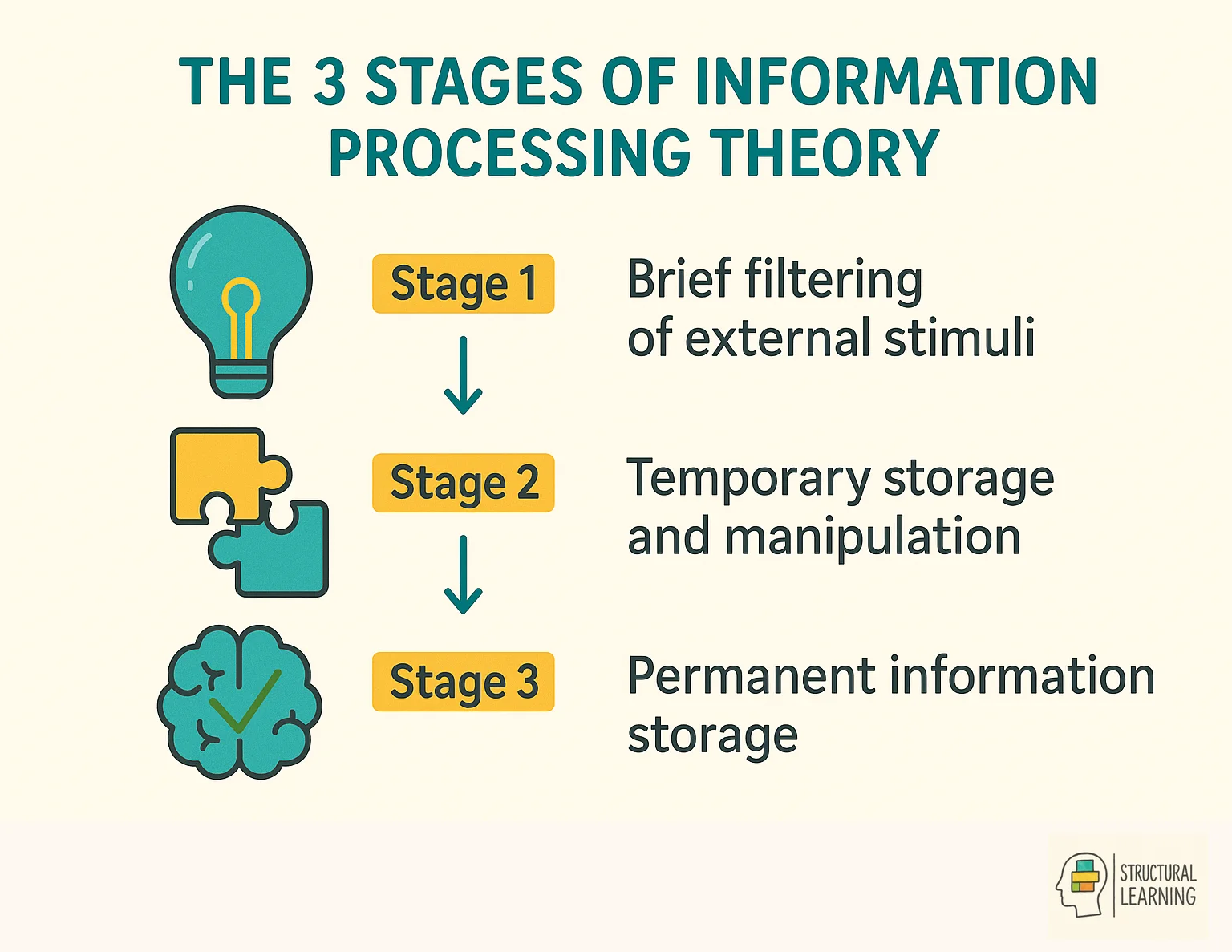
Information processing theory is an approach in cognitive psychology that studies how people select, transform, store and recover information. The best-known classroom version comes from Atkinson and Shiffrin's multi-store model (1968). It proposed a sensory register, a short-term store and a long-term store, together with control processes such as rehearsal and retrieval.
The model gave researchers a useful language for memory. Later work changed important parts of it. Baddeley and Hitch (1974) showed that short-term retention and active mental work could not be explained well by one simple store.
Their working-memory model separated attentional control from verbal and visual-spatial processing. Baddeley (2000) later added the episodic buffer to explain how information from different sources can be bound together.
This matters because short-term memory and working memory are not interchangeable labels. Short-term memory refers mainly to brief retention. Working memory includes holding information while using it, such as remembering the first part of an instruction while completing the second.
The five steps are sensory input, attention, working-memory processing, encoding and retrieval. They are easier to use as a diagnostic sequence than as a rigid pipeline. Processing can overlap. Prior knowledge also affects what a learner notices from the start.
Sights, sounds and other sensory events are available very briefly. Most disappear without further processing. A colourful slide does not guarantee attention, and a spoken explanation can be masked by competing speech or uncertainty about where to look.
Attention prioritises some information for further processing. Selection is influenced by task goals, expectations, prior knowledge and competing demands. Teachers can support it with a clear cue, a single focal example and an explicit question to answer.
Working memory maintains a small amount of information while the learner compares, calculates, explains or decides. Capacity varies with the material and the learner's knowledge. The familiar claim that working memory always holds seven items is too crude.
Cowan's review (2001) argued that capacity is often closer to four chunks when rehearsal and grouping are controlled. Our Cognitive Load Theory guide examines the related implications for instructional design.
Encoding is not a file transfer. New learning is interpreted through what the learner already knows. Organisation, examples, explanation and comparison can create useful links.
Craik and Lockhart (1972) argued that memory depends on the kind of processing undertaken. Thinking about meaning generally supports stronger retention than attending only to appearance or sound.
Retrieval brings stored knowledge into use. It is sensitive to cues and context, so failure to recall does not always mean that nothing was learned. Retrieving can also strengthen later memory. In controlled experiments with prose passages, Roediger and Karpicke (2006) found that repeated testing produced better delayed retention than repeated study, despite looking less successful during initial practice. The Retrieval Practice guide covers task selection and feedback.
A Year 7 science class is learning why particles spread during diffusion. The teacher begins with one particle diagram and asks learners to predict what will change. This gives attention a clear target.
If the later explanation fails, the teacher can inspect the sequence. Did learners attend to the particle movement? Were two new terms introduced before the visual made sense? Did they explain the causal relation, or only copy it? Was there any delayed retrieval?
A wrong answer does not reveal which memory process failed. The learner may have missed the cue, lost a step, lacked a key concept or used an unhelpful retrieval cue. Compare work from more than one task before choosing a response.
Start with access. Check whether the learner could hear, see and understand the instruction. Remove competing talk and point to one stable visual. Ask the learner to show the first action, rather than repeat all your words.
If the first action is now clear, the issue was not a failure to remember subject knowledge. It was a problem at the point of access or attention. Keep the cue visible while the routine becomes familiar.
The model may be carrying more of the task than you think. Hide one part and ask the learner to reconstruct it. A small prompt can show whether the missing element is a fact, a sequence or a choice.
Do not remove all support at once. Fade one feature after success. Then return to it later with a new example. This separates useful support from a prompt that prevents retrieval.
The knowledge may be present as separate details without a clear relation. Ask for a comparison, a cause or a worked example. Give a sentence stem if language is the barrier, but keep the subject thinking intact.
For example, recalling that evaporation and condensation are changes of state is not yet enough. Ask what happens to particle movement in each change. The explanation reveals whether the terms connect to the model.
Immediate success can rely on recent cues. Plan a short check after a delay. Remove the original example and change the surface details. Feedback should repair the missing idea, then give another chance to retrieve it.
A memory-aware lesson does not need a special template. It needs a clear learning goal, a manageable explanation, active thought and a later check. The sequence below keeps those decisions visible without turning the model into a script.
Apply the sequence to one demanding part of a lesson, not every minute. Familiar routines should become easy to use. This leaves more attention for the new subject knowledge.
Collect evidence from what learners do without the model. A neat book can hide weak recall, while a hesitant spoken answer may contain sound knowledge. Use a short written check, an example and a later question. Together, they give a fairer view of what is available and what still needs support.
Useful strategies protect attention, reduce avoidable load, connect new ideas to known ones and require later recall. Each choice should serve the exact knowledge being learned. A memory technique is not useful simply because it feels active or looks engaging.
Tell learners what to inspect and what decision to make. “Look at the two denominator values and decide whether the fractions can be added yet” is more useful than “look carefully”. Remove decorative material that competes with the required relation.
Keep essential instructions visible, model one unfamiliar step at a time and avoid asking learners to search between several sources. Chunking means organising meaningful units, not arbitrarily limiting every list to four items. Experts can treat a familiar pattern as one chunk because long-term knowledge changes the task. Temporary support should then be faded, as explained in our guide to scaffolding in education.
A broad starter can consume time without preparing the new idea. Ask for the concept, vocabulary or procedure that the next explanation depends on. If that prerequisite is missing, reteach it before adding more information.
Ask learners to explain why, distinguish two cases, produce an example or repair an error. Copying can support accurate notes, but it gives weak evidence that the idea has been encoded. The task should make the important relation mentally active.
Return to important knowledge after short and longer gaps. Cepeda and colleagues' meta-analysis (2006) found a robust spacing effect across verbal-learning studies. Vary the cue and application after initial success so learners can use knowledge outside the original example. See Spaced Practice for practical schedules.
A diagram helps when it represents the relation being explained and the teacher directs attention to matching parts. It does not help simply because it is visual. Multimedia research reviewed by Mayer (2024) supports managing essential processing and avoiding extraneous material. Our Dual Coding guide shows how to coordinate words and visuals.
Use this mini app before a lesson or after a learning check. It turns the model into six questions and produces a printable diagnostic plan. It does not measure a learner's memory capacity or diagnose a special educational need.
Name one learning goal, then check each point where information could be lost.
The model can help locate barriers, but it must not turn difference into a deficit label. A missed instruction may reflect language processing, hearing, attention, sensory load, anxiety, unfamiliar vocabulary or an inaccessible task. It is not evidence of low ability.
Agree substantial adjustments with the learner and relevant school specialists. The aim is access to the same worthwhile learning, not a permanently easier curriculum. Use metacognitive prompts only when learners have enough knowledge to monitor the task.
Four shortcuts often weaken this model in schools. Working memory does not have one fixed item limit. Repetition is not the same as learning. More media is not always better. Forgetting does not prove that teaching failed.
Miller's 1956 paper described a recurring range in several judgement tasks. It was not a universal classroom limit. Capacity depends on chunking, knowledge, rehearsal and the task. Use overload as a design question, not a fixed learner score.
Repetition can maintain information briefly, but durable learning also depends on meaning, organisation and useful retrieval cues. A learner can repeat a sentence without understanding the relation it expresses.
Words and visuals help when they work together. Redundant text, narration, animation and decoration can compete for attention. The aim is a coherent explanation, not more media.
Some forgetting is expected. Retrieval after a gap reveals what is accessible and gives learners another chance to strengthen it. The useful response is targeted review, not simply showing the same material again.
The computer metaphor is useful because it separates attention, temporary processing, storage and retrieval. It becomes misleading when treated literally. Human memory is reconstructive and shaped by meaning. Learners do not receive neutral inputs and store exact copies.
The approach can also understate emotion, social interaction, language and culture. A learner may know an answer but struggle to retrieve it under threat or time pressure. Talk with a teacher or peer can change the representation being learned, not merely transmit an input.
Finally, the multi-store sequence is historically important but too simple as a complete account. Modern working-memory theories contain specialised components and interaction with long-term knowledge. Teachers should use the model to ask better questions about task design, then check those questions against what learners actually say, make and remember. The broader Cognitivism guide places this model among related theories.
These answers separate the useful classroom model from common overclaims. They clarify what the stages mean, how teachers can use them and where the computer metaphor stops helping in real lessons.
It is a cognitive approach that explains learning through attention, temporary processing, encoding, storage and retrieval. The stages are a useful model, not literal boxes in the brain.
It helps teachers diagnose where learning may be breaking down. They can inspect attention, working-memory demands, prior knowledge, meaning-making and delayed retrieval instead of responding to every error with more explanation.
Short-term memory usually means brief retention. Working memory includes retaining information while manipulating or using it. Remembering a number is short-term retention; holding it while solving a problem uses working memory.
Its computer metaphor can make human learning look too linear and mechanical. It does not, by itself, explain the full effects of emotion, social interaction, language, embodiment and prior knowledge.
These eight sources support the model, its later revisions and the teaching strategies used in this guide. Each link resolves to the named academic work and gives the full source identity used for the linked claim.