Behaviourism in Education: Classical and Operant Conditioning in the ClassroomGCSE students aged 15-16 in navy blazers with striped ties, seated at desks, receiving positive reinforcement from the teacher.

Updated on  

February 13, 2026

Behaviourism in Education: Classical and Operant Conditioning in the Classroom

|

November 17, 2023

Explore behaviourism in education through classical and operant conditioning. Learn how reinforcement shapes learning and impacts classroom practices today.

Course Enquiry
Copy citation

Main, P. (2023, November 17). Theory of Behaviorism in Learning. Structural Learning. Retrieved from https://www.structural-learning.com/post/theory-of-behaviorism-in-learning

What is Behaviorism in Education?

Behaviourism dominated psychology and education for much of the 20th century. Based on the principle that learning involves changes in observable behaviour through conditioning, behaviourism gave us concepts still used in classrooms today: reinforcement, punishment, shaping, and behaviour modification. While cognitive approaches have largely superseded strict behaviourism, understanding this theory remains es sen tial for teachers. Behaviour management strategies, reward systems, and programmed instruction all have behaviourist roots.

Core Principles of Educational Behaviorism

  1. Why Rewards Sometimes Backfire: Discover the hidden psychology behind why star charts work brilliantly for some pupils but completely demotivate others
  2. Beyond the Carrot and Stick: Learn how combining classical and operant conditioning creates behaviour strategies that actually stick, not just temporary compliance
  3. The Pavlovian Classroom Trap: Uncover how you're accidentally conditioning anxiety responses in pupils and simple switches to build confidence instead
  4. Behaviour Systems That Last: Why understanding behaviourism helps you design reward systems that worklong-term, especially for pupils with SEND

This approach rejects the notion of analysing emotions, thoughts, or consciousness, instead focusing solely on what can be directly observed and measured. By examining the relationship between stimuli and responses, behaviorism aims to explain human behaviour through principles of conditioning, reinforcement, and stimulus-response associations.

Behaviorism vs Cognitive Learning Theories

Understanding the differences between behaviourism, cognitivism, and constructivism is essential for effective teaching. Each learning theory offers distinct approaches to how students learn and how teachers should design their classroom strategies.

Aspect Behaviourism Cognitivism Constructivism
Definition Learning through observable behaviour changes via reinforcement and conditioning Learning through internal mental processes like memory, thinking, and problem-solving Learning by actively building knowledge through experience and social interaction
Classroom Application Reward systems, behaviour charts, direct instruction, programmed learning Graphic organisers, chunking information, cognitive load theory, memory strategies Project-based learning, group work, discovery learning, hands-on activities
Teacher's Role Director and controller who shapes behaviour through consequences Information presenter who structures content for optimal mental processing Facilitator and guide who supports student-led discovery
Assessment Focus Observable performance and behaviour change measurement Testing knowledge retention, understanding, and cognitive skills Portfolio assessment, peer evaluation, and self-reflection
Student Interaction Individual focus with minimal peer interaction required Mix of individual and group work to support cognitive processing Heavy emphasis on collaborative learning and social construction
Best Used For Behaviour management, basic skill acquisition, SEND support, routine establishment Content delivery, exam preparation, complex concept explanation, study skills Creative subjects, critical thinking development, real-world problem solving

Behaviourism excels in behaviour management and skill building, cognitivism focuses on how students process information, whilst constructivism emphasises active knowledge creation. Most effective teachers blend elements from all three theories depending on their learning objectives and student needs.

Understanding the definition and principles of behaviourist learning theory is crucial in comprehending the role of external factors in shaping behaviour and the effectiveness of behaviour modification techniques.

Types of Behaviorism

There are two main types of behaviorism: methodological behaviorism and radical behaviorism. Both types focus on the study of human and animal behaviour, but they differ in key elements, strategies, and criticisms.

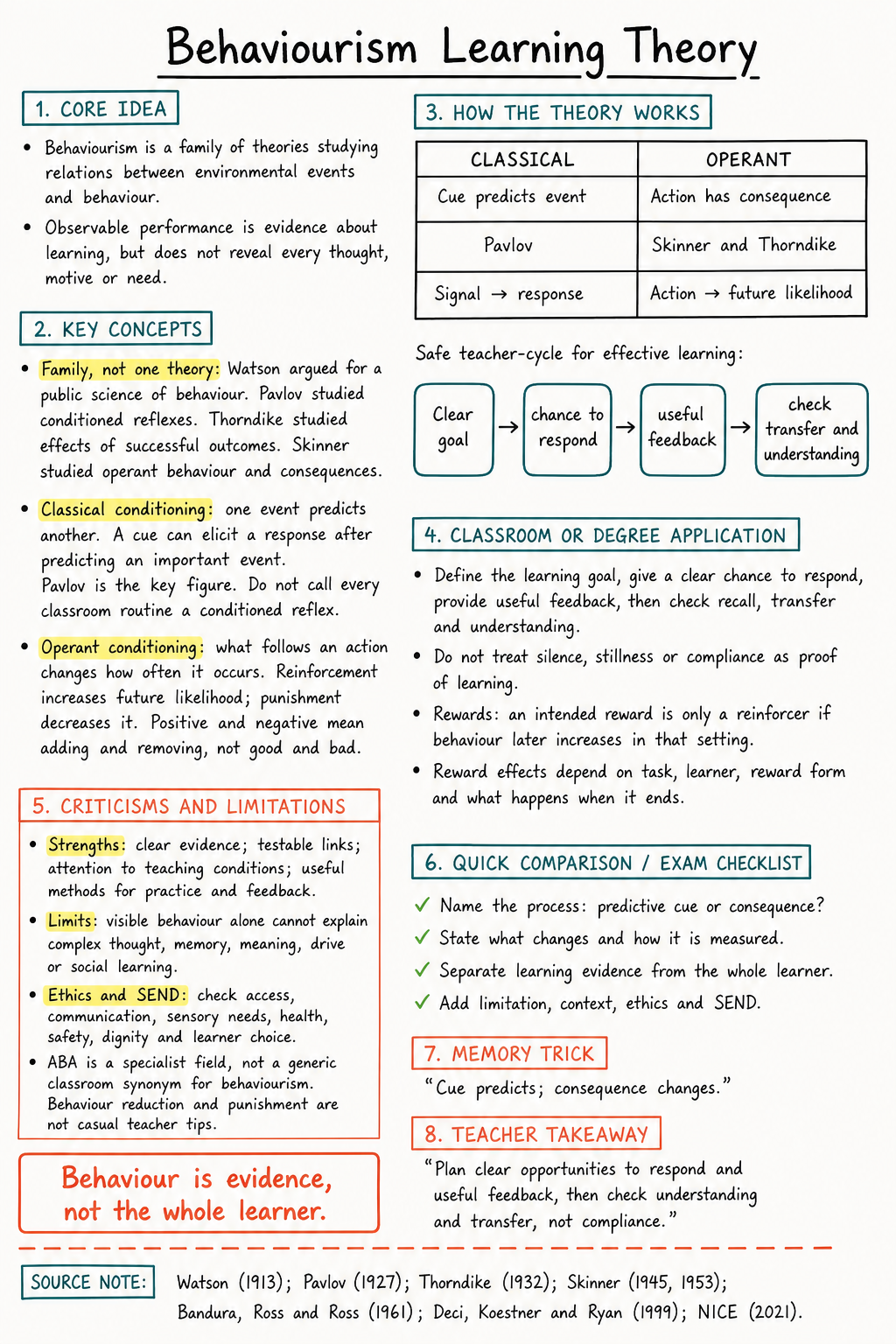
Infographic comparing classical and operant conditioning methods in educational settings
Classical vs Operant Conditioning

Comparison table showing differences between classical and operant conditioning in classrooms
Side-by-side comparison table: Classical vs Operant Conditioning in Education

Methodological behaviorism, also known as Watsonian behaviorism, is based on the belief that only observable behaviour should be studied. It originated from the works of John B. Watson and emphasises the use of scientific methods for understanding behaviour.

This type of behaviorism excludes mental processes and focuses solely on behaviour as a response to stimuli. It heavily relies on objective observation and experimentation, and it often uses conditioning techniques, such as classical and operant conditioning, to explain behaviour.

Side-by-side comparison of classical conditioning versus operant conditioning methods in educational settings
Classical vs Operant

On the other hand, radical behaviorism, developed by B.F. Skinner, expands the scope of behaviorism by acknowledging the importance of both observable behaviour and internal mental processes. It recognises that behaviour is influenced not only by external stimuli but also by internal thoughts, beliefs, and motivations. Radical behaviorism incorporates the concept of private events, such as thoughts and em otions, into the study of behaviour, considering them as behaviours that are not directly observable but can still be objectively analysed.

While methodological behaviorism has been criticised for its oversimplification of human behaviour and neglect of internal processes, radical behaviorism has received criticism for its reductionist approach and its exclusive focus on behaviour, neglecting the influence of other factors, such as genetics and biology.

the two types of behaviorism differ in their approaches to studying behaviour, with methodological behaviorism focusing solely on observable behaviour and radical behaviorism acknowledging the importance of both observable behaviour and internal mental processes.

Behaviouristic theory of learning

History of Behaviorism in Learning

Behaviorism is a learning theory that focuses on observable behaviour and the relationship between stimuli and responses. It began to develop in the early 20th century and was influenced by the work of several key figures.

Ivan Pavlov, a Russian physiologist, is renowned for his experiments on classical conditioning. He discovered that dogs could be conditioned to associate a neutral stimulus, such as the ringing of a bell, with an unconditioned stimulus, such as food. This led to the creation of what is known as Pavlovian conditioning, demonstrating the power of conditioning in shaping behaviour.

Edward Thorndike, an American psychologist, introduced the concept of the law of effect, stating that behaviour that is followed by a pleasant consequence is more likely to be repeated, while behaviour followed by an unpleasant consequence is less likely to be repeated. This laid the foundation for operant conditioning.

John B. Watson, an influential American psychologist, is considered the founder of behaviorism. He emphasised the importance of studying observable behaviour and rejected the study of internal mental processes. Watson believed that all behaviour is learned, and he aimed to explain how it could be understood and controlled.

Skinner expanded on the work of Watson and developed the concept of operant conditioning. He proposed that behaviour is shaped by consequences and that reinforcement or punishment could be used to increase or decrease the likelihood of certain behaviours. Skinner's research on schedules of reinforcement and his invention of the operant conditioning chamber (commonly known as the "Skinner box") further solidified the principles of behaviorism.

behaviorism in learning has a rich history shaped by the contributions of Ivan Pavlov, Edward Thorndike, John B. Watson, and B.F. Skinner. Their work laid the groundwork for understanding how behaviour is learned and influenced by external factors.

Classical Conditioning in Classroom Settings

Classical conditioning in the classroom occurs when students develop automatic emotional responses to specific stimuli, like feeling anxious when entering a test room or becoming excited when hearing a particular transition signal. Teachers can use this principle positively by pairing challenging subjects with pleasant experiences, such as playing calming music during difficult tasks or using specific scents during relaxation activities. This helps create positive associations that improve student engagement and reduce anxiety.

Classical conditioning is a form of learning in which an organism develops a response to a previously neutral stimulus through its association with a biologically significant stimulus. This type of learning was first described by Ivan Pavlov in the early 1900s through his groundbreaking experiments with dogs.

Classical conditioning has since become a fundamental concept in the field of psychology, explaining the formation of both simple and complex behaviours in various species, including humans.

This form of conditioning is based on the principles of stimulus-response associations, providing insights into how our behaviours can be influenced and modified by our environment. Understanding classical conditioning can help us comprehend how new behaviours or responses can be learned, as well as how certain conditioned responses can be extinguished.

Through this introduction, we will further explore this essential concept in psychology and its applications in various aspects of our lives.


Pavlov's Experiments

Pavlov's experiments were pivotal in establishing the principles of classical conditioning and their contribution to the theory of behaviorism. Classical conditioning is a process where a neutral stimulus becomes associated with a meaningful stimulus, resulting in a reflexive response.

Pavlov conducted his experiments with dogs and observed their salivary response to food. Initially, the presentation of food (an unconditioned stimulus) naturally elicited salivation (an unconditioned response). He then introduced a neutral stimulus, such as ringing a bell, before presenting the food. Over time, the dogs began associating the bell with food and eventually salivated upon hearing the bell alone. The bell, previously a neutral stimulus, became a conditioned stimulus that triggered a conditioned response of salivation.

These experiments revealed that learned associations can be formed between stimuli and responses. The stimulus-response model, which posits that external stimuli elicit specific responses, gained significant support through Pavlov's work. His experiments demonstrated that responses could be obtained through learned associations rather than being solely predetermined or reflexive.

Pavlov's experiments greatly influenced the theory of behaviorism, which emphasises the study of observable behaviour and the environmental factors that shape it. His concept of conditioned reflexes provided a solid foundation for the behaviorist perspective, as it illustrated that behaviour could be modified and influenced by external stimuli and reinforced through conditioning.

Pavlov's experiments in classical conditioning, demonstrating the formation of conditioned reflexes, have greatly contributed to the theory of behaviorism. They highlighted the importance of learned associations between stimuli and responses and helped establish the stimulus-response model as an essential aspect of behavioural psychology.

Behaviorism
Behaviorism

Classical Conditioning Classroom Applications

In order to apply the concepts of behavioural learning in the context of learning theory, several strategies can be incorporated.

Firstly, creating the right environment is crucial. This involves using a conditioned stimulus, which is a stimulus that produces a specific response when paired with a specific behaviour. For example, a teacher can use a bell as a conditioned stimulus to signal the start of a learning activity, conditioning the students to associate the bell with focused attention and engagement.

Another strategy is introducing self-directed learning and gamification. Self-directed learning allows students to take control of their own learningprocess, developing independence and motivation. Gamification involves incorporating game-like elements into the learning experience, such as rewards, badges, and competition, to make it more engaging and enjoyable.

Furthermore, active learning techniques play an important role. This approach encourages students to actively participate in the learning process through hands-on activities, discussions, and problem-solving tasks. This active engagement enhances understanding and retention of information.

Lastly, social learning techniques can be utilised. This involves promoting collaboration and interaction among students. Group work, peer teaching, and cooperative learning activities help students learn from each other, exchange ideas, and develop effective communication skills.

By incorporating these strategies, educators can effectively apply the concepts of behavioural learning in the context of learning theory, creating a conducive environment for students to maximise their learning potential.

Limitations of Classical Conditioning

Classical conditioning, a type of learning in which a neutral stimulus becomes associated with a specific response, has various limitations when applied to education. One significant limitation is that classical conditioning primarily focuses on involuntary responses. In an educational setting, where voluntary behaviour plays a crucial role, this limitation restricts the application of classical conditioning.

Furthermore, classical conditioning lacks the ability to explain complex learning processes. It oversimplifies the understanding of human behaviour, as it primarily assumes that learning occurs through association. However, education involves higher-order cognitive processes such as critical thinking, problem-solving, and creativity, which cannot be adequately explained solely through classical conditioning.

Another limitation of classical conditioning in education is the inability to explain individual differences in learning. Each student possesses unique backgrounds, abilities, and interests, which influence their learning experiences. Classical conditioning fails to account for these individual differences, as it focuses on general associations between stimuli and responses. Consequently, educators must employ more comprehensive theories of learning, such as operant conditioning or cognitive approaches, to address the diverse needs of their students.

classical conditioning in education has limitations that prevent its comprehensive application. Its emphasis on involuntary responses, oversimplified understanding of learning processes, and inability to explain individual differences restrict its effectiveness as an educational tool. Educators should consider utilising more encompassing theories to enhance their teaching methods and facilitate optimal learning outcomes.

Behaviorism Key Figures

Operant Conditioning for Teachers

Operant conditioning involves using consequences to modify behaviour through reinforcement (rewards) and punishment, commonly seen in classroom managementsystems like token economies, behaviour charts, and point systems. Teachers apply this by immediately reinforcing desired behaviours with specific praise, privileges, or tangible rewards while removing reinforcement for unwanted behaviours through planned ignoring or logical consequences. The key to success is consistency, immediacy of response, and gradually moving from continuous to intermittent reinforcement schedules.

Operant conditioning is a type of learning that focuses on how an individual's behaviour is influenced by the consequences of their actions. This theory suggests that behaviours can be reinforced or diminished through either positive or negative reinforcement, as well as punishment.

Positive reinforcement involves rewarding desired behaviours, while negative reinforcement involves the removal of an unpleasant stimulus. Conversely, punishment aims to decrease unwanted behaviours by either adding an aversive consequence or removing a desirable stimulus. Through operant conditioning, individuals can learn to associate their actions with certain outcomes, leading to changes in behaviour over time.

This process of conditioning can be seen in various aspects of daily life, from classroom strategies to shaping the behaviour of animals. Understanding the principles of operant conditioning can provide valuable insights into how behaviours are shaped and modified, offering practical applications in fields such as education, psychology, and animal training.


B.F. Skinner’s Theory

B.F. Skinner was a renowned psychologist known for his theory of behaviorism. He believed that human behaviour is shaped by external factors rather than internal thoughts and feelings. Skinner's work in radical behaviorism emphasised the importance of studying observable and measurable behaviour.

One of the key concepts in Skinner's theory is reinforcement. He proposed that behaviour is reinforced by positive consequences, such as rewards, which increase the likelihood of that behaviour occurring again. Likewise, punishment and negative consequences decrease the probability of the behaviour being repeated. Skinner's reinforcement principles were vital in shaping understanding of how behaviour can be modified and controlled.

Skinner's behaviorist theory found practical application in the field of education. He advocated for a system where positive reinforcement is used to encourage desired behaviours in students. This approach involves rewarding students for displaying appropriate behaviour, such as completing assignments or participating actively in class discussions. By employing these principles, educators can create a positive learning environment, motivating students to engage and succeed academically.

B.F. Skinner's theory of behaviorism, particularly his work in radical behaviorism and reinforcement principles, has had a significant impact on understanding human behaviour and its practical application in education. By focusing on observable behaviour and utilising positive reinforcement, his theories have helped shape effective teaching practices.

Behaviourist theory of a learning process

Positive Reinforcement

Positive reinforcement refers to the practise of rewarding or reinforcing desired behaviours in order to motivate and encourage students in the context of education. This method is based on the belief that positive consequences can increase the likelihood of repeating the desired behaviour.

One of the main benefits of positive reinforcement in education is that it creates a positive and supportive learning environment. When students receive recognition for their efforts, they feel valued, encouraged, and more motivated to engage in the desired behaviours. This enhances their self-esteem and confidence, developing a growth mindset and leading to improved learning outcomes.

Educators can use rewards or incentives to motivate students and reinforce desired behaviours. These rewards can be tangible, such as stickers, certificates, or small gifts, or intangible, like verbal praise, increased privileges, or extra free time. By carefully selecting and delivering these rewards, educators can create a positive association with desired behaviours, making students more likely to repeat them.

To effectively use this method, educators should clearly define the desired behaviours and communicate the expectations to students. Consistency is also vital, as students need to know that their efforts will be consistently recognised and rewarded. Additionally, individualize the rewards and incentives to suit the needs and interests of each student, ensuring that they are meaningful and motivating.

Positive reinforcement is a powerful tool that educators can use to motivate students and reinforce desired behaviours in the context of education. By providing appropriate rewards and incentives, educators create a positive learning environment and enhance student engagement and student achievement.

behavioural theory of learning

Negative Reinforcement

Negative reinforcement refers to a concept in which a behaviour is strengthened by the removal of an aversive stimulus when that behaviour is displayed. In the context of education, negative reinforcement can have several benefits.

Firstly, negative reinforcement can help students avoid unpleasant situations. By reinforcing behaviours that lead to the removal of a negative stimulus, students are encouraged to take actions that prevent them from experiencing discomfort or inconvenience. For example, if a student consistently completes their homework on time to avoid the negative consequence of staying after school for extra help, they learn the value of proactive work completion.

Additionally, negative reinforcement can increase motivation and persistence. When students realise that their efforts to escape an aversive situation are successful, they are more likely to repeat those efforts in the future. This can lead to increased motivation to engage in desired behaviours and a greater sense of persistence when faced with challenges.

Furthermore, negative reinforcement can help reduce anxiety and stress in education. By reinforcing behaviours that alleviate stress or anxiety-producing situations, students are encouraged to engage in coping mechanisms or seek assistance when needed. This can create an environment that is more conducive to learning, as students feel supported and less overwhelmed by anxiety-inducing tasks or situations.

Negative reinforcement in education can help students avoid unpleasant situations, increase motivation and persistence, and reduce anxiety and stress. By using this concept effectively, educators can create a positive and supportive learning environment for their students.


Positive Punishment

Positive punishment is a concept in psychology that involves applying negative consequences to discourage undesirable behaviours. It is based on the principle that by associating an unpleasant outcome with a specific behaviour, individuals are less likely to repeat that behaviour in the future.

The effects of positive punishment can be twofold. First, it serves as a deterrent by creating an aversive experience that individuals want to avoid. For example, a student who consistently disrupts the class may be given extra homework or be made to stay after school. By experiencing these negative consequences, the student may be less likely to repeat their transformative behaviour.

Second, positive punishment can help individuals understand the consequences of their actions and develop self-control. By immediately linking the negative outcome to their behaviour, individuals learn to associate their actions with undesirable outcomes. This can lead to a better understanding of cause-and-effect relationships and promote responsible decision-making.

However, the potential impact of positive punishment on students' motivation, self-esteem, and behaviour should be considered. Excessive or inappropriate use of positive punishment can create a hostile learning environment and damage students' motivation and self-esteem. It may lead to feelings of frustration, discouragement, and even defiance. Consequently, students may become less motivated to learn, exhibit low self-esteem, and engage in more problem behaviours.

To mitigate these negative effects, pair positive punishment with positive reinforcement and provide clear guidelines for behaviour expectations. Additionally, open communication and support from teachers and parents can help students understand the purpose of positive punishment and its role in shaping behaviour.

Overall, positive punishment involves applying negative consequences to discourage undesirable behaviours. While it can be an effective strategy for behaviour management, it must be used judiciously and in conjunction with other positive behavioural supports to maintain students' motivation, self-esteem, and overall well-being.


Negative Punishment

Negative punishment is a concept within the framework of behaviorism that aims to decrease the frequency of a particular behaviour by removing a desired stimulus. In behaviorism, the focus is on understanding how the environment influences behaviour, and negative punishment is one of the strategies used to shape and modify behaviour.

Negative punishment involves the removal of a desired stimulus as a consequence of engaging in a certain behaviour. This leads to a decrease in the frequency of the behaviour in future instances. For example, let's imagine a child repeatedly interrupts their sibling during playtime.

To address this behaviour using negative punishment, the parent can remove the child from the play area whenever they interrupt. By doing so, the child experiences the removal of the desired stimulus, which is the opportunity to play with their sibling. Consequently, the child learns that their interrupting behaviour results in the loss of the enjoyable activity, and they are more likely to refrain from interrupting in the future.

The main purpose of negative punishment is to help individuals learn and understand the consequences of their behaviour. By removing a desired stimulus, negative punishment aims to teach individuals that engaging in certain behaviours can result in the loss of something they value. This can be effective in reducing the frequency of unwanted behaviours and promoting more desirable ones.

Overall, negative punishment within the context of behaviorism involves the removal of a desired stimulus to decrease the frequency of a targeted behaviour. By employing this technique, individuals can learn the importance of making better choices and behaving in ways that align with societal expectations.


Social Learning Theory in Classrooms

Observational learning occurs when students acquire new behaviours by watching others, making teacher modelling and peer demonstrations powerful teaching tools. Teachers can use this by explicitly demonstrating problem-solving strategies, thinking aloud during tasks, and showcasing exemplar work from other students. Creating opportunities for peer tutoring and collaborative learning also allows students to learn from observing their classmates' successful strategies and behaviours.

Observational learning, also known as modelling, is a powerful form of learning in which individuals acquire new knowledge and skills by observing others. Rather than relying solely on their own experiences, individuals can learn by watching the actions, behaviours, and outcomes of others.

This process allows people to learn from both positive and negative examples, expanding their knowledge and shaping their behaviour. By mimicking the actions of others, individuals can adopt new behaviours, acquire skills, and adapt to their environment in a more efficient and less trial-and-error manner.

Observational learning plays a significant role in various areas of life, from children learning social skills from their parents to individuals acquiring new abilities in a professional or educational setting. Understanding the mechanisms behind observational learning can enhance our understanding of how individuals learn and can have implications for education, socialization, and behaviour modification.

Behavioural learning theory

Bandura’s Studies on modelling and Imitation

Albert Bandura conducted several studies on modelling and imitation, focusing on the role of observation in learning and behaviour. One of his key studies was the Bobo doll study, in which children observed an adult model interacting with a Bobo doll in an aggressive or non-aggressive manner.

Bandura explored the concepts of modelling and observational learning, which refer to the idea that individuals learn by observing and imitating others. In the Bobo doll study, children were divided into groups, with each group exposed to different adult models (aggressive, non-aggressive, or no model).

After observing the adult's behaviour, the children were given the opportunity to play with the Bobo doll. Bandura found that children who observed the aggressive model exhibited more aggressive behaviour towards the doll, while those who observed the non-aggressive model showed less aggression.

The main findings of Bandura's research suggest that observation and imitation play a significant role in learning and behaviour. Through observing others, individuals acquire new behaviours and develop expectations about the consequences of those behaviours. This has important implications for understanding how individuals learn from their social environment and how behaviours can be influenced by the models they observe.

Bandura's studies highlight the importance of media and social interactions in shaping behaviour, implying that exposure to positive role models can promote prosocial behaviours, while exposure to aggressive behaviour can lead to the imitation of aggression.

Behaviorism Implementation Guide for Teachers

Essential resources for understanding behaviorism in education include B.F. Skinner's 'The Technology of Teaching' and Alberto & Troutman's 'Applied behaviour Analysis for Teachers' which provide practical classroom applications. Online resources like the Journal of Applied behaviour Analysis and the Cambridge Centre for behavioural Studies offer current research and evidence-based strategies. For immediate classroom implementation, texts focusing on positive behaviour support (PBS) and functional behaviour assessment (FBA) provide actionable frameworks for modern educators.

These studies offer a diverse perspective on the efficacy of behaviorism theory in learning, spanning various educational contexts and theoretical frameworks.

1. Albert Bandura's theory of learning: bridging behaviourist and cognitivist role of online student's self-efficacy.

Summary: This study highlights the role of Albert Bandura's theory in bridging behaviorist and cognitivist learning theories. It emphasises how a student's self-efficacy in online learning environments impacts engagement, completion, and educational results.

2. Rats, reinforcements and role-models: Taking a second look at behaviourism and its relevance to education

Summary: This paper discusses the behaviorist model of learningas a sophisticated and adaptable tool for understanding and positively influencing various types of learning across diverse educational contexts.

3. Constructivism: The Career and Technical Education Perspective

Summary: This research suggests that cognitive constructivism may be more compatible with career and technical education, indicating a potential alternative to behaviorism as a learning theory.

4. Strategies for facilitating self‐directed learning: A process for enhancing human resource development

Summary: This study proposes an integrated framework combining experiential learning, behavioural modelling, threat elimination, and persuasion to improve self-efficacy perceptions and self-leadership skills in adult learning.

5. Self-efficacy for reading and writing: influence of modelling, goal setting, and self-evaluation

Summary: This paper explores how self-efficacy, a critical mechanism in social cognitive theory, influences the choice of tasks, effort, persistence, and achievement in the context of reading and writing.

These studies offer a diverse perspective on the efficacy of behaviorism theory in learning, spanning various educational contexts and theoretical frameworks.

Classical Conditioning: Foundations and Key Principles

Classical conditioning, discovered by Ivan Pavlov through his famous dog experiments, forms the foundation of behaviourist learning theory. This process involves pairing a neutral stimulus with an unconditioned stimulus until the neutral stimulus alone triggers a response. In Pavlov's research, dogs learned to salivate at the sound of a bell after it was repeatedly paired with food presentation.

John Watson expanded Pavlov's work into human psychology, demonstrating through the controversial 'Little Albert' experiment how fears and emotional responses could be conditioned in children. His work showed that a child could learn to fear a previously neutral object, such as a white rat, when it was paired with a loud, frightening noise. This research, whilst ethically questionable by today's standards, revealed how powerful environmental associations shape behaviour and emotional responses in educational settings.

Teachers unconsciously use classical conditioning principles daily. When you play a specific piece of music during tidy-up time, children eventually begin clearing away at the first notes; the music becomes a conditioned stimulus for the tidying response. Similarly, using a particular hand signal or sound to gain attention creates an automatic response in pupils who have learned to associate that cue with the need to stop and listen.

Understanding classical conditioning helps teachers recognise why some pupils develop anxiety around certain subjects or activities. A child who experienced embarrassment whilst reading aloud might develop a conditioned fear response to any reading task. By creating positive associations instead, such as pairing challenging tasks with encouraging praise or enjoyable activities, teachers can recondition these responses and build confidence in previously anxiety-inducing situations.

Frequently Asked Questions

Classical vs Operant Conditioning Differences

Classical conditioning involves creating automatic emotional responses by pairing neutral stimuli with meaningful experiences, such as playing calming music during difficult tasks to reduce anxiety. Operant conditioning focuses on using consequences like rewards and punishments to increase or decrease the likelihood of specific behaviours being repeated.

Reducing Student Anxiety Through Classical Conditioning

Teachers can pair challenging subjects or activities with pleasant experiences, such as using specific scents during relaxation activities or playing calming music during tests. This creates positive associations that help students feel more comfortable and engaged rather than anxious when encountering difficult material.

Why do reward systems sometimes backfire with certain pupils?

Reward systems can demotivate some pupils because they may undermine intrinsic motivation or create dependency on external validation. Understanding behaviourist principles helps teachers design reward systems that work long-term by focusing on meaningful reinforcement rather than simple 'carrot and stick' approaches.

Behaviorism for SEND Behaviour Management

Behaviourist approaches provide structured, observable methods for shaping behaviour through consistent reinforcement and clear stimulus-response patterns. These techniques are particularly effective for SEND pupils as they offer predictable frameworks and can be tailored to individual needs through systematic behaviour modification strategies.

Common Teacher Mistakes in Conditioning

Teachers may unknowingly create anxiety responses by consistently pairing certain subjects, activities, or classroom environments with stress or negative experiences. For example, always announcing tests in a stern voice or using red pens for corrections can condition pupils to feel anxious when encountering these stimuli.

Combining Conditioning Types for Better Results

By using classical conditioning to create positive emotional associations with learning environments whilst simultaneously applying operant conditioning techniques like strategic reinforcement, teachers can address both the emotional and behavioural aspects of learning. This combination creates behaviour changes that are more likely to stick rather than producing temporary compliance.

Implementing Behaviorism Without Oversimplifying Motivation

Teachers should focus on creating consistent, positive stimulus-response patterns whilst recognising that modern understanding includes internal mental processes alongside observable behaviour. This means using reinforcement strategically, monitoring both emotional responses and behavioural outcomes, and adapting techniques based on individual student needs rather than applying rigid behavioural formulas.

Essential Behaviorism Research Studies

These peer-reviewed studies provide the research foundation for the strategies discussed in this article:

Social Networking Sites Classroom Framework using Operant Conditioning of Learning View study ↗

Yousuf Anwar Al Sandi & Bernard Ugalde (2019)

This research explores how teachers can apply operant conditioning principles when using social media platforms like Facebook or Twitter for classroom learning. The authors propose a structured framework for monitoring student progress and providing appropriate rewards or feedback through social networks. This work offers practical guidance for educators looking to blend traditional behavioural learning principles with modern digital platforms their students already use.

Exploring Student Interactions with AI-Powered Learning Tools: A Qualitative Study Connecting Interaction Patterns to Educational Learning Theories View study ↗

Prathamesh Muzumdar & Sumanth Cheemalapati (2025)

Researchers observed how undergraduate students actually use AI tools like ChatGPT and Khan Academy, then connected these usage patterns to established learning theories including behaviorism. The study reveals that students naturally engage with AI feedback systems in ways that mirror classical conditioning and reinforcement patterns. These findings help teachers understand how to better integrate AI tools into their classrooms while using proven behavioural learning principles.

APPLICATION OF B.F. SKINNER'S BEHAVIORISM LEARNING THEORY IN ISLAMIC EDUCATION LEARNING FOR HIGH SCHOOL STUDENTS View study ↗
1 citations

Yunita Nita Yuli et al. (2024)

This study demonstrates how high school Islamic education teachers successfully applied Skinner's operant conditioning techniques, including strategic use of rewards and consequences, to improve student engagement and student achievement. The research shows that behaviorist principles can be effectively adapted across different cultural and religious educational contexts. Teachers in any subject area can learn from these practical examples of how to implement systematic reinforcement strategies in their own classrooms.

Independent Curriculum and Behaviorism-Based Learning: Analysis of Reinforcement Effectiveness View study ↗

Ismail Musa (2025)

This comprehensive study found that positive reinforcement significantly increases student motivation and engagement when teachers customize rewards to match individual student characteristics and preferences. The research used classroom observations and student surveys to show that behaviorist techniques remain highly effective in modern educational settings. Teachers will find valuable insights on how to tailor their reinforcement strategies to maximise impact while preparing students for 21st-century learning demands.

Constructing Reliable and Valid Assessment Tool for Measuring Competencies in Educational Psychology View study ↗

M. Karthick & Dr.P.N.Lakshmi Shanmugam (2023)

Researchers developed and tested a comprehensive assessment tool that measures student teachers' understanding of key learning theories, including Pavlov's classical conditioning and Skinner's operant conditioning alongside other major educational psychology concepts. The study validates that these foundational behaviorist principles remain essential knowledge for effective teaching practise. This research provides teacher educators with a reliable way to evaluate whether future teachers truly understand the behavioural learning theories they'll need in their classrooms.

Loading audit...

What is Behaviorism in Education?

Behaviourism dominated psychology and education for much of the 20th century. Based on the principle that learning involves changes in observable behaviour through conditioning, behaviourism gave us concepts still used in classrooms today: reinforcement, punishment, shaping, and behaviour modification. While cognitive approaches have largely superseded strict behaviourism, understanding this theory remains es sen tial for teachers. Behaviour management strategies, reward systems, and programmed instruction all have behaviourist roots.

Core Principles of Educational Behaviorism

  1. Why Rewards Sometimes Backfire: Discover the hidden psychology behind why star charts work brilliantly for some pupils but completely demotivate others
  2. Beyond the Carrot and Stick: Learn how combining classical and operant conditioning creates behaviour strategies that actually stick, not just temporary compliance
  3. The Pavlovian Classroom Trap: Uncover how you're accidentally conditioning anxiety responses in pupils and simple switches to build confidence instead
  4. Behaviour Systems That Last: Why understanding behaviourism helps you design reward systems that worklong-term, especially for pupils with SEND

This approach rejects the notion of analysing emotions, thoughts, or consciousness, instead focusing solely on what can be directly observed and measured. By examining the relationship between stimuli and responses, behaviorism aims to explain human behaviour through principles of conditioning, reinforcement, and stimulus-response associations.

Behaviorism vs Cognitive Learning Theories

Understanding the differences between behaviourism, cognitivism, and constructivism is essential for effective teaching. Each learning theory offers distinct approaches to how students learn and how teachers should design their classroom strategies.

Aspect Behaviourism Cognitivism Constructivism
Definition Learning through observable behaviour changes via reinforcement and conditioning Learning through internal mental processes like memory, thinking, and problem-solving Learning by actively building knowledge through experience and social interaction
Classroom Application Reward systems, behaviour charts, direct instruction, programmed learning Graphic organisers, chunking information, cognitive load theory, memory strategies Project-based learning, group work, discovery learning, hands-on activities
Teacher's Role Director and controller who shapes behaviour through consequences Information presenter who structures content for optimal mental processing Facilitator and guide who supports student-led discovery
Assessment Focus Observable performance and behaviour change measurement Testing knowledge retention, understanding, and cognitive skills Portfolio assessment, peer evaluation, and self-reflection
Student Interaction Individual focus with minimal peer interaction required Mix of individual and group work to support cognitive processing Heavy emphasis on collaborative learning and social construction
Best Used For Behaviour management, basic skill acquisition, SEND support, routine establishment Content delivery, exam preparation, complex concept explanation, study skills Creative subjects, critical thinking development, real-world problem solving

Behaviourism excels in behaviour management and skill building, cognitivism focuses on how students process information, whilst constructivism emphasises active knowledge creation. Most effective teachers blend elements from all three theories depending on their learning objectives and student needs.

Understanding the definition and principles of behaviourist learning theory is crucial in comprehending the role of external factors in shaping behaviour and the effectiveness of behaviour modification techniques.

Types of Behaviorism

There are two main types of behaviorism: methodological behaviorism and radical behaviorism. Both types focus on the study of human and animal behaviour, but they differ in key elements, strategies, and criticisms.

Infographic comparing classical and operant conditioning methods in educational settings
Classical vs Operant Conditioning

Comparison table showing differences between classical and operant conditioning in classrooms
Side-by-side comparison table: Classical vs Operant Conditioning in Education

Methodological behaviorism, also known as Watsonian behaviorism, is based on the belief that only observable behaviour should be studied. It originated from the works of John B. Watson and emphasises the use of scientific methods for understanding behaviour.

This type of behaviorism excludes mental processes and focuses solely on behaviour as a response to stimuli. It heavily relies on objective observation and experimentation, and it often uses conditioning techniques, such as classical and operant conditioning, to explain behaviour.

Side-by-side comparison of classical conditioning versus operant conditioning methods in educational settings
Classical vs Operant

On the other hand, radical behaviorism, developed by B.F. Skinner, expands the scope of behaviorism by acknowledging the importance of both observable behaviour and internal mental processes. It recognises that behaviour is influenced not only by external stimuli but also by internal thoughts, beliefs, and motivations. Radical behaviorism incorporates the concept of private events, such as thoughts and em otions, into the study of behaviour, considering them as behaviours that are not directly observable but can still be objectively analysed.

While methodological behaviorism has been criticised for its oversimplification of human behaviour and neglect of internal processes, radical behaviorism has received criticism for its reductionist approach and its exclusive focus on behaviour, neglecting the influence of other factors, such as genetics and biology.

the two types of behaviorism differ in their approaches to studying behaviour, with methodological behaviorism focusing solely on observable behaviour and radical behaviorism acknowledging the importance of both observable behaviour and internal mental processes.

Behaviouristic theory of learning

History of Behaviorism in Learning

Behaviorism is a learning theory that focuses on observable behaviour and the relationship between stimuli and responses. It began to develop in the early 20th century and was influenced by the work of several key figures.

Ivan Pavlov, a Russian physiologist, is renowned for his experiments on classical conditioning. He discovered that dogs could be conditioned to associate a neutral stimulus, such as the ringing of a bell, with an unconditioned stimulus, such as food. This led to the creation of what is known as Pavlovian conditioning, demonstrating the power of conditioning in shaping behaviour.

Edward Thorndike, an American psychologist, introduced the concept of the law of effect, stating that behaviour that is followed by a pleasant consequence is more likely to be repeated, while behaviour followed by an unpleasant consequence is less likely to be repeated. This laid the foundation for operant conditioning.

John B. Watson, an influential American psychologist, is considered the founder of behaviorism. He emphasised the importance of studying observable behaviour and rejected the study of internal mental processes. Watson believed that all behaviour is learned, and he aimed to explain how it could be understood and controlled.

Skinner expanded on the work of Watson and developed the concept of operant conditioning. He proposed that behaviour is shaped by consequences and that reinforcement or punishment could be used to increase or decrease the likelihood of certain behaviours. Skinner's research on schedules of reinforcement and his invention of the operant conditioning chamber (commonly known as the "Skinner box") further solidified the principles of behaviorism.

behaviorism in learning has a rich history shaped by the contributions of Ivan Pavlov, Edward Thorndike, John B. Watson, and B.F. Skinner. Their work laid the groundwork for understanding how behaviour is learned and influenced by external factors.

Classical Conditioning in Classroom Settings

Classical conditioning in the classroom occurs when students develop automatic emotional responses to specific stimuli, like feeling anxious when entering a test room or becoming excited when hearing a particular transition signal. Teachers can use this principle positively by pairing challenging subjects with pleasant experiences, such as playing calming music during difficult tasks or using specific scents during relaxation activities. This helps create positive associations that improve student engagement and reduce anxiety.

Classical conditioning is a form of learning in which an organism develops a response to a previously neutral stimulus through its association with a biologically significant stimulus. This type of learning was first described by Ivan Pavlov in the early 1900s through his groundbreaking experiments with dogs.

Classical conditioning has since become a fundamental concept in the field of psychology, explaining the formation of both simple and complex behaviours in various species, including humans.

This form of conditioning is based on the principles of stimulus-response associations, providing insights into how our behaviours can be influenced and modified by our environment. Understanding classical conditioning can help us comprehend how new behaviours or responses can be learned, as well as how certain conditioned responses can be extinguished.

Through this introduction, we will further explore this essential concept in psychology and its applications in various aspects of our lives.


Pavlov's Experiments

Pavlov's experiments were pivotal in establishing the principles of classical conditioning and their contribution to the theory of behaviorism. Classical conditioning is a process where a neutral stimulus becomes associated with a meaningful stimulus, resulting in a reflexive response.

Pavlov conducted his experiments with dogs and observed their salivary response to food. Initially, the presentation of food (an unconditioned stimulus) naturally elicited salivation (an unconditioned response). He then introduced a neutral stimulus, such as ringing a bell, before presenting the food. Over time, the dogs began associating the bell with food and eventually salivated upon hearing the bell alone. The bell, previously a neutral stimulus, became a conditioned stimulus that triggered a conditioned response of salivation.

These experiments revealed that learned associations can be formed between stimuli and responses. The stimulus-response model, which posits that external stimuli elicit specific responses, gained significant support through Pavlov's work. His experiments demonstrated that responses could be obtained through learned associations rather than being solely predetermined or reflexive.

Pavlov's experiments greatly influenced the theory of behaviorism, which emphasises the study of observable behaviour and the environmental factors that shape it. His concept of conditioned reflexes provided a solid foundation for the behaviorist perspective, as it illustrated that behaviour could be modified and influenced by external stimuli and reinforced through conditioning.

Pavlov's experiments in classical conditioning, demonstrating the formation of conditioned reflexes, have greatly contributed to the theory of behaviorism. They highlighted the importance of learned associations between stimuli and responses and helped establish the stimulus-response model as an essential aspect of behavioural psychology.

Behaviorism
Behaviorism

Classical Conditioning Classroom Applications

In order to apply the concepts of behavioural learning in the context of learning theory, several strategies can be incorporated.

Firstly, creating the right environment is crucial. This involves using a conditioned stimulus, which is a stimulus that produces a specific response when paired with a specific behaviour. For example, a teacher can use a bell as a conditioned stimulus to signal the start of a learning activity, conditioning the students to associate the bell with focused attention and engagement.

Another strategy is introducing self-directed learning and gamification. Self-directed learning allows students to take control of their own learningprocess, developing independence and motivation. Gamification involves incorporating game-like elements into the learning experience, such as rewards, badges, and competition, to make it more engaging and enjoyable.

Furthermore, active learning techniques play an important role. This approach encourages students to actively participate in the learning process through hands-on activities, discussions, and problem-solving tasks. This active engagement enhances understanding and retention of information.

Lastly, social learning techniques can be utilised. This involves promoting collaboration and interaction among students. Group work, peer teaching, and cooperative learning activities help students learn from each other, exchange ideas, and develop effective communication skills.

By incorporating these strategies, educators can effectively apply the concepts of behavioural learning in the context of learning theory, creating a conducive environment for students to maximise their learning potential.

Limitations of Classical Conditioning

Classical conditioning, a type of learning in which a neutral stimulus becomes associated with a specific response, has various limitations when applied to education. One significant limitation is that classical conditioning primarily focuses on involuntary responses. In an educational setting, where voluntary behaviour plays a crucial role, this limitation restricts the application of classical conditioning.

Furthermore, classical conditioning lacks the ability to explain complex learning processes. It oversimplifies the understanding of human behaviour, as it primarily assumes that learning occurs through association. However, education involves higher-order cognitive processes such as critical thinking, problem-solving, and creativity, which cannot be adequately explained solely through classical conditioning.

Another limitation of classical conditioning in education is the inability to explain individual differences in learning. Each student possesses unique backgrounds, abilities, and interests, which influence their learning experiences. Classical conditioning fails to account for these individual differences, as it focuses on general associations between stimuli and responses. Consequently, educators must employ more comprehensive theories of learning, such as operant conditioning or cognitive approaches, to address the diverse needs of their students.

classical conditioning in education has limitations that prevent its comprehensive application. Its emphasis on involuntary responses, oversimplified understanding of learning processes, and inability to explain individual differences restrict its effectiveness as an educational tool. Educators should consider utilising more encompassing theories to enhance their teaching methods and facilitate optimal learning outcomes.

Behaviorism Key Figures

Operant Conditioning for Teachers

Operant conditioning involves using consequences to modify behaviour through reinforcement (rewards) and punishment, commonly seen in classroom managementsystems like token economies, behaviour charts, and point systems. Teachers apply this by immediately reinforcing desired behaviours with specific praise, privileges, or tangible rewards while removing reinforcement for unwanted behaviours through planned ignoring or logical consequences. The key to success is consistency, immediacy of response, and gradually moving from continuous to intermittent reinforcement schedules.

Operant conditioning is a type of learning that focuses on how an individual's behaviour is influenced by the consequences of their actions. This theory suggests that behaviours can be reinforced or diminished through either positive or negative reinforcement, as well as punishment.

Positive reinforcement involves rewarding desired behaviours, while negative reinforcement involves the removal of an unpleasant stimulus. Conversely, punishment aims to decrease unwanted behaviours by either adding an aversive consequence or removing a desirable stimulus. Through operant conditioning, individuals can learn to associate their actions with certain outcomes, leading to changes in behaviour over time.

This process of conditioning can be seen in various aspects of daily life, from classroom strategies to shaping the behaviour of animals. Understanding the principles of operant conditioning can provide valuable insights into how behaviours are shaped and modified, offering practical applications in fields such as education, psychology, and animal training.


B.F. Skinner’s Theory

B.F. Skinner was a renowned psychologist known for his theory of behaviorism. He believed that human behaviour is shaped by external factors rather than internal thoughts and feelings. Skinner's work in radical behaviorism emphasised the importance of studying observable and measurable behaviour.

One of the key concepts in Skinner's theory is reinforcement. He proposed that behaviour is reinforced by positive consequences, such as rewards, which increase the likelihood of that behaviour occurring again. Likewise, punishment and negative consequences decrease the probability of the behaviour being repeated. Skinner's reinforcement principles were vital in shaping understanding of how behaviour can be modified and controlled.

Skinner's behaviorist theory found practical application in the field of education. He advocated for a system where positive reinforcement is used to encourage desired behaviours in students. This approach involves rewarding students for displaying appropriate behaviour, such as completing assignments or participating actively in class discussions. By employing these principles, educators can create a positive learning environment, motivating students to engage and succeed academically.

B.F. Skinner's theory of behaviorism, particularly his work in radical behaviorism and reinforcement principles, has had a significant impact on understanding human behaviour and its practical application in education. By focusing on observable behaviour and utilising positive reinforcement, his theories have helped shape effective teaching practices.

Behaviourist theory of a learning process

Positive Reinforcement

Positive reinforcement refers to the practise of rewarding or reinforcing desired behaviours in order to motivate and encourage students in the context of education. This method is based on the belief that positive consequences can increase the likelihood of repeating the desired behaviour.

One of the main benefits of positive reinforcement in education is that it creates a positive and supportive learning environment. When students receive recognition for their efforts, they feel valued, encouraged, and more motivated to engage in the desired behaviours. This enhances their self-esteem and confidence, developing a growth mindset and leading to improved learning outcomes.

Educators can use rewards or incentives to motivate students and reinforce desired behaviours. These rewards can be tangible, such as stickers, certificates, or small gifts, or intangible, like verbal praise, increased privileges, or extra free time. By carefully selecting and delivering these rewards, educators can create a positive association with desired behaviours, making students more likely to repeat them.

To effectively use this method, educators should clearly define the desired behaviours and communicate the expectations to students. Consistency is also vital, as students need to know that their efforts will be consistently recognised and rewarded. Additionally, individualize the rewards and incentives to suit the needs and interests of each student, ensuring that they are meaningful and motivating.

Positive reinforcement is a powerful tool that educators can use to motivate students and reinforce desired behaviours in the context of education. By providing appropriate rewards and incentives, educators create a positive learning environment and enhance student engagement and student achievement.

behavioural theory of learning

Negative Reinforcement

Negative reinforcement refers to a concept in which a behaviour is strengthened by the removal of an aversive stimulus when that behaviour is displayed. In the context of education, negative reinforcement can have several benefits.

Firstly, negative reinforcement can help students avoid unpleasant situations. By reinforcing behaviours that lead to the removal of a negative stimulus, students are encouraged to take actions that prevent them from experiencing discomfort or inconvenience. For example, if a student consistently completes their homework on time to avoid the negative consequence of staying after school for extra help, they learn the value of proactive work completion.

Additionally, negative reinforcement can increase motivation and persistence. When students realise that their efforts to escape an aversive situation are successful, they are more likely to repeat those efforts in the future. This can lead to increased motivation to engage in desired behaviours and a greater sense of persistence when faced with challenges.

Furthermore, negative reinforcement can help reduce anxiety and stress in education. By reinforcing behaviours that alleviate stress or anxiety-producing situations, students are encouraged to engage in coping mechanisms or seek assistance when needed. This can create an environment that is more conducive to learning, as students feel supported and less overwhelmed by anxiety-inducing tasks or situations.

Negative reinforcement in education can help students avoid unpleasant situations, increase motivation and persistence, and reduce anxiety and stress. By using this concept effectively, educators can create a positive and supportive learning environment for their students.


Positive Punishment

Positive punishment is a concept in psychology that involves applying negative consequences to discourage undesirable behaviours. It is based on the principle that by associating an unpleasant outcome with a specific behaviour, individuals are less likely to repeat that behaviour in the future.

The effects of positive punishment can be twofold. First, it serves as a deterrent by creating an aversive experience that individuals want to avoid. For example, a student who consistently disrupts the class may be given extra homework or be made to stay after school. By experiencing these negative consequences, the student may be less likely to repeat their transformative behaviour.

Second, positive punishment can help individuals understand the consequences of their actions and develop self-control. By immediately linking the negative outcome to their behaviour, individuals learn to associate their actions with undesirable outcomes. This can lead to a better understanding of cause-and-effect relationships and promote responsible decision-making.

However, the potential impact of positive punishment on students' motivation, self-esteem, and behaviour should be considered. Excessive or inappropriate use of positive punishment can create a hostile learning environment and damage students' motivation and self-esteem. It may lead to feelings of frustration, discouragement, and even defiance. Consequently, students may become less motivated to learn, exhibit low self-esteem, and engage in more problem behaviours.

To mitigate these negative effects, pair positive punishment with positive reinforcement and provide clear guidelines for behaviour expectations. Additionally, open communication and support from teachers and parents can help students understand the purpose of positive punishment and its role in shaping behaviour.

Overall, positive punishment involves applying negative consequences to discourage undesirable behaviours. While it can be an effective strategy for behaviour management, it must be used judiciously and in conjunction with other positive behavioural supports to maintain students' motivation, self-esteem, and overall well-being.


Negative Punishment

Negative punishment is a concept within the framework of behaviorism that aims to decrease the frequency of a particular behaviour by removing a desired stimulus. In behaviorism, the focus is on understanding how the environment influences behaviour, and negative punishment is one of the strategies used to shape and modify behaviour.

Negative punishment involves the removal of a desired stimulus as a consequence of engaging in a certain behaviour. This leads to a decrease in the frequency of the behaviour in future instances. For example, let's imagine a child repeatedly interrupts their sibling during playtime.

To address this behaviour using negative punishment, the parent can remove the child from the play area whenever they interrupt. By doing so, the child experiences the removal of the desired stimulus, which is the opportunity to play with their sibling. Consequently, the child learns that their interrupting behaviour results in the loss of the enjoyable activity, and they are more likely to refrain from interrupting in the future.

The main purpose of negative punishment is to help individuals learn and understand the consequences of their behaviour. By removing a desired stimulus, negative punishment aims to teach individuals that engaging in certain behaviours can result in the loss of something they value. This can be effective in reducing the frequency of unwanted behaviours and promoting more desirable ones.

Overall, negative punishment within the context of behaviorism involves the removal of a desired stimulus to decrease the frequency of a targeted behaviour. By employing this technique, individuals can learn the importance of making better choices and behaving in ways that align with societal expectations.


Social Learning Theory in Classrooms

Observational learning occurs when students acquire new behaviours by watching others, making teacher modelling and peer demonstrations powerful teaching tools. Teachers can use this by explicitly demonstrating problem-solving strategies, thinking aloud during tasks, and showcasing exemplar work from other students. Creating opportunities for peer tutoring and collaborative learning also allows students to learn from observing their classmates' successful strategies and behaviours.

Observational learning, also known as modelling, is a powerful form of learning in which individuals acquire new knowledge and skills by observing others. Rather than relying solely on their own experiences, individuals can learn by watching the actions, behaviours, and outcomes of others.

This process allows people to learn from both positive and negative examples, expanding their knowledge and shaping their behaviour. By mimicking the actions of others, individuals can adopt new behaviours, acquire skills, and adapt to their environment in a more efficient and less trial-and-error manner.

Observational learning plays a significant role in various areas of life, from children learning social skills from their parents to individuals acquiring new abilities in a professional or educational setting. Understanding the mechanisms behind observational learning can enhance our understanding of how individuals learn and can have implications for education, socialization, and behaviour modification.

Behavioural learning theory

Bandura’s Studies on modelling and Imitation

Albert Bandura conducted several studies on modelling and imitation, focusing on the role of observation in learning and behaviour. One of his key studies was the Bobo doll study, in which children observed an adult model interacting with a Bobo doll in an aggressive or non-aggressive manner.

Bandura explored the concepts of modelling and observational learning, which refer to the idea that individuals learn by observing and imitating others. In the Bobo doll study, children were divided into groups, with each group exposed to different adult models (aggressive, non-aggressive, or no model).

After observing the adult's behaviour, the children were given the opportunity to play with the Bobo doll. Bandura found that children who observed the aggressive model exhibited more aggressive behaviour towards the doll, while those who observed the non-aggressive model showed less aggression.

The main findings of Bandura's research suggest that observation and imitation play a significant role in learning and behaviour. Through observing others, individuals acquire new behaviours and develop expectations about the consequences of those behaviours. This has important implications for understanding how individuals learn from their social environment and how behaviours can be influenced by the models they observe.

Bandura's studies highlight the importance of media and social interactions in shaping behaviour, implying that exposure to positive role models can promote prosocial behaviours, while exposure to aggressive behaviour can lead to the imitation of aggression.

Behaviorism Implementation Guide for Teachers

Essential resources for understanding behaviorism in education include B.F. Skinner's 'The Technology of Teaching' and Alberto & Troutman's 'Applied behaviour Analysis for Teachers' which provide practical classroom applications. Online resources like the Journal of Applied behaviour Analysis and the Cambridge Centre for behavioural Studies offer current research and evidence-based strategies. For immediate classroom implementation, texts focusing on positive behaviour support (PBS) and functional behaviour assessment (FBA) provide actionable frameworks for modern educators.

These studies offer a diverse perspective on the efficacy of behaviorism theory in learning, spanning various educational contexts and theoretical frameworks.

1. Albert Bandura's theory of learning: bridging behaviourist and cognitivist role of online student's self-efficacy.

Summary: This study highlights the role of Albert Bandura's theory in bridging behaviorist and cognitivist learning theories. It emphasises how a student's self-efficacy in online learning environments impacts engagement, completion, and educational results.

2. Rats, reinforcements and role-models: Taking a second look at behaviourism and its relevance to education

Summary: This paper discusses the behaviorist model of learningas a sophisticated and adaptable tool for understanding and positively influencing various types of learning across diverse educational contexts.

3. Constructivism: The Career and Technical Education Perspective

Summary: This research suggests that cognitive constructivism may be more compatible with career and technical education, indicating a potential alternative to behaviorism as a learning theory.

4. Strategies for facilitating self‐directed learning: A process for enhancing human resource development

Summary: This study proposes an integrated framework combining experiential learning, behavioural modelling, threat elimination, and persuasion to improve self-efficacy perceptions and self-leadership skills in adult learning.

5. Self-efficacy for reading and writing: influence of modelling, goal setting, and self-evaluation

Summary: This paper explores how self-efficacy, a critical mechanism in social cognitive theory, influences the choice of tasks, effort, persistence, and achievement in the context of reading and writing.

These studies offer a diverse perspective on the efficacy of behaviorism theory in learning, spanning various educational contexts and theoretical frameworks.

Classical Conditioning: Foundations and Key Principles

Classical conditioning, discovered by Ivan Pavlov through his famous dog experiments, forms the foundation of behaviourist learning theory. This process involves pairing a neutral stimulus with an unconditioned stimulus until the neutral stimulus alone triggers a response. In Pavlov's research, dogs learned to salivate at the sound of a bell after it was repeatedly paired with food presentation.

John Watson expanded Pavlov's work into human psychology, demonstrating through the controversial 'Little Albert' experiment how fears and emotional responses could be conditioned in children. His work showed that a child could learn to fear a previously neutral object, such as a white rat, when it was paired with a loud, frightening noise. This research, whilst ethically questionable by today's standards, revealed how powerful environmental associations shape behaviour and emotional responses in educational settings.

Teachers unconsciously use classical conditioning principles daily. When you play a specific piece of music during tidy-up time, children eventually begin clearing away at the first notes; the music becomes a conditioned stimulus for the tidying response. Similarly, using a particular hand signal or sound to gain attention creates an automatic response in pupils who have learned to associate that cue with the need to stop and listen.

Understanding classical conditioning helps teachers recognise why some pupils develop anxiety around certain subjects or activities. A child who experienced embarrassment whilst reading aloud might develop a conditioned fear response to any reading task. By creating positive associations instead, such as pairing challenging tasks with encouraging praise or enjoyable activities, teachers can recondition these responses and build confidence in previously anxiety-inducing situations.

Frequently Asked Questions

Classical vs Operant Conditioning Differences

Classical conditioning involves creating automatic emotional responses by pairing neutral stimuli with meaningful experiences, such as playing calming music during difficult tasks to reduce anxiety. Operant conditioning focuses on using consequences like rewards and punishments to increase or decrease the likelihood of specific behaviours being repeated.

Reducing Student Anxiety Through Classical Conditioning

Teachers can pair challenging subjects or activities with pleasant experiences, such as using specific scents during relaxation activities or playing calming music during tests. This creates positive associations that help students feel more comfortable and engaged rather than anxious when encountering difficult material.

Why do reward systems sometimes backfire with certain pupils?

Reward systems can demotivate some pupils because they may undermine intrinsic motivation or create dependency on external validation. Understanding behaviourist principles helps teachers design reward systems that work long-term by focusing on meaningful reinforcement rather than simple 'carrot and stick' approaches.

Behaviorism for SEND Behaviour Management

Behaviourist approaches provide structured, observable methods for shaping behaviour through consistent reinforcement and clear stimulus-response patterns. These techniques are particularly effective for SEND pupils as they offer predictable frameworks and can be tailored to individual needs through systematic behaviour modification strategies.

Common Teacher Mistakes in Conditioning

Teachers may unknowingly create anxiety responses by consistently pairing certain subjects, activities, or classroom environments with stress or negative experiences. For example, always announcing tests in a stern voice or using red pens for corrections can condition pupils to feel anxious when encountering these stimuli.

Combining Conditioning Types for Better Results

By using classical conditioning to create positive emotional associations with learning environments whilst simultaneously applying operant conditioning techniques like strategic reinforcement, teachers can address both the emotional and behavioural aspects of learning. This combination creates behaviour changes that are more likely to stick rather than producing temporary compliance.

Implementing Behaviorism Without Oversimplifying Motivation

Teachers should focus on creating consistent, positive stimulus-response patterns whilst recognising that modern understanding includes internal mental processes alongside observable behaviour. This means using reinforcement strategically, monitoring both emotional responses and behavioural outcomes, and adapting techniques based on individual student needs rather than applying rigid behavioural formulas.

Essential Behaviorism Research Studies

These peer-reviewed studies provide the research foundation for the strategies discussed in this article:

Social Networking Sites Classroom Framework using Operant Conditioning of Learning View study ↗

Yousuf Anwar Al Sandi & Bernard Ugalde (2019)

This research explores how teachers can apply operant conditioning principles when using social media platforms like Facebook or Twitter for classroom learning. The authors propose a structured framework for monitoring student progress and providing appropriate rewards or feedback through social networks. This work offers practical guidance for educators looking to blend traditional behavioural learning principles with modern digital platforms their students already use.

Exploring Student Interactions with AI-Powered Learning Tools: A Qualitative Study Connecting Interaction Patterns to Educational Learning Theories View study ↗

Prathamesh Muzumdar & Sumanth Cheemalapati (2025)

Researchers observed how undergraduate students actually use AI tools like ChatGPT and Khan Academy, then connected these usage patterns to established learning theories including behaviorism. The study reveals that students naturally engage with AI feedback systems in ways that mirror classical conditioning and reinforcement patterns. These findings help teachers understand how to better integrate AI tools into their classrooms while using proven behavioural learning principles.

APPLICATION OF B.F. SKINNER'S BEHAVIORISM LEARNING THEORY IN ISLAMIC EDUCATION LEARNING FOR HIGH SCHOOL STUDENTS View study ↗
1 citations

Yunita Nita Yuli et al. (2024)

This study demonstrates how high school Islamic education teachers successfully applied Skinner's operant conditioning techniques, including strategic use of rewards and consequences, to improve student engagement and student achievement. The research shows that behaviorist principles can be effectively adapted across different cultural and religious educational contexts. Teachers in any subject area can learn from these practical examples of how to implement systematic reinforcement strategies in their own classrooms.

Independent Curriculum and Behaviorism-Based Learning: Analysis of Reinforcement Effectiveness View study ↗

Ismail Musa (2025)

This comprehensive study found that positive reinforcement significantly increases student motivation and engagement when teachers customize rewards to match individual student characteristics and preferences. The research used classroom observations and student surveys to show that behaviorist techniques remain highly effective in modern educational settings. Teachers will find valuable insights on how to tailor their reinforcement strategies to maximise impact while preparing students for 21st-century learning demands.

Constructing Reliable and Valid Assessment Tool for Measuring Competencies in Educational Psychology View study ↗

M. Karthick & Dr.P.N.Lakshmi Shanmugam (2023)

Researchers developed and tested a comprehensive assessment tool that measures student teachers' understanding of key learning theories, including Pavlov's classical conditioning and Skinner's operant conditioning alongside other major educational psychology concepts. The study validates that these foundational behaviorist principles remain essential knowledge for effective teaching practise. This research provides teacher educators with a reliable way to evaluate whether future teachers truly understand the behavioural learning theories they'll need in their classrooms.

Psychology

Back to Blog

{"@context":"https://schema.org","@graph":[{"@type":"Article","@id":"https://www.structural-learning.com/post/theory-of-behaviorism-in-learning#article","headline":"Behaviourism in Education: Classical and Operant Conditioning in the Classroom","description":"Explore behaviourism in education through classical and operant conditioning. Learn how reinforcement shapes learning and impacts classroom practices today.","datePublished":"2023-11-17T12:08:30.193Z","dateModified":"2026-02-11T11:37:33.470Z","author":{"@type":"Person","name":"Paul Main","url":"https://www.structural-learning.com/team/paulmain","jobTitle":"Founder & Educational Consultant"},"publisher":{"@type":"Organization","name":"Structural Learning","url":"https://www.structural-learning.com","logo":{"@type":"ImageObject","url":"https://cdn.prod.website-files.com/5b69a01ba2e409e5d5e055c6/6040bf0426cb415ba2fc7882_newlogoblue.svg"}},"mainEntityOfPage":{"@type":"WebPage","@id":"https://www.structural-learning.com/post/theory-of-behaviorism-in-learning"},"image":"https://cdn.prod.website-files.com/5b69a01ba2e409501de055d1/69513c23f69ae95b2dfd4ce3_17dd51.webp","wordCount":6116},{"@type":"BreadcrumbList","@id":"https://www.structural-learning.com/post/theory-of-behaviorism-in-learning#breadcrumb","itemListElement":[{"@type":"ListItem","position":1,"name":"Home","item":"https://www.structural-learning.com/"},{"@type":"ListItem","position":2,"name":"Blog","item":"https://www.structural-learning.com/blog"},{"@type":"ListItem","position":3,"name":"Behaviourism in Education: Classical and Operant Conditioning in the Classroom","item":"https://www.structural-learning.com/post/theory-of-behaviorism-in-learning"}]},{"@type":"FAQPage","mainEntity":[{"@type":"Question","name":"Classical vs Operant Conditioning Differences","acceptedAnswer":{"@type":"Answer","text":"Classical conditioning involves creating automatic emotional responses by pairing neutral stimuli with meaningful experiences, such as playing calming music during difficult tasks to reduce anxiety. Operant conditioning focuses on using consequences like rewards and punishments to increase or decrease the likelihood of specific behaviours being repeated."}},{"@type":"Question","name":"Reducing Student Anxiety Through Classical Conditioning","acceptedAnswer":{"@type":"Answer","text":"Teachers can pair challenging subjects or activities with pleasant experiences, such as using specific scents during relaxation activities or playing calming music during tests. This creates positive associations that help students feel more comfortable and engaged rather than anxious when encountering difficult material."}},{"@type":"Question","name":"Why do reward systems sometimes backfire with certain pupils?","acceptedAnswer":{"@type":"Answer","text":"Reward systems can demotivate some pupils because they may undermine intrinsic motivation or create dependency on external validation. Understanding behaviourist principles helps teachers design reward systems that work long-term by focusing on meaningful reinforcement rather than simple 'carrot and stick' approaches."}},{"@type":"Question","name":"Behaviorism for SEND Behaviour Management","acceptedAnswer":{"@type":"Answer","text":"Behaviourist approaches provide structured, observable methods for shaping behaviour through consistent reinforcement and clear stimulus-response patterns. These techniques are particularly effective for SEND pupils as they offer predictable frameworks and can be tailored to individual needs through systematic behaviour modification strategies."}},{"@type":"Question","name":"Common Teacher Mistakes in Conditioning","acceptedAnswer":{"@type":"Answer","text":"Teachers may unknowingly create anxiety responses by consistently pairing certain subjects, activities, or classroom environments with stress or negative experiences. For example, always announcing tests in a stern voice or using red pens for corrections can condition pupils to feel anxious when encountering these stimuli."}},{"@type":"Question","name":"Combining Conditioning Types for Better Results","acceptedAnswer":{"@type":"Answer","text":"By using classical conditioning to create positive emotional associations with learning environments whilst simultaneously applying operant conditioning techniques like strategic reinforcement, teachers can address both the emotional and behavioural aspects of learning. This combination creates behaviour changes that are more likely to stick rather than producing temporary compliance."}},{"@type":"Question","name":"Implementing Behaviorism Without Oversimplifying Motivation","acceptedAnswer":{"@type":"Answer","text":"Teachers should focus on creating consistent, positive stimulus-response patterns whilst recognising that modern understanding includes internal mental processes alongside observable behaviour. This means using reinforcement strategically, monitoring both emotional responses and behavioural outcomes, and adapting techniques based on individual student needs rather than applying rigid behavioural formulas."}},{"@type":"Question","name":"Essential Behaviorism Research Studies","acceptedAnswer":{"@type":"Answer","text":"These peer-reviewed studies provide the research foundation for the strategies discussed in this article:"}}]}]}