Instructional DesignSixth form students in maroon sweatshirts collaborate on instructional design project using laptops in modern study space.

Updated on  

January 2, 2026

Instructional Design

|

July 13, 2023

Explore best practices in instructional design for effective learning. Discover strategies to engage learners, enhance knowledge acquisition, and boost retention.

Course Enquiry
Copy citation

Main, P (2023, July 13). Instructional Design. Retrieved from https://www.structural-learning.com/post/instructional-design

What is Instructional Design?

Instructional design is a systematic and thoughtful process that crafts impactful lessons. It's a methodology that takes into account the specific learning needs of an audience and designs instructional materials and activities to meet those needs. The ultimate goal is to present educational content in a way that is both engaging and digestible for learners.

Key Takeaways

  1. Beyond One-Size-Fits-All Teaching: Discover why your struggling pupils need radically different approaches and how instructional design transforms their learning outcomes
  2. The 25% Learning Boost: Uncover the systematic process that research shows can dramatically increase pupil achievement when you align objectives with activities
  3. Why Adult Learners Rebel: Master the overlooked principles that make CPD sessions actually stick and turn resistant staff into engaged learners
  4. The Hidden Gap Analysis: Learn how assessing attitudes, not just knowledge, revolutionises your lesson planning and finally reaches those hard-to-engage pupils

At the core of instructional design is a deep understanding of the learners. This involves assessing their attitudes, identifying knowledge gaps, and . With this understanding, instructional designers can customize their content and instructional strategies to create meaningful classroom activities that resonate with the learners.

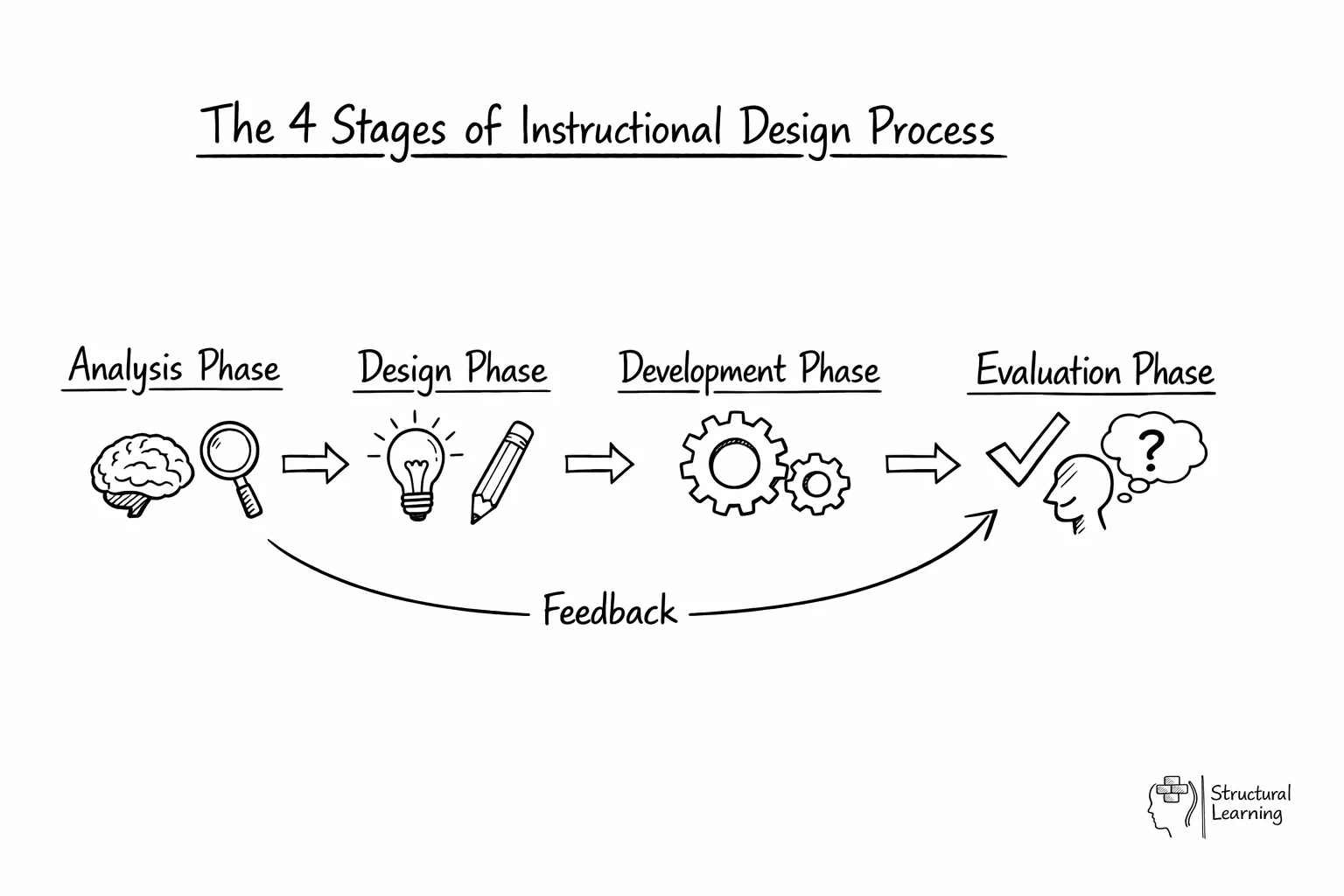
Four-stage instructional design process: Analysis, Design, Development, and Evaluation phases
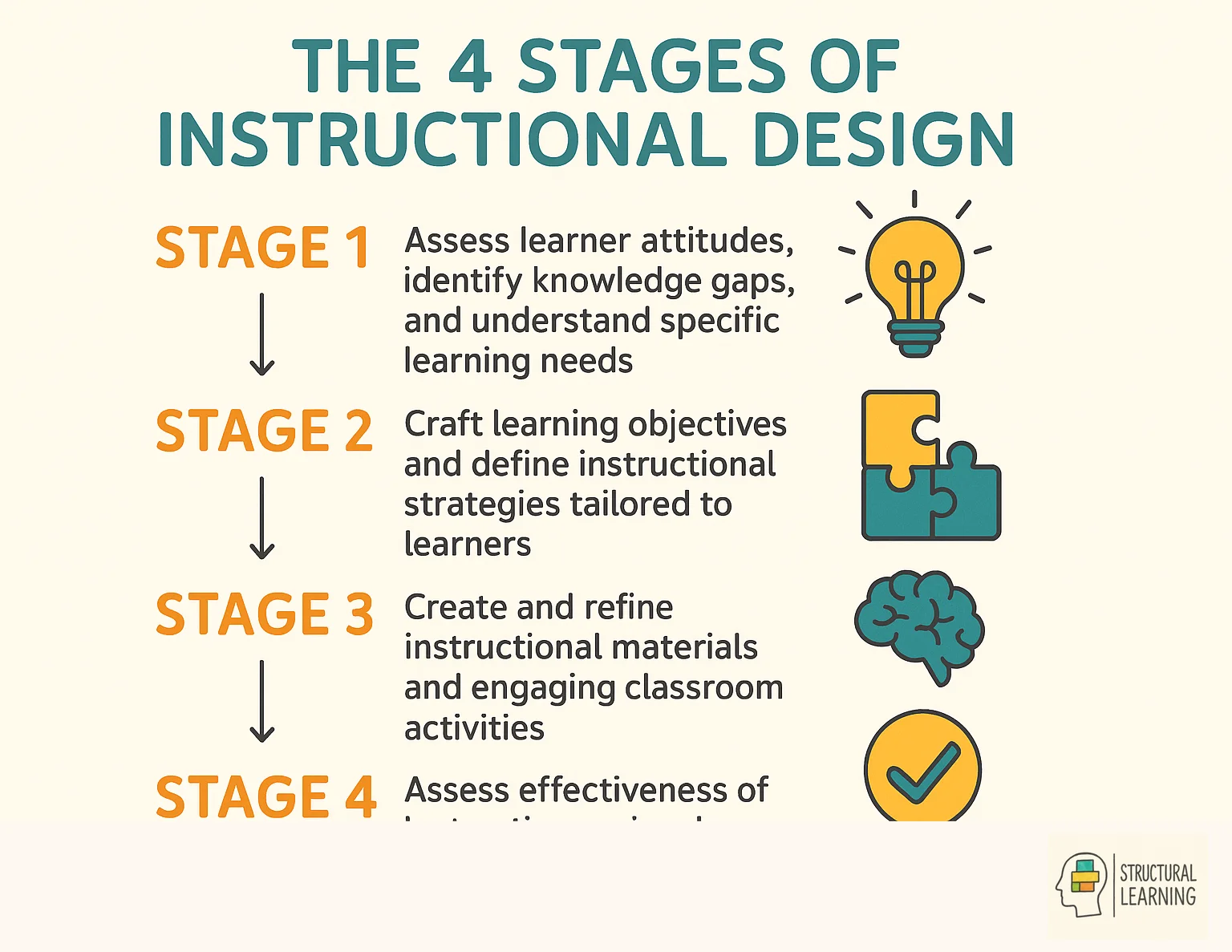
The 4 Stages of Instructional Design

The process of instructional design unfolds in several key stages. It begins with a comprehensive analysis phase, where information about the learners and their learning goals is gathered. This sets the foundation for the design phase, where learning objectives are crafted and defined.

Following this, the development phase involves the creation and refinement of instructional materials. The final stage is the evaluation phase, where the effectiveness of the instructional design is assessed, and revisions are made as necessary.

Instructional design principles ground teaching methods in robust learning theory, leading to clear and efficient instruction through methods such as explicit instruction. According to a study by the National Center for Education Statistics, well-designed instruction can increase learning outcomes by up to 25%.

For instance, consider an online course on environmental science. An instructional designer would first analyze the learners' and attitudes towards environmental issues. They would then design the course content and activities to address these needs, perhaps incorporating interactive simulations to engage learners. The course materials would be developed and then evaluated for effectiveness, with revisions made as necessary.

In essence, instructional design is about enhancing the . It's about designing and delivering content in a way that optimizes engagement, knowledge acquisition, and retention. For more insights, consider exploring this academic source on the importance of clear learning objectives.


What Principles does an Instructional Designer embrace?

An Instructional Designer embraces several principles when creating hands-on classroom activities. These principles guide the instructional design process and are crucial for ensuring that the student achievement are achieved.

First and foremost, an Instructional Designer understands the importance of learner-centeredness. They recognize that learners have unique needs, preferences, and learning styles, and they tailor their instructional strategies and materials accordingly. By considering the , an Instructional Designer can create engaging and personalized activities that cater to their individual needs.

Another key principle is the alignment of learning objectives with the overall instructional design. An Instructional Designer ensures that the learning objectives are clear, achievable, and measurable. By establishing specific goals, they provide a roadmap for both the learners and the instructional design process.

Additionally, an Instructional Designer embraces the use of interactive and engaging instructional strategies. They incorporate a variety of multimedia, simulations, and hands-on activities to promote active learning, critical thinking, and problem-solving skills. By using these strategies, they create an immersive learning environment that keeps learners engaged and motivated.

Lastly, an Instructional Designer believes in the importance of and improvement. They regularly assess the effectiveness of the instructional materials and strategies and make necessary revisions based on learner feedback and performance data. This iterative process ensures that the lessons are constantly refined to maximize their impact.

Incorporating these principles into instructional design work is critical because they promote learner engagement, motivation, and retention. By considering the learners' needs, creating clear objectives, using interactive strategies, and engaging in continuous evaluation, Instructional Designers can create engaging activities that empower learners and facilitate their growth and development.


Instructional design principles

What Adult Learning Theories Are Used in Instructional Design?

The most influential adult learning theories in instructional design include andragogy (self-directed learning), experiential learning theory, and transformative learning. These theories emphasize that adults learn best when content connects to their existing experience and addresses immediate practical needs. Instructional designers apply these by creating problem-based scenarios and allowing learners to draw on their professional background.

play a crucial role in instructional design, helping designers create appropriate learning solutions. One notable theory is Knowles' Theory of Andragogy, which emphasizes the of adult learners.

This theory suggests that adults are motivated by the relevance of learning to their lives and prefer a problem-solving approach. Instructional designers can incorporate this theory by designing lessons that are practical, experiential, and promote active participation.

Gagne's Nine Events of Instruction is another influential theory in learning design. It outlines a systematic approach to instructional design, including gaining attention, informing objectives, stimulating recall, presenting content, providing guidance, eliciting performance, providing feedback, assessing performance, and enhancing retention and transfer.

By following these events, instructional designers ensure that lessons are engaging, focused, and promote the acquisition and application of knowledge and skills.

Maslow's Hierarchy of Needs, a well-known theory in psychology, also has implications for instructional design. This theory suggests that learners have different needs that must be met for optimal learning to occur. Instructional designers can consider this theory by creating a supportive and inclusive learning environment that addresses learners' physiological, safety, belongingness, esteem, and self-actualization needs.

Lastly, Meier's Accelerated Learning theory focuses on the holistic development of learners, incorporating elements such as music, movement, whole-brain engagement, and positive psychological states. Instructional designers can apply this theory by incorporating techniques such as mind mapping, role-playing, and visualization to enhance classroom activities and foster deeper understanding and retention.

Overall, by incorporating these adult learning theories into instructional design, designers can create learning solutions that are tailored to the specific needs and preferences of adult learners, resulting in more meaningful activities.

Why Does Instructional Design Matter for Student Achievement?

Research shows that systematic instructional design can increase student achievement by up to 25% when learning objectives are properly aligned with activities and assessments. It matters because it moves beyond one-size-fits-all teaching to address specific learning needs and knowledge gaps. This targeted approach particularly benefits struggling learners who need different instructional strategies to succeed.

Instructional design plays a crucial role in education by creating engaging activities that effectively bridge the knowledge and skills gap. With the rapidly evolving nature of the world and advancements in technology, it is more important than ever to design instruction that meets the needs of diverse learners and ensures their success.

One of the main reasons why instructional design matters is that it helps create engaging activities. By incorporating instructional strategies, technologies, and theories, designers can create activities that captivate learners' attention and foster their active participation in the learning process.

This active involvement enhances motivation, promotes deeper understanding, and facilitates the acquisition and application of knowledge and skills.

Additionally, instructional design is essential for closing the knowledge and skills gap. Through research and analysis, instructional designers can identify the specific needs of learners and the desired educational results.

By designing and developing appropriate instructional materials, resources, and activities, designers can provide learners with the necessary tools and opportunities to develop their knowledge and skills. This targeted approach ensures that the instruction is relevant, meaningful, and aligned with the desired learning gains.

Instructional design is a cyclical process that involves research and analysis, design and development, assessment, and evolution. Through research and analysis, designers gain insights into learners' needs and the context in which the instruction will take place.

This information informs the design and development of instruction, ensuring its effectiveness and relevance. Assessment allows for the evaluation of academic progress and the identification of areas that need improvement. Finally, instructional design is an iterative process, where feedback and evaluation lead to continuous improvement and evolution of the instruction.

Instructional design is crucial in education as it creates engaging activities and addresses the knowledge and skills gap. By incorporating research, analysis, design, assessment, and evolution, instructional designers can enhance skill development and ensure that learners are successful in their educational journey.


Instructional technology
Instructional materials

How Do You Become an Instructional Designer?

Most instructional designers hold a bachelor's degree in education, psychology, or a related field, with many pursuing specialized master's programs in instructional design or educational technology. Essential skills include learning theory knowledge, technical proficiency with e-learning tools, and project management abilities. Many professionals transition from teaching roles by gaining experience with curriculum development and educational technology implementation.

One of the pathways to becoming an instructional designer is through obtaining a bachelor's degree in a related field such as education, instructional design, or instructional technology.

This foundational education provides a solid understanding of learning theories and instructional strategies. Many universities and colleges offer undergraduate programs specializing in instructional design.

To further enhance career prospects and gain a deeper understanding of the field, individuals can pursue a master's degree in Instructional Design and Learning Technology. A master's degree program equips students with advanced knowledge and skills in instructional design principles, learning theories, and the use of educational technologies. Graduates of these programs are well-prepared to design engaging activities and develop instructional materials for various settings.

For those seeking to establish themselves as experts in the field and take on leadership roles, a Doctor of Professional Studies in Instructional Design Leadership can be an excellent choice.

This doctoral program focuses on advanced research, leadership skills, and the application of instructional design principles in complex educational settings. Graduates of this program are equipped to lead instructional design initiatives, conduct research, and contribute to the advancement of the field.

Whether through a bachelor's degree, master's degree, or doctoral degree, each pathway offers unique benefits and opportunities to gain the knowledge and skills necessary to become a successful instructional designer.


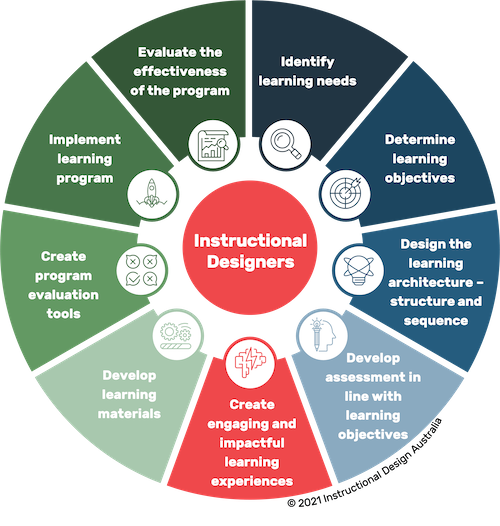
Instructional design duties

What Are the Main Instructional Design Theories?

The foundational instructional design theories include ADDIE (Analyze, Design, Develop, Implement, Evaluate), Bloom's Taxonomy for learning objectives, and Gagne's Nine Events of Instruction. These theories provide systematic frameworks for creating effective learning experiences by ensuring proper sequence and structure. Modern approaches also incorporate constructivist principles and social learning theory to enhance engagement and retention.

Instructional design theories serve as foundational frameworks for the development and implementation of engaging activities. By exploring these theories, instructional design professionals gain insights into how people learn and the most appropriate strategies for facilitating learning.

Some commonly studied instructional design theories include behaviorism, cognitivism, constructivism, and connectivism. Behaviorism focuses on the relationship between stimuli and responses, while cognitivism emphasizes the mental processes involved in learning.

Constructivism highlights the active role of learners in constructing knowledge, and connectivism recognizes the importance of social networks and technology in facilitating learning. By understanding and applying these theories, instructional design professionals can create engaging and impactful activities that meet the needs of diverse learners in various settings.


Instructional materials

1. The ADDIE Model of Instructional Design

The ADDIE Model of Instructional Design is a widely used framework that guides the development of engaging activities. It consists of five phases: Analysis, Design, Development, Implementation, and Evaluation.

In the Analysis phase, the instructional designer gathers information about the target learners, their needs, and the learning environment. This initial step helps identify the goals, learning objectives, and content to be covered.

Next comes the Design phase, where the instructional designer creates the overall structure and framework of the instructional materials. This includes defining the instructional strategies, selecting appropriate learning activities, and designing assessment methods.

During the Development phase, the instructional materials are created. This could involve storyboarding, creating multimedia elements, and developing any necessary technology or resources.

Once the materials are developed, they move on to the Implementation phase. This is when the instructional materials are delivered to the learners. This phase includes the facilitation of the learning experience, whether it be through classroom instruction, online courses, or other methods.

Finally, the Evaluation phase assesses the effectiveness of the instructional materials and the student achievement. Feedback from learners and other stakeholders is gathered to make any necessary revisions or improvements.

While the ADDIE Model was originally designed to be a sequential process, modern approaches to instructional design allow for simultaneous management of each phase. This flexibility enables a more iterative and efficient process, allowing for adjustments and improvements throughout the entire instructional design journey.


Instructional design model Addie

2. Gagne's Nine Events of Instruction

Gagne's Nine Events of Instruction is a widely recognized instructional design model that provides a blueprint for designing targeted instructional interventions. These events are sequential steps that guide instructional designers in creating impactful classroom activities. While they do not necessarily need to occur in a specific order, following a logical sequence is often recommended for maximum effectiveness.

1. Gain attention: This event aims to capture learners' attention by creating an engaging opening that motivates and stimulates their curiosity.

2. State objectives: Clear objectives are essential in guiding learners and providing them with a sense of direction. This event involves explicitly stating what learners are expected to achieve by the end of the instructional session.

3. Stimulate recall: By activating learners' prior knowledge and experiences related to the topic, this event helps establish connections and create a foundation for new learning.

4. Present content: This event involves delivering the instructional content in a systematic and organized manner. It includes relevant explanations, examples, and demonstrations to facilitate understanding.

5. Provide guidance: Learners need guidance to apply their newly acquired knowledge and skills effectively. This event involves offering strategies, assistance, and practice opportunities to support their learning.

6. Elicit performance: This event encourages learners to actively participate and demonstrate their understanding of the instructional content. It can involve activities such as quizzes, discussions, or hands-on exercises.

7. Provide feedback: Feedback plays a crucial role in the learning process. This event involves providing learners with constructive feedback to help them assess their performance and identify areas for improvement.

8. Assess performance: Assessing learners' performance allows both learners and instructors to determine the extent to which the learning objectives have been achieved. This event includes formal assessments, such as tests or assignments.

9. Enhance retention and transfer: This final event focuses on promoting long-term retention and transfer of knowledge and skills to real-life situations. It involves providing opportunities for learners to apply their learning in practical and meaningful contexts.

By following Gagne's Nine Events of Instruction, instructional designers can create well-structured and engaging activities that facilitate direct instruction and maximize learner outcomes.


Gagnes nine events of instruction

3. Action Mapping

Action Mapping is a performance consulting approach to instructional design developed by Cathy Moore. It is a systematic process that identifies business goals and high-priority actions, and then designs interventions to help employees perform those actions correctly.

The first step in Action Mapping is to clearly define the business goals that the training is intended to support. By aligning the training with the organization's strategic objectives, Action Mapping ensures that the training is relevant and has a direct impact on performance.

Next, high-priority actions are identified. These actions are the key behaviors or tasks that employees need to perform in order to achieve the business goals. By focusing on these specific actions, Action Mapping avoids the trap of trying to cover too much information and instead concentrates on what really matters.

Once the business goals and high-priority actions have been identified, the design of the training interventions can begin. Action Mapping emphasizes the importance of designing activities and resources that directly support the performance of these actions. This approach ensures that the training is practical and immediately applicable to the job.

One of the main benefits of Action Mapping is that it holds instructional design teams accountable for results. By focusing on business goals and high-priority actions, the success of the training can be measured based on its impact on job performance. This helps to ensure that the training is relevant and delivers tangible results.

Overall, Action Mapping is a powerful approach to instructional design that emphasizes the importance of aligning training with business goals and focusing on high-priority actions. By doing so, it increases the likelihood of meaningful and impactful activities for employees.

Action Mapping
Action Mapping


What Are the Best Practices for Effective Instructional Design?

Best practices include conducting thorough learner analysis to identify both knowledge gaps and attitudes before designing content. Effective instructional design aligns learning objectives with appropriate activities and assessment methods, while incorporating multiple learning modalities to accommodate different learning styles. Regular evaluation and iteration based on learner feedback ensures continuous improvement and maximum impact.

Instructional design is a systematic process that involves the creation of engaging activities through the application of instructional design models and theories. By utilizing these best practices, instructional designers can ensure that their training programs are engaging, impactful, and aligned with the desired educational results.

Using instructional design models, such as the ADDIE model or action mapping, provides a structured approach to the design and development of instructional materials. These models guide instructional designers in conducting thorough needs analyses, setting clear objectives, designing learning activities, and evaluating the effectiveness of the training program. By following these models, instructional designers are able to create customized programs that cater to the unique needs of learners.

In addition, instructional design incorporates student participation as a key component of the learning process. By involving learners in active engagement and interactive activities, instructional designers can enhance knowledge retention and application of the learned concepts. This fosters a learner-centered approach that encourages active learning and increases learner motivation.

Setting clear learning objectives is another crucial aspect of instructional design. By clearly defining the desired outcomes, instructional designers provide learners with a sense of purpose and direction. This enables teachers to understand what they are expected to gain from the training program and allows them to self-monitor their progress.

Furthermore, instructional design streamlines the learning experience by organizing information in a clear and logical manner. By breaking down complex concepts into smaller, manageable chunks, instructional designers simplify the learning process and enhance comprehension. This ensures that learners can understand and apply the content effectively.

Looking ahead, the potential of artificial intelligence (AI) in instructional design is promising. AI has the capability to automate certain aspects of the instructional design process, such as content creation, assessment, and feedback. This not only saves time and resources but also allows teachers to focus on more strategic tasks, such as analyzing learner data and personalizing lessons.

In conclusion, instructional design models and theories are vital for creating engaging activities. They allow teachers to create customized programs, encourage student participation, set clear objectives, and simplify learning for students. With the advancements in AI, the future of instructional design holds great potential for further enhancing the effectiveness and efficiency of the instructional design process.

Frequently Asked Questions

What exactly is instructional design and how does it differ from traditional teaching methods?

Instructional design is a systematic process that creates tailored learning experiences by first analysing learners' specific needs, attitudes, and knowledge gaps, then designing materials and activities to meet those exact requirements. Unlike traditional one-size-fits-all teaching, it customises content and strategies for different learners, moving through four key stages: analysis, design, development, and evaluation to ensure maximum effectiveness.

How can teachers implement the four stages of instructional design in their classroom planning?

Teachers can start with the analysis phase by assessing pupils' existing knowledge, attitudes, and learning needs through surveys or informal discussions. Next, they design clear, measurable learning objectives, then develop engaging materials and activities that align with these goals, before finally evaluating effectiveness through pupil feedback and performance data to make necessary improvements.

What evidence exists that instructional design actually improves student outcomes?

Research from the National Center for Education Statistics demonstrates that well-designed instruction can increase learning outcomes by up to 25% when learning objectives are properly aligned with classroom activities and assessments. This significant boost occurs because instructional design addresses individual learning needs rather than using generic teaching approaches that may not resonate with all pupils.

How can instructional design principles help teachers reach hard-to-engage pupils?

Instructional design emphasises assessing pupils' attitudes alongside their knowledge gaps, which reveals the hidden reasons why some learners struggle to engage. By understanding these underlying attitudes and designing interactive, problem-solving activities that connect to pupils' interests and experiences, teachers can create personalised approaches that finally reach previously disengaged learners.

What makes adult learning different in instructional design, particularly for CPD sessions with staff?

Adult learners require content that connects to their existing professional experience and addresses immediate practical needs, following principles like Knowles' Theory of Andragogy which emphasises self-directed learning. Instructional designers create problem-based scenarios that allow staff to draw on their background knowledge, making CPD sessions more relevant and engaging rather than theoretical presentations that adults often resist.

How can teachers ensure their lesson objectives align properly with their teaching activities?

Teachers should follow Gagne's Nine Events of Instruction, which provides a systematic approach including gaining attention, clearly informing objectives, presenting content with guidance, and providing feedback that directly relates to the stated goals. This alignment ensures that every classroom activity serves a specific purpose in achieving the learning objectives, rather than being disconnected or merely entertaining.

What are some practical examples of how instructional design transforms everyday classroom activities?

Instead of traditional lectures, instructional design might incorporate interactive simulations, mind mapping, role-playing, and problem-solving scenarios that directly address identified learning gaps. For example, an environmental science lesson would first assess pupils' attitudes towards environmental issues, then use hands-on experiments and real-world case studies that connect to their interests, followed by evaluation and refinement based on pupil responses.

Loading audit...

What is Instructional Design?

Instructional design is a systematic and thoughtful process that crafts impactful lessons. It's a methodology that takes into account the specific learning needs of an audience and designs instructional materials and activities to meet those needs. The ultimate goal is to present educational content in a way that is both engaging and digestible for learners.

Key Takeaways

  1. Beyond One-Size-Fits-All Teaching: Discover why your struggling pupils need radically different approaches and how instructional design transforms their learning outcomes
  2. The 25% Learning Boost: Uncover the systematic process that research shows can dramatically increase pupil achievement when you align objectives with activities
  3. Why Adult Learners Rebel: Master the overlooked principles that make CPD sessions actually stick and turn resistant staff into engaged learners
  4. The Hidden Gap Analysis: Learn how assessing attitudes, not just knowledge, revolutionises your lesson planning and finally reaches those hard-to-engage pupils

At the core of instructional design is a deep understanding of the learners. This involves assessing their attitudes, identifying knowledge gaps, and . With this understanding, instructional designers can customize their content and instructional strategies to create meaningful classroom activities that resonate with the learners.

Four-stage instructional design process: Analysis, Design, Development, and Evaluation phases
The 4 Stages of Instructional Design

The process of instructional design unfolds in several key stages. It begins with a comprehensive analysis phase, where information about the learners and their learning goals is gathered. This sets the foundation for the design phase, where learning objectives are crafted and defined.

Following this, the development phase involves the creation and refinement of instructional materials. The final stage is the evaluation phase, where the effectiveness of the instructional design is assessed, and revisions are made as necessary.

Instructional design principles ground teaching methods in robust learning theory, leading to clear and efficient instruction through methods such as explicit instruction. According to a study by the National Center for Education Statistics, well-designed instruction can increase learning outcomes by up to 25%.

For instance, consider an online course on environmental science. An instructional designer would first analyze the learners' and attitudes towards environmental issues. They would then design the course content and activities to address these needs, perhaps incorporating interactive simulations to engage learners. The course materials would be developed and then evaluated for effectiveness, with revisions made as necessary.

In essence, instructional design is about enhancing the . It's about designing and delivering content in a way that optimizes engagement, knowledge acquisition, and retention. For more insights, consider exploring this academic source on the importance of clear learning objectives.


What Principles does an Instructional Designer embrace?

An Instructional Designer embraces several principles when creating hands-on classroom activities. These principles guide the instructional design process and are crucial for ensuring that the student achievement are achieved.

First and foremost, an Instructional Designer understands the importance of learner-centeredness. They recognize that learners have unique needs, preferences, and learning styles, and they tailor their instructional strategies and materials accordingly. By considering the , an Instructional Designer can create engaging and personalized activities that cater to their individual needs.

Another key principle is the alignment of learning objectives with the overall instructional design. An Instructional Designer ensures that the learning objectives are clear, achievable, and measurable. By establishing specific goals, they provide a roadmap for both the learners and the instructional design process.

Additionally, an Instructional Designer embraces the use of interactive and engaging instructional strategies. They incorporate a variety of multimedia, simulations, and hands-on activities to promote active learning, critical thinking, and problem-solving skills. By using these strategies, they create an immersive learning environment that keeps learners engaged and motivated.

Lastly, an Instructional Designer believes in the importance of and improvement. They regularly assess the effectiveness of the instructional materials and strategies and make necessary revisions based on learner feedback and performance data. This iterative process ensures that the lessons are constantly refined to maximize their impact.

Incorporating these principles into instructional design work is critical because they promote learner engagement, motivation, and retention. By considering the learners' needs, creating clear objectives, using interactive strategies, and engaging in continuous evaluation, Instructional Designers can create engaging activities that empower learners and facilitate their growth and development.


Instructional design principles

What Adult Learning Theories Are Used in Instructional Design?

The most influential adult learning theories in instructional design include andragogy (self-directed learning), experiential learning theory, and transformative learning. These theories emphasize that adults learn best when content connects to their existing experience and addresses immediate practical needs. Instructional designers apply these by creating problem-based scenarios and allowing learners to draw on their professional background.

play a crucial role in instructional design, helping designers create appropriate learning solutions. One notable theory is Knowles' Theory of Andragogy, which emphasizes the of adult learners.

This theory suggests that adults are motivated by the relevance of learning to their lives and prefer a problem-solving approach. Instructional designers can incorporate this theory by designing lessons that are practical, experiential, and promote active participation.

Gagne's Nine Events of Instruction is another influential theory in learning design. It outlines a systematic approach to instructional design, including gaining attention, informing objectives, stimulating recall, presenting content, providing guidance, eliciting performance, providing feedback, assessing performance, and enhancing retention and transfer.

By following these events, instructional designers ensure that lessons are engaging, focused, and promote the acquisition and application of knowledge and skills.

Maslow's Hierarchy of Needs, a well-known theory in psychology, also has implications for instructional design. This theory suggests that learners have different needs that must be met for optimal learning to occur. Instructional designers can consider this theory by creating a supportive and inclusive learning environment that addresses learners' physiological, safety, belongingness, esteem, and self-actualization needs.

Lastly, Meier's Accelerated Learning theory focuses on the holistic development of learners, incorporating elements such as music, movement, whole-brain engagement, and positive psychological states. Instructional designers can apply this theory by incorporating techniques such as mind mapping, role-playing, and visualization to enhance classroom activities and foster deeper understanding and retention.

Overall, by incorporating these adult learning theories into instructional design, designers can create learning solutions that are tailored to the specific needs and preferences of adult learners, resulting in more meaningful activities.

Why Does Instructional Design Matter for Student Achievement?

Research shows that systematic instructional design can increase student achievement by up to 25% when learning objectives are properly aligned with activities and assessments. It matters because it moves beyond one-size-fits-all teaching to address specific learning needs and knowledge gaps. This targeted approach particularly benefits struggling learners who need different instructional strategies to succeed.

Instructional design plays a crucial role in education by creating engaging activities that effectively bridge the knowledge and skills gap. With the rapidly evolving nature of the world and advancements in technology, it is more important than ever to design instruction that meets the needs of diverse learners and ensures their success.

One of the main reasons why instructional design matters is that it helps create engaging activities. By incorporating instructional strategies, technologies, and theories, designers can create activities that captivate learners' attention and foster their active participation in the learning process.

This active involvement enhances motivation, promotes deeper understanding, and facilitates the acquisition and application of knowledge and skills.

Additionally, instructional design is essential for closing the knowledge and skills gap. Through research and analysis, instructional designers can identify the specific needs of learners and the desired educational results.

By designing and developing appropriate instructional materials, resources, and activities, designers can provide learners with the necessary tools and opportunities to develop their knowledge and skills. This targeted approach ensures that the instruction is relevant, meaningful, and aligned with the desired learning gains.

Instructional design is a cyclical process that involves research and analysis, design and development, assessment, and evolution. Through research and analysis, designers gain insights into learners' needs and the context in which the instruction will take place.

This information informs the design and development of instruction, ensuring its effectiveness and relevance. Assessment allows for the evaluation of academic progress and the identification of areas that need improvement. Finally, instructional design is an iterative process, where feedback and evaluation lead to continuous improvement and evolution of the instruction.

Instructional design is crucial in education as it creates engaging activities and addresses the knowledge and skills gap. By incorporating research, analysis, design, assessment, and evolution, instructional designers can enhance skill development and ensure that learners are successful in their educational journey.


Instructional technology
Instructional materials

How Do You Become an Instructional Designer?

Most instructional designers hold a bachelor's degree in education, psychology, or a related field, with many pursuing specialized master's programs in instructional design or educational technology. Essential skills include learning theory knowledge, technical proficiency with e-learning tools, and project management abilities. Many professionals transition from teaching roles by gaining experience with curriculum development and educational technology implementation.

One of the pathways to becoming an instructional designer is through obtaining a bachelor's degree in a related field such as education, instructional design, or instructional technology.

This foundational education provides a solid understanding of learning theories and instructional strategies. Many universities and colleges offer undergraduate programs specializing in instructional design.

To further enhance career prospects and gain a deeper understanding of the field, individuals can pursue a master's degree in Instructional Design and Learning Technology. A master's degree program equips students with advanced knowledge and skills in instructional design principles, learning theories, and the use of educational technologies. Graduates of these programs are well-prepared to design engaging activities and develop instructional materials for various settings.

For those seeking to establish themselves as experts in the field and take on leadership roles, a Doctor of Professional Studies in Instructional Design Leadership can be an excellent choice.

This doctoral program focuses on advanced research, leadership skills, and the application of instructional design principles in complex educational settings. Graduates of this program are equipped to lead instructional design initiatives, conduct research, and contribute to the advancement of the field.

Whether through a bachelor's degree, master's degree, or doctoral degree, each pathway offers unique benefits and opportunities to gain the knowledge and skills necessary to become a successful instructional designer.


Instructional design duties

What Are the Main Instructional Design Theories?

The foundational instructional design theories include ADDIE (Analyze, Design, Develop, Implement, Evaluate), Bloom's Taxonomy for learning objectives, and Gagne's Nine Events of Instruction. These theories provide systematic frameworks for creating effective learning experiences by ensuring proper sequence and structure. Modern approaches also incorporate constructivist principles and social learning theory to enhance engagement and retention.

Instructional design theories serve as foundational frameworks for the development and implementation of engaging activities. By exploring these theories, instructional design professionals gain insights into how people learn and the most appropriate strategies for facilitating learning.

Some commonly studied instructional design theories include behaviorism, cognitivism, constructivism, and connectivism. Behaviorism focuses on the relationship between stimuli and responses, while cognitivism emphasizes the mental processes involved in learning.

Constructivism highlights the active role of learners in constructing knowledge, and connectivism recognizes the importance of social networks and technology in facilitating learning. By understanding and applying these theories, instructional design professionals can create engaging and impactful activities that meet the needs of diverse learners in various settings.


Instructional materials

1. The ADDIE Model of Instructional Design

The ADDIE Model of Instructional Design is a widely used framework that guides the development of engaging activities. It consists of five phases: Analysis, Design, Development, Implementation, and Evaluation.

In the Analysis phase, the instructional designer gathers information about the target learners, their needs, and the learning environment. This initial step helps identify the goals, learning objectives, and content to be covered.

Next comes the Design phase, where the instructional designer creates the overall structure and framework of the instructional materials. This includes defining the instructional strategies, selecting appropriate learning activities, and designing assessment methods.

During the Development phase, the instructional materials are created. This could involve storyboarding, creating multimedia elements, and developing any necessary technology or resources.

Once the materials are developed, they move on to the Implementation phase. This is when the instructional materials are delivered to the learners. This phase includes the facilitation of the learning experience, whether it be through classroom instruction, online courses, or other methods.

Finally, the Evaluation phase assesses the effectiveness of the instructional materials and the student achievement. Feedback from learners and other stakeholders is gathered to make any necessary revisions or improvements.

While the ADDIE Model was originally designed to be a sequential process, modern approaches to instructional design allow for simultaneous management of each phase. This flexibility enables a more iterative and efficient process, allowing for adjustments and improvements throughout the entire instructional design journey.


Instructional design model Addie

2. Gagne's Nine Events of Instruction

Gagne's Nine Events of Instruction is a widely recognized instructional design model that provides a blueprint for designing targeted instructional interventions. These events are sequential steps that guide instructional designers in creating impactful classroom activities. While they do not necessarily need to occur in a specific order, following a logical sequence is often recommended for maximum effectiveness.

1. Gain attention: This event aims to capture learners' attention by creating an engaging opening that motivates and stimulates their curiosity.

2. State objectives: Clear objectives are essential in guiding learners and providing them with a sense of direction. This event involves explicitly stating what learners are expected to achieve by the end of the instructional session.

3. Stimulate recall: By activating learners' prior knowledge and experiences related to the topic, this event helps establish connections and create a foundation for new learning.

4. Present content: This event involves delivering the instructional content in a systematic and organized manner. It includes relevant explanations, examples, and demonstrations to facilitate understanding.

5. Provide guidance: Learners need guidance to apply their newly acquired knowledge and skills effectively. This event involves offering strategies, assistance, and practice opportunities to support their learning.

6. Elicit performance: This event encourages learners to actively participate and demonstrate their understanding of the instructional content. It can involve activities such as quizzes, discussions, or hands-on exercises.

7. Provide feedback: Feedback plays a crucial role in the learning process. This event involves providing learners with constructive feedback to help them assess their performance and identify areas for improvement.

8. Assess performance: Assessing learners' performance allows both learners and instructors to determine the extent to which the learning objectives have been achieved. This event includes formal assessments, such as tests or assignments.

9. Enhance retention and transfer: This final event focuses on promoting long-term retention and transfer of knowledge and skills to real-life situations. It involves providing opportunities for learners to apply their learning in practical and meaningful contexts.

By following Gagne's Nine Events of Instruction, instructional designers can create well-structured and engaging activities that facilitate direct instruction and maximize learner outcomes.


Gagnes nine events of instruction

3. Action Mapping

Action Mapping is a performance consulting approach to instructional design developed by Cathy Moore. It is a systematic process that identifies business goals and high-priority actions, and then designs interventions to help employees perform those actions correctly.

The first step in Action Mapping is to clearly define the business goals that the training is intended to support. By aligning the training with the organization's strategic objectives, Action Mapping ensures that the training is relevant and has a direct impact on performance.

Next, high-priority actions are identified. These actions are the key behaviors or tasks that employees need to perform in order to achieve the business goals. By focusing on these specific actions, Action Mapping avoids the trap of trying to cover too much information and instead concentrates on what really matters.

Once the business goals and high-priority actions have been identified, the design of the training interventions can begin. Action Mapping emphasizes the importance of designing activities and resources that directly support the performance of these actions. This approach ensures that the training is practical and immediately applicable to the job.

One of the main benefits of Action Mapping is that it holds instructional design teams accountable for results. By focusing on business goals and high-priority actions, the success of the training can be measured based on its impact on job performance. This helps to ensure that the training is relevant and delivers tangible results.

Overall, Action Mapping is a powerful approach to instructional design that emphasizes the importance of aligning training with business goals and focusing on high-priority actions. By doing so, it increases the likelihood of meaningful and impactful activities for employees.

Action Mapping
Action Mapping


What Are the Best Practices for Effective Instructional Design?

Best practices include conducting thorough learner analysis to identify both knowledge gaps and attitudes before designing content. Effective instructional design aligns learning objectives with appropriate activities and assessment methods, while incorporating multiple learning modalities to accommodate different learning styles. Regular evaluation and iteration based on learner feedback ensures continuous improvement and maximum impact.

Instructional design is a systematic process that involves the creation of engaging activities through the application of instructional design models and theories. By utilizing these best practices, instructional designers can ensure that their training programs are engaging, impactful, and aligned with the desired educational results.

Using instructional design models, such as the ADDIE model or action mapping, provides a structured approach to the design and development of instructional materials. These models guide instructional designers in conducting thorough needs analyses, setting clear objectives, designing learning activities, and evaluating the effectiveness of the training program. By following these models, instructional designers are able to create customized programs that cater to the unique needs of learners.

In addition, instructional design incorporates student participation as a key component of the learning process. By involving learners in active engagement and interactive activities, instructional designers can enhance knowledge retention and application of the learned concepts. This fosters a learner-centered approach that encourages active learning and increases learner motivation.

Setting clear learning objectives is another crucial aspect of instructional design. By clearly defining the desired outcomes, instructional designers provide learners with a sense of purpose and direction. This enables teachers to understand what they are expected to gain from the training program and allows them to self-monitor their progress.

Furthermore, instructional design streamlines the learning experience by organizing information in a clear and logical manner. By breaking down complex concepts into smaller, manageable chunks, instructional designers simplify the learning process and enhance comprehension. This ensures that learners can understand and apply the content effectively.

Looking ahead, the potential of artificial intelligence (AI) in instructional design is promising. AI has the capability to automate certain aspects of the instructional design process, such as content creation, assessment, and feedback. This not only saves time and resources but also allows teachers to focus on more strategic tasks, such as analyzing learner data and personalizing lessons.

In conclusion, instructional design models and theories are vital for creating engaging activities. They allow teachers to create customized programs, encourage student participation, set clear objectives, and simplify learning for students. With the advancements in AI, the future of instructional design holds great potential for further enhancing the effectiveness and efficiency of the instructional design process.

Frequently Asked Questions

What exactly is instructional design and how does it differ from traditional teaching methods?

Instructional design is a systematic process that creates tailored learning experiences by first analysing learners' specific needs, attitudes, and knowledge gaps, then designing materials and activities to meet those exact requirements. Unlike traditional one-size-fits-all teaching, it customises content and strategies for different learners, moving through four key stages: analysis, design, development, and evaluation to ensure maximum effectiveness.

How can teachers implement the four stages of instructional design in their classroom planning?

Teachers can start with the analysis phase by assessing pupils' existing knowledge, attitudes, and learning needs through surveys or informal discussions. Next, they design clear, measurable learning objectives, then develop engaging materials and activities that align with these goals, before finally evaluating effectiveness through pupil feedback and performance data to make necessary improvements.

What evidence exists that instructional design actually improves student outcomes?

Research from the National Center for Education Statistics demonstrates that well-designed instruction can increase learning outcomes by up to 25% when learning objectives are properly aligned with classroom activities and assessments. This significant boost occurs because instructional design addresses individual learning needs rather than using generic teaching approaches that may not resonate with all pupils.

How can instructional design principles help teachers reach hard-to-engage pupils?

Instructional design emphasises assessing pupils' attitudes alongside their knowledge gaps, which reveals the hidden reasons why some learners struggle to engage. By understanding these underlying attitudes and designing interactive, problem-solving activities that connect to pupils' interests and experiences, teachers can create personalised approaches that finally reach previously disengaged learners.

What makes adult learning different in instructional design, particularly for CPD sessions with staff?

Adult learners require content that connects to their existing professional experience and addresses immediate practical needs, following principles like Knowles' Theory of Andragogy which emphasises self-directed learning. Instructional designers create problem-based scenarios that allow staff to draw on their background knowledge, making CPD sessions more relevant and engaging rather than theoretical presentations that adults often resist.

How can teachers ensure their lesson objectives align properly with their teaching activities?

Teachers should follow Gagne's Nine Events of Instruction, which provides a systematic approach including gaining attention, clearly informing objectives, presenting content with guidance, and providing feedback that directly relates to the stated goals. This alignment ensures that every classroom activity serves a specific purpose in achieving the learning objectives, rather than being disconnected or merely entertaining.

What are some practical examples of how instructional design transforms everyday classroom activities?

Instead of traditional lectures, instructional design might incorporate interactive simulations, mind mapping, role-playing, and problem-solving scenarios that directly address identified learning gaps. For example, an environmental science lesson would first assess pupils' attitudes towards environmental issues, then use hands-on experiments and real-world case studies that connect to their interests, followed by evaluation and refinement based on pupil responses.

CPD

Back to Blog