Updated on
September 9, 2026
Developing Students' Digital Literacy Skills
Explore effective strategies for enhancing digital literacy in the classroom and preparing students for a tech-driven future.


Updated on
September 9, 2026
Explore effective strategies for enhancing digital literacy in the classroom and preparing students for a tech-driven future.
Digital literacy in the classroom encompasses students' ability to critically evaluate and create digital content, and to work through the digital world beyond basic computer skills. This includes developing critical thinking for online safety. It also means moving from passive consumers to active creators, which builds genuine digital citizenship. This thorough approach prepares students for an evolving digital world that requires adaptable technological skills.
With the over the years, and the extensive use of online learning during COVID-19, the education community has been and gadgets. The digital world offers enormous benefits to both teachers and students. However, without proper understanding, digital tools can become overwhelming or dangerous for younger age groups. Children currently live in an evolving digital world that requires increasing abilities and skills to use and adapt digital tools (Lankshear & Knobel, 2008).
Experts agree that technology skills are vital for students' educational development. However, they disagree on the exact knowledge children need to be digitally literate. Past definitions of digital literacy focused on skills with specific tools. These included using word processors, search engines, or configuring hardware (Adams, 1984; Gilster, 1997; Inskeep, 1982). Although these definitions are specific and measurable, they do not reflect the reality of our current world. Continuous studies have attempted to unfold the meaning and need for digital literacy. Leu et al. (2004) have argued that most literacies, including digital literacy, consist of four assumptions:
As this implies, digital literacy may start with the efficient use of digital tools and communication technologies but it does not stop there. It is a complex set of skills which include knowledge, understanding, application and reflection (Giannikas, 2020). Twenty-first century education bears emphasis on the importance of digital literacy (a synthesis of information literacy, internet literacy, and computer literacy), and on how it can be formally and informally acquired to help students' effective integration (Lau & Yuen, 2014), which can lead to numerous benefits. This article explores students' digital literacy. It suggests viewing digital literacy as the habits children use when learning with digital tools. Additionally, the article will discuss the benefits and principles of digital literacy, and show examples of how these can be put into practice and in the curriculum.
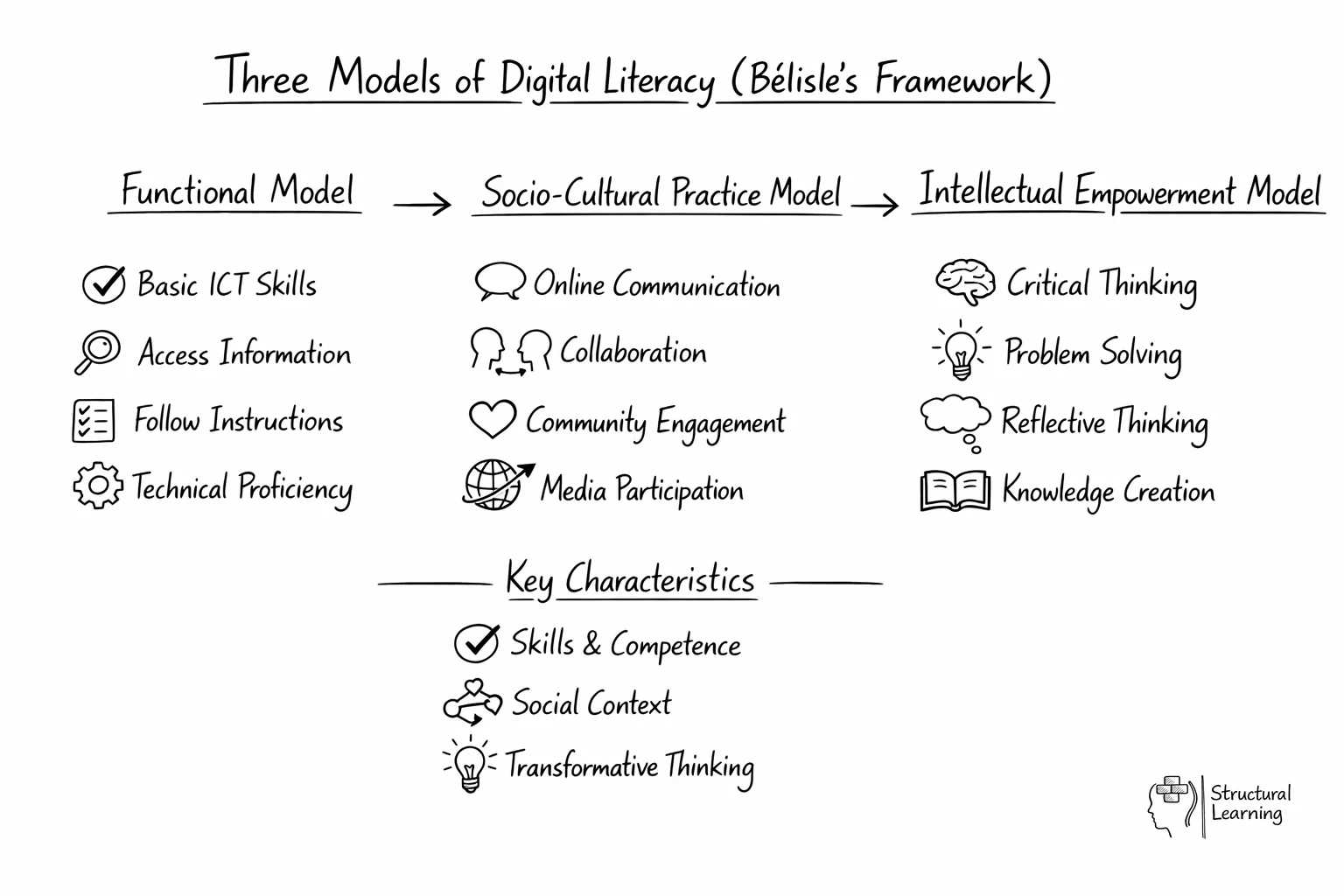
Bélisle (2006) explains the evolution of literacy concepts in terms of three models:
In viewing literacy within the context of a digital educational community, keeping the functional, socio-cultural and intellectual models in mind, we can see it as a powerful tool for students to comprehend their ownrelationship to the digital. The word "literacy" usually means reading and writing skills. However, adding the word "digital" gives the term a much wider meaning. We constantly find new ways to use digital tools for communication. Following its extensive use during COVID-19, digital literacy clearly requires a broader skill set. It is not merely about knowing how a tool or software functions.
As Martin (2008) has argued, digital literacy is the awareness, attitude and ability of individuals to appropriately use digital tools and facilities to identify, access, manage, integrate, evaluate, analyse and synthesise digital resources, construct new knowledge, create media expressions, and communicate with others, in the context of specific life situations, in order to enable constructive social action; and to reflect on this process. Buckingham (2010) explains that digital literacy in the classroom is more than just integrating technology into instruction. Digital literacy involves mentoring students as they learn with digital tools. It helps them build learning systems and understand cultural interactions inside and outside of school. Moreover, digital literacy requires critical thinking skills. It also involves understanding appropriate online behaviour and social issues caused by digital technologies. Therefore, one would argue that to develop digital literacy, students need to become accustomed to the following components:
These components go far beyond being able to simply use a computer or a specific piece of software. They represent a deeper understanding of the digital world and how to work through it safely and effectively. Digitally literate students become active participants in the modern age. They are able to learn, create, and connect in meaningful ways.
Digital literacy offers a multitude of benefits for students, extending far beyond the classroom walls. As our world becomes more digital, these skills are essential for success in higher education, work, and community life. Some key benefits include:
Several key principles can guide educators in effectively integrating digital literacy into the curriculum. These include:
For example, instead of simply teaching students how to use a word processor, have them create a blog post about a topic they are passionate about. Instead of simply demonstrating a search engine, challenge students to research a controversial issue. Ask them to carefully evaluate different information sources. Teachers can help students thrive in the digital age. They achieve this by integrating digital literacy into meaningful learning experiences.
Developing students' digital literacy skills is no longer optional but a fundamental necessity in today's educational landscape. It extends beyond basic computer skills, encompassing critical evaluation, content creation, and responsible online navigation. By embracing the principles of digital literacy and integrating them into the curriculum, educators can helps students to become active, informed, and engaged citizens of the digital world.
The benefits of digital literacy are far-reaching, impacting not only academic achievement but also future career prospects and civic participation. As technology continues to evolve, the need for digitally literate individuals will only intensify. Therefore, we must prioritise developing these skills in our students. This equips them with the tools needed to succeed in an increasingly digital society. Developing a digital literacy culture in our classrooms ensures all students can thrive in the 21st century.
Digital literacy involves the ability to critically evaluate and create digital content instead of simply using basic computer tools. It includes understanding how to work through online spaces safely and using technology to construct new knowledge. Teachers focus on helping students transition from passive users to active participants in the digital world.
Teachers can integrate these skills by embedding critical thinking tasks into daily lessons. For instance, students might assess the reliability of search engine results or use digital tools to present their research. This method ensures that technology supports the wider curriculum rather than being treated as a separate, isolated task.
Students with strong digital literacy skills are better prepared to manage the complexity of the modern information environment. They develop the habits required to identify bias and misinformation, which supports their academic progress. These abilities also help children prepare for future careers where adaptable technological skills are a requirement.
Research indicates that digital literacy is a complex set of habits involving knowledge, application, and reflection. Scholars such as Bélisle suggest that moving beyond mechanical skills to an intellectual approach leads to deeper understanding. Evidence highlights that students who reflect on their use of digital tools show higher levels of cognitive engagement.
One frequent error is focusing entirely on technical skills like word processing or using search engines. This approach ignores the critical thinking and social awareness needed to work through online spaces effectively. A common mistake is assuming children are naturally digitally literate. In reality, they need formal guidance to use devices safely.
Digital citizenship helps younger learners understand how their online behaviour affects themselves and their peers. It creates a foundation of vocabulary and habits that promote safety and responsible communication. By starting early, schools help students avoid the risks linked to the extensive use of online learning and social platforms.
For educators seeking to deepen their understanding of digital literacy, the following research papers offer valuable insights: