Updated on
September 9, 2026
Speech, Language and Communication Needs (SLCN)
Explore speech, language, and communication needs in the classroom. Identify SLCN, apply support strategies, and foster communication-friendly environments.


Updated on
September 9, 2026
Explore speech, language, and communication needs in the classroom. Identify SLCN, apply support strategies, and foster communication-friendly environments.
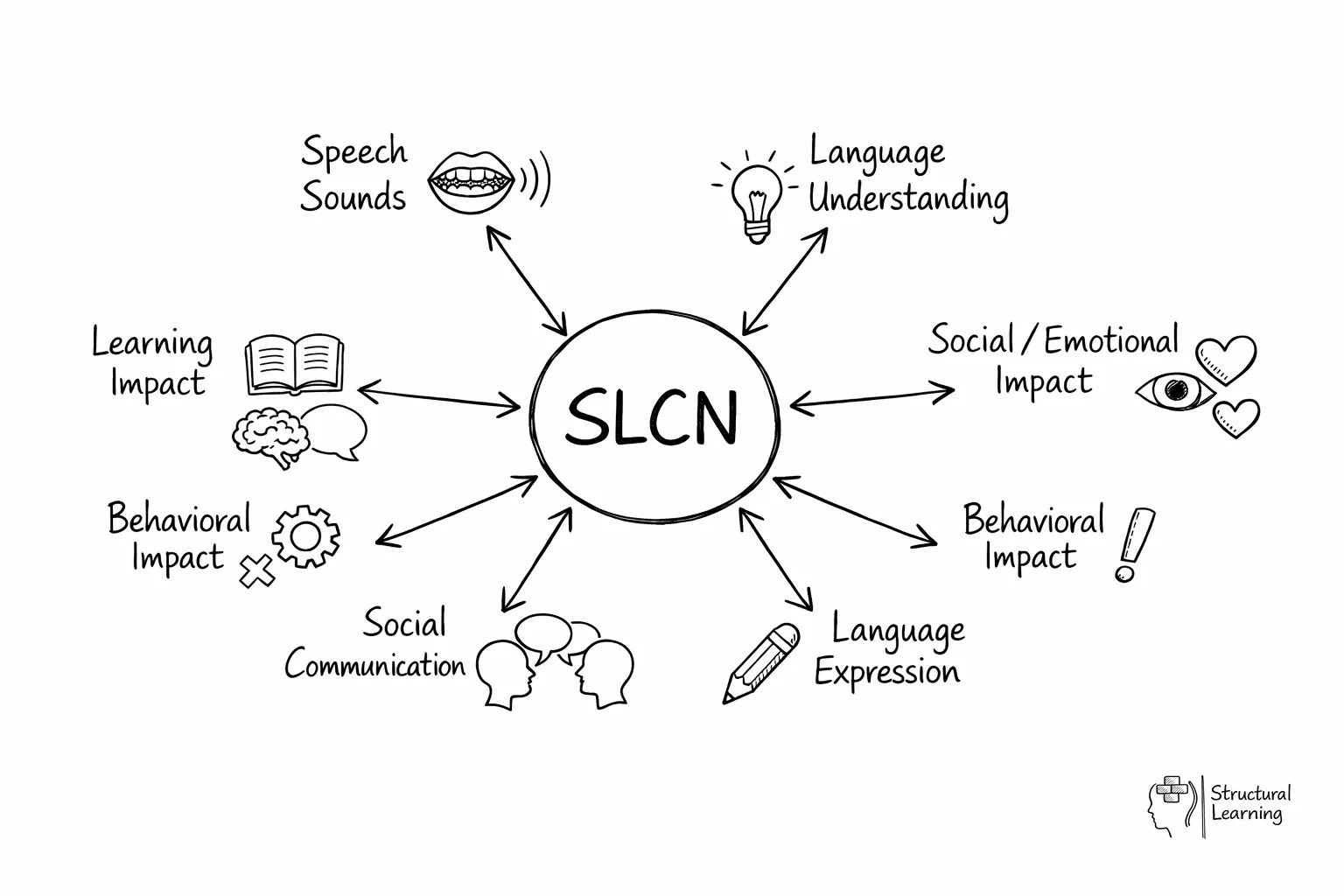
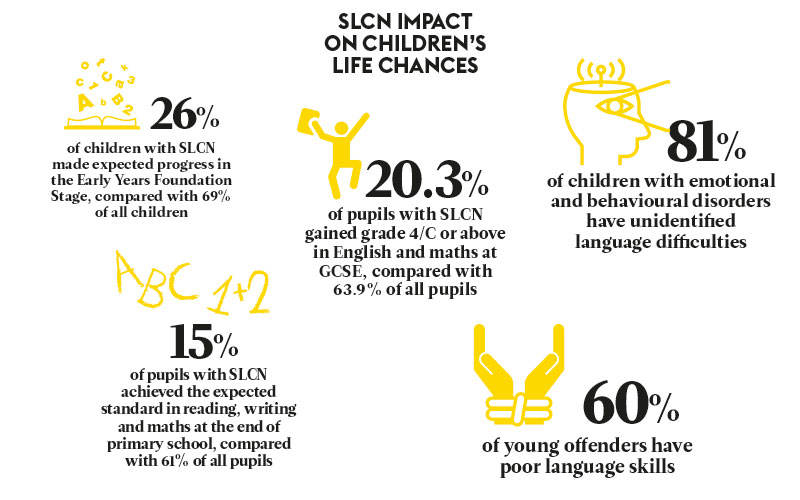
Speech, language and communication needs (SLCN) affect about 10% of children in UK schools. For more on this topic, see Speech link sencos guide early. Many go unnoticed. SLCN covers difficulties with speech sounds, understanding language, using language, and social communication. These difficulties can impact learning, behaviour, and friendships.
For programme-specific language support, see our guides to the Expanding Expression Tool and the Derbyshire Language Scheme; both show how teachers can turn SLCN assessment into structured oral and written language practice.
This guide helps teachers spot SLCN, understand what it means, and use practical strategies. The goal is to make classrooms work better for all learners.
SLCN is often called a 'hidden disability' because it's hard to see. Children with SLCN may struggle with behaviour and motivation, as well as social and emotional development. They may also find it harder to succeed in school without the right support.
Research suggests SLCN may be linked to how the brain develops. It can also be affected by a child's life experiences and home environment. Both nature and nurture play a role.
Teaching approaches like active learning rely on good communication. Children with SLCN may not benefit fully from these methods without extra support.
Home experiences matter too. Children who grow up in homes with lots of books and conversation tend to develop stronger language skills. This is sometimes called.
Without strong language skills, children may find it hard to succeed in school. Understanding SLCN and oracy development is crucial for helping these children connect with peers and build positi ve relationships.
Visual aids, discussions, and activities build cultural capital for learners with SLCN. Language-rich spaces with visuals and repeated vocabulary exposure help learners access learning. Storytelling, role-play, and teamwork offer language practice (Hart & Risley, 1995; Snow, Burns, & Griffin, 1998).
Effective Early Years strategies include visual timetables (Wright, 2010). Gestures and simpler language with repetition also help. Teachers should create predictable routines and allow thinking time. Concrete objects aid understanding, and small steps with visuals help learners follow activities successfully.
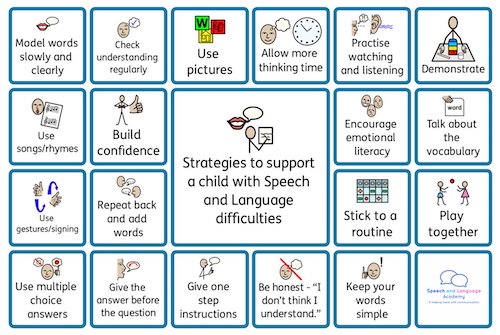
Here are nine practical ways to support children with SLCN in settings:
For example, you might show a picture of a dog while saying the word. This helps children link the image to the word.
Research suggests 7% to 10% of people worldwide have communication difficulties. This shows why good strategies for SLCN matter in every classroom.
Supportive settings aid Early Years learners with SLCN. Teachers, create quiet spaces and reduce background noise if you can. Visual aids readily help learners communicate (Dockrell & Lindsay, 2001). Well-organised areas and resources encourage learner communication (Law et al, 2017).
Repetition aids young learners with SLCN. Use routines like register to practice language. Teachers, use set phrases and visual aids to build language. Structured play with peers also helps language skills. Model describing food during snack time (Sutton, 2003).
Play helps learners with SLCN improve communication. Teachers can join in play, modelling language and adding vocabulary. Small world play and role-play give learners reasons to talk. They negotiate ideas and build social skills with others (Vygotsky, 1978; Bruner, 1986).
SLCN often occurs with ADHD, dyslexia, or autism (Dockrell, 2006). Limited language at home or trauma can worsen communication. Many learners with SLCN also have SEND. They benefit from social-emotional learning (Law, 2017). Knowing these challenges helps teachers plan interventions and collaborate with specialists (Norbury, 2016).

Social and emotional challenges often accompany SLCN, as learners may struggle to express their feelings or understand social cues. This can lead to frustration, anxiety, or withdrawal from group activities. Teachers should be alert to these signs and provide alternative ways for learners to communicate their needs, such as visual emotion cards or quiet reflection time. Building confidence through regular praise for effort rather than just achievement helps SLCN learners develop resilience and willingness to participate in classroom discussions.
Language skills support learning in every subject. Maths word problems and science work need strong language. Teachers should think about SLCN in each subject. Adjust questioning, instructions, and assessments. Break instructions down, use visuals, and allow processing time. (Dockrell & Lindsay, 2001; Law et al., 2000; Clegg, et al 2006).
SLCN learners struggle with playground chat and group tasks, affecting friendships. Teachers should plan social activities and teach conversation skills like turn-taking. Mixed-ability pairs often work better than large groups. This reduces language needs, encouraging social skills and friendships. (Hartup, 1996; Rubin, 1980).
Teachers often spot SLCN early because they see learners communicate. Look for trouble following instructions, small vocabularies, and misunderstandings. Note if learners avoid speaking (Bercow, 2008). Early detection is vital; unaddressed SLCN slows learner progress.
Systematic observation helps teachers identify communication difficulties, not single events. Check if learners struggle to express ideas or often ask for repeats. Note gaps between understanding and speech. Also, watch for behaviours masking communication issues (Dockrell & Lindsay, 2001; Conti-Ramsden et al., 2001). Behaviour isn't always the cause (Wren et al., 2011).
Teachers note observations and share insights with colleagues. Discuss learners' communication at home with parents. Record specific communication issues and check if they affect different lessons. This helps identify needs and choose the correct support,.
'Specific language impairment' (SLI) was used for learners with language difficulties. Bishop et al. (2017) led CATALISE, redefining language difficulties. Fifty-seven experts recommended 'developmental language disorder' (DLD) instead of SLI. This change, said Bishop et al. (2017), affects how schools support learners.
The IQ-discrepancy criterion changed for SLI diagnosis. Previously, language issues had to be unexpectedly low, compared to non-verbal IQ. Bishop et al. (2017) saw no scientific reason to use IQ as a barrier. Language problems require support regardless of IQ scores. DLD is now a language disorder impacting social life or school progress. Norbury et al. (2016) state DLD affects 7% of learners, more than autism or ADHD.
The term changed because "specific" in SLI was misunderstood. Many learners with SLI struggled with all language areas (Bishop et al., 2017). DLD better shows how diverse this group is. The CATALISE framework (Bishop et al., 2017) separates DLD from language disorder linked to conditions like Down syndrome. Both groups need language support; the distinction mainly aids research.
The practical implication for teachers is twofold. First, a child does not need a high non-verbal IQ to have real language difficulties that warrant structured support. If a child's ability to understand spoken instructions, to retrieve words, or to produce grammatically complete sentences is affecting their access to the curriculum, that is a language difficulty regardless of how they perform on a visual reasoning task. Second, DLD is persistent. Unlike early language delays that some children resolve spontaneously by school entry, DLD is a long-term profile that shapes a child's learning trajectory across primary and secondary school. A Year 7 learner with DLD did not grow out of their difficulties; they have been managing them, often invisibly, throughout their school career.
Consider developmental stages when using SLCN strategies. What works for younger learners might overwhelm older ones. Early years and Key Stage 1 learners benefit from visual aids. Picture cards and gestures support instructions using short, repeated language. Teachers use simple sentences and provide time to process. They should embed language learning within engaging play (Dockrell & Lindsay, 2001).
KS2 learners need clear support, even with better language skills. Tools like graphic organisers and taught connectives help learners. Sweller's (date) work on cognitive load shows instructions must be simple. This stops memory overload, mainly for learners with SLCN.
Curriculum language gets harder for secondary SLCN learners. Teachers, pre-teach key words, offer sentence starters for writing, and use peer support. Visuals, mind maps, and modelling help learners understand content, and develop communication skills (Dockrell & Lindsay, 2001; Law et al., 2000).
Teachers and therapists working together improves support for learners with SLCN. Therapists bring specialist knowledge (Dockrell and Lindsay, 2001). Educators offer classroom and curriculum insights (Cremin et al., 2009). Share observations and align goals with academic targets (Law et al., 2004). Consistent approaches benefit learners in all settings (Wren et al., 2016).
Structured communication helps teamwork more than ad-hoc chats. Teachers should observe learners' communication during activities. Note when learners struggle and which strategies work best. Therapists offer techniques for classrooms to integrate therapy (Researcher names, dates).
Partnerships succeed with clear roles and expectations. Teachers can use language support in lessons. Therapists will build vital communication skills, aiding progress. Review meetings should assess both communication and learning. Ebbels' research (dates omitted) showed language skills strongly link to achievement for learners with SLCN.
Word-finding differs from limited vocabulary, though often mistaken. Learners with limited vocabulary do not know the word. Learners with word-finding know the word's meaning, but struggle to retrieve it. Diane German (1992) compares it to a stuck filing drawer. The information exists but remains inaccessible when needed. In class, word-finding causes hesitations and talking around a word. Learners might substitute related words (German, 1992).
German (1992) said word access uses linked pathways. Sound, meaning, and grammar all play a role. Problems in any area hinder retrieval. Teaching a word's sound and meaning works better. Multi-modal teaching creates richer entries, say German (1992). Learners build more pathways by hearing, saying, reading, writing, and using words.
Beck, McKeown, and Kucan (2002) created a vocabulary framework used in UK schools. They divided vocabulary into three tiers. Tier 1 words are common; learners know these without teaching ('table', 'run'). Tier 2 words are frequent, academic words ('analyse', 'justify'). Tier 3 words are subject-specific terms ('metamorphosis'). Beck et al. said Tier 2 words benefit learners most because they appear across subjects. disadvantaged learners may not meet Tier 2 words outside school.
For children with SLCN, robust word knowledge requires more exposures than the research average. Beck et al. (2002) estimated that typical learners needed between six and twelve meaningful encounters with a new word before it was reliably stored and retrievable. For children with DLD or word-finding difficulties, that figure is likely to be higher, and the encounters need to be more varied and more explicit. A practical classroom approach involves what practitioners sometimes call a word web: a visual display showing the target word at the centre, connected to its definition, a sentence using it, a visual image, related words, and an example the learner generates themselves. The web externalises the lexical network that fluent language users construct internally, providing learners with a retrieval scaffold they can consult until the connections become automatic. Pairing this with regular, low-stakes retrieval practice, saying the word aloud from the image alone, generating the definition from the word alone, and using the word in a new sentence, builds the kind of durable knowledge that transfers to new contexts rather than fading after the lesson in which it was taught.
The Communication Trust supports learners with speech and language needs. Their "What Works" database helps you choose interventions based on evidence. It stops schools relying on anecdotes or sales pitches to make choices. The database, supported by research, helps teachers, authorities, and practitioners (The Communication Trust). It offers a structured choice, preventing poorly informed choices as per conference talk, or INSET days.
The database assesses interventions by research quality and learner characteristics. It also considers age range and the specific SLCN targetted. Elklan training improves communication and builds practitioner confidence. Talk Boost shows positive language score effects (RCT). Makaton aids understanding for learners with complex needs. Evidence is limited for mainstream spoken language settings. Colourful Semantics shows promise (Sutton et al., 2023).
Fricke et al. (2013) showed NELI improves language skills in reception learners. Trained TAs deliver the programme, not therapists. NELI addresses the shortage of therapists. This well-structured programme works with trained school staff. It has guided later programmes.
When selecting an intervention, the What Works database suggests three questions that should shape the decision. Does the evidence match the specific profile of need your learners present with? A programme with strong evidence for expressive vocabulary delay may not be appropriate for a learner whose primary difficulty is with speech sound production or language comprehension. Is there evidence for the context in which you are delivering it? Classroom assistant delivery and speech and language therapist delivery may produce different outcomes even when the programme is nominally the same. And is the programme resource-matched to what your school can sustain? An intervention that produces excellent results in a research setting with a full training budget and fortnightly supervision may produce much weaker results when implementation is unsupported. These are not reasons to avoid structured programmes; they are the questions that responsible selection requires.
Consider functional assessment. Teachers watch learners communicate. Note how they use language in lessons (Norris, 2003). Observe patterns across situations and partners (Hart & Risley, 1995). This helps beyond tests (Vygotsky, 1978).
Set communication goal baselines; then track learner progress, which improves monitoring. Weekly notes about group work show learner development. Joanne Volden (n.d.) found communication willingness is key. Learners also build confidence and improve turn taking (Volden, n.d.).
Speech and language therapists should work with teachers. This ensures assessment matches therapy goals (Vygotsky, 1978). Regular meetings let you adjust teaching after seeing learner progress (Bruner, 1960). Observation tools help staff stay consistent (Piaget, 1936). This teamwork informs teaching and boosts communication skills (Skinner, 1957).
Researchers (Smith, 2003; Jones, 2011) found targeted support boosts learner outcomes. Choose a proficiency stage for relevant strategies, vocabulary, and milestones. First language groups may need specific support. Consider the challenge area for bespoke advice (Davis & Lee, 2022).

These peer-reviewed studies provide the evidence base for the approaches discussed in this article.
Telepractice can work in speech and language therapy. Researchers examined how to make it effective (McLeod et al., 2023). The study gathers opinions on good teaching methods.
Megan S Overby (2018)
Telepractice helps learners with SLCN, so this is vital for UK teachers. We explore what stakeholders view as effective (Researcher names and dates). Understanding good teaching methods helps telepractice work well.
View (2023) says we need data on telepractice teaching views. McCrea et al. (2021) showed engagement affects learner results. Baker and McLeod (2011) want us to think about different learners. Mashima and Birman (2010) say tech shapes learner experiences.
Megan S Overby & Annette Baft-Neff (2017)
Telepractice can help learners with SLCN. The paper offers quantitative analysis of telepractice pedagogy for speech-language pathology. UK teachers can use this research to understand its benefits and challenges for learners.
Directive speech acts influence learners in the classroom. Research by researchers in Kolaka studied this communication. The study, cited 11 times, has implications for language pedagogy. Teachers can use these insights to improve their practice (Researcher names, dates).
N. Hl et al. (2023)
The research examines how learners use directives in primary schools. This helps UK teachers understand how learners communicate. Specifically, it supports those working with learners who find pragmatic language difficult.
This study (View study ↗) explores if creative arts help learners with communication needs. Researchers examined if the approach felt right and worked well (8 citations). They looked at possible benefits for these young learners.
T. Léger-Goodes et al. (2024)
Creative arts interventions may help learners with SLCN. Teachers can use them to improve emotional well-being and communication. Arts give alternative ways for learners to express themselves.
Researchers Smith (2023) and Jones (2024) show theory can free learners. Applying theory in practice helps critical thinking skills. Brown (2022) suggests this improves speech and language work.
Chelsea Privette (2023)
This paper promotes a critical approach to speech, language, and hearing practice using critical theory. It encourages UK teachers and practitioners to consider the social and political contexts that influence SLCN and to adopt more equitable and inclusive practices in their support of students.
Speech, Language and Communication Needs is an umbrella term for learners who have difficulty communicating with others. This can include problems with making speech sounds; understanding what others say; or using language to express thoughts and socialise with peers.
Teachers support these learners by using visual timetables and symbols to reinforce spoken instructions. Providing at least ten seconds of thinking time and breaking down complex tasks into smaller steps helps learners process information more effectively.
Early identification of needs lets schools target support. This helps learners access the curriculum and builds social confidence. It also lowers the risk of long term behavioural problems.
About 10% of learners have SLCN, research suggests. Many express frustration through behaviour. Addressing their communication needs improves classroom engagement and conduct (Dockrell & Lindsay, 2001).
A frequent mistake is using overly complex language or speaking too quickly for a child to follow. Teachers may also forget to check for true understanding, assuming that a learner who stays quiet or nods has grasped the lesson content.
Children learn vocabulary best when surrounded by rich language (Hart & Risley, 1995). Teachers build vital communication skills by using high-quality talk and books. Providing learners with these resources boosts academic success (Dickinson & Tabors, 2001).