Language Development in Children: Stages, Theories, and Teaching Strategies
From babbling to complex sentences: the 5 stages of language development, key theories (Chomsky, Vygotsky, Bruner), and practical strategies for supporting every child.


From babbling to complex sentences: the 5 stages of language development, key theories (Chomsky, Vygotsky, Bruner), and practical strategies for supporting every child.
Many UK learners have communication needs (Bercow, 2008). This affects their learning in all subjects. Oral language work boosts progress by six months (EEF, 2021).

Language skills support learners as they grow. Auditory skills come before speaking (Vygotsky, 1978). Language helps learners understand feelings and think clearly (Bruner, 1966). Language skills prepare them for literacy and relationships. Strong language skills help learners connect with others. This supports healthy social development (Bowlby, 1969).
Chomsky's language theories are key. We cover universal grammar and the Language Acquisition Device. Chomsky (1959) and Pinker (1994) researched nativism. These learners gain crucial insights.
Hart and Risley (1995) found a 30-million-word gap by age 3. EEF reports oral language work boosts progress by six months. Hoff (2003) linked language quality to vocabulary; child-directed speech matters.
Researchers study how language evolves over time. They seek principles for improved learner language growth. Educators can use strategies to boost learners' communication (Vygotsky, 1978; Bruner, 1983; Locke, 1993). These methods support language learning and expressive skills (Snow, 1999; Dickinson & Tabors, 2001; Hart & Risley, 2003).
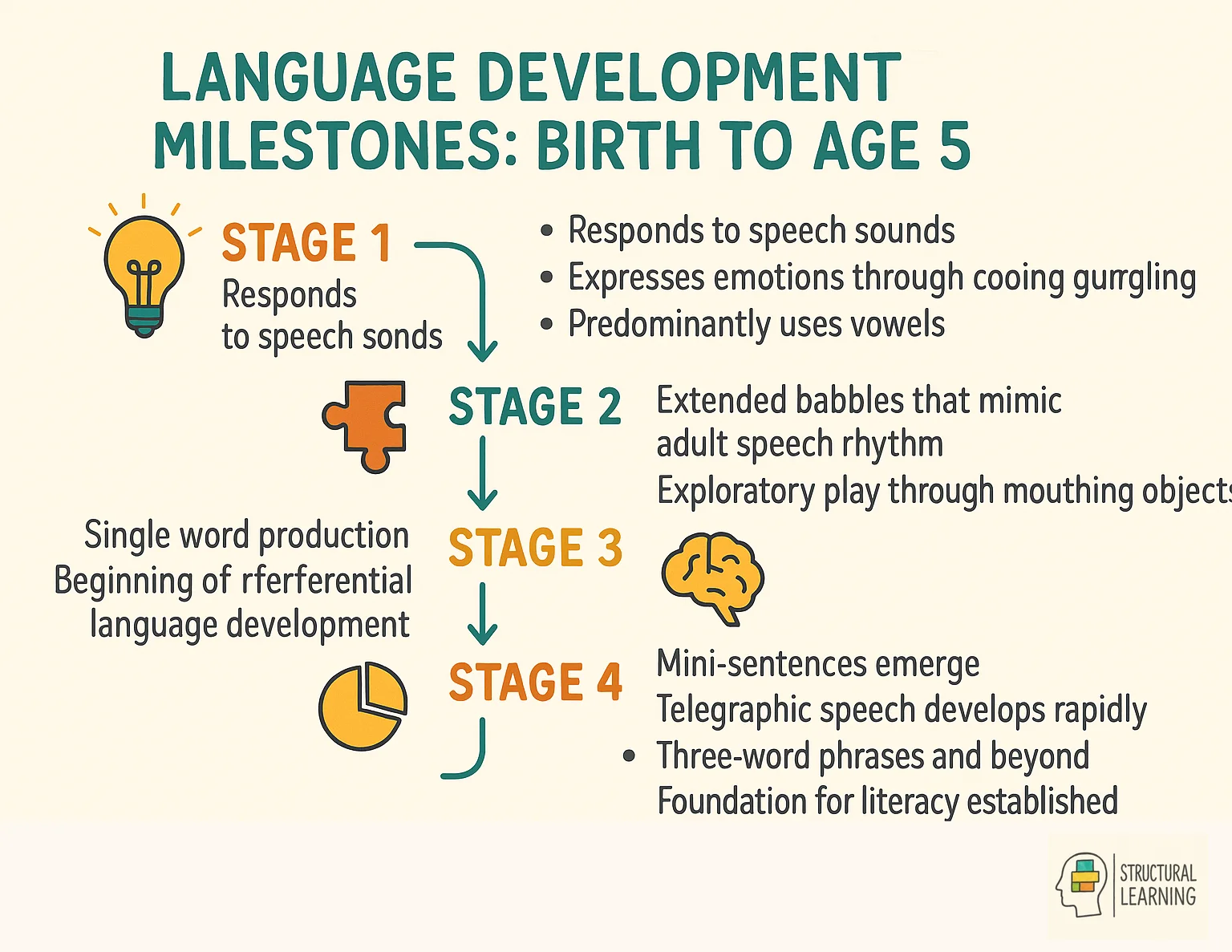
From birth until age five, infants quickly develop telegraphic speech. The of language skills are universal. The age and rate at which a child passes each spoken language milestone varies considerably. Thus, a child's spoken language skills development must be compared to norms, not other children. Girls can acquire language more rapidly than boys.
Language development reflects a learner's thinking skills. Lenneberg (1967) found learning speech after age five could present issues. Bates et al. (1979) observed learners often understand language quicker than speaking it.
Referential learners start with single words, then two-word phrases, and later, three-word phrases. Expressive learners babble, mimicking adult speech rhythm (Bloom, 1970; Dore, 1974). Most learners use both techniques to develop their phrasing skills.
Bruner (1983) argued Chomsky's LAD needs support. Learners need a Language Acquisition Support System (LASS). LASS involves routines and games from caregivers. This interaction helps learners before they speak (Bruner, 1983). LAD and LASS are two parts of one process.
Bruner used Vygotsky's (1978) ideas on how social interaction creates thinking. For language, conversations build grammar. Caregivers make routines before learners talk. Peekaboo shows this: hide, wait, reveal, react. The learner then adds sounds. Repeated play teaches turn-taking, shared focus, and meaning, which builds language.
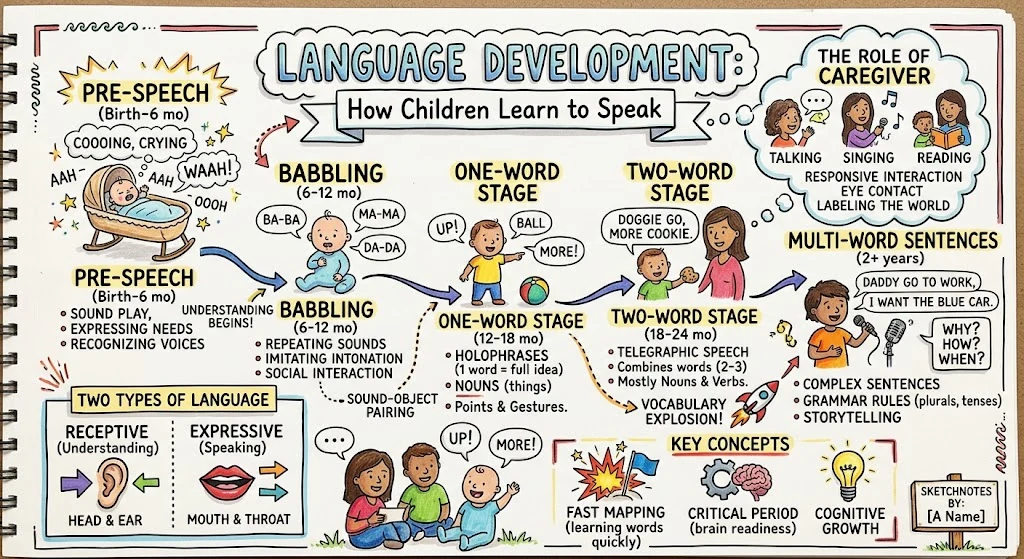
Tomasello and Farrar (1986) showed quick vocabulary growth occurs when adults follow a learner's gaze. Labelling what learners look at helps their vocabulary at 18 months. Therefore, teachers should follow learners' interests to improve language input.
LASS helps teachers build language opportunities. Teachers plan routines with set language, like registration. Ninio and Bruner (1978) proved this in picture-book reading. Their research showed attention, questions, naming, and feedback all help the learner.
Language milestones show how learners progress. Learners advance at varied rates, though "normal" ranges exist. Missing milestones may show language difficulties, for example, hearing problems. These milestones can highlight possible speech problems (Vihman et al., 2004; McLeod et al., 2017).
Milestones of language and child development for infants aged 0 to 2 years:
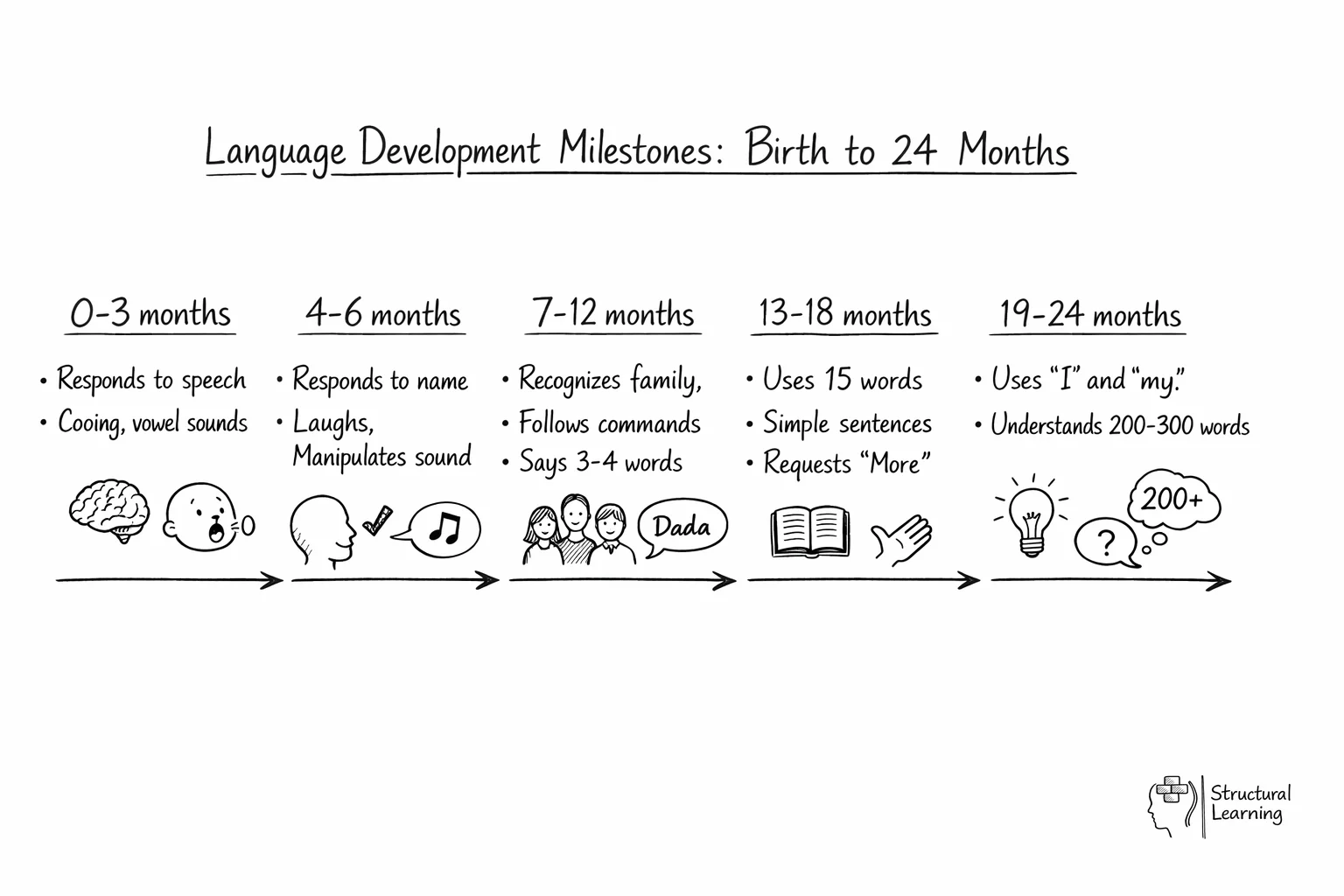
Later, during the one-word stage (12-18 months), learners start using single words to communicate (Bloom, 1973). Research by Nelson (1973) shows early words often relate to familiar objects.
Learners say single words around 12-18 months (Bloom, 1973). "Milk" can mean "I want milk" (Clark, 1978). Teachers should recognise this shows understanding (Nelson, 1973). Respond by extending meaning using child-directed speech (Snow, 1972).
At 18-24 months, learners enter the two-word stage, a start for grammar. They use basic rules to combine words, for example, "more biscuit". This telegraphic speech (Brown, 1970) shows they understand word order. Model full sentences and praise learner efforts to support language growth (Bloom, 1970; Schlesinger, 1971).
Snow found that child-directed speech helps learners with vocabulary. Complex language also benefits learners, according to Snow's research. Teachers must model good communication, as Snow suggested.
Classrooms benefit from wait time, giving learners time to think. Teachers should build on learner's words using correct grammar. For example, respond to "car go fast" with "Yes, the red car is going very fast down the hill". This validates the learner’s message (as shown by, for example, [researcher name, date]).
Storytelling, role-play, and discussions build learners' language skills. Teachers support talks with questions and peer work. They should have learners explain their ideas. Observing and recording language use helps teachers target support (Vygotsky, 1978; Bruner, 1986).
Teachers notice language needs as they watch learners each day. Classrooms show real learner communication (Bishop, date). Learners understand instructions and participate in groups. Early help works best (Bishop, date). Teacher observations are important.
Vocabulary gaps, trouble following instructions, and limited class talk can indicate problems. Learners may struggle to find words, using "thing" a lot. Catherine Snow's (date) work shows learners with weak story skills benefit from help.
Watch learners consistently, not just occasionally. Use checklists to monitor their speaking skills. Check if learners understand instructions without pictures and can explain what they need. Record both good and bad communication. This data informs referrals and changes to teaching (Hart & Drummond, 2009).
Learner language skills vary due to biology, home life, and society. Cognitive speed, memory, and hearing all affect grammar and vocabulary. Hart and Risley found some learners heard 30 million more words by age four. Teachers should understand these differences and plan lessons around learner exposure.
Hart and Risley (1995) found talking and reading with learners boosts their language skills. Books introduce learners to new words. Bilingual learners may acquire English more slowly. Bialystok (2001) showed they have strong language awareness.
Teachers change their lessons to meet learner needs. They should see slower progress as a normal variation needing help. Create classrooms full of language, give learners time, and value all languages. Watch and record individual patterns to adjust what you expect (Tomlinson, 2017), while maintaining standards (Wiliam, 2011).
Lenneberg (1967) said first language learning has a biological window from age two to puberty. He thought the brain had enough plasticity to learn language during this time. After puberty, the language function moves to the left side (Lenneberg, 1967). Kids before puberty recover language better from brain damage than adults, showing plasticity at work.
Genie, discovered in 1970, lacked early language input. Curtiss (1977) noted Genie built vocabulary but struggled with syntax. She used noun phrases but missed syntax seen in young learners at Brown's Stage III. Curtiss thought syntax needs critical period exposure for typical growth. Genie's case has issues as deprivation affected more than language. Researchers favour "sensitive period," not a sharp cut-off, showing lessened plasticity.
Newport (1990) studied deaf adults learning American Sign Language at various ages. Learners acquiring it from birth showed native grammar skills. Those learning after age 12 had grammar and syntax gaps, even after 30 years. Newport found grammar hardest to learn later, vocabulary easier. This matches late language learner issues.
EAL learners in UK schools face many challenges. Cummins (1984) found young learners pick up basic English fast. Academic English takes longer, around 5 to 7 years. Older learners often have good literacy in their first language. Phonics and morphology can be tough for them, though. Early years should create language rich spaces. Secondary teachers must teach grammar and vocabulary. This will support older learners after primary.
Learners develop language skills to understand speech from before birth. This development carries on throughout childhood. Vygotsky (1978), Piaget (1936) and Chomsky (1957) link this to hearing, speaking and cognitive-emotional skills.
Dickinson and Tabors (2001) found child-directed speech helps language. Teachers, encourage storytelling; it builds learner literacy. Whitehurst et al. (1988) showed interactive tasks boost all skills. Hart and Risley (1995) noted conversations and new words help too.
Vygotsky (1978) and Piaget (1952) state language shapes learner thinking and feelings. Language skills assist learners in problem-solving and understanding emotions. Bruner (1966) and Halliday (1975) reveal language constructs literacy and relationships.
Teachers often over-correct learners' speech and miss chances for talk. Language should suit the learner's level, say researchers (Vygotsky, 1978). Create supportive spaces so learners can communicate, (Bruner, 1983).
Crystal (1997) says language milestones help you check learner progress. Caregivers' feedback shows what learners can do, researchers find. Observing learners track their language use, as Berko Gleason (2009) confirms.

Teachers use language milestones to spot learners needing support and to praise improvements. Brown (1973) showed learners use single words at 12 months, two words at 18-24 months, and complex sentences by age four. Normal variation exists; learners reach milestones at different times (Brown, 1973).
Assess the learner's functional communication, not perfect grammar. Language use for questioning is key, say Kuhl (2000). Kuhl (2000) found interaction beats passive learning for language growth. Use classroom chats as good assessment chances.
Observation checklists monitor learner language use. Note vocabulary, sentences, and activity understanding. Contact specialists if concerned; Snow (1972) showed early support matters. Multilingual learners may progress differently, developing skills across languages.
Research shows oral language and literacy skills support each other. Learners with better vocabularies often read more easily (Dickinson & Tabors, 2001). Reading builds language skills as learners meet new words and sentences (Perfetti & Hart, 2001).
Snow (date) found conversations help learners decode text effectively. Playful language games build learners' phonological awareness (Snow, date). Storytelling improves learners' text comprehension and creation skills (Snow, date).
Shared reading builds learners' vocabulary. Discuss texts and have learners retell stories (Vygotsky, 1978). This encourages them to use new words. Learners create and listen to stories, boosting literacy and speaking skills (Bruner, 1990).
Smith (2003) and Jones (2011) suggest customising strategies for learners. Assess each learner's ability and language skills. Identify their main learning challenge. Brown (2018) advises setting targets using this initial assessment.
Bowlby (1969) and Ainsworth (1978) found early relationships are important. Use the resource pack to help learner wellbeing with materials and posters. Share Thompson's (2015) attachment advice with your colleagues.
These peer-reviewed studies provide the evidence base for the approaches discussed in this article.
Alexander (2005) showed professional development boosts teaching skills. Bakhtin (1981) said dialogue changes teacher beliefs and practice. Wegerif (2011) and Mercer (2004) studied language use in classrooms. Littleton and Mercer (2013) found dialogue helps learner development.
I. Wilkinson et al. (2017)
Professional development changes teachers' language arts. It improves learner language skills through better discussions in class. This paper offers interaction strategies for UK teachers (Researcher names and dates).
Culturally responsive training changes teachers' views of Latino/a learners (Researchers, date). Researchers cite the study 102 times, giving clear specifics (Researchers, date). The full study is available online (Researchers, date).
Paula J. Mellom et al. (2018)
Author (Date) found training shifts teacher attitudes. This benefits inclusive classrooms greatly. It supports learners from diverse cultural backgrounds effectively.
Corpus-based pedagogy helps TESOL teachers. Training involves two steps, supported by online work. Researchers like Johns (1991) and Sinclair (2004) show its value. Bowker (2002) and Aston (2001) provide context for implementation. Work by Tribble (1997) and Boulton (2017) guides practice for the learner.
Qing Ma et al. (2021)
The study by [researcher names and dates] explores TESOL teacher training. It uses corpus linguistics and online work in two steps. This could help UK teachers use data to improve language lessons. It offers practical ways to analyse language for better instruction.
Genre teaching impacts learners' academic literacy in CLIL, a recent study found. Genre affects learners, supported by research (49 citations). Hyland (2007) and Swales (1990) help us understand this method.
Y. Lo & Heeseon Jeong (2018)
Genre-based teaching supports academic literacy for CLIL learners. This helps learners build language skills within their subject (Swain, 1985; Cummins, 2000; Gibbons, 2009). Understanding this approach can help UK teachers.
Research by Clegg et al. (1999) explores language growth and social feelings. The case study focused on nine-year-old learners with speech delay. Paul et al. (2007) and St Clair et al. (2011) also investigated this area. These studies offer valuable insights for educators.
Fitriyani Fitriyani et al. (2019)
Dockrell and Law (2000) found that language skills impact social-emotional behaviour. The case study stresses early help for speech delays. UK teachers can use this to support each learner's progress. Baird and Nash (2022) link early support to better overall outcomes.
Many UK learners have communication needs (Bercow, 2008). This affects their learning in all subjects. Oral language work boosts progress by six months (EEF, 2021).

Language skills support learners as they grow. Auditory skills come before speaking (Vygotsky, 1978). Language helps learners understand feelings and think clearly (Bruner, 1966). Language skills prepare them for literacy and relationships. Strong language skills help learners connect with others. This supports healthy social development (Bowlby, 1969).
Chomsky's language theories are key. We cover universal grammar and the Language Acquisition Device. Chomsky (1959) and Pinker (1994) researched nativism. These learners gain crucial insights.
Hart and Risley (1995) found a 30-million-word gap by age 3. EEF reports oral language work boosts progress by six months. Hoff (2003) linked language quality to vocabulary; child-directed speech matters.
Researchers study how language evolves over time. They seek principles for improved learner language growth. Educators can use strategies to boost learners' communication (Vygotsky, 1978; Bruner, 1983; Locke, 1993). These methods support language learning and expressive skills (Snow, 1999; Dickinson & Tabors, 2001; Hart & Risley, 2003).
From birth until age five, infants quickly develop telegraphic speech. The of language skills are universal. The age and rate at which a child passes each spoken language milestone varies considerably. Thus, a child's spoken language skills development must be compared to norms, not other children. Girls can acquire language more rapidly than boys.
Language development reflects a learner's thinking skills. Lenneberg (1967) found learning speech after age five could present issues. Bates et al. (1979) observed learners often understand language quicker than speaking it.
Referential learners start with single words, then two-word phrases, and later, three-word phrases. Expressive learners babble, mimicking adult speech rhythm (Bloom, 1970; Dore, 1974). Most learners use both techniques to develop their phrasing skills.
Bruner (1983) argued Chomsky's LAD needs support. Learners need a Language Acquisition Support System (LASS). LASS involves routines and games from caregivers. This interaction helps learners before they speak (Bruner, 1983). LAD and LASS are two parts of one process.
Bruner used Vygotsky's (1978) ideas on how social interaction creates thinking. For language, conversations build grammar. Caregivers make routines before learners talk. Peekaboo shows this: hide, wait, reveal, react. The learner then adds sounds. Repeated play teaches turn-taking, shared focus, and meaning, which builds language.
Tomasello and Farrar (1986) showed quick vocabulary growth occurs when adults follow a learner's gaze. Labelling what learners look at helps their vocabulary at 18 months. Therefore, teachers should follow learners' interests to improve language input.
LASS helps teachers build language opportunities. Teachers plan routines with set language, like registration. Ninio and Bruner (1978) proved this in picture-book reading. Their research showed attention, questions, naming, and feedback all help the learner.
Language milestones show how learners progress. Learners advance at varied rates, though "normal" ranges exist. Missing milestones may show language difficulties, for example, hearing problems. These milestones can highlight possible speech problems (Vihman et al., 2004; McLeod et al., 2017).
Milestones of language and child development for infants aged 0 to 2 years:

Later, during the one-word stage (12-18 months), learners start using single words to communicate (Bloom, 1973). Research by Nelson (1973) shows early words often relate to familiar objects.
Learners say single words around 12-18 months (Bloom, 1973). "Milk" can mean "I want milk" (Clark, 1978). Teachers should recognise this shows understanding (Nelson, 1973). Respond by extending meaning using child-directed speech (Snow, 1972).
At 18-24 months, learners enter the two-word stage, a start for grammar. They use basic rules to combine words, for example, "more biscuit". This telegraphic speech (Brown, 1970) shows they understand word order. Model full sentences and praise learner efforts to support language growth (Bloom, 1970; Schlesinger, 1971).
Snow found that child-directed speech helps learners with vocabulary. Complex language also benefits learners, according to Snow's research. Teachers must model good communication, as Snow suggested.
Classrooms benefit from wait time, giving learners time to think. Teachers should build on learner's words using correct grammar. For example, respond to "car go fast" with "Yes, the red car is going very fast down the hill". This validates the learner’s message (as shown by, for example, [researcher name, date]).
Storytelling, role-play, and discussions build learners' language skills. Teachers support talks with questions and peer work. They should have learners explain their ideas. Observing and recording language use helps teachers target support (Vygotsky, 1978; Bruner, 1986).
Teachers notice language needs as they watch learners each day. Classrooms show real learner communication (Bishop, date). Learners understand instructions and participate in groups. Early help works best (Bishop, date). Teacher observations are important.
Vocabulary gaps, trouble following instructions, and limited class talk can indicate problems. Learners may struggle to find words, using "thing" a lot. Catherine Snow's (date) work shows learners with weak story skills benefit from help.
Watch learners consistently, not just occasionally. Use checklists to monitor their speaking skills. Check if learners understand instructions without pictures and can explain what they need. Record both good and bad communication. This data informs referrals and changes to teaching (Hart & Drummond, 2009).
Learner language skills vary due to biology, home life, and society. Cognitive speed, memory, and hearing all affect grammar and vocabulary. Hart and Risley found some learners heard 30 million more words by age four. Teachers should understand these differences and plan lessons around learner exposure.
Hart and Risley (1995) found talking and reading with learners boosts their language skills. Books introduce learners to new words. Bilingual learners may acquire English more slowly. Bialystok (2001) showed they have strong language awareness.
Teachers change their lessons to meet learner needs. They should see slower progress as a normal variation needing help. Create classrooms full of language, give learners time, and value all languages. Watch and record individual patterns to adjust what you expect (Tomlinson, 2017), while maintaining standards (Wiliam, 2011).
Lenneberg (1967) said first language learning has a biological window from age two to puberty. He thought the brain had enough plasticity to learn language during this time. After puberty, the language function moves to the left side (Lenneberg, 1967). Kids before puberty recover language better from brain damage than adults, showing plasticity at work.
Genie, discovered in 1970, lacked early language input. Curtiss (1977) noted Genie built vocabulary but struggled with syntax. She used noun phrases but missed syntax seen in young learners at Brown's Stage III. Curtiss thought syntax needs critical period exposure for typical growth. Genie's case has issues as deprivation affected more than language. Researchers favour "sensitive period," not a sharp cut-off, showing lessened plasticity.
Newport (1990) studied deaf adults learning American Sign Language at various ages. Learners acquiring it from birth showed native grammar skills. Those learning after age 12 had grammar and syntax gaps, even after 30 years. Newport found grammar hardest to learn later, vocabulary easier. This matches late language learner issues.
EAL learners in UK schools face many challenges. Cummins (1984) found young learners pick up basic English fast. Academic English takes longer, around 5 to 7 years. Older learners often have good literacy in their first language. Phonics and morphology can be tough for them, though. Early years should create language rich spaces. Secondary teachers must teach grammar and vocabulary. This will support older learners after primary.
Learners develop language skills to understand speech from before birth. This development carries on throughout childhood. Vygotsky (1978), Piaget (1936) and Chomsky (1957) link this to hearing, speaking and cognitive-emotional skills.
Dickinson and Tabors (2001) found child-directed speech helps language. Teachers, encourage storytelling; it builds learner literacy. Whitehurst et al. (1988) showed interactive tasks boost all skills. Hart and Risley (1995) noted conversations and new words help too.
Vygotsky (1978) and Piaget (1952) state language shapes learner thinking and feelings. Language skills assist learners in problem-solving and understanding emotions. Bruner (1966) and Halliday (1975) reveal language constructs literacy and relationships.
Teachers often over-correct learners' speech and miss chances for talk. Language should suit the learner's level, say researchers (Vygotsky, 1978). Create supportive spaces so learners can communicate, (Bruner, 1983).
Crystal (1997) says language milestones help you check learner progress. Caregivers' feedback shows what learners can do, researchers find. Observing learners track their language use, as Berko Gleason (2009) confirms.

Teachers use language milestones to spot learners needing support and to praise improvements. Brown (1973) showed learners use single words at 12 months, two words at 18-24 months, and complex sentences by age four. Normal variation exists; learners reach milestones at different times (Brown, 1973).
Assess the learner's functional communication, not perfect grammar. Language use for questioning is key, say Kuhl (2000). Kuhl (2000) found interaction beats passive learning for language growth. Use classroom chats as good assessment chances.
Observation checklists monitor learner language use. Note vocabulary, sentences, and activity understanding. Contact specialists if concerned; Snow (1972) showed early support matters. Multilingual learners may progress differently, developing skills across languages.
Research shows oral language and literacy skills support each other. Learners with better vocabularies often read more easily (Dickinson & Tabors, 2001). Reading builds language skills as learners meet new words and sentences (Perfetti & Hart, 2001).
Snow (date) found conversations help learners decode text effectively. Playful language games build learners' phonological awareness (Snow, date). Storytelling improves learners' text comprehension and creation skills (Snow, date).
Shared reading builds learners' vocabulary. Discuss texts and have learners retell stories (Vygotsky, 1978). This encourages them to use new words. Learners create and listen to stories, boosting literacy and speaking skills (Bruner, 1990).
Smith (2003) and Jones (2011) suggest customising strategies for learners. Assess each learner's ability and language skills. Identify their main learning challenge. Brown (2018) advises setting targets using this initial assessment.
Bowlby (1969) and Ainsworth (1978) found early relationships are important. Use the resource pack to help learner wellbeing with materials and posters. Share Thompson's (2015) attachment advice with your colleagues.
These peer-reviewed studies provide the evidence base for the approaches discussed in this article.
Alexander (2005) showed professional development boosts teaching skills. Bakhtin (1981) said dialogue changes teacher beliefs and practice. Wegerif (2011) and Mercer (2004) studied language use in classrooms. Littleton and Mercer (2013) found dialogue helps learner development.
I. Wilkinson et al. (2017)
Professional development changes teachers' language arts. It improves learner language skills through better discussions in class. This paper offers interaction strategies for UK teachers (Researcher names and dates).
Culturally responsive training changes teachers' views of Latino/a learners (Researchers, date). Researchers cite the study 102 times, giving clear specifics (Researchers, date). The full study is available online (Researchers, date).
Paula J. Mellom et al. (2018)
Author (Date) found training shifts teacher attitudes. This benefits inclusive classrooms greatly. It supports learners from diverse cultural backgrounds effectively.
Corpus-based pedagogy helps TESOL teachers. Training involves two steps, supported by online work. Researchers like Johns (1991) and Sinclair (2004) show its value. Bowker (2002) and Aston (2001) provide context for implementation. Work by Tribble (1997) and Boulton (2017) guides practice for the learner.
Qing Ma et al. (2021)
The study by [researcher names and dates] explores TESOL teacher training. It uses corpus linguistics and online work in two steps. This could help UK teachers use data to improve language lessons. It offers practical ways to analyse language for better instruction.
Genre teaching impacts learners' academic literacy in CLIL, a recent study found. Genre affects learners, supported by research (49 citations). Hyland (2007) and Swales (1990) help us understand this method.
Y. Lo & Heeseon Jeong (2018)
Genre-based teaching supports academic literacy for CLIL learners. This helps learners build language skills within their subject (Swain, 1985; Cummins, 2000; Gibbons, 2009). Understanding this approach can help UK teachers.
Research by Clegg et al. (1999) explores language growth and social feelings. The case study focused on nine-year-old learners with speech delay. Paul et al. (2007) and St Clair et al. (2011) also investigated this area. These studies offer valuable insights for educators.
Fitriyani Fitriyani et al. (2019)
Dockrell and Law (2000) found that language skills impact social-emotional behaviour. The case study stresses early help for speech delays. UK teachers can use this to support each learner's progress. Baird and Nash (2022) link early support to better overall outcomes.
{"@context":"https://schema.org","@graph":[{"@type":"Article","@id":"https://www.structural-learning.com/post/language-development#article","headline":"Language Development in Children: Stages and Teaching Strategies","description":"Children develop language from babbling through to fluent speech in predictable stages. Covers Chomsky, Piaget, Vygotsky and Bruner with age-by-age...","datePublished":"2022-10-20T15:58:49.936Z","dateModified":"2026-03-02T11:01:16.827Z","author":{"@type":"Person","name":"Paul Main","url":"https://www.structural-learning.com/team/paulmain","jobTitle":"Founder & Educational Consultant"},"publisher":{"@type":"Organization","name":"Structural Learning","url":"https://www.structural-learning.com","logo":{"@type":"ImageObject","url":"https://cdn.prod.website-files.com/5b69a01ba2e409e5d5e055c6/6040bf0426cb415ba2fc7882_newlogoblue.svg"}},"mainEntityOfPage":{"@type":"WebPage","@id":"https://www.structural-learning.com/post/language-development"},"image":"https://cdn.prod.website-files.com/5b69a01ba2e409501de055d1/695267b7cb656249ee1f6166_695267b5e33217ec941db454_language-development-infographic.webp","wordCount":2739},{"@type":"BreadcrumbList","@id":"https://www.structural-learning.com/post/language-development#breadcrumb","itemListElement":[{"@type":"ListItem","position":1,"name":"Home","item":"https://www.structural-learning.com/"},{"@type":"ListItem","position":2,"name":"Blog","item":"https://www.structural-learning.com/blog"},{"@type":"ListItem","position":3,"name":"Language Development in Children: Stages and Teaching Strategies","item":"https://www.structural-learning.com/post/language-development"}]}]}