Updated on
September 9, 2026
Teaching and Learning INSET days
Transform INSET days from passive training into collaborative action research that drives real classroom improvements and professional development.


Updated on
September 9, 2026
Transform INSET days from passive training into collaborative action research that drives real classroom improvements and professional development.
An Inset Day, or in-service training day, is a fixed date in the school calendar dedicated to theprofessional development of school staff. Typically occurring at the beginning or end of a school term, these days are designed to give teachers and staff the opportunity to reflect, plan, and enhance their practise in line with the school curriculum and overarching goals. For primary school teachers and staff across English schools, this often means stepping away from the demands of the school day to focus on training aimed at improving the development in schools.
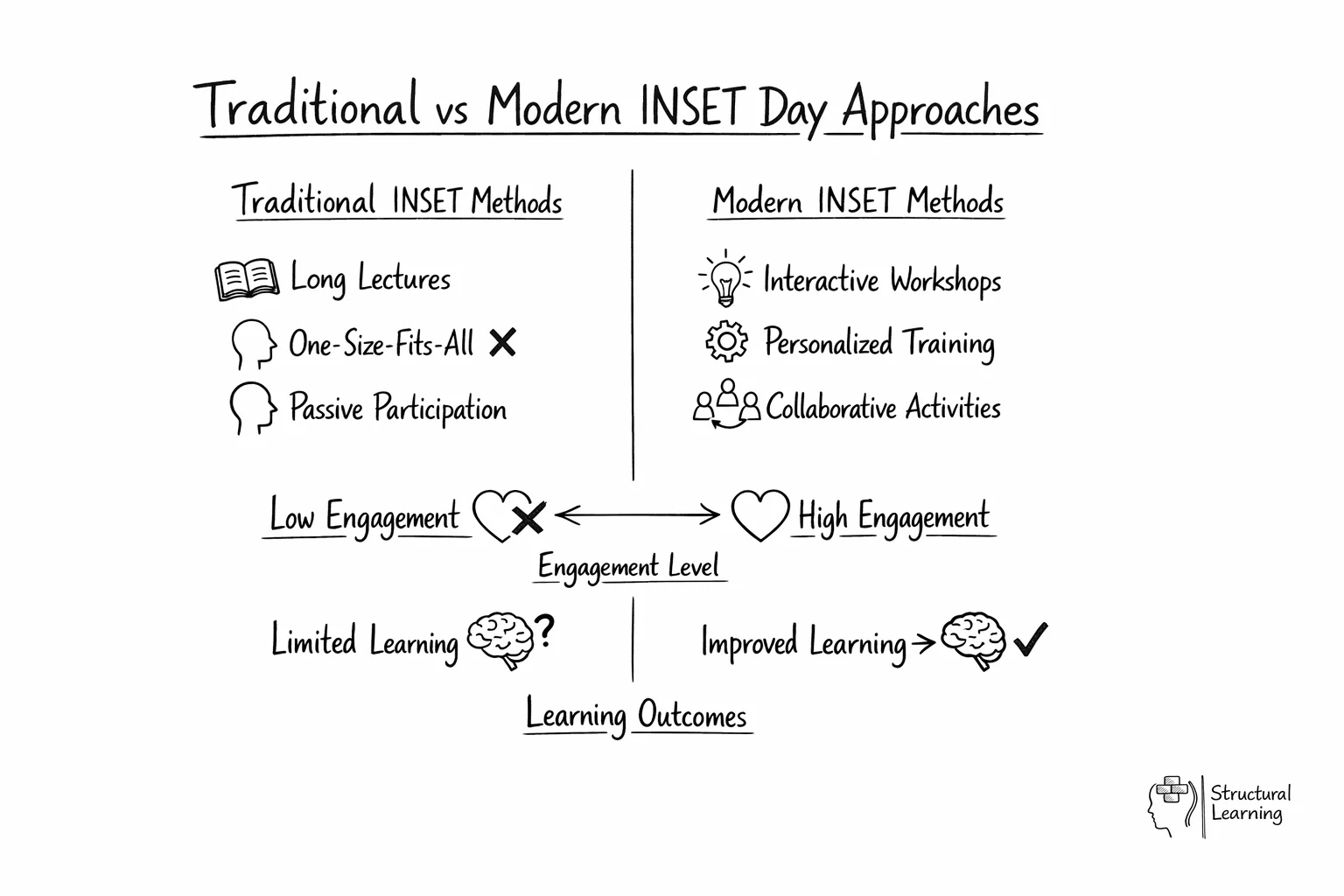
However, despite their intended purpose, the traditional format of Inset Days frequently falls short of expectations. The sessions often rely heavily on outdated methods, such as lengthy PowerPoint presentations, top-down lecturing, and minimal time for collaboration or dialogue. These approaches fail to meet the needs of today's inclusive school environments, where professional learning should be dynamic, engaging, and tailored to the unique challenges of each institution.
The reality is that days per school year dedicated to professional learning are scarce, and the structure of Inset Days has become a missed opportunity to truly embed meaningful change in schools. For a school headteacher tasked with leading staff, this poses a particular challenge: How can these vital moments be transformed into meaningful, impactful experiences at the very heart of school leadership?
Traditional INSET days often rely on outdated methods like lengthy PowerPoint presentations and top-down lecturing that fail to engage teachers effectively. These approaches waste precious professional development time and don't address the unique challenges facing individual schools. Modern professional learning requires dynamic, collaborative formats that create meaningful classroom improvements.
It is high time to reimagine the structure and purpose of Inset Days. While the traditional approach has long been accepted as part of the school calendar, it is no longer fit for purpose in the ever-evolving world of education. Modern approaches to development for schools should focus on more personalised, flexible, and collaborative methods that go beyond a "one-size-fits-all" model.
Schools are unique, with distinct priorities, challenges, and needs. Academy schools, for instance, may need a different focus than community or voluntary-controlled schools. A "cookie-cutter" approach to professional learning undermines the potential for curriculum for schools to be tailored effectively, especially as demands on educators grow. Instead, schools should embrace models that allow for peer-to-peer learning, practical workshops, and facilitated discussions that address specific issues relevant to their context.
For example, instead of relying on outdated presentations, schools might explore collaborative learning sessions where primary school teachers work in small groups to co-construct solutions. Similarly, learning walks, team planning, and coaching from external experts could provide more practical findings, embedding professional learning directly into the day of the school term rather than isolating it.
Rethinking Inset Days is not just about making them less tedious but about aligning them with the purpose of creating development in schools that is impactful, sustainable, and tied directly to student outcomes. The future of professional development lies in designing sessions that inspire educators, enable teams, and genuinely improve teaching and learning.
Teachers frequently encounter three common INSET day challenges: over-reliance on passive PowerPoint presentations, insufficient collaboration time, and one-size-fits-all training approaches that fail to meet diverse professional development needs. Many INSET sessions fail to provide actionable strategies that teachers can immediately implement in their classrooms. The traditional format often leaves teachers feeling disengaged and without practical solutions to their daily challenges.The primary problems include over-reliance on passive learning presentations, lack of collaboration time, and one-size-fits-all training approaches. Many INSET sessions fail to provide actionable strategies that teachers can immediately implement in their classrooms. The traditional format often leaves teachers feeling disengaged and without practical solutions to their daily challenges.
School leaders have a responsibility to move the learning on not just for their students but their colleagues too. CPD is an activity within school that often gets overlooked or put at the bottom of the pile of the things to do list. An inset day usually involves the closing of schools which means for some, an unwelcome disruption to school life.
In recent years we have seen more teach coaching and other professional development choices for teachers. Overall, the development of teacher training has remained fairly stagnant. After the early careers framework, school systems are free to support their staff as they see fit. Professional learning activities requires dedication from teachers who are more often faced with the need to prepare for the teaching day ahead. So, how can we make CPD and Inset days more enticing for staff?
To transform Inset Days into meaningful professional development opportunities, schools must embrace effective strategies. One promising approach is the Explore, Design, Change framework, which helps teachers to become active researchers within their own classrooms. This framework involves:
By engaging in this cyclical process of exploration, design, and change, teachers become active participants in their own professional growth. They develop a deeper understanding of their teaching practice and gain valuable skills in research, collaboration, and problem-solving.
One-size-fits-all training sessions often fail to address the diverse needs and interests of teachers. Personalised learning approaches, on the other hand, allow teachers to pursue professional development opportunities that are relevant to their individual goals and interests. This could involve:
By helping teachers to take ownership of their professional development, schools can create a culture of continuous learning and improvement. When teachers are invested in their own growth, they are more likely to be engaged and motivated in their work with students.
An INSET day stands for in-service training; it is a dedicated date where a school closes to students so staff can engage in professional learning. These sessions allow teachers to update their skills, discuss school priorities, and plan for the upcoming term. Most state schools in England have five of these days throughout the academic year.
Successful implementation requires teachers to move beyond passive listening and start to practise new methods in their own classrooms. Staff should treat their lessons as a research laboratory, collecting data on how these changes affect student progress. This process works best when colleagues collaborate to observe each other and provide practical feedback on their daily teaching.
When these sessions focus on school-specific needs, they lead to more consistent teaching standards across the entire organisation. Modern approaches help staff to solve real classroom challenges through evidence-based experimentation rather than generic lectures. This targeted support ensures that professional development time directly improves the daily experiences and outcomes of every learner.
Evidence from educational research suggests that one-off training events rarely lead to long-term changes in teacher behaviour. Studies show that professional development is most effective when it is sustained over time, collaborative, and focussed on specific subject content. Impactful training involves a cycle of theory, demonstration, and classroom-based practice with ongoing peer support.
Many schools rely too heavily on lengthy presentations and top-down lecturing which fails to engage the expertise of their staff. A common error is providing a "one-size-fits-all" programme that does not recognise the different needs of primary, secondary, or specialist teachers. Without time for dialogue and planning, the ideas shared during the session are unlikely to be embedded into regular classroom routines.
Closing schools for training allows the leadership team to align staff with the overarching goals and curriculum priorities for the year ahead. It provides a vital space for teachers to organise their classrooms, prepare resources, and coordinate their approach to student behaviour. This preparation helps to create a structured and purposeful start for both the staff and the students.
Inset Days represent a valuable opportunity for schools to invest in the professional development of their staff. However, the traditional format of these days often falls short of expectations, relying on outdated methods that fail to engage teachers effectively. By embracing effective approaches such as the Explore, Design, Change framework and personalised learning, schools can transform Inset Days into meaningful and impactful experiences that lead to improved teaching and learning.
Ultimately, the goal of professional development is to create a culture of continuous improvement within schools. By helping teachers to become active participants in their own learning, schools can creates a community of passionate educators who are committed to providing the best possible education for their students. Rethinking Inset Days is not just about changing the format of these days; it is about changing the way we think about professional development as a whole.
Teacher professional development
CPD effectiveness research
Training day design