Ancient Greek Philosophy in Education: Socrates, PlatoSixth form students in maroon sweatshirts discussing Ancient Greek Philosophy in a modern study space with large windows.

Updated on  

March 4, 2026

Ancient Greek Philosophy in Education: Socrates, Plato

|

January 26, 2023

Discover how Socratic questioning and Plato's educational philosophy can transform your classroom into an active learning environment that develops...

Course Enquiry
Copy citation

Main, P (2023, January 26). Ancient Greek Philosophy. Retrieved from https://www.structural-learning.com/post/ancient-greek-philosophy

What is Philosophy in Ancient Greece?

Ancient Greek philosophy represents one of the foundational intellectual traditions in human history, shaping how we understand knowledge, morality, politics, and the human soul itself. Emerging in the 4th century BCE and earlier, Greek philosophers pioneered the practise of using reasoned argument to explore the natural world, human nature, and the underlying principles that govern society and the universe.

Key Takeaways

  1. Beyond Myths and Gods: Discover how ancient philosophers' shift from mythology to reasoning mirrors the critical thinking process your students need to make
  2. The Socratic Classroom Revolution: Transform passive learners into active questioners using the same dialogue techniques that shaped Western education for 2,400 years
  3. Why Philosophy Starts with Wonder: Learn how the Milesians' curiosity about water and air can ignite scientific inquiry in your most reluctant learners
  4. The Hidden Democracy Connection: Uncover why teaching philosophical debate skills directly strengthens students' citizenship capabilities and democratic participation in modern classrooms

The history of philosophy in Ancient Greece spans several centuries and includes a rich diversity of philosophical traditions. While famous names such as Socrates, Plato, and Aristotle often dominate discussions, they were part of a much larger philosophical landscape, one shaped by earlier pre-Socratic thinkers and later Hellenistic schools. Together, these intellectual traditions created a dynamic and evolving dialogue on ethics, politics, science, and metaphysics, a dialogue that continues to influence education, political theory, and critical thinking today.

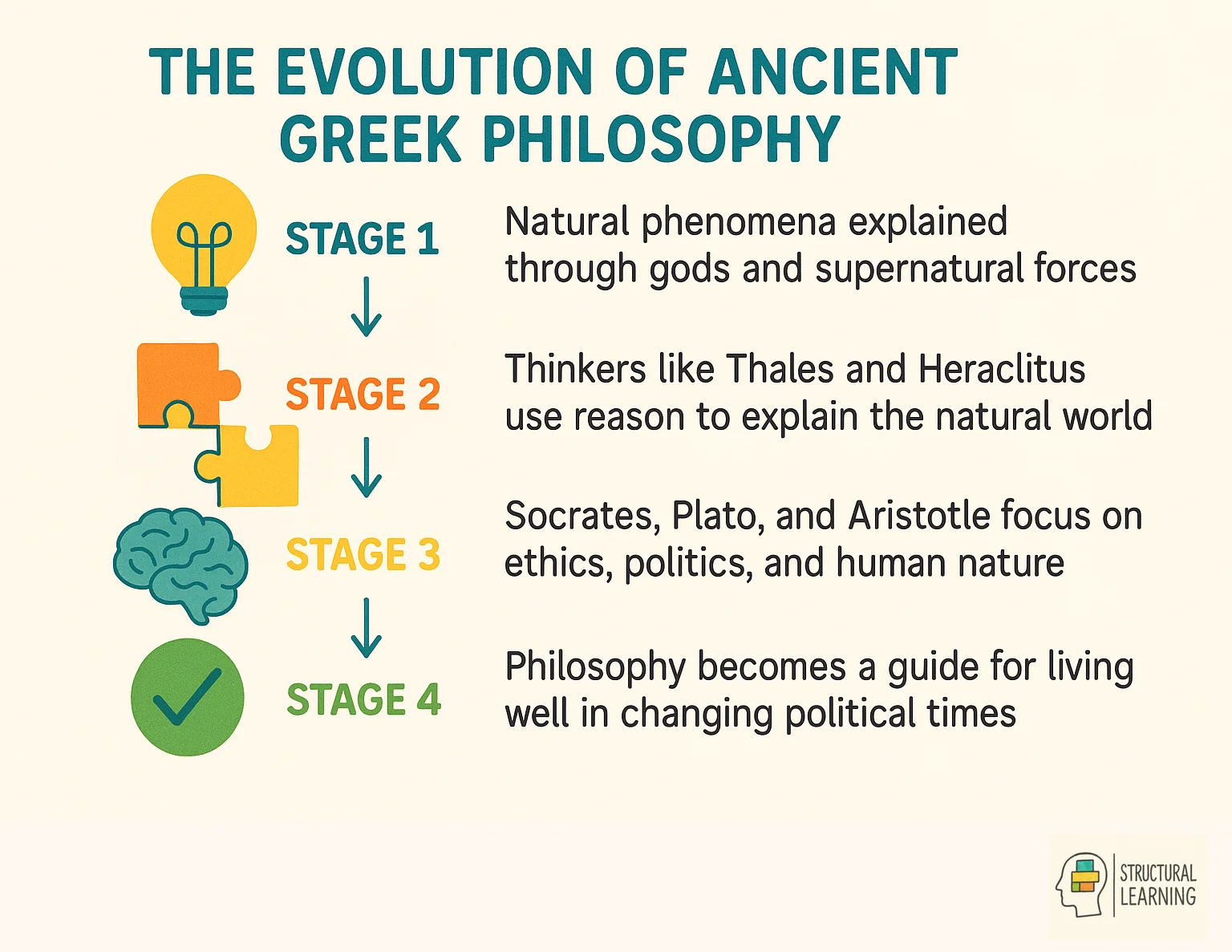
Timeline showing four stages of Ancient Greek philosophy from mythology to Hellenistic schools
The Evolution of Ancient Greek Philosophy

What made Ancient Greek philosophy so unique was its connection to the social and political changes occurring in 4th century Athens and beyond. The development of democracy in Greek city-states provided fertile ground for public debate, where questions of justice, virtue, and citizenship were constantly re-examined. Philosophers did not simply speculate in isolation, they actively engaged with the political and cultural issues of their time, creating a philosophy that was grounded in lived experience.

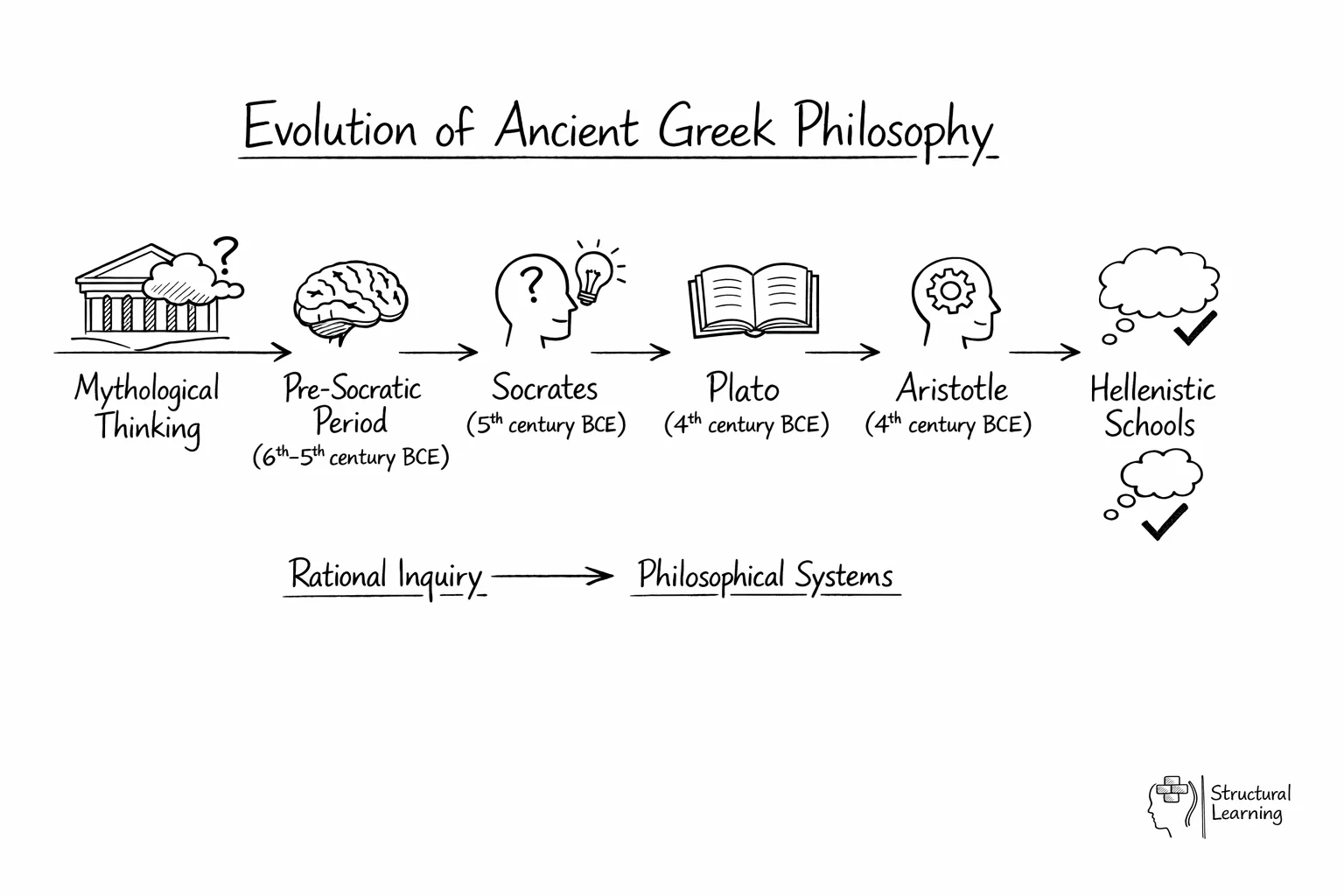
Timeline showing evolution of Ancient Greek philosophy from Pre-Socratics through Classical period
Linear timeline: Evolution of Ancient Greek Philosophy

Central to many Ancient Greek philosophical traditions was the concept of the human soul, its nature, its purpose, and its relationship to knowledge and the good life. From Plato's theory of the tripartite soul, which explored the balance between reason, spirit, and desire, to Aristotle's more empirical view of human potential, these reflections on the soul laid the groundwork for future explorations in psychology, ethics, and theology.

The history of philosophy would look very different without the contributions of Ancient Greek thinkers. Their philosophical traditions, shaped by constant questioning, public discourse, and effective reasoning, gave us enduring tools to think critically about society, morality, and human purpose. In this article, we'll explore some of the key figures, central themes, and lasting legacies of Ancient Greek philosophy, helping you bring this fascinating period into your curriculum conversations, and showing students how these intellectual traditions still shape our understanding of the world today.

Who Were the Pre-Socratic Philosophers and What Did They Teach?

The Pre-Socratic philosophers were early Greek thinkers who focused on explaining the natural world through reason rather than mythology, including Thales, Anaximander, and Heraclitus. They pioneered scientific thinking by asking fundamental questions about the origin of the universe, the nature of matter, and the principles governing change. Their methods of rational inquiry laid the groundwork for all later Western philosophy and science.

The 5th and 4th centuries BCE marked the Golden Age of Ancient Greek philosophy, led by three of the most influential thinkers in the history of philosophy: Socrates, Plato, and Aristotle. Their ideas shaped not only the intellectual traditions of Ancient Greece but also Western thought, education, and political theory for centuries to come.

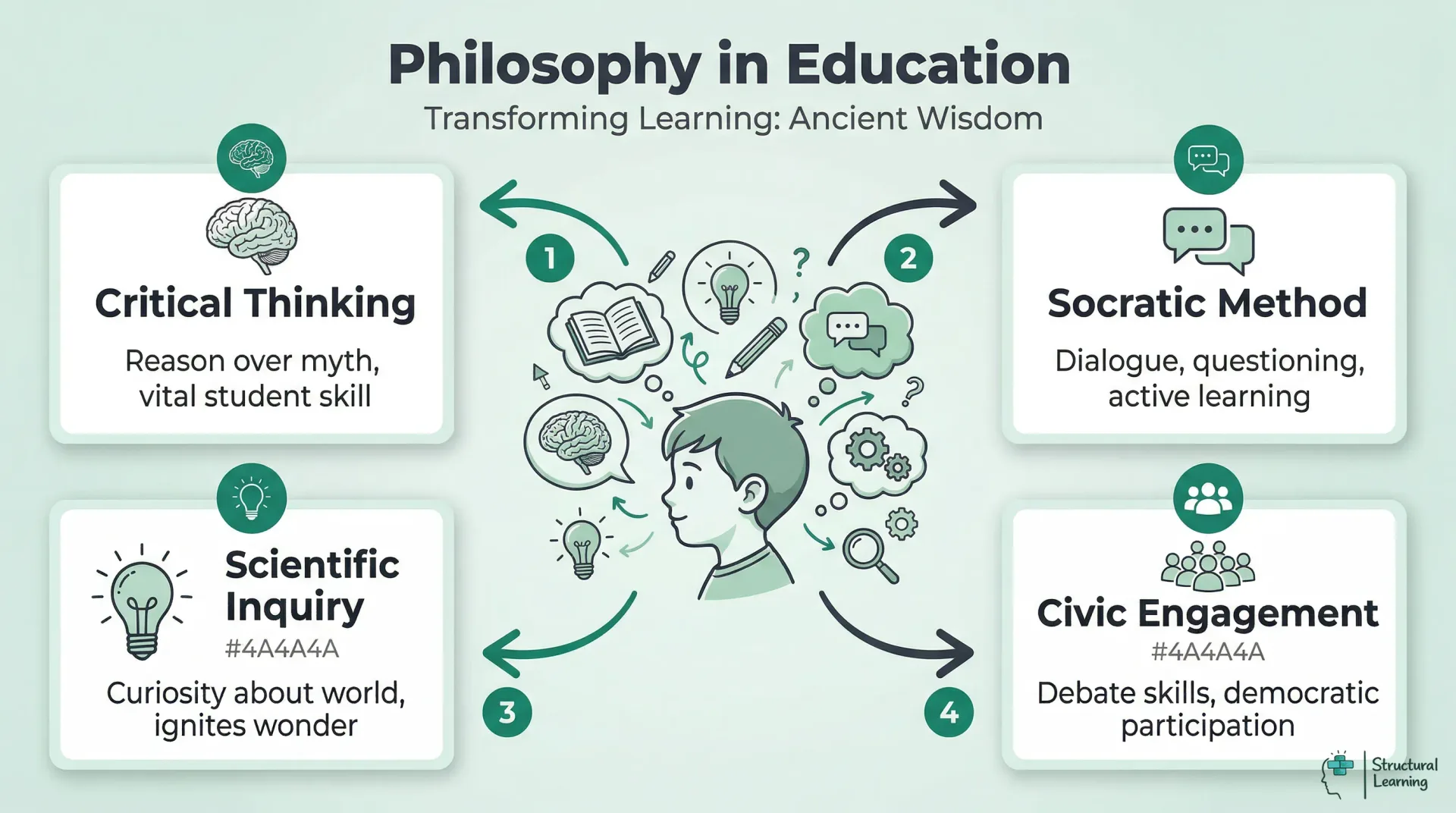
Infographic showing four key educational benefits of Ancient Greek Philosophy: critical thinking, Socratic method, scientific inquiry, and civic engagement.
Philosophy in Education

Socrates, often regarded as the founding figure of Western philosophy, transformed philosophical inquiry by focusing on ethical questions rather than the natural world. He believed that true wisdom came from recognising one's own ignorance, and his method of dialogue and questioning, later called the Socratic Method, encouraged learners to examine their own beliefs through reasoned debate. Socrates' relentless questioning of truth, justice, and virtue ultimately led to his trial and execution, but his legacy shaped future philosophical traditions.

Plato, Socrates' most famous student, expanded these ethical inquiries into a comprehensive philosophical system that explored politics, metaphysics, and the human soul. In his dialogues, Plato introduced the Theory of Forms, the belief that beyond the physical world lies a timeless domain of perfect abstract ideals, such as justice, beauty, and truth, that shape reality. Plato's political philosophy, outlined in *The Republic*, explored the ideal state ruled by philosopher-kings, emphasising the importance of reason and justice in governance. Through his Academy, Plato formalised philosophical education, ensuring the continuation of Socratic questioning and the pursuit of knowledge for future generations.

Aristotle, Plato's student, took a different path, emphasising empirical observation and systematic analysis as the keys to understanding the world. He made significant contributions to logic, science, ethics, and politics, establishing the foundation for much of Western scientific inquiry. Aristotle's ethical framework, focused on the development of virtuous character through practical wisdom, had a lasting impact on moral philosophy and continues to be relevant in contemporary ethical discussions. His political theories, which categorised different forms of government and explored the conditions for political stability, continue to influence political science and governance today.

What is the Legacy of Ancient Greek Philosophy?

The legacy of Ancient Greek philosophy extends far beyond the confines of academic discourse. Its impact can be seen in education, political theory, science, and ethics. By emphasising reason, critical thinking, and the pursuit of knowledge, Ancient Greek philosophers laid the foundation for Western intellectual traditions. Their ideas continue to shape our understanding of the world and our place within it.

The emphasis on critical thinking and questioning in Ancient Greek philosophy also directly influences teaching in modern classrooms. Encouraging students to engage in dialogue, examine their assumptions, and develop reasoned arguments are all legacies of the Socratic Method. By incorporating philosophical inquiry into your lesson plans, you can helps students to think critically, solve problems creatively, and become active, engaged citizens.

Ancient Greek philosophy encourages us to look beyond surface appearances, to question assumptions, and to seek deeper understanding. By studying these thinkers, we gain valuable insights into the nature of knowledge, morality, and the human condition and we prepare our students to engage with complex issues, make informed decisions, and contribute meaningfully to society.

Further Reading

Philosophy in education

Classical pedagogy

Socratic method research

  1. Shields, C. (2012). *Ancient Philosophy: A Very Short Introduction*. Oxford University Press.
  2. Guthrie, W. K. C. (1962). *A History of Greek Philosophy, Vol. 1: The Earlier Presocratics and the Pythagoreans*. Cambridge University Press.
  3. Annas, J. (1993). *The Morality of Happiness*. Oxford University Press.
  4. Irwin, T. (2007). *The Development of Ethics: A Historical and Critical Study, Volume I: From Socrates to the Reformation*. Oxford University Press.
  5. Blackwell, C., & Plass, P. (Eds.). (2023). *Sources in Ancient Philosophy*. Wiley.

The revolutionary nature of ancient Greek philosophy lies in its systematic approach to questioning. Philosophers like Socrates developed the dialectical method, a process of asking probing questions to examine beliefs and assumptions. This technique, now known as the Socratic method, remains a cornerstone of effective teaching, encouraging students to think critically rather than simply memorise facts. Teachers can apply this by asking "Why do you think that?" or "What evidence supports this view?" to deepen classroom discussions.

Greek philosophical concepts also introduced the idea of universal principles that could be discovered through reason. Aristotle's classification systems influenced how we organise knowledge today, whilst Plato's theory of Forms demonstrated abstract thinking about ideals and perfection. These approaches help educators understand how to structure learning progressively, moving from concrete examples to abstract concepts.

For modern educators, ancient Greek philosophy offers practical frameworks for developing analytical thinking skills. The emphasis on logical reasoning, ethical reflection, and the pursuit of truth through inquiry creates a foundation for cross-curricular learning that connects philosophy with science, literature, and citizenship education.

Who Was Socrates and What Is the Socratic Method?

Socrates (470-399 BCE) transformed Western thought not through grand theories, but by asking the right questions. This ancient Greek philosopher developed what we now call the Socratic Method, a form of dialogue where systematic questioning leads students to examine their assumptions and discover knowledge for themselves. Rather than lecturing, Socrates guided his students through careful inquiry, helping them recognise the gaps in their understanding and arrive at deeper insights through rational examination.

The Socratic Method operates on the principle that genuine learning occurs when students actively construct knowledge rather than passively receive information. This approach aligns remarkably well with modern educational research, as Kirschner and Sweller's work on guided discovery demonstrates that structured questioning can effectively support student learning whilst avoiding cognitive overload. The method typically involves asking clarifying questions, challenging assumptions, examining evidence, and exploring implications, creating a scaffold for critical thinking.

Educators can apply Socratic questioning by replacing direct answers with strategic questions such as "What evidence supports that view?" or "How might someone disagree with this position?" This technique encourages students to articulate their reasoning, consider alternative perspectives, and develop intellectual independence. The educational relevance of this ancient Greek approach remains profound, offering teachers a timeless tool for developing analytical thinking across all subjects.

What Were Plato's Key Ideas and Contributions?

Plato's philosophical framework centres on three revolutionary concepts that continue to shape educational practise today. His Theory of Forms proposed that abstract ideals like justice, beauty, and truth exist as perfect, unchanging realities beyond our physical world. This laid the groundwork for teaching students to think beyond immediate experience and engage with universal principles. His famous Allegory of the Cave illustrates how education should guide learners from ignorance towards enlightenment, moving from shadows of understanding to genuine knowledge.

Perhaps most significantly for educators, Plato established the Academy around 387 BCE, creating the first institution of higher learning in the Western world. His approach emphasised dialectical inquiry, where students learned through structured questioning and dialogue rather than passive absorption of information. This Socratic method, inherited from his teacher, encourages critical thinking by challenging assumptions and exploring contradictions in reasoning.

Modern classroom applications of Platonic concepts are remarkably relevant. Teachers can use his tripartite theory of the soul, reason, spirit, and appetite, to help students understand decision-making and self-regulation. The Socratic questioning technique remains one of the most effective pedagogical tools, encouraging students to examine their beliefs and develop rational inquiry skills that form the foundation of Western thought.

How Did Aristotle Shape Logic and Ethical Thinking?

Aristotle's revolutionary approach to logic established the foundation for systematic reasoning that continues to influence education today. His development of syllogistic reasoning, where conclusions follow logically from premises, created a structured method for teaching critical thinking. Unlike his predecessors who relied primarily on rhetoric and debate, Aristotle codified the rules of valid argument, making logical reasoning teachable and measurable. This systematic approach proves invaluable in modern classrooms, where educators can use Aristotelian logic to help students distinguish between valid reasoning and common logical fallacies.

In ethics, Aristotle introduced the concept of the "golden mean", arguing that virtue lies between extremes of excess and deficiency. His Nicomachean Ethics emphasised that moral character develops through practise and habit, a principle that resonates strongly with contemporary educational psychology. Research by Albert Bandura on social learning theory supports Aristotle's insight that ethical behaviour is learned through repeated practise rather than mere instruction. This ancient Greek wisdom suggests that moral education requires consistent modelling and practical application rather than abstract discussion alone.

For classroom application, educators can integrate Aristotelian principles by teaching logical structure through everyday examples and encouraging students to identify the premises and conclusions in arguments. Similarly, discussing ethical dilemmas through the lens of the golden mean helps students develop nuanced moral reasoning, moving beyond simplistic right-wrong categorisations towards thoughtful consideration of context and proportion.

What Is Stoicism and How Did Hellenistic Philosophy Develop?

Stoicism emerged in ancient Greece around 300 BCE as part of the broader Hellenistic philosophical movement, offering practical wisdom for navigating life's challenges through reason and virtue. Unlike earlier Greek philosophical schools that focused primarily on abstract metaphysical questions, Stoic thinkers like Epictetus and Marcus Aurelius developed a practical philosophy centred on what individuals can control versus what lies beyond their influence. This rational approach to emotional regulation and ethical decision-making makes Stoicism particularly relevant for modern educational contexts.

Hellenistic philosophy broadly encompassed several schools including Stoicism, Epicureanism, and Scepticism, all emerging during a period of political uncertainty following Alexander the Great's conquests. These philosophical traditions shifted focus from Plato's idealism and Aristotle's systematic categorisation towards more individualised approaches to achieving happiness and tranquillity. Research by cognitive psychologist Albert Ellis demonstrates how Stoic principles directly influenced modern cognitive behavioural therapy, highlighting the enduring relevance of these ancient Greek concepts for understanding human psychology and resilience.

Educators can effectively integrate Stoic principles into classroom discussions about critical thinking and

What Are the Core Concepts of Ancient Greek Philosophy?

Ancient Greek philosophy established four foundational concepts that remain central to philosophical inquiry today: arete (virtue or excellence), sophia (wisdom), dikaiosyne (justice), and eudaimonia (the good life or flourishing). These interconnected ideas formed the bedrock of ethical and political thought, with philosophers like Aristotle arguing that virtue represents the mean between extremes, whilst Plato explored justice as harmony within both the soul and society.

The concept of rational inquiry distinguished Greek philosophical thinking from mythological explanations. Socrates' method of questioning assumptions, Aristotle's systematic categorisation of knowledge, and the Stoics' emphasis on logical reasoning all demonstrated how philosophical concepts could be examined through structured dialogue and analysis. These approaches established critical thinking as a cornerstone of Western intellectual tradition.

For classroom application, these concepts offer powerful frameworks for developing students' analytical skills. Teachers can employ Socratic questioning to explore moral dilemmas, use Aristotelian virtue ethics to discuss character development, or examine contemporary issues of justice through Platonic perspectives. Research by Matthew Lipman on Philosophy for Children demonstrates that introducing these foundational concepts enhances students' reasoning abilities and ethical awareness, making ancient Greek philosophy remarkably relevant for modern educational contexts.

Match the Philosopher to the Idea

Drag each concept to the correct Greek philosopher. Test your knowledge of Socrates, Plato and Aristotle.

Frequently Asked Questions

schema.org/FAQPage">

What is the Socratic method in education?

The Socratic method is a form of cooperative dialogue that uses questioning to stimulate critical thinking and uncover underlying beliefs. Teachers use this approach to move away from passive lectures, instead encouraging learners to actively investigate complex ideas through reasoned debate. It helps students recognise their own assumptions while building a deeper understanding of the subject.

How do teachers use Socratic questioning in the classroom?

Teachers who practise these techniques start with questions that have no single correct answer to initiate a discussion. They then guide the inquiry by asking follow up questions that require students to justify their reasoning and consider alternative perspectives. This technique helps transform the classroom into a space for active inquiry rather than simple fact retrieval.

What are the benefits of teaching Greek philosophy to students?

Teaching Greek philosophy helps students develop essential critical thinking and reasoning skills that are applicable across the entire curriculum. It encourages a sense of wonder and curiosity about the world, which can increase engagement in subjects such like science and citizenship. By engaging with these ancient ideas, learners also build the communication skills needed for effective participation in democratic society.

What does the research say about the impact of philosophical inquiry on learning?

Research indicates that engaging in regular philosophical inquiry can improve cognitive abilities as well as social and emotional development. Studies by organisations such as the Education Endowment Foundation suggest that structured talk and questioning techniques can add several months of additional progress to a learner's academic year. These methods are particularly effective at supporting the progress of disadvantaged children.

What are common mistakes when using Socratic dialogue in schools?

One common mistake is the teacher dominating the conversation rather than allowing students to lead the inquiry process. Another frequent error is choosing questions that are too narrow, which limits the scope for genuine debate and critical reflection. Teachers must also ensure they create a safe environment where learners feel comfortable sharing and revising their thoughts.

border-left: 4px solid #128770; padding: 20px; margin: 25px 0; border-radius: 4px;">

Further Reading: Key Research Papers

These peer-reviewed studies examine how ancient Greek philosophical traditions continue to shape modern educational practice, from Socratic questioning to virtue ethics in the classroom.

Thinking More Wisely: Using the Socratic Method to Develop Critical Thinking Skills Amongst Healthcare Students View study ↗
97 citations

Ho, Chen & Li (2023)

This systematic review demonstrates that Socratic questioning significantly improves critical thinking scores compared with traditional lecture methods. Teachers can adapt the structured questioning sequences described here for any subject, using graduated prompts that guide pupils toward independent reasoning rather than simply providing answers.

The Development and Validation of the Blended Socratic Method of Teaching: An Instructional Model to Enhance Critical Thinking Skills View study ↗
64 citations

Boa, Wattanatorn & Tagong (2018)

This validated instructional model blends Socratic dialogue with collaborative learning tasks. The five-stage framework moves from initial questioning through guided discussion to independent application, offering teachers a practical structure for embedding philosophical enquiry into everyday lessons.

The Fact of Ignorance: Revisiting the Socratic Method as a Tool for Teaching Critical Thinking View study ↗
45 citations

Oyler & Romanelli (2014)

The authors argue that Socratic questioning works precisely because it foregrounds what learners do not yet know, creating productive discomfort. For classroom practice, this paper shows how admitting uncertainty and modelling intellectual humility can strengthen pupils' willingness to engage with difficult material.

The MelArete Project: Educating Children to the Ethics of Virtue and of Care View study ↗
15 citations

Mortari & Ubbiali (2017)

This intervention study brings Aristotelian virtue ethics into primary classrooms through structured reflective activities. Pupils engaged with concepts of courage, fairness and compassion through storytelling and group discussion, showing measurable gains in moral reasoning and prosocial behaviour.

Promoting Students' Critical Thinking through Socratic Method: Views and Challenges
19 citations

Dalim, Ishak & Hamzah (2022)

Drawing on teacher interviews and classroom observations, this study identifies the practical barriers to implementing Socratic dialogue, including time pressure, large class sizes and pupils' reluctance to challenge ideas publicly. The suggested scaffolding strategies help teachers introduce philosophical questioning gradually.

Written by the Structural Learning Research Team

Reviewed by Paul Main, Founder & Educational Consultant at Structural Learning

Loading audit...

What is Philosophy in Ancient Greece?

Ancient Greek philosophy represents one of the foundational intellectual traditions in human history, shaping how we understand knowledge, morality, politics, and the human soul itself. Emerging in the 4th century BCE and earlier, Greek philosophers pioneered the practise of using reasoned argument to explore the natural world, human nature, and the underlying principles that govern society and the universe.

Key Takeaways

  1. Beyond Myths and Gods: Discover how ancient philosophers' shift from mythology to reasoning mirrors the critical thinking process your students need to make
  2. The Socratic Classroom Revolution: Transform passive learners into active questioners using the same dialogue techniques that shaped Western education for 2,400 years
  3. Why Philosophy Starts with Wonder: Learn how the Milesians' curiosity about water and air can ignite scientific inquiry in your most reluctant learners
  4. The Hidden Democracy Connection: Uncover why teaching philosophical debate skills directly strengthens students' citizenship capabilities and democratic participation in modern classrooms

The history of philosophy in Ancient Greece spans several centuries and includes a rich diversity of philosophical traditions. While famous names such as Socrates, Plato, and Aristotle often dominate discussions, they were part of a much larger philosophical landscape, one shaped by earlier pre-Socratic thinkers and later Hellenistic schools. Together, these intellectual traditions created a dynamic and evolving dialogue on ethics, politics, science, and metaphysics, a dialogue that continues to influence education, political theory, and critical thinking today.

Timeline showing four stages of Ancient Greek philosophy from mythology to Hellenistic schools
The Evolution of Ancient Greek Philosophy

What made Ancient Greek philosophy so unique was its connection to the social and political changes occurring in 4th century Athens and beyond. The development of democracy in Greek city-states provided fertile ground for public debate, where questions of justice, virtue, and citizenship were constantly re-examined. Philosophers did not simply speculate in isolation, they actively engaged with the political and cultural issues of their time, creating a philosophy that was grounded in lived experience.

Timeline showing evolution of Ancient Greek philosophy from Pre-Socratics through Classical period
Linear timeline: Evolution of Ancient Greek Philosophy

Central to many Ancient Greek philosophical traditions was the concept of the human soul, its nature, its purpose, and its relationship to knowledge and the good life. From Plato's theory of the tripartite soul, which explored the balance between reason, spirit, and desire, to Aristotle's more empirical view of human potential, these reflections on the soul laid the groundwork for future explorations in psychology, ethics, and theology.

The history of philosophy would look very different without the contributions of Ancient Greek thinkers. Their philosophical traditions, shaped by constant questioning, public discourse, and effective reasoning, gave us enduring tools to think critically about society, morality, and human purpose. In this article, we'll explore some of the key figures, central themes, and lasting legacies of Ancient Greek philosophy, helping you bring this fascinating period into your curriculum conversations, and showing students how these intellectual traditions still shape our understanding of the world today.

Who Were the Pre-Socratic Philosophers and What Did They Teach?

The Pre-Socratic philosophers were early Greek thinkers who focused on explaining the natural world through reason rather than mythology, including Thales, Anaximander, and Heraclitus. They pioneered scientific thinking by asking fundamental questions about the origin of the universe, the nature of matter, and the principles governing change. Their methods of rational inquiry laid the groundwork for all later Western philosophy and science.

The 5th and 4th centuries BCE marked the Golden Age of Ancient Greek philosophy, led by three of the most influential thinkers in the history of philosophy: Socrates, Plato, and Aristotle. Their ideas shaped not only the intellectual traditions of Ancient Greece but also Western thought, education, and political theory for centuries to come.

Infographic showing four key educational benefits of Ancient Greek Philosophy: critical thinking, Socratic method, scientific inquiry, and civic engagement.
Philosophy in Education

Socrates, often regarded as the founding figure of Western philosophy, transformed philosophical inquiry by focusing on ethical questions rather than the natural world. He believed that true wisdom came from recognising one's own ignorance, and his method of dialogue and questioning, later called the Socratic Method, encouraged learners to examine their own beliefs through reasoned debate. Socrates' relentless questioning of truth, justice, and virtue ultimately led to his trial and execution, but his legacy shaped future philosophical traditions.

Plato, Socrates' most famous student, expanded these ethical inquiries into a comprehensive philosophical system that explored politics, metaphysics, and the human soul. In his dialogues, Plato introduced the Theory of Forms, the belief that beyond the physical world lies a timeless domain of perfect abstract ideals, such as justice, beauty, and truth, that shape reality. Plato's political philosophy, outlined in *The Republic*, explored the ideal state ruled by philosopher-kings, emphasising the importance of reason and justice in governance. Through his Academy, Plato formalised philosophical education, ensuring the continuation of Socratic questioning and the pursuit of knowledge for future generations.

Aristotle, Plato's student, took a different path, emphasising empirical observation and systematic analysis as the keys to understanding the world. He made significant contributions to logic, science, ethics, and politics, establishing the foundation for much of Western scientific inquiry. Aristotle's ethical framework, focused on the development of virtuous character through practical wisdom, had a lasting impact on moral philosophy and continues to be relevant in contemporary ethical discussions. His political theories, which categorised different forms of government and explored the conditions for political stability, continue to influence political science and governance today.

What is the Legacy of Ancient Greek Philosophy?

The legacy of Ancient Greek philosophy extends far beyond the confines of academic discourse. Its impact can be seen in education, political theory, science, and ethics. By emphasising reason, critical thinking, and the pursuit of knowledge, Ancient Greek philosophers laid the foundation for Western intellectual traditions. Their ideas continue to shape our understanding of the world and our place within it.

The emphasis on critical thinking and questioning in Ancient Greek philosophy also directly influences teaching in modern classrooms. Encouraging students to engage in dialogue, examine their assumptions, and develop reasoned arguments are all legacies of the Socratic Method. By incorporating philosophical inquiry into your lesson plans, you can helps students to think critically, solve problems creatively, and become active, engaged citizens.

Ancient Greek philosophy encourages us to look beyond surface appearances, to question assumptions, and to seek deeper understanding. By studying these thinkers, we gain valuable insights into the nature of knowledge, morality, and the human condition and we prepare our students to engage with complex issues, make informed decisions, and contribute meaningfully to society.

Further Reading

Philosophy in education

Classical pedagogy

Socratic method research

  1. Shields, C. (2012). *Ancient Philosophy: A Very Short Introduction*. Oxford University Press.
  2. Guthrie, W. K. C. (1962). *A History of Greek Philosophy, Vol. 1: The Earlier Presocratics and the Pythagoreans*. Cambridge University Press.
  3. Annas, J. (1993). *The Morality of Happiness*. Oxford University Press.
  4. Irwin, T. (2007). *The Development of Ethics: A Historical and Critical Study, Volume I: From Socrates to the Reformation*. Oxford University Press.
  5. Blackwell, C., & Plass, P. (Eds.). (2023). *Sources in Ancient Philosophy*. Wiley.

The revolutionary nature of ancient Greek philosophy lies in its systematic approach to questioning. Philosophers like Socrates developed the dialectical method, a process of asking probing questions to examine beliefs and assumptions. This technique, now known as the Socratic method, remains a cornerstone of effective teaching, encouraging students to think critically rather than simply memorise facts. Teachers can apply this by asking "Why do you think that?" or "What evidence supports this view?" to deepen classroom discussions.

Greek philosophical concepts also introduced the idea of universal principles that could be discovered through reason. Aristotle's classification systems influenced how we organise knowledge today, whilst Plato's theory of Forms demonstrated abstract thinking about ideals and perfection. These approaches help educators understand how to structure learning progressively, moving from concrete examples to abstract concepts.

For modern educators, ancient Greek philosophy offers practical frameworks for developing analytical thinking skills. The emphasis on logical reasoning, ethical reflection, and the pursuit of truth through inquiry creates a foundation for cross-curricular learning that connects philosophy with science, literature, and citizenship education.

Who Was Socrates and What Is the Socratic Method?

Socrates (470-399 BCE) transformed Western thought not through grand theories, but by asking the right questions. This ancient Greek philosopher developed what we now call the Socratic Method, a form of dialogue where systematic questioning leads students to examine their assumptions and discover knowledge for themselves. Rather than lecturing, Socrates guided his students through careful inquiry, helping them recognise the gaps in their understanding and arrive at deeper insights through rational examination.

The Socratic Method operates on the principle that genuine learning occurs when students actively construct knowledge rather than passively receive information. This approach aligns remarkably well with modern educational research, as Kirschner and Sweller's work on guided discovery demonstrates that structured questioning can effectively support student learning whilst avoiding cognitive overload. The method typically involves asking clarifying questions, challenging assumptions, examining evidence, and exploring implications, creating a scaffold for critical thinking.

Educators can apply Socratic questioning by replacing direct answers with strategic questions such as "What evidence supports that view?" or "How might someone disagree with this position?" This technique encourages students to articulate their reasoning, consider alternative perspectives, and develop intellectual independence. The educational relevance of this ancient Greek approach remains profound, offering teachers a timeless tool for developing analytical thinking across all subjects.

What Were Plato's Key Ideas and Contributions?

Plato's philosophical framework centres on three revolutionary concepts that continue to shape educational practise today. His Theory of Forms proposed that abstract ideals like justice, beauty, and truth exist as perfect, unchanging realities beyond our physical world. This laid the groundwork for teaching students to think beyond immediate experience and engage with universal principles. His famous Allegory of the Cave illustrates how education should guide learners from ignorance towards enlightenment, moving from shadows of understanding to genuine knowledge.

Perhaps most significantly for educators, Plato established the Academy around 387 BCE, creating the first institution of higher learning in the Western world. His approach emphasised dialectical inquiry, where students learned through structured questioning and dialogue rather than passive absorption of information. This Socratic method, inherited from his teacher, encourages critical thinking by challenging assumptions and exploring contradictions in reasoning.

Modern classroom applications of Platonic concepts are remarkably relevant. Teachers can use his tripartite theory of the soul, reason, spirit, and appetite, to help students understand decision-making and self-regulation. The Socratic questioning technique remains one of the most effective pedagogical tools, encouraging students to examine their beliefs and develop rational inquiry skills that form the foundation of Western thought.

How Did Aristotle Shape Logic and Ethical Thinking?

Aristotle's revolutionary approach to logic established the foundation for systematic reasoning that continues to influence education today. His development of syllogistic reasoning, where conclusions follow logically from premises, created a structured method for teaching critical thinking. Unlike his predecessors who relied primarily on rhetoric and debate, Aristotle codified the rules of valid argument, making logical reasoning teachable and measurable. This systematic approach proves invaluable in modern classrooms, where educators can use Aristotelian logic to help students distinguish between valid reasoning and common logical fallacies.

In ethics, Aristotle introduced the concept of the "golden mean", arguing that virtue lies between extremes of excess and deficiency. His Nicomachean Ethics emphasised that moral character develops through practise and habit, a principle that resonates strongly with contemporary educational psychology. Research by Albert Bandura on social learning theory supports Aristotle's insight that ethical behaviour is learned through repeated practise rather than mere instruction. This ancient Greek wisdom suggests that moral education requires consistent modelling and practical application rather than abstract discussion alone.

For classroom application, educators can integrate Aristotelian principles by teaching logical structure through everyday examples and encouraging students to identify the premises and conclusions in arguments. Similarly, discussing ethical dilemmas through the lens of the golden mean helps students develop nuanced moral reasoning, moving beyond simplistic right-wrong categorisations towards thoughtful consideration of context and proportion.

What Is Stoicism and How Did Hellenistic Philosophy Develop?

Stoicism emerged in ancient Greece around 300 BCE as part of the broader Hellenistic philosophical movement, offering practical wisdom for navigating life's challenges through reason and virtue. Unlike earlier Greek philosophical schools that focused primarily on abstract metaphysical questions, Stoic thinkers like Epictetus and Marcus Aurelius developed a practical philosophy centred on what individuals can control versus what lies beyond their influence. This rational approach to emotional regulation and ethical decision-making makes Stoicism particularly relevant for modern educational contexts.

Hellenistic philosophy broadly encompassed several schools including Stoicism, Epicureanism, and Scepticism, all emerging during a period of political uncertainty following Alexander the Great's conquests. These philosophical traditions shifted focus from Plato's idealism and Aristotle's systematic categorisation towards more individualised approaches to achieving happiness and tranquillity. Research by cognitive psychologist Albert Ellis demonstrates how Stoic principles directly influenced modern cognitive behavioural therapy, highlighting the enduring relevance of these ancient Greek concepts for understanding human psychology and resilience.

Educators can effectively integrate Stoic principles into classroom discussions about critical thinking and

What Are the Core Concepts of Ancient Greek Philosophy?

Ancient Greek philosophy established four foundational concepts that remain central to philosophical inquiry today: arete (virtue or excellence), sophia (wisdom), dikaiosyne (justice), and eudaimonia (the good life or flourishing). These interconnected ideas formed the bedrock of ethical and political thought, with philosophers like Aristotle arguing that virtue represents the mean between extremes, whilst Plato explored justice as harmony within both the soul and society.

The concept of rational inquiry distinguished Greek philosophical thinking from mythological explanations. Socrates' method of questioning assumptions, Aristotle's systematic categorisation of knowledge, and the Stoics' emphasis on logical reasoning all demonstrated how philosophical concepts could be examined through structured dialogue and analysis. These approaches established critical thinking as a cornerstone of Western intellectual tradition.

For classroom application, these concepts offer powerful frameworks for developing students' analytical skills. Teachers can employ Socratic questioning to explore moral dilemmas, use Aristotelian virtue ethics to discuss character development, or examine contemporary issues of justice through Platonic perspectives. Research by Matthew Lipman on Philosophy for Children demonstrates that introducing these foundational concepts enhances students' reasoning abilities and ethical awareness, making ancient Greek philosophy remarkably relevant for modern educational contexts.

Match the Philosopher to the Idea

Drag each concept to the correct Greek philosopher. Test your knowledge of Socrates, Plato and Aristotle.

Frequently Asked Questions

schema.org/FAQPage">

What is the Socratic method in education?

The Socratic method is a form of cooperative dialogue that uses questioning to stimulate critical thinking and uncover underlying beliefs. Teachers use this approach to move away from passive lectures, instead encouraging learners to actively investigate complex ideas through reasoned debate. It helps students recognise their own assumptions while building a deeper understanding of the subject.

How do teachers use Socratic questioning in the classroom?

Teachers who practise these techniques start with questions that have no single correct answer to initiate a discussion. They then guide the inquiry by asking follow up questions that require students to justify their reasoning and consider alternative perspectives. This technique helps transform the classroom into a space for active inquiry rather than simple fact retrieval.

What are the benefits of teaching Greek philosophy to students?

Teaching Greek philosophy helps students develop essential critical thinking and reasoning skills that are applicable across the entire curriculum. It encourages a sense of wonder and curiosity about the world, which can increase engagement in subjects such like science and citizenship. By engaging with these ancient ideas, learners also build the communication skills needed for effective participation in democratic society.

What does the research say about the impact of philosophical inquiry on learning?

Research indicates that engaging in regular philosophical inquiry can improve cognitive abilities as well as social and emotional development. Studies by organisations such as the Education Endowment Foundation suggest that structured talk and questioning techniques can add several months of additional progress to a learner's academic year. These methods are particularly effective at supporting the progress of disadvantaged children.

What are common mistakes when using Socratic dialogue in schools?

One common mistake is the teacher dominating the conversation rather than allowing students to lead the inquiry process. Another frequent error is choosing questions that are too narrow, which limits the scope for genuine debate and critical reflection. Teachers must also ensure they create a safe environment where learners feel comfortable sharing and revising their thoughts.

border-left: 4px solid #128770; padding: 20px; margin: 25px 0; border-radius: 4px;">

Further Reading: Key Research Papers

These peer-reviewed studies examine how ancient Greek philosophical traditions continue to shape modern educational practice, from Socratic questioning to virtue ethics in the classroom.

Thinking More Wisely: Using the Socratic Method to Develop Critical Thinking Skills Amongst Healthcare Students View study ↗
97 citations

Ho, Chen & Li (2023)

This systematic review demonstrates that Socratic questioning significantly improves critical thinking scores compared with traditional lecture methods. Teachers can adapt the structured questioning sequences described here for any subject, using graduated prompts that guide pupils toward independent reasoning rather than simply providing answers.

The Development and Validation of the Blended Socratic Method of Teaching: An Instructional Model to Enhance Critical Thinking Skills View study ↗
64 citations

Boa, Wattanatorn & Tagong (2018)

This validated instructional model blends Socratic dialogue with collaborative learning tasks. The five-stage framework moves from initial questioning through guided discussion to independent application, offering teachers a practical structure for embedding philosophical enquiry into everyday lessons.

The Fact of Ignorance: Revisiting the Socratic Method as a Tool for Teaching Critical Thinking View study ↗
45 citations

Oyler & Romanelli (2014)

The authors argue that Socratic questioning works precisely because it foregrounds what learners do not yet know, creating productive discomfort. For classroom practice, this paper shows how admitting uncertainty and modelling intellectual humility can strengthen pupils' willingness to engage with difficult material.

The MelArete Project: Educating Children to the Ethics of Virtue and of Care View study ↗
15 citations

Mortari & Ubbiali (2017)

This intervention study brings Aristotelian virtue ethics into primary classrooms through structured reflective activities. Pupils engaged with concepts of courage, fairness and compassion through storytelling and group discussion, showing measurable gains in moral reasoning and prosocial behaviour.

Promoting Students' Critical Thinking through Socratic Method: Views and Challenges
19 citations

Dalim, Ishak & Hamzah (2022)

Drawing on teacher interviews and classroom observations, this study identifies the practical barriers to implementing Socratic dialogue, including time pressure, large class sizes and pupils' reluctance to challenge ideas publicly. The suggested scaffolding strategies help teachers introduce philosophical questioning gradually.

Written by the Structural Learning Research Team

Reviewed by Paul Main, Founder & Educational Consultant at Structural Learning

Big Ideas

Back to Blog

<script type="application/ld+json">{"@context":"https://schema.org","@graph":[{"@type":"Article","@id":"https://www.structural-learning.com/post/ancient-greek-philosophy#article","headline":"Ancient Greek Philosophy in Education: Socrates, Plato and Aristotle","description":"Socratic questioning, Plato's theory of forms and Aristotle's virtue ethics still shape modern teaching. Understand how these ancient ideas inform critical...","datePublished":"2023-01-26T16:38:39.467Z","dateModified":"2026-03-02T11:01:03.895Z","author":{"@type":"Person","name":"Paul Main","url":"https://www.structural-learning.com/team/paulmain","jobTitle":"Founder & Educational Consultant"},"publisher":{"@type":"Organization","name":"Structural Learning","url":"https://www.structural-learning.com","logo":{"@type":"ImageObject","url":"https://cdn.prod.website-files.com/5b69a01ba2e409e5d5e055c6/6040bf0426cb415ba2fc7882_newlogoblue.svg"}},"mainEntityOfPage":{"@type":"WebPage","@id":"https://www.structural-learning.com/post/ancient-greek-philosophy"},"image":"https://cdn.prod.website-files.com/5b69a01ba2e409501de055d1/69525fab9ee102ae2395d7c5_69525faa5afeea639858136b_ancient-greek-philosophy-infographic.webp","wordCount":2728},{"@type":"BreadcrumbList","@id":"https://www.structural-learning.com/post/ancient-greek-philosophy#breadcrumb","itemListElement":[{"@type":"ListItem","position":1,"name":"Home","item":"https://www.structural-learning.com/"},{"@type":"ListItem","position":2,"name":"Blog","item":"https://www.structural-learning.com/blog"},{"@type":"ListItem","position":3,"name":"Ancient Greek Philosophy in Education: Socrates, Plato and Aristotle","item":"https://www.structural-learning.com/post/ancient-greek-philosophy"}]},{"@type":"FAQPage","mainEntity":[{"@type":"Question","name":"What is the Socratic method in education?","acceptedAnswer":{"@type":"Answer","text":"The Socratic method is a form of cooperative dialogue that uses questioning to stimulate critical thinking and uncover underlying beliefs. Teachers use this approach to move away from passive lectures, instead encouraging learners to actively investigate complex ideas through reasoned debate. It helps students recognise their own assumptions while building a deeper understanding of the subject."}},{"@type":"Question","name":"How do teachers use Socratic questioning in the classroom?","acceptedAnswer":{"@type":"Answer","text":"Teachers who practise these techniques start with questions that have no single correct answer to initiate a discussion. They then guide the inquiry by asking follow up questions that require students to justify their reasoning and consider alternative perspectives. This technique helps transform the classroom into a space for active inquiry rather than simple fact retrieval."}},{"@type":"Question","name":"What are the benefits of teaching Greek philosophy to students?","acceptedAnswer":{"@type":"Answer","text":"Teaching Greek philosophy helps students develop essential critical thinking and reasoning skills that are applicable across the entire curriculum. It encourages a sense of wonder and curiosity about the world, which can increase engagement in subjects such like science and citizenship. By engaging with these ancient ideas, learners also build the communication skills needed for effective participation in democratic society."}},{"@type":"Question","name":"What does the research say about the impact of philosophical inquiry on learning?","acceptedAnswer":{"@type":"Answer","text":"Research indicates that engaging in regular philosophical inquiry can improve cognitive abilities as well as social and emotional development. Studies by organisations such as the Education Endowment Foundation suggest that structured talk and questioning techniques can add several months of additional progress to a learner's academic year. These methods are particularly effective at supporting the progress of disadvantaged children."}},{"@type":"Question","name":"What are common mistakes when using Socratic dialogue in schools?","acceptedAnswer":{"@type":"Answer","text":"One common mistake is the teacher dominating the conversation rather than allowing students to lead the inquiry process. Another frequent error is choosing questions that are too narrow, which limits the scope for genuine debate and critical reflection. Teachers must also ensure they create a safe environment where learners feel comfortable sharing and revising their thoughts."}},{"@type":"Question","name":"Further Reading: Key Research Papers","acceptedAnswer":{"@type":"Answer","text":"These peer-reviewed studies examine how ancient Greek philosophical traditions continue to shape modern educational practice, from Socratic questioning to virtue ethics in the classroom."}}]}]}</script>