Updated on
September 9, 2026
Nessy for Dyslexia: Understanding Orton-Gillingham Phonics
How Nessy uses Orton-Gillingham structured literacy to teach struggling readers: the pedagogy, optimal dosing, teacher scaffolding and when to move on.


Updated on
September 9, 2026
How Nessy uses Orton-Gillingham structured literacy to teach struggling readers: the pedagogy, optimal dosing, teacher scaffolding and when to move on.
Nessy Review 2026: if you are asking whether the Nessy Learning Programme is worth it, the short answer is yes for many families. This is especially true if your child needs extra support with reading, spelling and dyslexia-friendly practise. It combines structured literacy teaching with game-based activities, which many children find easier to approach than traditional worksheets. However, the subscription cost will matter if you are comparing it with other home learning tools.
In this review, we look at how effective Nessy really is, what it costs, how children actually experience it, and where its strengths and limitations show up in day-to-day use. If you want a clear verdict before you spend the money, the details below will help you decide quickly.
Quick answer: Nessy is a structured literacy and phonics programme for learners with dyslexia and reading difficulties. UK primary schools and SEND settings use it to teach systematic phonics, spelling, and comprehension through multisensory games for ages 5 to 12. It also gives detailed progress tracking, which SENCOs can use in provision maps.
A quality appraisal found that only 24.7% of foundational literacy apps reached a good app-quality score (Furlong et al., 2025). That is the right lens for Nessy: judge the programme by explicit teaching, adult follow-up and transfer into reading and writing, not by screen engagement alone.
A 2025 app-quality review is useful evidence, but it is not the same as a school attainment trial. Furlong and colleagues reviewed 309 foundational literacy apps. They used the Mobile Application Rating Scale and an expert literacy review. The study found that many app-store ratings did not reflect instructional quality.
ILT Education reports that Nessy apps performed strongly in that appraisal. Use this as evidence that app design and phonics alignment matter. Do not use it alone to claim that Nessy will produce a fixed number of months of progress in every classroom.
Nessy Reading and Spelling is a structured literacy programme that uses animated games and videos to teach reading and spelling. Specialist teachers at the Bristol Dyslexia Centre developed it. Nessy creates learning games and videos for schools. Teachers use these resources in 192 countries around the world (Nessy Learning Programme).
Game-based learning makes reading and spelling fun. Teachers can create word lists for learners to practise (Byrne & Fielding, 2023). This supports specific learning objectives with scaffolding strategies. Syllabification games help learners read by breaking words down.
The programme’s game-based learning can raise engagement and support higher attainment. Nessy publishes its own evaluation data on programme outcomes. When judging effect sizes, teachers should check the company's published evidence base and independent reviews.
The Nessy Reading & Spelling Programme by Mike Jones was the first cloud-based educational learning programme. Nessy's Dyslexia Quest was the first app created for dyslexic learners.
All of the Nessy programmes were designed for dyslexic learners between 5 and 16 years old, but after it was discovered that they were effective for teaching all learners to read, they began to be used as general phonics and structured literacy-based curriculum. The organisation have school specialists who can help teachers with the effective deployment of the platform. As well as offering a free trial, the website also has a range of free educational resourcesthat schools can utilise.
Nessy Learning (formerly Net Educational Systems) creates these programmes. Mike Jones, a British entrepreneur with dyslexia, and his team developed them (Nessy Learning Limited Company). They work in Bristol, UK, plus Texas and New Jersey, USA.
In 2019, a short film, MiCAL, was made about Mike Jones’ experiences as a bullied dyslexic child in school, and his Mother Pat Jones OBE's determined efforts to help him. It is one of the most successful films about dyslexia ever made.
Pat Jones’ work teaching her own son led to her becoming a dyslexia specialist and later forming the Bristol Dyslexia Centre and the Belgrave Schools in the west of England. Pat Jones was awarded the Order of the British Empire by Queen Elizabeth in 2015 for her services to dyslexic children.
Nessy uses a structured literacy approach for learners with dyslexia. This method teaches reading and spelling step by step.
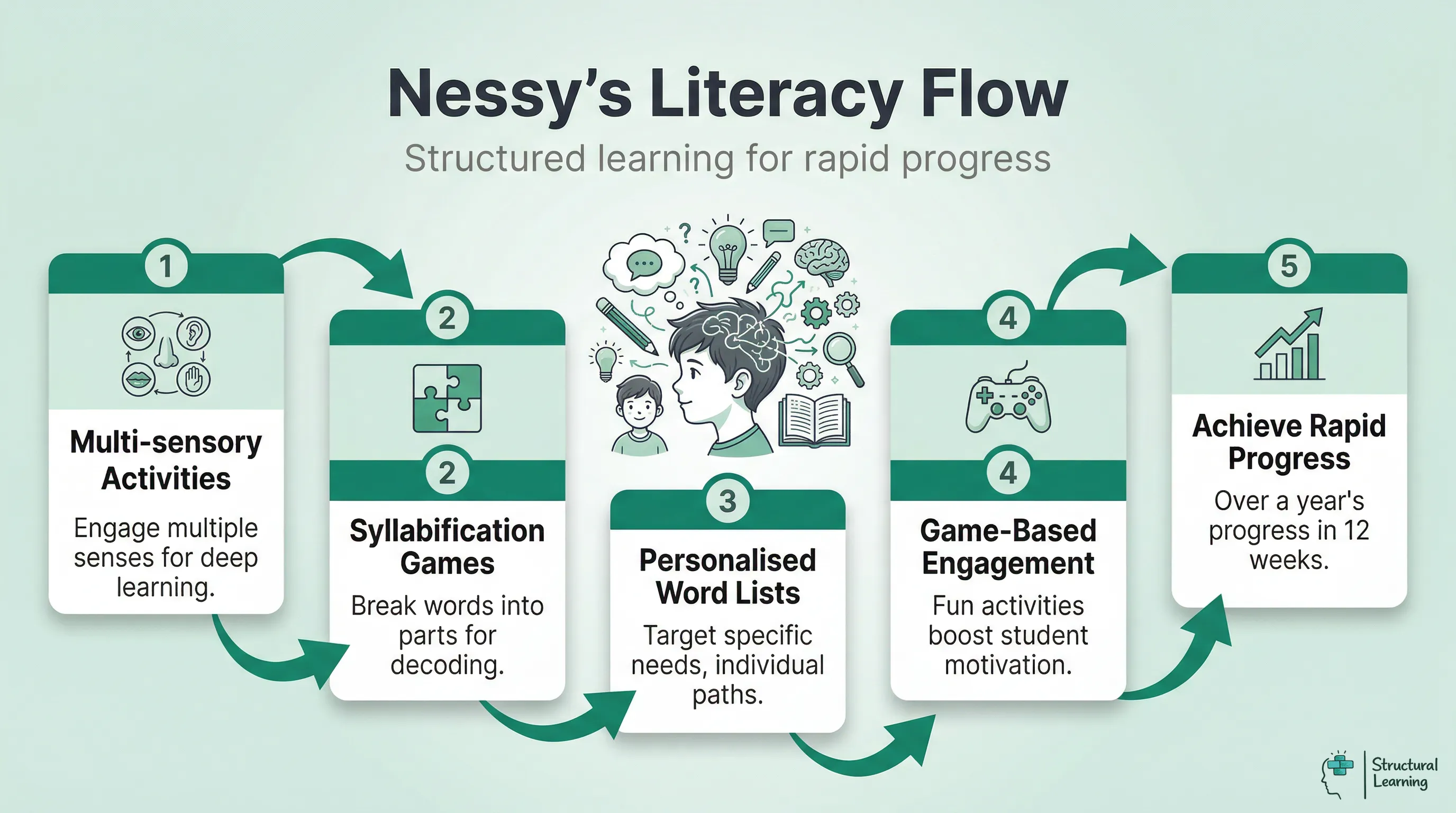
It uses activities and word games that use multiple senses. These target what each learner needs. Learners often improve their reading age by a year in just 12 weeks.
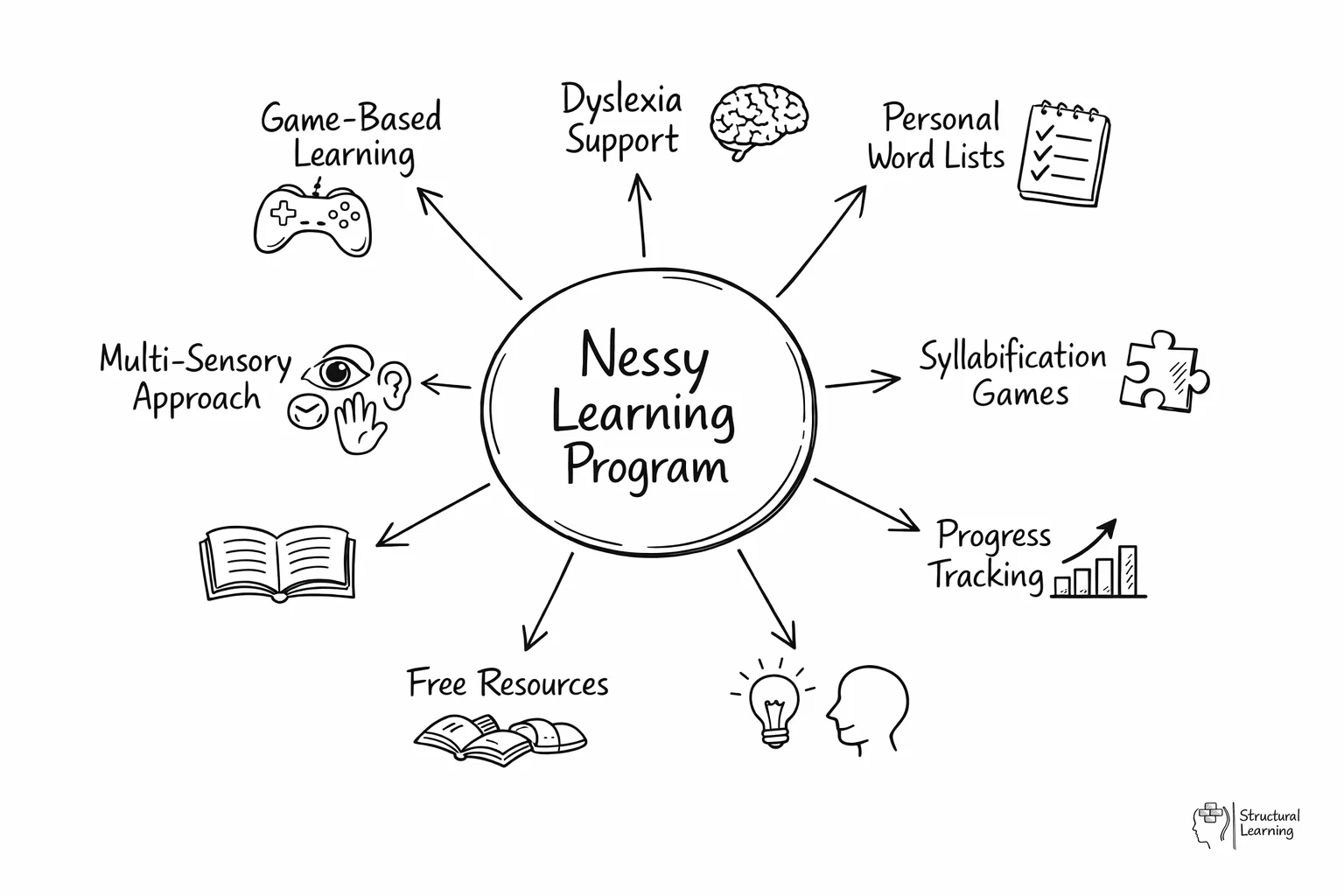
Nessy helps dyslexic learners via syllabification games. Games break words into parts and provide tailored lists. Created for learners aged 5 to 16, Nessy uses animated tasks. This simplifies learning for those with difficulties.
Research shows dyslexia causes reading difficulty with speech sounds (decoding). It affects how learners connect sounds to letters and words. Individual brain differences in language areas cause dyslexia (Lyon et al., 2003). This reading disability impacts many learners.
Dyslexia brings many different learning challenges. Learners may struggle to remember maths methods. They often find handwriting hard. Memory issues often affect these learners.
Source: nessy.com
Signs of Dyslexia

Nessy is not only one reading game. Schools may encounter Reading and Spelling, Writing Beach, Dyslexia Quest, Nessy Fingers, Hairy Letters, Chimp Fu Syllables and other linked tools. Treat each tool as serving a different job rather than assuming one login solves every literacy need.
For example, Reading and Spelling supports phonics and spelling practice. Dyslexia Quest is closer to screening and profiling. Nessy Fingers supports touch typing.
Writing Beach is more about grammar and sentence work. SENCOs should map the tool to the learner target before buying licences or writing provision-map notes.
Nessy's core reading and spelling features use animated, game-based activities to build phonics, spelling and learner engagement. The animated activities help keep learners involved. Structured early-reading interventions that combine phonics with engaging practice can improve attainment for learners at risk of reading difficulties (Hatcher, Hulme and Snowling, 2006). Cite the actual evaluation study that found 1 year of progress in 12 weeks for Nessy, or remove the specific citation if it refers to general intensive intervention rather than Nessy itself.
Technology use is key in today's education to support all learners. Nessy offers help for learners with dyslexia and other needs. Teachers can use Nessy in nine ways to boost literacy and engagement.
Experts claim that Nessy meets both academic and well-being needs. However, there is limited independent peer-reviewed evidence on Nessy. Teachers should check the actual evaluation reports before they rely on specific percentage claims.
Nessy helps learners, using tech, creativity, and empathy. This approach may benefit learners struggling in standard classrooms. Teachers can use these methods to enable potential.

Getting started with Nessy involves using a free trial. The official platform gives you training resources and setup guidance.
School specialists provide support for deployment and training resources. The platform also offers professional teaching videos. It includes setup guides and plans for classroom use.
Teachers can access Nessy Learning through school subscriptions that provide cloud-based access to the full programme suite. The platform includes free professional teaching videos, ebooks, and flashcards that support both classroom instruction and home learning partnerships.
Nessy is an online tool that embraces game-based and video-based learning and can be easily accessed online for its original website nessy.com. You have to login first then you can start playing and exploring the various dyslexia resources. Nessy can be easily accessed by network server like Chrome, Safari or Firefox.
Source: learn.nessy.co
What are benefits of using Nessy?
Free learning resource:
You can watch nessy videos for free. It is developed to support teacher and parents. Teacher can use free material available on Nessy like ebooks flashcard and teaching videos to support learning at school and parents can also use the same data to support children in learning at home.
Engaging platform:
Studies have shown that digital games on Nessy prove to be a method of learning which is engaging as well as beneficial. It is said to increase motor skills as well as cognitive skillsand it also creates curiosity, imagination and exploration.
Effective learning and understanding
AUSPELD and DSF (1) recommend Nessy Reading and Spelling as an evidence-based tool. The British Dyslexia Association gave Nessy its quality mark. Nessy also won the Educational Resources Award. The platform aims to make learning effective and easy to access.
Multipurpose Tool:
Nessy programmes are not only for dyslexia. Nessy is widely used for whole class, phonics, math, typing and early reading instruction. Nessy collaborates with some of the world's leading academics, and follows the Science of Reading, to ensure our programmes are based upon proven research.
Affordable Learning programme
It is an affordable learning programme and one can select the appropriate Nessy programme or pack required. It also offer free trail. There is no obligation, and no payment details are required. The free trial lasts for 7 days.
Complete Curriculum
Nessy is a website that contain complete curriculum. Nessy is a reading, spelling and grammar resource that is designed for kids with all sorts of abilities. What sets Nessy apart from competitors is the design. Nessy is aligned with how children with dyslexia learn to read and write.
Nessy pricing for schools and teachers changes based on a few factors. These include learner numbers, licence length and how the school buys it. Schools can try the platform for free before they buy a yearly plan. Nessy's school specialist team offers educational discounts and bulk pricing.
Nessy offers flexible pricing options for schools based on the number of learner licenses and features needed. Schools should contact Nessy directly for customised quotes that include access to all learning programmes, teacher resources, and progress tracking tools.
Nessy offers flexible pricing based on the number of licences your school requires. The more licences you purchase, the more cost-effective the platform becomes.
All prices exclude VAT. Schools receive access to training and support from Nessy specialists. Contact schools@nessy.com to discuss requirements.
Nessy is strongest when teachers understand what structured literacy is not. It is not asking learners to guess from pictures, memorise whole words, or use context before they can decode. Structured literacy teaches the sound and spelling system directly, then gives repeated practice with the pattern.
For dyslexic learners, this matters because weak decoding does not improve through more guessing. Link Nessy to explicit teaching of phonology, sound-symbol links, syllables, morphology, vocabulary, syntax and meaning. For a wider SEND route, connect this work to classroom dyslexia support. Do not treat it as a separate software task.
Nessy's science of reading alignment is based on structured literacy, systematic phonics, syllable work and personalised practice. The programme teaches phonics and breaks words into syllables (Rose, 2006). Personalised lists improve reading skills (Ehri, 2020). This approach keeps learners engaged and builds skills step by step (Hollis & Butterworth, 2002).
Nessy builds reading and spelling using custom word lists, personalising learning. Interactive games and splitting words help learners master complex words. This reinforces core skills.
The programme uses a variety of videos and online games to support the development of reading and spelling skills. It was originally developed as a tool to support dyslexia, but has been found to benefit a wide range of learners with their reading and spelling skills. Nessy Reading and Spelling is an effective resource that covers 5 school years of literacy development, from Year 1 to Year 6. The programme has been used since 1999, with millions of children worldwide.
How do children log in to Nessy?
The best way to access your account is with your Secret Word. Your Secret Word is not case sensitive.
Use your Secret Word to log in at learn.nessy.com.
Your child will need a login and password. How teacher can add learners on Nessy?
Once you have logged into Admin & Reports using your email address:
Click on 'Groups' > 'All Groups' in the navigation bar at the top of the page. Click on the blue 'people' icon next to the group you would like to add your learner to. Type the name of the learner you would like to add to the group in the search box. Does Nessy have an app?
The Nessy Learning app is a safe way for children to enjoy Nessy programmes online. Play and learn without the worry of distractions from other websites. Use this app if you already have a Nessy account or want to try out Nessy Reading & Spelling.
What age learners is Nessy for?
It is designed for children 6-11 years old, although many older learners find the programme helpful. Nessy is not just for dyslexia. All learners benefit from Structured Literacy based upon the Science of Reading.
Support for dyslexia and SEND is a defining feature of Nessy Reading and Spelling, a specialist programme built around additional learning needs. The programme's foundation at the Bristol Dyslexia Centre means every feature addresses the unique challenges these learners face. Rather than adapting mainstream resources, Nessy builds from the ground up with dyslexic learners' needs at its core.
The programme uses Orton-Gillingham methods for teaching learners with dyslexia. Learners see letters, hear sounds and play games to learn, for example, 'igh'. This helps build stronger neural pathways, addressing processing differences (Orton, 1937; Gillingham & Stillman, 1960).
Teachers say Nessy's memory tricks and visual aids work well. Learners spell 'necessary' using 'one collar, two sleeves' (Nessy). Nessy stories fix b/d confusion. This helps dyslexic learners learn letter shapes (Nessy).
Nessy lets learners work at their own speed, ideal for processing difficulties. Activities repeat until mastered, relieving pressure unlike whole class phonics. Teachers use reports to track progress (Nessy), showing which areas need focused support.
Dyslexic learners typically need more repetition than peers to reach automatic word reading, which is a core rationale for structured-literacy approaches (Snowling and Hulme, 2011). Nessy games make this repetition fun, not boring. This keeps learners motivated and gives them the intensive practise they need.
Interactive reading and spelling activities are a core part of Nessy, turning literacy work into engaging tasks with clear goals and rewards. Learners want to join in, turning drills into adventures. Rewards and badges track progress. Learners focus on quests, not phonics (Nessy, date unknown).
Game-based learning is linked with stronger engagement and more time on task. However, gains in retention depend on how the programme is designed (Gee, 2003). Teachers find that learners using Nessy ask for more time, unlike with spelling sheets. The varied games hide the repeated practice, so learners practise phonics often without getting bored.
Set weekly challenges; learners earn Nessy nuggets (Nessy, 2026) or finish game levels. A classroom chart shows progress through the islands, building excitement. Pair learners for gameplay; (Nessy, 2026) this boosts support and maintains competition.
Games give learners quick feedback, helpful for those who find reading hard. Nessy lets learners try again with hints if they misspell, reducing worry. This safe space encourages learners to try difficult words. Practise time increases, speeding progress (Nessy).
The competitor-safe SERP run showed that this article needed a clearer curriculum map. When you review a Nessy pathway, check for phoneme-grapheme correspondences, syllable types, suffixes, rhyming, blending and segmenting. Also check for phonological awareness, word recognition, vocabulary and fluency.
That list gives teachers a practical audit. If a learner is stuck, ask which part of the sequence is weak. The answer may be sound discrimination, spelling choice, syllable division, or transfer into a sentence. The next adult prompt should match that exact need.
Nessy is a structured literacy programme that teaches phonics, spelling and sentence structure in a carefully sequenced order. This method helps learners with dyslexia and reading challenges.
The programme explicitly builds skills. It covers phonics, spelling and sentence structure (Kilpatrick, 2015; Birsh, 2018). Learners master basics before moving on.
The programme starts with single letter sounds, moving to complex spellings. Learners begin with 'cat' and 'dog' using games, then learn digraphs like 'ch' and 'sh'. Teachers track progress using the programme's assessments, showing mastered and needed phonetic patterns.
Nessy uses multiple senses to teach literacy. Learners use visuals, sounds, and games together. For example, in learning the "magic e" rule, they move letters. They hear the sound and see how "hop" changes to "hope".
The diagnostic assessment uses Orton-Gillingham. It spots phonological processing gaps and makes learning paths. Teachers add words from texts to learners' lists. This mixes instruction with personalised content for each learner's needs.
Gameplay is the mechanism Nessy uses to sustain motivation, combining quick feedback, achievable challenge and visible progress. Games give fast feedback and harder tasks like video games. This helps learners who find normal methods hard.
Game-based learning engages multiple cognitive processes for deeper retention (University of Oxford). In Nessy, learners use spelling to enable levels, for instance, spelling 'night' (Rello et al., 2012). Learners guide a knight, using 'igh' words to open castle gates (Connolly et al., 2012). This helps learners remember rules through association (Gee, 2003).
Classroom challenges using Nessy activities can engage learners, say researchers (Nessy, various dates). Create a weekly leaderboard which tracks scores and improvement; this helps every learner feel success. Learners earn Nessy game time by completing standard tasks. For example, five minutes writing open ten minutes gameplay.
The programme's adaptive difficulty helps learners work within the Zone of Proximal Development, as proposed by Vygotsky (1978). This gives learners challenges they can achieve. It helps prevent frustration while still supporting growth.
Nessy data provides evidence for EHCPs and SEND tracking. It shows baselines, review points and responses to targeted support. Nessy’s diagnostic tools work best within the graduated approach.
They give teachers and SENCOs a clear record of starting points and teaching focus. This fits the Assess, Plan, Do, Review cycle in the SEND Code of Practice. It also meets the need for clear evidence in the SEND and AP Improvement Plan (Department
In practice, Nessy helps schools turn general concerns into useful SENCO reports. The platform starts with a baseline check. It then sets personal reading and spelling targets. Teachers can save learner reports as PDFs.
They can check progress and time spent using Nessy Classroom. For provision mapping, you can link a precise need to a specific intervention. You can set a clear amount of time and a review date. This is better than just writing 'extra phonics' and hoping it satisfies an an
A Year 4 teacher may say, “I’m attaching the Nessy baseline, the 30-day report, and two independent writing samples so we can show what has changed.” The learner’s first science paragraph may omit endings such as -ed and -ing, while six weeks later the same learner produces a short write-up with those spellings correct in context and says, “I know which bit to listen for now.” That combination of diagnostic analytics, work scrutiny and learner voice is far stronger EHCP evidence than a single test score.
Nessy will not replace teacher judgement, speech and language advice, or parent views, but it can tighten the paper trail. Busy teams need data that leads to action, and evidence on diagnostic assessment is clear that assessment only matters if it changes teaching and support (EEF, 2021). Used properly, Nessy gives schools a practical way to document the Assess Plan Do Review process, strengthen provision mapping, and show whether support is actually working.
Nessy is quite safe for children. Schools must use its privacy controls properly. They must also manage access and handle data well.
Nessy's notices explain school use. The school controls the data. Nessy processes the data.
Data is encrypted when sent. Staff get data protection training. Access depends on staff roles.
Customer data lives in UK and Ireland data centres. These use Microsoft Azure (https://www.nessy.com/en-gb/shop/data-privacy-legal/p).
One key point is that Nessy collects real learner data. It can hold a learner's name and date of birth.
It also tracks progress. This includes scores, hard areas, and login times. It notes how long learners spend learning.
Nessy uses this to shape lessons and reports. This is normal for smart literacy software.
But teachers should see setup as real assessment practice. It is not just a fun extra. The wider guide is the ICO's Children's Code.
In practice, three habits make the biggest difference. First, add only the data you genuinely need, for example a first name and school identifier where that works locally, rather than extra profile details. Second, build a half-termly routine to remove leavers, old staff accounts and exported reports sitting in shared folders. Third, if a child needs tighter teacher oversight, review whether Nessy's automatic lesson pathways should stay on, or whether the SENCo or class teacher should set the sequence manually.
Parents and teachers should take a balanced view. Nessy takes data protection seriously. It gives a privacy notice made for children. But schools should still check the data processing agreement.
They must note the rules on keeping data. Schools should add the platform to their DPIA before starting.
This follows a safe privacy approach. It keeps the literacy support and cuts risk. It also makes home and school talk much clearer.
The teacher dashboard is the main tool for monitoring learners' completion, accuracy and consistency in Nessy over time. For classroom use, the key question is not simply whether learners enjoy it, but whether their reading and spelling accuracy improve over time. A sensible starting point is to look for patterns in completion, accuracy and consistency, because these give a clearer picture of progress than scores alone. This fits well with formative assessment research, which shows that regular, low-stakes feedback helps teachers adjust teaching before gaps become entrenched.
One useful strategy is to check the dashboard every week. You can group learners into three simple categories. These are secure progress, uneven progress, and stalled progress. A learner may finish tasks but keep making the same vowel or blending errors.
They may need a short follow-up session with clear teaching. This is better than more independent game time.
Another learner may be accurate but rarely finish tasks. They may need timetable changes or a shorter, more regular slot. This helps teachers use Ne
A second useful approach is to compare dashboard data with what you see in books, reading records and oral work. If a learner is succeeding in Nessy but still struggling to apply the same pattern in dictated sentences, that tells you transfer is not yet secure. The Simple View of Reading is helpful here, because gains in word reading need to connect with language use and classroom application. Teachers can then reinforce the same grapheme pattern during handwriting practise, guided reading or spelling review.
For return on investment, the most meaningful reports are the ones that show small gains building steadily across a half term. You may track one target group, such as Year 3 learners with weak decoding, and note whether Nessy use links to fewer errors in weekly spelling checks or greater confidence in reading aloud.
Another effective routine is to share a brief progress summary with support staff and parents, so everyone focuses on the same next step. Used this way, the dashboard becomes less about monitoring screen time and more about making sharper teaching decisions.
Nessy can sit in different tiers of support, but the adult role changes at each tier. At Tier 1, teachers may use short whole-class routines or homework practice. At Tier 2, small groups need targeted practice linked to diagnostic gaps. At Tier 3, learners need more intensive adult-led instruction and review.
This maps well to the UK graduated approach. Use Nessy evidence alongside reading records, spelling books, phonics checks and SENCO notes. A digital progress chart is useful only when it changes the next teaching decision.
Using Nessy at home and school involves adapting clear literacy teaching to each setting. You must match it to daily routines and adult support. This approach works best when teaching is clear, builds up and is reviewed often.
This matches what we know about spaced practice and retrieval practice, as explained by Karpicke (2008). The games are helpful, but real progress comes from how adults organise the learning.
In a homeschool setting, the main advantage is flexibility. Parents can keep sessions short, around 15 to 20 minutes, four times a week, and stop before attention drops. A simple routine works well: watch the teaching clip together, complete one or two game activities, then finish with a quick off-screen task such as building words with letter tiles or writing three words that use the new pattern. That final step matters because it helps children transfer what they practised on screen into real reading and spelling.
Nessy works best as targeted help in a normal classroom. It is not a whole-class core programme. Teachers get the best results by matching tasks to gaps.
These gaps may be vowel sounds or spelling patterns. Teachers use the software during small group work.
They can also use it for early morning catch-up. Teaching assistants can support these sessions.
One good way is to teach the sound first. Then learners do the Nessy activity. Finally, check their understanding.
The common mistake in both settings is treating Nessy as independent screen time with no follow-up. In school, this becomes a screen-time substitute for provision: the licence looks like provision, but the learner does not receive the adult explanation, pronunciation check or transfer task that changes reading and writing.
Headteachers should cost Nessy alongside TA CPD and weekly review time, not as a stand-alone SEND purchase. For schools, that can mean sending home one weekly spelling pattern for parents to reinforce; for families, it can mean keeping a short record of mastered sounds to share with school. The tool is engaging, but implementation still matters most.
The main classroom risk is transfer. A learner can succeed inside Nessy but still fail to use the same spelling pattern in a sentence, dictation task or reading book. Plan one off-screen step after each digital task.
For example, after a learner practises a vowel pattern, ask them to build three words with magnetic letters, read one decodable sentence, then write one sentence in a book. This creates a route from screen success to classroom literacy. It also supports phonics screening preparation without reducing reading to a game score.
Do not treat "multisensory" as the active ingredient on its own. The stronger evidence base is in explicit, systematic phonics. This means a planned order for sound-symbol teaching, regular review and corrective feedback (Castles, Rastle & Nation, 2018). Reviews of Orton-Gillingham interventions find promising but methodologically mixed evidence, partly because studies often combine systematic phonics with branded multisensory routines, so it is hard to tell what causes improvement (Ritchey & Goeke, 2006; Elliott & Grigorenko, 2014).
The practical test is transfer, not whether a task looks sensory-rich. If the animation, reward screen and click sequence pull attention away from the grapheme, reduce the screen demand and use one physical action: build the word with magnetic letters, say each phoneme, then type it. This keeps working memory on the spelling pattern and gives teachers a quick check that learners can apply the pattern outside the game (Sweller, 1988; Furlong et al., 2025).
For Key Stage 1 learners using Nessy for initial phonics instruction, teachers can pair digital tasks with letter tiles or magnetic letters. Before a learner types a CVC word like 'cat' into the programme, the teacher can instruct them to build it physically. For example, the teacher may say, "Before you click to spell 'cat' on Nessy, first build it with your magnetic letters on the board."
This approach helps learners segment and blend sounds in a physical way. They can feel each letter and the order it comes in. After building 'c-a-t' with their hands, they move the same idea to the digital interface. This reinforces grapheme-phoneme correspondence, which is the link between a letter or letter group and its sound, and helps learners remember spelling patterns better than screen-based input alone.
In Key Stage 2, when learners encounter more complex spelling patterns or polysyllabic words, teachers can use manipulatives like linking cubes or playdough. If Nessy presents a word like 'beautiful' for spelling, the teacher can guide learners to break it down using physical objects.
The teacher may instruct, "Nessy is asking you to spell 'beautiful'. Let's break it down into syllables first. Use three linking cubes to represent 'beau-ti-ful', saying each syllable as you connect them."
Learners physically segment the word, assigning a cube to each syllable, then practise spelling each part. They can then use mini whiteboards to write out the phonemes or morphemes for each cube before typing the full word into Nessy. This process provides a tangible scaffold for complex word structures, aiding both spelling accuracy and phonological awareness (Ehri, 2014).
Combining digital phonics with hands-on activities can support learners with varying needs when the physical task is tightly matched to the spelling pattern. Learners with working memory challenges benefit from seeing the word parts outside their head, which can reduce cognitive load (Sweller, 1988). Avoid claiming that a learner simply "learns best by doing"; the point is to make the phoneme, grapheme or morpheme visible enough to discuss.
This integrated approach means that digital practice does not stand alone. It links to a wider multisensory learning environment, where learners use more than one sense to learn. By working with physical tools, learners build deeper understanding and transfer skills more easily to other reading and writing tasks. In this way, teachers create a more complete and inclusive phonics instruction model.
Phonics software often gives teachers useful data on learner performance. But its value goes beyond accuracy and fluency scores. Teachers can use this data to build metacognitive awareness, which means helping learners understand how they learn phonics. This shifts the focus from finishing tasks to thinking about strategies and progress (Wiliam, 2011).
Phonics software data, such as repeated errors on specific grapheme-phoneme correspondences or blending patterns, offers a precise starting point for metacognitive conversations. Instead of just noting a learner's score, teachers can guide them to interpret why they struggled with certain sounds or words. For example, if a Year 2 learner consistently misreads words containing the 'ea' digraph, the teacher can show them the data and ask, "What do you notice about these words? What strategy did you try when you saw 'ea'?"
This process helps learners take an active role in their learning. They start to spot their own "stuck points" instead of only receiving corrections. Teaching learners to check their understanding and change their strategies helps them become self-regulated learners (Dunlosky et al., 2013). Teachers can ask learners to explain their thinking, such as "I thought 'ea' always made an /ee/ sound, but in 'bread' it makes an /e/ sound, so I need to check other letters too."
Teachers can integrate specific metacognitive prompts when reviewing phonics software data with learners. After a session, a Year 1 teacher may present a learner with their results showing difficulty with CVC words containing the short 'a' sound.
The teacher could ask, "When you saw 'cat', what did you do first? Did that help you? What could you try next time you see a word with 'a'?"
Another example involves using a simple graphic organiser to track common errors. A Year 3 learner struggling with vowel digraphs can record the words they misread, the sound they thought it made, and the correct sound. This visual representation helps learners see patterns in their errors and reflect on the effectiveness of their decoding strategies (Hattie & Timperley, 2007).
The teacher plays an important role in turning raw data into metacognitive learning opportunities. This means helping learners think about how they learn. Teachers should model reflective thinking and give learners clear chances to explain their strategies and spot areas for improvement. They can do this by asking open-ended questions that prompt deeper thinking, rather than simply giving the correct answer (Rosenshine, 2012).
When teachers regularly guide learners to analyse their phonics software performance, they help them build a repertoire of effective learning strategies. Learners also gain a clearer understanding of how they learn best. This metacognitive approach moves phonics instruction beyond rote memorisation. It helps build resilient and independent readers.
By 2026, the important shift is oral reading fluency. Newer AI reading tools can listen to a child read aloud, estimate words-correct-per-minute and flag prosody or accuracy patterns, while Nessy still relies mainly on click, drag and typed responses. That does not make Nessy obsolete, but it does show its boundary: it is stronger for structured phonics practice than for hearing whether a learner can decode connected text aloud (Wang et al., 2024; ETS, 2024).
For teachers, the useful question is not whether an AI report looks impressive, but whether it changes tomorrow's group teaching. If voice data shows a Year 4 learner reads "shouted" as "showed" and drops the final /t/, the follow-up is a short adult-led decoding and dictation task, then a check in the reading book. The technology only matters when it improves the next teaching move.
AI algorithms can analyse how a learner performs in reading and spelling games at home. They can show clear strengths and areas where the learner keeps finding things difficult. This does more than track whether a task is finished. The AI can spot error patterns, such as repeated confusion between certain phonemes, or speech sounds, and graphemes, or written letters and letter groups.
For instance, a Year 2 learner may often misread words with the 'ea' digraph in home activities. The AI system records this pattern. This detailed data gives teachers a clear view of individual learning needs. Teachers can then plan targeted interventions.
The data collected by AI from home practice gives teachers useful formative assessment insights (Wiliam, 2011). Teachers receive reports that show common misconceptions across the class. The reports also show specific areas where individual learners need more support.
A Year 4 teacher can review an AI report from home reading tasks. The report may show that several learners struggle to decode multi-syllabic words with prefixes and suffixes. This helps the teacher plan a focused mini-lesson on morphology, which is how word parts carry meaning. That is more useful than a general phonics review.
Teachers can translate AI-generated insights into concrete classroom actions. For example, a Year 3 teacher observes from AI data that a group of learners consistently confuses the 'igh' and 'ie' spellings in their home spelling practice.
The teacher then plans a targeted small-group intervention. They use a graphic organiser to compare words with these spellings, such as 'light' versus 'tie'. Using home data in this direct way helps classroom time focus on specific learning gaps.
Similarly, a Year 6 teacher may see from AI reports that the whole class is finding inferential comprehension questions hard in home reading passages. The teacher can then use a shared text to model how to make inferences. This means showing learners how to use clues in the text and what they already know.
AI can provide useful data, but teacher professional judgement is still important. Teachers need to interpret these insights and design suitable responses. The AI acts as a diagnostic tool, but the teacher plans the pedagogical solution.
Teachers should check the AI data with care. They should compare it with classroom observations and learner interactions, so they understand each learner's literacy development. In this way, technology supports expert teaching rather than replacing it.
For mainstream teachers, the challenge is to understand what dyslexia feels like for the learner, not only the signs they see in class. Academic definitions often mention phonological processing deficits, which means difficulty noticing and working with speech sounds. However, these definitions do not always help teachers spot dyslexia in everyday classroom work (Snowling & Hulme, 2011). Teachers need a clear mental picture of how these cognitive differences affect daily learning.
This deeper understanding helps teachers do more than spot reading and spelling errors. It helps them interpret a learner's behaviour, effort, and responses in light of their specific cognitive profile. This matters because it supports targeted, empathetic help that addresses real learning barriers.
Dyslexia often places a hidden load on working memory, even during tasks that may look simple. Learners with dyslexia use much more mental effort to decode words. This leaves less capacity for comprehension and other learning activities (Sweller, 1988). Over time, this effort can lead to tiredness, frustration, and reluctance to read or write.

Consider a Year 4 learner, Alex, attempting to read a short passage aloud during guided reading. The teacher observes Alex frequently losing his place, substituting words, and rereading sentences multiple times. While Alex eventually decodes most words, his face shows clear signs of strain, and he sighs deeply at the end, having understood little of the content.
The teacher recognises that this is not a lack of effort. It reflects the high cognitive load involved in basic decoding. Alex's working memory is overloaded by the mechanics of reading, so he cannot process meaning effectively. This helps the teacher decide to provide pre-reading support or use audio versions of texts.
Slower processing speed and limitations in working memory are hallmarks of dyslexia that profoundly affect classroom participation. Learners may struggle to keep up with fast-paced verbal instructions or quickly transcribe information from the board. This can appear as inattention or a lack of understanding, when in fact, it is a processing delay.
Imagine a Year 7 science lesson where the teacher explains a complex experiment while writing key terms on the whiteboard. Sarah, a learner with dyslexia, attempts to copy the notes while simultaneously listening to the instructions. She misses important steps because her brain cannot process the auditory and visual information at the same speed as her peers.
Sarah may then ask a question about a step the teacher has just explained. This does not mean she wasn't listening. She may still be processing the previous instruction or trying to finish copying. The teacher can respond by pausing more often, giving written instructions, or using a graphic organiser to show information visually.
Dyslexia can affect more than decoding words. It can also affect comprehension and written expression. Even when a learner reads a text, the effort used for decoding can leave less mental energy for understanding the whole meaning. As a result, they may read fluently but still struggle to answer comprehension questions.
Similarly, written expression can be challenging, even when a learner has a clear understanding of the subject matter. The act of forming letters, spelling words, and structuring sentences can be so demanding that it hinders the flow of ideas. A learner may know the answer to a history question but struggle to articulate it coherently on paper.
These peer-reviewed studies provide the research foundation for the strategies discussed in this article.
Meta-analysis of intervention research on older struggling readers
342 citations
Wanzek, J., Vaughn, S., Scammacca, N., & Gatlin, B. (2016), Reading & Writing
Older struggling readers benefit from targeted reading interventions, particularly those focusing on phonics and fluency. This research highlights the importance of evidence-based approaches for secondary learners, helping teachers choose effective strategies to improve literacy skills.
Prevention and remediation of severe reading disabilities
587 citations
Torgesen, J. K., Schotte, A., & Meadows, A. (2012), Current Directions in Psychological Science
Torgesen, Schotte, and Meadows (2012) found that early intervention using evidence-based phonics instruction can significantly improve reading outcomes for children at risk of severe reading disabilities. this shows the importance of teachers implementing systematic and explicit phonics programmes, like Orton-Gillingham, to prevent reading difficulties.
Separate genetic influences on reading and spelling
198 citations
Lovett, M. W., Defries, J. C., & Frijters, J. C. (2000), Journal of Learning Disabilities
Research suggests that reading and spelling skills are influenced by separate genetic factors. this shows the importance of addressing both areas explicitly in literacy instruction, as difficulties in one area may not automatically indicate problems in the other.
Building academic vocabulary
892 citations
Marzano, R. J., & Pickering, D. J. (2005), ASCD
Marzano and Pickering's research highlights the critical role of explicit vocabulary instruction in academic success. A strong vocabulary base supports reading comprehension and overall learning, making targeted vocabulary strategies essential to implement across all subject areas.
An evaluation of phonological processing in dyslexic children
156 citations
Singleton, C., & Simmons, F. (2001), Journal of Research in Reading
Singleton and Simmons (2001) found that dyslexic children often demonstrate weaknesses in phonological processing skills. this shows the importance of explicit and systematic phonics instruction, such as the Orton-Gillingham approach, to support these learners' reading development.
Nessy should also be compared with paper-based interventions, not only other apps. Linear programmes such as Toe by Toe or Alpha to Omega can be cheaper and highly structured, but they often rely on adult delivery and learner persistence. Nessy adds motivation, feedback and easier home access, but still needs adult monitoring.
The practical question is not "Which programme is best?" It is "Which learner needs which format now?" A learner who avoids reading may need a game-based entry point. A learner with severe decoding gaps may need slower adult-led practice before the software.
Nessy versus other reading programmes is a comparison of how this dyslexia-focused phonics tool differs from other widely used options. Understanding how it compares to other widely-used tools helps you decide whether it's the right fit for your setting.
Bringing Nessy into teaching can make targeted support more effective and improve classroom practice for all learners. Nessy’s structured approach draws from Orton-Gillingham principles (Gillingham & Stillman, 1960). Researchers have found it useful for learners who need structured literacy interventions (Torgesen et al., 2001; Galuschka, et al., 2014; Rolfe, 2020). Nessy can also build spelling skills, which can affect outcomes across the curriculum (Johnston & Watson, 2005).
*** Rewritten Paragraph: Nessy uses a dyslexia-first design and phonics screening. It links intervention for learners with reading needs to whole class teaching. This support works for learners needing structured help (Torgesen et al., 2001; Galuschka, et al., 2014; Rolfe, 2020). Nessy also improves spelling, helping learning across subjects (Johnston & Watson, 2005).
| Platform | Price Range | Phonics Approach | Gamification Level | Dyslexia Focus | UK Curriculum Alignment | Best For |
|---|---|---|---|---|---|---|
| Nessy | Per-learner, modest cost | Science of Reading, systematic phonics | High, adventure game format | Explicit, designed for dyslexia-first | Strong, maps DfE phonics phases | SEND cohorts, phonics interventions |
| Lexia Core5 | Per-learner, higher cost | Adaptive, scaffolded phonics | Moderate, skills-based, less game-like | Present, strong data analytics | US-focused, but adaptable | Large-scale deployments, evidence-led schools |
| Reading Eggs | Subscription-based, moderate | Blended phonics, whole language elements | Very high, arcade-style games | Limited, general learners | Moderate, some UK adaptation | Reception and KS1, engagement-focused |
| Phonics Hero | Budget-friendly, school pack | Synthetic phonics, DfE-aligned | Moderate, light gamification | Limited, general screening prep | Excellent, built for Year 1 check | Phonics screening check prep, budget-conscious schools |
| Sound Discovery | CPD-inclusive, higher investment | Structured phonics, linguistic foundations | Low, workbook-based, teacher-led | Present, multi-sensory approach | Strong, teacher-training focused | Schools wanting staff development, phonics coaching |
Nessy and the Year 1 phonics screening check are closely linked through practice in grapheme-phoneme knowledge and word reading. This government assessment tests whether children can apply grapheme-phoneme knowledge to read real and nonsense words (Carver et al., 2022). Nessy is specifically designed to prepare learners for this check while building foundational reading skills.
The DfE phonics framework is divided into synthetic phonics phases: Phase 2 (initial sounds), Phase 3 (vowel digraphs), Phase 4 (blending), Phase 5 (alternative graphemes), and Phase 6 (syllables and morphology). Nessy mirrors this structure through its level system. Learners progress through Nessy levels at their own pace, explicitly covering the grapheme-phoneme correspondence patterns assessed in the Year 1 check. Each level focuses on real-world application: learners don't just "know" phonemes, they blend and segment real words.
A typical classroom sequence looks like this: In the autumn and spring terms, learners spend 10-15 minutes daily on Nessy after whole-class phonics input. As the summer term approaches (when the check takes place), increase Nessy sessions and focus on blending and segmentation fluency.
The platform tracks individual progress in real time, you'll see which learners are secure in Phase 3 blending, which are struggling with Phase 5 alternative graphemes. Use this data to target small-group intervention before the check. By summer, learners should be scoring 30+ in Nessy's blending level with confidence; this typically correlates with strong phonics check performance.
One Year 1 teacher reported that after three terms of Nessy, 89% of her class achieved the expected standard on the phonics screening check, compared to 72% the previous year (when phonics was taught via paper workbooks alone).
Dyslexia is not a lack of ability, but a difference in how the brain processes written language. The British Dyslexia Association estimates that 10% of the UK population has dyslexia; in a typical class of 30, three learners will have dyslexia-profile reading difficulties. Nessy is one of the few programmes built explicitly for this cohort.
Nessy uses structured literacy. It teaches sound and letter links clearly (Moats, 2020). This is not like picking up sounds by chance.
Learners with dyslexia often need structured literacy. Hidden phonics is not enough. Nessy gives them this through a game. Learners use phonics to make active progress.
Nessy helps dyslexic learners by repeating letter-sound patterns in visual, spoken and typed forms. The important classroom question is whether the learner can use the same pattern away from the screen. After a digital activity on igh, ask the learner to read light, build night with letters and write one dictated sentence using the pattern.
If you're a SENCO or teach learners with identified dyslexia, Nessy's progress tracking is invaluable. Export the learner's level history: this shows which phoneme patterns they've mastered and where they're stuck. If a learner is fluent in Phase 3 (single sounds, CVC words) but hitting a wall in Phase 4 (blending), you know to intensify small-group teaching on blending rather than continue prematurely.
This data-informed approach helps teachers avoid a common mistake. A learner may not be "isn't ready"; they may need more targeted scaffolding. Share Nessy progress reports with parents, educational psychologists, and external support services (e.g., dyslexia assessment teams). These reports show how the learner is responding to intervention.
If a learner has an EHCP (Education, Health and Care Plan) with literacy targets, Nessy provides objective progress data. For example, an EHCP may state: "By July 2026, [learner] will blend and segment CVC words with 80% accuracy." Run Nessy reports monthly to track this.
If progress stalls, adjust intervention. If progress exceeds expectations, communicate this to the EHCP review team. This evidence is essential for demonstrating that support is effective and can justify continuation (or expansion) of resources.
Furlong, L., Serry, T., Erickson, S., Lefort, M., Gath, M., & Morris, M. E. (2025). Finding the needle in the haystack: A quality appraisal of mobile applications for foundational literacy skills. Early Childhood Education Journal.
International Dyslexia Association. (2025). Structured literacy: Effective instruction for students with dyslexia and related reading difficulties. IDA. https://dyslexiaida.org/structured-literacy-effective-instruction-for-students-with-dyslexia-and-related-reading-difficulties/
Nessy Learning. (2026). The Nessy approach to learning. Nessy. https://www.nessy.com/en-gb/about-us/the-nessy-approach-to-learning
ILT Education. (2026). Nessy apps shine in a world-first literacy study. ILT Education. https://www.ilteducation.com/uk/news/nessy-apps-shine-in-a-world-first-literacy-study/
Jones and teachers made Nessy, an online programme, at Bristol Dyslexia Centre. It helps learners aged 5-16 with dyslexia. It is now used globally, teaching all learners to read (Jones, date not in original text).
According to recent research studies, learners using the Nessy programme make more than one year of reading progress in just 12 weeks. This accelerated progress is attributed to the programme's game-based learning approach, which leads to increased levels of engagement and higher attainment.
Nessy helps dyslexic learners with syllable games. These games break words into easy chunks. Custom word lists give targeted practice. Animated tasks and mixed sensory methods help a lot.
These multisensory techniques are widely used in structured-literacy programmes and align with the Orton-Gillingham approach (Birsh, 2018).
Word lists personalise spelling practise, moving away from generic worksheets. This supports individual learning. Teachers and teaching assistants meet learning objectives with effective scaffolding. They focus on words each learner needs to master.
Nessy provides free resources like videos and ebooks to aid learners in class and at home. They offer a free trial and school specialists are available to assist teachers. (Nessy, undated)
Nessy, designed for learners with dyslexia, now helps all learners read. It's a common phonics curriculum offering specialist benefits. This approach improves reading progress for everyone (Nessy, 2026).
Nessy (n.d.) uses games to make reading and spelling fun for learners. Animated activities from Nessy (n.d.) engage learners and help them improve their literacy. This mixes enjoyment with building skills, improving motivation and results.