Chomsky's TheorySecondary students aged 12-14 in bottle green cardigans discussing Chomsky's language theory in class

Updated on  

January 30, 2026

Chomsky's Theory

|

July 20, 2023

Explore Chomsky's theory of language acquisition and universal grammar, focusing on the innate language faculty and its implications for classroom practices.

Course Enquiry
Copy citation

Main, P (2023, July 20). Chomsky's Theory. Retrieved from https://www.structural-learning.com/post/chomskys-theory

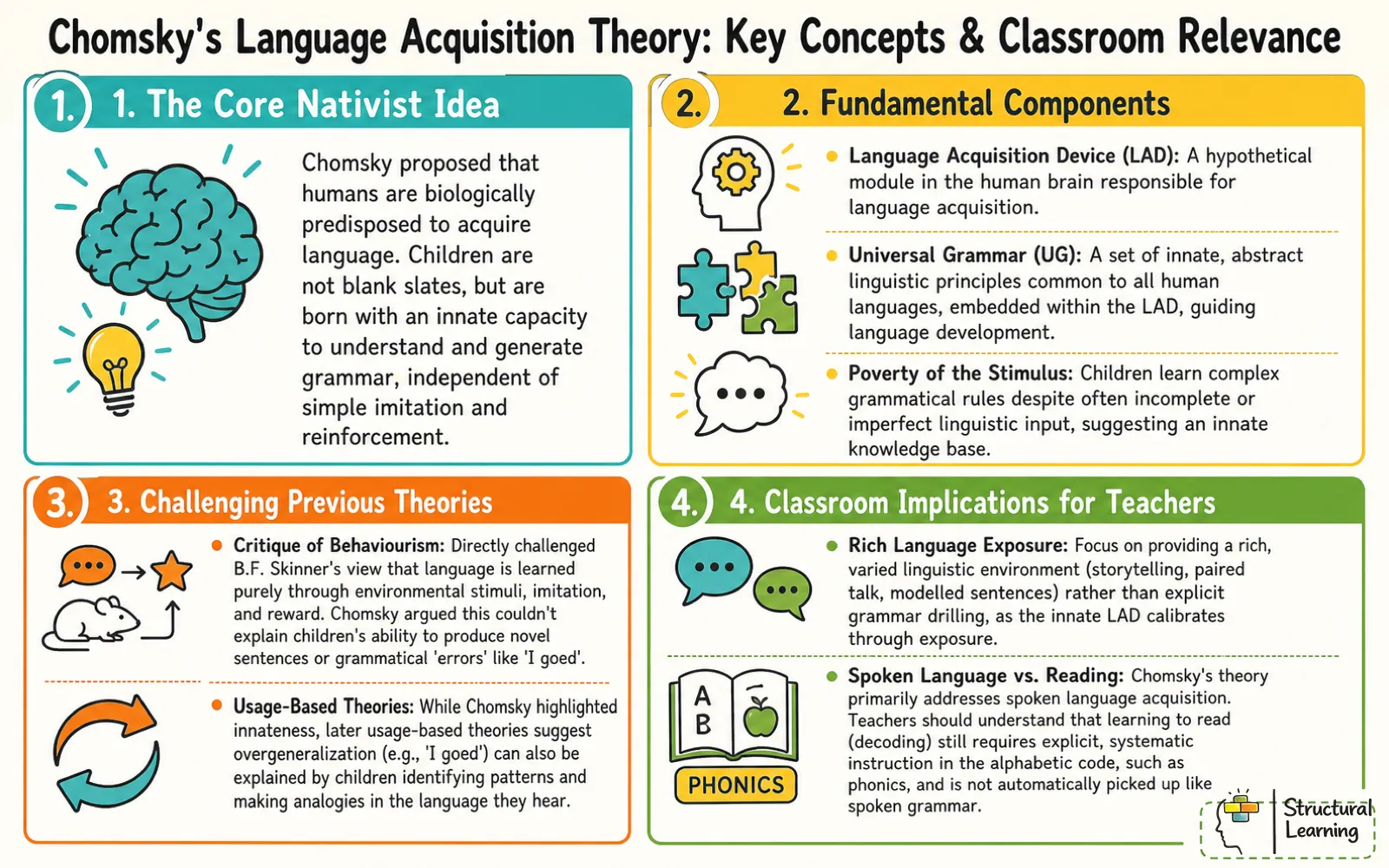
Chomsky's Theory of Language Acquisition

The theories proposed by Noam Chomsky have significantly shaped our understanding of language acquisition and universal grammar. Chomsky's perspective suggests that the human mind is pre-equipped with a set of linguistic constraints, often referred to as "universal grammar." This framework provides a common structural foundation across all languages, despite their apparent differences.

Key Takeaways

  1. Children Master Complex Grammar Naturally: Discover why explicit grammar drills often fail and how to harness children's innate language learningabilities in your classroom.
  2. Universal Grammar Changes Everything: Learn how all languages share hidden structures that can transform your approach to teaching EAL learners and struggling readers.
  3. The Language Acquisition Device: Understand the biological mechanism in every child's brain that makes rapid language learning possible without direct instruction.
  4. Why Repetitive Exercises Fail: Explore the scientific evidence behind why traditional drill methods contradict how the human brain actually acquires language skills.

Chomsky Theory Summary and Applications

  1. The Grammar Instinct: Why children master complex rules without teaching, and how this changes your approach to language instruction
  2. Beyond Drill and Practise: The biological reason why repetitive exercises fail: How Chomsky's LAD theory transforms your literacy interventions
  3. Universal Patterns, Individual Needs: Discover the innate structures all pupils share, and why understanding parameters explains EAL learners' specific challenges
  4. The Effortless Learning Paradox: Why struggling readersmight have intact language systems: Chomsky's insights into separating acquisition from literacy difficulties

Stage/LevelAge RangeKey CharacteristicsClassroom Implications
Grammar InstinctEarly childhoodChildren master complex rules without explicit teaching, demonstrating innate language capacityFocus on natural language exposurerather than explicit grammar instruction
Language Acquisition Device (LAD)Birth to adolescenceInternal mechanism enabling rapid grasp of grammatical structures without direct instructionMove beyond repetitive drills, recognise biological basisof language learning
Universal Grammar ApplicationAll agesCommon structural foundation across all languages despite surface differencesUnderstand that all learners share innate linguistic structures, adapt teaching to parameters
Effortless Learning PhaseEarly language developmentRapid acquisition of complex rules (like pluralization) with minimal inputSeparate language acquisition abilities from literacy difficulties in struggling readers

One of the intriguing aspects of language acquisition that Chomsky explored is the seemingly effortless way in which children grasp grammatical rules and structures.

Comparison chart showing Chomsky's innate language theory versus behaviorist environmental approach
Chomsky vs. Behaviorist Theory

This stands in stark contrast to the behaviorist perspective, which places heavy emphasis on external stimuli and reinforcement in language learning. Instead, Chomsky proposed the existence of an internal language acquisition mechanism within the human brain.

This mechanism enables children to rapidly grasp complex grammatical structures, even without explicit instruction or sufficient language input.

Chomsky's theory was revolutionary in that it challenged the prevailing belief that language development was solely influenced by environmental factors.

He suggested that children are born with an innate understanding of grammar, which provides a framework for language acquisition. Despite the surface-level variations among languages, Chomsky argued that all human languages share underlying syntactic categoriesand grammatical features.

According to a study by Lisa Pearl, the "Universal Grammar + statistics" (UG+stats) perspective has been instrumental in understanding the development of morphology and syntax knowledge. This perspective combines the principles of Universal Grammar with statistical learning approaches to explain how children acquire language.

For instance, consider the way a child learns to form plurals in English. Despite the irregularities and exceptions in the language, most children quickly grasp that adding an "s" or "es" to a noun usually indicates more than one. This rapid understanding of a complex rule suggests the existence of an internal mechanism, as proposed by Chomsky.

As linguist Steven Pinker once said, "Language is not a cultural artifact that we learn the way we learn to tell time or how the federal government works. Instead, it is a distinct piece of the biological makeupof our brains." This quote encapsulates the essence of Chomsky's theory, emphasising the biological and cognitive aspects of language.

Many contemporary linguists incorporate aspects of Chomsky's theory into their research, highlighting its ongoing relevance and influence.

Key insights from Chomsky's theory include:

  • The concept of "universal grammar" suggests a common structural basis for all languages.
  • Chomsky proposed an internal language acquisition mechanism within the human brain, enabling rapid and effortless learning of grammatical structures.
  • Despite surface-level variations, all human languages share underlying syntactic categories and grammatical features, according to Chomsky's theory.

Neuroscience Evidence Supporting Chomsky's Theory

Chomsky's work evolved through four main phases: Standard Theory (1957-1965), Extended Standard Theory (1965-1973), Government and Binding Theory (1973-1990s), and the Minimalist Programme (1990s-present). Each phase refined his understanding of how universal grammar operates, moving from complex rule systems to simpler, more elegant explanations of language structure. The Minimalist Programme represents his current approach, focusing on the most basic computational principles needed for language.

Comparison diagram showing Chomsky vs behaviorist language theories with timeline of Chomsky's evolution
Side-by-side comparison with timeline: Chomsky vs Behaviorist Theory and Chomsky's Theoretical Evolution

Chomsky's work in the field of linguistics can be understood through different phases that he went through in developing and refining his theories.

The first phase introduced the idea of generative grammar, which proposed that the process of generating and understanding sentences could be described using rules. Chomsky distinguished between phrase structure rules, which determine the basic structure of sentences, and transformations, which manipulate sentence structures to produce different meanings.

This model aimed to capture the underlying knowledge and rules that speakers possess to generate and interpret an infinite number of grammatically correct sentences.

The second phase, known as the Aspects Model, introduced the concepts of deep structure and surface structure. Deep structure represents the underlying meaning and syntactic structure of a sentence, while surface structure refers to the specific arrangement of words in a sentence. Chomsky argued that the transformational processes between deep and surface structure could account for the variation observed in language use.

The final phase, known as the Government and Binding Model, introduced the ideas of principles and parameters. Chomsky proposed that there are universal principles that govern the structure of all human languages, while specific parameters can vary across different languages.

This model aimed to capture the innate knowledge and constraints that guide language acquisition and enable the processing of language. It emphasised the role of government, which refers to the relationship between heads and their dependents in a sentence.

Throughout these phases, Chomsky's theories have sought to uncover the underlying structures and principles that govern language, highlighting the innate and cognitive aspects of language acquisition and processing. This has greatly influenced the field of linguistics and our understanding of the human language capacity.

What is Universal Grammar?

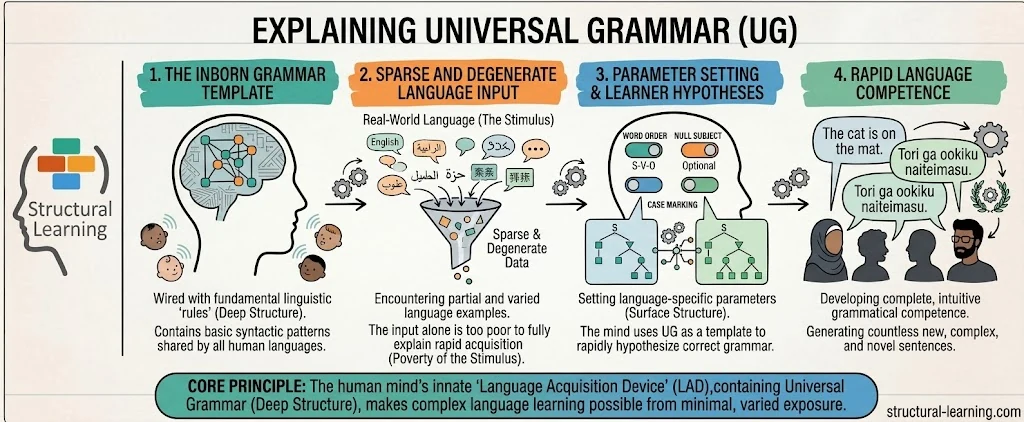
Universal Grammar Theory proposes that all humans possess an innate biological capacity for language acquisition. This theory suggests that children are born with a mental framework containing fundamental grammatical principles shared across all languages. The framework enables rapid language learning despite limited input from the environment.

Universal Grammar is Chomsky's theory that all humans are born with an innate set of language principles hardwired into their brains. This biological endowment includes basic grammatical rules and structures that are common to all languages, explaining why children can learn any language they're exposed to. The theory suggests that while languages appear different on the surface, they all share fundamental structural properties at a deeper level.

The theory of Universal Grammar, as proposed by Chomsky, posits that certain grammatical structures and rules are innate to all human languages. This concept, despite the apparent differences between languages, suggests a deep and underlying structure that is universal across all languages.

Chomsky's theory distinguishes between surface structure and deep structure in language. The surface structure refers to the specific arrangement of words in a sentence, while the deep structure represents the underlying meaning and syntactic structure.

Transformations occur between these two levels, producing the variation observed in language use.

A key aspect of Chomsky's theory is the concept of principles and parameters. Universal Grammar consists of universal principles that govern the structure of all languages. These principles are innate and provide a foundation for language acquisition.

Parameters, on the other hand, are language-specific settings that vary across different languages, allowing for the diversity and variation observed in grammatical structures across languages.

Chomsky's Universal Grammar theory suggests that all humans are born with an innate capacity for language acquisition. This capacity is made possible by the knowledge of these innate grammatical structures and rules.

Through exposure to language input, children are able to acquire and develop their linguistic skills, using the principles and parameters of Universal Grammar.

In a studyby Robert D. Borsley and Kersti Börjars, the authors explore non-transformational syntax, which provides a different perspective on the principles and parameters of Universal Grammar. This study provides a deeper understanding of the complexities of language acquisition and the role of Universal Grammar.

Consider the example of a child learning to form questions in English. Despite the complex rules and exceptions, children quickly understand that the auxiliary verb usually moves to the beginning of the sentence to form a question. This rapid understanding of a complex rule suggests the existence of an innate language acquisition mechanism, as proposed by Chomsky.

Chomskys Universal Grammar

Innate Language Knowledge: Born to Speak

Innate knowledge in language learning refers to the biological predisposition humans possess for acquiring grammatical structures without explicit instruction. Chomsky argued that children demonstrate this innate capacity by mastering complex linguistic rules rapidly. This knowledge provides the foundation for all subsequent language development.

Innate knowledge provides children with a pre-programmed template for understanding grammatical structures, allowing them to learn complex language rules without explicit teaching. This biological foundation explains why children can produce sentences they've never heard before and understand grammatical patterns despite limited exposure. The Language Acquisition Device (LAD) acts as an internal mechanism that automatically processes linguistic input and generates appropriate grammatical rules.

Chomsky's theory on language acquisition emphasises the role of innate knowledge in the process of learning and using language. According to Chomsky, language acquisition is not solely dependent on external stimuli and environmental factors. Instead, he proposes that humans possess an inherent language faculty, which enables them to acquire and understand language.

Universal Grammar provides the foundation for language acquisition, serving as a blueprint for constructing grammatically correct sentences across different languages.

Chomsky also introduces the concept of the Language Acquisition Device (LAD), a specialised language processor within the human brain. The LAD is believed to contain the innate principles necessary for language learning. It enables children to navigate the intricacies of language, process linguistic input, and generate grammatically accurate sentences.

While the LAD is activated and influenced by the language exposure in the environment, Chomsky argues that it is unique to humans. This supports the notion that language acquisition is a distinct human capacity, separate from general cognitive abilities.

The LAD allows children to effortlessly acquire language, even in the absence of explicit instruction, and adapt to the specific grammatical patterns of their native language.

Chomsky's theory emphasises the role of innate knowledge in language acquisition. The concept of Universal Grammar and the Language Acquisition Device highlight the capacity of humans to effortlessly acquire and use language, guided by innate underlying grammatical rules and a specialised language processor in the brain.

Noam Chomsky
Noam Chomsky

Neuroscience research has identified Broca's and Wernicke's areas as specialised language centres in the brain, providing evidence that supports Chomsky's theory of an innate biological capacity for language acquisition. His early work proposed complex transformation rules to explain sentence structure, while later theories simplified these into universal principles with language-specific parameters. The current Minimalist Programme seeks to reduce language to its most essential computational properties, suggesting language evolved from a single genetic mutation.Chomsky's theories evolved from focusing on transformational rules in the 1950s to emphasising more abstract principles and parameters in the 1980s. His early work proposed complex transformation rules to explain sentence structure, while later theories simplified these into universal principles with language-specific parameters. The current Minimalist Programme seeks to reduce language to its most essential computational properties, suggesting language evolved from a single genetic mutation.

Chomsky's theories have evolved over time, undergoing several phases of work that have greatly influenced the field of linguistics. The initial phase can be found in his groundbreaking book "Syntactic Structures," where he introduced the concept of generative grammar.

This model focused on the underlying structures of language rather than surface-level observations. Chomsky argued for a clear distinction between competence (knowledge of language) and performance (actual language use), emphasising the importance of studying the innate grammatical rules that govern language.

In the subsequent phase, Chomsky developed the Aspects Model, also known as the Standard Theory, presented in "Aspects of the Theory of Syntax." This model expanded on the idea of generative grammar, introducing the notions of deep and surface structure.

Deep structure refers to the abstract underlying representation of a sentence, while surface structure pertains to its observable form. Chomsky proposed transformational rules that convert deep structures into surface structures, accounting for the surface variations between sentences.

Later, Chomsky proposed the Government and Binding Model, which emphasised the role of specific principles and parameters in language acquisition. This model focused on the syntactic relations between words and introduced the idea that each language may have different settings for these universal principles. This allowed for a more flexible approach to explaining the variation between languages.

Throughout these phases, Chomsky's theories have continuously sought to uncover the innate knowledge and structures that underlie human language capacity, making significant contributions to the understanding of language acquisition and the nature of linguistic structures.

Chomsky's Hierarchy
Chomsky's Hierarchy

Chomsky vs Skinner: The Great Debate

The great debate between Chomsky and Skinner centred on whether language acquisition results from innate biological mechanisms or environmental conditioning through stimulus-response learning. His famous 1959 review of B.F. Skinner's work demonstrated that stimulus-response learning alone cannot account for the creative and rule-governed nature of language use. He argued that children's ability to understand and produce infinite sentence combinations proves language learning requires innate biological mechanisms, not just environmental conditioning.Chomsky rejected behaviorism because it couldn't explain how children learn grammatical rules they've never explicitly been taught or produce novel sentences. His famous 1959 review of B.F. Skinner's work demonstrated that stimulus-response learning alone cannot account for the creative and rule-governed nature of language use. He argued that children's ability to understand and produce infinite sentence combinations proves language learning requires innate biological mechanisms, not just environmental conditioning.

The theories proposed by Noam Chomsky stand in stark contrast to the behaviorist perspective on language acquisition. While behaviorism posits that language development is primarily driven by external stimuli and reinforced through behavioural conditioning, Chomsky's perspective is rooted in innate knowledge and universal grammatical principles.

Chomsky's critique of behaviorist theories, such as those proposed by B.F. Skinner, centres on their inability to account for the complex and creative nature of language. He argues that behavioural reinforcement alone cannot sufficiently explain the rapidity and precision with which children acquire their native language.

Instead, he suggests that children possess an innate language acquisition mechanism, which enables them to naturally grasp the underlying grammatical structures of any language they are exposed to.

The key difference between Chomsky's theory and Skinner's behaviorist approach lies in the emphasis on internal knowledge versus external conditioning.

Chomsky argues that language acquisition is not solely dependent on external factors, but rather on the innate ability of the human brain to acquire grammatical categories and syntactic rules. In contrast, behaviorism focuses on the role of external stimuli and behavioural reinforcement in shaping language development.

In a studyby Gregory Radick, the author explores the politics of behaviorism and the unmaking of a modern synthesis between Noam Chomsky and Charles Hockett. This study provides a deeper understanding of the complexities of language acquisition and the role of Universal Grammar.

https://www.structural-learning.com/post/sociology-theories
Chomskys Theories in Context

Major Criticisms of Chomsky's Theory

Critics argue that Chomsky's theory overemphasises innate structures while undervaluing the role of social interaction and cultural context in language learning. Some linguists point out that the theory struggles to explain significant variations between languages and the importance of communication in driving language development. Additionally, empirical evidence for a specific language acquisition device in the brain remains limited, leading some researchers to favour usage-based theories of language learning.

Critiques of Chomsky's linguistic theories have been raised by scholars and researchers, challenging some of the key assumptions and claims put forth by Chomsky in his work. One main criticism revolves around the lack of empirical evidence supporting Chomsky's theories.

Some argue that his ideas are largely theoretical and have not been adequately tested or supported by experimental research.

Another objection centres around the concept of universal grammar, which is at the core of Chomsky's theory. Critics argue that the notion of a universal grammar, a set of innate grammar rules shared by all human languages, is controversial and lacks substantial evidence.

They contend that the diversity and variation between languages and cultures suggest that grammatical structures are not universal, but rather shaped by specific historical, social, and cultural contexts.

Furthermore, critics point out that Chomsky's theories fail to account for the significant variation in language use and acquisition between individuals and cultures. They argue that language acquisition is influenced by a wide range of factors, including cultural norms, individual experiences, and social interactions, which cannot be fully explained by Chomsky's theory of universal grammar alone.

while Chomsky's linguistic theories have made significant contributions to the field of linguistics, they have also faced critiques regarding the lack of empirical evidence, the controversy surrounding universal grammar, and the failure to account for language variation.

These criticisms highlight the need for continued research and dialogue in the field of linguistics to further our understanding of language acquisition and use.

Noam Chomsky's theory of human languages and grammatical rules

Chomsky's Impact on Modern Linguistics

Chomsky's impact on modern linguistics includes establishing it as a cognitive science, transforming language acquisition theory, and influencing interdisciplinary fields such as psychology, philosophy, and computer science. His work established linguistics as a cognitive science and influenced fields including psychology, philosophy, and computer science. The theory has shaped language teaching methods, moving away from pure memorization towards understanding structural patterns and supporting natural language acquisition processes.Chomsky transformed linguistics by shifting focus from describing language patterns to explaining the underlying mental processes that generate them. His work established linguistics as a cognitive science and influenced fields including psychology, philosophy, and computer science. The theory has shaped language teaching methods, moving away from pure memorization towards understanding structural patterns and supporting natural language acquisition processes.

Chomsky's Theory of Universal Grammar has had a profound impact on modern linguistics, transforming the field and challenging traditional views on language acquisition. At its core, Chomsky's theory posits that humans are born with an innate knowledge of language structures and grammatical rules, which he refers to as Universal Grammar.

This departure from behaviorist explanations, which suggested that language development was solely a product of environmental factors and conditioning, was groundbreaking.

Chomsky argued that the human brain possesses a language acquisition mechanism that enables children to effortlessly learn and generate grammatically correct sentences, despite the limited input they receive during the critical period of language development.

Chomsky's Theory of Universal Grammar not only challenged prevailing theories, but also paved the way for a deeper understanding of the structure of language and how it is processed in the human brain.

By positing the existence of universal grammatical categories and syntactic rules, Chomsky provided a framework for studying language that transcends individual languages and allows for the identification of underlying linguistic principles.

Today, Chomsky's theories continue to shape the study of language structure and the development of linguistics as a scientific discipline. His emphasis on the innate knowledge of grammar and the systematic nature of language has led to advancements in our understanding of the cognitive processes involved in language acquisition and processing.

Chomsky's work has sparked greater interest in the field and developed ongoing research into the properties and universality of language across cultures.

Chomsky's Theory of Universal Grammar has had a transformative impact on modern linguistics by challenging behaviorist explanations of language acquisition and providing a framework for studying the structure and development of language.

His theories continue to guide research in the field and shape our understanding of the innate nature of human language knowledge.

Chomskys Hierarchy of Formal Languages

Key Chomsky Books for Language Study

Four key Chomsky books form the foundation of modern language study: 'Syntactic Structures' (1957), 'Aspects of the Theory of Syntax' (1965), 'Language and Mind' (1968), and 'The Minimalist Programme' (1995). 'Language and Mind' (1968) made his theories accessible to general readers, while 'The Minimalist Programme' (1995) presents his current theoretical framework. These books fundamentally changed how we understand language structure and acquisition.Chomsky's most influential linguistic works include 'Syntactic Structures' (1957), which introduced transformational grammar, and 'Aspects of the Theory of Syntax' (1965), which developed the Standard Theory. 'Language and Mind' (1968) made his theories accessible to general readers, while 'The Minimalist Programme' (1995) presents his current theoretical framework. These books fundamentally changed how we understand language structure and acquisition.

Noam Chomsky, a renowned linguist and philosopher, has made significant contributions to the field of linguistics through his extensive research and influential writings. His notable works include "Current Issues in Linguistic Theory" (1964), "Language and Mind" (1972), "Studies on Semantics in Generative Grammar" (1972), "Knowledge of Language" (1986), and "Gaza in Crisis" (2010).

In "Current Issues in Linguistic Theory," Chomsky explores into the fundamental principles of generative grammar and syntax, presenting his groundbreaking theories on the innate nature of language acquisition and the structure of human language. "Language and Mind" explores the relationship between language, thought, and the human mind, highlighting the role of language as a cognitive tool.

Chomsky's "Studies on Semantics in Generative Grammar" focuses on the study of meaning in language and the development of a formalized system for the analysis of semantic structures.

"Knowledge of Language" explores into the concept of linguistic competence and challenges prevailing notions of language as a behaviorist phenomenon, emphasising the innate knowledge and underlying systematic rules of language.

Outside of linguistics, Chomsky's book "Gaza in Crisis" explores the Israeli-Palestinian conflict and the humanitarian crisis in Gaza, offering a critical analysis and advocating for a just resolution.

Through his books, Chomsky has shaped the field of linguistics, transformed our understanding of language and cognition, and provided a powerful critique of political and societal issues. His impressive body of work continues to inspire researchers and scholars across various disciplines.

Here are ten of Noam Chomsky's most influential publications that have significantly shaped the field of linguistics and cognitive science:

  1. Syntactic Structures (1957): This groundbreaking work is considered the cornerstone of Chomsky's linguistic theory, introducing the concept of transformational grammar.
  2. Aspects of the Theory of Syntax (1965): In this book, Chomsky elaborates on his theory of transformational grammar, further developing the concept of deep structure and surface structure.
  3. The Sound Pattern of English (1968): Co-authored with Morris Halle, this book presents a comprehensive analysis of English phonology.
  4. Language and Mind (1968): This book expands on Chomsky's belief in the innate aspects of language, arguing against behaviorist theories of language acquisition.
  5. American Power and the New Mandarins (1969): Chomsky's first political book, it is a collection of essays criticising American foreign policy.
  6. The Logical Structure of Linguistic Theory (1975): A technical treatise on transformational grammar, it was actually written in the 1950s but only published in full in 1975.
  7. Knowledge of Language: Its Nature, Origin, and Use (1986): Here, Chomsky introduces the concept of principles and parameters, a significant development in his linguistic theory.
  8. Manufacturing Consent: The Political Economy of the Mass Media (1988): Co-authored with Edward S. Herman, this book critiques the media's role in promoting government propaganda.
  9. The Minimalist Programme (1995): This book presents Chomsky's minimalist programme, a major revision of his linguistic theory.
  10. Who Rules the World? (2016): In this recent work, Chomsky critiques contemporary power structures and foreign policy.
  11. As John Collins, a linguistics scholar, once said, "Chomsky's work has not only transformed the field of linguistics, but has also left a significant impact on psychology, cognitive science, philosophy of mind, and brain science." Indeed, a study found that Chomsky is one of the most cited scholars in the academic world, underscoring the profound influence of his work.

    Key Insights:

    • Chomsky's work spans a wide range of topics, from linguistics to media critique and political commentary.
    • His theories, particularly those related to transformational grammar and universal grammar, have transformed the field of linguistics.
    • Chomsky's influence extends beyond linguistics, impacting fields such as psychology, cognitive science, and political science.

    Language Acquisition Device: Biological Basis

    The Language Acquisition Device (LAD) is Chomsky's proposed mental mechanism that enables children to acquire language naturally and efficiently. The LAD processes linguistic input and extracts grammatical rules automatically. This theoretical device explains how children learn language without formal instruction or adequate stimulus.

    The Language Acquisition Device (LAD) is Chomsky's proposed innate mental mechanism that enables children to acquire language naturally and rapidly. This biological system contains universal grammar principles that help children analyse incoming language data and construct grammatical rules automatically. The LAD theory explains why all typically developing childrensuccessfully learn their native language's complex grammar by age five, regardless of intelligence or formal instruction.

    These studies provide valuable insights into various aspects of language acquisition theories, highlighting their relevance and application in understanding how languages are learned and processed in the human mind.

    1. IMPLICATIONS OF RECENT PSYCHOLINGUISTIC DEVELOPMENTS FOR THE TEACHING OF A SECOND LANGUAGE by L. A. Jakobovits (1968)

    This study emphasises the developmental nature of language acquisition, advocating for controlled exposure to linguistic materials and transformation exercises at various levels. It suggests a significant shift in teaching methodologies for language learners, especially for those acquiring languages beyond their native ones.

    2. Nativization, Linguistic Theory, and Deaf Language Acquisition by J. Gee and Wendy Goodhart (2013)

    This paper explores deaf language acquisition and supports theories like nativization-denativization and bioprogram, highlighting complexities in language acquisition among deaf individuals. It sheds light on the unique aspects of acquiring natural languages in deaf individuals, distinct from those observed in hearing individuals.

    3. The Least a Second Language Acquisition Theory Needs to Explain by Michael H. Long (1990)

    Long's work argues that second language acquisition theories need to explain major findings such as the relationships between process and product, and variance in learners and learning environments. It stresses the importance of understanding how different variables impact the learning of single languages.

    4. The Competence of Processing: Classifying Theories of Second Language Acquisition by E. Bialystok (1990)

    Bialystok proposes a reclassification of second language acquisition theories based on competence and processing criteria. The paper provides insights into understanding the distinction between competence and performance in language use, highlighting the complexities of acquiring linguistic competence.

    5. The Influence of Linguistic Theories on Language Acquisition Research: Description and Explanation by P. Lightbown and Lydia White (1987)

    This paper discusses how linguistic theories are essential in explaining the acquisition of formal grammar properties, though their role in other aspects of language acquisition, such as the acquisition of linguistic knowledge by English speakers, remains unclear.

    Frequently Asked Questions About Chomsky

    Universal Grammar for Educators

    Frequently asked questions about Chomsky typically focus on his Universal Grammar theory, transformational syntax, critique of behaviourism, and political activism spanning linguistics and social commentary. This means children can rapidly acquire complex grammatical rules without explicit teaching, suggesting educators should focus on natural language exposure rather than repetitive grammar drills.Universal Grammar is Chomsky's theory that all humans are born with innate language principles hardwired into their brains, providing a common structural foundation across all languages. This means children can rapidly acquire complex grammatical rules without explicit teaching, suggesting educators should focus on natural language exposure rather than repetitive grammar drills.

    Applying LAD Theory in Classrooms

    Teachers should move beyond repetitive exercises and recognise that children have a biological mechanism enabling rapid grasp of grammatical structures without direct instruction. This means providing rich language experiences and natural exposure to language patterns rather than focusing heavily on explicit grammar teaching, especially for younger learners.

    Supporting EAL Learners Using Chomsky

    Chomsky's theory suggests all learners share innate linguistic structures, so EAL students aren't starting from scratch but adapting existing language parameters. Teachers can focus on helping students recognise universal patterns whilst understanding that specific challenges arise from parameter differences between their first language and English.

    Chomsky's Theory for Struggling Readers

    Chomsky's insights help teachers separate language acquisition abilities from literacydifficulties, recognising that struggling readers might have intact language systems. This means reading difficulties don't necessarily indicate language processing problems, allowing teachers to target specific literacy skills whilst building on students' natural language competence.

    Why Traditional Grammar Teaching Fails

    Chomsky's theory explains that repetitive drill and practise fail because language learning is biologically driven rather than behaviourally conditioned through external reinforcement. Children naturally master complex rules through exposure and internal processing, making mechanical repetition less effective than meaningful language interaction.

    Effortless Learning in Language Instruction

    Recognising that children rapidly acquire complex rules like pluralisation with minimal input should encourage teachers to trust students' natural language abilities. This means creating language-rich environments where students can unconsciously absorb patterns rather than breaking down every grammatical rule explicitly.

    Scientific Evidence Supporting Chomsky's Theory

    Teachers can observe how children master complex grammatical structures without explicit teaching, such as correctly forming plurals despite irregularities in English. They should also notice how quickly young learners grasp sophisticated language rules with relatively little direct instruction, demonstrating the innate language acquisition mechanism Chomsky proposed.

    The Poverty of the Stimulus Argument

    The Poverty of the Stimulus argument states that children acquire language knowledge that exceeds the linguistic input they receive from their environment. Chomsky used this argument to demonstrate that language learning cannot rely solely on imitation or reinforcement. The argument supports the necessity of innate linguistic knowledge.

    Chomsky's most compelling evidence for innate language capacity emerges from what he termed the "poverty of the stimulus" argument. This principle reveals that children acquire grammatical knowledge far exceeding what their limited linguistic input could reasonably provide. Consider how a four-year-old correctly forms questions like "What did Sarah say she wanted?" without ever being explicitly taught the complex rules governing question formation, or how children instinctively know that "The boy who is tall is happy" is grammatically correct whilst "Is the boy who tall is happy?" is not, despite never encountering explicit instruction about embedded clauses.

    This phenomenon parallels mathematical reasoning, where learners demonstrate understanding beyond direct instruction. As noted in research on proof and proving in mathematics education (Hanna et al., 2008), students often develop intuitive grasp of logical structures before formal teaching occurs. Similarly, children's linguistic competence reveals knowledge of abstract principles they could not have derived from the fragmented, error-filled speech they typically hear. They somehow know that whilst we can say "John is eager to please" and "John is easy to please," these sentences have fundamentally different underlying structures, with John as the subject performing the action in the first but receiving it in the second.

    Classroom Recognition of Implicit Knowledge

    Understanding poverty of the stimulus transforms how educators approach language difficulties. When a pupil struggles with written grammar yet speaks fluently, the issue likely lies not in their language system but in translating implicit knowledge to explicit rules. Teachers can use this by using students' spoken competence as a diagnostic tool, asking themto judge whether sentences "sound right" rather than explain grammatical rules. For instance, EAL learners who say "I goed to shop" demonstrate sophisticated knowledge, they have correctly internalised the regular past tense rule and applied it logically, showing their LAD is functioning perfectly despite producing a surface error.

    This insight particularly benefits intervention planning. Rather than assuming grammatical errors indicate deficient language capacity, educators can recognise that pupils often possess complete grammatical systems that simply differ in surface features. A child who writes "Me and Tom went swimming" understands complex coordination rules, they have merely selected a different pronoun form than standard written English requires. By acknowledging this underlying competence, teachers can frame corrections as choices between language varieties rather than remediation of deficits, maintaining pupils' linguistic confidence whilst expanding their repertoire for formal contexts.

    Transformational-Generative Grammar

    Transformational-Generative Grammar is Chomsky's framework describing how sentences are constructed through systematic rules that transform basic structures into complex expressions. This grammar system generates infinite sentences from finite rules. The approach transformed linguistic analysis by focusing on underlying structures rather than surface patterns.

    Chomsky's transformational-generative grammar transformed linguistic theory by proposing that humans possess an innate ability to transform basic sentence structures into infinite variations. This framework explains how children generate novel sentences they've never heard before, moving beyond mere imitation to creative language production. As Dr. Joy Jacob (2024) notes in her analysis for beginners, this theory demonstrates how our minds contain rules for transforming simple kernel sentences into complex utterances through systematic operations.

    At its core, transformational-generative grammar distinguishes between deep structure (the underlying meaning) and surface structure (the actual spoken or written form). Consider how a pupil might express the same idea multiple ways: "The teacher marked the essays" can transform into "The essays were marked by the teacher" or "It was the teacher who marked the essays." Each surface structure emerges from the same deep structure through different transformational rules. Qianhong Jiang (2025) emphasises how Chomsky combined mathematical logic with language research to reveal these systematic patterns, showing that language acquisition involves mastering these transformation rules rather than memorising fixed phrases.

    Competence Versus Performance in the Classroom

    Understanding the distinction between linguistic competence (what pupils know intuitively about language) and performance (how they actually use language) proves crucial for effective teaching. Newmeyer's (1990) research on this dichotomy reveals why pupils might struggle with written work whilst demonstrating sophisticated oral language skills. A Year 3 pupil might say "I don't want nothing" in casual speech (performance) whilst knowing the standard form requires "I don't want anything" (competence). This gap between implicit knowledge and explicit application helps explain why traditional error correction often fails, as it targets performance without acknowledging underlying competence.

    For classroom practise, transformational-generative grammar offers powerful diagnostic tools. When assessing writing difficulties, teachers can distinguish between pupils who lack understanding of deep structures versus those struggling with surface-level transformations. A pupil writing "The boy the ball kicked" likely understands the semantic relationships but hasn't mastered English word-order transformations. Rather than drilling correct forms, teachers can use sentence-combining activities that explicitly demonstrate transformations: start with kernel sentences like "The cat sat" and "The cat was black," then guide pupils to transform these into "The black cat sat" or "The cat that was black sat." This approach builds on their innate grammatical competence whilst developing conscious control over transformational rules, particularly benefiting EAL learners who bring different transformation patterns from their first languages.

    Chomsky's language acquisition theory concept map showing universal grammar, language acquisition device, and natural learning
    Chomsky's Theory - Visual Overview

    Competence Versus Performance

    Competence versus Performance distinguishes between a speaker's underlying knowledge of language rules (competence) and their actual use of language in real situations (performance). Chomsky argued that linguistic competence represents the idealised knowledge system. Performance includes errors, hesitations, and other factors affecting actual speech production.

    Chomsky's crucial distinction between competence (what learners know) and performance (what they actually produce) transforms how we interpret classroom behaviour. Competence represents the underlying linguistic knowledge stored in a pupil's mind, whilst performance encompasses their actual speech or writing, which factors like fatigue, anxiety, or working memory constraints can compromise. This separation explains why a Year 3 pupil might perfectly understand past tense rules yet write "runned" under test pressure, or why an EAL learner comprehends complex classroom instructions but produces fragmented responses.

    Recent research reinforces this distinction's pedagogical importance. Blömeke et al. (2015) reconceptualised competence as a continuum rather than a binary state, revealing how pupils' underlying knowledge develops gradually even when their performance appears static. This finding particularly matters when assessing struggling writers who possess sophisticated grammatical competence but whose performance suffers due to spelling difficulties or motor coordination challenges. The competence-performance gap also manifests in simulation-based learning contexts, where learners demonstrate different capabilities in practise versus assessment scenarios (Jumah & Ruland, 2015).

    How to Recognise Hidden Language Competence

    Understanding this distinction transforms assessment practices. Rather than judging linguistic ability solely through written tests, teachers can probe competence through varied channels: oral explanations, picture sequencing tasks, or grammaticality judgements where pupils identify correct versus incorrect sentences without producing language themselves. Consider the selective mute who demonstrates perfect comprehension through non-verbal responses, or the dyslexic pupil whose verbal storytelling reveals complex syntactic structures absent from their writing. These learners possess intact competence despite performance barriers.

    This framework also explains why explicit error correction often fails. When a pupil says "I goed to the shops," they likely possess the competence to form "went" but performance factors interfered. Rather than repetitive correction, teachers should create low-pressure environments where competence naturally emerges. Harris and Sun's (2013) work on e-learning strategies demonstrates how reducing performance anxiety through self-paced digital platforms allows learners' true competence to surface, suggesting similar approaches might benefit language learners facing performance constraints in traditional classroom settings. The key insight: assessment should capture what pupils know, not merely what stress, time limits, or physical constraints allow them to demonstrate.

    Modern Neuroscience Supporting Universal Grammar

    These peer-reviewed studies provide the research foundation for the strategies discussed in this article:

    How Statistical Learning Can Play Well with Universal Grammar
    6 citations

    Lisa Pearl (2021)

    This paper explores how children might use pattern recognition and statistical learning to work within the constraints of Universal Grammar that Chomsky proposed. Teachers can benefit from understanding that language learning involves both recognising patterns in language input and applying innate grammatical principles, suggesting that exposure to rich, varied language examples supports children's natural learning abilities.

    Input and competing grammars in L2 syntax
    4 citations

    T. Rankin (2022)

    This research examines how second language learners navigate between different grammatical systems, building on Chomsky's Universal Grammar framework while accounting for input frequency. For language teachers, this highlights the importance of providing consistent, high-quality language input and recognising that learners may shift between different grammatical patterns as they develop proficiency.

    The Impacts of AI-Driven Storytelling Applications on Language Acquisition and Literacy Development in Early Childhood Education: A Systematic Review
    4 citations

    Guanzheng Chen (2024)

    This review examines how AI-powered storytelling tools with interactive and personalised features support early language and literacy development. Teachers can use these findings to evaluate and integrate digital storytelling platforms that adapt to individual learners' needs, providing engaging alternatives to traditional language instruction methods while supporting diverse learning styles.

    Noam Chomsky's Linguistic Theory: Generative Transformation Theory
    2 citations

    Reva Riani Putri Asyrofi et al. (2023)

    This paper provides an overview of Chomsky's transformational generative grammar theory, which explains how humans generate infinite sentences from finite grammatical rules. Understanding this theory helps teachers recognise that language learning involves both understanding deep grammatical structures and surface-level sentence variations, informing how they approach grammar instruction and error correction.

    Essential Chomsky Research Papers

    Attitudes and Motivation of TVET Students in Learning English View study ↗

    Wirda Syaheera Mohd Sulaiman et al. (2024)

    This research explores what drives technical and vocational students to engage with English learning, finding that students' attitudes and motivation levels significantly impact their language acquisition success. The study reveals specific factors that influence how these career-focused students approach English, which is crucial for their future employability. Teachers working with vocational students can use these insights to design more targeted approaches that align with students' practical career goals and motivational drivers.

    Concept Maps as a Conceptual Modelling Device in L2 Abstract Vocabulary Acquisition View study ↗

    Milena Levunlieva (2025)

    This research demonstrates how concept maps can make abstract vocabulary more accessible to language learners by using visual representations and metaphors to connect complex ideas. The study addresses the challenge that today's students, surrounded by multimedia, often struggle with traditional text-based vocabulary instruction. Teachers can apply these findings to create more engaging vocabulary lessons that use visual mapping techniques to help students grasp difficult abstract concepts in their second language.

    New grammar instruction: employing corpus-based pedagogy and the 4P model for teaching Wh-questions View study ↗

    Jackie F. K. Lee (2025)

    This study shows how teachers can use real language data from large text collections, combined with a structured four-phase teaching model, to make grammar instruction more effective and engaging for students learning question formation. The research demonstrates that analysing authentic language patterns helps students understand how questions actually work in real communication contexts. Grammar teachers can adopt these computer-assisted techniques to move beyond traditional rule-memorization towards discovery-based learning that shows students genuine language use.

    Quipper Application for Teaching Descriptive Text: Concurrent Mixed Methods Study at MAN 3 Banyuwangi View study ↗

    Nila Husnul Aribah (2025)

    This research proves that using the Quipper educational app significantly improved students' understanding of descriptive writing, with measurable gains shown through before-and-after testing. The study combines test scores with student interviews and classroom observations to provide a complete picture of how digital learning platforms affect writing instruction. Teachers can confidently integrate similar educational apps into their writing lessons, knowing that technology-supported instruction can produce concrete improvements in student comprehension and performance.

    How Universal Grammar Works

    Universal Grammar (UG) represents Chomsky's most revolutionary contribution to linguistics, proposing that all humans are born with an innate language faculty. This biological endowment contains the fundamental principles common to every human language, from English to Mandarin, from British Sign Language to Swahili.

    According to Chomsky, Universal Grammar functions like a blueprint in the mind, containing core principles such as the distinction between nouns and verbs, the concept of phrase structure, and the ability to form questions and negatives. Whilst languages differ in their surface features; for instance, whether adjectives come before or after nouns; these variations represent different settings of the same underlying parameters.

    For teachers, understanding UG transforms how we approach language instruction. Rather than viewing pupils as empty vessels requiring grammar rules to be poured in, we recognise them as naturally equipped language learners. This explains why a five-year-old can effortlessly produce sentences they've never heard before, applying rules they've never been explicitly taught.

    In practise, this means creating language-rich environments where pupils can activate their innate abilities. For example, when teaching question formation, instead of drilling "Do you like..?" patterns endlessly, expose pupils to varied authentic questions in context. Their UG will help them extract the underlying pattern. Similarly, when supporting EAL learners, remember they already possess the same linguistic blueprint as native speakers; they simply need exposure to how English sets its particular parameters.

    Research by Crain and Thornton (1998) demonstrated that children consistently follow UG principles even when making errors, suggesting these mistakes are systematic rather than random. This insight helps teachers distinguish between developmental errors that will naturally resolve and those requiring targeted intervention.

    LAD Theory Applications in Education

    Educational applications of LAD theory include using natural language immersion methods, designing curricula that support children's innate grammatical instincts, and creating learning environments that mirror how children naturally acquire their first language. This hypothetical mental faculty suggests that humans are born with an innate biological programme specifically designed for language learning, much like how birds instinctively know how to build nests.Chomsky's Language Acquisition Device (LAD) represents a revolutionary concept in understanding how children naturally acquire language. This hypothetical mental faculty suggests that humans are born with an innate biological programme specifically designed for language learning, much like how birds instinctively know how to build nests.

    The LAD functions as an internal processor that enables children to decode the linguistic input they receive and construct grammatical rules without explicit instruction. This biological mechanism explains why a four-year-old can produce sentences they've never heard before, correctly applying complex grammatical rules they've never been taught. For instance, when children say "I goed" instead of "I went," they're actually demonstrating sophisticated pattern recognition; they've internalised the rule for past tense formation and are applying it logically, even if incorrectly.

    In the classroom, understanding the LAD transforms how we approach language teaching. Rather than correcting every grammatical error, teachers can create language-rich environments where natural acquisition occurs. Try implementing 'recast' techniques: when a pupil says "I catched the ball," respond naturally with "Oh, you caught the ball! What happened next?" This provides correct modelling without interrupting communication flow.

    For supporting EAL learners, the LAD concept suggests focusing on meaningful interaction rather than isolated grammar drills. Organise collaborative storytelling sessions where pupils build narratives together, or establish 'language partnership' programmes pairing fluent speakers with language learners for natural conversation practise. These approaches align with how the LAD processes authentic language input, allowing the biological mechanisms of language acquisition to function optimally whilst maintaining engagement and reducing anxiety around making mistakes.

    Duplicate content undermines Chomsky's theory by creating redundant explanations that dilute the core principles of universal grammar and innate language acquisition mechanisms. Whilst behaviourists like B.F. Skinner argued that language develops through imitation, reinforcement and habit formation, Chomsky's revolutionary perspective demonstrated that children's linguistic capabilities far exceed what they could learn through simple copying and repetition.

    Consider how a four-year-old might say "I goed to the shop" instead of "I went." From a behaviourist viewpoint, this error suggests failed imitation. However, Chomsky's theory reveals something remarkable: the child has extracted the rule for past tense (-ed endings) and applied it logically. This overgeneralisation actually proves the existence of internal grammar rules, not mere mimicry.

    The practical implications for teaching are profound. Behaviourist methods emphasise repetitive drills, immediate correction, and reward systems for correct responses. In contrast, Chomskyan approaches recognise that children naturally hypothesise about language rules. Rather than drilling irregular verbs endlessly, teachers might highlight patterns whilst accepting that errors like "runned" show healthy language development, not failure.

    This theoretical divide particularly affects EAL instruction. Behaviourist-influenced programmes often focus on memorising phrases and practising dialogues. Yet Chomsky's framework suggests providing rich, meaningful input that activates learners' innate grammar systems. For instance, instead of rote-learning question formations, expose pupils to varied authentic questions in context, trusting their Language Acquisition Device to extract underlying patterns.

    Understanding this debate helps teachers recognise why certain traditional methods falter. When a pupil struggles with grammar worksheets yet speaks fluently, or when endless corrections fail to eliminate systematic errors, Chomsky's insights explain these apparent contradictions. Language acquisition operates through internal mechanisms, not external conditioning.

    Universal Grammar: The Foundation of Language

    Universal Grammar (UG) represents Chomsky's revolutionary idea that all human beings are born with an innate template for language. This biological endowment explains why children across cultures can acquire any language with remarkable speed and accuracy, despite the complexity involved.

    According to Chomsky, Universal Grammar consists of principles and parameters. Principles are the fixed rules that apply to all languages, such as the existence of nouns and verbs, whilst parameters are the variable settings that differ between languages. For instance, word order represents a parameter; English follows Subject-Verb-Object (SVO) structure, whilst Japanese uses Subject-Object-Verb (SOV).

    This theory carries profound implications for classroom practise. When teaching grammar, rather than drilling isolated rules, teachers can build upon pupils' existing linguistic knowledge. For example, when introducing past tense formations, acknowledge that children already understand the concept of time in language; they simply need to map the specific English markers onto this pre-existing framework.

    For EAL learners, understanding UG helps explain both their struggles and successes. A Polish pupil might initially place adjectives after nouns ("a car red") because their parameter settings differ from English. However, their rapid adjustment demonstrates the flexibility of Universal Grammar, not a fundamental misunderstanding of how language works.

    Research by Stephen Crain and colleagues supports this approach, showing that children rarely produce grammatical errors that would be logical but violate universal principles. This suggests that effective language teaching should work with, not against, pupils' innate linguistic competence. Focus on meaningful communication and contextual learning, allowing the Universal Grammar to guide natural acquisition rather than forcing artificial rule memorisation.

    The Language Acquisition Device: Biological Basis of Language

    Chomsky's Language Acquisition Device (LAD) represents a theoretical biological system that enables children to acquire language naturally and rapidly. This innate mechanism, hardwired into the human brain, explains why children worldwide achieve linguistic competence without formal instruction, regardless of their native language or cultural background.

    The LAD functions as a specialised mental faculty that processes linguistic input and generates grammatical rules automatically. When children hear language around them, this device activates, sorting through the sounds and structures to identify patterns that align with universal grammar principles. Unlike learning multiplication tables or historical dates, language acquisition occurs effortlessly because the brain comes pre-programmed with this sophisticated processing system.

    For teachers, understanding the LAD transforms classroom practise in several ways. First, it explains why immersion and meaningful interaction succeed where grammar worksheets often fail. Consider setting up 'language labs' where pupils engage in structured conversations about their interests; the LAD processes this authentic input far more effectively than isolated grammar exercises. Second, when supporting EAL learners, recognise that their LAD remains fully functional; they simply need rich exposure to English in context. Create opportunities for peer interaction through collaborative projects where language emerges naturally from genuine communication needs.

    Research by Pinker (1994) and subsequent studies confirm that children's brains show heightened activity in specific regions when processing language, supporting Chomsky's biological basis for language learning. This evidence reinforces why traditional rote learning contradicts our neurological design. Instead, structure lessons around meaningful communication, storytelling, and interactive dialogue. When pupils struggle with written language, remember their LAD likely functions perfectly; the challenge lies in connecting spoken competence to literacy skills, requiring different instructional approaches altogether.

    Chomsky's Theory vs Behaviourist Language Learning

    Before Chomsky transformed our understanding of language acquisition, behaviourist theories dominated educational practise. B.F. Skinner and his followers believed children learned language through imitation, repetition, and reinforcement; essentially treating language as a set of habits to be drilled into young minds. This approach led to classrooms filled with chorus repetition, rote memorisation, and endless grammar worksheets.

    Chomsky's critique of behaviourism fundamentally challenged these practices. He demonstrated that children produce sentences they've never heard before, make systematic errors that reveal underlying rule formation, and acquire language far too quickly for simple imitation to explain. His famous review of Skinner's "Verbal Behaviour" highlighted how children saying "goed" instead of "went" actually shows sophisticated rule application, not failed imitation.

    This theoretical shift has profound classroom implications. Rather than correcting every error, teachers can recognise that mistakes like "sheeps" or "runned" indicate healthy language development. Instead of repetitive drilling, create environments rich in meaningful communication. For instance, when teaching past tense, engage pupils in storytelling activities where they naturally need these forms, rather than completing fill-in-the-blank exercises.

    Consider how differently you might approach a Year 2 pupil struggling with irregular verbs. A behaviourist approach would prescribe more practise sheets. Understanding Chomsky's theory, you'd provide varied reading experiences where these forms appear naturally, trusting the child's innate language acquisition device to recognise patterns. This explains why pupils who read extensively often develop stronger grammar than those who complete countless worksheets, despite less explicit instruction.

    How can teachers identify when a pupil's difficulties are language acquisition versus literacy issues?

    Teachers should remove duplicate content by identifying repeated explanations, eliminating redundant examples, and consolidating similar concepts to streamline language learning materials. If oral language skills are strong but literacy skills lag behind, this suggests the Language Acquisition Device is functioning normally and the issue may be specific to written language processing. This distinction helps teachers target interventions more effectively.Observe whether the child demonstrates natural conversational abilities and grammatical understanding in spoken language whilst struggling with reading or writing tasks. If oral language skills are strong but literacy skills lag behind, this suggests the Language Acquisition Device is functioning normally and the issue may be specific to written language processing. This distinction helps teachers target interventions more effectively.

    What practical strategiessupport EAL learners based on Chomsky's universal grammar principles?

    Focus on helping EAL learners recognise the parameter differences between their first language and English, such as word order patterns or question formation. Provide rich natural language input rather than isolated grammar exercises, as their universal grammar will help them identify the underlying patterns. Emphasise meaningful communication opportunities where grammatical structures emerge naturally.

    How should teachers modify their approach to grammar teaching based on Chomsky's theory?

    Move away from explicit rule memorisation and repetitive drilling towards providing rich, meaningful language experiences. Create opportunities for natural language use where grammatical patterns can emerge organically. Focus on communication-based activities that allow pupils' innate grammar systems to develop naturally rather than forcing artificial practise.

    What does Chomsky's theory suggest about the timing of formal grammar instruction?

    Chomsky's theory indicates that formal grammar instruction should come after natural language acquisition has occurred, typically in later primary or secondary years. Young children's Language Acquisition Device works most effectively through natural exposure rather than explicit teaching. Early years education should prioritise rich language environments over formal grammar lessons.

    How can teachers recognise signs that a child's Language Acquisition Device is functioning properly?

    Look for evidence of creative language use, overgeneralisation of rules (like saying 'goed' instead of 'went'), and the ability to understand and produce sentences they've never heard before. Children should demonstrate rapid vocabulary growth and increasingly complex sentence structures without explicit instruction. These signs indicate that their innate language mechanisms are developing normally.

    Further Reading: Key Research Papers

    Explicit grammar instruction in the EFL classroom: studying the impact of age and gender View study ↗
    6 citations

    Frøis O. Frøisland et al. (2023)

    This research challenges the widespread shift away from direct grammar teaching, revealing that students often develop persistent errors when grammar is taught only through implicit methods. The study examines how different age groups and genders respond to explicit grammar instruction, providing valuable insights for teachers navigating the transition between primary and secondary language education. For educators, this work offers evidence-based guidance on when and how to incorporate direct grammar teaching alongside communicative approaches.

    Teaching Grammar through Content-Based Instruction in a Second Language Classroom View study ↗
    3 citations

    V. Vinita & M. Ilankumaran (2023)

    This study demonstrates how teachers can effectively teach grammar by embedding it within meaningful content rather than as isolated rules and exercises. The research shows that Content-Based Instruction helps students develop both speaking and writing skills more naturally by learning grammar in context. This approach offers teachers a practical framework for making grammar lessons more engaging and relevant, connecting language structure to real-world communication needs.

    Comparative Analysis of Multimedia Tools for Enhancing English Grammar Instruction Among Adult Learners in Northeastern Nigeria View study ↗
    2 citations

    Mohammed Sani Ya'u (2025)

    This comprehensive study compares the effectiveness of different digital tools, including mobile apps, online platforms, interactive textbooks, and video tutorials for teaching grammar to adult learners. The research provides practical insights into which multimedia approaches work best for older students who face unique challenges in grammar acquisition. Teachers working with adult learners will find valuable guidance on selecting and implementing technology tools that can overcome traditional barriers to grammar instruction.

    Can Multimodal Large Language Models Enhance Performance Benefits Among Higher Education Students? An Investigation Based on the Task-Technology Fit Theory and the Artificial Intelligence Device Use Acceptance Model View study ↗
    13 citations

    A. Al-Dokhny et al. (2024)

    This recent research explores how advanced AI language models that can process text, images, and other media types can improve student learning outcomes in higher education settings. The study identifies key factors that determine whether students will successfully adopt and benefit from AI-powered learning tools, emphasising the importance of matching technology features to specific educational tasks. For educators, this research provides a roadmap for integrating AI tools effectively, showing how to align these powerful technologies with actual classroom needs rather than adopting them simply because they're new.

Loading audit...

Chomsky's Theory of Language Acquisition

The theories proposed by Noam Chomsky have significantly shaped our understanding of language acquisition and universal grammar. Chomsky's perspective suggests that the human mind is pre-equipped with a set of linguistic constraints, often referred to as "universal grammar." This framework provides a common structural foundation across all languages, despite their apparent differences.

Key Takeaways

  1. Children Master Complex Grammar Naturally: Discover why explicit grammar drills often fail and how to harness children's innate language learningabilities in your classroom.
  2. Universal Grammar Changes Everything: Learn how all languages share hidden structures that can transform your approach to teaching EAL learners and struggling readers.
  3. The Language Acquisition Device: Understand the biological mechanism in every child's brain that makes rapid language learning possible without direct instruction.
  4. Why Repetitive Exercises Fail: Explore the scientific evidence behind why traditional drill methods contradict how the human brain actually acquires language skills.

Chomsky Theory Summary and Applications

  1. The Grammar Instinct: Why children master complex rules without teaching, and how this changes your approach to language instruction
  2. Beyond Drill and Practise: The biological reason why repetitive exercises fail: How Chomsky's LAD theory transforms your literacy interventions
  3. Universal Patterns, Individual Needs: Discover the innate structures all pupils share, and why understanding parameters explains EAL learners' specific challenges
  4. The Effortless Learning Paradox: Why struggling readersmight have intact language systems: Chomsky's insights into separating acquisition from literacy difficulties

Stage/LevelAge RangeKey CharacteristicsClassroom Implications
Grammar InstinctEarly childhoodChildren master complex rules without explicit teaching, demonstrating innate language capacityFocus on natural language exposurerather than explicit grammar instruction
Language Acquisition Device (LAD)Birth to adolescenceInternal mechanism enabling rapid grasp of grammatical structures without direct instructionMove beyond repetitive drills, recognise biological basisof language learning
Universal Grammar ApplicationAll agesCommon structural foundation across all languages despite surface differencesUnderstand that all learners share innate linguistic structures, adapt teaching to parameters
Effortless Learning PhaseEarly language developmentRapid acquisition of complex rules (like pluralization) with minimal inputSeparate language acquisition abilities from literacy difficulties in struggling readers

One of the intriguing aspects of language acquisition that Chomsky explored is the seemingly effortless way in which children grasp grammatical rules and structures.

Comparison chart showing Chomsky's innate language theory versus behaviorist environmental approach
Chomsky vs. Behaviorist Theory

This stands in stark contrast to the behaviorist perspective, which places heavy emphasis on external stimuli and reinforcement in language learning. Instead, Chomsky proposed the existence of an internal language acquisition mechanism within the human brain.

This mechanism enables children to rapidly grasp complex grammatical structures, even without explicit instruction or sufficient language input.

Chomsky's theory was revolutionary in that it challenged the prevailing belief that language development was solely influenced by environmental factors.

He suggested that children are born with an innate understanding of grammar, which provides a framework for language acquisition. Despite the surface-level variations among languages, Chomsky argued that all human languages share underlying syntactic categoriesand grammatical features.

According to a study by Lisa Pearl, the "Universal Grammar + statistics" (UG+stats) perspective has been instrumental in understanding the development of morphology and syntax knowledge. This perspective combines the principles of Universal Grammar with statistical learning approaches to explain how children acquire language.

For instance, consider the way a child learns to form plurals in English. Despite the irregularities and exceptions in the language, most children quickly grasp that adding an "s" or "es" to a noun usually indicates more than one. This rapid understanding of a complex rule suggests the existence of an internal mechanism, as proposed by Chomsky.

As linguist Steven Pinker once said, "Language is not a cultural artifact that we learn the way we learn to tell time or how the federal government works. Instead, it is a distinct piece of the biological makeupof our brains." This quote encapsulates the essence of Chomsky's theory, emphasising the biological and cognitive aspects of language.

Many contemporary linguists incorporate aspects of Chomsky's theory into their research, highlighting its ongoing relevance and influence.

Key insights from Chomsky's theory include:

  • The concept of "universal grammar" suggests a common structural basis for all languages.
  • Chomsky proposed an internal language acquisition mechanism within the human brain, enabling rapid and effortless learning of grammatical structures.
  • Despite surface-level variations, all human languages share underlying syntactic categories and grammatical features, according to Chomsky's theory.

Neuroscience Evidence Supporting Chomsky's Theory

Chomsky's work evolved through four main phases: Standard Theory (1957-1965), Extended Standard Theory (1965-1973), Government and Binding Theory (1973-1990s), and the Minimalist Programme (1990s-present). Each phase refined his understanding of how universal grammar operates, moving from complex rule systems to simpler, more elegant explanations of language structure. The Minimalist Programme represents his current approach, focusing on the most basic computational principles needed for language.

Comparison diagram showing Chomsky vs behaviorist language theories with timeline of Chomsky's evolution
Side-by-side comparison with timeline: Chomsky vs Behaviorist Theory and Chomsky's Theoretical Evolution

Chomsky's work in the field of linguistics can be understood through different phases that he went through in developing and refining his theories.

The first phase introduced the idea of generative grammar, which proposed that the process of generating and understanding sentences could be described using rules. Chomsky distinguished between phrase structure rules, which determine the basic structure of sentences, and transformations, which manipulate sentence structures to produce different meanings.

This model aimed to capture the underlying knowledge and rules that speakers possess to generate and interpret an infinite number of grammatically correct sentences.

The second phase, known as the Aspects Model, introduced the concepts of deep structure and surface structure. Deep structure represents the underlying meaning and syntactic structure of a sentence, while surface structure refers to the specific arrangement of words in a sentence. Chomsky argued that the transformational processes between deep and surface structure could account for the variation observed in language use.

The final phase, known as the Government and Binding Model, introduced the ideas of principles and parameters. Chomsky proposed that there are universal principles that govern the structure of all human languages, while specific parameters can vary across different languages.

This model aimed to capture the innate knowledge and constraints that guide language acquisition and enable the processing of language. It emphasised the role of government, which refers to the relationship between heads and their dependents in a sentence.

Throughout these phases, Chomsky's theories have sought to uncover the underlying structures and principles that govern language, highlighting the innate and cognitive aspects of language acquisition and processing. This has greatly influenced the field of linguistics and our understanding of the human language capacity.

What is Universal Grammar?

Universal Grammar Theory proposes that all humans possess an innate biological capacity for language acquisition. This theory suggests that children are born with a mental framework containing fundamental grammatical principles shared across all languages. The framework enables rapid language learning despite limited input from the environment.

Universal Grammar is Chomsky's theory that all humans are born with an innate set of language principles hardwired into their brains. This biological endowment includes basic grammatical rules and structures that are common to all languages, explaining why children can learn any language they're exposed to. The theory suggests that while languages appear different on the surface, they all share fundamental structural properties at a deeper level.

The theory of Universal Grammar, as proposed by Chomsky, posits that certain grammatical structures and rules are innate to all human languages. This concept, despite the apparent differences between languages, suggests a deep and underlying structure that is universal across all languages.

Chomsky's theory distinguishes between surface structure and deep structure in language. The surface structure refers to the specific arrangement of words in a sentence, while the deep structure represents the underlying meaning and syntactic structure.

Transformations occur between these two levels, producing the variation observed in language use.

A key aspect of Chomsky's theory is the concept of principles and parameters. Universal Grammar consists of universal principles that govern the structure of all languages. These principles are innate and provide a foundation for language acquisition.

Parameters, on the other hand, are language-specific settings that vary across different languages, allowing for the diversity and variation observed in grammatical structures across languages.

Chomsky's Universal Grammar theory suggests that all humans are born with an innate capacity for language acquisition. This capacity is made possible by the knowledge of these innate grammatical structures and rules.

Through exposure to language input, children are able to acquire and develop their linguistic skills, using the principles and parameters of Universal Grammar.

In a studyby Robert D. Borsley and Kersti Börjars, the authors explore non-transformational syntax, which provides a different perspective on the principles and parameters of Universal Grammar. This study provides a deeper understanding of the complexities of language acquisition and the role of Universal Grammar.

Consider the example of a child learning to form questions in English. Despite the complex rules and exceptions, children quickly understand that the auxiliary verb usually moves to the beginning of the sentence to form a question. This rapid understanding of a complex rule suggests the existence of an innate language acquisition mechanism, as proposed by Chomsky.

Chomskys Universal Grammar

Innate Language Knowledge: Born to Speak

Innate knowledge in language learning refers to the biological predisposition humans possess for acquiring grammatical structures without explicit instruction. Chomsky argued that children demonstrate this innate capacity by mastering complex linguistic rules rapidly. This knowledge provides the foundation for all subsequent language development.

Innate knowledge provides children with a pre-programmed template for understanding grammatical structures, allowing them to learn complex language rules without explicit teaching. This biological foundation explains why children can produce sentences they've never heard before and understand grammatical patterns despite limited exposure. The Language Acquisition Device (LAD) acts as an internal mechanism that automatically processes linguistic input and generates appropriate grammatical rules.

Chomsky's theory on language acquisition emphasises the role of innate knowledge in the process of learning and using language. According to Chomsky, language acquisition is not solely dependent on external stimuli and environmental factors. Instead, he proposes that humans possess an inherent language faculty, which enables them to acquire and understand language.

Universal Grammar provides the foundation for language acquisition, serving as a blueprint for constructing grammatically correct sentences across different languages.

Chomsky also introduces the concept of the Language Acquisition Device (LAD), a specialised language processor within the human brain. The LAD is believed to contain the innate principles necessary for language learning. It enables children to navigate the intricacies of language, process linguistic input, and generate grammatically accurate sentences.

While the LAD is activated and influenced by the language exposure in the environment, Chomsky argues that it is unique to humans. This supports the notion that language acquisition is a distinct human capacity, separate from general cognitive abilities.

The LAD allows children to effortlessly acquire language, even in the absence of explicit instruction, and adapt to the specific grammatical patterns of their native language.

Chomsky's theory emphasises the role of innate knowledge in language acquisition. The concept of Universal Grammar and the Language Acquisition Device highlight the capacity of humans to effortlessly acquire and use language, guided by innate underlying grammatical rules and a specialised language processor in the brain.

Noam Chomsky
Noam Chomsky

Neuroscience research has identified Broca's and Wernicke's areas as specialised language centres in the brain, providing evidence that supports Chomsky's theory of an innate biological capacity for language acquisition. His early work proposed complex transformation rules to explain sentence structure, while later theories simplified these into universal principles with language-specific parameters. The current Minimalist Programme seeks to reduce language to its most essential computational properties, suggesting language evolved from a single genetic mutation.Chomsky's theories evolved from focusing on transformational rules in the 1950s to emphasising more abstract principles and parameters in the 1980s. His early work proposed complex transformation rules to explain sentence structure, while later theories simplified these into universal principles with language-specific parameters. The current Minimalist Programme seeks to reduce language to its most essential computational properties, suggesting language evolved from a single genetic mutation.

Chomsky's theories have evolved over time, undergoing several phases of work that have greatly influenced the field of linguistics. The initial phase can be found in his groundbreaking book "Syntactic Structures," where he introduced the concept of generative grammar.

This model focused on the underlying structures of language rather than surface-level observations. Chomsky argued for a clear distinction between competence (knowledge of language) and performance (actual language use), emphasising the importance of studying the innate grammatical rules that govern language.

In the subsequent phase, Chomsky developed the Aspects Model, also known as the Standard Theory, presented in "Aspects of the Theory of Syntax." This model expanded on the idea of generative grammar, introducing the notions of deep and surface structure.

Deep structure refers to the abstract underlying representation of a sentence, while surface structure pertains to its observable form. Chomsky proposed transformational rules that convert deep structures into surface structures, accounting for the surface variations between sentences.

Later, Chomsky proposed the Government and Binding Model, which emphasised the role of specific principles and parameters in language acquisition. This model focused on the syntactic relations between words and introduced the idea that each language may have different settings for these universal principles. This allowed for a more flexible approach to explaining the variation between languages.

Throughout these phases, Chomsky's theories have continuously sought to uncover the innate knowledge and structures that underlie human language capacity, making significant contributions to the understanding of language acquisition and the nature of linguistic structures.

Chomsky's Hierarchy
Chomsky's Hierarchy

Chomsky vs Skinner: The Great Debate

The great debate between Chomsky and Skinner centred on whether language acquisition results from innate biological mechanisms or environmental conditioning through stimulus-response learning. His famous 1959 review of B.F. Skinner's work demonstrated that stimulus-response learning alone cannot account for the creative and rule-governed nature of language use. He argued that children's ability to understand and produce infinite sentence combinations proves language learning requires innate biological mechanisms, not just environmental conditioning.Chomsky rejected behaviorism because it couldn't explain how children learn grammatical rules they've never explicitly been taught or produce novel sentences. His famous 1959 review of B.F. Skinner's work demonstrated that stimulus-response learning alone cannot account for the creative and rule-governed nature of language use. He argued that children's ability to understand and produce infinite sentence combinations proves language learning requires innate biological mechanisms, not just environmental conditioning.

The theories proposed by Noam Chomsky stand in stark contrast to the behaviorist perspective on language acquisition. While behaviorism posits that language development is primarily driven by external stimuli and reinforced through behavioural conditioning, Chomsky's perspective is rooted in innate knowledge and universal grammatical principles.

Chomsky's critique of behaviorist theories, such as those proposed by B.F. Skinner, centres on their inability to account for the complex and creative nature of language. He argues that behavioural reinforcement alone cannot sufficiently explain the rapidity and precision with which children acquire their native language.

Instead, he suggests that children possess an innate language acquisition mechanism, which enables them to naturally grasp the underlying grammatical structures of any language they are exposed to.

The key difference between Chomsky's theory and Skinner's behaviorist approach lies in the emphasis on internal knowledge versus external conditioning.

Chomsky argues that language acquisition is not solely dependent on external factors, but rather on the innate ability of the human brain to acquire grammatical categories and syntactic rules. In contrast, behaviorism focuses on the role of external stimuli and behavioural reinforcement in shaping language development.

In a studyby Gregory Radick, the author explores the politics of behaviorism and the unmaking of a modern synthesis between Noam Chomsky and Charles Hockett. This study provides a deeper understanding of the complexities of language acquisition and the role of Universal Grammar.

https://www.structural-learning.com/post/sociology-theories
Chomskys Theories in Context

Major Criticisms of Chomsky's Theory

Critics argue that Chomsky's theory overemphasises innate structures while undervaluing the role of social interaction and cultural context in language learning. Some linguists point out that the theory struggles to explain significant variations between languages and the importance of communication in driving language development. Additionally, empirical evidence for a specific language acquisition device in the brain remains limited, leading some researchers to favour usage-based theories of language learning.

Critiques of Chomsky's linguistic theories have been raised by scholars and researchers, challenging some of the key assumptions and claims put forth by Chomsky in his work. One main criticism revolves around the lack of empirical evidence supporting Chomsky's theories.

Some argue that his ideas are largely theoretical and have not been adequately tested or supported by experimental research.

Another objection centres around the concept of universal grammar, which is at the core of Chomsky's theory. Critics argue that the notion of a universal grammar, a set of innate grammar rules shared by all human languages, is controversial and lacks substantial evidence.

They contend that the diversity and variation between languages and cultures suggest that grammatical structures are not universal, but rather shaped by specific historical, social, and cultural contexts.

Furthermore, critics point out that Chomsky's theories fail to account for the significant variation in language use and acquisition between individuals and cultures. They argue that language acquisition is influenced by a wide range of factors, including cultural norms, individual experiences, and social interactions, which cannot be fully explained by Chomsky's theory of universal grammar alone.

while Chomsky's linguistic theories have made significant contributions to the field of linguistics, they have also faced critiques regarding the lack of empirical evidence, the controversy surrounding universal grammar, and the failure to account for language variation.

These criticisms highlight the need for continued research and dialogue in the field of linguistics to further our understanding of language acquisition and use.

Noam Chomsky's theory of human languages and grammatical rules

Chomsky's Impact on Modern Linguistics

Chomsky's impact on modern linguistics includes establishing it as a cognitive science, transforming language acquisition theory, and influencing interdisciplinary fields such as psychology, philosophy, and computer science. His work established linguistics as a cognitive science and influenced fields including psychology, philosophy, and computer science. The theory has shaped language teaching methods, moving away from pure memorization towards understanding structural patterns and supporting natural language acquisition processes.Chomsky transformed linguistics by shifting focus from describing language patterns to explaining the underlying mental processes that generate them. His work established linguistics as a cognitive science and influenced fields including psychology, philosophy, and computer science. The theory has shaped language teaching methods, moving away from pure memorization towards understanding structural patterns and supporting natural language acquisition processes.

Chomsky's Theory of Universal Grammar has had a profound impact on modern linguistics, transforming the field and challenging traditional views on language acquisition. At its core, Chomsky's theory posits that humans are born with an innate knowledge of language structures and grammatical rules, which he refers to as Universal Grammar.

This departure from behaviorist explanations, which suggested that language development was solely a product of environmental factors and conditioning, was groundbreaking.

Chomsky argued that the human brain possesses a language acquisition mechanism that enables children to effortlessly learn and generate grammatically correct sentences, despite the limited input they receive during the critical period of language development.

Chomsky's Theory of Universal Grammar not only challenged prevailing theories, but also paved the way for a deeper understanding of the structure of language and how it is processed in the human brain.

By positing the existence of universal grammatical categories and syntactic rules, Chomsky provided a framework for studying language that transcends individual languages and allows for the identification of underlying linguistic principles.

Today, Chomsky's theories continue to shape the study of language structure and the development of linguistics as a scientific discipline. His emphasis on the innate knowledge of grammar and the systematic nature of language has led to advancements in our understanding of the cognitive processes involved in language acquisition and processing.

Chomsky's work has sparked greater interest in the field and developed ongoing research into the properties and universality of language across cultures.

Chomsky's Theory of Universal Grammar has had a transformative impact on modern linguistics by challenging behaviorist explanations of language acquisition and providing a framework for studying the structure and development of language.

His theories continue to guide research in the field and shape our understanding of the innate nature of human language knowledge.

Chomskys Hierarchy of Formal Languages

Key Chomsky Books for Language Study

Four key Chomsky books form the foundation of modern language study: 'Syntactic Structures' (1957), 'Aspects of the Theory of Syntax' (1965), 'Language and Mind' (1968), and 'The Minimalist Programme' (1995). 'Language and Mind' (1968) made his theories accessible to general readers, while 'The Minimalist Programme' (1995) presents his current theoretical framework. These books fundamentally changed how we understand language structure and acquisition.Chomsky's most influential linguistic works include 'Syntactic Structures' (1957), which introduced transformational grammar, and 'Aspects of the Theory of Syntax' (1965), which developed the Standard Theory. 'Language and Mind' (1968) made his theories accessible to general readers, while 'The Minimalist Programme' (1995) presents his current theoretical framework. These books fundamentally changed how we understand language structure and acquisition.

Noam Chomsky, a renowned linguist and philosopher, has made significant contributions to the field of linguistics through his extensive research and influential writings. His notable works include "Current Issues in Linguistic Theory" (1964), "Language and Mind" (1972), "Studies on Semantics in Generative Grammar" (1972), "Knowledge of Language" (1986), and "Gaza in Crisis" (2010).

In "Current Issues in Linguistic Theory," Chomsky explores into the fundamental principles of generative grammar and syntax, presenting his groundbreaking theories on the innate nature of language acquisition and the structure of human language. "Language and Mind" explores the relationship between language, thought, and the human mind, highlighting the role of language as a cognitive tool.

Chomsky's "Studies on Semantics in Generative Grammar" focuses on the study of meaning in language and the development of a formalized system for the analysis of semantic structures.

"Knowledge of Language" explores into the concept of linguistic competence and challenges prevailing notions of language as a behaviorist phenomenon, emphasising the innate knowledge and underlying systematic rules of language.

Outside of linguistics, Chomsky's book "Gaza in Crisis" explores the Israeli-Palestinian conflict and the humanitarian crisis in Gaza, offering a critical analysis and advocating for a just resolution.

Through his books, Chomsky has shaped the field of linguistics, transformed our understanding of language and cognition, and provided a powerful critique of political and societal issues. His impressive body of work continues to inspire researchers and scholars across various disciplines.

Here are ten of Noam Chomsky's most influential publications that have significantly shaped the field of linguistics and cognitive science:

  1. Syntactic Structures (1957): This groundbreaking work is considered the cornerstone of Chomsky's linguistic theory, introducing the concept of transformational grammar.
  2. Aspects of the Theory of Syntax (1965): In this book, Chomsky elaborates on his theory of transformational grammar, further developing the concept of deep structure and surface structure.
  3. The Sound Pattern of English (1968): Co-authored with Morris Halle, this book presents a comprehensive analysis of English phonology.
  4. Language and Mind (1968): This book expands on Chomsky's belief in the innate aspects of language, arguing against behaviorist theories of language acquisition.
  5. American Power and the New Mandarins (1969): Chomsky's first political book, it is a collection of essays criticising American foreign policy.
  6. The Logical Structure of Linguistic Theory (1975): A technical treatise on transformational grammar, it was actually written in the 1950s but only published in full in 1975.
  7. Knowledge of Language: Its Nature, Origin, and Use (1986): Here, Chomsky introduces the concept of principles and parameters, a significant development in his linguistic theory.
  8. Manufacturing Consent: The Political Economy of the Mass Media (1988): Co-authored with Edward S. Herman, this book critiques the media's role in promoting government propaganda.
  9. The Minimalist Programme (1995): This book presents Chomsky's minimalist programme, a major revision of his linguistic theory.
  10. Who Rules the World? (2016): In this recent work, Chomsky critiques contemporary power structures and foreign policy.
  11. As John Collins, a linguistics scholar, once said, "Chomsky's work has not only transformed the field of linguistics, but has also left a significant impact on psychology, cognitive science, philosophy of mind, and brain science." Indeed, a study found that Chomsky is one of the most cited scholars in the academic world, underscoring the profound influence of his work.

    Key Insights:

    • Chomsky's work spans a wide range of topics, from linguistics to media critique and political commentary.
    • His theories, particularly those related to transformational grammar and universal grammar, have transformed the field of linguistics.
    • Chomsky's influence extends beyond linguistics, impacting fields such as psychology, cognitive science, and political science.

    Language Acquisition Device: Biological Basis

    The Language Acquisition Device (LAD) is Chomsky's proposed mental mechanism that enables children to acquire language naturally and efficiently. The LAD processes linguistic input and extracts grammatical rules automatically. This theoretical device explains how children learn language without formal instruction or adequate stimulus.

    The Language Acquisition Device (LAD) is Chomsky's proposed innate mental mechanism that enables children to acquire language naturally and rapidly. This biological system contains universal grammar principles that help children analyse incoming language data and construct grammatical rules automatically. The LAD theory explains why all typically developing childrensuccessfully learn their native language's complex grammar by age five, regardless of intelligence or formal instruction.

    These studies provide valuable insights into various aspects of language acquisition theories, highlighting their relevance and application in understanding how languages are learned and processed in the human mind.

    1. IMPLICATIONS OF RECENT PSYCHOLINGUISTIC DEVELOPMENTS FOR THE TEACHING OF A SECOND LANGUAGE by L. A. Jakobovits (1968)

    This study emphasises the developmental nature of language acquisition, advocating for controlled exposure to linguistic materials and transformation exercises at various levels. It suggests a significant shift in teaching methodologies for language learners, especially for those acquiring languages beyond their native ones.

    2. Nativization, Linguistic Theory, and Deaf Language Acquisition by J. Gee and Wendy Goodhart (2013)

    This paper explores deaf language acquisition and supports theories like nativization-denativization and bioprogram, highlighting complexities in language acquisition among deaf individuals. It sheds light on the unique aspects of acquiring natural languages in deaf individuals, distinct from those observed in hearing individuals.

    3. The Least a Second Language Acquisition Theory Needs to Explain by Michael H. Long (1990)

    Long's work argues that second language acquisition theories need to explain major findings such as the relationships between process and product, and variance in learners and learning environments. It stresses the importance of understanding how different variables impact the learning of single languages.

    4. The Competence of Processing: Classifying Theories of Second Language Acquisition by E. Bialystok (1990)

    Bialystok proposes a reclassification of second language acquisition theories based on competence and processing criteria. The paper provides insights into understanding the distinction between competence and performance in language use, highlighting the complexities of acquiring linguistic competence.

    5. The Influence of Linguistic Theories on Language Acquisition Research: Description and Explanation by P. Lightbown and Lydia White (1987)

    This paper discusses how linguistic theories are essential in explaining the acquisition of formal grammar properties, though their role in other aspects of language acquisition, such as the acquisition of linguistic knowledge by English speakers, remains unclear.

    Frequently Asked Questions About Chomsky

    Universal Grammar for Educators

    Frequently asked questions about Chomsky typically focus on his Universal Grammar theory, transformational syntax, critique of behaviourism, and political activism spanning linguistics and social commentary. This means children can rapidly acquire complex grammatical rules without explicit teaching, suggesting educators should focus on natural language exposure rather than repetitive grammar drills.Universal Grammar is Chomsky's theory that all humans are born with innate language principles hardwired into their brains, providing a common structural foundation across all languages. This means children can rapidly acquire complex grammatical rules without explicit teaching, suggesting educators should focus on natural language exposure rather than repetitive grammar drills.

    Applying LAD Theory in Classrooms

    Teachers should move beyond repetitive exercises and recognise that children have a biological mechanism enabling rapid grasp of grammatical structures without direct instruction. This means providing rich language experiences and natural exposure to language patterns rather than focusing heavily on explicit grammar teaching, especially for younger learners.

    Supporting EAL Learners Using Chomsky

    Chomsky's theory suggests all learners share innate linguistic structures, so EAL students aren't starting from scratch but adapting existing language parameters. Teachers can focus on helping students recognise universal patterns whilst understanding that specific challenges arise from parameter differences between their first language and English.

    Chomsky's Theory for Struggling Readers

    Chomsky's insights help teachers separate language acquisition abilities from literacydifficulties, recognising that struggling readers might have intact language systems. This means reading difficulties don't necessarily indicate language processing problems, allowing teachers to target specific literacy skills whilst building on students' natural language competence.

    Why Traditional Grammar Teaching Fails

    Chomsky's theory explains that repetitive drill and practise fail because language learning is biologically driven rather than behaviourally conditioned through external reinforcement. Children naturally master complex rules through exposure and internal processing, making mechanical repetition less effective than meaningful language interaction.

    Effortless Learning in Language Instruction

    Recognising that children rapidly acquire complex rules like pluralisation with minimal input should encourage teachers to trust students' natural language abilities. This means creating language-rich environments where students can unconsciously absorb patterns rather than breaking down every grammatical rule explicitly.

    Scientific Evidence Supporting Chomsky's Theory

    Teachers can observe how children master complex grammatical structures without explicit teaching, such as correctly forming plurals despite irregularities in English. They should also notice how quickly young learners grasp sophisticated language rules with relatively little direct instruction, demonstrating the innate language acquisition mechanism Chomsky proposed.

    The Poverty of the Stimulus Argument

    The Poverty of the Stimulus argument states that children acquire language knowledge that exceeds the linguistic input they receive from their environment. Chomsky used this argument to demonstrate that language learning cannot rely solely on imitation or reinforcement. The argument supports the necessity of innate linguistic knowledge.

    Chomsky's most compelling evidence for innate language capacity emerges from what he termed the "poverty of the stimulus" argument. This principle reveals that children acquire grammatical knowledge far exceeding what their limited linguistic input could reasonably provide. Consider how a four-year-old correctly forms questions like "What did Sarah say she wanted?" without ever being explicitly taught the complex rules governing question formation, or how children instinctively know that "The boy who is tall is happy" is grammatically correct whilst "Is the boy who tall is happy?" is not, despite never encountering explicit instruction about embedded clauses.

    This phenomenon parallels mathematical reasoning, where learners demonstrate understanding beyond direct instruction. As noted in research on proof and proving in mathematics education (Hanna et al., 2008), students often develop intuitive grasp of logical structures before formal teaching occurs. Similarly, children's linguistic competence reveals knowledge of abstract principles they could not have derived from the fragmented, error-filled speech they typically hear. They somehow know that whilst we can say "John is eager to please" and "John is easy to please," these sentences have fundamentally different underlying structures, with John as the subject performing the action in the first but receiving it in the second.

    Classroom Recognition of Implicit Knowledge

    Understanding poverty of the stimulus transforms how educators approach language difficulties. When a pupil struggles with written grammar yet speaks fluently, the issue likely lies not in their language system but in translating implicit knowledge to explicit rules. Teachers can use this by using students' spoken competence as a diagnostic tool, asking themto judge whether sentences "sound right" rather than explain grammatical rules. For instance, EAL learners who say "I goed to shop" demonstrate sophisticated knowledge, they have correctly internalised the regular past tense rule and applied it logically, showing their LAD is functioning perfectly despite producing a surface error.

    This insight particularly benefits intervention planning. Rather than assuming grammatical errors indicate deficient language capacity, educators can recognise that pupils often possess complete grammatical systems that simply differ in surface features. A child who writes "Me and Tom went swimming" understands complex coordination rules, they have merely selected a different pronoun form than standard written English requires. By acknowledging this underlying competence, teachers can frame corrections as choices between language varieties rather than remediation of deficits, maintaining pupils' linguistic confidence whilst expanding their repertoire for formal contexts.

    Transformational-Generative Grammar

    Transformational-Generative Grammar is Chomsky's framework describing how sentences are constructed through systematic rules that transform basic structures into complex expressions. This grammar system generates infinite sentences from finite rules. The approach transformed linguistic analysis by focusing on underlying structures rather than surface patterns.

    Chomsky's transformational-generative grammar transformed linguistic theory by proposing that humans possess an innate ability to transform basic sentence structures into infinite variations. This framework explains how children generate novel sentences they've never heard before, moving beyond mere imitation to creative language production. As Dr. Joy Jacob (2024) notes in her analysis for beginners, this theory demonstrates how our minds contain rules for transforming simple kernel sentences into complex utterances through systematic operations.

    At its core, transformational-generative grammar distinguishes between deep structure (the underlying meaning) and surface structure (the actual spoken or written form). Consider how a pupil might express the same idea multiple ways: "The teacher marked the essays" can transform into "The essays were marked by the teacher" or "It was the teacher who marked the essays." Each surface structure emerges from the same deep structure through different transformational rules. Qianhong Jiang (2025) emphasises how Chomsky combined mathematical logic with language research to reveal these systematic patterns, showing that language acquisition involves mastering these transformation rules rather than memorising fixed phrases.

    Competence Versus Performance in the Classroom

    Understanding the distinction between linguistic competence (what pupils know intuitively about language) and performance (how they actually use language) proves crucial for effective teaching. Newmeyer's (1990) research on this dichotomy reveals why pupils might struggle with written work whilst demonstrating sophisticated oral language skills. A Year 3 pupil might say "I don't want nothing" in casual speech (performance) whilst knowing the standard form requires "I don't want anything" (competence). This gap between implicit knowledge and explicit application helps explain why traditional error correction often fails, as it targets performance without acknowledging underlying competence.

    For classroom practise, transformational-generative grammar offers powerful diagnostic tools. When assessing writing difficulties, teachers can distinguish between pupils who lack understanding of deep structures versus those struggling with surface-level transformations. A pupil writing "The boy the ball kicked" likely understands the semantic relationships but hasn't mastered English word-order transformations. Rather than drilling correct forms, teachers can use sentence-combining activities that explicitly demonstrate transformations: start with kernel sentences like "The cat sat" and "The cat was black," then guide pupils to transform these into "The black cat sat" or "The cat that was black sat." This approach builds on their innate grammatical competence whilst developing conscious control over transformational rules, particularly benefiting EAL learners who bring different transformation patterns from their first languages.

    Chomsky's language acquisition theory concept map showing universal grammar, language acquisition device, and natural learning
    Chomsky's Theory - Visual Overview

    Competence Versus Performance

    Competence versus Performance distinguishes between a speaker's underlying knowledge of language rules (competence) and their actual use of language in real situations (performance). Chomsky argued that linguistic competence represents the idealised knowledge system. Performance includes errors, hesitations, and other factors affecting actual speech production.

    Chomsky's crucial distinction between competence (what learners know) and performance (what they actually produce) transforms how we interpret classroom behaviour. Competence represents the underlying linguistic knowledge stored in a pupil's mind, whilst performance encompasses their actual speech or writing, which factors like fatigue, anxiety, or working memory constraints can compromise. This separation explains why a Year 3 pupil might perfectly understand past tense rules yet write "runned" under test pressure, or why an EAL learner comprehends complex classroom instructions but produces fragmented responses.

    Recent research reinforces this distinction's pedagogical importance. Blömeke et al. (2015) reconceptualised competence as a continuum rather than a binary state, revealing how pupils' underlying knowledge develops gradually even when their performance appears static. This finding particularly matters when assessing struggling writers who possess sophisticated grammatical competence but whose performance suffers due to spelling difficulties or motor coordination challenges. The competence-performance gap also manifests in simulation-based learning contexts, where learners demonstrate different capabilities in practise versus assessment scenarios (Jumah & Ruland, 2015).

    How to Recognise Hidden Language Competence

    Understanding this distinction transforms assessment practices. Rather than judging linguistic ability solely through written tests, teachers can probe competence through varied channels: oral explanations, picture sequencing tasks, or grammaticality judgements where pupils identify correct versus incorrect sentences without producing language themselves. Consider the selective mute who demonstrates perfect comprehension through non-verbal responses, or the dyslexic pupil whose verbal storytelling reveals complex syntactic structures absent from their writing. These learners possess intact competence despite performance barriers.

    This framework also explains why explicit error correction often fails. When a pupil says "I goed to the shops," they likely possess the competence to form "went" but performance factors interfered. Rather than repetitive correction, teachers should create low-pressure environments where competence naturally emerges. Harris and Sun's (2013) work on e-learning strategies demonstrates how reducing performance anxiety through self-paced digital platforms allows learners' true competence to surface, suggesting similar approaches might benefit language learners facing performance constraints in traditional classroom settings. The key insight: assessment should capture what pupils know, not merely what stress, time limits, or physical constraints allow them to demonstrate.

    Modern Neuroscience Supporting Universal Grammar

    These peer-reviewed studies provide the research foundation for the strategies discussed in this article:

    How Statistical Learning Can Play Well with Universal Grammar
    6 citations

    Lisa Pearl (2021)

    This paper explores how children might use pattern recognition and statistical learning to work within the constraints of Universal Grammar that Chomsky proposed. Teachers can benefit from understanding that language learning involves both recognising patterns in language input and applying innate grammatical principles, suggesting that exposure to rich, varied language examples supports children's natural learning abilities.

    Input and competing grammars in L2 syntax
    4 citations

    T. Rankin (2022)

    This research examines how second language learners navigate between different grammatical systems, building on Chomsky's Universal Grammar framework while accounting for input frequency. For language teachers, this highlights the importance of providing consistent, high-quality language input and recognising that learners may shift between different grammatical patterns as they develop proficiency.

    The Impacts of AI-Driven Storytelling Applications on Language Acquisition and Literacy Development in Early Childhood Education: A Systematic Review
    4 citations

    Guanzheng Chen (2024)

    This review examines how AI-powered storytelling tools with interactive and personalised features support early language and literacy development. Teachers can use these findings to evaluate and integrate digital storytelling platforms that adapt to individual learners' needs, providing engaging alternatives to traditional language instruction methods while supporting diverse learning styles.

    Noam Chomsky's Linguistic Theory: Generative Transformation Theory
    2 citations

    Reva Riani Putri Asyrofi et al. (2023)

    This paper provides an overview of Chomsky's transformational generative grammar theory, which explains how humans generate infinite sentences from finite grammatical rules. Understanding this theory helps teachers recognise that language learning involves both understanding deep grammatical structures and surface-level sentence variations, informing how they approach grammar instruction and error correction.

    Essential Chomsky Research Papers

    Attitudes and Motivation of TVET Students in Learning English View study ↗

    Wirda Syaheera Mohd Sulaiman et al. (2024)

    This research explores what drives technical and vocational students to engage with English learning, finding that students' attitudes and motivation levels significantly impact their language acquisition success. The study reveals specific factors that influence how these career-focused students approach English, which is crucial for their future employability. Teachers working with vocational students can use these insights to design more targeted approaches that align with students' practical career goals and motivational drivers.

    Concept Maps as a Conceptual Modelling Device in L2 Abstract Vocabulary Acquisition View study ↗

    Milena Levunlieva (2025)

    This research demonstrates how concept maps can make abstract vocabulary more accessible to language learners by using visual representations and metaphors to connect complex ideas. The study addresses the challenge that today's students, surrounded by multimedia, often struggle with traditional text-based vocabulary instruction. Teachers can apply these findings to create more engaging vocabulary lessons that use visual mapping techniques to help students grasp difficult abstract concepts in their second language.

    New grammar instruction: employing corpus-based pedagogy and the 4P model for teaching Wh-questions View study ↗

    Jackie F. K. Lee (2025)

    This study shows how teachers can use real language data from large text collections, combined with a structured four-phase teaching model, to make grammar instruction more effective and engaging for students learning question formation. The research demonstrates that analysing authentic language patterns helps students understand how questions actually work in real communication contexts. Grammar teachers can adopt these computer-assisted techniques to move beyond traditional rule-memorization towards discovery-based learning that shows students genuine language use.

    Quipper Application for Teaching Descriptive Text: Concurrent Mixed Methods Study at MAN 3 Banyuwangi View study ↗

    Nila Husnul Aribah (2025)

    This research proves that using the Quipper educational app significantly improved students' understanding of descriptive writing, with measurable gains shown through before-and-after testing. The study combines test scores with student interviews and classroom observations to provide a complete picture of how digital learning platforms affect writing instruction. Teachers can confidently integrate similar educational apps into their writing lessons, knowing that technology-supported instruction can produce concrete improvements in student comprehension and performance.

    How Universal Grammar Works

    Universal Grammar (UG) represents Chomsky's most revolutionary contribution to linguistics, proposing that all humans are born with an innate language faculty. This biological endowment contains the fundamental principles common to every human language, from English to Mandarin, from British Sign Language to Swahili.

    According to Chomsky, Universal Grammar functions like a blueprint in the mind, containing core principles such as the distinction between nouns and verbs, the concept of phrase structure, and the ability to form questions and negatives. Whilst languages differ in their surface features; for instance, whether adjectives come before or after nouns; these variations represent different settings of the same underlying parameters.

    For teachers, understanding UG transforms how we approach language instruction. Rather than viewing pupils as empty vessels requiring grammar rules to be poured in, we recognise them as naturally equipped language learners. This explains why a five-year-old can effortlessly produce sentences they've never heard before, applying rules they've never been explicitly taught.

    In practise, this means creating language-rich environments where pupils can activate their innate abilities. For example, when teaching question formation, instead of drilling "Do you like..?" patterns endlessly, expose pupils to varied authentic questions in context. Their UG will help them extract the underlying pattern. Similarly, when supporting EAL learners, remember they already possess the same linguistic blueprint as native speakers; they simply need exposure to how English sets its particular parameters.

    Research by Crain and Thornton (1998) demonstrated that children consistently follow UG principles even when making errors, suggesting these mistakes are systematic rather than random. This insight helps teachers distinguish between developmental errors that will naturally resolve and those requiring targeted intervention.

    LAD Theory Applications in Education

    Educational applications of LAD theory include using natural language immersion methods, designing curricula that support children's innate grammatical instincts, and creating learning environments that mirror how children naturally acquire their first language. This hypothetical mental faculty suggests that humans are born with an innate biological programme specifically designed for language learning, much like how birds instinctively know how to build nests.Chomsky's Language Acquisition Device (LAD) represents a revolutionary concept in understanding how children naturally acquire language. This hypothetical mental faculty suggests that humans are born with an innate biological programme specifically designed for language learning, much like how birds instinctively know how to build nests.

    The LAD functions as an internal processor that enables children to decode the linguistic input they receive and construct grammatical rules without explicit instruction. This biological mechanism explains why a four-year-old can produce sentences they've never heard before, correctly applying complex grammatical rules they've never been taught. For instance, when children say "I goed" instead of "I went," they're actually demonstrating sophisticated pattern recognition; they've internalised the rule for past tense formation and are applying it logically, even if incorrectly.

    In the classroom, understanding the LAD transforms how we approach language teaching. Rather than correcting every grammatical error, teachers can create language-rich environments where natural acquisition occurs. Try implementing 'recast' techniques: when a pupil says "I catched the ball," respond naturally with "Oh, you caught the ball! What happened next?" This provides correct modelling without interrupting communication flow.

    For supporting EAL learners, the LAD concept suggests focusing on meaningful interaction rather than isolated grammar drills. Organise collaborative storytelling sessions where pupils build narratives together, or establish 'language partnership' programmes pairing fluent speakers with language learners for natural conversation practise. These approaches align with how the LAD processes authentic language input, allowing the biological mechanisms of language acquisition to function optimally whilst maintaining engagement and reducing anxiety around making mistakes.

    Duplicate content undermines Chomsky's theory by creating redundant explanations that dilute the core principles of universal grammar and innate language acquisition mechanisms. Whilst behaviourists like B.F. Skinner argued that language develops through imitation, reinforcement and habit formation, Chomsky's revolutionary perspective demonstrated that children's linguistic capabilities far exceed what they could learn through simple copying and repetition.

    Consider how a four-year-old might say "I goed to the shop" instead of "I went." From a behaviourist viewpoint, this error suggests failed imitation. However, Chomsky's theory reveals something remarkable: the child has extracted the rule for past tense (-ed endings) and applied it logically. This overgeneralisation actually proves the existence of internal grammar rules, not mere mimicry.

    The practical implications for teaching are profound. Behaviourist methods emphasise repetitive drills, immediate correction, and reward systems for correct responses. In contrast, Chomskyan approaches recognise that children naturally hypothesise about language rules. Rather than drilling irregular verbs endlessly, teachers might highlight patterns whilst accepting that errors like "runned" show healthy language development, not failure.

    This theoretical divide particularly affects EAL instruction. Behaviourist-influenced programmes often focus on memorising phrases and practising dialogues. Yet Chomsky's framework suggests providing rich, meaningful input that activates learners' innate grammar systems. For instance, instead of rote-learning question formations, expose pupils to varied authentic questions in context, trusting their Language Acquisition Device to extract underlying patterns.

    Understanding this debate helps teachers recognise why certain traditional methods falter. When a pupil struggles with grammar worksheets yet speaks fluently, or when endless corrections fail to eliminate systematic errors, Chomsky's insights explain these apparent contradictions. Language acquisition operates through internal mechanisms, not external conditioning.

    Universal Grammar: The Foundation of Language

    Universal Grammar (UG) represents Chomsky's revolutionary idea that all human beings are born with an innate template for language. This biological endowment explains why children across cultures can acquire any language with remarkable speed and accuracy, despite the complexity involved.

    According to Chomsky, Universal Grammar consists of principles and parameters. Principles are the fixed rules that apply to all languages, such as the existence of nouns and verbs, whilst parameters are the variable settings that differ between languages. For instance, word order represents a parameter; English follows Subject-Verb-Object (SVO) structure, whilst Japanese uses Subject-Object-Verb (SOV).

    This theory carries profound implications for classroom practise. When teaching grammar, rather than drilling isolated rules, teachers can build upon pupils' existing linguistic knowledge. For example, when introducing past tense formations, acknowledge that children already understand the concept of time in language; they simply need to map the specific English markers onto this pre-existing framework.

    For EAL learners, understanding UG helps explain both their struggles and successes. A Polish pupil might initially place adjectives after nouns ("a car red") because their parameter settings differ from English. However, their rapid adjustment demonstrates the flexibility of Universal Grammar, not a fundamental misunderstanding of how language works.

    Research by Stephen Crain and colleagues supports this approach, showing that children rarely produce grammatical errors that would be logical but violate universal principles. This suggests that effective language teaching should work with, not against, pupils' innate linguistic competence. Focus on meaningful communication and contextual learning, allowing the Universal Grammar to guide natural acquisition rather than forcing artificial rule memorisation.

    The Language Acquisition Device: Biological Basis of Language

    Chomsky's Language Acquisition Device (LAD) represents a theoretical biological system that enables children to acquire language naturally and rapidly. This innate mechanism, hardwired into the human brain, explains why children worldwide achieve linguistic competence without formal instruction, regardless of their native language or cultural background.

    The LAD functions as a specialised mental faculty that processes linguistic input and generates grammatical rules automatically. When children hear language around them, this device activates, sorting through the sounds and structures to identify patterns that align with universal grammar principles. Unlike learning multiplication tables or historical dates, language acquisition occurs effortlessly because the brain comes pre-programmed with this sophisticated processing system.

    For teachers, understanding the LAD transforms classroom practise in several ways. First, it explains why immersion and meaningful interaction succeed where grammar worksheets often fail. Consider setting up 'language labs' where pupils engage in structured conversations about their interests; the LAD processes this authentic input far more effectively than isolated grammar exercises. Second, when supporting EAL learners, recognise that their LAD remains fully functional; they simply need rich exposure to English in context. Create opportunities for peer interaction through collaborative projects where language emerges naturally from genuine communication needs.

    Research by Pinker (1994) and subsequent studies confirm that children's brains show heightened activity in specific regions when processing language, supporting Chomsky's biological basis for language learning. This evidence reinforces why traditional rote learning contradicts our neurological design. Instead, structure lessons around meaningful communication, storytelling, and interactive dialogue. When pupils struggle with written language, remember their LAD likely functions perfectly; the challenge lies in connecting spoken competence to literacy skills, requiring different instructional approaches altogether.

    Chomsky's Theory vs Behaviourist Language Learning

    Before Chomsky transformed our understanding of language acquisition, behaviourist theories dominated educational practise. B.F. Skinner and his followers believed children learned language through imitation, repetition, and reinforcement; essentially treating language as a set of habits to be drilled into young minds. This approach led to classrooms filled with chorus repetition, rote memorisation, and endless grammar worksheets.

    Chomsky's critique of behaviourism fundamentally challenged these practices. He demonstrated that children produce sentences they've never heard before, make systematic errors that reveal underlying rule formation, and acquire language far too quickly for simple imitation to explain. His famous review of Skinner's "Verbal Behaviour" highlighted how children saying "goed" instead of "went" actually shows sophisticated rule application, not failed imitation.

    This theoretical shift has profound classroom implications. Rather than correcting every error, teachers can recognise that mistakes like "sheeps" or "runned" indicate healthy language development. Instead of repetitive drilling, create environments rich in meaningful communication. For instance, when teaching past tense, engage pupils in storytelling activities where they naturally need these forms, rather than completing fill-in-the-blank exercises.

    Consider how differently you might approach a Year 2 pupil struggling with irregular verbs. A behaviourist approach would prescribe more practise sheets. Understanding Chomsky's theory, you'd provide varied reading experiences where these forms appear naturally, trusting the child's innate language acquisition device to recognise patterns. This explains why pupils who read extensively often develop stronger grammar than those who complete countless worksheets, despite less explicit instruction.

    How can teachers identify when a pupil's difficulties are language acquisition versus literacy issues?

    Teachers should remove duplicate content by identifying repeated explanations, eliminating redundant examples, and consolidating similar concepts to streamline language learning materials. If oral language skills are strong but literacy skills lag behind, this suggests the Language Acquisition Device is functioning normally and the issue may be specific to written language processing. This distinction helps teachers target interventions more effectively.Observe whether the child demonstrates natural conversational abilities and grammatical understanding in spoken language whilst struggling with reading or writing tasks. If oral language skills are strong but literacy skills lag behind, this suggests the Language Acquisition Device is functioning normally and the issue may be specific to written language processing. This distinction helps teachers target interventions more effectively.

    What practical strategiessupport EAL learners based on Chomsky's universal grammar principles?

    Focus on helping EAL learners recognise the parameter differences between their first language and English, such as word order patterns or question formation. Provide rich natural language input rather than isolated grammar exercises, as their universal grammar will help them identify the underlying patterns. Emphasise meaningful communication opportunities where grammatical structures emerge naturally.

    How should teachers modify their approach to grammar teaching based on Chomsky's theory?

    Move away from explicit rule memorisation and repetitive drilling towards providing rich, meaningful language experiences. Create opportunities for natural language use where grammatical patterns can emerge organically. Focus on communication-based activities that allow pupils' innate grammar systems to develop naturally rather than forcing artificial practise.

    What does Chomsky's theory suggest about the timing of formal grammar instruction?

    Chomsky's theory indicates that formal grammar instruction should come after natural language acquisition has occurred, typically in later primary or secondary years. Young children's Language Acquisition Device works most effectively through natural exposure rather than explicit teaching. Early years education should prioritise rich language environments over formal grammar lessons.

    How can teachers recognise signs that a child's Language Acquisition Device is functioning properly?

    Look for evidence of creative language use, overgeneralisation of rules (like saying 'goed' instead of 'went'), and the ability to understand and produce sentences they've never heard before. Children should demonstrate rapid vocabulary growth and increasingly complex sentence structures without explicit instruction. These signs indicate that their innate language mechanisms are developing normally.

    Further Reading: Key Research Papers

    Explicit grammar instruction in the EFL classroom: studying the impact of age and gender View study ↗
    6 citations

    Frøis O. Frøisland et al. (2023)

    This research challenges the widespread shift away from direct grammar teaching, revealing that students often develop persistent errors when grammar is taught only through implicit methods. The study examines how different age groups and genders respond to explicit grammar instruction, providing valuable insights for teachers navigating the transition between primary and secondary language education. For educators, this work offers evidence-based guidance on when and how to incorporate direct grammar teaching alongside communicative approaches.

    Teaching Grammar through Content-Based Instruction in a Second Language Classroom View study ↗
    3 citations

    V. Vinita & M. Ilankumaran (2023)

    This study demonstrates how teachers can effectively teach grammar by embedding it within meaningful content rather than as isolated rules and exercises. The research shows that Content-Based Instruction helps students develop both speaking and writing skills more naturally by learning grammar in context. This approach offers teachers a practical framework for making grammar lessons more engaging and relevant, connecting language structure to real-world communication needs.

    Comparative Analysis of Multimedia Tools for Enhancing English Grammar Instruction Among Adult Learners in Northeastern Nigeria View study ↗
    2 citations

    Mohammed Sani Ya'u (2025)

    This comprehensive study compares the effectiveness of different digital tools, including mobile apps, online platforms, interactive textbooks, and video tutorials for teaching grammar to adult learners. The research provides practical insights into which multimedia approaches work best for older students who face unique challenges in grammar acquisition. Teachers working with adult learners will find valuable guidance on selecting and implementing technology tools that can overcome traditional barriers to grammar instruction.

    Can Multimodal Large Language Models Enhance Performance Benefits Among Higher Education Students? An Investigation Based on the Task-Technology Fit Theory and the Artificial Intelligence Device Use Acceptance Model View study ↗
    13 citations

    A. Al-Dokhny et al. (2024)

    This recent research explores how advanced AI language models that can process text, images, and other media types can improve student learning outcomes in higher education settings. The study identifies key factors that determine whether students will successfully adopt and benefit from AI-powered learning tools, emphasising the importance of matching technology features to specific educational tasks. For educators, this research provides a roadmap for integrating AI tools effectively, showing how to align these powerful technologies with actual classroom needs rather than adopting them simply because they're new.

Cognitive Development

Back to Blog

{"@context":"https://schema.org","@graph":[{"@type":"Article","@id":"https://www.structural-learning.com/post/chomskys-theory#article","headline":"Chomsky's Theory","description":"Explore Chomsky's revolutionary theories on language acquisition, universal grammar, and cognitive science. Dive into the mind of a linguistic pioneer.","datePublished":"2023-07-20T07:23:47.982Z","dateModified":"2026-01-26T10:09:32.212Z","author":{"@type":"Person","name":"Paul Main","url":"https://www.structural-learning.com/team/paulmain","jobTitle":"Founder & Educational Consultant"},"publisher":{"@type":"Organization","name":"Structural Learning","url":"https://www.structural-learning.com","logo":{"@type":"ImageObject","url":"https://cdn.prod.website-files.com/5b69a01ba2e409e5d5e055c6/6040bf0426cb415ba2fc7882_newlogoblue.svg"}},"mainEntityOfPage":{"@type":"WebPage","@id":"https://www.structural-learning.com/post/chomskys-theory"},"image":"https://cdn.prod.website-files.com/5b69a01ba2e409501de055d1/69523eeb7923951d43c4fb9b_69523ee97923951d43c4fa86_chomskys-theory-infographic.webp","wordCount":9640},{"@type":"BreadcrumbList","@id":"https://www.structural-learning.com/post/chomskys-theory#breadcrumb","itemListElement":[{"@type":"ListItem","position":1,"name":"Home","item":"https://www.structural-learning.com/"},{"@type":"ListItem","position":2,"name":"Blog","item":"https://www.structural-learning.com/blog"},{"@type":"ListItem","position":3,"name":"Chomsky's Theory","item":"https://www.structural-learning.com/post/chomskys-theory"}]},{"@type":"FAQPage","@id":"https://www.structural-learning.com/post/chomskys-theory#faq","mainEntity":[{"@type":"Question","name":"What practical strategies support EAL learners based on Chomsky's universal grammar principles?","acceptedAnswer":{"@type":"Answer","text":"Focus on helping EAL learners recognise the parameter differences between their first language and English, such as word order patterns or question formation. Provide rich natural language input rather than isolated grammar exercises, as their universal grammar will help them identify the underlying"}},{"@type":"Question","name":"How should teachers modify their approach to grammar teaching based on Chomsky's theory?","acceptedAnswer":{"@type":"Answer","text":"Move away from explicit rule memorisation and repetitive drilling towards providing rich, meaningful language experiences. Create opportunities for natural language use where grammatical patterns can emerge organically. Focus on communication-based activities that allow pupils' innate grammar system"}},{"@type":"Question","name":"What does Chomsky's theory suggest about the timing of formal grammar instruction?","acceptedAnswer":{"@type":"Answer","text":"Chomsky's theory indicates that formal grammar instruction should come after natural language acquisition has occurred, typically in later primary or secondary years. Young children's Language Acquisition Device works most effectively through natural exposure rather than explicit teaching. Early yea"}},{"@type":"Question","name":"How can teachers recognise signs that a child's Language Acquisition Device is functioning properly?","acceptedAnswer":{"@type":"Answer","text":"Look for evidence of creative language use, overgeneralisation of rules (like saying 'goed' instead of 'went'), and the ability to understand and produce sentences they've never heard before. Children should demonstrate rapid vocabulary growth and increasingly complex sentence structures without exp"}}]}]}