Fountas and Pinnell: A Teacher's GuideGCSE students in bottle green cardigans analyzing texts individually at their desks in a secondary classroom.

Updated on  

January 30, 2026

Fountas and Pinnell: A Teacher's Guide

|

December 7, 2022

Explore effective strategies for enhancing literacy with Fountas and Pinnell's approach, as teachers share their success stories and tips.


Course Enquiry
Copy citation

Main, P (2022, December 07). Fountas and Pinnell: A Teacher's Guide. Retrieved from https://www.structural-learning.com/post/fountas-and-pinnell

What is the Fountas and Pinnell Literacy System?

The Fountas and Pinnell Literacy System is a comprehensive, research-based reading approach that combines assessment tools, leveled books, and small-group instruction to accelerate literacy learning. Created by Irene Fountas and Gay Su Pinnell, it provides teachers with instructional materials and professional development resources to help all students, particularly struggling readers, become confident and successful.

Fountas and Pinnell Literacy™ is a comprehensive, research-based reading approach that offers educators a powerful way to speed up all students' literacy learning. Drawing on decades of experience teaching children to read, Irene Fountas and Gay Su Pinnell created this system of instructional materials and professional development resources to ensure that all students, particularly those who are struggling, become confident, successful readers.

Key Takeaways

  1. Beyond Levelled Books: Discover how Fountas & Pinnell's assessment tools reveal hidden reading gaps that traditional methods miss, transforming your intervention strategies.
  2. The Small-Group Revolution: Master the three-context approach that accelerates literacy learning for struggling readers while keeping your whole class engaged and progressing.
  3. Catch Up Without Falling Behind: Unlock the LLI intervention system that helps struggling readers close the gap in weeks, not years, without sacrificing classroom time.
  4. Your Literacy Data Goldmine: Transform daily reading observations into actionable progress tracking that proves impact and secures support for your most vulnerable learners.

Each level within the system is carefully calibrated based on ten key text characteristics, including genre and form, text structure, content themes, language complexity, sentence structure, vocabulary, word difficulty, illustration support, book length, and layout features. For example, Level A books typically feature single words or simple sentences with high picture support, whilst Level M books introduce chapter formats with more sophisticated vocabulary and complex sentence structures. This detailed progression ensures that students encounter manageable challenges that support their reading growth without overwhelming them.

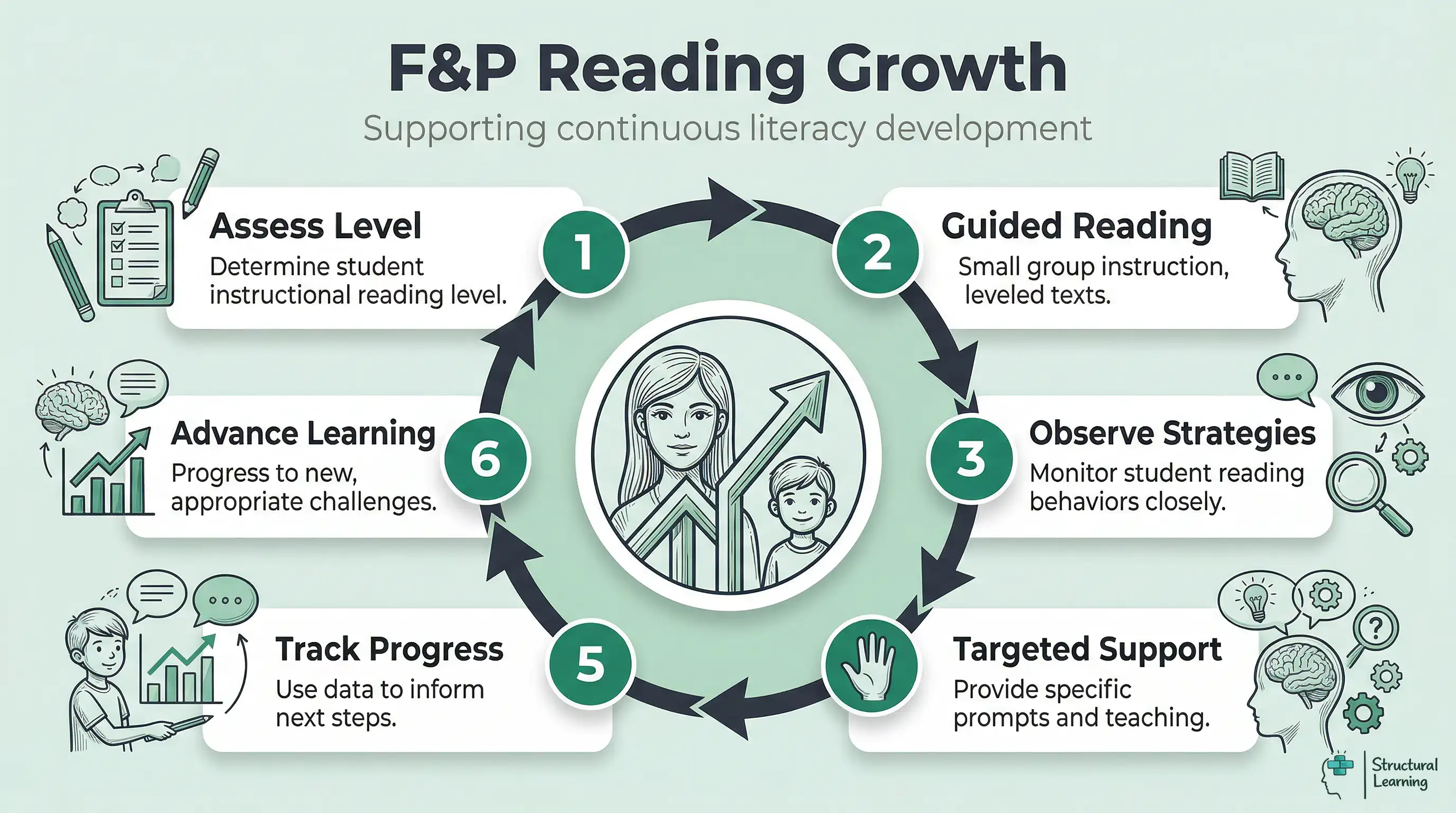
The framework also provides teachers with specific teaching behaviours and prompts for each level, helping educators support students effectively during guided reading sessions. These instructional strategies focus on developing reading behaviours such as monitoring for meaning, cross-checking information, and using multiple cueing systems. Teachers learn to observe and respond to student reading behaviours, providing targeted support that matches each child's instructional level and developmental needs.

What are the Benefits of the Fountas and Pinnell Approach?

The Fountas & Pinnell system is a comprehensive approach to reading instruction that includes assessment, levelled books, and small-group instruction. This system has been effective in increasing reading achievement for students of all abilities. The benefits of using the Fountas & Pinnell system include:

1. Increased reading achievement for all students
2. Systematic and explicit instruction in all aspects of reading
3. Differentiated instruction based on each student's needs
4. A wide variety of levelled books to meet the needs of all learners
5. Powerful daily teaching tools to help teachers plan and assess student progress

The approach promotes student agency by encouraging readers to develop self-monitoring strategies and metacognitive awareness. When students work within their instructional level, they experience success whilst being appropriately challenged, building both competence and confidence as readers.

Additionally, the systematic nature of Fountas and Pinnell supports consistent instruction across year groups and schools. Teachers can easily track student progress and communicate effectively with colleagues about individual reading development. The detailed assessment tools provide concrete data that inform instructional decisions, moving beyond subjective judgements to evidence-based teaching practices.

For teachers, this framework significantly reduces planning time by providing clear guidance on text selection and instructional focus. Rather than guessing which books suit individual learners, educators can confidently match texts to reading levels, ensuring optimal learning conditions. The structured observation notes help identify specific reading behaviours and inform targeted interventions, making guided reading sessions more purposeful and effective.

From a psychological perspective, students benefit enormously from experiencing manageable challenges within their zone of proximal development. This careful calibration prevents the frustration that comes with texts that are too difficult whilst avoiding the boredom of overly simple materials. Students develop resilience and positive attitudes towards reading, seeing themselves as successful readers who can tackle increasingly complex texts with appropriate support.

Using the Fountas & Pinnell Literacy Continuum for Assessment

The Fountas & Pinnell Literacy Continuum is a comprehensive assessment tool that provides educators with a way to measure student progress and plan specific lessons based on individual needs. The Continuum spans from prekindergarten through grade level eight, and across eight different literacy strands, making it an invaluable resource for any teacher. With its clear learning goals and easy-to-use format, the Literacy Continuum is an essential tool for any educator who wants to ensure that all students have the opportunity to reach their full potential through inclusive practices.

When conducting these assessments, teachers should focus on three key areas: accuracy rates, self-correction behaviours, and comprehension responses. An accuracy rate of 95-100% indicates the text is at the student's independent level, whilst 90-94% suggests an appropriate instructional level for guided reading sessions. Below 90% accuracy typically means the text is too challenging and may frustrate rather than support literacy development.

The assessment timeline should align with your school's reporting periods, with formal running records conducted at the beginning, middle, and end of each term. However, ongoing observational notes during guided reading sessions provide equally valuable data about student progress. Teachers should document specific reading behaviours such as how students approach unfamiliar vocabulary, their use of text features, and the sophistication of their comprehension responses.

To maximise the effectiveness of these assessment tools, maintain detailed records that track not just reading levels but also the strategies students employ. This comprehensive approach ensures that literacy development is measured completely, supporting teachers in making informed decisions about instruction and identifying students who may need additional intervention or extension opportunities.

Explore Fountas & Pinnell Literacy Resources for Your Classroom

Fountas & Pinnell Literacy Resources are tools, materials, and professional development resources that support the Fountas & Pinnell Literacy Framework. These resources include books, digital products, and online services that help educators plan and deliver effective instruction. The Fountas & Pinnell Online Resources site is a repository of resources that support the various products in the Fountas & Pinnell Literacy Framework and can be integrated into broader curriculum planning.

Using Fountas and Pinnell Reading Assessments Effectively

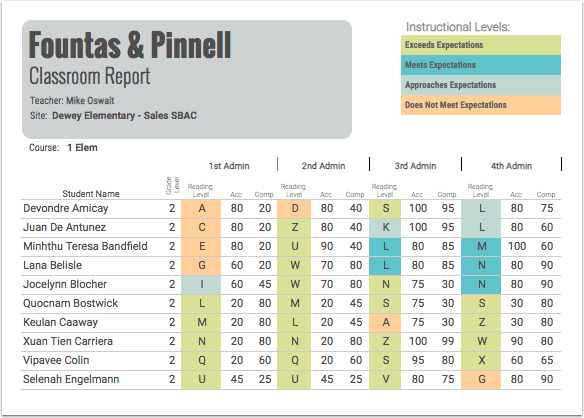
The Fountas and Pinnell Reading Diagnostic System provides teachers with precise tools and materials to help them identify students' strengths and weaknesses in reading comprehension. The systems are accurate and reliable and have been validated through research. They are also easy to use, with explicit instructions and well-designed student forms.

Fountas and Pinnell classroom report

Fountas & Pinnell Classroom Resources for Literacy Learning

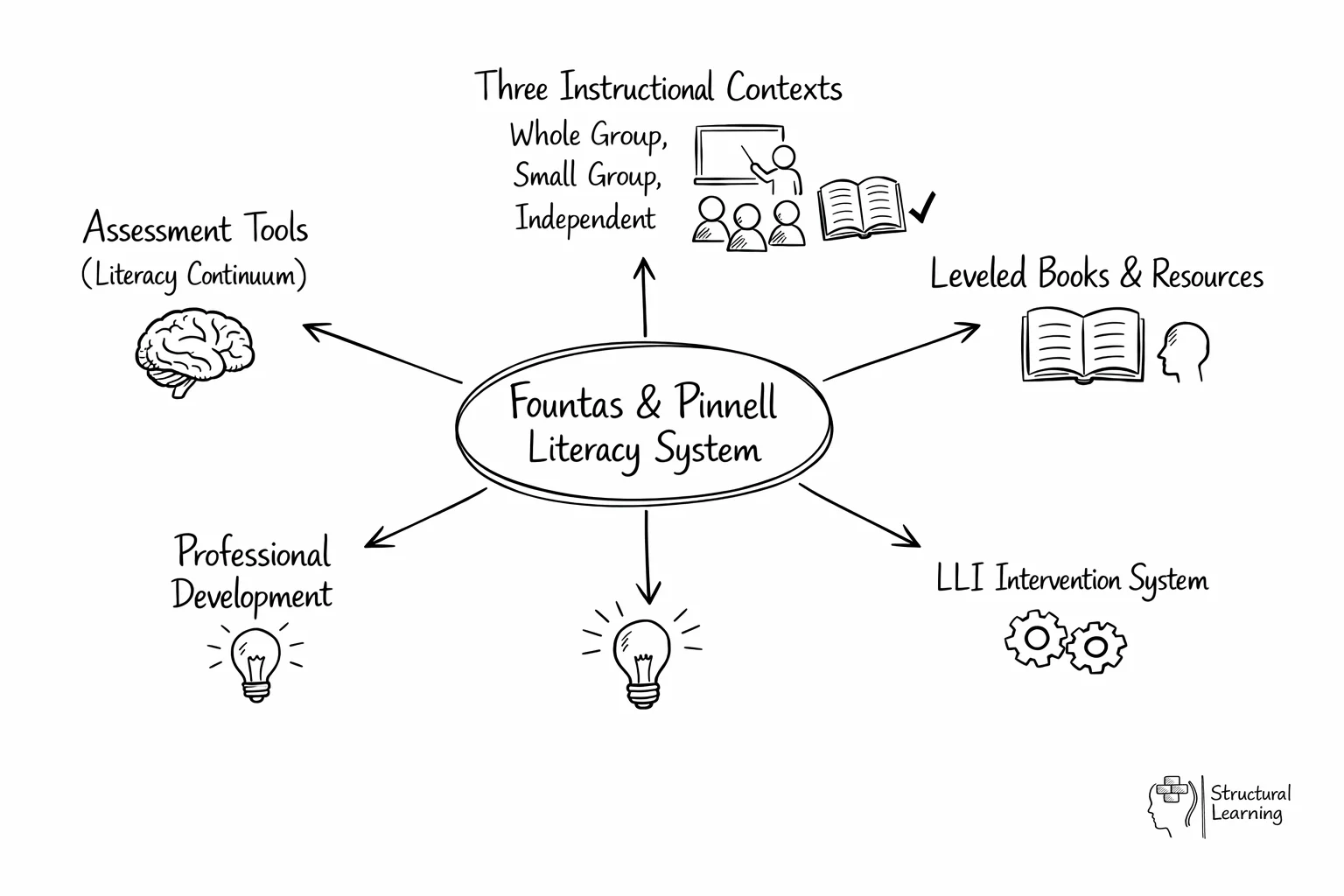
The System is designed around three instructional contexts, Whole Group, Small Group, and Independent Learning, and provides educators with powerful, comprehensive resources for a systematic approach to literacy learning. Fountas & Pinnell Classroom™ is rich with authentic texts, lessons or conferring cards, minilessons and professional tools & learning opportunities that support educators as they meet students where they are and lead them forward with intention and expertise. This approach naturally incorporates scaffolding techniques to support learners at different levels.

Hub diagram showing Fountas & Pinnell system with five connected components radiating from center
Hub-and-spoke diagram: Fountas and Pinnell Literacy System Components

Implementing Fountas and Pinnell Intervention Strategies

The Fountas and Pinnell LLI is an intensive, small-group, supplemental literacy program for students who find reading or writing difficult. The program is based upon the idea that all children can learn reading if they receive the proper training and is particularly effective for students with sen.

LLI is an effective, short-term intervention for students who need extra help with reading comprehension. It supplements regular classroom teaching and maintains high levels of engagement through its structured approach. The program includes a wide variety of leveled books, as well as a comprehensive system of professional development and support materials that address essential skills like phonics and fluency.

The LLI program has been extensively researched and has proven to be effective in helping struggling readers catch up to their peers. If you have a child who is struggling with reading, the Fountas & Pinnell Leveled Literacy Intervention System may be just what they need to get back on track. The program also supports broader sel development as students build confidence in their reading abilities.

Discover Fountas & Pinnell Professional Books for Educators

Fountas & Pinnell Professional Books are dedicated to providing educators with the resources they need to support student success. The company offers a variety of books and other materials on topics such as guided reading, assessment, and intervention. Their products help teachers effectively plan and implement instruction that meets the needs of all learners and can complement other approaches like integrating writing instruction. Besides their professional books, Fountas & Pinnell also offers several online resources, including webinars and research studies.

site-files.com/5b69a01ba2e409501de055d1/64974e1956e30c491f1c6571_fountas%2520pinnell%2520books.jpg" loading="lazy" alt="Selection of Fountas & Pinnell Professional Books" id="" width="auto" height="auto">
Selection of Fountas & Pinnell Professional Books

How do Fountas and Pinnell Align with Current Research?

The Fountas and Pinnell system aligns with current research in several key ways. Firstly, its emphasis on phonemic awareness and phonics instruction is supported by extensive research demonstrating the importance of these skills for early reading development. Secondly, the system's focus on providing students with access to a wide range of levelled texts aligns with research showing that students make the most progress when they are reading books at their instructional level. Thirdly, the system's emphasis on small-group instruction is supported by research indicating that this approach can be particularly effective for struggling readers, allowing for targeted and individualised support.

How Can Teachers Implement Guided Reading Groups Using Fountas and Pinnell?

Implementing guided reading groups effectively requires careful planning and systematic organisation that goes beyond simply gathering students around a table with levelled books. The Fountas and Pinnell framework provides teachers with a structured approach to small-group instruction that maximises learning time whilst addressing individual student needs. Teachers begin by conducting running records and using the Benchmark Assessment System to form flexible groups of four to six students who demonstrate similar reading behaviours and instructional needs. These groups meet with the teacher for 15-20 minutes daily, allowing for focused instruction that targets specific skills within each student's zone of proximal development.

During a typical guided reading session, teachers follow a predictable structure that scaffolds student learning whilst promoting independence. The lesson begins with a brief book introduction where teachers activate prior knowledge, introduce key vocabulary, and set a purpose for reading. Students then read the text independently at a whisper voice whilst the teacher circulates, taking anecdotal notes and providing individual support through prompting and reinforcing effective reading strategies. For example, when working with a Year 2 group reading at Level J, a teacher might prompt a student who pauses at an unfamiliar word by saying, "Look at the parts you know" or "Think about what would make sense and sound right." Following the reading, the group engages in a focused discussion about the text, with the teacher guiding students to deeper comprehension through thoughtful questioning and encouraging text evidence to support their thinking.

Research by Clay (2001) and subsequent studies by Berne and Degener (2012) demonstrate that guided reading groups significantly improve reading achievement when implemented with fidelity to the model. The key to success lies in the teacher's ability to provide differentiated instruction that challenges students at their instructional level whilst offering appropriate support. Teachers must also maintain detailed records of student progress, using tools such as the Literacy Continuum to track growth across multiple dimensions of reading development. Studies by Denton et al. (2014) found that students who participated in daily guided reading groups showed greater gains in reading fluency and comprehension compared to those receiving whole-class instruction alone, with effect sizes ranging from 0.3 to 0.5 standard deviations.

Practical implementation requires teachers to establish clear classroom routines that allow for uninterrupted small-group time whilst other students engage in meaningful independent literacy activities. Successful teachers create literacy workstations or centres where students practise skills independently through activities such as partner reading, word work, writing responses, and listening to recorded texts. The management system must be explicitly taught and practised until students can work autonomously for 60-90 minutes, allowing the teacher to meet with three to four guided reading groups per day. Teachers should also schedule regular assessment windows every 4-6 weeks to regroup students based on their changing needs, ensuring that instruction remains responsive and targeted. By maintaining this systematic approach, teachers can effectively implement the Fountas and Pinnell guided reading framework to accelerate literacy learning for all students in their classroom.

Overcoming Common Fountas and Pinnell Implementation Challenges

Implementation challenges with guided reading frameworks often stem from three core issues: insufficient time allocation, difficulty managing student behaviour during independent work, and limited access to levelled texts. Time constraints frequently force teachers to rush through assessment procedures or reduce group instruction time, ultimately compromising the quality of targeted support that makes guided reading effective.

Successful implementation requires strategic classroom organisation and clear routines. Establish independent reading centres with engaging, appropriately levelled materials to maintain student engagement whilst you work with guided groups. John Sweller's cognitive load theory demonstrates that students learn more effectively when distractions are minimised, making consistent behaviour expectations crucial. Consider training reading buddies or implementing silent signals to reduce interruptions during group instruction time.

Resource limitations can be addressed through creative text sourcing and digital platforms offering levelled reading materials. Partner with school libraries to rotate collections regularly, and utilise shared planning time with colleagues to pool resources across year groups. Remember that effective guided reading relies more on targeted instruction and appropriate text matching than expensive materials. Focus on building strong assessment practices to accurately determine instructional levels, as this foundation supports all other implementation efforts.

Differentiating Instruction Within Fountas and Pinnell Reading Levels

Whilst Fountas and Pinnell levels provide valuable structure for guided reading groups, teachers must recognise that students within the same level often demonstrate vastly different reading behaviours and learning preferences. Effective differentiation within levels requires careful observation of how individual children process text, their preferred learning modalities, and their specific areas of strength or challenge.

John Sweller's cognitive load theory demonstrates that students can become overwhelmed when processing multiple elements simultaneously. Within your Level J group, for instance, one child might excel at decoding but struggle with comprehension, whilst another may have strong inferential skills but need phonetic support. Consider providing varied text types, adjusting discussion complexity, or offering different response formats such as visual mapping versus written reflection to accommodate these diverse processing styles.

Practical classroom strategies include preparing tiered questions for the same text, offering choice in follow-up activities, and using flexible grouping within your guided reading sessions. Rotate students between different roles during discussions, provide sentence starters for reluctant speakers, and consider pairing stronger readers with those needing peer support. Remember that differentiation isn't about lowering expectations but rather providing multiple pathways for students to demonstrate their growing literacy competence at their instructional level.

Monitoring Student Progress with Fountas and Pinnell

Effective progress monitoring transforms assessment data into practical findings that drive instructional decisions and accelerate literacy development. Teachers should establish systematic observation schedules, collecting evidence during guided reading sessions through running records, comprehension conversations, and notes on reading behaviours. Clay's research emphasises the importance of frequent, brief assessments that capture students' problem-solving strategies and self-correction patterns, providing a comprehensive picture of reading development beyond simple accuracy measures.

Data collection becomes most valuable when teachers focus on observable reading behaviours that indicate strategic thinking. Document moments when students successfully decode unfamiliar words, make meaningful predictions, or demonstrate comprehension through discussion. These qualitative observations, combined with quantitative measures such as accuracy rates and self-correction ratios, create robust profiles of each learner's strengths and next learning steps.

Organise collected data using simple tracking systems that highlight progress over time rather than isolated performance snapshots. Weekly reviews of student evidence enable timely adjustments to text selection, grouping arrangements, and instructional focus. Share findings with colleagues during planning meetings and use trends to inform whole-class teaching priorities, ensuring that assessment directly supports rather than interrupts the learning process.

Conclusion

The Fountas and Pinnell Literacy System offers a robust and comprehensive framework for literacy instruction. By integrating assessment, levelled texts, and targeted small-group instruction, it helps educators to meet the diverse needs of their students and creates a lifelong love of reading. Its focus on continuous assessment and data-driven decision-making ensures that instruction remains responsive and effective.

Ultimately, the success of any literacy programme hinges on the skill and dedication of the teacher. Fountas and Pinnell provide the tools and resources, but it is the teacher who brings the system to life, creating engaging learning experiences and nurturing a classroom environment where every child feels supported and helped to reach their full potential as a reader and a learner.

To support this implementation, establish regular assessment cycles that allow you to track student progress systematically. Consider creating simple observation sheets to record reading behaviours during guided reading sessions, noting how students tackle unfamiliar vocabulary, use picture cues, and demonstrate comprehension strategies. These records become invaluable for planning future instruction and identifying students who may need additional support or challenge.

Building strong home-school partnerships also enhances the effectiveness of levelled reading programmes. Provide parents with guidance on how to support reading at home, including tips for discussing books and encouraging reading behaviours that complement classroom instruction. When families understand the instructional approach, they can better support their child's literacy development beyond school hours, creating consistency between home and classroom reading experiences that accelerates progress.

Further Reading and Professional Development Resources

  1. Fountas, I. C., & Pinnell, G. S. (2017). *Guided reading: Responsive teaching across the grades*. Heinemann.
  2. Pinnell, G. S., & Fountas, I. C. (2009). *When readers struggle: Teaching that works*. Heinemann.
  3. Fountas, I. C., & Pinnell, G. S. (2011). *The continuum of literacy learning, grades K-8: A guide to teaching*. Heinemann.
  4. Shanahan, T. (2020). *What is scientifically based research on reading instruction?* Reading Research Quarterly, 55(S1), S235-S247.
  5. Duke, N. K., & Cartwright, K. B. (2021). *The science of reading progresses: Communicating advances beyond the simple view of reading*. Reading Research Quarterly, 56(S1), S25-S34.
Loading audit...

What is the Fountas and Pinnell Literacy System?

The Fountas and Pinnell Literacy System is a comprehensive, research-based reading approach that combines assessment tools, leveled books, and small-group instruction to accelerate literacy learning. Created by Irene Fountas and Gay Su Pinnell, it provides teachers with instructional materials and professional development resources to help all students, particularly struggling readers, become confident and successful.

Fountas and Pinnell Literacy™ is a comprehensive, research-based reading approach that offers educators a powerful way to speed up all students' literacy learning. Drawing on decades of experience teaching children to read, Irene Fountas and Gay Su Pinnell created this system of instructional materials and professional development resources to ensure that all students, particularly those who are struggling, become confident, successful readers.

Key Takeaways

  1. Beyond Levelled Books: Discover how Fountas & Pinnell's assessment tools reveal hidden reading gaps that traditional methods miss, transforming your intervention strategies.
  2. The Small-Group Revolution: Master the three-context approach that accelerates literacy learning for struggling readers while keeping your whole class engaged and progressing.
  3. Catch Up Without Falling Behind: Unlock the LLI intervention system that helps struggling readers close the gap in weeks, not years, without sacrificing classroom time.
  4. Your Literacy Data Goldmine: Transform daily reading observations into actionable progress tracking that proves impact and secures support for your most vulnerable learners.

Each level within the system is carefully calibrated based on ten key text characteristics, including genre and form, text structure, content themes, language complexity, sentence structure, vocabulary, word difficulty, illustration support, book length, and layout features. For example, Level A books typically feature single words or simple sentences with high picture support, whilst Level M books introduce chapter formats with more sophisticated vocabulary and complex sentence structures. This detailed progression ensures that students encounter manageable challenges that support their reading growth without overwhelming them.

The framework also provides teachers with specific teaching behaviours and prompts for each level, helping educators support students effectively during guided reading sessions. These instructional strategies focus on developing reading behaviours such as monitoring for meaning, cross-checking information, and using multiple cueing systems. Teachers learn to observe and respond to student reading behaviours, providing targeted support that matches each child's instructional level and developmental needs.

What are the Benefits of the Fountas and Pinnell Approach?

The Fountas & Pinnell system is a comprehensive approach to reading instruction that includes assessment, levelled books, and small-group instruction. This system has been effective in increasing reading achievement for students of all abilities. The benefits of using the Fountas & Pinnell system include:

1. Increased reading achievement for all students
2. Systematic and explicit instruction in all aspects of reading
3. Differentiated instruction based on each student's needs
4. A wide variety of levelled books to meet the needs of all learners
5. Powerful daily teaching tools to help teachers plan and assess student progress

The approach promotes student agency by encouraging readers to develop self-monitoring strategies and metacognitive awareness. When students work within their instructional level, they experience success whilst being appropriately challenged, building both competence and confidence as readers.

Additionally, the systematic nature of Fountas and Pinnell supports consistent instruction across year groups and schools. Teachers can easily track student progress and communicate effectively with colleagues about individual reading development. The detailed assessment tools provide concrete data that inform instructional decisions, moving beyond subjective judgements to evidence-based teaching practices.

For teachers, this framework significantly reduces planning time by providing clear guidance on text selection and instructional focus. Rather than guessing which books suit individual learners, educators can confidently match texts to reading levels, ensuring optimal learning conditions. The structured observation notes help identify specific reading behaviours and inform targeted interventions, making guided reading sessions more purposeful and effective.

From a psychological perspective, students benefit enormously from experiencing manageable challenges within their zone of proximal development. This careful calibration prevents the frustration that comes with texts that are too difficult whilst avoiding the boredom of overly simple materials. Students develop resilience and positive attitudes towards reading, seeing themselves as successful readers who can tackle increasingly complex texts with appropriate support.

Using the Fountas & Pinnell Literacy Continuum for Assessment

The Fountas & Pinnell Literacy Continuum is a comprehensive assessment tool that provides educators with a way to measure student progress and plan specific lessons based on individual needs. The Continuum spans from prekindergarten through grade level eight, and across eight different literacy strands, making it an invaluable resource for any teacher. With its clear learning goals and easy-to-use format, the Literacy Continuum is an essential tool for any educator who wants to ensure that all students have the opportunity to reach their full potential through inclusive practices.

When conducting these assessments, teachers should focus on three key areas: accuracy rates, self-correction behaviours, and comprehension responses. An accuracy rate of 95-100% indicates the text is at the student's independent level, whilst 90-94% suggests an appropriate instructional level for guided reading sessions. Below 90% accuracy typically means the text is too challenging and may frustrate rather than support literacy development.

The assessment timeline should align with your school's reporting periods, with formal running records conducted at the beginning, middle, and end of each term. However, ongoing observational notes during guided reading sessions provide equally valuable data about student progress. Teachers should document specific reading behaviours such as how students approach unfamiliar vocabulary, their use of text features, and the sophistication of their comprehension responses.

To maximise the effectiveness of these assessment tools, maintain detailed records that track not just reading levels but also the strategies students employ. This comprehensive approach ensures that literacy development is measured completely, supporting teachers in making informed decisions about instruction and identifying students who may need additional intervention or extension opportunities.

Explore Fountas & Pinnell Literacy Resources for Your Classroom

Fountas & Pinnell Literacy Resources are tools, materials, and professional development resources that support the Fountas & Pinnell Literacy Framework. These resources include books, digital products, and online services that help educators plan and deliver effective instruction. The Fountas & Pinnell Online Resources site is a repository of resources that support the various products in the Fountas & Pinnell Literacy Framework and can be integrated into broader curriculum planning.

Using Fountas and Pinnell Reading Assessments Effectively

The Fountas and Pinnell Reading Diagnostic System provides teachers with precise tools and materials to help them identify students' strengths and weaknesses in reading comprehension. The systems are accurate and reliable and have been validated through research. They are also easy to use, with explicit instructions and well-designed student forms.

Fountas and Pinnell classroom report

Fountas & Pinnell Classroom Resources for Literacy Learning

The System is designed around three instructional contexts, Whole Group, Small Group, and Independent Learning, and provides educators with powerful, comprehensive resources for a systematic approach to literacy learning. Fountas & Pinnell Classroom™ is rich with authentic texts, lessons or conferring cards, minilessons and professional tools & learning opportunities that support educators as they meet students where they are and lead them forward with intention and expertise. This approach naturally incorporates scaffolding techniques to support learners at different levels.

Hub diagram showing Fountas & Pinnell system with five connected components radiating from center
Hub-and-spoke diagram: Fountas and Pinnell Literacy System Components

Implementing Fountas and Pinnell Intervention Strategies

The Fountas and Pinnell LLI is an intensive, small-group, supplemental literacy program for students who find reading or writing difficult. The program is based upon the idea that all children can learn reading if they receive the proper training and is particularly effective for students with sen.

LLI is an effective, short-term intervention for students who need extra help with reading comprehension. It supplements regular classroom teaching and maintains high levels of engagement through its structured approach. The program includes a wide variety of leveled books, as well as a comprehensive system of professional development and support materials that address essential skills like phonics and fluency.

The LLI program has been extensively researched and has proven to be effective in helping struggling readers catch up to their peers. If you have a child who is struggling with reading, the Fountas & Pinnell Leveled Literacy Intervention System may be just what they need to get back on track. The program also supports broader sel development as students build confidence in their reading abilities.

Discover Fountas & Pinnell Professional Books for Educators

Fountas & Pinnell Professional Books are dedicated to providing educators with the resources they need to support student success. The company offers a variety of books and other materials on topics such as guided reading, assessment, and intervention. Their products help teachers effectively plan and implement instruction that meets the needs of all learners and can complement other approaches like integrating writing instruction. Besides their professional books, Fountas & Pinnell also offers several online resources, including webinars and research studies.

site-files.com/5b69a01ba2e409501de055d1/64974e1956e30c491f1c6571_fountas%2520pinnell%2520books.jpg" loading="lazy" alt="Selection of Fountas & Pinnell Professional Books" id="" width="auto" height="auto">
Selection of Fountas & Pinnell Professional Books

How do Fountas and Pinnell Align with Current Research?

The Fountas and Pinnell system aligns with current research in several key ways. Firstly, its emphasis on phonemic awareness and phonics instruction is supported by extensive research demonstrating the importance of these skills for early reading development. Secondly, the system's focus on providing students with access to a wide range of levelled texts aligns with research showing that students make the most progress when they are reading books at their instructional level. Thirdly, the system's emphasis on small-group instruction is supported by research indicating that this approach can be particularly effective for struggling readers, allowing for targeted and individualised support.

How Can Teachers Implement Guided Reading Groups Using Fountas and Pinnell?

Implementing guided reading groups effectively requires careful planning and systematic organisation that goes beyond simply gathering students around a table with levelled books. The Fountas and Pinnell framework provides teachers with a structured approach to small-group instruction that maximises learning time whilst addressing individual student needs. Teachers begin by conducting running records and using the Benchmark Assessment System to form flexible groups of four to six students who demonstrate similar reading behaviours and instructional needs. These groups meet with the teacher for 15-20 minutes daily, allowing for focused instruction that targets specific skills within each student's zone of proximal development.

During a typical guided reading session, teachers follow a predictable structure that scaffolds student learning whilst promoting independence. The lesson begins with a brief book introduction where teachers activate prior knowledge, introduce key vocabulary, and set a purpose for reading. Students then read the text independently at a whisper voice whilst the teacher circulates, taking anecdotal notes and providing individual support through prompting and reinforcing effective reading strategies. For example, when working with a Year 2 group reading at Level J, a teacher might prompt a student who pauses at an unfamiliar word by saying, "Look at the parts you know" or "Think about what would make sense and sound right." Following the reading, the group engages in a focused discussion about the text, with the teacher guiding students to deeper comprehension through thoughtful questioning and encouraging text evidence to support their thinking.

Research by Clay (2001) and subsequent studies by Berne and Degener (2012) demonstrate that guided reading groups significantly improve reading achievement when implemented with fidelity to the model. The key to success lies in the teacher's ability to provide differentiated instruction that challenges students at their instructional level whilst offering appropriate support. Teachers must also maintain detailed records of student progress, using tools such as the Literacy Continuum to track growth across multiple dimensions of reading development. Studies by Denton et al. (2014) found that students who participated in daily guided reading groups showed greater gains in reading fluency and comprehension compared to those receiving whole-class instruction alone, with effect sizes ranging from 0.3 to 0.5 standard deviations.

Practical implementation requires teachers to establish clear classroom routines that allow for uninterrupted small-group time whilst other students engage in meaningful independent literacy activities. Successful teachers create literacy workstations or centres where students practise skills independently through activities such as partner reading, word work, writing responses, and listening to recorded texts. The management system must be explicitly taught and practised until students can work autonomously for 60-90 minutes, allowing the teacher to meet with three to four guided reading groups per day. Teachers should also schedule regular assessment windows every 4-6 weeks to regroup students based on their changing needs, ensuring that instruction remains responsive and targeted. By maintaining this systematic approach, teachers can effectively implement the Fountas and Pinnell guided reading framework to accelerate literacy learning for all students in their classroom.

Overcoming Common Fountas and Pinnell Implementation Challenges

Implementation challenges with guided reading frameworks often stem from three core issues: insufficient time allocation, difficulty managing student behaviour during independent work, and limited access to levelled texts. Time constraints frequently force teachers to rush through assessment procedures or reduce group instruction time, ultimately compromising the quality of targeted support that makes guided reading effective.

Successful implementation requires strategic classroom organisation and clear routines. Establish independent reading centres with engaging, appropriately levelled materials to maintain student engagement whilst you work with guided groups. John Sweller's cognitive load theory demonstrates that students learn more effectively when distractions are minimised, making consistent behaviour expectations crucial. Consider training reading buddies or implementing silent signals to reduce interruptions during group instruction time.

Resource limitations can be addressed through creative text sourcing and digital platforms offering levelled reading materials. Partner with school libraries to rotate collections regularly, and utilise shared planning time with colleagues to pool resources across year groups. Remember that effective guided reading relies more on targeted instruction and appropriate text matching than expensive materials. Focus on building strong assessment practices to accurately determine instructional levels, as this foundation supports all other implementation efforts.

Differentiating Instruction Within Fountas and Pinnell Reading Levels

Whilst Fountas and Pinnell levels provide valuable structure for guided reading groups, teachers must recognise that students within the same level often demonstrate vastly different reading behaviours and learning preferences. Effective differentiation within levels requires careful observation of how individual children process text, their preferred learning modalities, and their specific areas of strength or challenge.

John Sweller's cognitive load theory demonstrates that students can become overwhelmed when processing multiple elements simultaneously. Within your Level J group, for instance, one child might excel at decoding but struggle with comprehension, whilst another may have strong inferential skills but need phonetic support. Consider providing varied text types, adjusting discussion complexity, or offering different response formats such as visual mapping versus written reflection to accommodate these diverse processing styles.

Practical classroom strategies include preparing tiered questions for the same text, offering choice in follow-up activities, and using flexible grouping within your guided reading sessions. Rotate students between different roles during discussions, provide sentence starters for reluctant speakers, and consider pairing stronger readers with those needing peer support. Remember that differentiation isn't about lowering expectations but rather providing multiple pathways for students to demonstrate their growing literacy competence at their instructional level.

Monitoring Student Progress with Fountas and Pinnell

Effective progress monitoring transforms assessment data into practical findings that drive instructional decisions and accelerate literacy development. Teachers should establish systematic observation schedules, collecting evidence during guided reading sessions through running records, comprehension conversations, and notes on reading behaviours. Clay's research emphasises the importance of frequent, brief assessments that capture students' problem-solving strategies and self-correction patterns, providing a comprehensive picture of reading development beyond simple accuracy measures.

Data collection becomes most valuable when teachers focus on observable reading behaviours that indicate strategic thinking. Document moments when students successfully decode unfamiliar words, make meaningful predictions, or demonstrate comprehension through discussion. These qualitative observations, combined with quantitative measures such as accuracy rates and self-correction ratios, create robust profiles of each learner's strengths and next learning steps.

Organise collected data using simple tracking systems that highlight progress over time rather than isolated performance snapshots. Weekly reviews of student evidence enable timely adjustments to text selection, grouping arrangements, and instructional focus. Share findings with colleagues during planning meetings and use trends to inform whole-class teaching priorities, ensuring that assessment directly supports rather than interrupts the learning process.

Conclusion

The Fountas and Pinnell Literacy System offers a robust and comprehensive framework for literacy instruction. By integrating assessment, levelled texts, and targeted small-group instruction, it helps educators to meet the diverse needs of their students and creates a lifelong love of reading. Its focus on continuous assessment and data-driven decision-making ensures that instruction remains responsive and effective.

Ultimately, the success of any literacy programme hinges on the skill and dedication of the teacher. Fountas and Pinnell provide the tools and resources, but it is the teacher who brings the system to life, creating engaging learning experiences and nurturing a classroom environment where every child feels supported and helped to reach their full potential as a reader and a learner.

To support this implementation, establish regular assessment cycles that allow you to track student progress systematically. Consider creating simple observation sheets to record reading behaviours during guided reading sessions, noting how students tackle unfamiliar vocabulary, use picture cues, and demonstrate comprehension strategies. These records become invaluable for planning future instruction and identifying students who may need additional support or challenge.

Building strong home-school partnerships also enhances the effectiveness of levelled reading programmes. Provide parents with guidance on how to support reading at home, including tips for discussing books and encouraging reading behaviours that complement classroom instruction. When families understand the instructional approach, they can better support their child's literacy development beyond school hours, creating consistency between home and classroom reading experiences that accelerates progress.

Further Reading and Professional Development Resources

  1. Fountas, I. C., & Pinnell, G. S. (2017). *Guided reading: Responsive teaching across the grades*. Heinemann.
  2. Pinnell, G. S., & Fountas, I. C. (2009). *When readers struggle: Teaching that works*. Heinemann.
  3. Fountas, I. C., & Pinnell, G. S. (2011). *The continuum of literacy learning, grades K-8: A guide to teaching*. Heinemann.
  4. Shanahan, T. (2020). *What is scientifically based research on reading instruction?* Reading Research Quarterly, 55(S1), S235-S247.
  5. Duke, N. K., & Cartwright, K. B. (2021). *The science of reading progresses: Communicating advances beyond the simple view of reading*. Reading Research Quarterly, 56(S1), S25-S34.

Learning Tools

Back to Blog

{"@context":"https://schema.org","@graph":[{"@type":"Article","@id":"https://www.structural-learning.com/post/fountas-and-pinnell#article","headline":"Fountas and Pinnell: A Teacher's Guide","description":"Explore effective strategies for enhancing literacy with Fountas and Pinnell's approach, as teachers share their success stories and tips.","datePublished":"2022-12-07T15:27:45.825Z","dateModified":"2026-01-26T10:09:32.212Z","author":{"@type":"Person","name":"Paul Main","url":"https://www.structural-learning.com/team/paulmain","jobTitle":"Founder & Educational Consultant"},"publisher":{"@type":"Organization","name":"Structural Learning","url":"https://www.structural-learning.com","logo":{"@type":"ImageObject","url":"https://cdn.prod.website-files.com/5b69a01ba2e409e5d5e055c6/6040bf0426cb415ba2fc7882_newlogoblue.svg"}},"mainEntityOfPage":{"@type":"WebPage","@id":"https://www.structural-learning.com/post/fountas-and-pinnell"},"image":"https://cdn.prod.website-files.com/5b69a01ba2e409501de055d1/6876378207405e5543aedef5_6390af71c2a60712ae2645e9_Fountas%2520and%2520Pinnell%2520classroom%2520report.png","wordCount":1802},{"@type":"BreadcrumbList","@id":"https://www.structural-learning.com/post/fountas-and-pinnell#breadcrumb","itemListElement":[{"@type":"ListItem","position":1,"name":"Home","item":"https://www.structural-learning.com/"},{"@type":"ListItem","position":2,"name":"Blog","item":"https://www.structural-learning.com/blog"},{"@type":"ListItem","position":3,"name":"Fountas and Pinnell: A Teacher's Guide","item":"https://www.structural-learning.com/post/fountas-and-pinnell"}]},{"@type":"FAQPage","@id":"https://www.structural-learning.com/post/fountas-and-pinnell#faq","mainEntity":[{"@type":"Question","name":"Does the Fountas and Pinnell system teach phonics skills?","acceptedAnswer":{"@type":"Answer","text":"The Fountas & Pinnell system is a comprehensive approach to teaching phonics, spelling and word study. The system helps students attend to, learn about, and efficiently use information about sounds, letters and words. Phonemic awareness instruction is given in a sequential manner, starting at th"}},{"@type":"Question","name":"What are the target grades for Fountas and Pinnell?","acceptedAnswer":{"@type":"Answer","text":"Fountas & Pinnel's comprehensive literary work includes:"}},{"@type":"Question","name":"How does Fountas and Pinnell relate to guided reading?","acceptedAnswer":{"@type":"Answer","text":"Fountas and Pinnell is a reading instruction method that is similar to guided reading. In both methods, teachers work with small groups of students who are at similar reading levels. The teacher uses leveled books to help teach new concepts and skills. Students in both methods also practice reading "}},{"@type":"Question","name":"Is Fountas and Pinnell a formal reading assessment tool?","acceptedAnswer":{"@type":"Answer","text":"Fountas and Pinnell is a formal assessment used to determine reading level. It is given to students in grades K-8."}},{"@type":"Question","name":"Does Fountas & Pinnell include a writing curriculum?","acceptedAnswer":{"@type":"Answer","text":"Fountas & Pinnell has a writing curriculum available for educators to use in the classroom. This curriculum helps students of all abilities improve their"}}]}]}