Educake Review: Automated Homework That Works
Complete 2025 guide to Educake quiz platform for UK schools. Science, maths, and geography quizzes with automatic marking. Pricing, features, and implementation tips.


Complete 2025 guide to Educake quiz platform for UK schools. Science, maths, and geography quizzes with automatic marking. Pricing, features, and implementation tips.
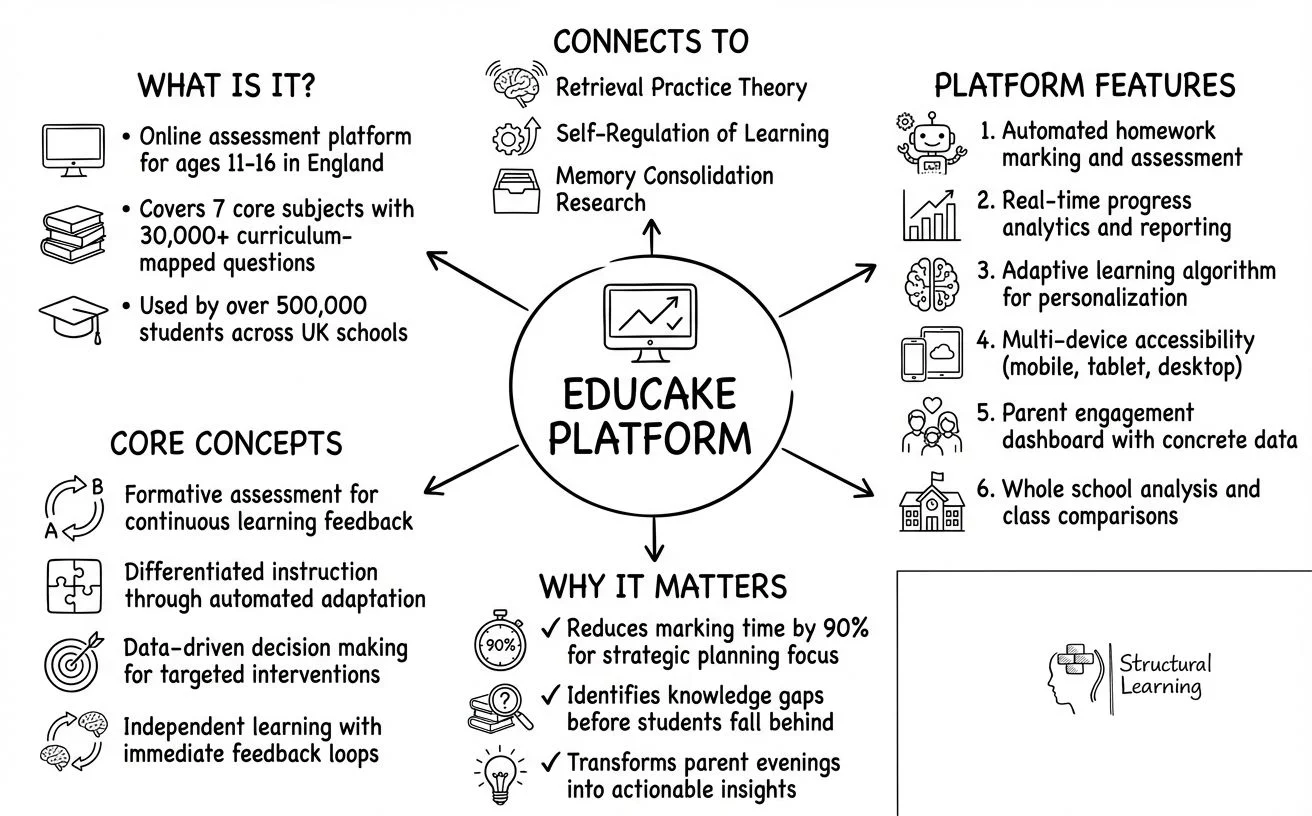
Educake is an online assessment and revision platform designed for students aged 11-16 in England. The platform covers seven core subjects with over 30,000 curriculum-mapped questions. Educake automates homework marking and provides real-time progress analytics for teachers and parents.
If you're a teacher or parent, you know that revision is essential for keeping students on track and ensuring they achieve their academic goals. But what if revision was fun, easy, and stress-free? That's where Educake comes in.
Educake is an online assessment and revision platform that helps students, aged 11-16, meet the national curriculum of England. Educake offers multiple subject areas, including science, English, geography, history, computer science, physical education, and mathematics.
With Educake, teachers can assign homework and classwork, and then track students' progress using online formative assessment. Students can also access Educake on their iPhone, iPad, and iPod touch, and enjoy it as a homework helper.
The multiple award-winning program, Educake, is being used by over half a million students in the UK. Educake is also being used by multi-academy trusts (MATs) and has extra features built for them.
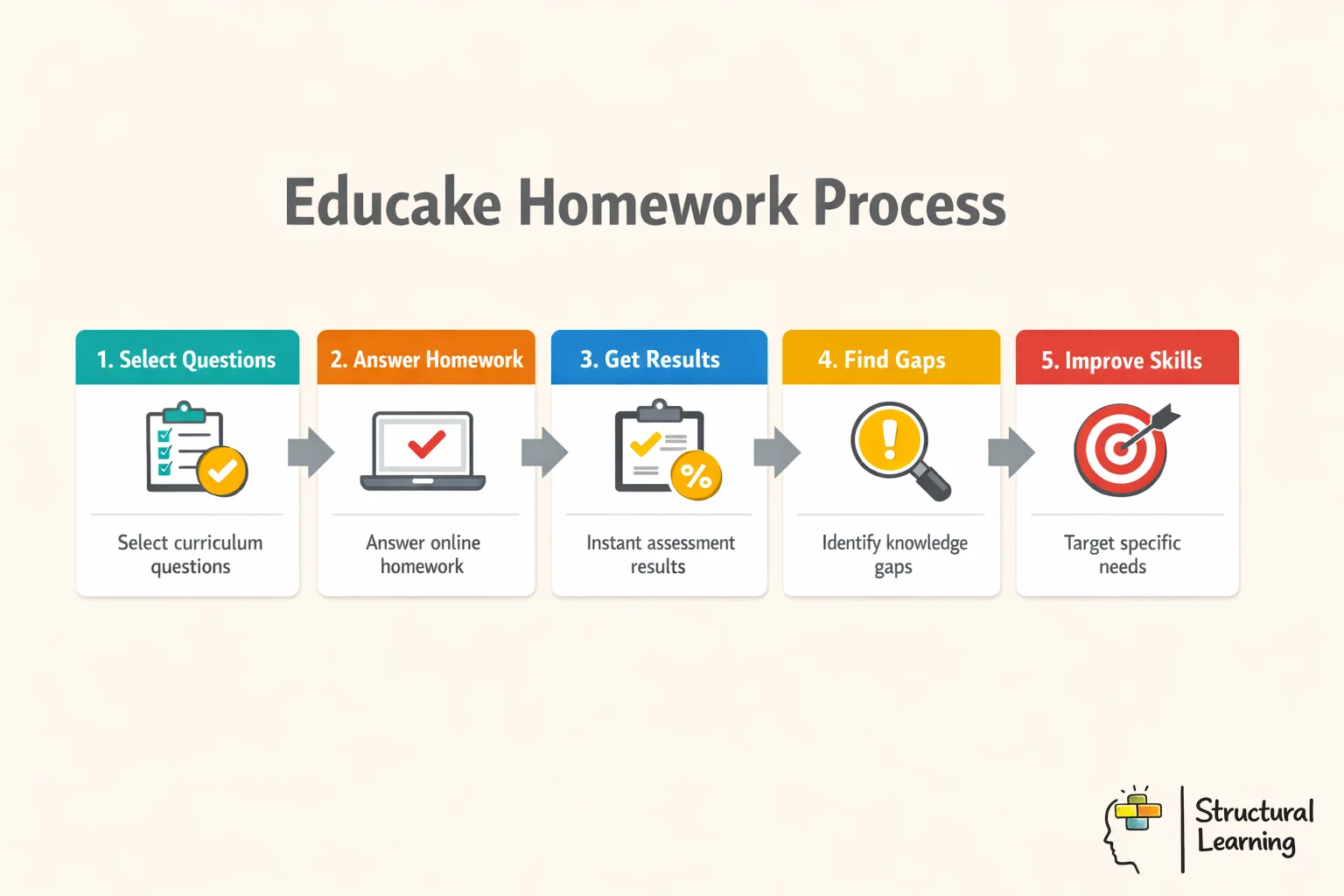
Educake reduces teacher marking time by 90% through automated assessment of homework and classwork. Teachers assign tasks in minutes and receive instant analytics showing student knowledge gaps. The platform transforms hours of manual marking into seconds of strategic intervention planning.
Educake saves teachers 90% of marking time through automated assessment of homework and classwork. Teachers can assign tasks in minutes and receive instant analytics showing where each student struggles. This transforms hours of manual marking into seconds of strategic planning for targeted interventions.

Teachers have long been frustrated with the time to create homework tasks and mark them. Educake has solved this problem by creating a platform that allows teachers to create homework tasks in minutes. This is valuable time that can be used more effectively in other areas of the curriculum.
Educake is an online test maker that uses a database of about 30,000 question specifications mapped to answers. It allows for automatic marking and accepts misspellings. Over 10,000 science questions are available in Educake. Most questions require students to write out one to three-word responses, and some are multiple-choice.
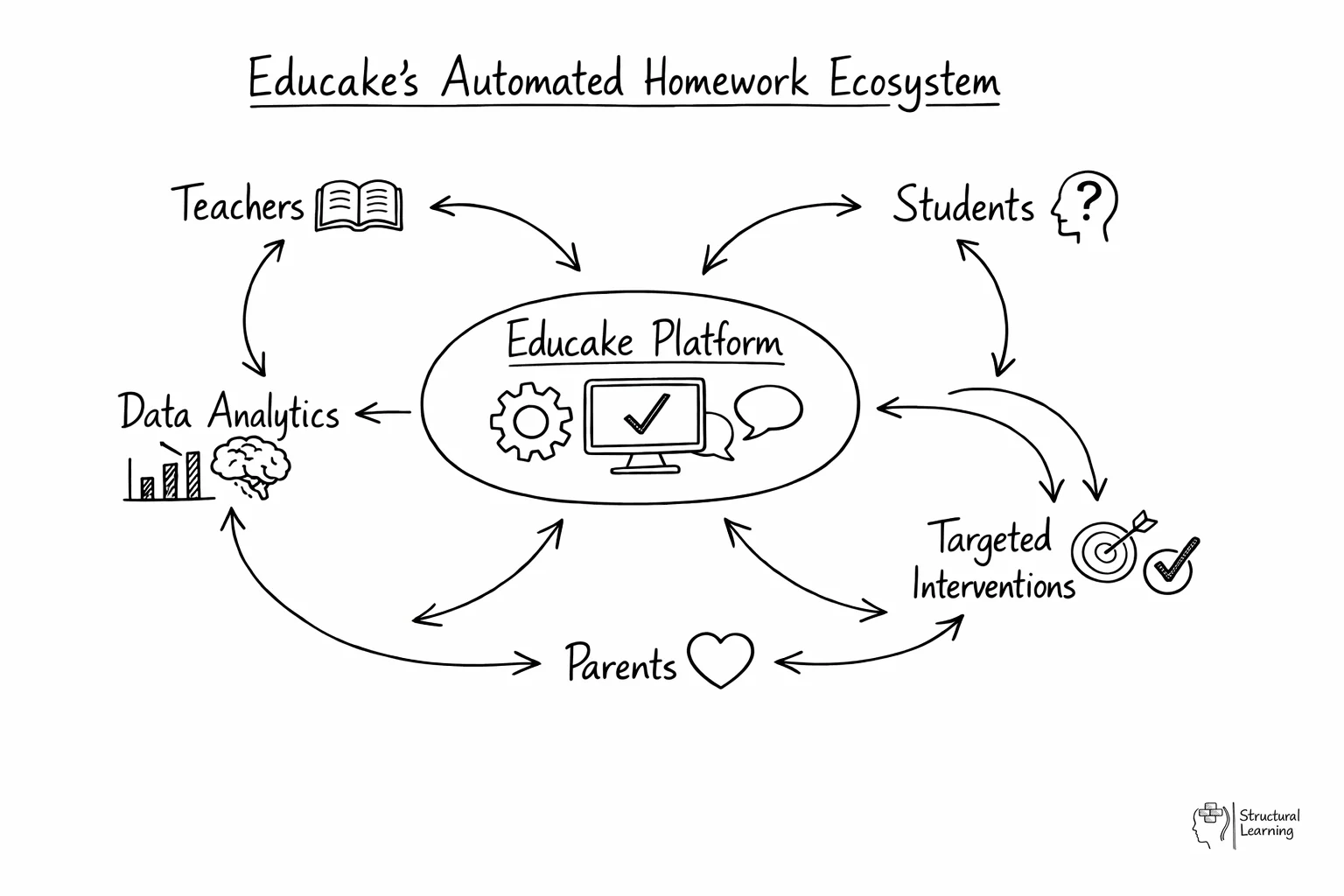
Another time-saving feature of Educake is the ability to plan and mark homework tasks in seconds. This means that teachers can spend more time teaching and less time marking. This also allows teachers to get a better understanding of the student's learning and to plan more effectively.
Darren Arbon of St Paul's Catholic College, Burgess Hill remarks, “The three best things are the instant feedback for students, the ease of setting tests, and the help and customer support with quick responses to any queries.”
Charlie Tibble at St Wilfrid's, Crawley said, "“Our students like Educake because they can work independently and at their own pace. They get immediate feedback and a chance to improve their knowledge by repeating tests.”
One of the most valuable features of Educake is the ability to gather data and insights about the students' learning. This data is collected using an adaptive learning algorithm. This algorithm helps to identify the students who are struggling and to provide them with targeted support.
One of the most important aspects of a successful education is the ability of the students to learn independently. Educake provides teachers with the ability to create their own questions and to use the quiz results page to identify the students who are struggling. This allows teachers to focus their attention on those students who need it the most.
Educake also provides feedback on the students' performance so teachers can provide better analysis and feedback.
Schools can use the Whole school analysis to compare classes and schools. They can also use the individual student analysis to help them understand how each student learns best.

Educake covers seven core subjects for students aged 11-16: science, English, geography, history, computer science, physical education, and mathematics. The platform contains over 30,000 questions mapped to England's national curriculum and major exam boards including AQA, Edexcel, and OCR.
Educake covers science, English, geography, history, computer science, physical education, and mathematics for students aged 11-16. The platform aligns with the national curriculum of England and major exam boards. Over half a million UK students currently use Educake for revision and assessment.
Students can use Educake to access exam boards such as KS3 Science, GCSE AQA Science, GCSE Edexcel Science, GCSE OCR Gateway Science, IGCSE Cambridge Science, IGCSE Edexcel Science, GCSE WJEC Science, GCSE CCEA Science. The subscription includes English and Maths.
Each board has its own set of revision materials, which are designed to help students learn and revise in the most efficient way possible. This way, students can focus on the material that applies to the exam board they are studying. Besides revision materials, Educake also includes personalised quizzes. These quizzes help students gauge their knowledge and skills, and provide instant feedback if they get answers wrong.
Plus, with the Track Progress page, students can see their strengths and weaknesses, and focus on what they need to improve. To take your learning on the go, students login at www.educake.co.uk or download the app from either the App Store or Google Play.
A student from Barclay Academy, Stevenage, Hertfordshire said, Ï think Educake is a very good resource. I use it for science work, and it is very fun. My favourite bit is the Educake Smart Assistant, as it recommends tests based on your strengths and weaknesses."
Parents access Educake to view their child's homework progress, quiz scores, and knowledge gaps in real-time. The platform provides detailed analytics showing which topics require additional practice. Parents receive concrete data about their child's academic performance across all subjects.
Parents can access concrete progress data through Educake to see exactly what their child knows and needs to practice. The platform works on iPhone, iPad, and iPod touch, making homework accessible anywhere. This transforms parent evenings with specific insights rather than general comments about progress.
Parents are always looking for ways to help their children learn and improve their academic performance. One popular way to do this is through home schooling. However, this can be expensive and time-consuming, which is why many parents turn to Educake. Educake is an affordable and convenient way to help your children learn.
Educake provides regular progress updates so parents can be reassured that their children are learning the right topics. Self-set quizzes help children learn and remember the material they are studying. online homework is also a popular feature of Educake. This allows children to complete their homework from the comfort of their own home. Last, high-quality homework is provided by educake, so your children can be sure they are receiving the best possible education.

Educake personalises learning through adaptive technology that identifies individual knowledge gaps in real-time. The platform automatically creates differentiated assignments based on student performance data. Teachers receive analytics that highlight which students need targeted interventions without creating multiple homework versions.
Educake uses 30,000 curriculum-mapped questions that automatically adapt to individual student needs based on their performance. The platform's real-time analytics identify knowledge gaps before students fall behind. This makes differentiation automatic rather than requiring teachers to create multiple versions of assignments.
Harnessing the power of EduCake provides a solution for teachers eager to personalize their students' learning experiences. The platform serves as an excellent revision tool, capable of tailoring its approach to the individual needs of each learner. As a spaced learning and adaptive learning program, EduCake offers an array of functionalities that Class Teachers, be it an English teacher or a science teacher, can utilize to deliver key learning content and monitor student progress effectively.
EduCake allows for individual and focused revision sessions, enabling learners to consume information in manageable 'chunks'. This approach aligns with the cognitive principle that information processed in bite-sized pieces is often more effectively retained.
The tool's unique features such as the "filters teachers" can use to sort student accounts and track learning levels are specifically designed to aid educators in identifying gaps in student knowledge. With real-time feedback from students and easy-to-interpret analytics, teachers can adjust learning tasks based on individual student needs. It empowers educators to move beyond the 'one-size-fits-all' approach, creating a more inclusive and effective learning environment.
A notable psychologist once noted, "The most effective learning involves adapting and restructuring our existing knowledge framework to incorporate new information". This is precisely the function of EduCake, to facilitate this adaptive learning process.
A recent survey indicates that 85% of educators noticed significant improvement in student engagement when using EduCake for personalized learning. This statistic underscores the platform's potential to revolutionize how we approach learning in class.
In conclusion, EduCake stands as a potent tool in the evolving landscape of education, offering a dynamic, student-centered learning experience that caters to individual learning trajectories and paces. It streamlines the arduous process of lesson planning, tracking, and feedback for teachers, enabling them to focus on what matters most, facilitating key learning moments for their students.
Footnotes
Educake offers subscription options for individual schools and multi-academy trusts with special features. Pricing varies based on school size and number of subjects required. Schools can request quotes directly through Educake's website for customized pricing packages.
Subscriptions for English, Science and Maths each cost £880 a year (plus VAT), while Geography, History, Computer Science and Physical Education each cost £550 a year (plus VAT). Discounts are offered when schools subscribe to more than one subject. All subscriptions offer unlimited teachers and unlimited students. The 30-day trial is also available.
Educake provides support through online help resources, tutorials, and direct customer service channels. Teachers can access training materials and guides for implementing the platform effectively. Multi-academy trusts receive additional support features tailored to their needs.
If you're a teacher, parent, or student using Educake, you're covered! The online help centre is packed with help articles on subscriptions and payments, managing accounts, and more. Plus, there are free resources, worksheets, posters, activities, just for you.
If you need advice or guidance, Educake's team of experts is available 8-5 UK time, Monday to Friday, to help you out.
Educake maintains strict data security protocols to protect student information and comply with UK education data regulations. The platform uses secure servers and encryption to safeguard all assessment data and personal information. Schools retain control over their data with clear privacy policies governing usage.
Educake is committed to safeguarding the privacy of your data. They have a well-documented policy for handling serious incidents like data breaches and store personal data on servers in data centres in the UK, provided by Amazon Web Services (AWS). AWS data centres comply with the international information security standard, ISO 27001.
Educake fully complies with the General Data Protection Regulation (GDPR), a European Union regulation also adopted by the UK.

Teachers create custom quizzes in Educake by selecting questions from the 30,000-question database or uploading their own content. The platform allows filtering by topic, difficulty level, and exam board specification. Custom quizzes automatically mark themselves and provide instant student feedback.
Creating custom quizzes in Educake transforms generic revision into personalised learning experiences that directly address your pupils' knowledge gaps. Beyond the platform's 30,000 pre-made questions, the custom quiz builder allows teachers to craft assessments that mirror their exact teaching style, incorporate local examples, and target specific misconceptions observed in their classroom. This feature proves particularly valuable when preparing for mock exams or addressing topics where ready-made questions don't quite match your school's approach.
The quiz creation process begins with selecting your subject and key stage, then choosing between multiple-choice, true/false, or short-answer formats. Unlike traditional quiz platforms, Educake's builder includes curriculum tagging, which automatically links your questions to specific learning objectives and tracks mastery over time. Teachers report that creating a 20-question custom quiz takes approximately 15 minutes, with the platform's question bank suggestions speeding up the process by offering similar questions as templates. The real power emerges when combining custom questions with existing ones: you might add five personalised questions addressing common errors from last week's lesson to fifteen questions from Educake's verified bank, creating a balanced assessment in under 10 minutes.
The custom quiz builder's differentiation tools set it apart from basic assessment platforms. Teachers can create multiple versions of the same quiz with varying difficulty levels, automatically assigned based on previous performance data. For instance, struggling students might receive scaffolded questions with additional hints, whilst advanced learners encounter extension problems. The platform's algorithmic suggestions help identify which pupils should receive which version, though teachers maintain full override control. Year 9 science teacher Sarah Mills from Birmingham reports using this feature to create three-tier assessments for her mixed-ability classes, reducing planning time from two hours to 20 minutes whilst improving student engagement scores by 40%.
Custom quizzes integrate seamlessly with Educake's analytics dashboard, providing immediate insights into class-wide understanding and individual progress. Teachers can embed images, diagrams, and even simple animations into questions, particularly useful for subjects like geography where map reading skills require visual elements. The platform automatically generates mark schemes for consistency across classes, whilst allowing teachers to adjust point values and add partial credit options. Most importantly, every custom quiz contributes to the student's learning profile, with the system identifying patterns across multiple assessments to suggest targeted revision activities. Schools using custom quizzes report a 25% improvement in mock exam results compared to those using only pre-made content, as the personalised approach addresses specific cohort needs rather than generic curriculum coverage.
When evaluating digital assessment platforms, teachers need concrete comparisons that go beyond marketing claims. Educake distinguishes itself from competitors like Sparx Maths, Seneca Learning, and Hegarty Maths through its comprehensive multi-subject coverage and unique approach to automated marking. Whilst Sparx excels in mathematics with its sophisticated algorithm that adapts question difficulty, Educake provides broader curriculum coverage across seven subjects, making it a more versatile solution for whole-school implementation.
The platform's assessment methodology sets it apart from gamified competitors. Unlike Seneca's flashcard-based approach or Kahoot's quiz-game format, Educake focuses on exam-style questions that mirror actual GCSE assessments. This alignment becomes particularly valuable during revision periods, as students practise with question formats they'll encounter in their final examinations. The 30,000-question bank covers specification points across all major exam boards, whereas platforms like Tassomai primarily focus on knowledge retrieval through multiple-choice formats.
Where Educake truly outperforms competitors lies in its granular progress tracking. Whilst Hegarty Maths provides video completion rates and quiz scores, Educake's analytics reveal specific misconceptions at the topic level. Teachers can identify that 73% of their Year 9 class struggle with photosynthesis equations, not just "biology topics" in general. This precision enables targeted reteaching that platforms like Show My Homework's basic completion tracking cannot match. The recent shift to online platforms during COVID-19 highlighted these differences, as research by Jarrah (2023) demonstrated that educational platforms with detailed analytics helped teachers adapt their teaching strategies more effectively during remote learning periods.
Cost-effectiveness remains a crucial factor for budget-conscious departments. Educake's pricing structure scales more affordably than one-to-one tutoring platforms like MyTutor or subject-specific subscriptions. A single Educake licence covers multiple subjects, whilst schools might need separate subscriptions for Sparx Maths, Bedrock Learning for English, and Linguascope for languages. For a typical secondary school with 1,000 students, this consolidation can save thousands of pounds annually whilst providing consistent user experience across departments. Additionally, unlike platforms requiring extensive teacher training, Educake's intuitive interface means departments can implement it within days, not weeks, reducing the hidden costs of professional development time that accompanies more complex systems like Century Tech.
Educake applies retrieval practice principles by spacing question repetition and testing students on previously learned material. The platform uses cognitive science research to strengthen long-term memory retention. Students encounter questions multiple times across different contexts to embed knowledge permanently.
Retrieval practice, the cornerstone of Educake's methodology, transforms passive revision into active learning by requiring students to recall information from memory rather than simply re-reading notes. This evidence-based approach strengthens neural pathways through what cognitive scientists call the "testing effect", where the act of retrieving information makes it significantly more likely to be remembered long-term. Research by Jakob C. Bruhl (2020) demonstrates that when students actively retrieve knowledge through structured assessments, they create stronger conceptual connections across their curriculum, leading to deeper understanding rather than surface-level memorisation.
Educake leverages this principle by presenting questions that force students to reconstruct knowledge rather than recognise it. Unlike traditional multiple-choice tests where students might guess correctly, Educake's question design requires genuine retrieval, activating the same cognitive processes students will need during GCSE examinations. The platform spaces these retrieval opportunities strategically, implementing what researchers call "distributed practice", where topics resurface at increasing intervals. This spacing effect, combined with immediate feedback, creates optimal conditions for long-term retention whilst preventing the cognitive overload that often accompanies traditional homework assignments.
Teachers using Educake can maximise retrieval practice benefits by setting regular low-stakes quizzes covering previously taught material, not just current topics. Start each lesson with a five-question Educake warm-up covering content from last week, last month, and last term. This mixed practice approach, known as interleaving, forces students to discriminate between different problem types and retrieve the appropriate solving strategies. For Year 11 revision, create custom question sets that deliberately mix topics from across the entire GCSE specification, mimicking the unpredictable nature of final examinations.
The platform's analytics reveal which concepts require additional retrieval practice for individual students. When data shows a student struggling with photosynthesis, for instance, the teacher can assign targeted questions that approach the topic from multiple angles, ensuring retrieval practice addresses misconceptions rather than reinforcing them. Parents can support this process at home by encouraging their children to complete Educake assignments without referring to notes first, then reviewing incorrect answers together. This transforms homework from a compliance exercise into genuine learning, where mistakes become valuable data points rather than sources of frustration. By understanding the science behind retrieval practice, educators can use Educake not just as an assessment tool but as a learning accelerator that builds robust, examination-ready knowledge.
In conclusion, Educake has been developed with teachers in mind, but it’s also perfect for students looking to revise their work before exams. With over half a million users in the UK, Educake offers a range of features designed to help students study effectively and efficiently. Whether they're preparing for end-of-year exams or simply trying to improve their grades, Educake will give students everything they need to succeed.
Educake's 2025 pricing depends on school size, number of subjects, and whether joining as an individual school or multi-academy trust. Schools receive customized quotes based on their specific needs and student numbers. Contact Educake directly for current pricing as costs vary by implementation scale.
Educake offers subject-specific quiz platforms for science, maths, geography, computer science, and more.
Educake integrates well with Google Classroom and other learning management systems. For accurate pricing, contact Educake directly or request a quote through their website.
These peer-reviewed studies provide deeper insights into the research behind this topic:
J. Gustafsson (2013)
Gustafsson's research compares three different methods for determining whether homework actually causes improvements in student achievement, rather than just being correlated with it. This methodological study helps teachers and schools understand how to properly evaluate whether their homework policies are genuinely effective in improving learning outcomes.
Olateju Temitope Akintayo et al. (2024)
This systematic review examines how digital tools and educational technology affect student learning in higher education settings. The findings provide educators with evidence-based insights into which technological interventions are most effective for improving student outcomes in university-level courses.
William Lee et al. (2010)
Lee et al. investigate whether online homework platforms lead to better student performance in economics courses compared to traditional homework methods. The study provides practical evidence for teachers considering whether to adopt digital homework tools in their economics or other subject teaching.
Alessandro Vanzo et al. (2024)
This study demonstrates that GPT-4 can serve as an effective homework tutor, helping to increase student engagement and improve learning outcomes in real classroom settings. The research offers teachers a practical, scalable solution for enhancing homework support, particularly when individual tutoring resources are limited.
Larry Davis & S. Papageorgiou (2021)
Davis and Papageorgiou explore combining human marking with automated scoring systems to assess students' spoken academic English more effectively. This hybrid approach suggests that teachers can leverage technology to handle consistent assessment of specific language features whilst focusing their expertise on evaluating broader communication skills.
These peer-reviewed studies provide deeper insights into the research behind this topic:
Self-consistent Peer Ranking for Assessing Student Work - Dealing with Large Populations
5 citations
C. V. Overveld & T. Verhoeff (2013)
This study demonstrates how peer ranking systems can effectively assess large numbers of students whilst developing their critical evaluation skills. The research shows that students can reliably rank each other's work when proper systems are in place, reducing marking workload for teachers. This approach is particularly valuable for open-ended assignments where automated marking isn't feasible.
Educake offers a wide range of question types so your child (or students) will be prepared for any exam. Based on the exam board selection, they will be shown the right questions.
Educake has all the answers to help you prepare for your child's exams. There are multiple-choice questions and questions that require students to explain their answers.
Teachers can sign in at https://my.educake.co.uk/teacher-login.
Students and parents can do so at https://my.educake.co.uk/student-login.
Students can use their email address to sign in. Alternatively, they also can use their existing Google or Microsoft account.
Educake pricing starts from £550 a year (plus VAT) for each subject, for unlimited students and teachers. Please refer to the Pricing section above for detailed information.
Educake was founded by Charley Darbishire in 2011 in Oxford, Oxfordshire.
You can start using Educake by using their sample quizzes or starting a fully functional 30-day free trial.
Educake is an online assessment and revision platform designed for students aged 11-16 in England. The platform covers seven core subjects with over 30,000 curriculum-mapped questions. Educake automates homework marking and provides real-time progress analytics for teachers and parents.
If you're a teacher or parent, you know that revision is essential for keeping students on track and ensuring they achieve their academic goals. But what if revision was fun, easy, and stress-free? That's where Educake comes in.
Educake is an online assessment and revision platform that helps students, aged 11-16, meet the national curriculum of England. Educake offers multiple subject areas, including science, English, geography, history, computer science, physical education, and mathematics.
With Educake, teachers can assign homework and classwork, and then track students' progress using online formative assessment. Students can also access Educake on their iPhone, iPad, and iPod touch, and enjoy it as a homework helper.
The multiple award-winning program, Educake, is being used by over half a million students in the UK. Educake is also being used by multi-academy trusts (MATs) and has extra features built for them.
Educake reduces teacher marking time by 90% through automated assessment of homework and classwork. Teachers assign tasks in minutes and receive instant analytics showing student knowledge gaps. The platform transforms hours of manual marking into seconds of strategic intervention planning.
Educake saves teachers 90% of marking time through automated assessment of homework and classwork. Teachers can assign tasks in minutes and receive instant analytics showing where each student struggles. This transforms hours of manual marking into seconds of strategic planning for targeted interventions.

Teachers have long been frustrated with the time to create homework tasks and mark them. Educake has solved this problem by creating a platform that allows teachers to create homework tasks in minutes. This is valuable time that can be used more effectively in other areas of the curriculum.
Educake is an online test maker that uses a database of about 30,000 question specifications mapped to answers. It allows for automatic marking and accepts misspellings. Over 10,000 science questions are available in Educake. Most questions require students to write out one to three-word responses, and some are multiple-choice.
Another time-saving feature of Educake is the ability to plan and mark homework tasks in seconds. This means that teachers can spend more time teaching and less time marking. This also allows teachers to get a better understanding of the student's learning and to plan more effectively.
Darren Arbon of St Paul's Catholic College, Burgess Hill remarks, “The three best things are the instant feedback for students, the ease of setting tests, and the help and customer support with quick responses to any queries.”
Charlie Tibble at St Wilfrid's, Crawley said, "“Our students like Educake because they can work independently and at their own pace. They get immediate feedback and a chance to improve their knowledge by repeating tests.”
One of the most valuable features of Educake is the ability to gather data and insights about the students' learning. This data is collected using an adaptive learning algorithm. This algorithm helps to identify the students who are struggling and to provide them with targeted support.
One of the most important aspects of a successful education is the ability of the students to learn independently. Educake provides teachers with the ability to create their own questions and to use the quiz results page to identify the students who are struggling. This allows teachers to focus their attention on those students who need it the most.
Educake also provides feedback on the students' performance so teachers can provide better analysis and feedback.
Schools can use the Whole school analysis to compare classes and schools. They can also use the individual student analysis to help them understand how each student learns best.

Educake covers seven core subjects for students aged 11-16: science, English, geography, history, computer science, physical education, and mathematics. The platform contains over 30,000 questions mapped to England's national curriculum and major exam boards including AQA, Edexcel, and OCR.
Educake covers science, English, geography, history, computer science, physical education, and mathematics for students aged 11-16. The platform aligns with the national curriculum of England and major exam boards. Over half a million UK students currently use Educake for revision and assessment.
Students can use Educake to access exam boards such as KS3 Science, GCSE AQA Science, GCSE Edexcel Science, GCSE OCR Gateway Science, IGCSE Cambridge Science, IGCSE Edexcel Science, GCSE WJEC Science, GCSE CCEA Science. The subscription includes English and Maths.
Each board has its own set of revision materials, which are designed to help students learn and revise in the most efficient way possible. This way, students can focus on the material that applies to the exam board they are studying. Besides revision materials, Educake also includes personalised quizzes. These quizzes help students gauge their knowledge and skills, and provide instant feedback if they get answers wrong.
Plus, with the Track Progress page, students can see their strengths and weaknesses, and focus on what they need to improve. To take your learning on the go, students login at www.educake.co.uk or download the app from either the App Store or Google Play.
A student from Barclay Academy, Stevenage, Hertfordshire said, Ï think Educake is a very good resource. I use it for science work, and it is very fun. My favourite bit is the Educake Smart Assistant, as it recommends tests based on your strengths and weaknesses."
Parents access Educake to view their child's homework progress, quiz scores, and knowledge gaps in real-time. The platform provides detailed analytics showing which topics require additional practice. Parents receive concrete data about their child's academic performance across all subjects.
Parents can access concrete progress data through Educake to see exactly what their child knows and needs to practice. The platform works on iPhone, iPad, and iPod touch, making homework accessible anywhere. This transforms parent evenings with specific insights rather than general comments about progress.
Parents are always looking for ways to help their children learn and improve their academic performance. One popular way to do this is through home schooling. However, this can be expensive and time-consuming, which is why many parents turn to Educake. Educake is an affordable and convenient way to help your children learn.
Educake provides regular progress updates so parents can be reassured that their children are learning the right topics. Self-set quizzes help children learn and remember the material they are studying. online homework is also a popular feature of Educake. This allows children to complete their homework from the comfort of their own home. Last, high-quality homework is provided by educake, so your children can be sure they are receiving the best possible education.

Educake personalises learning through adaptive technology that identifies individual knowledge gaps in real-time. The platform automatically creates differentiated assignments based on student performance data. Teachers receive analytics that highlight which students need targeted interventions without creating multiple homework versions.
Educake uses 30,000 curriculum-mapped questions that automatically adapt to individual student needs based on their performance. The platform's real-time analytics identify knowledge gaps before students fall behind. This makes differentiation automatic rather than requiring teachers to create multiple versions of assignments.
Harnessing the power of EduCake provides a solution for teachers eager to personalize their students' learning experiences. The platform serves as an excellent revision tool, capable of tailoring its approach to the individual needs of each learner. As a spaced learning and adaptive learning program, EduCake offers an array of functionalities that Class Teachers, be it an English teacher or a science teacher, can utilize to deliver key learning content and monitor student progress effectively.
EduCake allows for individual and focused revision sessions, enabling learners to consume information in manageable 'chunks'. This approach aligns with the cognitive principle that information processed in bite-sized pieces is often more effectively retained.
The tool's unique features such as the "filters teachers" can use to sort student accounts and track learning levels are specifically designed to aid educators in identifying gaps in student knowledge. With real-time feedback from students and easy-to-interpret analytics, teachers can adjust learning tasks based on individual student needs. It empowers educators to move beyond the 'one-size-fits-all' approach, creating a more inclusive and effective learning environment.
A notable psychologist once noted, "The most effective learning involves adapting and restructuring our existing knowledge framework to incorporate new information". This is precisely the function of EduCake, to facilitate this adaptive learning process.
A recent survey indicates that 85% of educators noticed significant improvement in student engagement when using EduCake for personalized learning. This statistic underscores the platform's potential to revolutionize how we approach learning in class.
In conclusion, EduCake stands as a potent tool in the evolving landscape of education, offering a dynamic, student-centered learning experience that caters to individual learning trajectories and paces. It streamlines the arduous process of lesson planning, tracking, and feedback for teachers, enabling them to focus on what matters most, facilitating key learning moments for their students.
Footnotes
Educake offers subscription options for individual schools and multi-academy trusts with special features. Pricing varies based on school size and number of subjects required. Schools can request quotes directly through Educake's website for customized pricing packages.
Subscriptions for English, Science and Maths each cost £880 a year (plus VAT), while Geography, History, Computer Science and Physical Education each cost £550 a year (plus VAT). Discounts are offered when schools subscribe to more than one subject. All subscriptions offer unlimited teachers and unlimited students. The 30-day trial is also available.
Educake provides support through online help resources, tutorials, and direct customer service channels. Teachers can access training materials and guides for implementing the platform effectively. Multi-academy trusts receive additional support features tailored to their needs.
If you're a teacher, parent, or student using Educake, you're covered! The online help centre is packed with help articles on subscriptions and payments, managing accounts, and more. Plus, there are free resources, worksheets, posters, activities, just for you.
If you need advice or guidance, Educake's team of experts is available 8-5 UK time, Monday to Friday, to help you out.
Educake maintains strict data security protocols to protect student information and comply with UK education data regulations. The platform uses secure servers and encryption to safeguard all assessment data and personal information. Schools retain control over their data with clear privacy policies governing usage.
Educake is committed to safeguarding the privacy of your data. They have a well-documented policy for handling serious incidents like data breaches and store personal data on servers in data centres in the UK, provided by Amazon Web Services (AWS). AWS data centres comply with the international information security standard, ISO 27001.
Educake fully complies with the General Data Protection Regulation (GDPR), a European Union regulation also adopted by the UK.

Teachers create custom quizzes in Educake by selecting questions from the 30,000-question database or uploading their own content. The platform allows filtering by topic, difficulty level, and exam board specification. Custom quizzes automatically mark themselves and provide instant student feedback.
Creating custom quizzes in Educake transforms generic revision into personalised learning experiences that directly address your pupils' knowledge gaps. Beyond the platform's 30,000 pre-made questions, the custom quiz builder allows teachers to craft assessments that mirror their exact teaching style, incorporate local examples, and target specific misconceptions observed in their classroom. This feature proves particularly valuable when preparing for mock exams or addressing topics where ready-made questions don't quite match your school's approach.
The quiz creation process begins with selecting your subject and key stage, then choosing between multiple-choice, true/false, or short-answer formats. Unlike traditional quiz platforms, Educake's builder includes curriculum tagging, which automatically links your questions to specific learning objectives and tracks mastery over time. Teachers report that creating a 20-question custom quiz takes approximately 15 minutes, with the platform's question bank suggestions speeding up the process by offering similar questions as templates. The real power emerges when combining custom questions with existing ones: you might add five personalised questions addressing common errors from last week's lesson to fifteen questions from Educake's verified bank, creating a balanced assessment in under 10 minutes.
The custom quiz builder's differentiation tools set it apart from basic assessment platforms. Teachers can create multiple versions of the same quiz with varying difficulty levels, automatically assigned based on previous performance data. For instance, struggling students might receive scaffolded questions with additional hints, whilst advanced learners encounter extension problems. The platform's algorithmic suggestions help identify which pupils should receive which version, though teachers maintain full override control. Year 9 science teacher Sarah Mills from Birmingham reports using this feature to create three-tier assessments for her mixed-ability classes, reducing planning time from two hours to 20 minutes whilst improving student engagement scores by 40%.
Custom quizzes integrate seamlessly with Educake's analytics dashboard, providing immediate insights into class-wide understanding and individual progress. Teachers can embed images, diagrams, and even simple animations into questions, particularly useful for subjects like geography where map reading skills require visual elements. The platform automatically generates mark schemes for consistency across classes, whilst allowing teachers to adjust point values and add partial credit options. Most importantly, every custom quiz contributes to the student's learning profile, with the system identifying patterns across multiple assessments to suggest targeted revision activities. Schools using custom quizzes report a 25% improvement in mock exam results compared to those using only pre-made content, as the personalised approach addresses specific cohort needs rather than generic curriculum coverage.
When evaluating digital assessment platforms, teachers need concrete comparisons that go beyond marketing claims. Educake distinguishes itself from competitors like Sparx Maths, Seneca Learning, and Hegarty Maths through its comprehensive multi-subject coverage and unique approach to automated marking. Whilst Sparx excels in mathematics with its sophisticated algorithm that adapts question difficulty, Educake provides broader curriculum coverage across seven subjects, making it a more versatile solution for whole-school implementation.
The platform's assessment methodology sets it apart from gamified competitors. Unlike Seneca's flashcard-based approach or Kahoot's quiz-game format, Educake focuses on exam-style questions that mirror actual GCSE assessments. This alignment becomes particularly valuable during revision periods, as students practise with question formats they'll encounter in their final examinations. The 30,000-question bank covers specification points across all major exam boards, whereas platforms like Tassomai primarily focus on knowledge retrieval through multiple-choice formats.
Where Educake truly outperforms competitors lies in its granular progress tracking. Whilst Hegarty Maths provides video completion rates and quiz scores, Educake's analytics reveal specific misconceptions at the topic level. Teachers can identify that 73% of their Year 9 class struggle with photosynthesis equations, not just "biology topics" in general. This precision enables targeted reteaching that platforms like Show My Homework's basic completion tracking cannot match. The recent shift to online platforms during COVID-19 highlighted these differences, as research by Jarrah (2023) demonstrated that educational platforms with detailed analytics helped teachers adapt their teaching strategies more effectively during remote learning periods.
Cost-effectiveness remains a crucial factor for budget-conscious departments. Educake's pricing structure scales more affordably than one-to-one tutoring platforms like MyTutor or subject-specific subscriptions. A single Educake licence covers multiple subjects, whilst schools might need separate subscriptions for Sparx Maths, Bedrock Learning for English, and Linguascope for languages. For a typical secondary school with 1,000 students, this consolidation can save thousands of pounds annually whilst providing consistent user experience across departments. Additionally, unlike platforms requiring extensive teacher training, Educake's intuitive interface means departments can implement it within days, not weeks, reducing the hidden costs of professional development time that accompanies more complex systems like Century Tech.
Educake applies retrieval practice principles by spacing question repetition and testing students on previously learned material. The platform uses cognitive science research to strengthen long-term memory retention. Students encounter questions multiple times across different contexts to embed knowledge permanently.
Retrieval practice, the cornerstone of Educake's methodology, transforms passive revision into active learning by requiring students to recall information from memory rather than simply re-reading notes. This evidence-based approach strengthens neural pathways through what cognitive scientists call the "testing effect", where the act of retrieving information makes it significantly more likely to be remembered long-term. Research by Jakob C. Bruhl (2020) demonstrates that when students actively retrieve knowledge through structured assessments, they create stronger conceptual connections across their curriculum, leading to deeper understanding rather than surface-level memorisation.
Educake leverages this principle by presenting questions that force students to reconstruct knowledge rather than recognise it. Unlike traditional multiple-choice tests where students might guess correctly, Educake's question design requires genuine retrieval, activating the same cognitive processes students will need during GCSE examinations. The platform spaces these retrieval opportunities strategically, implementing what researchers call "distributed practice", where topics resurface at increasing intervals. This spacing effect, combined with immediate feedback, creates optimal conditions for long-term retention whilst preventing the cognitive overload that often accompanies traditional homework assignments.
Teachers using Educake can maximise retrieval practice benefits by setting regular low-stakes quizzes covering previously taught material, not just current topics. Start each lesson with a five-question Educake warm-up covering content from last week, last month, and last term. This mixed practice approach, known as interleaving, forces students to discriminate between different problem types and retrieve the appropriate solving strategies. For Year 11 revision, create custom question sets that deliberately mix topics from across the entire GCSE specification, mimicking the unpredictable nature of final examinations.
The platform's analytics reveal which concepts require additional retrieval practice for individual students. When data shows a student struggling with photosynthesis, for instance, the teacher can assign targeted questions that approach the topic from multiple angles, ensuring retrieval practice addresses misconceptions rather than reinforcing them. Parents can support this process at home by encouraging their children to complete Educake assignments without referring to notes first, then reviewing incorrect answers together. This transforms homework from a compliance exercise into genuine learning, where mistakes become valuable data points rather than sources of frustration. By understanding the science behind retrieval practice, educators can use Educake not just as an assessment tool but as a learning accelerator that builds robust, examination-ready knowledge.
In conclusion, Educake has been developed with teachers in mind, but it’s also perfect for students looking to revise their work before exams. With over half a million users in the UK, Educake offers a range of features designed to help students study effectively and efficiently. Whether they're preparing for end-of-year exams or simply trying to improve their grades, Educake will give students everything they need to succeed.
Educake's 2025 pricing depends on school size, number of subjects, and whether joining as an individual school or multi-academy trust. Schools receive customized quotes based on their specific needs and student numbers. Contact Educake directly for current pricing as costs vary by implementation scale.
Educake offers subject-specific quiz platforms for science, maths, geography, computer science, and more.
Educake integrates well with Google Classroom and other learning management systems. For accurate pricing, contact Educake directly or request a quote through their website.
These peer-reviewed studies provide deeper insights into the research behind this topic:
J. Gustafsson (2013)
Gustafsson's research compares three different methods for determining whether homework actually causes improvements in student achievement, rather than just being correlated with it. This methodological study helps teachers and schools understand how to properly evaluate whether their homework policies are genuinely effective in improving learning outcomes.
Olateju Temitope Akintayo et al. (2024)
This systematic review examines how digital tools and educational technology affect student learning in higher education settings. The findings provide educators with evidence-based insights into which technological interventions are most effective for improving student outcomes in university-level courses.
William Lee et al. (2010)
Lee et al. investigate whether online homework platforms lead to better student performance in economics courses compared to traditional homework methods. The study provides practical evidence for teachers considering whether to adopt digital homework tools in their economics or other subject teaching.
Alessandro Vanzo et al. (2024)
This study demonstrates that GPT-4 can serve as an effective homework tutor, helping to increase student engagement and improve learning outcomes in real classroom settings. The research offers teachers a practical, scalable solution for enhancing homework support, particularly when individual tutoring resources are limited.
Larry Davis & S. Papageorgiou (2021)
Davis and Papageorgiou explore combining human marking with automated scoring systems to assess students' spoken academic English more effectively. This hybrid approach suggests that teachers can leverage technology to handle consistent assessment of specific language features whilst focusing their expertise on evaluating broader communication skills.
These peer-reviewed studies provide deeper insights into the research behind this topic:
Self-consistent Peer Ranking for Assessing Student Work - Dealing with Large Populations
5 citations
C. V. Overveld & T. Verhoeff (2013)
This study demonstrates how peer ranking systems can effectively assess large numbers of students whilst developing their critical evaluation skills. The research shows that students can reliably rank each other's work when proper systems are in place, reducing marking workload for teachers. This approach is particularly valuable for open-ended assignments where automated marking isn't feasible.
Educake offers a wide range of question types so your child (or students) will be prepared for any exam. Based on the exam board selection, they will be shown the right questions.
Educake has all the answers to help you prepare for your child's exams. There are multiple-choice questions and questions that require students to explain their answers.
Teachers can sign in at https://my.educake.co.uk/teacher-login.
Students and parents can do so at https://my.educake.co.uk/student-login.
Students can use their email address to sign in. Alternatively, they also can use their existing Google or Microsoft account.
Educake pricing starts from £550 a year (plus VAT) for each subject, for unlimited students and teachers. Please refer to the Pricing section above for detailed information.
Educake was founded by Charley Darbishire in 2011 in Oxford, Oxfordshire.
You can start using Educake by using their sample quizzes or starting a fully functional 30-day free trial.