Updated on
September 24, 2026
The Early Career Framework (ECF): A Guide for New Teachers
Learn about the Early Career Framework for new teachers: two-year induction programme, mentoring support, and professional development requirements.


Updated on
September 24, 2026
Learn about the Early Career Framework for new teachers: two-year induction programme, mentoring support, and professional development requirements.
The Early Career Framework (ECF) is more than just a training programme; it's a significant process that shapes the future of the teaching profession. Spanning over a 2-year period, the ECF is a meticulously designed early roll-out programme that offers fully funded, high-quality training and support, all anchored in advanced research evidence.
It helps new teachers prepare for school life and gives them time for development. These structures support new teachers in early classroom practice. This supports learners and helps teachers implement best practices.
The ECF's delivery partners, who bear regional responsibilities, collaborate with induction mentors to create a strong induction process. Together, they lay down the bedrock of knowledge and skills essential for independent classroom functioning.
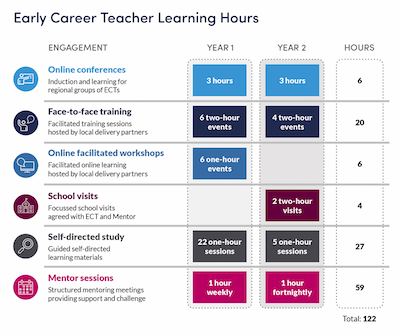
Induction helps teachers understand quality teaching, not just assessment (Hoban, 2002). One day a week involves training with experts, exploring teaching practice (Cochran-Smith, 2004). Learners examine behaviour and workload management (Ingersoll, 2001).
The ITT Core Content Framework underpins this provision. It ensures learners get full teaching theory and practical coverage.
Key Insights and Important Facts:
In 2019, the Teacher Recruitment and Retention Strategy was published by the Department for Education (DfE), which highlighted the adverse impact and major problems in education, specifically relating to the challenges in teacher retention. It was noticed that the main reason for teacher shortages was the lack of support at the start of teaching career. To provide sufficient support to the early career teachers, a reform was introduced for teacher development - the Early Career Framework (ECF).
The Early Career Framework (ECF) describes the skills and knowledge for the early career teachers, and it has been utilised for creating the 2-Year programme of training and development. This programme is aimed at providing the right support to lay the foundation of a successful and rewarding career in teaching.
Teachers need to be prepared with professional knowledge in the classroom. The early career framework provides teachers with evidence-informed ideas that are deemed important for classroom practice. As well as addressing curriculum knowledge, the framework also addresses pedagogical challenges that educators will inevitably face. As well as exploring concepts such as curriculum structure and design, participants will also develop skills in areas such as:
1) Scaffolding
4) Practise, challenge and success
5) Classroom talk
6) Formative assessment
7) Structured support for learning

8) Instructions
Depending on the school context, participants will focus on these given areas with different priorities. It might be that the training materials are particularly focussed upon special educational needsif there are a significant amount of special schools within the cluster. The training sessions could also be centred around quality learner learning in secondary schools if the School hub has fewer primary schools.
Regardless of the school context, induction activities should prepare student teachers with the pedagogical strategies they need to excel in the classroom environment. Many of the principles included in the ECT induction have universal application across all school phases.
The Early Career Framework benefits new teachers. It gives them key knowledge on classroom practice and career paths. (DfE, 2019). Learners easily access:

An early career framework is advantageous for the schools as they can benefit from:
Every early career teacher, previously called newly qualified teacher (NQT), across each subject and phase at a state-funded school, is entitled to the ECF programme.

From September 2021, it has been made mandatory for every school to enrol each early career teacher (ECT) for the structured Two-Year Package of Early Career Framework programme.
The 2-year ECF Roll-out programme was initiated in September 2020 for the selected school partners in Greater Manchester, North-East, Doncaster and Bradford.
Due to the coronavirus pandemic, the 2-year ECF Roll-out programme was widened to 4,600 new educators other than early roll-out areas, who earned a 1-year package of support-based on the ECF. Those who started their ECF programmes will proceed as planned until their completion and wouldn't be affected by the launch of the new ECF national roll-out.
As part of the ECF reforms, statutory induction for new teachers was changed in September 2021. According to the new reforms, each early career teacher on statutory induction will be eligible for a structured 2-year package of high-quality professional development support based on the ECF.

Every school needs to replace its induction programme. The schools can benefit from a range of support available to ensure that they meet the statute, including an updated DfE funded provider-led programme of training and support.
This programme is vital for retention and teacher development (DfE, 2021). Mentors, induction tutors, and leaders support early career teachers through induction. These roles assist learners in completing their core induction programme, as advised by the DfE (2021).
Major changes are:
Schools can choose from the following 3 approaches to enable the delivery of an ECF-based induction.

School leaders can decide the most suitable approach after ensuring that their selected approach to induction will best suit their early career teachers and mentors.
Schools using DfE materials for early career teacher induction receive funding. Mentors and learners get time off timetable (DfE pays for this). DfE pays schools directly in the second induction year.
These schools are expected to develop a 2-year programme of support and training including every ‘learn how to’ and ‘learn that’ practise statements in the ECF. Also, they must provide evidence to their appropriate body to ascertain their induction programme meets statutory requirements and is ECF-based. These schools need to get in touch with their appropriate body for additional details of what body of evidence will be needed in the summer term. Schools that will create and deliver theirindividual ECF-based induction wouldn't use DfE’s online resources to run their induction.
It is expected that the early career framework reforms will bring a significant change and support early career teachers, through a funded, provider-led programme entitlement to professional development. The early career framework is part of the teacher recruitment and retention strategy of the local government, which aims to provide initial teacher training and development opportunities to early career teachers. The early career framework sets out what exactly an early career teacher must know, and learn the best ways of teaching, in their first 2 years of teaching careers. Before September 2021, every school was expected to:
The Early Career Framework provides new teachers with a wealth of carefully curated learning materials designed to bridge the gap between initial teacher training and confident classroom practice. These resources form the backbone of professional development during the crucial first two years of teaching.
ECF resources have self-study modules for busy learners, alongside mentor meetings. Videos show teachers modelling useful methods like cold-calling (Christodoulou, 2017). Modules link to Teachers' Standards, showing how knowledge applies to classroom actions (Simonsmeier et al., 2022).
ECF resources offer practical toolkits with lesson plans and behaviour charts. The 'Responsive Teaching Toolkit' (Coe et al, 2014) has sentence stems for questioning. This helps learners think critically instead of just answering yes/no questions. 'Classroom Climate Resources' (Simonsmeier et al, 2022) provides scripts for establishing routines in September.
Digests summarise complex research on each learning area. These practical guides explain why specific teaching methods work. For instance, cognitive load theory materials (Sweller, 1988) show how to break down GCSE science (Johnstone, 1993; Paas, Renkl & Sweller, 2004), including understanding checks.
Digital portfolios help ECTs record their work. Learners' work, journals, and videos show their impact. This evidence assists progress reviews and pinpoints development needs. Teachers translate learning goals into real growth (Yorke, 2003; Boud & Walker, 1998).
Understanding the ECF timeline is critical for planning. Know your cohort dates for proper placement. Check funding eligibility deadlines. Plan career progression.
Teachers starting their induction before 1 September 2025 will follow the current ECF structure, with statutory induction lasting two full school years. Your appropriate body must register you by the October half-term to secure funded provision. For example, if you begin teaching in January 2025, you'll complete your ECF by December 2026, with progress reviews scheduled each term.
Those beginning after 1 September 2025 should note potential changes to the framework structure. The Department for Education typically announces modifications by the preceding Easter, giving schools time to prepare. Key registration windows include:
Practical tip: Create a shared calendar with your mentor marking all ECF milestones. Include observation dates, portfolio submission deadlines, and professional development sessions. Many successful ECTs use backwards planning from their final assessment date, scheduling regular evidence collection points throughout each term.
Bank holidays don't pause your two-year induction, which runs from your start date. Missing deadlines can delay your qualification. Regularly contact your induction coordinator about what's coming up.
The ECF Handbook guides UK teachers and mentors on programme needs. The Department for Education published it. The resource presents eight teaching standards from setting expectations to managing behaviour (DfE, 2021). It acts as the ECF framework's base.
Teachers can find standard breakdowns and practical strategies in this handbook. Standard 4, planning lessons well, offers lesson sequencing guidance and templates. Mentors can adapt observation forms showing effective practice at various career stages.
Schools get extra resources like mentor training and assessment sheets. These help in weekly mentor meetings. The 'Professional Development Journal' helps early career teachers track progress and record evidence. Discussion prompts, like using cognitive load theory for maths, are helpful (Sweller, 1988).
Statutory guidance explains legal requirements and timelines clearly. Schools must understand their obligations, like 10% timetable reduction and assessments. Documents are regularly updated with new research. Recent additions cover adaptive teaching and supporting learners with SEND. This shows commitment to educational research.
The Early Career Framework supports new teachers for two years. It provides training, mentoring, and learning based on research. The programme replaced the old one in September 2021. It is now required for early career learners in state schools.
Every early career teacher (previously called newly qualified teacher or NQT) working in state-funded schools across all subjects and phases is entitled to participate in the ECF programme. Since September 2021, it has become mandatory for all schools to enrol their early career teachers in this structured 2-year package. This ensures that no new teacher misses out on essential professional development support during their crucial early years.
The ECF covers key teaching areas: scaffolding, metacognition, working memory, and formative assessment. It also addresses classroom talk and structured learner support. Training uses evidence-based research, following the ITT Core Content Framework. Materials adapt to specific school settings, like SEN.
New teachers get a mentor for two years. Schools access training for experienced teachers (Hobson & Malderez, 2013). Mentors share classroom strategies via a network (Wong, 2004). Mentors work with partners to improve new learner progress (Ingersoll & Strong, 2011).
Schools implementing the ECF report stronger teacher retention rates, helping to address the early-career exodus that has plagued the profession. The programme provides schools with training for senior leaders, online materials for mentors, and access to teaching school hubs that support the induction process. Additionally, schools benefit from having better-prepared teachers, as ECF participants report improvements in their teaching skills.
The ECF blends online resources and face-to-face training. It sets aside one day a week for professional development with experts. Training gives access to resources, events, and learning materials. This helps teachers gain knowledge and apply it practically (Allen et al., 2019).
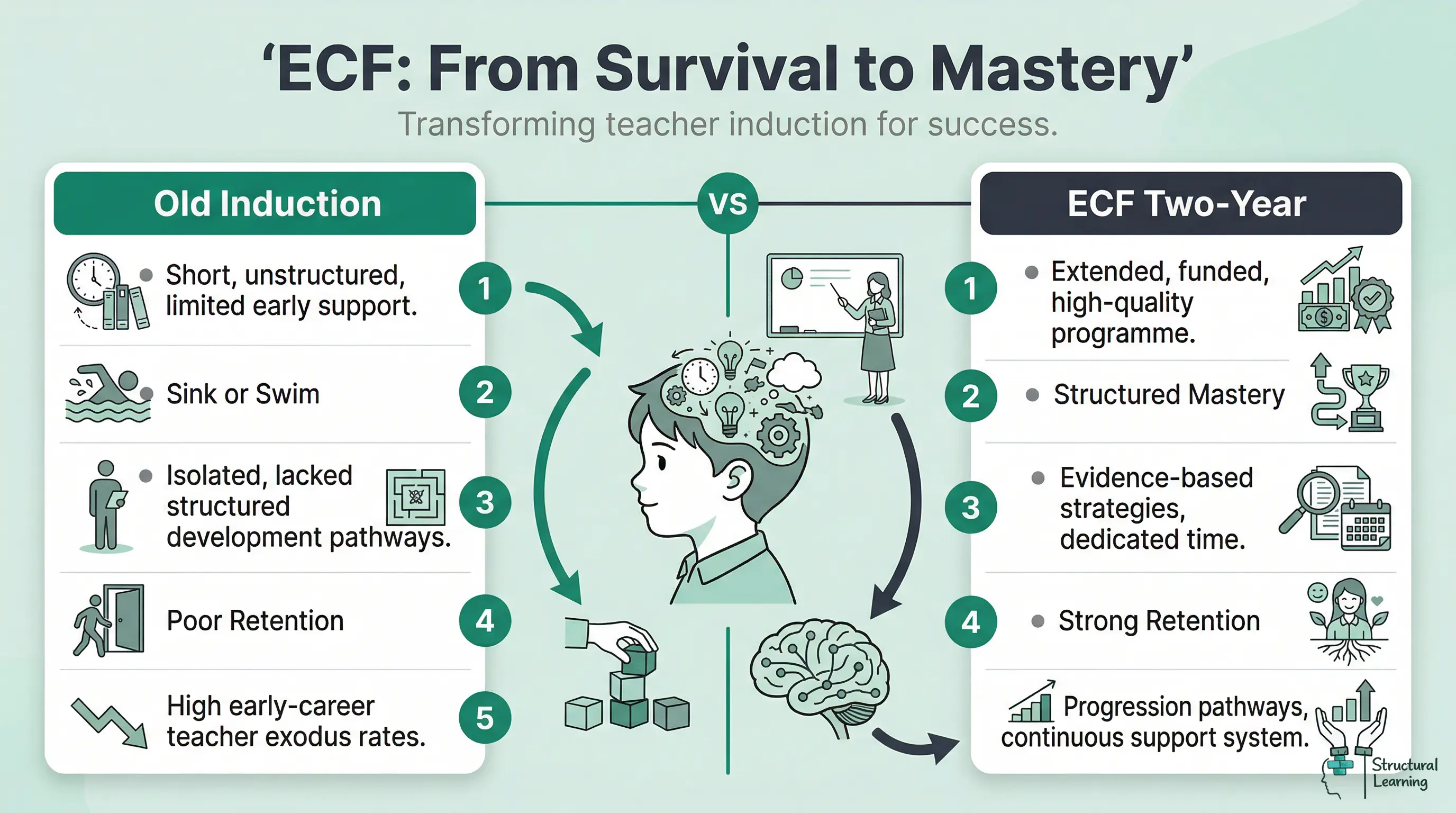
The ECF came after the 2019 strategy on teacher recruitment. It found early career support lacking as a key reason for shortages. The programme changes induction from survival to structured learning. It provides two years of support instead of one, building strong teaching careers.
New teacher research
Teacher induction
These peer-reviewed studies provide the research foundation for the strategies discussed in this article:
INFLUENCE OF FORMATIVE ASSESSMENT CLASSROOM TECHNIQUES (FACTs) ON STUDENT'S OUTCOMES IN CHEMISTRY AT SECONDARY SCHOOL View study ↗
28 citations
M. Babinčáková et al. (2020)
Formative assessment improves chemistry learner performance (Black & Wiliam, 1998). Ongoing assessment, instead of end tests, helps learners understand more deeply (Hattie & Timperley, 2007). Shifting to classroom assessment techniques supports learner success (Bennett, 2011; Shute, 2008).
Teachers can boost formative assessment skills, according to studies. Brookhart (2017) and Heritage (2010) say this helps learners. Wiliam (2011) stresses formative assessment boosts learning outcomes. Black and Wiliam's (1998) research highlights its positive impact.
Jiayi Li & Peter Yongqi Gu (2023) This study follows an English language teacher through a 12-week professional development programme focussed on improving formative assessment skills in the classroom. The research reveals that many teachers struggle to implement effective formative assessment not because they don't want to, but because they lack the specific knowledge and practical skills needed. The findings highlight how targeted training can transform a teacher's ability to use assessment as a powerful tool for improving student learningrather than just measuring it.Effects of Teachers' Roles as Scaffolding in Classroom Instruction View study ↗
4 citations
Zheren Wang (2024)
This research examines how teachers can effectively support student learning by taking on different roles that provide just the right amount of guidance at the right time. Drawing on classroom examples, the study shows how teachers can shift between being facilitators, coaches, and direct instructors depending on what students need to progress. For new teachers, this research offers practical insights into how to recognise when students need more or less support and how to adjust teaching approaches accordingly.
Application of Scaffolding Instruction in Senior High School English Reading Teaching: A Case Study of Living Legends View study ↗
This case study demonstrates how teachers can break down complex reading tasks into manageable steps that help students gradually build their comprehension and critical thinking skills. Using a specific English lesson as an example, the research shows how strategic support structures can help students tackle challenging texts they couldn't handle independently. The study provides new teachers with concrete strategies for supporting student learning without doing the work for them, ultimately building student confidence and autonomy.
Preschool teachers used typical methods to support learners' social and emotional growth during remote learning (Vygotsky, 1978). COVID-19 presented new problems and chances to adapt their strategies (Bronfenbrenner, 1979). Researchers are examining how teachers scaffolded learning in this context (Wood et al., 1976).
Jennifer J. Chen & Charlene Brotherson Adams (2022)
The study shows how preschool teachers supported young learners' emotional and social growth during remote learning. Teachers adapted classroom strategies for online use and found ways to involve families. This research highlights the need for flexibility and creativity to maintain learner connections.