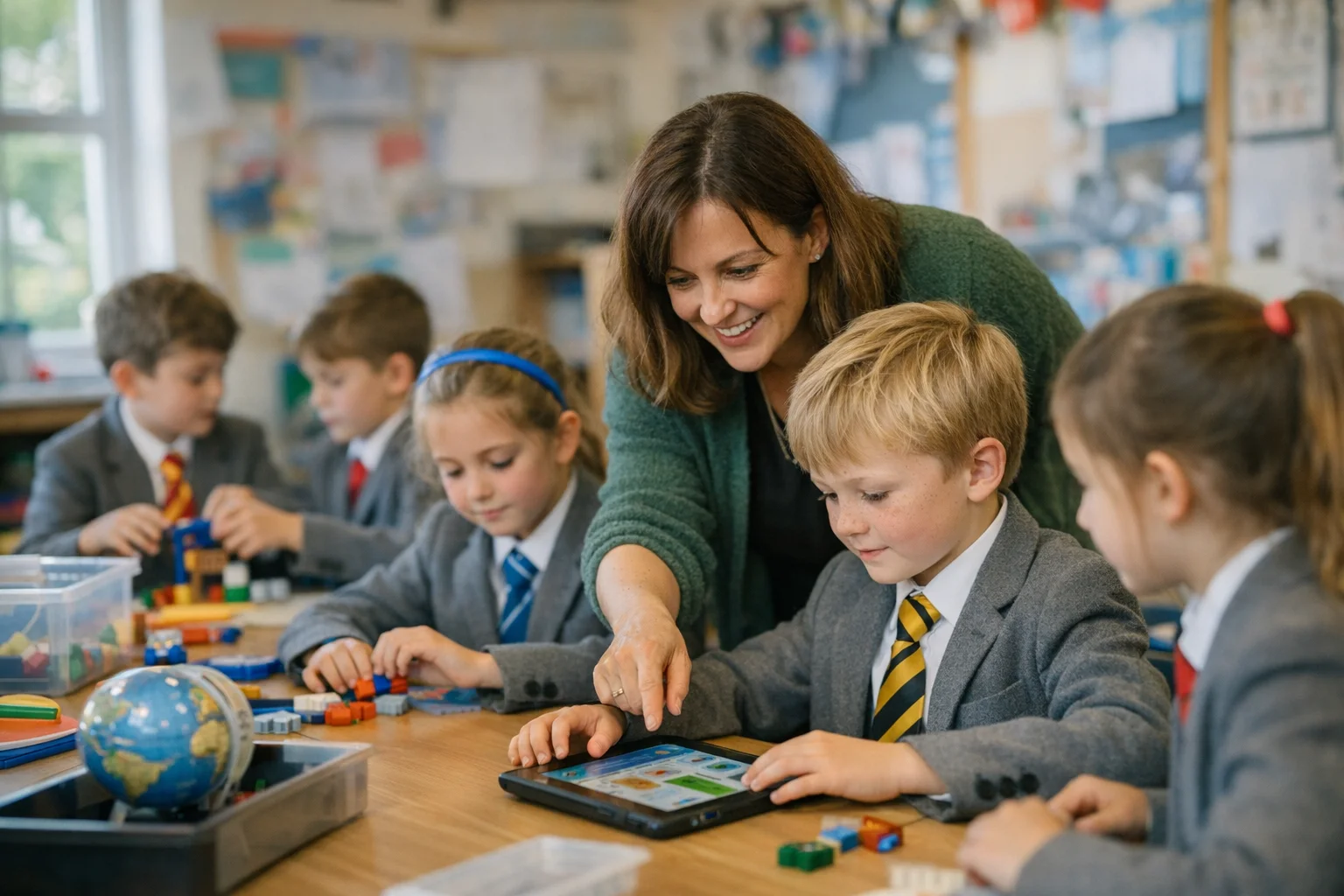
Twinkl Resources: A Complete Guide for UK TeachersPrimary students aged 7-9 in grey blazers with house colour ties interact with educational displays and resources in classroom.

Updated on  

February 7, 2026

Twinkl Resources: A Complete Guide for UK Teachers

|

June 14, 2021

Explore Twinkl resources tailored for UK teachers. Compare subscription tiers, understand pricing, and learn how to effectively utilize this valuable platform.

Course Enquiry
Copy citation

Main, P (2021, June 14). Free Twinkl teaching resources: A teacher's guide. Retrieved from https://www.structural-learning.com/post/twinkl-teaching-resources

What is Twinkl?

Twinkl is a name you will find in many UK primary school classrooms. If you need a quick resource for your lesson, chances are you have used one of their materials at some point. This article looks at what this educational publisher offers.

Key Takeaways

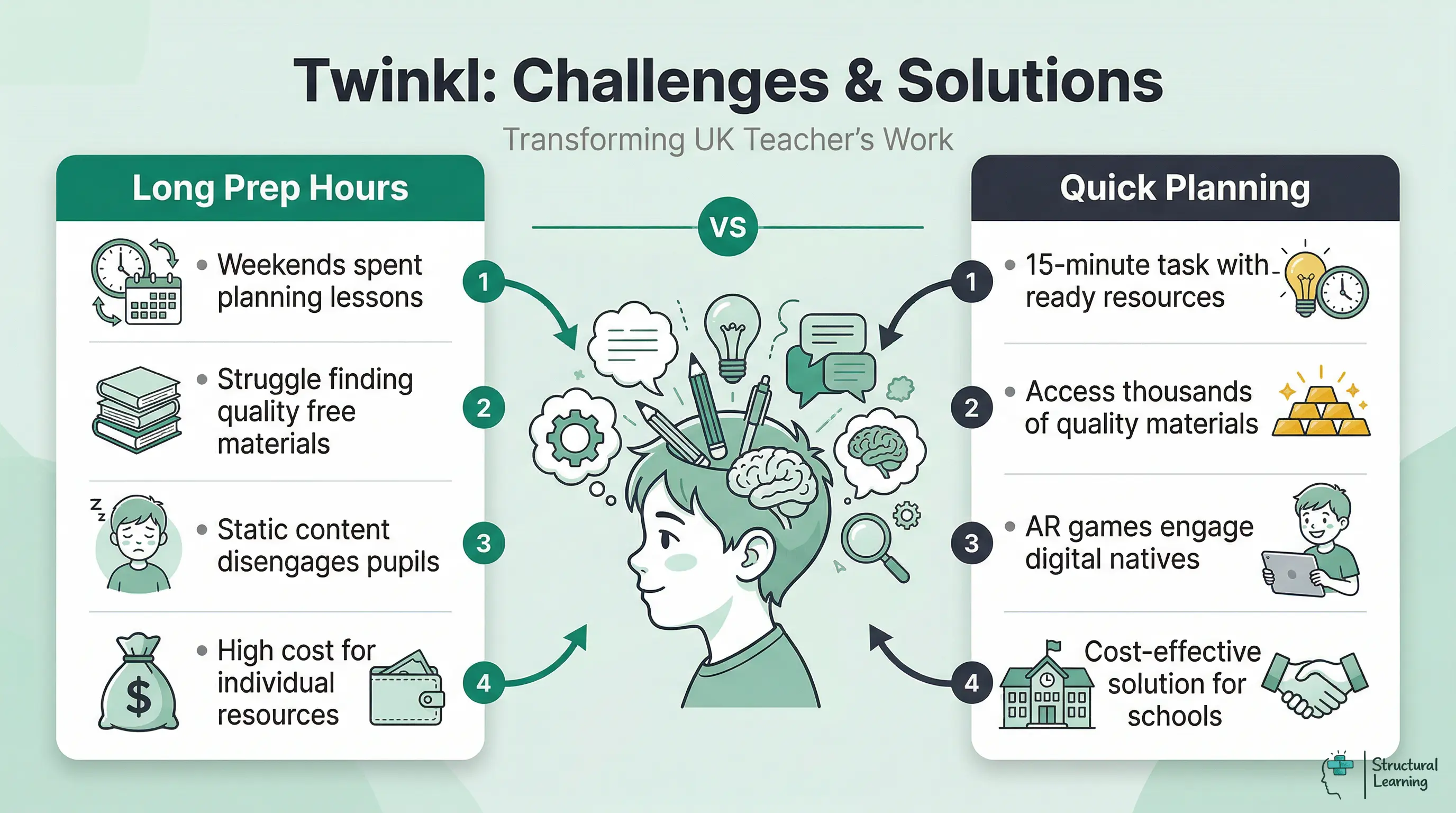
  1. Save Hours Every Week: Discover how Twinkl's 525,000+ ready-made resources transform lesson planning from weekend burden to 15-minute task
  2. The Free Resources Goldmine: Access thousands of quality materials without spending: what experienced teachers know about maximising Twinkl's free tier
  3. Beyond Worksheets: From AR apps to interactive games: the lesser-known Twinkl tools that engage digital natives and reduce screen fatigue
  4. The School Budget Solution: Why UK primaries invest in site licenses: calculating the real cost-per-lesson and what SLTs need to know

Twinkl is an online educational publishing house. It provides a large variety of resources for teachers, schools, and parents. These include schemes of work, assessments, games, resources that build cultural capital, and much more.

Teachers use Twinkl to create lesson plans, share videos, and support scaffolding learning whilst working with students and colleagues. They can upload photos, documents, and web pages to their account. This makes it easy to add content to blogs and websites.

When teachers share their resources online, they can reach thousands of students at once. Parents can stay connected with their children's learning. And teachers help others learn at the same time.

Making Resources with Twinkl

What is Twinkl and When Was It Founded?

Twinkl is an online educational publishing house founded on 3rd February 2010 by Susie and Jonathan Seaton in Sheffield. Started from their back bedroom, it has grown to serve over one million subscribers worldwide with teaching resources and lesson materials.

Twinkl Educational Publishing is based in Sheffield. It was founded on 3rd February 2010 by Susie Seaton and Jonathan Seaton. They started the company from their back bedroom. Today it has more than one million subscribers around the world.

Their resources save teachers valuable time and support effective teaching strategies for a wide range of educators. In 2019, the company received the Queen's Award f or Enterprise in International Trade.

The founders' background as former teachers provided crucial insight into the daily challenges of lesson preparation and resource creation. This practical experience shaped Twinkl's approach to developing materials that genuinely address classroom needs rather than simply digitising existing content. Their understanding of time constraints, curriculum pressures, and the importance of engaging pupils informed the platform's user-friendly design and comprehensive resource coverage.

The timing of Twinkl's launch coincided with significant changes in educational technology adoption. As schools began integrating digital tools into their teaching practice, educators needed resources that could smoothly transition between online and offline environments. This dual functionality became particularly valuable during periods of remote learning, demonstrating the forward-thinking approach that characterised the platform's early development.

Central to Twinkl's educational philosophy is the belief that high-quality resources should support rather than replace teacher expertise. The materials are designed to provide a foundation upon which educators can build, adapting content to suit their pupils' specific needs and learning styles. This approach recognises that effective teaching requires both excellent resources and professional judgement in their implementation.

How Do I Access Twinkl Resources as a Teacher?

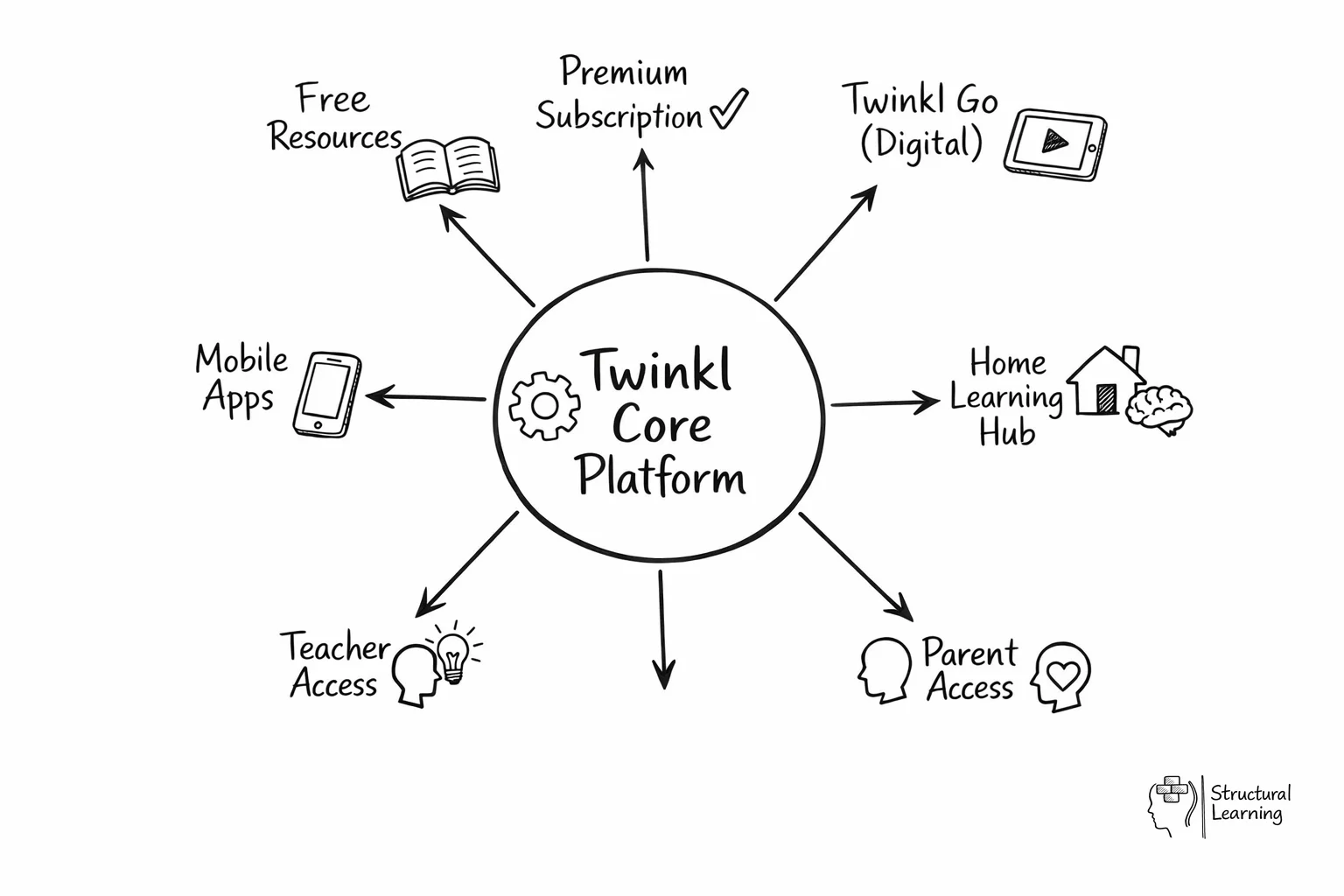
Teachers can access Twinkl resources by creating a free account at twinkl.co.uk, which provides access to thousands of free materials. For full access to over 525,000 resources, teachers can upgrade to a paid membership starting from £4.49 per month.

Hub-and-spoke diagram showing Twinkl's platform structure with core platform at center
Hub-and-spoke diagram: Twinkl Platform Structure and Access Points

Once you have signed into the platform and set up a free or paid account, it is easy to access resources. Just type what you need in the search box, such as sounds, letters, or phonics. Or click on the options provided.

Twinkl's resources are sorted into categories:

  • EYFS, Early Years Foundation Stage
  • KS1, KS2, KS3/4 (Key Stages)
  • Welsh and ESL/TESL
  • EAL
  • SEND ( Special Educational Needs and Disability)
  • After clicking on a category, you can choose a specific topic such as science, reading, or maths. Twinkl keeps adding new services including 'Activities and Games' and 'Health and Wellbeing'.

    Is Twinkl Free?

    Twinkl contains more than 525,000 different educational resources. New content is added every day. Many resources are free to use, while some are only for subscribers.

    The free Twinkl resources are a useful starting point for your classroom. Many schools invest in a site licence. The membership options mean that investing in the platform is affordable for most teachers.

    Another free resource that works well with Twinkl is the Universal Thinking Framework. You can download a high resolution copy and use it as a planning tool to develop critical thinking.
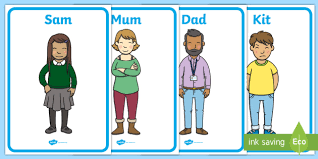
    Twinkl Visuals
    Twinkl Visuals

    The limitations of the free tier become particularly apparent when planning comprehensive schemes of work or seeking resources for specific curriculum requirements. Free users may find themselves with access to individual worksheets but lacking the accompanying teacher guidance, assessment rubrics, or differentiated versions that support effective classroom implementation. This can result in additional preparation time as teachers adapt materials to meet their pupils' varying needs.

    Schools often find that sharing a subscription across departments or year groups provides better value than individual teachers relying solely on free resources. The collaborative approach allows teaching teams to access the full range of materials whilst distributing costs effectively. Additionally, many teachers report that the time saved through access to ready-made, curriculum-aligned resources justifies the subscription cost, particularly when considering the hours typically spent creating materials from scratch.

    How Can Parents Use Twinkl for Home Learning?

    Parents can use Twinkl's dedicated home learning section to access age-appropriate worksheets, activities, and educational games that align with the UK curriculum. The platform offers both free and premium resources specifically designed to support children's learning at home.

    The Home Learning Hub at Twinkl has a complete timetable of content that is updated daily. All content in the Home Learning Hub is free. It offers a time-saving solution if you need to switch to online education at short notice.

    This service saw a spike in membership during the pandemic. Parents needed somewhere to turn for quick and easy solutions. It remains a popular platform for homeschooled children around the globe and helps improve student engagement.

    Exploring the Twinkl Apps

    Twinkl apps provide a great way to create lasting learning experiences at home. These apps offer a large variety of choices. Parents and teachers can browse all available resources and explore the collection of online learning materials.

    The 'Twinkl Originals' app contains many storybooks for children that help develop literacy skills and expand vocabulary. The 'Learn & Explore' app brings learning to life using a ugmented reality. Everything in the apps is free for subscribers and supports curriculum objectives.

    image w-richtext-align-center" data-rt-type="image" data-rt-align="center">
    Twinkl Apps

    How Much Does Twinkl Cost?

    Twinkl offers a range of membership options to suit different needs and budgets. While a free account provides access to a selection of resources, full access to the entire library of over 525,000 resources requires a paid subscription. These subscriptions vary in price depending on the level of access and the duration of the membership, with options available for individuals, schools, and entire districts. Prices start from as little as £4.49 per month.

    Twinkl provides different levels of membership. The Core membership gives access to the basic resources. The Extra membership has interactive activities, online games, and handwriting resources. The Ultimate membership includes everything in Core and Extra as well as Twinkl Boost, which is a targeted intervention toolkit.

    For schools, a site licence provides access for all staff members. This often proves to be the most cost-effective solution when multiple teachers are using the platform. Contact Twinkl directly for a quote and to discuss your school's specific needs.

    What Types of Resources Does Twinkl Offer?

    The platform provides an extensive collection of ready-to-use teaching materials spanning every key stage and curriculum area. Teachers can access thousands of worksheets, interactive activities, PowerPoint presentations, and assessment tools, all aligned with National Curriculum requirements. The resources cover core subjects including English, mathematics, and science, alongside foundation subjects such as history, geography, art, and modern foreign languages.

    Particularly valuable are the differentiated materials that support inclusive classroom practice. John Sweller's cognitive load theory demonstrates the importance of presenting information at appropriate complexity levels, and these tiered resources enable teachers to meet diverse learning needs within a single lesson. The collection includes visual aids, manipulatives, and multi-sensory activities that accommodate different learning preferences whilst maintaining rigorous academic standards.

    Beyond traditional worksheets, the platform offers comprehensive planning documentation including detailed lesson plans, unit overviews, and assessment frameworks. These resources prove particularly beneficial for early career teachers developing their pedagogical expertise, whilst experienced practitioners can adapt and customise materials to suit their established teaching methods. The inclusion of display materials, certificates, and home-school communication resources further supports whole-school approaches to education.

    Twinkl Resources by Subject Area

    Understanding how digital resources align with different subject areas is crucial for effective curriculum delivery. Each subject presents unique pedagogical challenges that require tailored approaches to resource selection and implementation. Mathematics demands visual representations and progressive skill-building materials, whilst English benefits from diverse literary texts and scaffolded writing frameworks. Science subjects require accurate diagrams and practical investigation guides, whereas humanities subjects need source materials and analytical thinking tools.

    Richard Mayer's multimedia learning theory demonstrates that students learn more effectively when information is presented through multiple channels simultaneously. This principle proves particularly valuable when selecting subject-specific resources, as different disciplines naturally lend themselves to varying multimedia approaches. Visual subjects like geography and art benefit from high-quality images and interactive elements, whilst language subjects require audio components and textual variety.

    When implementing subject-specific resources, consider your pupils' prior knowledge and the cognitive demands of each task. Start with familiar formats before introducing more complex interactive elements, ensuring that technological features enhance rather than distract from learning objectives. Regular evaluation of resource effectiveness within each subject area helps build a comprehensive understanding of what works best for your particular teaching context and student needs.

    How to Integrate Twinkl Resources into Your Teaching Practice

    Successful integration of digital resources begins with strategic lesson planning that aligns materials with specific learning objectives rather than retrofitting content around available resources. Start by identifying the core concepts you need to teach, then select materials that directly support these goals whilst considering your pupils' prior knowledge and learning styles. This approach ensures resources enhance rather than overwhelm your teaching practice.

    John Sweller's cognitive load theory demonstrates the importance of presenting information in digestible chunks, making it crucial to sequence digital materials thoughtfully throughout your lessons. Use visual resources during direct instruction to support explanations, interactive activities for guided practice, and independent worksheets for consolidation. Consider how each resource transitions into the next, maintaining lesson flow whilst providing varied engagement opportunities that cater to different learning preferences.

    Establish a consistent implementation routine by dedicating time each week to preview and adapt resources for your specific classroom context. This might involve modifying difficulty levels, adding extension activities, or connecting materials to real-world examples relevant to your pupils' experiences. Remember that effective integration requires flexibility; be prepared to adjust your approach based on pupil responses and learning outcomes, treating resources as tools to support your professional judgement rather than rigid scripts to follow.

    Curriculum Alignment and Resource Quality

    Curriculum alignment forms the backbone of effective educational resources, ensuring that materials directly support statutory requirements whilst maintaining pedagogical rigour. Quality resources demonstrate clear connections to specific curriculum objectives, age-appropriate learning outcomes, and assessment criteria. This alignment eliminates guesswork for teachers, allowing them to confidently integrate materials into their existing schemes of work without compromising educational standards.

    Effective resource quality extends beyond curriculum matching to encompass sound educational principles. John Sweller's cognitive load theory demonstrates that well-designed materials should present information in manageable chunks, reducing extraneous cognitive burden on learners. High-quality resources incorporate scaffolding techniques, differentiation opportunities, and clear progression pathways that support diverse learning needs within the classroom.

    When evaluating resource quality, consider three practical criteria: clarity of learning objectives, appropriateness of content difficulty, and alignment with assessment expectations. Resources should provide explicit links to curriculum codes, offer extension activities for advanced learners, and include guidance for supporting struggling pupils. This comprehensive approach ensures that materials enhance rather than complicate your teaching practice, ultimately improving pupil outcomes and reducing planning time.

    Conclusion

    Twinkl has become a staple resource for many UK teachers, and for good reason. Its vast library of resources, ranging from lesson plans to interactive games, can significantly reduce teacher workload and enhance the learning experience for students. The platform's commitment to providing high-quality, curriculum-aligned materials has solidified its position as a leading educational publisher.

    Whether you're a newly qualified teacher looking for ready-made resources or an experienced educator seeking to refresh your teaching strategies, Twinkl offers something for everyone. By using its free resources and exploring its membership options, teachers can unlock a wealth of tools to support their teaching and inspire their students.

    Further Reading

    To further explore the impact and effectiveness of online educational resources like Twinkl, consider the following research:

    • Holmes, K., & Gardner, J. (2006). E-Learning: Concepts and Practice. *SAGE Publications*. This book provides a broad overview of e-learning, including its benefits and challenges in educational settings.
    • Higgins, S., Xiao, Z., & Katsipataki, M. (2012). The Impact of Digital Technology on Learning: A Summary for Teachers. *Education Endowment Foundation*. This report summarises the evidence on the impact of digital technology on learning, offering insights into effective implementation strategies.
    • Somekh, B., Lewin, C., Mavers, D., Fisher, T., Harrison, C., & Green, D. (2007). Case Study Research Methods for Investigating Information and Communication Technologies in Education. *Technology, Pedagogy and Education, 16*(3), 255-267. This paper discusses methodologies for researching the use of ICT in education, providing a framework for evaluating the effectiveness of digital resources.
Loading audit...

What is Twinkl?

Twinkl is a name you will find in many UK primary school classrooms. If you need a quick resource for your lesson, chances are you have used one of their materials at some point. This article looks at what this educational publisher offers.

Key Takeaways

  1. Save Hours Every Week: Discover how Twinkl's 525,000+ ready-made resources transform lesson planning from weekend burden to 15-minute task
  2. The Free Resources Goldmine: Access thousands of quality materials without spending: what experienced teachers know about maximising Twinkl's free tier
  3. Beyond Worksheets: From AR apps to interactive games: the lesser-known Twinkl tools that engage digital natives and reduce screen fatigue
  4. The School Budget Solution: Why UK primaries invest in site licenses: calculating the real cost-per-lesson and what SLTs need to know

Twinkl is an online educational publishing house. It provides a large variety of resources for teachers, schools, and parents. These include schemes of work, assessments, games, resources that build cultural capital, and much more.

Teachers use Twinkl to create lesson plans, share videos, and support scaffolding learning whilst working with students and colleagues. They can upload photos, documents, and web pages to their account. This makes it easy to add content to blogs and websites.

When teachers share their resources online, they can reach thousands of students at once. Parents can stay connected with their children's learning. And teachers help others learn at the same time.

Making Resources with Twinkl

What is Twinkl and When Was It Founded?

Twinkl is an online educational publishing house founded on 3rd February 2010 by Susie and Jonathan Seaton in Sheffield. Started from their back bedroom, it has grown to serve over one million subscribers worldwide with teaching resources and lesson materials.

Twinkl Educational Publishing is based in Sheffield. It was founded on 3rd February 2010 by Susie Seaton and Jonathan Seaton. They started the company from their back bedroom. Today it has more than one million subscribers around the world.

Their resources save teachers valuable time and support effective teaching strategies for a wide range of educators. In 2019, the company received the Queen's Award f or Enterprise in International Trade.

The founders' background as former teachers provided crucial insight into the daily challenges of lesson preparation and resource creation. This practical experience shaped Twinkl's approach to developing materials that genuinely address classroom needs rather than simply digitising existing content. Their understanding of time constraints, curriculum pressures, and the importance of engaging pupils informed the platform's user-friendly design and comprehensive resource coverage.

The timing of Twinkl's launch coincided with significant changes in educational technology adoption. As schools began integrating digital tools into their teaching practice, educators needed resources that could smoothly transition between online and offline environments. This dual functionality became particularly valuable during periods of remote learning, demonstrating the forward-thinking approach that characterised the platform's early development.

Central to Twinkl's educational philosophy is the belief that high-quality resources should support rather than replace teacher expertise. The materials are designed to provide a foundation upon which educators can build, adapting content to suit their pupils' specific needs and learning styles. This approach recognises that effective teaching requires both excellent resources and professional judgement in their implementation.

How Do I Access Twinkl Resources as a Teacher?

Teachers can access Twinkl resources by creating a free account at twinkl.co.uk, which provides access to thousands of free materials. For full access to over 525,000 resources, teachers can upgrade to a paid membership starting from £4.49 per month.

Hub-and-spoke diagram showing Twinkl's platform structure with core platform at center
Hub-and-spoke diagram: Twinkl Platform Structure and Access Points

Once you have signed into the platform and set up a free or paid account, it is easy to access resources. Just type what you need in the search box, such as sounds, letters, or phonics. Or click on the options provided.

Twinkl's resources are sorted into categories:

  • EYFS, Early Years Foundation Stage
  • KS1, KS2, KS3/4 (Key Stages)
  • Welsh and ESL/TESL
  • EAL
  • SEND ( Special Educational Needs and Disability)
  • After clicking on a category, you can choose a specific topic such as science, reading, or maths. Twinkl keeps adding new services including 'Activities and Games' and 'Health and Wellbeing'.

    Is Twinkl Free?

    Twinkl contains more than 525,000 different educational resources. New content is added every day. Many resources are free to use, while some are only for subscribers.

    The free Twinkl resources are a useful starting point for your classroom. Many schools invest in a site licence. The membership options mean that investing in the platform is affordable for most teachers.

    Another free resource that works well with Twinkl is the Universal Thinking Framework. You can download a high resolution copy and use it as a planning tool to develop critical thinking.

    Twinkl Visuals
    Twinkl Visuals

    The limitations of the free tier become particularly apparent when planning comprehensive schemes of work or seeking resources for specific curriculum requirements. Free users may find themselves with access to individual worksheets but lacking the accompanying teacher guidance, assessment rubrics, or differentiated versions that support effective classroom implementation. This can result in additional preparation time as teachers adapt materials to meet their pupils' varying needs.

    Schools often find that sharing a subscription across departments or year groups provides better value than individual teachers relying solely on free resources. The collaborative approach allows teaching teams to access the full range of materials whilst distributing costs effectively. Additionally, many teachers report that the time saved through access to ready-made, curriculum-aligned resources justifies the subscription cost, particularly when considering the hours typically spent creating materials from scratch.

    How Can Parents Use Twinkl for Home Learning?

    Parents can use Twinkl's dedicated home learning section to access age-appropriate worksheets, activities, and educational games that align with the UK curriculum. The platform offers both free and premium resources specifically designed to support children's learning at home.

    The Home Learning Hub at Twinkl has a complete timetable of content that is updated daily. All content in the Home Learning Hub is free. It offers a time-saving solution if you need to switch to online education at short notice.

    This service saw a spike in membership during the pandemic. Parents needed somewhere to turn for quick and easy solutions. It remains a popular platform for homeschooled children around the globe and helps improve student engagement.

    Exploring the Twinkl Apps

    Twinkl apps provide a great way to create lasting learning experiences at home. These apps offer a large variety of choices. Parents and teachers can browse all available resources and explore the collection of online learning materials.

    The 'Twinkl Originals' app contains many storybooks for children that help develop literacy skills and expand vocabulary. The 'Learn & Explore' app brings learning to life using a ugmented reality. Everything in the apps is free for subscribers and supports curriculum objectives.

    image w-richtext-align-center" data-rt-type="image" data-rt-align="center">
    Twinkl Apps

    How Much Does Twinkl Cost?

    Twinkl offers a range of membership options to suit different needs and budgets. While a free account provides access to a selection of resources, full access to the entire library of over 525,000 resources requires a paid subscription. These subscriptions vary in price depending on the level of access and the duration of the membership, with options available for individuals, schools, and entire districts. Prices start from as little as £4.49 per month.

    Twinkl provides different levels of membership. The Core membership gives access to the basic resources. The Extra membership has interactive activities, online games, and handwriting resources. The Ultimate membership includes everything in Core and Extra as well as Twinkl Boost, which is a targeted intervention toolkit.

    For schools, a site licence provides access for all staff members. This often proves to be the most cost-effective solution when multiple teachers are using the platform. Contact Twinkl directly for a quote and to discuss your school's specific needs.

    What Types of Resources Does Twinkl Offer?

    The platform provides an extensive collection of ready-to-use teaching materials spanning every key stage and curriculum area. Teachers can access thousands of worksheets, interactive activities, PowerPoint presentations, and assessment tools, all aligned with National Curriculum requirements. The resources cover core subjects including English, mathematics, and science, alongside foundation subjects such as history, geography, art, and modern foreign languages.

    Particularly valuable are the differentiated materials that support inclusive classroom practice. John Sweller's cognitive load theory demonstrates the importance of presenting information at appropriate complexity levels, and these tiered resources enable teachers to meet diverse learning needs within a single lesson. The collection includes visual aids, manipulatives, and multi-sensory activities that accommodate different learning preferences whilst maintaining rigorous academic standards.

    Beyond traditional worksheets, the platform offers comprehensive planning documentation including detailed lesson plans, unit overviews, and assessment frameworks. These resources prove particularly beneficial for early career teachers developing their pedagogical expertise, whilst experienced practitioners can adapt and customise materials to suit their established teaching methods. The inclusion of display materials, certificates, and home-school communication resources further supports whole-school approaches to education.

    Twinkl Resources by Subject Area

    Understanding how digital resources align with different subject areas is crucial for effective curriculum delivery. Each subject presents unique pedagogical challenges that require tailored approaches to resource selection and implementation. Mathematics demands visual representations and progressive skill-building materials, whilst English benefits from diverse literary texts and scaffolded writing frameworks. Science subjects require accurate diagrams and practical investigation guides, whereas humanities subjects need source materials and analytical thinking tools.

    Richard Mayer's multimedia learning theory demonstrates that students learn more effectively when information is presented through multiple channels simultaneously. This principle proves particularly valuable when selecting subject-specific resources, as different disciplines naturally lend themselves to varying multimedia approaches. Visual subjects like geography and art benefit from high-quality images and interactive elements, whilst language subjects require audio components and textual variety.

    When implementing subject-specific resources, consider your pupils' prior knowledge and the cognitive demands of each task. Start with familiar formats before introducing more complex interactive elements, ensuring that technological features enhance rather than distract from learning objectives. Regular evaluation of resource effectiveness within each subject area helps build a comprehensive understanding of what works best for your particular teaching context and student needs.

    How to Integrate Twinkl Resources into Your Teaching Practice

    Successful integration of digital resources begins with strategic lesson planning that aligns materials with specific learning objectives rather than retrofitting content around available resources. Start by identifying the core concepts you need to teach, then select materials that directly support these goals whilst considering your pupils' prior knowledge and learning styles. This approach ensures resources enhance rather than overwhelm your teaching practice.

    John Sweller's cognitive load theory demonstrates the importance of presenting information in digestible chunks, making it crucial to sequence digital materials thoughtfully throughout your lessons. Use visual resources during direct instruction to support explanations, interactive activities for guided practice, and independent worksheets for consolidation. Consider how each resource transitions into the next, maintaining lesson flow whilst providing varied engagement opportunities that cater to different learning preferences.

    Establish a consistent implementation routine by dedicating time each week to preview and adapt resources for your specific classroom context. This might involve modifying difficulty levels, adding extension activities, or connecting materials to real-world examples relevant to your pupils' experiences. Remember that effective integration requires flexibility; be prepared to adjust your approach based on pupil responses and learning outcomes, treating resources as tools to support your professional judgement rather than rigid scripts to follow.

    Curriculum Alignment and Resource Quality

    Curriculum alignment forms the backbone of effective educational resources, ensuring that materials directly support statutory requirements whilst maintaining pedagogical rigour. Quality resources demonstrate clear connections to specific curriculum objectives, age-appropriate learning outcomes, and assessment criteria. This alignment eliminates guesswork for teachers, allowing them to confidently integrate materials into their existing schemes of work without compromising educational standards.

    Effective resource quality extends beyond curriculum matching to encompass sound educational principles. John Sweller's cognitive load theory demonstrates that well-designed materials should present information in manageable chunks, reducing extraneous cognitive burden on learners. High-quality resources incorporate scaffolding techniques, differentiation opportunities, and clear progression pathways that support diverse learning needs within the classroom.

    When evaluating resource quality, consider three practical criteria: clarity of learning objectives, appropriateness of content difficulty, and alignment with assessment expectations. Resources should provide explicit links to curriculum codes, offer extension activities for advanced learners, and include guidance for supporting struggling pupils. This comprehensive approach ensures that materials enhance rather than complicate your teaching practice, ultimately improving pupil outcomes and reducing planning time.

    Conclusion

    Twinkl has become a staple resource for many UK teachers, and for good reason. Its vast library of resources, ranging from lesson plans to interactive games, can significantly reduce teacher workload and enhance the learning experience for students. The platform's commitment to providing high-quality, curriculum-aligned materials has solidified its position as a leading educational publisher.

    Whether you're a newly qualified teacher looking for ready-made resources or an experienced educator seeking to refresh your teaching strategies, Twinkl offers something for everyone. By using its free resources and exploring its membership options, teachers can unlock a wealth of tools to support their teaching and inspire their students.

    Further Reading

    To further explore the impact and effectiveness of online educational resources like Twinkl, consider the following research:

    • Holmes, K., & Gardner, J. (2006). E-Learning: Concepts and Practice. *SAGE Publications*. This book provides a broad overview of e-learning, including its benefits and challenges in educational settings.
    • Higgins, S., Xiao, Z., & Katsipataki, M. (2012). The Impact of Digital Technology on Learning: A Summary for Teachers. *Education Endowment Foundation*. This report summarises the evidence on the impact of digital technology on learning, offering insights into effective implementation strategies.
    • Somekh, B., Lewin, C., Mavers, D., Fisher, T., Harrison, C., & Green, D. (2007). Case Study Research Methods for Investigating Information and Communication Technologies in Education. *Technology, Pedagogy and Education, 16*(3), 255-267. This paper discusses methodologies for researching the use of ICT in education, providing a framework for evaluating the effectiveness of digital resources.

Learning Tools

Back to Blog

{"@context":"https://schema.org","@graph":[{"@type":"Article","@id":"https://www.structural-learning.com/post/twinkl-teaching-resources#article","headline":"Twinkl Resources: A Complete Guide for UK Teachers","description":"Everything teachers need to know about Twinkl teaching resources. Compare subscription tiers, understand pricing, and discover how to make the most of this...","datePublished":"2021-06-14T10:38:10.607Z","dateModified":"2026-01-26T10:09:32.212Z","author":{"@type":"Person","name":"Paul Main","url":"https://www.structural-learning.com/team/paulmain","jobTitle":"Founder & Educational Consultant"},"publisher":{"@type":"Organization","name":"Structural Learning","url":"https://www.structural-learning.com","logo":{"@type":"ImageObject","url":"https://cdn.prod.website-files.com/5b69a01ba2e409e5d5e055c6/6040bf0426cb415ba2fc7882_newlogoblue.svg"}},"mainEntityOfPage":{"@type":"WebPage","@id":"https://www.structural-learning.com/post/twinkl-teaching-resources"},"image":"https://cdn.prod.website-files.com/5b69a01ba2e409501de055d1/6876285fed0f7f163e65ae0a_6465e293df60830cc73349ff_Making%2520Resources%2520with%2520Twinkl.jpeg","wordCount":2282},{"@type":"BreadcrumbList","@id":"https://www.structural-learning.com/post/twinkl-teaching-resources#breadcrumb","itemListElement":[{"@type":"ListItem","position":1,"name":"Home","item":"https://www.structural-learning.com/"},{"@type":"ListItem","position":2,"name":"Blog","item":"https://www.structural-learning.com/blog"},{"@type":"ListItem","position":3,"name":"Twinkl Resources: A Complete Guide for UK Teachers","item":"https://www.structural-learning.com/post/twinkl-teaching-resources"}]},{"@type":"FAQPage","mainEntity":[{"@type":"Question","name":"What is Twinkl and When Was It Founded?","acceptedAnswer":{"@type":"Answer","text":"Twinkl is an online educational publishing house founded on 3rd February 2010 by Susie and Jonathan Seaton in Sheffield. Started from their back bedroom, it has grown to serve over one million subscribers worldwide with teaching resources and lesson materials."}},{"@type":"Question","name":"How Do I Access Twinkl Resources as a Teacher?","acceptedAnswer":{"@type":"Answer","text":"Teachers can access Twinkl resources by creating a free account at twinkl.co.uk, which provides access to thousands of free materials. For full access to over 525,000 resources, teachers can upgrade to a paid membership starting from £4.49 per month."}},{"@type":"Question","name":"How Can Parents Use Twinkl for Home Learning?","acceptedAnswer":{"@type":"Answer","text":"Parents can use Twinkl's dedicated home learning section to access age-appropriate worksheets, activities, and educational games that align with the UK curriculum. The platform offers both free and premium resources specifically designed to support children's learning at home."}},{"@type":"Question","name":"How Much Does Twinkl Cost?","acceptedAnswer":{"@type":"Answer","text":"Twinkl offers a range of membership options to suit different needs and budgets. While a free account provides access to a selection of resources, full access to the entire library of over 525,000 resources requires a paid subscription. These subscriptions vary in price depending on the level of access and the duration of the membership, with options available for individuals, schools, and entire districts. Prices start from as little as £4.49 per month."}},{"@type":"Question","name":"What Types of Resources Does Twinkl Offer?","acceptedAnswer":{"@type":"Answer","text":"The platform provides an extensive collection of ready-to-use teaching materials spanning every key stage and curriculum area. Teachers can access thousands of worksheets, interactive activities, PowerPoint presentations, and assessment tools, all aligned with National Curriculum requirements. The resources cover core subjects including English, mathematics, and science, alongside foundation subjects such as history, geography, art, and modern foreign languages."}}]}]}