Updated on
September 24, 2026
Autism vs Asperger's: Differences After the DSM-5 Change
Asperger's is no longer a separate diagnosis; DSM-5 places it within autism spectrum disorder. Compare differences, shared traits and classroom support.


Updated on
September 24, 2026
Asperger's is no longer a separate diagnosis; DSM-5 places it within autism spectrum disorder. Compare differences, shared traits and classroom support.
Autism affects how a learner communicates, handles social situations and copes with routines. Support needs can still vary widely (Volkmar et al., 2000). Under DSM-IV, Asperger's syndrome meant there was no clinically significant general delay in language, which is more exact than saying these learners had fewer language delays (Attwood, 2006).
The DSM-5-TR now places established Asperger's diagnoses within Autism Spectrum Disorder, so teachers need current terms and practical support plans (APA, 2022). The diagnosis should guide clear classroom decisions, not just act as a label.
Autism Spectrum Disorder (ASD) affects how the brain develops. The DSM-5-TR defines ASD through differences in social communication and interaction, plus repetitive behaviours or sensory responses (APA, 2022). Autistic learners may have highly focused interests, sensory needs, or a strong need for predictable routines. The old Asperger's diagnosis now sits within ASD, rather than in a separate category (APA, 2022; Department for Education and Department of Health, 2015).
In 2013, the DSM-5 merged Asperger's syndrome into Autism Spectrum Disorder (ASD). The DSM-5-TR retained that change and states that people with a well-established DSM-IV Asperger's diagnosis should receive an ASD diagnosis, rather than lose diagnostic recognition (APA, 2022). Learners previously diagnosed with Asperger's often map to ASD Level 1, but support levels can change by context. The current diagnostic standard is set out by the NHS, with further guidance from the National Autistic Society.
Studies by Volkmar et al. (2000), Wing (1981) and Gillberg & Gillberg (1989) showed Asperger's and autism are forms of the same condition, while older "high-functioning" labels often reflected bias. In England, the SEND Code of Practice groups Asperger's Syndrome and Autism under ASD, and the SEND and Alternative Provision Improvement Plan was published in March 2023, not 2026. The 2026 date belongs to the SEND Change Programme timetable for findings, so schools should cite the 2023 plan and track later programme updates separately (Department for Education and Department of Health, 2015; Department for Education, 2023). EHCPs now tend to use ASD, but daily support still needs a clear account of communication, sensory, executive function and anxiety needs.
One learner may have strong academic skills. Another may need major support with social communication (Attwood, 2006; Ghaziuddin et al., 1995).
In practice, a Year 6 learner with a former Asperger's label, or with lower visible support needs, may benefit from social stories (Gray & Garand, 1993), visual timetables and short sensory breaks. These can help with unstructured times, such as transitions or break time (Myles & Simpson, 2003). Learners diagnosed before 2013 may still say they have Asperger's, and that identity can matter.
The risk for schools is a lost middle: learners with real needs, but with parent terminology, school records and Local Authority paperwork that no longer match neatly after DSM-5 criteria changes (Smith et al., 2015; Ohan et al., 2015). Respect the learner's personal language, translate it into current ASD terminology for EHCP evidence, and list the practical barriers you see: break-time anxiety, sensory overload, hidden exhaustion, unsupported transitions or social communication demands.
Wing (1981) and Gillberg (1991) described Asperger's as a specific profile. These learners usually developed early speech and thinking skills at a typical rate. Under older DSM-IV rules, the main feature was a lack of major delays in talking or thinking, rather than just having mild autism.
On the other hand, Kanner (1943) detailed autistic learners with a much wider range of speech and thought. Today, the DSM-5 and DSM-5-TR group all these profiles under Autism Spectrum Disorder (APA, 2013; APA, 2022).
Research shows autism and Asperger's share traits but differ (Volkmar et al., 2000). Both involve social and communication struggles, plus focused interests (APA, 2013). Language and thinking skills often vary between learners with these conditions (Attwood, 2006).
Wing and Gould (1979) saw language issues and cognitive delays in autism. Asperger's (1944) learners often had strong language skills and intelligence. Gillberg (1991) noted autistic learners may lack social interest.
Frith (1991) said those with Asperger's want interaction but miss social cues. Autistic learners (Kanner, 1943) may need language help and routines. Asperger's learners (Attwood, 1998) benefit from social skills work. Both now fall under Autism Spectrum Disorder (ASD; DSM-5, 2013).
Some autistic learners have language or cognitive delays, while others do not (APA, 2022). Learners with a former Asperger's diagnosis often show average or higher measured intelligence. You should avoid using "high-functioning autism" to mean a learner has low support needs. This label can hide hidden struggles like anxiety, sensory overload, masking, and the need for daily executive function support (Attwood, 2006; Frith, 2003).
Many think those with autism cannot live full lives. Yet, with support, many autistic adults lead independent lives. They can also shine in areas they enjoy (Attwood, 2006).
Social communication can differ across autism profiles. Some learners with a former Asperger's diagnosis want interaction but struggle with social cues. Some autistic learners may show less visible interest in social learning, while others want friends but withdraw because the classroom feels unpredictable or exhausting (Volkmar et al., 2000; Klin et al., 2003; Attwood, 2006).
| Aspect | Autism | Asperger's Syndrome |
|---|---|---|
| Definition | A neurodevelopmental condition often associated with language impairment and delays in cognitive development, now classified as Autism Spectrum Disorder (ASD) | A former DSM-IV autism diagnosis defined by no clinically significant general language delay and no clinically significant cognitive delay, now included within Autism Spectrum Disorder |
| Key Feature | May show less interest in social interaction with difficulties in nonverbal speech and language needs and potential language delays | Strong desire to interact with others but difficulty reading social norms and cues, with no clinically significant general language delay under DSM-IV |
| Example | A learner who may have delayed speech, use limited eye contact, and prefer solitary activities | A learner with an intense interest in trains, strong language skills, and difficulty with turn-taking in conversation |
| Classroom Use | May require language support, visual aids, structured routines and behaviour support | Benefits from explicit social communication teaching and channelling focused interests into learning activities |
| Best For | Understanding the full spectrum of autism with varying support levels and comprehensive intervention approaches | Recognising lower visible support needs and planning explicit social communication teaching |
Baron-Cohen et al. (1997) found that adults with Asperger's scored higher on systemising tasks than other groups. This suggests they have a strong drive to figure out how systems work, but teachers should not treat the old Asperger's profile as a universal template. Later, Lai et al. (2011) noted that autistic women face more long term sensory challenges but fewer daily social hurdles than autistic men. Autistic girls and gender diverse learners may hide their stress, copy friends, or look socially skilled while actually feeling exhausted (Hull et al., 2020).
The older autism evidence base over-represented White, middle-class boys, so "classic" classroom signs can miss learners whose presentation is shaped by gender, race, language or poverty (Loomes et al., 2017; Lai & Szatmari, 2020; Weiss et al., 2024). A quiet White British boy absorbed in railway maps may be read as Asperger's, while a Black Caribbean learner showing the same rigidity or sensory distress may be misread as defiant. Check for masking, anxiety, language demands and sensory load before sending the issue down a behaviour route.
Research by Baron-Cohen suggests that some autistic learners process social information in different ways. Teachers should not read this as a simple lack of empathy. Milton's double empathy account explains these misunderstandings as a two-way communication gap between autistic and non-autistic people (Milton, 2012). In class, this means peers and adults also need to adjust how they communicate, instead of asking the autistic learner to do all the adapting.
A useful classroom approach uses both diagnosis-led support and neuro-affirming practice. A formal diagnosis can help secure support and reasonable adjustments, but the plan must say what the learner needs in lessons, corridors, lunch queues and online communication. Neuro-affirming teaching sees autistic communication, sensory needs and focused interests as differences to understand, not faults to correct (McGoldrick et al., 2025). Screening should lead to practical support, not lower expectations or pressure on the learner to act non-autistic.
A learner with a former Asperger's diagnosis can focus intensely on trains, memorise routes and read about them daily, as noted by Frith (2003). Baron-Cohen (2008) found that learners can still struggle with conversational turn-taking. Attwood (2006) also notes that learners may miss cues that peers have lost interest.
Some autistic learners prefer working alone or use less eye contact while listening. Teachers can use structured communication support and visual schedules to help. Creating predictable routines will also reduce uncertainty for these learners (Attwood, 2006; Grandin, 1995).
Knowing the history of autism helps teachers offer better support in the classroom. Attwood (1998) and Baron-Cohen (2000) noted that teachers should directly help learners to build social skills. Working on these skills can help autistic learners to manage their special interests. It also helps them to think more flexibly during their daily lessons.
Attwood (1998) noted learners gain from clear social rules and conversation practice. Strong academic skills help learning. Use learner interests for projects (Gray, 2010). Try presentations or peer teaching (Myles & Simpson, 2003).
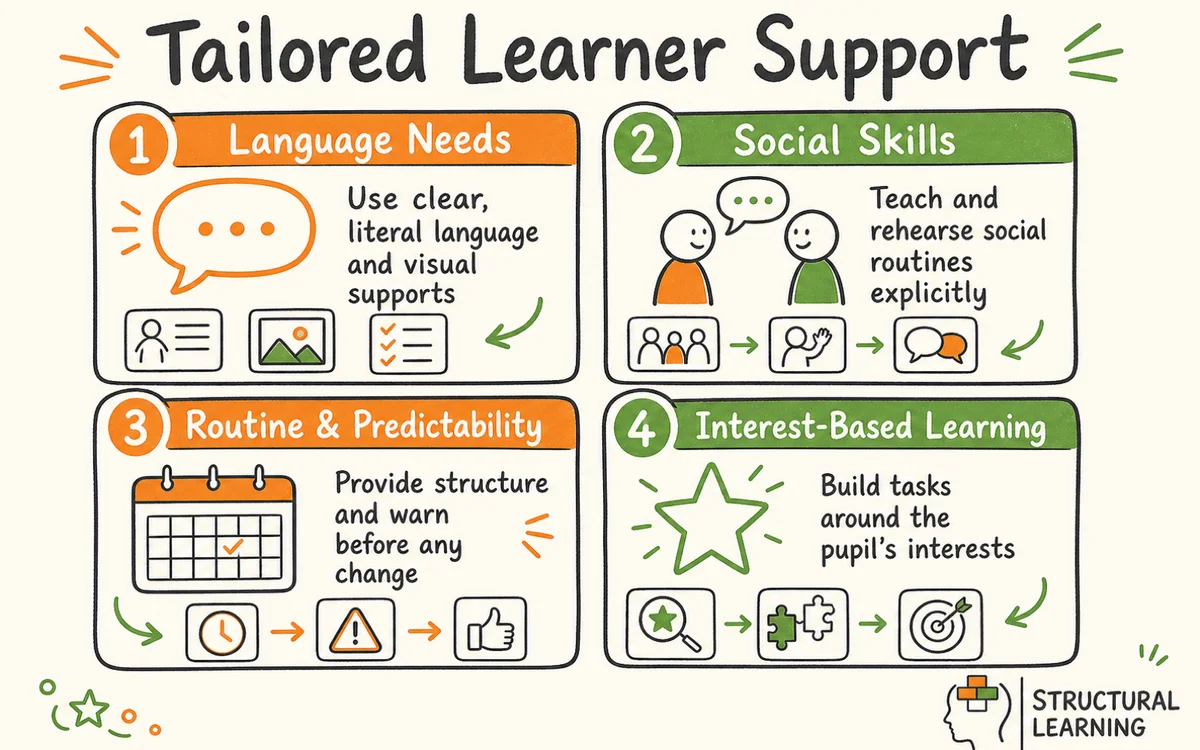
For learners with high needs, use communication aids, sensory supports, and structured programmes. Visual cues, routines, and expectations benefit learners greatly. Give notice of changes and quiet spaces (Kern et al, 2008). Special interests engage learners (Hume et al, 2012; Mesibov et al, 2005).
Attwood (1998) says you should tailor support to each learner's needs. Individual plans help learners access education and develop (Jordan, 2005; Gray & Attwood, 2011).
Baron-Cohen et al. (2009) found that spotting autism early helps learners. However, teachers can still find the signs hard to see. This is often true if learners mask, speak clearly, do well in strict routines or use digital tools to script social life.
In 2026, some autistic learners use GenAI to draft peer messages, rehearse replies or plan what to say before tutor time. That can be useful scaffolding, but it can also hide support needs because the learner appears socially fluent online while exhausted in class (McNally et al., 2024). Spotting these patterns early lets you guide learners with help from your SENCO.
Social communication displays key signs. Autistic learners find turn-taking hard and may interrupt or miss cues. Learners may take language literally, missing sarcasm (Frith, 2003). "It's raining cats and dogs" can confuse learners (Baron-Cohen, 1995; Attwood, 2006).
Sensory differences appear in the classroom in many ways. Some learners find bright lights overwhelming. They may cover ears during fire drills.
Some learners avoid messy textures in art. Others seek strong sensory input, like clicking pens. Rocking in chairs or movement breaks help them focus (Dunn, 1999).
Repetitive actions and strong interests can seem odd, but help learners cope. A Year 3 learner may say train times in maths. A secondary learner may talk about their passion, whatever the lesson. Before stopping these actions, think how to use them in lessons.
Research shows executive function affects learning. Learners may find activity changes hard. Multi-step tasks need support, (Diamond, 2016).
Routine changes can cause stress. Unstructured times, like breaks, are often difficult (Barkley, 2012; Meltzer, 2018). This impacts academic success, (Anderson, 2002).
Track behaviours by writing down triggers and coping methods each week. Vygotsky (1978), Piaget (1952) and Bruner (1960) all point teachers towards close observation, developmentally appropriate support and scaffolded learning. A clear record makes SENCO meetings and EHCP applications easier, and it helps you choose support that fits the learner.
Inclusive classrooms help everyone, and they are especially helpful for autistic learners. The National Autistic Society notes that simple changes to the room can lower anxiety. Use Universal Design for Learning as the default: show the routine visually, give the instruction clearly, model the task, and offer more than one way to respond before a learner has to fail first. Petersson-Bloom and Holmqvist (2022) found that teacher knowledge, attitudes and school-level adaptations shape inclusion, while McGoldrick et al. (2025) frame autism-friendly education around sensory needs, predictability, acceptance, communication and empathy.
Grandin (1995) found visual structure helps autistic learners. Visual timetables allow learners to predict changes and reduce anxiety. Atkinson et al. (2024) found that autistic primary learners value being understood and supported without being made to stand out. Use colours or pictures to label learning areas, and create a quiet sensory area away from group activities.
Attwood (2006) says routines and clear expectations help autistic learners. Review the lesson schedule at the start, noting changes. Grandin (1995) advises using consistent language and avoiding idioms. Use visual guides with verbal instructions for new tasks (Hodgdon, 1999).
Lighting, sound, and touch matter for learners. Seat autistic learners away from noisy equipment where you can. Offer choices for tough sensory tasks, like gloves for art. Consider sensory breaks to help all learners (Grandin, 1986; Bogdashina, 2003).
Communication supports help learners access the curriculum. Use precise examples and plain language; avoid abstract ideas. Explain literal and intended meanings when teaching metaphors. Grandin (1995) notes autistic learners may need more thinking time for questions.
Technology can give learners another way to communicate, as Higgins (2003) found. Interactive whiteboards can display daily routines, while tablets can help learners with limited spoken language join group work. Simple tools such as noise-cancelling headphones can also help learners focus. Even when school budgets are tight, these tools support inclusion (Somekh et al., 2007).
Strong partnerships help autistic learners succeed (Dunst et al., 2011). When families and school staff talk openly, learners often make steadier progress (Guralnick et al., 2007). Consistent support across home and school benefits every learner in the classroom, which the wider home-school partnership evidence base reinforces (Dunst et al., 2011).

According to Epstein (2011), recognise parents as experts. Communicate regularly using diaries or email. Share classroom strategies families can use at home.
For example, offer visual schedule templates aligned with the structured-teaching approach (TEACCH; Mesibov et al., 2005). This helps learners use the same routines at home and school.
Work closely with therapists and educational psychologists to support your learners. Attend review meetings where you can, so you can share what you observe in the classroom. Ask for teaching strategies that connect therapy goals to daily lessons (Dollaghan & Campbell, 1998).
Effective record keeping tracks learning and social progress. Use standard tools to show external experts how the learner is growing, such as behaviour charts, communication examples, sensory logs and attendance patterns.
For headteachers and SENCOs, this is also a budget and legal issue: EHCP disputes become harder when family language says "Asperger's", Local Authority paperwork says ASD, and school evidence only says "coping". Translate labels into barriers you can observe, provision tried, impact and remaining need. This evidence helps with annual reviews, transition planning and tribunal ready decision making (Black et al., 2010).
Autistic learners need careful transition planning due to change difficulties. Start secondary school prep early, with quiet visits (Mesibov & Schopler, 2010). Use visual guides showing key places and staff (Attwood, 2006). Share strategies with new schools for consistent support (Myles & Simpson, 2003).
Personalised support works best for learners with autism spectrum disorder. Research, including Lovaas (1987), shows early support can improve outcomes. Structured programmes can help learners under five (Smith et al., 2000). Support should change as learners develop, according to Howlin (1998).
ABA is evidence based, but practice differs. Teachers use discrete trial training, (Cooper et al., 2020). Writing skills become small steps.
A Year 2 learner holds a pencil, then forms letters. They then write whole words. This system builds confidence and reduces stress.
Speech and language therapy helps learners with communication needs. Therapists may use PECS, communication books or tablet-based AAC alongside spoken-language goals. A learner can use a tablet to join group talk, request help or show understanding during paired work. Plan these tools with the speech and language therapist so classroom use matches clinical targets.
Social skills training is key, especially for learners with former Asperger's diagnoses. Group work helps with conversation, understanding feelings, and social cues. Teachers can run lunch clubs for learners to practise these skills via games. This offers peer interaction alongside teacher support (Attwood, 1998; Gray, 2004).
Sensory supports help learners who experience sensory overload or sensory seeking. Teachers can use headphones for quiet work, fidget tools during carpet time or short movement breaks before writing. These low-cost changes can improve focus and reduce anxiety when they match the learner's sensory profile (Ayres, 1972).
Research from Volkmar et al. (2000) shows social communication differences between autistic learners and those with Asperger's. Wing (1981) found both groups have social problems, but reasons for these differ. These distinctions, Baron-Cohen et al. (1985) argued, help teachers tailor support to meet individual learner needs.
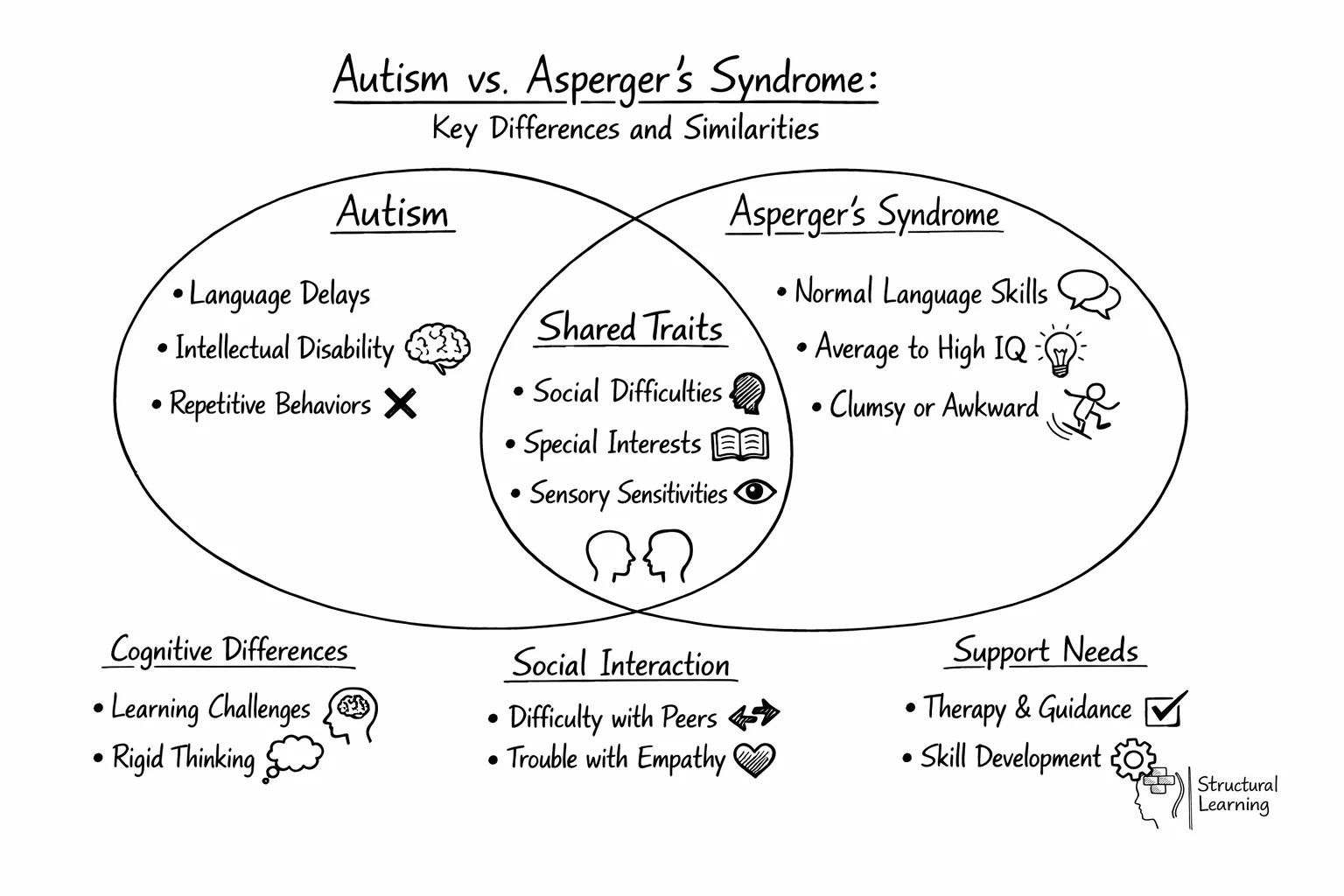
Learners with autism often prefer solo play, showing limited social interest. Joint attention can be hard; they seldom point things out (Mundy et al., 1986). Learners with former Asperger's seek connections but misread cues (Attwood, 1998). They may talk too much about interests or stand too close, wanting friends but lacking skills (Frith, 2003).
Classrooms show clear behaviour differences. A learner with autism may become distressed when routines change, so use visual timetables and warn them early (Attwood, 2006). An overwhelmed learner may flap their hands, withdraw or leave the group.
Learners with a former Asperger's diagnosis may show fewer visible repetitive actions but still think rigidly (Frith, 1991; Wing, 1981). Group work changes can upset them (Gillberg, 1998).
Use quiet spaces and picture cards for learners with autism traits. For learners with a former Asperger's profile, teach social scripts and assign peer partners. If a learner shows intense demand avoidance, treat this as a stress and autonomy signal to discuss with the SENCO, not simple refusal. PDA, sometimes reframed as a Pervasive Drive for Autonomy, remains a contested construct rather than a DSM-5-TR diagnosis, so support should focus on low-arousal choices and individual need (Haire et al., 2024).
Experts like Attwood (2006), Grandin (1995), and Jordan (2005) have written widely on autism support. Reading these evidence-based papers helps teachers see how brain differences affect learning and behaviour. This gives you practical knowledge to support autistic learners in your classroom.
Attwood (2006) explains how autism can affect social understanding, routines and classroom anxiety. Grandin (1995) and Jordan (2005) give practical strategies for daily support. Early work by Wing & Gould (1979) also gives useful background on autism as a spectrum. Use these sources to plan support that fits each learner, rather than relying on the old Asperger's/autism split.
Check Individual Education Plans for learners with ASD, noting effective support. Record each learner's strengths and challenges, not past labels. Collaborate with the SENCO to ensure accommodations are suitable and lawful.
Volkmar et al. (2000) suggest watching learners for social stress signs. Myles & Simpson (2003) found some learners feel anxious or misinterpret play. Regular break-time checks help identify problems early in line with the Myles & Simpson framework cited above.
Learner brains differ; a glasses analogy can help peers understand why support is normal. Discuss learning preferences and strengths in class, then model respectful ways to ask questions. Vygotsky, Piaget and Bruner all show why social interaction, development and carefully structured teaching matter for learning.
Clear, written instructions help learners alongside verbal directions. Establish consistent daily routines and give advance notice of changes. Create quiet spaces for overwhelmed learners or offer sensory breaks.
Use their interests to motivate learning (Kern et al., 1998). Offer alternative ways for learners to show knowledge (for example, written responses, drawing, or modelled answers) as a standard inclusive-assessment adjustment.
Learner engagement often increases when lessons connect with their interests (Deci & Ryan, 2000). Set clear times for learners to discuss interests during class (Wigfield & Eccles, 2002). Skinner (1953) showed why reinforcement shapes behaviour, but in autism support this should mean using interests respectfully to open learning, not withholding a learner's safe topic. Link interests to learning goals in all subjects (Hidi & Renninger, 2006).
Maslow (1943) argued that unmet basic needs can affect focus, behaviour and class participation. This is useful for teachers, but the model has limits when applied to autistic learners. Wahba and Bridwell (1976) found little evidence that humans always follow a strict five-step order of needs.
Later global studies showed that people can still seek friendship, respect and purpose when their physical needs are only partly met (Tay & Diener, 2011). For autism, the latest peer-reviewed guidance on DSM reclassification is available in Lord et al. (2022).
A second criticism is cultural. Maslow focuses on personal success, which reflects a Western view of child development. This does not always fit cultures that value family duties and shared community goals (Hofstede, 1984). This matters because a learner's race, language, gender, family expectations and access to services can shape both diagnosis and classroom support (Weiss et al., 2024).
Maslow based his ideas on personal studies of highly successful people, which makes it hard to apply his theory broadly (Neher, 1991). His framework can also lead us to view autistic behaviour negatively. A teacher may assume a quiet learner lacks safety or belonging.
In reality, the learner may be withdrawing because of sensory overload, anxiety, masking or excessive demand. Maslow's model is still useful for checking basic learning needs, but teachers should use it alongside current autism research and individual learner assessments.
Maslow, A. (1943). A theory of human motivation.
These peer-reviewed studies provide the research foundation for the strategies discussed in this article: