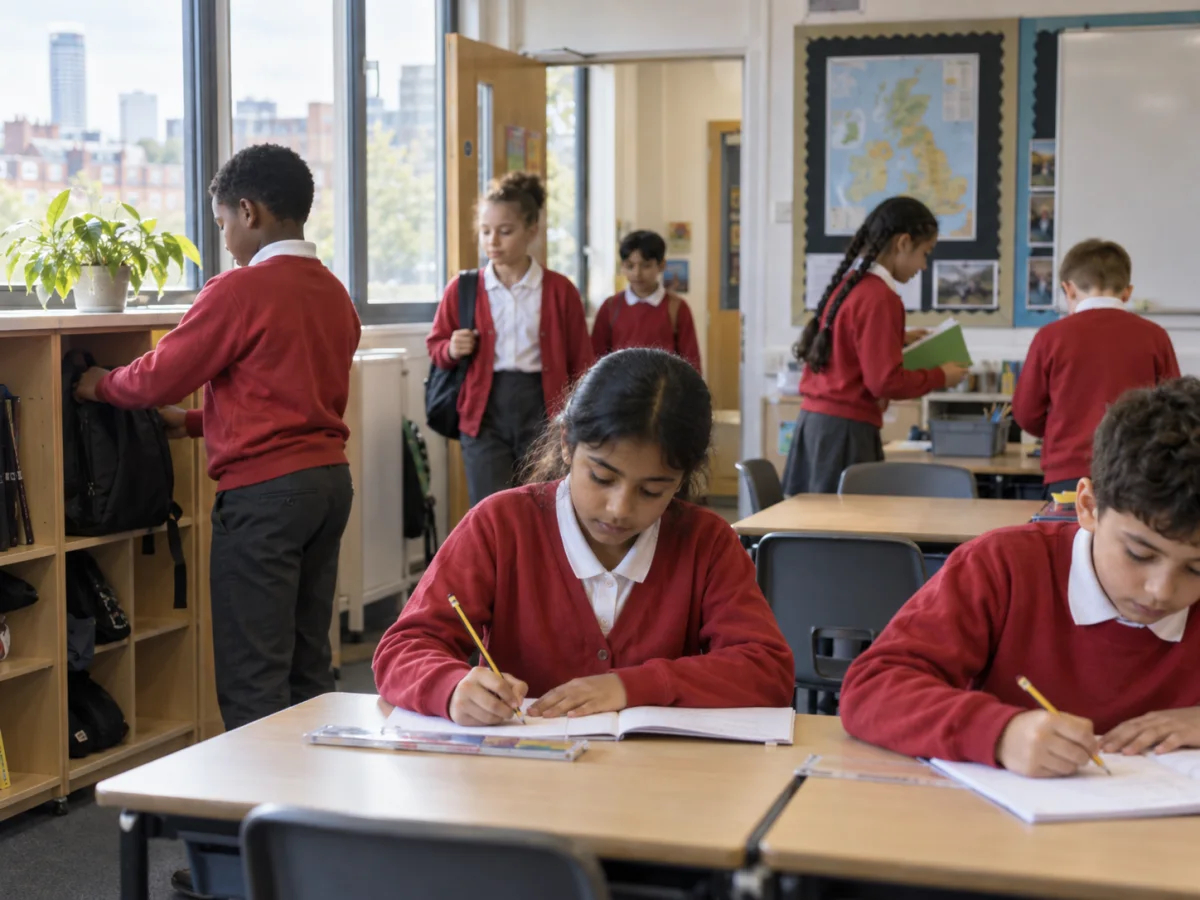
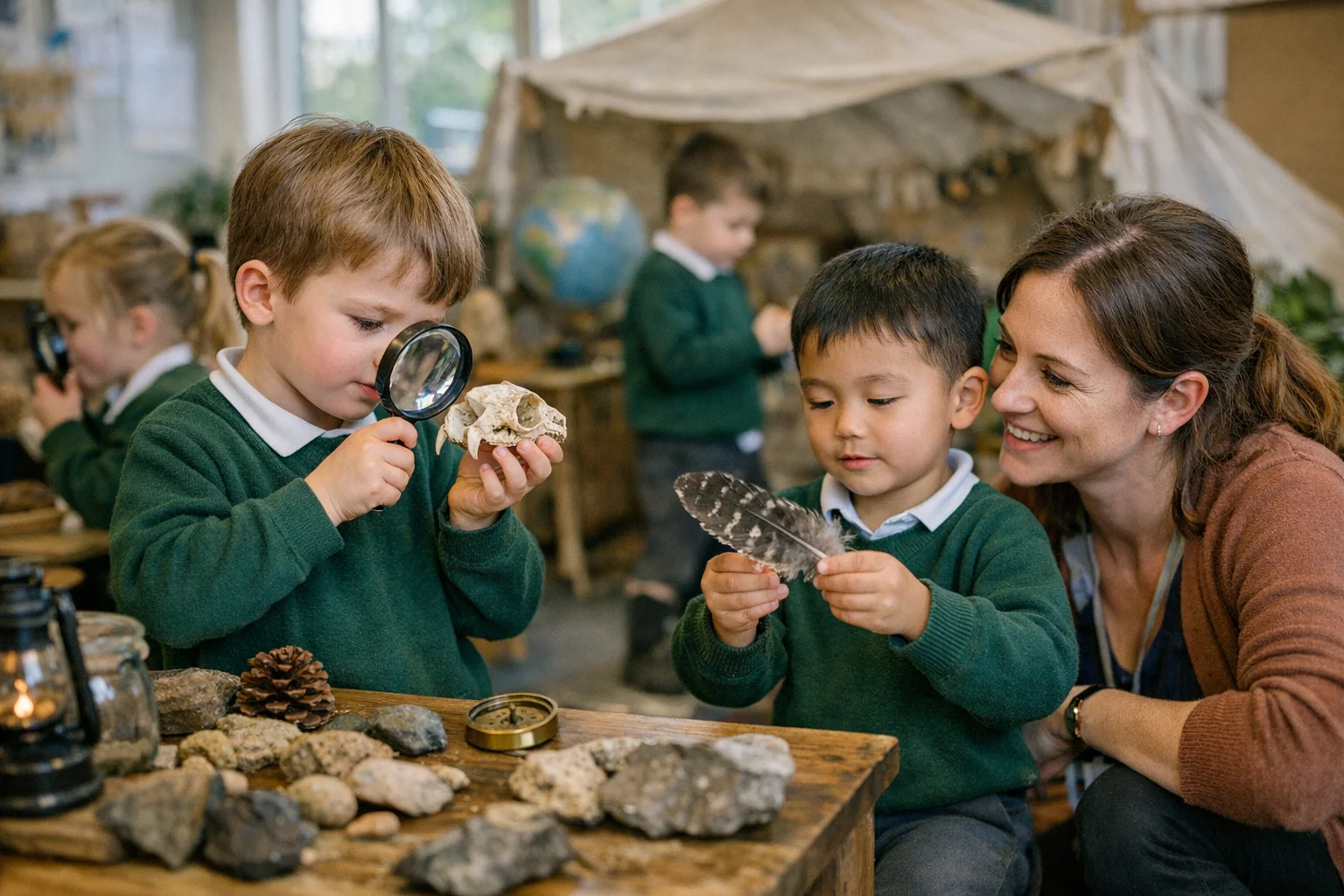
Expeditionary LearningEarly years students in green cardigans and grey trousers exploring expedition-themed learning stations with natural specimens.

Updated on  

February 2, 2026

Expeditionary Learning

|

July 22, 2023

Discover Expeditionary Learning, an innovative educational approach that combines active learning, character growth, and teamwork for holistic development.

Course Enquiry
Copy citation

Main, P (2023, July 22). Expeditionary Learning. Retrieved from https://www.structural-learning.com/post/expeditionary-learning

Exploring Expeditionary Learning: A Teaching Method

Expeditionary Learning represents an effective instructional strategy, extending learning beyond the confines of the traditional classroom and immersing students in authentic, real-world activities. Rather than solely depending on traditional classroom methods, Expeditionary Learning places emphasis on learning through carefully planned expeditions. Here, students actively participate in hands-on projects and fieldwork, enabling them to explore topics in a compelling and engaging way.

Key Takeaways

  1. Beyond Field Trips: Discover how expeditionary learning transforms ordinary topics into multi-week investigations that spark genuine curiosity and deep understanding
  2. Character Through Challenge: Learn why deliberate struggle and collaborative problem-solving build resilience, empathy and citizenship far beyond traditional behaviour management approaches
  3. Projects That Matter: Uncover the framework for designing real-world projects that make students forget they're learning while exceeding academic standards
  4. Culture Shift Blueprint: Master the four principles that transform classroom dynamics from compliance to ownership, creating environments where every student thrives

One of the fundamental principles of Expeditionary Learning is a commitment to character development. Active, experiential learningenhances understanding.al-learning.com/post/active-learning">active, experiential learning

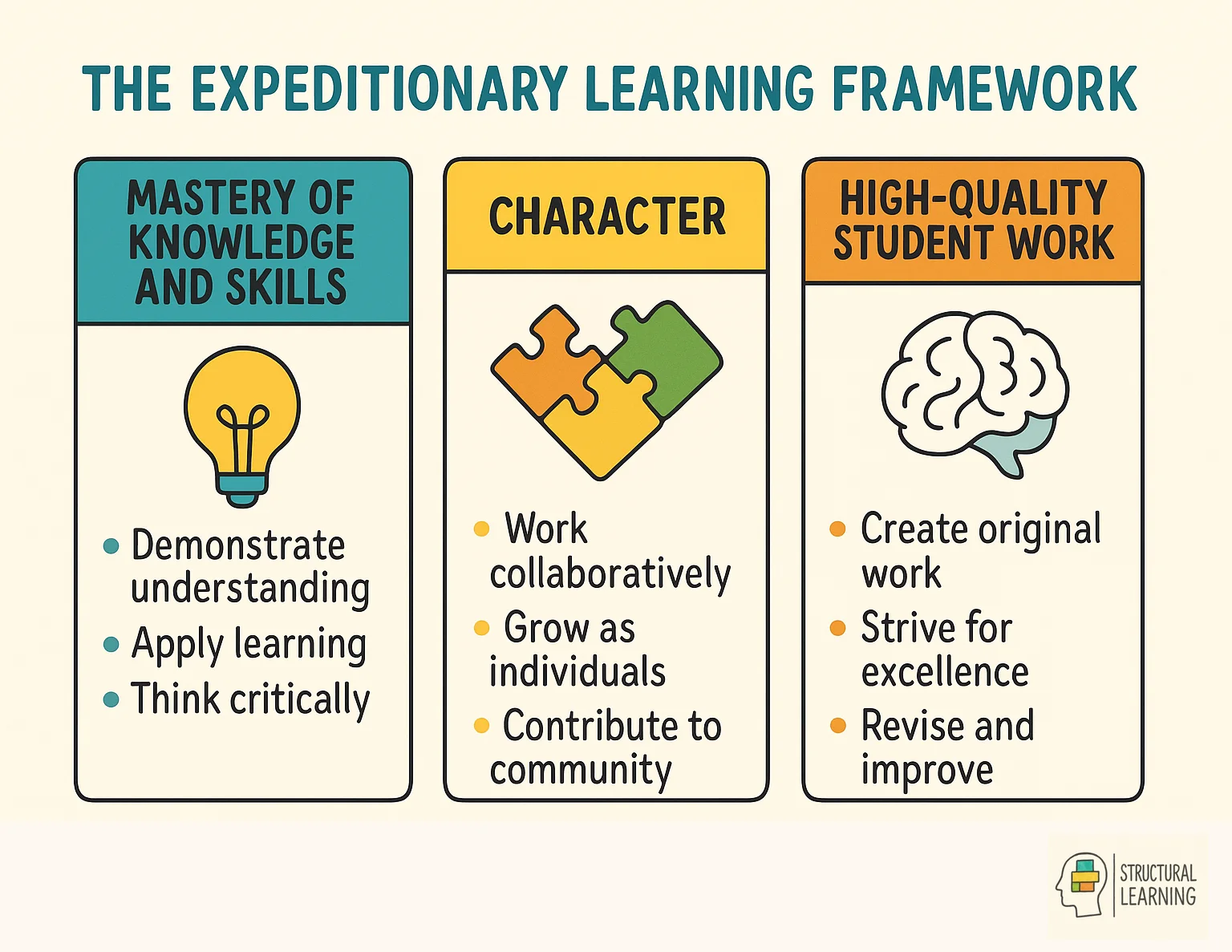
Expeditionary Learning framework showing what it is, how it works, and why it's effective
The Expeditionary Learning Framework

By participating in challenging tasks and working collaboratively with their peers, students develop the ability to overcome obstacles, function effectively within teams, and cultivate enhanced social and emotional awareness.

Another key element of Expeditionary Learning is its profound impact on school culture. Inquiry and curiosity enhances understanding.str

This emphasis on building a positive school culture not only boosts student engagement and academic performance but also establishes an environment conducive to the comprehensive development of each student.

Expeditionary Learning provides a distinctive approach to education, encouraging students to venture beyond the conventional boundaries of the classroom and engage in meaningful activities that promote both academic and personal growth.

By integrating learning expeditions, character development, and a positive school culture, Expeditionary Learning equips students with a comprehensive and enriching educational journey.

What Are the Core Principles of Expeditionary Learning?

The core principles of Expeditionary Learning include commitment to character development through challenging tasks, active experiential learning, collaborative problem-solving, and building positive school culture. These principles transform classroom dynamics from compliance to ownership, creating environments where students develop resilience, empathy, and citizenship. The framework emphasises learning through real-world projects that matter to students and their communities.

Expeditionary Learning is firmly rooted in a set of core principles that serve as the bedrock of this educational philosophy. These principles are inspired by the activities of Outward Bound, which is well-known for its experiential learning expeditions.

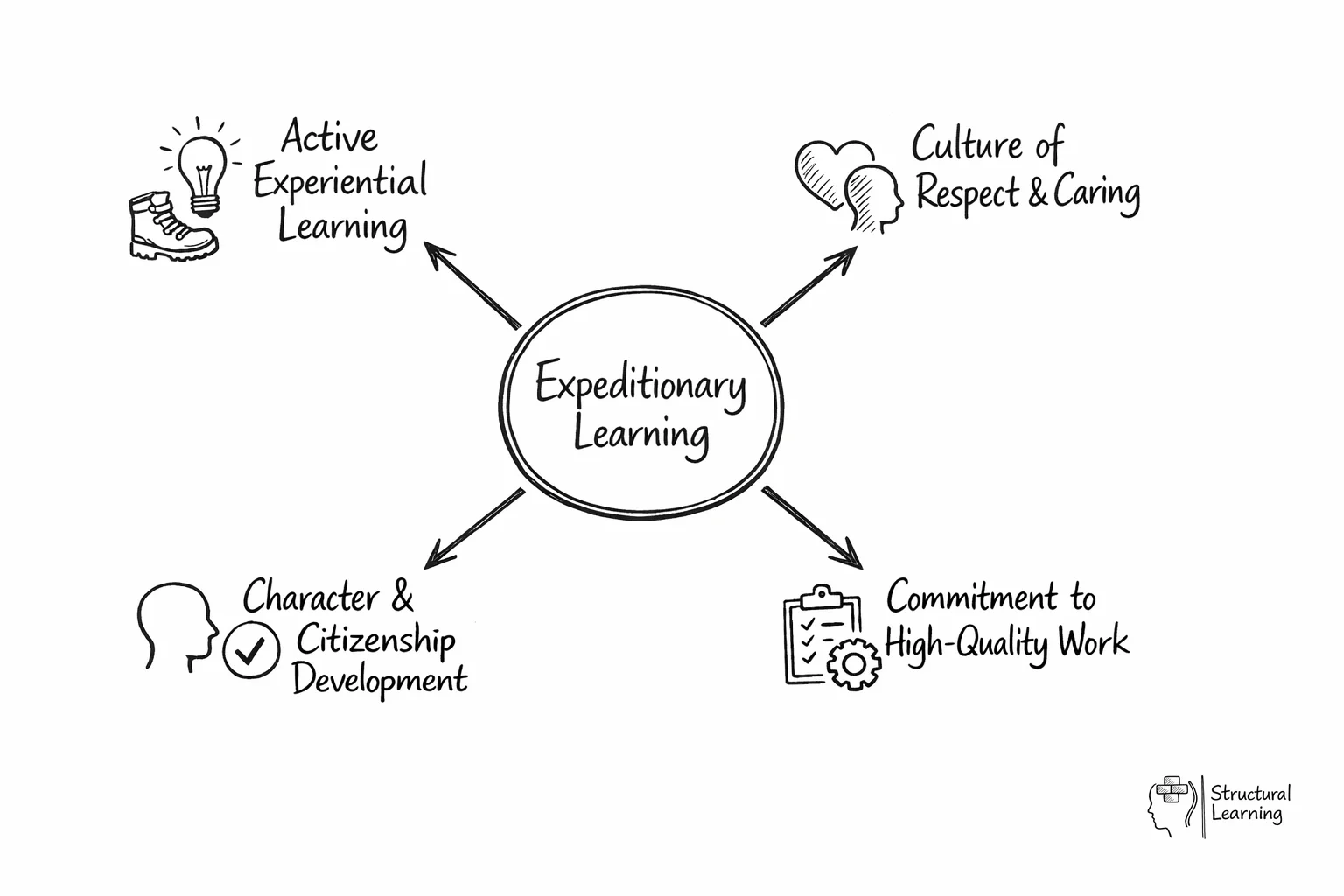
Hub-and-spoke diagram showing Expeditionary Learning's four core principles radiating from center
Hub-and-spoke diagram: Four Core Principles of Expeditionary Learning

These guiding principles influence every aspect of the Expeditionary Learning framework, from the design of the classroom environment to the evaluation of Expeditionary Learning schools.

The first core principle centres on active, experiential learning. Students participate in hands-on activities, real-world projects, and field studies to deepen their comprehension and establish meaningful connections with the world around them.

This principle highlights the significance of learning by doing and motivates students to apply their knowledge in authentic, practical scenarios.

The second core principle emphasises a culture of respect and caring. Expeditionary Learning schools endeavour to cultivate a supportive and inclusiveclassroom atmosphere where every student feels valued and respected. This promotes positive relationships between students and teachers, developing social-emotional development.

The third core principle focuses on the development of character and responsible citizenship. Expeditionary Learning schools aim to instil qualities such as empathy, perseverance, and responsibility in their students. These attributes are nurtured through collaborative projects, teamwork, and opportunities for meaningful service to the community.

Finally, the fourth core principle highlights a commitment to high-quality work. Students are encouraged to produce work that is both meaningful and reflects high standards. They engage in a cyclical process of revision and reflection, refining their critical thinking and problem-solving skills.

These core principles not only shape the design of Expeditionary Learning but also inform the evaluation of Expeditionary Learning schools. Schools are assessed based on their success in embodying these principles and demonstrating their impact on student achievement and character development.

By adhering to these principles, Expeditionary Learning creates a powerful and transformative educational experience for students.

Benefits of expeditionary learning

How Do Projects Drive Learning in Expeditionary Learning?

Projects are at the heart of Expeditionary Learning, providing students with opportunities to apply their knowledge, skills, and understanding to real-world problems and challenges. These projects are not merely add-ons to the curriculum but rather the driving force behind it.

In Expeditionary Learning, projects are designed to be interdisciplinary, incorporating multiple subject areas and connecting learning to students' lives and communities. These projects are often long-term, spanning several weeks or even months, allowing students to examine deeply into a topic and develop a comprehensive understanding.

Furthermore, projects in Expeditionary Learning are student-driven, helping students to take ownership of their learning and make meaningful contributions to their communities. Through project-based learning, students develop essential skills such as critical thinking, problem-solving, collaboration, and communication, preparing them for success in college, career, and life.

Benefits of Expeditionary Learning

Expeditionary Learning offers a range of benefits for students, teachers, and schools alike. For students, it provides a more engaging, relevant, and meaningful learning experience, developing a love of learning and a desire to make a difference in the world. It helps them develop the skills and knowledge they need to succeed in a rapidly changing world, as well as the character and values to be responsible and engaged citizens.

For teachers, Expeditionary Learning offers a more collaborative and rewarding professional experience, allowing them to work closely with students and colleagues to design and implement effective and effective learning experiences. It also provides teachers with opportunities for professional growth and development, as they learn new skills and strategies for engaging students and promoting deeper learning.

For schools, Expeditionary Learning provides a framework for creating a more positive and supportive school culture, where students feel valued, respected, and helped to succeed. It also helps schools improve student achievement and close achievement gaps, as students become more engaged in learning and develop the skills and knowledge they need to succeed.

Implementing Expeditionary Learning in Your Classroom

Successfully implementing Expeditionary Learning requires a fundamental shift from traditional transmission-based teaching towards student-driven inquiry and authentic problem-solving. Begin by redesigning your physical classroom environment to support collaborative work, with flexible seating arrangements that facilitate group discussions and project development. Establish learning stations where students can access research materials, create presentations, and engage with community partners through technology.

The pedagogical transformation centres on developing compelling learning expeditions that connect curriculum objectives to real-world challenges within your local community. Start small by identifying one significant problem that genuinely matters to your students, then scaffold backwards to align with required learning standards. As Dewey's experiential learning theory demonstrates, students retain knowledge more effectively when they can immediately apply concepts to meaningful contexts outside the classroom.

Cultivate partnerships with local organisations, experts, and community groups who can serve as authentic audiences for student work. These connections transform abstract learning into purposeful investigation, where students present findings to genuine stakeholders rather than merely completing assignments for grades. Implement regular reflection protocols and peer feedback sessions to develop critical thinking skills while maintaining rigorous academic standards throughout each expedition.

Real-World Examples of Expeditionary Learning Projects

One compelling example comes from a secondary school in Manchester, where Year 9 students investigated local water quality issues affecting nearby communities. Students conducted scientific tests, interviewed environmental scientists, and presented findings to the city council, demonstrating how authentic audiences transform learning from academic exercise to meaningful inquiry. This project smoothly integrated chemistry, geography, and civic engagement whilst addressing genuine community concerns.

Another successful initiative involved primary students in Sheffield who became 'urban planners' redesigning their neighbourhood playground. Working with local architects and surveying community members, pupils applied mathematical concepts through budget calculations, geometric design principles, and data analysis of usage patterns. The project culminated in presenting proposals to actual planning committees, where several student suggestions were incorporated into the final design.

These examples illustrate Dewey's principle that learning emerges from experience and reflection on real problems. Teachers implementing similar projects should begin with community connections, identifying local issues that naturally span multiple curriculum areas. Success depends on establishing partnerships with professionals who can serve as mentors and authentic audiences, ensuring students understand their work has genuine impact beyond classroom walls.

Assessment and Evaluation in Expeditionary Learning

Assessment in expeditionary learning requires a fundamental shift from traditional testing towards authentic evaluation methods that mirror real-world professional practices. Rather than relying on standardised assessments, educators must design evaluation strategies that capture students' ability to synthesise knowledge across disciplines, collaborate effectively, and present findings to genuine audiences. This approach aligns with Dylan Wiliam's research on formative assessment, emphasising the importance of feedback that advances learning rather than merely measuring it.

Effective assessment strategies in expeditionary learning include portfolio-based evaluation, where students curate evidence of their learning journey, and peer assessment protocols that develop critical evaluation skills. Performance-based assessments, such as community presentations or policy recommendations to local organisations, provide authentic contexts for demonstrating mastery. These methods honour the interdisciplinary nature of expeditionary learning whilst maintaining rigorous academic standards.

Practical implementation requires establishing clear rubrics that balance content knowledge with transferable skills such as communication, collaboration, and critical thinking. Teachers should integrate reflection protocols throughout the expedition, enabling students to articulate their learning process and identify areas for growth. By involving authentic audiences in the assessment process, educators create meaningful accountability that extends beyond the classroom, developing genuine engagement with real-world problems.

Overcoming Common Implementation Challenges

Implementation of expeditionary learning often encounters three primary obstacles: time constraints, assessment alignment, and community partnership development. Many educators struggle to balance the extended timeframes required for authentic project-based learning with curriculum coverage demands. Additionally, traditional assessment methods may not capture the depth of interdisciplinary understanding that emerges through real-world problem solving, creating tension between effective pedagogy and institutional expectations.

Successful implementation requires strategic scaffolding and collaborative planning. Start with shorter expeditions focused on local community connections before expanding to complex, multi-week investigations. John Dewey's experiential learning principles suggest that meaningful engagement develops progressively, making phased implementation more sustainable than wholesale curriculum transformation. Establish partnerships with authentic audiences early in the planning process, ensuring that student work addresses genuine community needs rather than manufactured scenarios.

Assessment challenges dissolve when evaluation becomes embedded within the expedition process itself. Develop rubrics that capture both content mastery and critical thinking skills, involving students in self-assessment and peer evaluation. Document learning through portfolios, presentations to community partners, and reflection journals that demonstrate growth over time. This approach transforms assessment from external judgement to student-driven evidence of learning, aligning perfectly with expeditionary learning's commitment to authentic, meaningful education.

Conclusion

Expeditionary Learning represents a powerful and transformative approach to education, one that helps students to become active, engaged, and responsible citizens. By integrating learning expeditions, character development, and a positive school culture, Expeditionary Learning equips students with a comprehensive and enriching educational journey.

Through its emphasis on real-world projects, active learning, and character development, Expeditionary Learning prepares students for success in college, career, and life, while also developing a love of learning and a desire to make a difference in the world. As education continues to evolve, Expeditionary Learning stands as a beacon of innovation and excellence, inspiring educators and students alike to embrace the challenges and opportunities of the 21st century.

Beginning this journey requires starting small and building confidence through pilot projects. Consider launching with a single interdisciplinary expedition that connects two subject areas, such as combining history and English through local heritage research, or integrating science and mathematics via environmental monitoring projects. Establish partnerships with one or two community organisations initially, allowing time to develop sustainable relationships with authentic audiences who can provide genuine feedback on student work. Professional learning communities within schools prove invaluable, enabling educators to share challenges, celebrate successes, and collaboratively refine their approach to student-driven inquiry.

The ripple effects of implementing Expeditionary Learning extend far beyond individual classrooms. When students engage with real-world problems through meaningful community connections, they develop agency as learners and citizens. Schools report increased parent engagement, stronger relationships with local organisations, and improved school culture overall. For educational leaders ready to embrace this transformative approach, the key lies in providing sustained support for teachers, celebrating the learning process alongside outcomes, and remaining committed to the fundamental belief that all students can achieve academic excellence whilst developing the character and skills needed to contribute meaningfully to their communities.

Further Reading

For those interested in delving deeper into the research and theory behind Expeditionary Learning, the following resources offer valuable insights:

  1. Berger, R., Woodfin, L., Gasper, J., & Hammond, C. (2014). *Leaders of Their Own Learning: Transforming Schools Through Student-Engaged Assessment*. John Wiley & Sons.
  2. Boss, S., & Larmer, J. (2018). *Project Based Teaching: How to Create Rigorous and Engaging Learning Experiences*. Prufrock Press Inc.
  3. Lieberman, D. A., & Hoody, L. L. (1998). *Closing the Achievement Gap: Using the Environment as an Integrating Context for Learning*. State Education and Environment Roundtable.
  4. Rose, D. H., Meyer, A., Strangman, N., & Rappolt, G. (2002). *Teaching Every Student in the Digital Age: Universal Design for Learning*. Association for Supervision and Curriculum Development.
  5. Wiggins, G., & McTighe, J. (2005). *Understanding by Design*. Association for Supervision and Curriculum Development.
Loading audit...

Exploring Expeditionary Learning: A Teaching Method

Expeditionary Learning represents an effective instructional strategy, extending learning beyond the confines of the traditional classroom and immersing students in authentic, real-world activities. Rather than solely depending on traditional classroom methods, Expeditionary Learning places emphasis on learning through carefully planned expeditions. Here, students actively participate in hands-on projects and fieldwork, enabling them to explore topics in a compelling and engaging way.

Key Takeaways

  1. Beyond Field Trips: Discover how expeditionary learning transforms ordinary topics into multi-week investigations that spark genuine curiosity and deep understanding
  2. Character Through Challenge: Learn why deliberate struggle and collaborative problem-solving build resilience, empathy and citizenship far beyond traditional behaviour management approaches
  3. Projects That Matter: Uncover the framework for designing real-world projects that make students forget they're learning while exceeding academic standards
  4. Culture Shift Blueprint: Master the four principles that transform classroom dynamics from compliance to ownership, creating environments where every student thrives

One of the fundamental principles of Expeditionary Learning is a commitment to character development. Active, experiential learningenhances understanding.al-learning.com/post/active-learning">active, experiential learning

Expeditionary Learning framework showing what it is, how it works, and why it's effective
The Expeditionary Learning Framework

By participating in challenging tasks and working collaboratively with their peers, students develop the ability to overcome obstacles, function effectively within teams, and cultivate enhanced social and emotional awareness.

Another key element of Expeditionary Learning is its profound impact on school culture. Inquiry and curiosity enhances understanding.str

This emphasis on building a positive school culture not only boosts student engagement and academic performance but also establishes an environment conducive to the comprehensive development of each student.

Expeditionary Learning provides a distinctive approach to education, encouraging students to venture beyond the conventional boundaries of the classroom and engage in meaningful activities that promote both academic and personal growth.

By integrating learning expeditions, character development, and a positive school culture, Expeditionary Learning equips students with a comprehensive and enriching educational journey.

What Are the Core Principles of Expeditionary Learning?

The core principles of Expeditionary Learning include commitment to character development through challenging tasks, active experiential learning, collaborative problem-solving, and building positive school culture. These principles transform classroom dynamics from compliance to ownership, creating environments where students develop resilience, empathy, and citizenship. The framework emphasises learning through real-world projects that matter to students and their communities.

Expeditionary Learning is firmly rooted in a set of core principles that serve as the bedrock of this educational philosophy. These principles are inspired by the activities of Outward Bound, which is well-known for its experiential learning expeditions.

Hub-and-spoke diagram showing Expeditionary Learning's four core principles radiating from center
Hub-and-spoke diagram: Four Core Principles of Expeditionary Learning

These guiding principles influence every aspect of the Expeditionary Learning framework, from the design of the classroom environment to the evaluation of Expeditionary Learning schools.

The first core principle centres on active, experiential learning. Students participate in hands-on activities, real-world projects, and field studies to deepen their comprehension and establish meaningful connections with the world around them.

This principle highlights the significance of learning by doing and motivates students to apply their knowledge in authentic, practical scenarios.

The second core principle emphasises a culture of respect and caring. Expeditionary Learning schools endeavour to cultivate a supportive and inclusiveclassroom atmosphere where every student feels valued and respected. This promotes positive relationships between students and teachers, developing social-emotional development.

The third core principle focuses on the development of character and responsible citizenship. Expeditionary Learning schools aim to instil qualities such as empathy, perseverance, and responsibility in their students. These attributes are nurtured through collaborative projects, teamwork, and opportunities for meaningful service to the community.

Finally, the fourth core principle highlights a commitment to high-quality work. Students are encouraged to produce work that is both meaningful and reflects high standards. They engage in a cyclical process of revision and reflection, refining their critical thinking and problem-solving skills.

These core principles not only shape the design of Expeditionary Learning but also inform the evaluation of Expeditionary Learning schools. Schools are assessed based on their success in embodying these principles and demonstrating their impact on student achievement and character development.

By adhering to these principles, Expeditionary Learning creates a powerful and transformative educational experience for students.

Benefits of expeditionary learning

How Do Projects Drive Learning in Expeditionary Learning?

Projects are at the heart of Expeditionary Learning, providing students with opportunities to apply their knowledge, skills, and understanding to real-world problems and challenges. These projects are not merely add-ons to the curriculum but rather the driving force behind it.

In Expeditionary Learning, projects are designed to be interdisciplinary, incorporating multiple subject areas and connecting learning to students' lives and communities. These projects are often long-term, spanning several weeks or even months, allowing students to examine deeply into a topic and develop a comprehensive understanding.

Furthermore, projects in Expeditionary Learning are student-driven, helping students to take ownership of their learning and make meaningful contributions to their communities. Through project-based learning, students develop essential skills such as critical thinking, problem-solving, collaboration, and communication, preparing them for success in college, career, and life.

Benefits of Expeditionary Learning

Expeditionary Learning offers a range of benefits for students, teachers, and schools alike. For students, it provides a more engaging, relevant, and meaningful learning experience, developing a love of learning and a desire to make a difference in the world. It helps them develop the skills and knowledge they need to succeed in a rapidly changing world, as well as the character and values to be responsible and engaged citizens.

For teachers, Expeditionary Learning offers a more collaborative and rewarding professional experience, allowing them to work closely with students and colleagues to design and implement effective and effective learning experiences. It also provides teachers with opportunities for professional growth and development, as they learn new skills and strategies for engaging students and promoting deeper learning.

For schools, Expeditionary Learning provides a framework for creating a more positive and supportive school culture, where students feel valued, respected, and helped to succeed. It also helps schools improve student achievement and close achievement gaps, as students become more engaged in learning and develop the skills and knowledge they need to succeed.

Implementing Expeditionary Learning in Your Classroom

Successfully implementing Expeditionary Learning requires a fundamental shift from traditional transmission-based teaching towards student-driven inquiry and authentic problem-solving. Begin by redesigning your physical classroom environment to support collaborative work, with flexible seating arrangements that facilitate group discussions and project development. Establish learning stations where students can access research materials, create presentations, and engage with community partners through technology.

The pedagogical transformation centres on developing compelling learning expeditions that connect curriculum objectives to real-world challenges within your local community. Start small by identifying one significant problem that genuinely matters to your students, then scaffold backwards to align with required learning standards. As Dewey's experiential learning theory demonstrates, students retain knowledge more effectively when they can immediately apply concepts to meaningful contexts outside the classroom.

Cultivate partnerships with local organisations, experts, and community groups who can serve as authentic audiences for student work. These connections transform abstract learning into purposeful investigation, where students present findings to genuine stakeholders rather than merely completing assignments for grades. Implement regular reflection protocols and peer feedback sessions to develop critical thinking skills while maintaining rigorous academic standards throughout each expedition.

Real-World Examples of Expeditionary Learning Projects

One compelling example comes from a secondary school in Manchester, where Year 9 students investigated local water quality issues affecting nearby communities. Students conducted scientific tests, interviewed environmental scientists, and presented findings to the city council, demonstrating how authentic audiences transform learning from academic exercise to meaningful inquiry. This project smoothly integrated chemistry, geography, and civic engagement whilst addressing genuine community concerns.

Another successful initiative involved primary students in Sheffield who became 'urban planners' redesigning their neighbourhood playground. Working with local architects and surveying community members, pupils applied mathematical concepts through budget calculations, geometric design principles, and data analysis of usage patterns. The project culminated in presenting proposals to actual planning committees, where several student suggestions were incorporated into the final design.

These examples illustrate Dewey's principle that learning emerges from experience and reflection on real problems. Teachers implementing similar projects should begin with community connections, identifying local issues that naturally span multiple curriculum areas. Success depends on establishing partnerships with professionals who can serve as mentors and authentic audiences, ensuring students understand their work has genuine impact beyond classroom walls.

Assessment and Evaluation in Expeditionary Learning

Assessment in expeditionary learning requires a fundamental shift from traditional testing towards authentic evaluation methods that mirror real-world professional practices. Rather than relying on standardised assessments, educators must design evaluation strategies that capture students' ability to synthesise knowledge across disciplines, collaborate effectively, and present findings to genuine audiences. This approach aligns with Dylan Wiliam's research on formative assessment, emphasising the importance of feedback that advances learning rather than merely measuring it.

Effective assessment strategies in expeditionary learning include portfolio-based evaluation, where students curate evidence of their learning journey, and peer assessment protocols that develop critical evaluation skills. Performance-based assessments, such as community presentations or policy recommendations to local organisations, provide authentic contexts for demonstrating mastery. These methods honour the interdisciplinary nature of expeditionary learning whilst maintaining rigorous academic standards.

Practical implementation requires establishing clear rubrics that balance content knowledge with transferable skills such as communication, collaboration, and critical thinking. Teachers should integrate reflection protocols throughout the expedition, enabling students to articulate their learning process and identify areas for growth. By involving authentic audiences in the assessment process, educators create meaningful accountability that extends beyond the classroom, developing genuine engagement with real-world problems.

Overcoming Common Implementation Challenges

Implementation of expeditionary learning often encounters three primary obstacles: time constraints, assessment alignment, and community partnership development. Many educators struggle to balance the extended timeframes required for authentic project-based learning with curriculum coverage demands. Additionally, traditional assessment methods may not capture the depth of interdisciplinary understanding that emerges through real-world problem solving, creating tension between effective pedagogy and institutional expectations.

Successful implementation requires strategic scaffolding and collaborative planning. Start with shorter expeditions focused on local community connections before expanding to complex, multi-week investigations. John Dewey's experiential learning principles suggest that meaningful engagement develops progressively, making phased implementation more sustainable than wholesale curriculum transformation. Establish partnerships with authentic audiences early in the planning process, ensuring that student work addresses genuine community needs rather than manufactured scenarios.

Assessment challenges dissolve when evaluation becomes embedded within the expedition process itself. Develop rubrics that capture both content mastery and critical thinking skills, involving students in self-assessment and peer evaluation. Document learning through portfolios, presentations to community partners, and reflection journals that demonstrate growth over time. This approach transforms assessment from external judgement to student-driven evidence of learning, aligning perfectly with expeditionary learning's commitment to authentic, meaningful education.

Conclusion

Expeditionary Learning represents a powerful and transformative approach to education, one that helps students to become active, engaged, and responsible citizens. By integrating learning expeditions, character development, and a positive school culture, Expeditionary Learning equips students with a comprehensive and enriching educational journey.

Through its emphasis on real-world projects, active learning, and character development, Expeditionary Learning prepares students for success in college, career, and life, while also developing a love of learning and a desire to make a difference in the world. As education continues to evolve, Expeditionary Learning stands as a beacon of innovation and excellence, inspiring educators and students alike to embrace the challenges and opportunities of the 21st century.

Beginning this journey requires starting small and building confidence through pilot projects. Consider launching with a single interdisciplinary expedition that connects two subject areas, such as combining history and English through local heritage research, or integrating science and mathematics via environmental monitoring projects. Establish partnerships with one or two community organisations initially, allowing time to develop sustainable relationships with authentic audiences who can provide genuine feedback on student work. Professional learning communities within schools prove invaluable, enabling educators to share challenges, celebrate successes, and collaboratively refine their approach to student-driven inquiry.

The ripple effects of implementing Expeditionary Learning extend far beyond individual classrooms. When students engage with real-world problems through meaningful community connections, they develop agency as learners and citizens. Schools report increased parent engagement, stronger relationships with local organisations, and improved school culture overall. For educational leaders ready to embrace this transformative approach, the key lies in providing sustained support for teachers, celebrating the learning process alongside outcomes, and remaining committed to the fundamental belief that all students can achieve academic excellence whilst developing the character and skills needed to contribute meaningfully to their communities.

Further Reading

For those interested in delving deeper into the research and theory behind Expeditionary Learning, the following resources offer valuable insights:

  1. Berger, R., Woodfin, L., Gasper, J., & Hammond, C. (2014). *Leaders of Their Own Learning: Transforming Schools Through Student-Engaged Assessment*. John Wiley & Sons.
  2. Boss, S., & Larmer, J. (2018). *Project Based Teaching: How to Create Rigorous and Engaging Learning Experiences*. Prufrock Press Inc.
  3. Lieberman, D. A., & Hoody, L. L. (1998). *Closing the Achievement Gap: Using the Environment as an Integrating Context for Learning*. State Education and Environment Roundtable.
  4. Rose, D. H., Meyer, A., Strangman, N., & Rappolt, G. (2002). *Teaching Every Student in the Digital Age: Universal Design for Learning*. Association for Supervision and Curriculum Development.
  5. Wiggins, G., & McTighe, J. (2005). *Understanding by Design*. Association for Supervision and Curriculum Development.

Classroom Practice

Back to Blog

{"@context":"https://schema.org","@graph":[{"@type":"Article","@id":"https://www.structural-learning.com/post/expeditionary-learning#article","headline":"Expeditionary Learning","description":"Discover Expeditionary Learning, an innovative educational approach that combines active learning, character growth, and teamwork for holistic development.","datePublished":"2023-07-22T16:15:09.549Z","dateModified":"2026-01-26T10:09:32.212Z","author":{"@type":"Person","name":"Paul Main","url":"https://www.structural-learning.com/team/paulmain","jobTitle":"Founder & Educational Consultant"},"publisher":{"@type":"Organization","name":"Structural Learning","url":"https://www.structural-learning.com","logo":{"@type":"ImageObject","url":"https://cdn.prod.website-files.com/5b69a01ba2e409e5d5e055c6/6040bf0426cb415ba2fc7882_newlogoblue.svg"}},"mainEntityOfPage":{"@type":"WebPage","@id":"https://www.structural-learning.com/post/expeditionary-learning"},"image":"https://cdn.prod.website-files.com/5b69a01ba2e409501de055d1/69523e00c5c5ade3a7576a19_69523dfe4bcc85b6473c1882_expeditionary-learning-infographic.webp","wordCount":3156},{"@type":"BreadcrumbList","@id":"https://www.structural-learning.com/post/expeditionary-learning#breadcrumb","itemListElement":[{"@type":"ListItem","position":1,"name":"Home","item":"https://www.structural-learning.com/"},{"@type":"ListItem","position":2,"name":"Blog","item":"https://www.structural-learning.com/blog"},{"@type":"ListItem","position":3,"name":"Expeditionary Learning","item":"https://www.structural-learning.com/post/expeditionary-learning"}]}]}