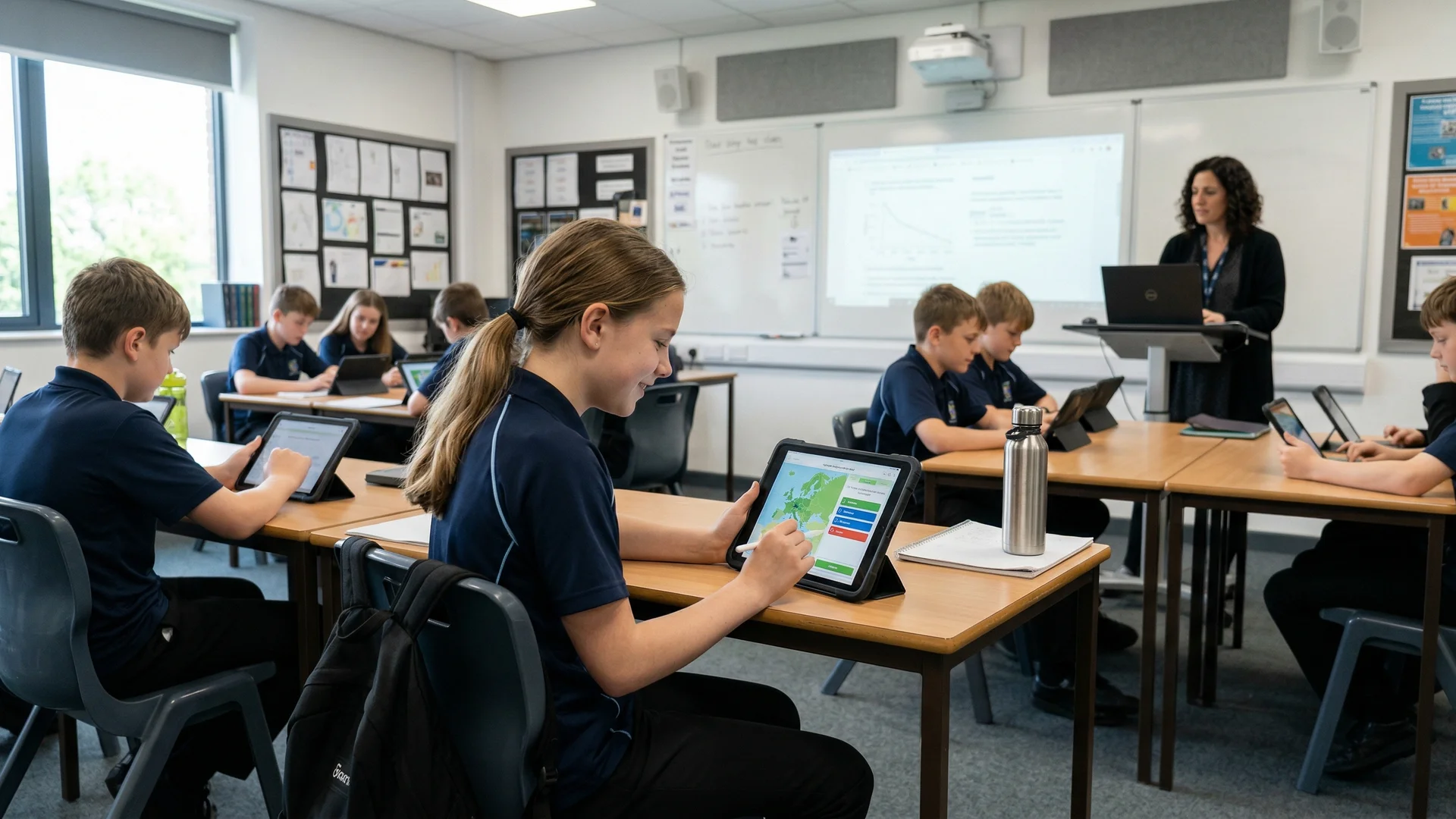
AI in education, adaptive learning, digital literacy, and the evidence behind EdTech. Practical guidance for teachers navigating technology in the classroom. Updated for 2026.
Educational technology is one of the most heavily marketed domains in education and one of the most poorly evidenced. The arrival of generative AI in 2022 compressed a decade of EdTech adoption into two years, leaving many schools uncertain about what to embrace and what to resist. The honest answer from research is that technology is a delivery mechanism: it amplifies good pedagogy and it amplifies bad pedagogy. Hattie (2009) found that educational technology has a moderate average effect size, but the variance is enormous; the determining factor is almost always how the technology is used, not which technology is used.
Adaptive learning platforms adjust content difficulty in response to learner performance, promising personalised instruction at scale. The evidence for adaptive learning is genuinely promising: Ma et al. (2014) found effect sizes between 0.08 and 0.55 across 35 studies. The best adaptive systems are those built on sound cognitive science principles: spaced retrieval, immediate corrective feedback, and mastery gating before progression. Blended learning, which combines face-to-face and digital instruction, has stronger evidence still, particularly when the digital component handles retrieval practice and the teacher uses the resulting data to inform instruction. AI tutoring systems, the newest category, show early promise, but the evidence base remains thin at the time of writing. This hub covers the landscape honestly and gives you the evidence to make informed decisions.
Start with AI in Modern Education for the current landscape, then follow the pathway below.
| Category | What It Does | Evidence Strength | Best Use Case |
|---|---|---|---|
| Adaptive Learning | Adjusts content difficulty and sequence based on real-time learner performance data. | Moderate (Ma et al., 2014). Effect sizes 0.08-0.55 across 35 studies. | Maths and reading fluency practice; retrieval and spaced practice at home; differentiation at scale. |
| Classroom Response Systems | Allow all learners to respond simultaneously (polling, quizzes) so teachers can see the whole class's understanding at once. | Moderate-high. Works because it enables formative assessment and retrieval practice. | Hinge questions, exit tickets, retrieval starters, live misconception diagnosis. |
| AI Writing and Tutoring Tools | Generate content, provide feedback on writing, or answer questions in natural language conversation. | Emerging. Early studies are promising but the evidence base is thin and rapidly evolving. | Providing immediate feedback on drafts; generating differentiated question sets; supporting EAL learners. |
| Learning Management Systems | Platforms (Google Classroom, Teams) for distributing resources, collecting work, communicating, and tracking progress. | Weak as standalone. Value depends almost entirely on how teachers use them pedagogically. | Organising retrieval tasks, flipping instruction, building homework routines, parental communication. |
| Blended Learning | Combines face-to-face instruction with digital learning in a deliberate, integrated way. | Moderate-high. Consistently outperforms purely online or purely face-to-face when well designed. | Freeing teacher time for high-value interactions while technology handles practice and retrieval. |
A balanced overview of generative AI in schools: what it can do, what it cannot, and how to make evidence-informed decisions about adoption.
The two EdTech approaches with the strongest evidence. Both require deliberate design to work: understand the conditions that make them effective.
Build digital literacy across your curriculum. Use response systems to make formative assessment instant and whole-class.
The Structural Learning platform has CPD courses, interactive lesson planning tools, and a growing library of resources built on the research above. Open a free account to browse.
No credit card required.
About this hub. Articles are written by practising educators and reviewed against peer-reviewed research. Citations follow author-date format. New content added regularly. Get in touch if you cannot find what you need.
Start with the most-comprehensive guide in the list below. Look for titles that say A Teachers Guide those are flagship deep-dives. They link out to all the related concepts.
Every article cites peer-reviewed research and translates findings into classroom practice. Where research is contested, we say so. Where the evidence is strong, we explain why and what to do.
Each guide ends with practical next-lesson actions. You can also use our AI lesson planning tools which generate full lesson plans grounded in these methods.