Updated on
September 23, 2026
Teacher Self-Efficacy and Metacognition: Why Belief Matters
Master teacher self-efficacy metacognition implementation. Discover how building your own confidence directly improves learner thinking and self-regulation.


Updated on
September 23, 2026
Master teacher self-efficacy metacognition implementation. Discover how building your own confidence directly improves learner thinking and self-regulation.
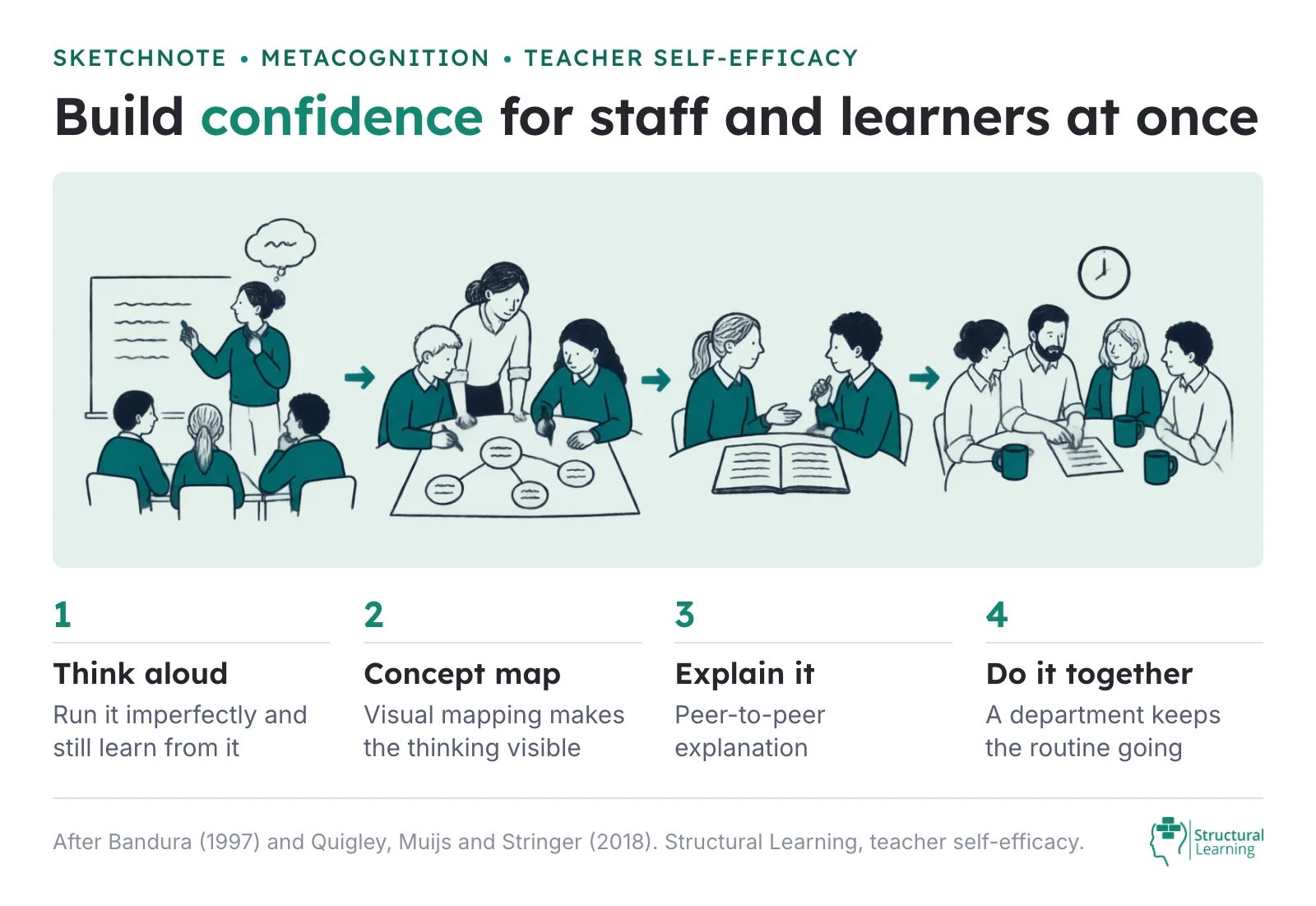
Teacher self-efficacy matters because a teacher who feels a fraud teaching thinking about thinking retreats to vague advice. Confidence comes from running a short routine imperfectly and learning from it: a think-aloud, a concept map or a peer explanation, with the thinking shown, not described.
Teacher self-efficacy is your belief that you can model, guide and check how learners plan, monitor and evaluate their thinking, and it decides whether metacognition reaches the classroom at all. A teacher who doubts that belief turns metacognition into vague advice. A teacher who holds it runs short, visible routines: learners predict how hard a task will be, explain a strategy aloud, or write why an answer changed. Build the belief with three low-stakes routines, watch for the mistakes that drain it, and keep it going across a department.
Self-efficacy shapes how teachers respond when these routines feel messy or slow (Bandura, 1997). A confident teacher can say, 'I am going to model my confusion here', then use prompts, concept maps and peer explanation to move cognitive work back to learners. The aim is not polished performance; it is repeated, observable practice that helps learners recognise how they think and adjust what they do next.
Teacher self-efficacy is your belief that you can plan and carry out what it takes to get a given learning result. When you look at teacher self-efficacy and metacognition implementation together, that belief is the engine that drives success in class. Bandura (1997) showed that efficacy beliefs decide how much effort people put in.
They also decide how long people keep going when things get hard. Teaching learners to think about their own thinking puts plenty of hard things in a teacher's way (Zohar, 2006). For the wider teaching sequence, see our guide on how to develop metacognition.
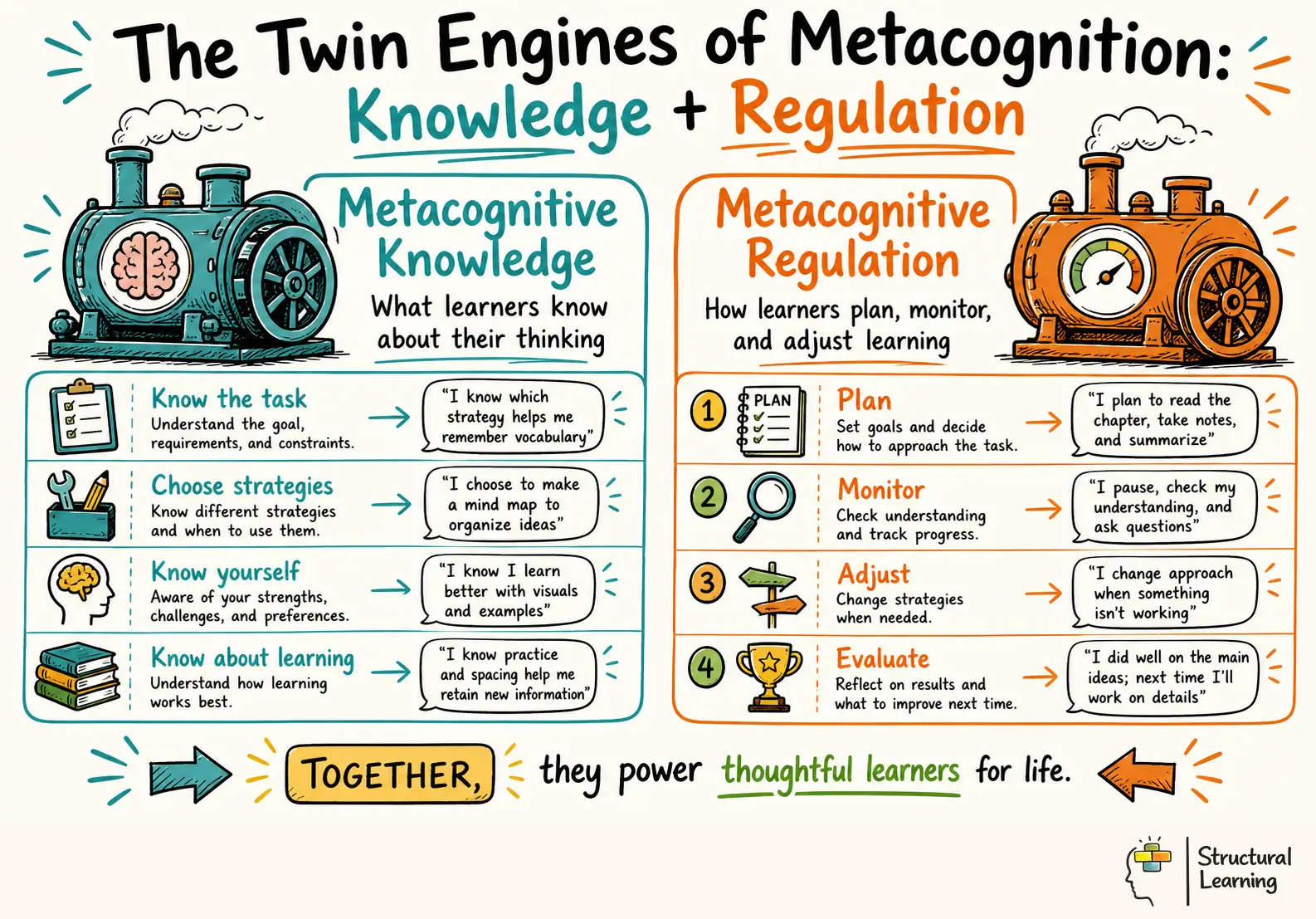
Metacognition has two parts. Our guide to metacognition and cognition sets out both in full. The first is metacognitive knowledge. That means a learner knows their own strengths as a thinker, and knows what a task asks of them. The second is metacognitive regulation.
That means planning, monitoring and evaluating their learning strategies as they go. Schraw, Crippen, and Hartley (2006) place metacognition inside a wider view of self-regulated learning in science education.
But modelling your thinking out loud means showing the class where you are unsure. That exposure can feel uncomfortable for teachers who are not used to making uncertainty public. Teachers hold back from teaching complex thinking strategies that nobody taught them at school. So building self-efficacy is not just a matter of a positive mindset before a lesson.
It is the base you need before you can make abstract thinking visible. Teachers who doubt their own teaching avoid the hard work of modelling how they think. Building that confidence takes set routines you can repeat and that bring early wins in class.
In practice, what the teacher does is say out loud that they are confused by a hard historical source. What the learners produce is a written list of the questions the teacher asked themselves to clear that confusion. That list maps the expert's hidden thinking.
Teacher self-efficacy and self-regulated learning feed each other in a loop (Tschannen-Moran & Hoy, 2001). Teachers who believe in their own skill are far more likely to teach complex metacognitive strategies day to day. As learners build better thinking habits and self-regulation, the whole class does better. You can see it. That success then feeds back into the teacher's belief in their own teaching.
Baumert et al. (2010) showed that pedagogical content knowledge shapes how well a teacher teaches and how well learners do. But subject knowledge on its own is not enough.
You also need the confidence to use it as the lesson shifts. When a teacher doubts they can steer a messy, open reflection task, they fall back on safe, transmission-style teaching. That step back robs learners of the chance to wrestle with hard ideas on their own.
What stops teachers teaching metacognition is rarely a gap in theory. It is the fear of losing control of the room when an open task drifts off course. High self-efficacy lets a teacher treat learner struggle as useful formative data, not as a personal failure. Confident teachers accept that teaching learners to regulate their own learning is messy. It rarely goes in a straight line.
To build that climate, what the teacher does is put up a science hypothesis with a flaw in it. The teacher admits they find the topic hard to put into words. What the learners produce is a corrected hypothesis plus a 'confidence scale' showing how sure they are of their fix. This shows that not being sure is a normal and needed stage of learning.
Putting metacognition into practice means turning theory into short routines you can repeat in class. These routines have to build learner independence and protect teacher confidence at the same time. In every one of them, what the teacher does is give the first, exposed model of thinking. What the learners produce is visible proof of their own thinking, which moves the cognitive load from the front of the room to the desks.
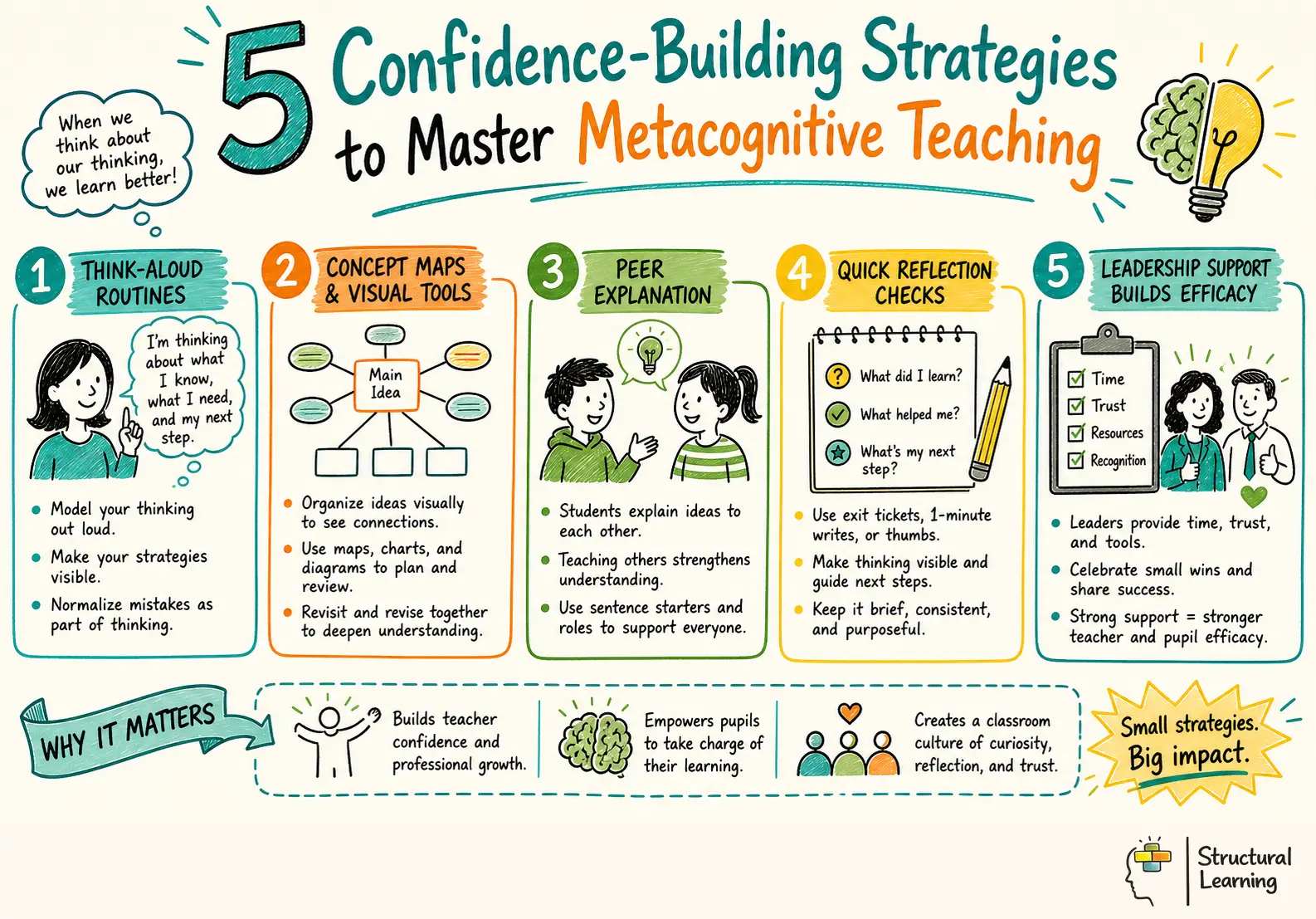
In a think-aloud, the teacher says their inner voice out loud while doing a hard task. The teacher models how to plan an approach, monitor progress against the goal, and judge the final result. Learners watch and listen closely as the expert makes the thinking plain.
For example, a maths teacher models a multi-step algebra equation on the board. Halfway through, the teacher makes a common slip on purpose. The teacher does not fix it quietly. Instead the teacher pauses and says, "Wait, looking at this subtotal, the number seems far too large compared to my initial estimate." The teacher then talks through the exact steps of tracking back up the working to find the mistake.
This routine builds teacher self-efficacy by making error fixing normal. It turns the fear of a public mistake into a planned teaching tool. Learners see that expert thinkers are not flawless calculators. Experts just have better, well-practised ways of spotting and fixing the mistakes they will make.
Abstract thinking is hard to monitor, which makes it daunting for teachers to assess. Visual concept mapping with a tool like 'Map It' gives metacognitive reflection a concrete, physical shape. The teacher hands out a blank graphic organiser. Learners fill it with linked ideas and the reasoning behind each link.
During the task, the teacher moves round the room, looking at the maps taking shape on the desks. Learners use the nodes and the lines between them to explain why one historical event links to another. If a learner's logic has a flaw, it shows at once as a line in the wrong place. The teacher does not have to guess what the learner is thinking.
Teachers get quick, clear proof that learners are learning and thinking. They can step in at the exact point where the thinking breaks down, rather than stopping the whole class to reteach. The physical map makes metacognitive reflection easier both to teach and to assess.
Moving the cognitive load from the front of the room to the learners is a strong efficacy builder. Using structured 'Say It' routines, teachers prompt learners to explain their problem-solving strategies to a partner. The teacher steps back from being the main explainer and becomes an active listener and guide.
The teacher gives sentence stems to guide the talk. Learners use phrases such as, "I decided to use this method because..." or "I realised my first attempt was wrong when...". Learners take turns telling their partner which metacognitive regulation strategies they used. The teacher listens in, gathering formative data on how aware the class is of its strategies.
This approach takes a lot of the pressure off the teacher. You do not need every answer, or to predict every misunderstanding. You just need to give learners a tight structure for questioning their own logic. As teachers watch learners guide one another well, their belief in the metacognitive process firms up.
| Routine, as teachers describe it | What you would notice | What the evidence says |
|---|---|---|
| Staff briefing before classroom rollout objection UK staff CPD on metacognition is a short adult briefing about teacher thinking. It is not a Do It Now, an A3 sheet, or Think Pair Share for the staff. |
Adults sitting as adults. No lining up in the yard. No group-work sheet that belongs in a lesson. | EEF Toolkit: strategies belong in the usual curriculum, not in discrete thinking-skills lessons. |
| Self-reflective questions in the I do In UK schools, one T and L practice on self-reflective questions during the I do, so the teacher’s thinking is audible while the model is on the board.
|
The I do is not silent demonstration. Learners hear the questions the teacher asks themselves. The classroom photograph is redrawn elsewhere, not republished. | EEF Toolkit (May 2025): teachers can promote metacognition by modelling their thinking aloud. Bradford Research School, How to Plan a Think Aloud (15 Mar 2025): script the thinking. Not a trial of this school’s practice. |
| Chosen coach, chosen goal UK trust: performance management replaced by coaching. Staff choose the coach and the goal, then observe and meet as needed.
|
A chosen partner, not a drop-in with a tick sheet. A goal the teacher named. | The replies on that thread disagree. @thegeekydht reports a culture shift after the first round. @MrMetacognition calls whole-school coaching the next fad. No study has tested it. |
| Notice your thinking first Before a think-aloud for learners, the teacher slows down enough to notice the in-lesson decisions they usually skip.
|
A pause in the adult’s own thinking, not a laminated plan-monitor-evaluate poster. Do not generate an AI poster of this. | EEF Toolkit: modelling thinking aloud. The claim is that noticing comes first. @helenrey called the original thread an AI post with an AI poster. No study has tested it. |
| Collab-planning think-aloud, then the class US variant: a teacher rehearses the think-aloud in collab planning before learners arrive, then takes it into the room. UK rooms keep the rehearsal; they do not need the US grade labels.
|
Adults modelling to adults first. Then the same move in front of the class. | EEF Toolkit: model thinking aloud; it can be difficult to realise the Toolkit mean in practice. A tweet is not a trial. |
| Walk for the next move, not silence objection Do not put silence, retrieval starter, cold call or exit ticket on the learning-walk sheet if the aim is metacognition. Look for the think-aloud and what the learner does next. |
A five-minute drop-in that cannot see oracy or thinking. A tick, then a silent room. | EEF guidance, second edition (13 Nov 2025): strategies appear more effective when embedded in a specific subject lesson. A tick sheet of presence is not that. |
| Subject instruction, not a laminated copy Do not implement exit tickets, laminated plan-monitor-evaluate posters, or a learning-to-learn CPD day and call it metacognition. Keep the strategy inside the subject task. |
A poster on the wall. A generic three-word cycle. No subject work attached. | EEF Toolkit (May 2025): +8 months is a mean across 355 studies and can be difficult to realise. EEF, 13 Nov 2025: more effective when embedded in a subject lesson. Hendrick, 12 Apr 2026: it probably emerges from well designed instruction. |
| Learner evidence, not adult look-fors objection US variant of the same tick-sheet fault: do not grade teachers on adult look-fors that appear once an observation. Ask what a learner can show. |
A checklist for adults. A walkthrough that never hears a learner name the strategy. | Same mechanism as the UK silence tick. Catlin Tucker (14 Jul 2025) names time as the first teacher objection in US rooms. Not a trial of look-fors. UK page keeps the UK walk; this is the US name for it. |
Teaching metacognition is often misread, and that leads to poor practice and fed-up teachers. Clearing up these myths keeps your self-efficacy up in the first weeks of trying it. To test a myth in practice, what the teacher does is build a five-minute reflection slot into a normal geography essay. What the learners produce is a 'thinking log' in the margin, noting the exact moments they fixed a mistake.
Metacognition is a separate activity. Many teachers see metacognition as an extra job to do at the end of a busy lesson. The evidence says it has to sit inside the subject teaching itself (Quigley et al., 2018). Teach abstract thinking skills in isolation and they rarely carry over to hard subject tasks.
Teachers must be flawless thinkers. A common myth says you have to be a perfect, fully regulated learner to teach these skills well. In fact, showing your own struggle and confusion teaches your class a great deal. Modelling how you get past your own frustration is worth far more than showing a polished final product.
Self-efficacy ignores actual pedagogical challenges. Some say high self-efficacy is just toxic positivity. They say it ignores what a real classroom is like. It is not. The real thing accepts that teaching metacognitive regulation is very hard. It is the grounded belief that you have the strategies to help learners succeed even so.
Metacognition is only for older learners. A common barrier is the belief that young children are not yet able to think about their thinking. Research shows that even early years learners can monitor their learning, given words that fit their age and visual tools (Whitebread et al., 2009). Waiting until secondary school to start self-regulation seriously holds learners back.
Putting these practices in place needs a planned, tightly structured approach, or the teacher gets overloaded. Start small to protect your confidence, and build up over a half-term. Täschner et al. (2025) find that small, step-by-step mastery experiences are the strongest and most reliable source of teacher self-efficacy.
Here, what the teacher does is run a tightly scripted two-minute think-aloud on a topic they know well. What the learners produce is a tally chart of exactly how many times the teacher paused to check their own working.
Step 1: Choose one task you know well. Pick an activity from a coming lesson that you have taught many times and taught well. A task you know cuts your own cognitive load, so all your attention can go on adding the metacognitive layer.
Step 2: Script your internal monologue in advance. Write down exactly what you will say during your classroom think-aloud. Include the specific questions you will ask yourself aloud about planning and monitoring the task. Planning the struggle makes the public performance feel incredibly safe and controlled.
Step 3: Introduce the routine to the class explicitly. Tell the learners clearly that you are going to show them the hidden thinking behind the academic work. Give them a specific listening task, such as asking them to tally every time you pause to check your own progress.
Step 4: Execute the routine and review the impact. Perform the think-aloud exactly as scripted, including your planned deliberate error. Afterwards, ask the learners directly how your verbalised checks helped solve the problem on the board. Reflect on how this process felt and identify one small tweak for next week's lesson.
Five classroom examples show a process, cause and effect, a timeline, change over time and a mind map.
1 · Process
1 · make learning visible
2 · What is the task?
3 · Is this working?
4 · What next?
A T and L practice put self-reflective questions into the I do so the model was not a silent performance. Learners hear the teacher ask what the task is, whether it is working, and what next.
Bradford Research School, How to Plan a Think Aloud, says script the thinking. How to Plan a Think Aloud.
2 · Cause and effect
The stall · silent demonstration thinking stays in the lecturer
2 · football lecture, no microphone
What unstuck it · put me under the microphone Roles reversed
4 · demonstrate my thinking whilst teaching
Pre-service PE teachers put the lecturer under a microphone during a football lecture, roles reversed. The stall is a silent demonstration; the unstick is hearing the thinking while teaching.
3 · Timeline
1 · pre teaching
2 · worked examples
3 · non examples
4 · scripting
5 · rehearsal
6 · feedback
A drama department named the adult session as rehearsal: pre teaching, worked examples, non examples, scripting, rehearsal and feedback. Staff practise one technique in the subject, not a policy lecture.
4 · Before and after
Before · 2nd grade teacher modeling in collab planning BEFORE they get in front of students
After · 4th grade teacher modeling a think aloud bringing the collab to classroom to life
A collab-planning slot had one teacher model before learners arrived, then another take the think-aloud into the classroom. UK rooms can steal the rehearsal without the US grade labels.
5 · Mind map
assessment cover
Before · Goal · steps to success
3 · Teacher Comment on the same goal
After · What went well · what next
5 · After feedback Keep, adapt, or new goal
The post links to a cover sheet that maps a coaching loop onto an assessment: a goal before the paper and a match after. One sheet, used twice, not a laminated poster.
Selective Blogging, awareness, insights, goals, steps, habits on a G10 to G12 cover sheet. Selective Blogging.
Self-efficacy grows from mastery experiences, and a mastery experience needs evidence you can see (Bandura, 1997). A think-aloud that went fine but left no trace gives you nothing to build your confidence on. So decide before the lesson what landing will look like, and settle for three signs. Each one shows up in the room or in the books, and none of them needs a tick sheet.
Sign one: learners borrow your words, and within a fortnight the checking phrases from your think-aloud turn up in their conversation. A Year 8 maths teacher models "does this look about the right size?" after every step of a calculation. Two lessons later, a learner says to a partner, "hang on, that is bigger than my estimate," without any prompting. What the teacher does is write down the phrase and the name. What the learners produce is your language, in their own talk, on their own work.
Sign two: the pause moves from you to them, as learners start to stop themselves without being told. In a history lesson, the teacher models one question aloud while reading a source: what is it not telling me? A week on, a learner writes that question in the margin before anyone asks for it. What the teacher does is skip the planned pause for one task and count who pauses anyway. What the learners produce is a margin note, or a crossed-out first attempt with the reason written beside it.
Sign three: learners can say when a strategy did not help. This is the strongest sign, and it is the one that looks like failure. A learner who says "I estimated first, but it did not help because I got the units wrong" has monitored and evaluated. The EEF guidance treats evaluation as the third part of regulation, and evaluating includes judging when a plan did not fit (Quigley et al., 2018). Give the class a sentence stem for it, such as "My strategy did not work here because...", and keep the honest answers.
Keep a tally for two weeks: the date, the sign, and one line of evidence. That tally is your mastery record, and it also answers the drop-in problem teachers raise elsewhere on this page. A visitor who ticks for silence will miss all three signs.
If two weeks pass with no sign at all, the routine is not landing yet. Shorten the script or pick an easier task; the belief stays and the design moves.
Metacognitive strategies have to fit the subject they are used in. The core ideas of planning, monitoring and evaluating stay the same. How they look in practice changes a great deal. Whatever the subject, what the teacher does is tie abstract thinking to the rules of that subject. What the learners produce is proof of those three moves, in the language of that subject.
In a creative writing task, the English teacher uses a visual map to plan a complex story arc on the board. The teacher talks through their choices of words and how fast each sentence moves. Learners watch as the teacher weighs up whether a chosen adjective creates the mood they want.
Learners then use their own visual maps to plan their individual paragraphs. The teacher mandates a pause every ten minutes for learners to evaluate their progress. Learners must check if their current writing matches their initial structural plan, making real-time adjustments if the narrative has drifted off course.
A maths teacher sets a hard geometry problem with several unknowns. Instead of teaching the formula straight away, the teacher asks learners to estimate the answer. Learners write down the strategy they plan to use before they touch a calculator.
After the class solves the problem, learners compare their first written strategy with the most efficient method shown. They name where their first plan fell short, or where their monitoring failed. This makes learners judge their maths approach, not just check whether the final number is right.
Before a required practical on rates of reaction, learners predict what the experiment will show. They set out the steps needed for a fair test and say where errors might creep in. The teacher models how to design a results table that makes odd results easy to spot.
During the experiment, the teacher stops the class halfway through. The teacher asks learners to judge how well they are monitoring and how they are collecting data. If a variable is not under control, learners have to find the error in their own plan before they can carry on.
In a PE lesson on gymnastics, the teacher models a tricky vault. Before showing it, the teacher says out loud the physical cues and the mental checklist they use to keep their balance. The teacher then does the vault and, on purpose, fails to stick the landing.
The teacher at once says out loud what went wrong, noting that their weight was too far forward on landing. Learners then pair up to practise their own routines. They must tell their partner their movement plan before they vault. Then they judge their own vault before their partner gives feedback.
Use the questions below to test whether professional development changes classroom practice or adds another short-lived initiative.
question
Give a teacher an audience of adults, then they feel obliged to give you a Do It Now, some sort of group activity involving a sheet of A3 and a Think Pair Share.
What the replies and the evidence say. The same UK window names the feeling as patronising, not “treated like children”. @Botifarradepag1: “Teachers don’t need to rehearse queuing to teach kids how to do it. Patronising staff isn’t the way to get it.” Adult CPD is a briefing about teacher thinking, not a recycled learner activity.
question
Nobody implements "metacognition". They implement something they take on trust to be metacognition, usually the cheapest and most superficially looking version…
What the replies and the evidence say. The same account, same morning: “For example, "Metacognition and self regulation, + eight months" is not a finding, it is a mean drawn across 100s of studies of different interventions”. EEF Toolkit (May 2025): +8 months across 355 studies, and it can be difficult to realise. EEF second edition (13 Nov 2025): more effective when embedded in a specific subject lesson.
question
I'm worried the next big education 'fad' may be whole-school coaching.
What the replies and the evidence say. Teachers differ on whether whole-school coaching adds another burden or helps when teachers choose their coach and goal. @adamboxer1: “Its not "next", its current”. @MissRimmer78 reports a chosen coach and goal across a trust. @KennyInclusion has seen coaching mixed with mentoring so people think they are coaching when they are dishing out advice. The live fight is logistics and choice, not a one-day INSET.
question
But if the learning walk has 'silence' as a tick box, upon which a teachers PM hinges, then silence, not oracy, there will be.
What the replies and the evidence say. The same thread lists retrieval starter, cold call, 3-2-1 and exit ticket as ticks. A five-minute drop-in cannot see a think-aloud. Look for the learner’s next move, not the wall display. EEF (13 Nov 2025): weave it into daily subject teaching, not an extra.
question
Last year was Think/Pair/Share. This year it is Turn and Talk.
What the replies and the evidence say. teachers fight the PD form, not a named metacognition initiative. The rename reads as a compliance eval. Do not sell a US campus a metacognition PD day. Sell one named routine that already lives in a lesson. Time is the named objection on Catlin Tucker’s 14 Jul 2025 post.
question
I will never understand why teachers primarily get graded on adult look-fors—especially those that occur every blue moon with an observation
What the replies and the evidence say. This is the US name for the UK tick sheet. If a campus asks for metacognition look-fors, expect a checkbox. Ask what a learner can show (a strategy named, used, then explained) rather than an adult observation list. Project Zero: a thinking routine is a short sequence of steps used to scaffold thinking, not a walkthrough list.
There are three cautions for teachers. First, metacognition is not a quick technique that works in every lesson. Learners may plan well in English but fail to use the same habits in science, because thinking routines depend on subject knowledge and task type. Willingham (2009) warns that general thinking skills rarely transfer without rich content to think with.
Second, much of the classroom evidence comes from short projects, motivated teachers, or carefully supported trials. That means a school should not expect the same results after one twilight session or a laminated prompt sheet. Third, teacher self-efficacy can be over-sold. Confidence helps teachers model confusion, checking and repair, but confidence without precise examples, agreed language and time for rehearsal can lead to vague advice such as "check your work". The practical test is whether learners can name the strategy, use it on real work, and explain when it helped.
Try one think-aloud this week on a problem you find slightly hard, not one you have rehearsed. Say the doubt out loud when it comes: "I am not sure this method fits, so I am going to check the question again." Then ask the class what they noticed you do. Their answer tells you whether the modelling landed, and it is the first piece of evidence your confidence can stand on.
Begin with a highly scripted think-aloud on a topic you know inside out. Removing subject-matter anxiety allows you to focus purely on the delivery of the cognitive modelling. Success in this small area will encourage you to try more complex strategies later.
Acknowledge the confusion immediately and make it part of the metacognitive process. Say out loud, "I can see this strategy isn't working for us, so I need to evaluate my approach and try a different explanation." This models adaptability and resilience in the face of failure.
No, concept maps are best used as low-stakes formative assessment tools. Grading them often restricts learner creativity and discourages them from mapping their genuine, messy thought processes. Use them to guide your real-time feedback and questioning during the lesson.
Provide highly structured sentence stems to reduce their vulnerability. Start by asking them to evaluate a fictional learner's work before asking them to evaluate their own. Gradually increase the expectation for self-explanation as classroom trust builds.
Mandating strategies rarely builds genuine teacher self-efficacy. Leaders must provide time for collaborative planning and peer observation of these routines. Confidence grows through shared professional experiences and observing colleagues succeed with the same methods. When addressing these concerns in a staff meeting, what the teacher does is share a brief video clip of their own failed think-aloud attempt, explaining how they recovered. What the observing colleagues produce is a collaborative risk assessment identifying potential pitfalls in their own upcoming lessons.
Bandura, A. (1997). Self-Efficacy: The Exercise of Control. W. H. Freeman. ISBN 9780716728504.
Baumert, J., Kunter, M., Blum, W., Brunner, M., Voss, T., Jordan, A., Klusmann, U., Krauss, S., Neubrand, M. and Tsai, Y.-M. (2010). Teachers' mathematical knowledge, cognitive activation in the classroom, and student progress. American Educational Research Journal, 47(1), 133 to 180.
Dignath, C. and Veenman, M. V. J. (2021). The role of direct strategy instruction and indirect activation of self-regulated learning: Evidence from classroom observation studies. Educational Psychology Review, 33(2), 489 to 533.
Education Endowment Foundation (2025). Metacognition and self-regulation. Teaching and Learning Toolkit. Education Endowment Foundation.
Quigley, A., Muijs, D. and Stringer, E. (2018). Metacognition and Self-Regulated Learning: Guidance Report. Education Endowment Foundation.
Schraw, G., Crippen, K. J. and Hartley, K. (2006). Promoting self-regulation in science education: Metacognition as part of a broader perspective on learning. Research in Science Education, 36(1-2), 111 to 139.
Tschannen-Moran, M. and Woolfolk Hoy, A. (2001). Teacher efficacy: capturing an elusive construct. Teaching and Teacher Education, 17(7), 783 to 805.
Täschner, J., Dicke, T., Reinhold, S. and Holzberger, D. (2025). "Yes, I can!" A systematic review and meta-analysis of intervention studies promoting teacher self-efficacy. Review of Educational Research, 95(1), 3 to 52.
Whitebread, D., Coltman, P., Pasternak, D. P., Sangster, C., Grau, V., Bingham, S., Almeqdad, Q. and Demetriou, D. (2009). The development of two observational tools for assessing metacognition and self-regulated learning in young children. Metacognition and Learning, 4(1), 63 to 85.
Willingham, D. T. (2009). Why Don't Students Like School? A Cognitive Scientist Answers Questions About How the Mind Works and What It Means for the Classroom. Jossey-Bass.
Zohar, A. (2006). The nature and development of teachers' metastrategic knowledge in the context of teaching higher order thinking. Journal of the Learning Sciences, 15(3), 331 to 377.