Updated on
October 7, 2026
Inclusion Bases in Schools: The DfE Guidance Explained
The DfE's 2026 inclusion bases guidance explained: six principles, support vs specialist bases, funding, and a free evidence-annotated self-audit tool.


Updated on
October 7, 2026
The DfE's 2026 inclusion bases guidance explained: six principles, support vs specialist bases, funding, and a free evidence-annotated self-audit tool.
Fifty-eight per cent of parents whose child attends a SEND base in a mainstream school report a positive experience, and 41 per cent describe it as entirely positive. Ask only the parents who wanted that placement, and the positive share climbs to 80 per cent (DfE parent survey, June 2026, 960 parents). The gap between those numbers is the whole story of inclusion bases. They work when families choose them and staff shape them deliberately. They struggle when they become somewhere learners are simply put.
The Department for Education published Inclusion bases in schools on 25 June 2026: 73 pages of non-statutory guidance produced with the Council for Disabled Children and nasen, informed by over 500 schools and settings, over 20 local authorities, over 100 expert lead practitioners, 30 parents and carers, and 34 children and young people. This guide reflects the June 2026 guidance as it stands in July 2026. It explains what the guidance asks of schools, what the research behind it actually shows, and how to audit your own provision against all six principles.
An inclusion base is a dedicated space within a mainstream school where learners with special educational needs, or learners who need behavioural or pastoral support, receive targeted teaching and specialist intervention from what the guidance calls "a skilled, teacher-led team". The term is new, but the provision is not. It formally replaces SEN unit, resourced provision and pupil support unit, and the guidance defines those legacy terms in its Annex B.
The status of the document matters as much as its content. It is non-statutory, so nothing in it creates a new legal duty. Where the guidance says "should", it is recommending. Where it says "must", it is pointing at a duty that already exists in law, such as the mandatory qualification for teachers of classes with sensory impairments.
Two verifiable facts anchor the rest. First, inspection: "Where a school has an inclusion base this is inspected by Ofsted as part of the school inspection." There is no separate inspection regime. Second, scale: in the DfE's own School and College Voice survey, 22 per cent of primary leaders and 68 per cent of secondary leaders report using a unit as a dedicated space away from the mainstream classroom, so this guidance describes something most secondary schools already run in some form.
If you are building your wider SEND knowledge first, start with what inclusion actually means in education and the broader principles of inclusive education, then come back to the base as one specific vehicle for both.
The guidance names two commissioning models, and the difference is who pays and who decides.
| Support base | Specialist base | |
|---|---|---|
| Commissioned and funded by | An individual school, an academy trust, or a local group of schools | The local authority |
| Typical layer of support | Targeted Plus | Specialist |
| Places decided by | The school or trust | The local authority |
| Typical use | Short-term targeted help alongside mainstream lessons | Ongoing intensive provision for higher levels of need |
One distinction stops SENCOs reading the document wrong. Targeted, Targeted Plus and Specialist are the national layers of support from the SEND white paper, not a taxonomy of bases. Bases occupy only the top two layers: support bases typically deliver Targeted Plus, and specialist bases deliver Specialist. The universal and targeted layers below them are ordinary classroom business, which is why the guidance keeps insisting on a strong universal offer before any base opens. Our guide to ordinarily available provision covers that foundation layer.
The policy context sits in the white paper Every child achieving and thriving and its five reform principles: early, local, fair, effective, shared. For the full programme, read our overviews of the SEND white paper for teachers and the 2026 SEND reforms for school leaders. This article stays on the base itself.
The most useful page in the guidance is Figure 1. It places every base on a continuum between two poles: at one end, a base that provides access to a dedicated learning area, which the guidance's prose calls a specialist space; at the other, a base that supports access to mainstream classes, an inclusive service. The axis between them is time in mainstream classes, and the DfE adapts the model from research by Strogilos and Ward.
The direction of travel is explicit: schools should "prioritise movement along the continuum to mainstream classes", while recognising that for some learners, long-term access to a base as a dedicated learning area is appropriate and fully compatible with inclusion. The continuum is a planning tool, not a league table.
Minutes in mainstream are not the real outcome, though. Across 375 children in four mainstream primaries, the frequency of meaningful contact with peers predicted peer-relation outcomes more strongly than either SEN status or behaviour (Pinto et al., 2018). A learner can spend 80 per cent of the week in mainstream classes and still be isolated in every one of them. When you place your base on the continuum, ask what the mainstream minutes contain, not just how many there are.
Try this tomorrow: sketch the continuum on your whiteboard in your next inclusion meeting. Mark where your base sits today and where you intend it to sit, then name the single barrier between the two marks. That one conversation surfaces more strategy than most annual reviews.

The guidance organises everything a base should do under six principles, each with a named exemplar school. Verbatim, they are:
Each principle section of our free audit tool below is mapped to the relevant recommendation from the Education Endowment Foundation's Special Educational Needs in Mainstream Schools guidance report.
Here is a detail you can check for yourself: not one of the DfE's own twelve spotlight schools calls its provision an "inclusion base". The real names in the document include Resource Base, The Eagles, Enhanced Provision Unit, Willow Room, Integrated Resource, Additionally Resourced Provision, The Willows, ELEVATE, Specialist Classroom, Cognition and Learning Needs Base, and Big Base and Little Base.
The DfE has coined an umbrella term that none of its own exemplars uses. That is not a criticism, but it has a practical consequence for you: colleagues, parents and local authorities will keep saying resourced provision and SEN unit for years, and search engines will keep being asked those terms too. Use the new vocabulary in policy documents, and keep translating it in conversation.
The exemplars are worth reading in their own right. The King's Academy runs three integrated bases in one secondary school, covering cognition and learning needs, vision impairment and hearing impairment, with around 90 per cent mainstream access for learners with sensory impairments. Its cognition and learning classes move around the school like any other set, sharing the same curriculum structure, uniform and routines. That is the continuum's inclusive-service pole made concrete.

The DfE is honest about the evidence base, and the honesty is worth quoting:
"Whilst there are several academic studies that identify strong benefits associated with inclusion bases as a form of provision, their scale and scope are limited."
The strongest recent evidence is genuinely encouraging. A three-year study of specialist resource centres for autistic learners found placement associated with higher attainment and stronger school belonging than mainstream schools without such a centre, and found that perceived peer and teacher support was the strongest correlate of good outcomes throughout (Cook et al., 2026). The honest headline is not that bases work. It is that relationships work, and bases help when they build them.
Parent-side evidence points the same way. Parents whose child attended a mainstream school with a specialist resource tended to be more positive about the provision than parents whose child was included individually into a mainstream school (Lindsay et al., 2016). First-year parent and learner perceptions of resource provisions are broadly positive too (Hebron and Bond, 2017).
The critical literature deserves equal weight, because your governors will not read it and your learners will live it. Experienced teaching assistants perceive a divide between "the mainstream" and the base whether or not the base is geographically separate (Lehane, 2016). Special units can render their learners a visible minority group within the school, and they promote genuine inclusion only where the norms of the mainstream school itself change (Holt et al., 2012). Learners with the highest needs can experience a separated, impoverished pedagogical diet (Webster et al., 2015), and one-to-one adult support, the most intuitive model of inclusion, is also one of the most restrictive when it is unexamined (Butt, 2016; Webster et al., 2021).
The National Deaf Children's Society has analysed what the guidance means for deaf learners specifically, a useful companion wherever a base serves sensory impairments.
One more finding belongs here because no official document will say it. A SENCO's published account of hosting a resourced provision reported that it improved inclusive values among its learners, while the provision's attainment data damaged the school's headline performance measures. The school, in the author's words, "paid the price for its commitment to inclusion" (Glazzard, 2013). Any leader weighing up a base should price that accountability tension in from the start.
One sentence in the guidance should be printed on the base door:
"Access to an inclusion base, even for behavioural or pastoral support, should never be used as a sanction or for removal from the classroom."
The family-involvement duties reinforce it. Schools must involve parents and carers in planning and reviewing their child's progress, and parents and carers should be involved in decisions about their child accessing a base. Where learners are directed offsite to improve behaviour by accessing base support, the governing board must notify parents in writing; education law firm Ward Hadaway has summarised the legal detail of the new guidance.
For learners with an EHC plan, the admissions mechanics matter: section I of the plan must name the mainstream school, and the provision described in section F will normally indicate what is delivered through the base. If those documents are unfamiliar territory, our teacher's guide to EHCPs and the EHCP annual review guide cover them, and the SENCO's role article sets out who holds which duty.
In practice the sanction line is where bases quietly go wrong. A learner sent to the base "to calm down" after an incident, with no plan and no parental conversation, is a removal wearing a support lanyard. If your base has a behaviour-adjacent purpose, write entry and exit criteria for it now, before the guidance's spirit is tested by a bad Tuesday.
Reading guidance is not the same as meeting it, so we built a free self-audit tool against all six principles, and it does three things the guidance itself cannot.
First, it is atomic. We distilled the guidance's school-facing "should" statements into 56 individually ratable criteria across seven sections, because a paragraph of prose cannot honestly take a single score.
Second, it is evidence-first. Every criterion puts a compulsory evidence cell physically before the 1 to 5 rating, with anchored descriptors at 1, 3 and 5. Self-assessment inflates without evidence and external challenge (León et al., 2023), and it inflates most where practice is least secure (León et al., 2021), which is exactly why the tool also names a moderator and sets a re-rate date.
Third, it covers the commissioning duties. The guidance's commissioning section carries three of its statutory musts, including dual registration and accurate census recording, and none of them appears in the six principles, so a school could score five on every principle and still be non-compliant. Our section C7 closes that gap.
The pack includes a continuum positioning page that turns Figure 1 into an instrument, a printable A4 landscape PDF, and an editable Word companion for recording evidence digitally, which mirrors how nasen ships its own reflection framework. Ten criteria carry a MUST badge so the legal duties are visible at a glance.
Use it the way the sector-standard instruments are used: one section at a time, evidence before ratings, moderated by someone who does not work in the base, such as a peer SENCO or a trust inclusion lead. A rating without evidence is a guess. A rating without moderation is a hope.
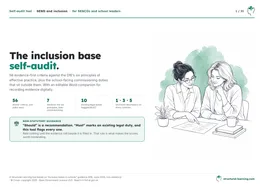
56 evidence-first criteria against all six DfE principles, plus the commissioning duties.
Instant download · from structural-learning.com

Honest limitations, because a critique-literate SEND audience will spot them anyway.
It is non-statutory, and schools know it. Nothing here compels action, and commentators flagged the "take it or leave it" status within days of publication; Schools Week has a concise news summary of what the guidance asks. The counterweight is that the musts it points to are real law, and Ofsted inspects the base as part of the school inspection.
The new money is capital, not staffing. The guidance attaches "at least £3.7bn between 2025 and 2030" in high-needs capital funding to the expansion, and capital builds and adapts spaces. Running costs fall to the existing per-place funding of £6,000 or £10,000 plus top-up, and whether that stretches to a skilled, teacher-led team is the question the guidance leaves with schools.
The evidence base is thin, and the DfE says so. It is funding new research, which is the right response, but today's guidance runs ahead of today's evidence. A recent analysis of 3.8 million children's linked education and health records found SEND provision overall showed no measurable benefit on attainment or hospital admissions, though it modestly reduced unauthorised absences in some subgroups, and the authors themselves caution about what their measures could capture (Gilbert et al., 2025). Analysis of key stage 1 data also shows large attainment gaps and a postcode lottery in provision for learners with SEND (Azpitarte et al., 2023).
Accountability still punishes hosts. The Glazzard finding above predates this guidance by over a decade, and nothing in the document resolves it. Until performance measures account for hosting specialist provision, some schools will pay for their commitment to inclusion in their headline data.
None of this argues against bases. It argues for building yours deliberately, with evidence, and with eyes open, which is precisely what an honest audit supports. Where a base is not the right vehicle at all, provision like nurture groups may fit the need better.
Do not start with a working party. Print the continuum page from the audit pack, put it in front of your head of inclusion this week, and mark two positions: where your base sits today and where you intend it to sit by July. Then name the single barrier between the marks and give it an owner and a date. Everything else in the guidance, and everything in the audit tool, hangs off that one honest conversation.
An inclusion base is a dedicated space in a mainstream school where learners with special educational needs, or learners needing behavioural or pastoral support, receive targeted teaching and specialist intervention from a teacher-led team. The term was introduced in the DfE's June 2026 guidance and replaces SEN unit, resourced provision and pupil support unit.
The guidance itself is non-statutory: its "should" statements are recommendations. But real legal duties still attach to running a base, because they exist in other law: dual registration and accurate census recording, section I of an EHC plan naming the mainstream school, written parental notification for offsite direction, and the mandatory qualification for teachers of classes of learners with sensory impairments.
A support base is commissioned and funded by an individual school, an academy trust or a local group of schools, and typically delivers the Targeted Plus layer of support. A specialist base is commissioned and funded by the local authority and delivers the Specialist layer, usually for higher levels of need.
Yes, as part of the school. The guidance states that where a school has an inclusion base, Ofsted inspects it within the normal school inspection. There is no separate inspection framework for the base itself.
Functionally, yes. Inclusion base is the DfE's new umbrella term, and the guidance's Annex B defines resourced provision, SEN unit and pupil support unit as the legacy terms it replaces. Notably, none of the twelve exemplar schools in the guidance itself uses the new name yet.
The studies behind the claims in this article, including the critical voices. References are complete so you can locate each paper through your library service.
The impact of specialist resource centres on autistic pupils' experience of mainstream school
Cook et al. (2026), Autism
A three-year study following 119 autistic learners and 119 matched peers across seven schools. Placement in a specialist resource centre was associated with higher attainment and stronger school belonging than in mainstream schools without such a centre, and perceived peer and teacher support was the strongest correlate of good outcomes throughout. The practical message: the relationships a base builds matter more than the room itself.
Meeting the educational and social needs of children with language impairment or autism spectrum disorder: the parents' perspectives
Lindsay et al. (2016), International Journal of Language and Communication Disorders
Parents whose child attended a mainstream school with a specialist resource tended to be more positive about the provision than parents whose child was included individually into a mainstream school. Useful evidence for conversations with families weighing up placement options.
Developing mainstream resource provision for pupils with autism spectrum disorder: parent and pupil perceptions
Hebron and Bond (2017), European Journal of Special Needs Education
Interviews with 16 parents and 9 learners across eight resource-provision schools during their first year. Perceptions were broadly positive, and the quality of home-school relationships shaped how well placements settled.
Teaching assistants and the perceived divide between the mainstream and the base
Lehane (2016), Educational Review
Experienced teaching assistants perceived a divide between the mainstream and the SEN base whether or not the base was geographically separate. A caution that belonging is built through whole-school culture, not floor plans.
Special Units for Young People on the Autistic Spectrum in Mainstream Schools: Sites of Normalisation, Abnormalisation, Inclusion, and Exclusion
Holt et al. (2012), Environment and Planning A
Association with a unit can render learners a visible minority group within their school. The authors conclude that units promote genuine inclusion only where the norms of the mainstream school itself change, which is exactly what the guidance's first principle asks.