Updated on
October 8, 2026
Cold Calling Strategies: 5 Warm Steps and a Printable
Cold calling strategies for the classroom: five warm steps, what it looks like in KS2, teachers' objections answered, X quotes and a printable routine table.


Updated on
October 8, 2026
Cold calling strategies for the classroom: five warm steps, what it looks like in KS2, teachers' objections answered, X quotes and a printable routine table.
Cold calling is a questioning technique where the teacher selects learners to respond rather than relying on volunteers. Instead of asking "Who can tell me?" and waiting for the same three hands, the teacher names the learner first: "Priya, what did you notice about the character's motivation?" Every learner stays mentally engaged because anyone could be called upon at any moment.
Wiliam (2011) found random calling helps with assessment. This stops volunteers hogging all the response time. Cold calling lets you see each learner's understanding clearly.
Cold calling works because it closes the gap between listening and thinking. In a classroom where only volunteers speak, the majority of learners can sit passively, processing at surface level. When cold calling is the norm, every learner must prepare a response because they know they might be asked.
Roediger and Karpicke (2006) state that retrieval practice improves learning. When learners recall what they know, the memory pathways get stronger. Cold calling gives every learner this kind of practice.
Cognitive load theory explains another benefit. When learners know they will be asked, they allocate more working memory to processing the content. A Year 9 Science teacher explaining osmosis gets better attention from 30 learners when all of them expect to be called on than when five learners plan to volunteer and 25 plan to wait.
Rosenshine (2012) showed good teachers check learners' understanding frequently. He also suggested teachers ask lots of questions. Cold calling lets you check every learner's grasp of concepts (Rosenshine, 2012).
Helen Reynolds posted a researchED slide with this sequence. The photograph is not republished. The drawing is ours. One orange wash. The words to say sit on the printable.
Write it before the lesson. A retrieval line is short. An elaborate line needs a longer pause.
The class already knows someone will be asked. That is the warm half of a cold call.
The question hits the room. Silent thinking time. No name yet.
Choose on purpose. A warm invitation, not an interrogation. Not a stick.
A second voice builds. Then the whole class shows. I do not know is not an exit.
Public views on cold calling, shown as three verbatim excerpts from posts on X. Follow each link for the complete post. These are opinions, not research evidence.
But it should be calm, predictable and supported by thinking time. The aim is not to catch pupils out.
You do need to promote it as an opportunity and permit 'passes'.
Pushback
Awful to stamp out enthusiasm with a blanket no hands up policy.
| Feature | Hands up | Cold calling |
|---|---|---|
| Who thinks | Self-selected learners | Every learner |
| Teacher data | Biased sample (confident learners) | Representative sample |
| Participation rate | Typically 15 to 20% of the class | 100% potential engagement |
| Metacognitive load | Low for non-volunteers | Higher for all learners |
Volunteer-only questioning gives teachers a narrow sample of class understanding. Cold calling is safer when it is routine, paired with adequate wait time, and framed as a normal participation structure rather than a surprise test. Dallimore, Hertenstein and Platt (2013) provide the strongest direct evidence here, while Rowe (1986) supports the wait-time principle.
Assessment for learning data can be unreliable. Poor data is not useful (Black & Wiliam, 1998). Good data shows the whole class progress quickly (Christodoulou, 2017; Hattie, 2012). Use sound data to guide teaching and support each learner.
The shift from hand-raising to cold calling is not about catching learners out. Teachers who use cold calling effectively frame it as a supportive routine: "I ask everyone because I am interested in what everyone thinks."

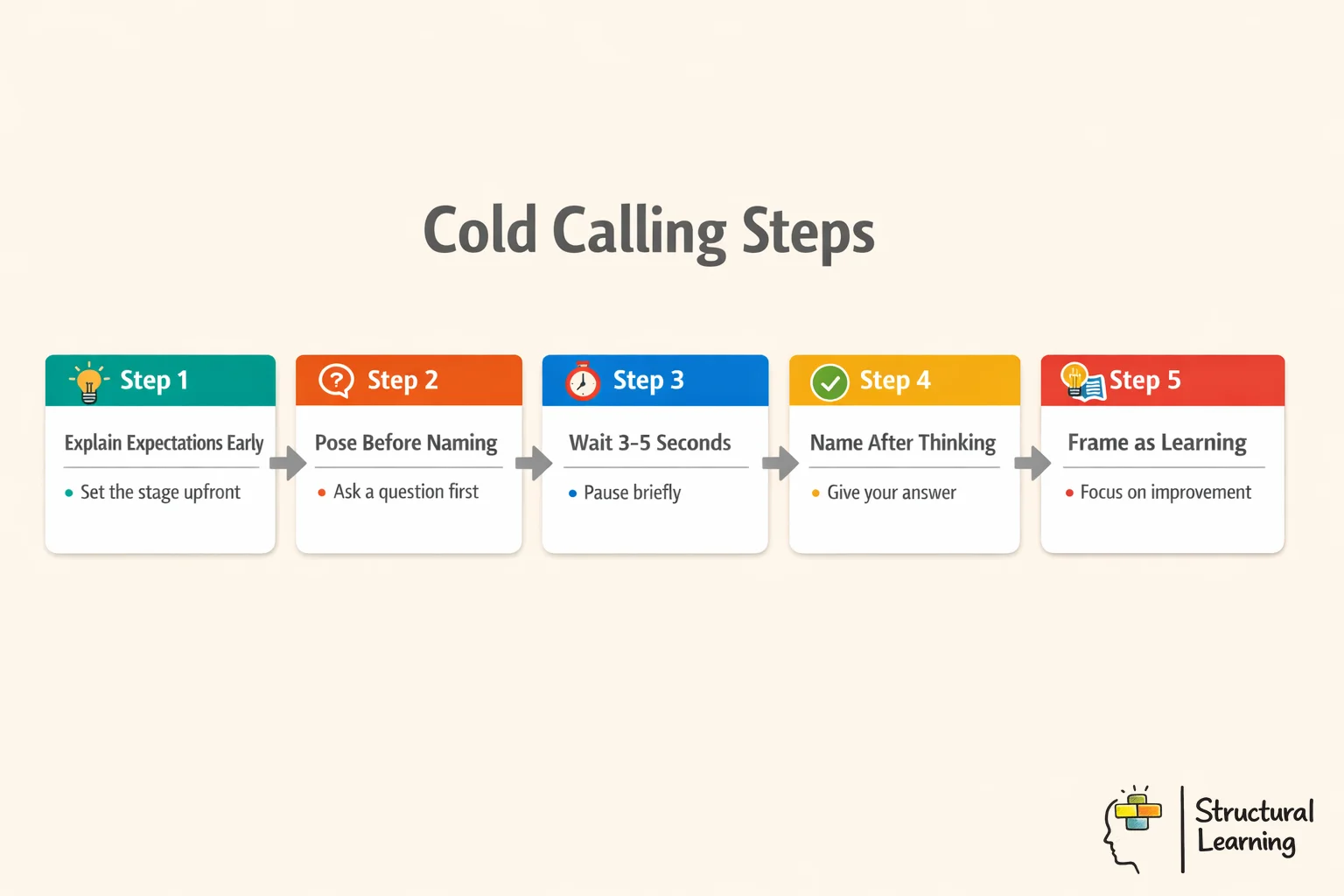
Introduce cold calling in the first week. Explain the reasoning: "In this classroom, I will ask people by name. This is not a test. It is how we learn together." Explain and model this expectation consistently.
In a Year 7 English class, the teacher might say: "I am going to ask five of you what you noticed about the poem's opening line. There are no wrong answers at this stage. I want to hear your first impressions." This sets a low-stakes entry point.
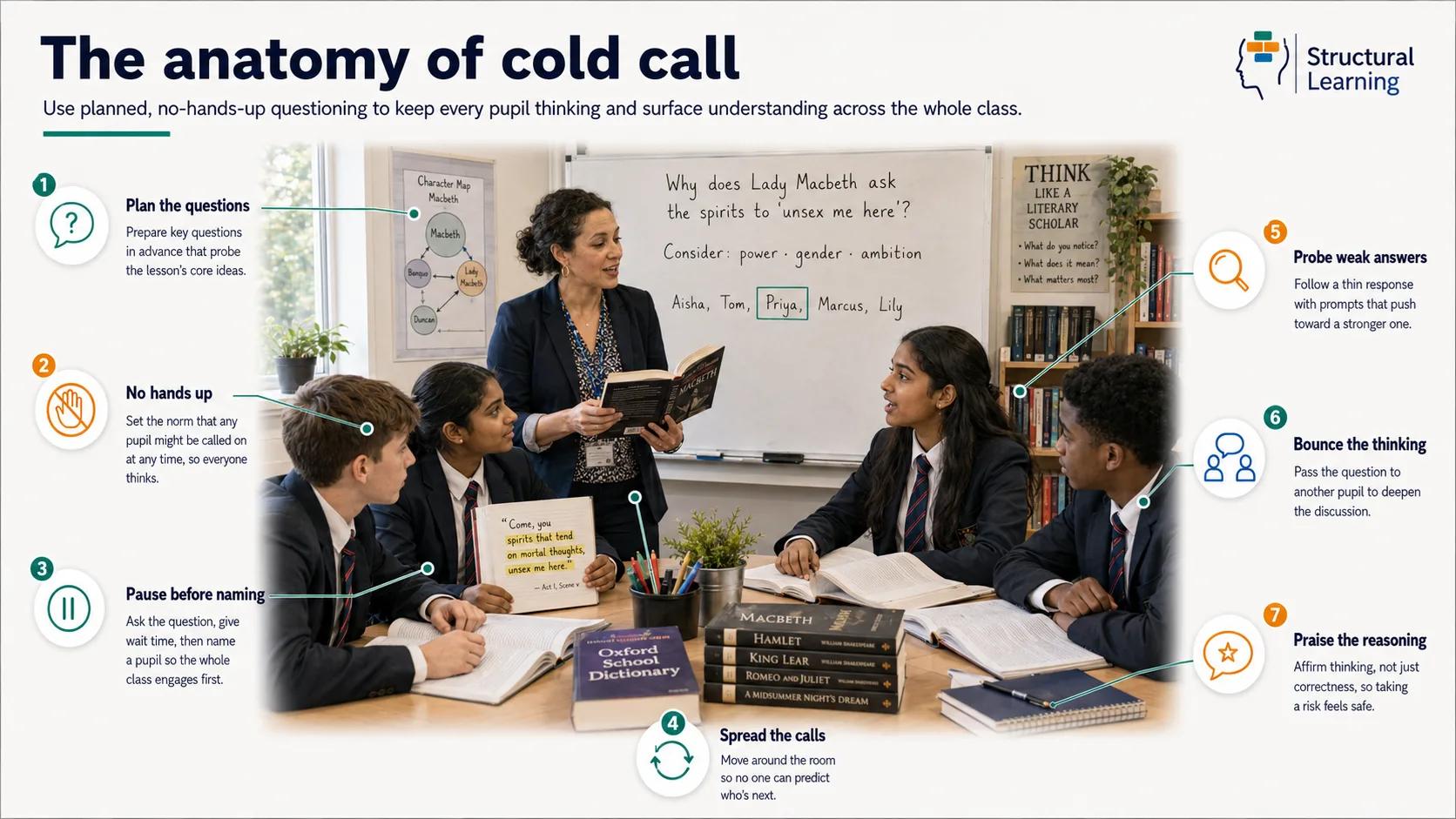
This is critical. Say: "What is the function of the mitochondria?" Pause for three to five seconds. Then: "Marcus." Every learner must process the question because the name comes last. If you say "Marcus, what is the function of the mitochondria?" only Marcus needs to think.
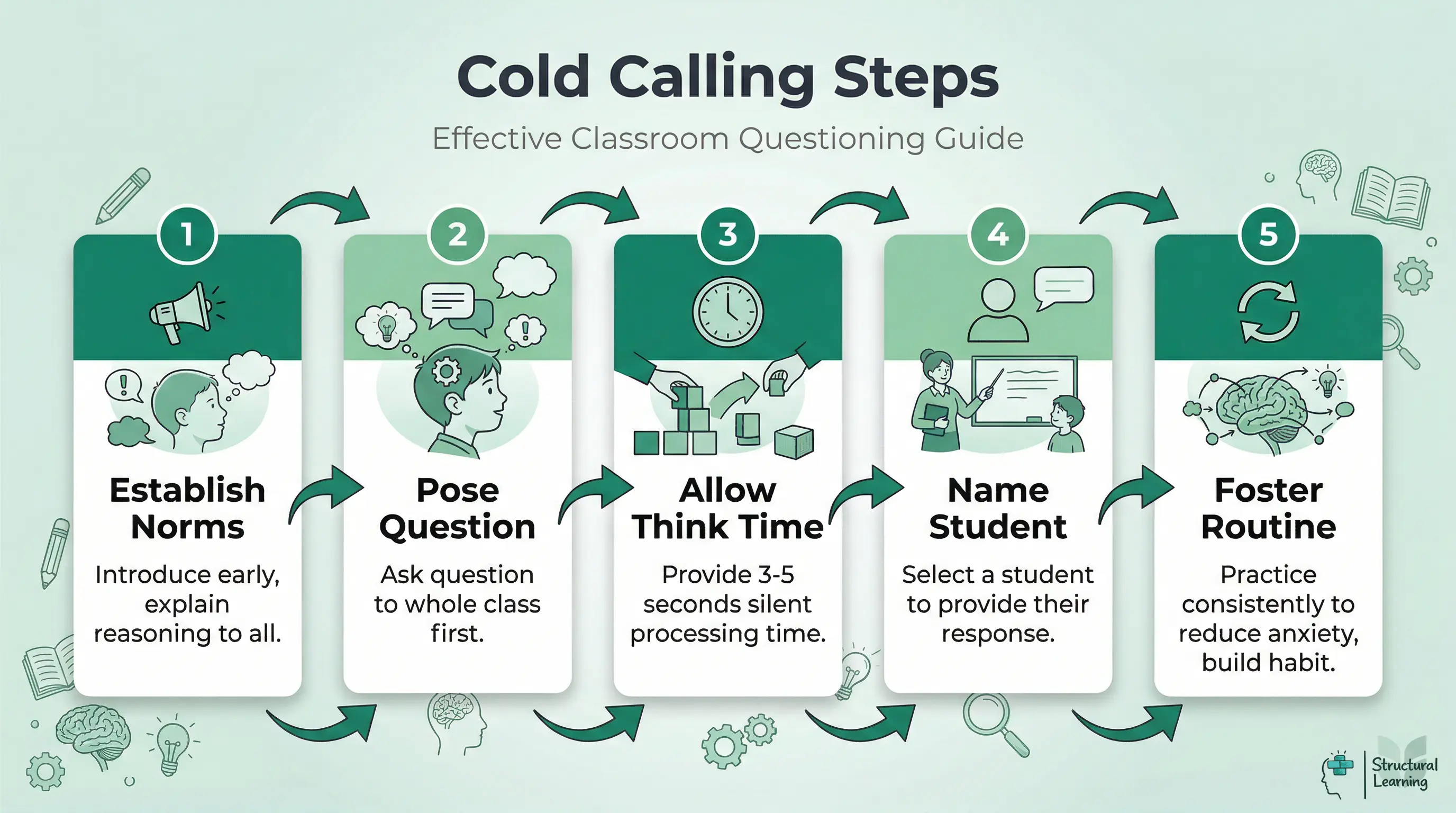
Doug Lemov (2015) calls this Cold Call: ask, pause, then name. Teachers in the UK often know the same sequence as pose, pause, pounce, bounce. The pause is where the thinking happens.
After posing the question, give learners three to five seconds of silent thinking time. This supports learners with slower processing speeds and those learning English as an additional language. Research by Mary Budd Rowe (1986) showed that increasing wait time from one second to three seconds improved the length and quality of learner responses.
For more complex questions, extend thinking time or pair it with a brief "think, then write" moment. A Year 10 History teacher might say: "I want you to identify two causes of the Industrial Revolution. Write them down. You have 30 seconds." Then cold call: "Aisha, what did you write?"
Cold calling does not mean putting learners on the spot without support. Use sentence stems: "The character seems to feel... because..." This gives learners with weaker verbal fluency a structure to build on. The Structural Learning Thinking Framework provides ready-made sentence starters through the Say It protocol, which pairs naturally with cold calling.
Use sentence stems, rehearsal time and a "phone a friend" option as practical scaffolds. Learners can ask peers for help if unsure, then repeat or refine the answer so the class still hears their thinking.
Make cold calling a predictable routine. Give learners thinking time and support rather than assuming that familiarity will remove anxiety. Teachers can use:
The Thinking Framework cards work well here too. Teachers can assign thinking skill cards to learners and cold call based on the skill: "Who has the green card? Tell me what you can Extract from this text."
Compare eight classroom routines for choosing who answers, protecting thinking time and avoiding a gotcha.
| Routine, as teachers describe it | What you would notice | What the evidence says |
|---|---|---|
| All hands up Ask the question. Every hand goes up. Then choose a name. The room shows who is thinking before anyone speaks. |
A Year 4 class with hands in the air, not a silent no-hands-up default. The teacher still chooses. | This is one teacher's account, not trial evidence. Pritesh Raichura, Bunsen Blue, 8 Apr 2023: all hands up is buy-in; no hands up is only “I could be picked.” The article already covers no-hands-up. This row is the UK primary swap. |
| Pose, wait, warm invite Plan the question. Tell the class they will be asked. Pose it. Leave silent thinking time. Then invite, do not interrogate. |
A pause you can hear. The name comes last. Nobody is caught mid-thought. | Durrington Research School, 6 Mar 2025: pause time in schools is still around 0.7 to 1.4 seconds. Rowe (1986) is already on the article. This row is the warm-invitation script teachers posted, not the wait-time paper. |
| Targeted, not a lottery Choose who answers after think time. Do not draw a stick. The question is aimed, not randomised. |
No pot of names on the desk. A learner who just practised the idea is asked next. | Teach Like a Champion, 7 Sep 2025: “We don’t recommend randomly calling on students or ‘pulling a popsicle stick’ to determine who answers next.” The article lists lolly sticks as a possible tool. teachers in the posts we read are walking away from them. |
| Calm, not a gotcha Make the ask predictable. Give thinking time. The aim is more voices in the thinking, not catching someone out. |
A quiet pause. A named share. No snap “what did I just say?” | Morek, Heller and Kinalzik (2023), Language and Education 37(6), DOI 10.1080/09500782.2022.2155474: 86 cold-calling events, German grade 5, two postures. Collaborative invitation versus moral obligation. Edutopia, 26 Apr 2023 summarises the same split. Not a UK classroom trial. |
| Teacher chooses, not the hand Do not smuggle two extra rules into the term. Pose-pause-name and random selection are add-ons. The teacher still chooses. |
Hands may be up. The teacher still picks. A volunteer is not the gate. | This is a definition fight, not a trial. Boxer, 31 Jan 2026: people treat pose-pause-name or random choice as the definition. Those are add-ons. The visible text of the post stops at “putting the name at the”; the rest is a note-tweet we could not read, so this row uses only the syndicated lines. Lemov’s own 2017 field note already split popsicle sticks from cold call. Dallimore, Hertenstein and Platt (2013), DOI 10.1177/1052562912446067, is a US college discussion study. It does not settle a UK science classroom. |
| Volunteers first, then quieter voices objection Start with hands. Then ask some who did not volunteer. A no-volunteers rule is treated as a sledgehammer. |
The same confident voices still go first. Quieter learners wait for a second pass that may not come. | Teachers split between cold calling before volunteers and keeping all-hands-up in the mix. @teacherhead, 25 Jul 2026: cold call several first, then ask volunteers to add. This is not trial evidence for a no-volunteers policy. The EEF Embedding Formative Assessment RCT (140 English secondaries, +2 months on Attainment 8) is a whole-school programme, not a cold-call trial (EEF page, fetched). |
| Expected, so it is safe Run cold call every day with turn and talk, so the class expects it. Name last. Correct yourself in public if the name slips out first. |
A grades 5 to 8 STEM room where the ask is ordinary. A filmed slip: name before the read, then a public correction. | Dallimore et al. (2013) found more voluntary talk in high cold-calling college classes. That is not a K-12 trial. Morek et al. (2023) still split invitation from trap. The US teacher frame here is predictability, not a randomiser. |
| Sticks so nobody is picked on Draw a popsicle stick or “equity stick” so the class cannot say you are targeting someone. teachers in the posts we read reject that lottery.
|
A cup of named sticks. A learner at the board after a random draw. The hardware is the pedagogy. | TLAC, 7 Sep 2025: do not pull a stick. The 2017 Lemov field note said the same. teachers still call the sticks cold calling. That gap is the finding, not a trial of cups. |
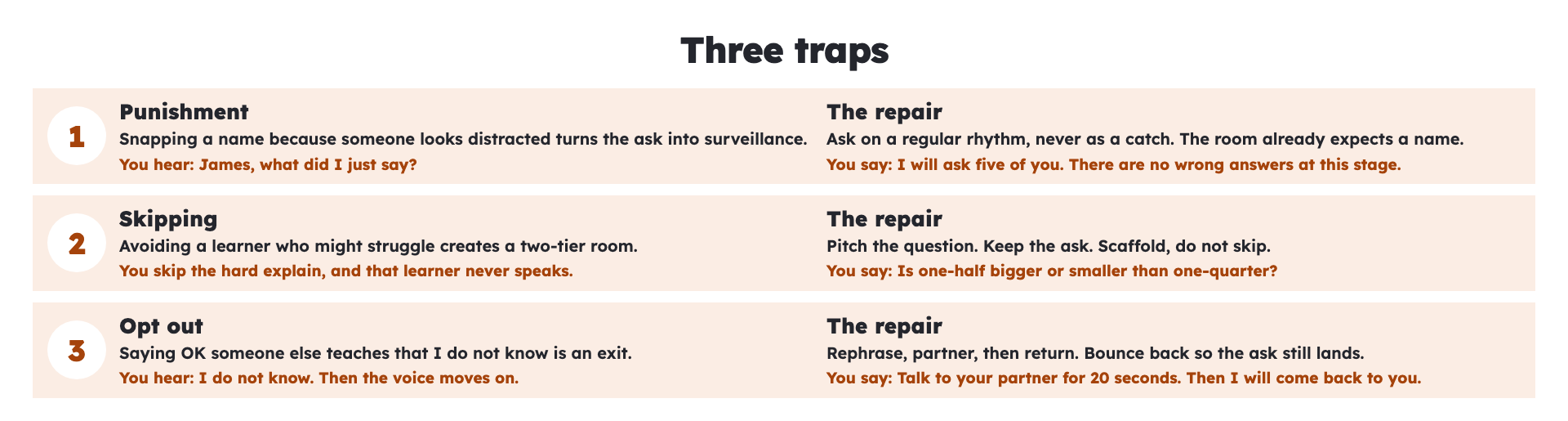
If a learner looks distracted and you snap "James, what did I just say?", you have turned cold calling into a surveillance tool. The learner associates being asked with being caught. This destroys the psychological safety that makes cold calling work.
Call on learners regularly to boost concentration. Nuthall (2005) and Wiliam (2011) found this routine engages learners well. Question all learners equally, no matter their attention levels. Cotton (1989) advised against using questioning as punishment.
Teachers sometimes unconsciously avoid cold calling learners who might struggle, fearing embarrassment. This creates a two-tier classroom where some learners are asked to think and others are not. Scaffolding the question is the answer, not avoiding the learner.
A Year 5 Maths teacher working on fractions might ask a struggling learner: "Is one-half bigger or smaller than one-quarter?" rather than "Explain how to add fractions with different denominators." Both are cold calls. The first is pitched at the right level.
When a learner says "I don't know," the response matters. Saying "OK, someone else?" teaches learners that opting out works. Instead, try:
Lemov (2015) calls this No Opt Out. The learner still answers, but with support: a hint, a rephrase, or a peer's answer to repeat.
Use the questions and evidence below to make cold calling predictable, supportive and useful for checking understanding.
Question
“Cold calling is not just asking a random pupil a question, it's also not a gotcha. If you're using cold calling to catch out pupils then of course you're going to increase their anxiety.”
What the replies and the evidence say. @Clive_Hill, 6 Apr 2025: forewarn, and keep the question low-stakes. @dnleslie, 11 Aug 2026: calm, predictable, thinking time. The replies do not all agree. @Stacenocheese, 11 Jan 2026, speaking as a formerly anxious learner now teaching, says effective cold calling helped reserved learners. The live split is gotcha versus invitation, not whether anxiety exists.
Question
“When my daughter was suffering extreme anxiety I was very surprised to hear the SENCo say cold calling was a general school policy ... she would have to make a special request that my girl was excluded from it.”
What the replies and the evidence say. The same parent, same day: it was not about knowing the answers. No SENCO posted the exemption request in their own voice. Classroom replies argue for a pre-call and a partner rehearsal rather than a permanent opt-out; that is their claim, not a trial, and the parent’s account still stands.
Question
“How does cold calling work for those with slower processing speeds or selective mutes?”
What the replies and the evidence say. @helenrey, 28 Feb 2026, names pre-call or warm-call on a researchED slide: tell them to expect the question, then a warm invitation. @Clive_Hill’s forewarn line is the same scaffold. The posts we read showed no UK teacher describing a selective-mute adaptation in their own classroom, so the honest answer is the heads-up, not an invented script.
Question
“Hmm. In over 30 years teaching, I've always started with volunteers but then moved on to asking some who don't put their hands up. Surely let's not use the sledgehammer of "no volunteering answers allowed"”
What the replies and the evidence say. @teacherhead, 25 Jul 2026, on the same thread: the volunteers do not matter more than the others; cold call several first, then ask volunteers to add. The disagreement is the finding. A no-volunteers rule is policy talk. It is not a classroom experiment in the posts we read.
Question
“Sadly, my children have never had the experience of lively debate in their clsssrooms. It’s all ‘cold-calling’ and following a PPT. ... He looks forward to sixth form college.”
What the replies and the evidence say. @BarbaraBleiman, same thread: especially dreadful for learners and for many teachers in schools like this. @DowlenHolly disagrees: lively debate is not possible for all until the knowledge is secure. Keyword searches for sixth-form seminar plus cold call returned nothing else, so this is one parent-teacher thread, not a sixth-form department describing its seminar.
Question
“As an English teacher I have had to fight my district on this. They love the idea of cold calling on kids with questions and read aloud.”
What the replies and the evidence say. The US fight is district pressure plus anxiety, not the technique name. @AmberBHaven’s reply to the same culture is that the class expects it, so it is not a trick. Morek et al. (2023) still split invitation from confrontation; England et al. (2017) and Cooper et al. (2018) are US undergraduate biology, not this English teacher’s district.
Cold calling works well in discussion subjects. For example, consider a Year 8 English lesson. The teacher, exploring "A Christmas Carol", might ask: "Fatima, which word shows Scrooge's personality?" (Lemov, 2015). This focuses learners on textual details, unlike a general question.
For oral rehearsal, pair cold calling with a thinking prompt from the Structural Learning Say It protocol. Learners can practise responding: "I think the word 'grasping' suggests Scrooge is..." The Say It cards are one option for supplying prompts that work alongside cold calling.
Cold calling is a quick way to check that learners understand. Before the calculations, ask, "Kai, what happens to reaction rate with more concentration?" This shows up misconceptions fast (Agarwal and Bain, 2019).
In Maths, cold call to verify intermediate steps: "Seren, what is the first thing you would do to solve this equation?" This connects to direct instruction approaches where the teacher models, then checks, then releases.
Cold calling works from Reception onwards. With younger children, frame it positively: "I am going to ask some of you to share your brilliant ideas." Use visual cues: a "talking teddy" that the teacher points towards the chosen child.
A Year 2 teacher using graphic organisers might cold call: "Leo, can you point to where you put the animals that live in water?" This checks understanding while keeping the cognitive demand appropriate for the age.
The direct evidence comes from Dallimore, Hertenstein and Platt (2013, 2019), who studied university classes. The school evidence is indirect. It draws on work about wait time, retrieval and formative assessment.
Cold calling draws on several established research traditions:
Wiliam (2011) said formative assessment uses cold calling to check learners understand the lesson. Assessment should happen during teaching, not afterwards, according to Wiliam. Cold calling quickly shows what each learner knows (Wiliam, 2011).
Himmele and Himmele (2011) say all learners should think in every lesson. Their Total Participation Techniques include cold calling. It is simple and has a quick effect, they argue.
Roediger and Karpicke (2006) support the wider testing-effect principle. In short, pulling information out of memory helps learners keep it for longer. Cold calling draws on that principle when questions ask learners to recall or explain material taught earlier. It works best when the tone stays low-stakes.
Fisher and Frey (2014) say teachers need proof learners grasp concepts before progressing. Use cold calling and exit tickets to collect useful data quickly. Teachers then use this data for immediate teaching adjustments.
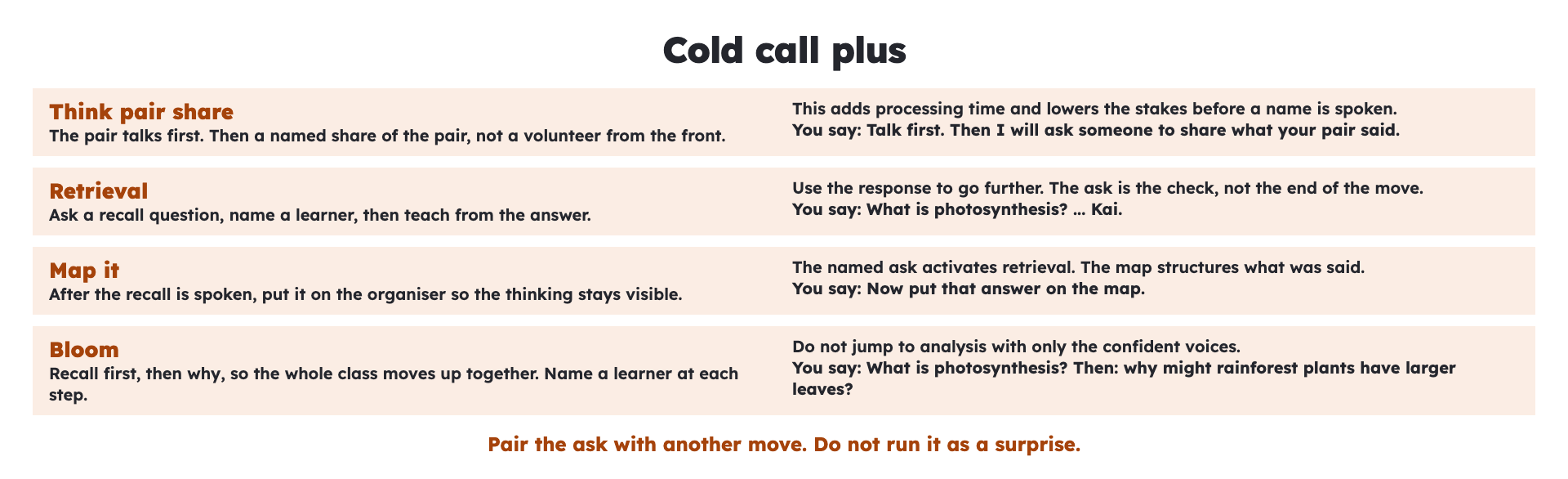
Cold calling is most powerful when combined with complementary techniques: Each pairing below keeps the cold call as the check and adds a second move that gives every learner time to think, talk or organise before they are named.
Digital name pickers, seating-plan tallies and participation trackers help you notice who has and has not spoken. These tools are aids to classroom management, not evidence in their own right. Use them as prompts for your own judgement, not as proof that participation is fair.
Participation tracking can reveal patterns that teachers might otherwise miss, but avoid presenting a single unsupported percentage as proof of bias. If a tool suggests a pattern, check it against classroom context and adapt the routine carefully.
Picture a Year 8 History teacher in an Industrial Revolution lesson. They might use a name picker or a tally on the seating plan to check who has already spoken. This helps spread questions more fairly. The teacher still needs to adjust for learner needs, confidence and how much wait time each learner has had.
Digital questioning tools raise fairness questions. A rotation tool cannot know every learner's context. Teachers should combine any participation data with their own judgement. Give extra thinking time where needed, and override the tool when that better supports learning.
When talk relies on volunteers, a pecking order forms. Confident learners answer first, and they answer often. Cold calling changes this pattern only when it is predictable, supportive and paired with wait time. That way, quieter learners get a real chance to prepare an answer.
Ask 'What makes this poem effective?' before naming a learner, then leave thinking time before inviting a response. Adapt the time and response format to individual needs. Do not assume that a routine alone makes cold calling inclusive for learners with SEND.
Teachers can make cold calling even more inclusive through simple adaptations. Provide sentence starters on the board ('I notice that...', 'This reminds me of...') to support learners who struggle with articulation. For anxious learners, try 'warm calling' where you give advance notice: 'In two minutes, I'll ask you about the water cycle, Amelia.' This maintains engagement whilst reducing anxiety.
Cultural awareness is important. Irvine (1990) found some learners dislike being singled out. Support learners by valuing effort more than perfect accuracy (Dweck, 2006). Learners can ask peers for help; this makes learning collaborative.
Before: framing the routine. Say why you are doing it, once, and then keep doing it. In a Year 7 history lesson the teacher opens the term like this. The words matter more than the technique, because a cold call lands as a threat or an invitation depending on the sentence around it.
"In this room I ask the question first and choose who answers second. Nobody is being caught out. It means everyone thinks, and I get to hear what the whole class knows, not just the fastest hands."
Learners hear the same framing each week until it stops being news. Warm the routine further by telling a nervous learner in advance: "I'll come to you on question three, so have something ready."
During: question, pause, name. Ask the whole room, wait a full three seconds, then name one learner: "Why did the Romans build straight roads? ... Three seconds ... Amira."
If Amira says "I don't know", do not move on. Say: "That's fine, let's build it. Jacob, give her the first half." Then return: "Amira, say it back to me in your own words."
The learner still answers, but with a scaffold. That is the whole point of No Opt Out (Lemov, 2015). Do not resolve the answer yourself. Leave a second silence after the learner speaks so the class can weigh it, because that second pause (Wait Time II) is where the thinking spreads (Rowe, 1986).
After: acknowledging a partial answer. Name what was right, then push. "You've got the trade part, that's half of it. What did straight roads do for the army?" Learners learn that a half-answer is a starting point, not a verdict, and a Year 7 class that hears this daily starts offering partial answers without being named.
Cold calling works best with good planning and delivery. Tell learners everyone joins in discussions, helping all learn (Lemov, 2015). After asking, wait three to five seconds before calling on a learner. This pause lets all learners think before answering.
Scaffolding builds learner confidence. Start with easy recall questions about past work, then move on to harder analytical questions as confidence grows. If a learner struggles, use 'phone a friend'. They nominate a classmate to help, then repeat the answer themselves.
Blend cold calling with other methods for better results. Think-pair-share before a cold call lets learners prepare with a partner. No-hands-up routines can widen participation. Black and Wiliam's formative-assessment work supports the principle of gathering evidence of learning, so use it for that and not for a precise participation-rate claim.
Acknowledge effort, not just correct answers. For partial answers, say, 'Interesting thinking; let's build on that.' This keeps learners safe and standards high. Expect every learner to take part, so deep thinking becomes normal (Dweck, 2006; Hattie, 2012).
Two posts carried a board or a slide a teacher could pin. The useful words are lifted into a strip you can print.
How to get them to think/participate? Cold calling - plan great questions - tell them to expect questions - pose a question, provide silent thinking time - (warm) invitation, not interrogation
@helenrey
The useful bit is the five-step sequence on the researchED slide.
Colleagues were asked to convert the key pedagogical research of No Opt Out, Cold Calling & Think - Pair - Share into images
@SmestowAcademy
The useful bit is the Show-me board labels: Cold call, No opt out, Think - Pair - Share.
Cold call - no hands up
No opt out
Think - Pair - Share
The difference between cold calling that works and cold calling that creates anxiety is culture. In classrooms where cold calling thrives: The routine only survives when learners trust that being asked is normal, warm and safe, and that trust is built by the teacher's response to every answer.
A Year 9 teacher who has embedded cold calling describes it: "After about two weeks, learners stopped noticing. It became how we do things. Now they expect to be asked and they are ready."
Cold calling can improve learner metacognition. Learners check their understanding, as they may be asked to explain it (Rohrer & Pashler, 2007). The question "Do I understand?" becomes automatic (Willingham, 2009; Dunlosky & Rawson, 2012).
Next lesson, replace one "hands up" question with a cold call. Name the learner after posing the question. Notice how the room changes when everyone is expected to think.
The strongest evidence for cold calling comes from university classrooms. Dallimore, Hertenstein and Platt (2013, 2019) found that frequent cold calling raised voluntary participation and narrowed the gender gap in discussion. Their learners, though, were adults on business courses who had chosen to be there. Nobody has repeated the study in a Year 8 class on a wet Friday.
School claims rest on nearby fields of research: wait time, retrieval practice and formative assessment (Black and Wiliam, 1998). That is reasonable inference, not direct proof.
A second critique concerns what cold calling does to the silence after an answer. Rowe (1986) separated Wait Time I, the pause before a learner speaks, from Wait Time II, the pause after. Tobin (1987) showed that the second pause is where reasoning grows longer and learners start to respond to each other.
Cold calling protects the first pause and often destroys the second. The teacher rushes to approve the named learner's answer and move on. So the routine can raise participation while flattening discussion.
Third, the habituation argument does not hold for every learner. This is the idea that repeated exposure reduces anxiety. Immordino-Yang (2016) shows that emotion and thinking cannot be separated in learning.
A learner with a demand-avoidant profile or a trauma history may not feel safe when they know a question could come at any time. They may feel under constant threat instead, and recall suffers under that load. Cotton (1989) warned decades ago against using questioning to discipline learners. Leaders still see staff doing exactly that.
Finally, the technique assumes that thinking aloud is the natural evidence of thinking. For learners with English as an additional language, and for those from cultures where public answering is not the norm, the assumption is not neutral. None of this makes cold calling wrong. It makes it a routine that needs warmth, a second silence and honest limits, which is where its value has always been.
These sources give teachers a clearer evidence base for cold calling, wait time, retrieval practice and formative questioning.
Impact of Cold-Calling on Student Voluntary Participation
Dallimore, E. J., Hertenstein, J. H. and Platt, M. B. (2013). Journal of Management Education.
Direct cold-calling evidence for voluntary participation and learner comfort in discussion-based classes.
Leveling the Playing Field: How Cold-Calling Affects Class Discussion Gender Equity
Dallimore, E. J., Hertenstein, J. H. and Platt, M. B. (2019). Journal of Education and Learning.
Useful for discussing participation equity, while avoiding unsupported universal claims about gender or talk-time percentages.
Wait Time: Slowing Down May Be A Way of Speeding Up!
Rowe, M. B. (1986). Journal of Teacher Education.
Core source for the pause after a question and after a learner response.
Assessment and Classroom Learning
Black, P. and Wiliam, D. (1998). Assessment in Education: Principles, Policy & Practice.
Supports the formative-assessment aim of eliciting evidence of learner understanding.
Roediger, H. L. and Karpicke, J. D. (2006). Perspectives on Psychological Science.
Supports low-stakes retrieval and testing-effect framing when cold calls ask learners to recall taught material.
Rosenshine, B. (2012). American Educator.
Useful teacher-facing synthesis for frequent questioning, checking understanding and guided practice.
Agarwal and Bain (2019).
Black and Wiliam (1998).
Dweck (2006).
Hattie (2012).
Lemov (2010).
Lemov (2015).
Rosenshine (2012).
Rowe (1986).
Wiliam (2011).
Willingham (2009).