Updated on
October 7, 2026
Thinking Frameworks: A Teacher's Guide to 42 Models
A teacher's guide to 42 thinking frameworks: the four families, the three models research recommends, and how to choose the right one for your classroom.

Updated on
October 7, 2026
A teacher's guide to 42 thinking frameworks: the four families, the three models research recommends, and how to choose the right one for your classroom.
A thinking framework is a structured model that classifies types of thinking so that teachers can plan, teach and assess it deliberately. Bloom's taxonomy is the most famous example, but it is far from the only one. When Moseley and colleagues at Newcastle University reviewed the field for their landmark handbook Frameworks for Thinking, they weighed up 42 models of thinking (Moseley et al., 2005). Their conclusion surprises most teachers: only three of the 42 were singled out as broadly useful for everyday teaching. The rest were judged too narrow, too complex or too thin on evidence for daily use.
This guide maps all 42 frameworks into the four families the handbook identified. It shows you which models are worth your planning time, which serve specialist purposes, and which are best left in the archive. The stakes are real: the Education Endowment Foundation rates metacognition and self-regulation, the engine room of most thinking frameworks, among the highest-impact, lowest-cost approaches it has tested. It is worth around eight months of extra progress in a school year.
A thinking framework is a model that names and organises types of thinking, such as recall, analysis, evaluation and creation, so that teachers can design tasks, questions and assessments on purpose rather than by instinct. Frameworks make invisible cognitive work visible, giving schools a shared language for cognitive skills across subjects and phases.
Some frameworks describe a hierarchy of difficulty. Others describe stages of development, dispositions of good thinkers, or the conditions that produce inventive ideas. That variety is why the label covers everything from Bloom's taxonomy to De Bono's Six Thinking Hats.
Used well, a framework supports metacognition: learners begin to recognise the kind of thinking a task demands and to monitor whether they are doing it. Used badly, it becomes wall art. The difference lies in choosing a model that fits the job you need it to do.
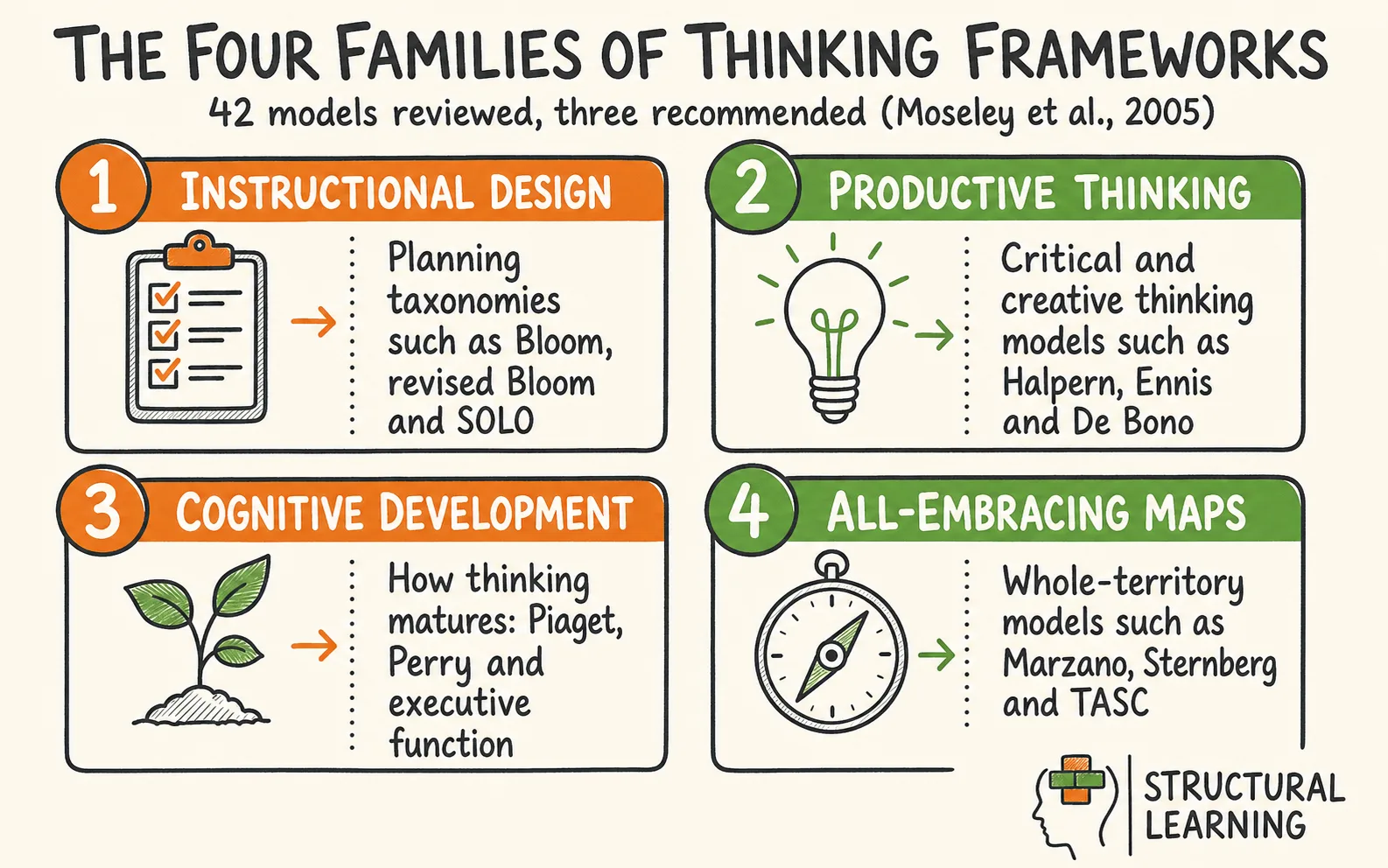
Moseley and colleagues sorted the 42 frameworks into four families: instructional design models built for planning teaching, productive thinking models focused on critical and creative thought, theories of cognitive structure and development, and all-embracing frameworks that attempt to map the whole territory of thinking and learning in one scheme.
The team also proposed an integrated model of their own. It groups thinking into information gathering, building understanding and productive thinking, all overseen by strategic and reflective thinking. That is their term for the metacognitive layer that plans, checks and judges the rest. That simple lens is a useful test for any framework a school considers adopting: does it cover all four of those functions, or only some?
Instructional design frameworks sort learning goals into levels. Teachers use them to sequence lessons, write questions and build assessments at the right level of demand. This family contains the models most teachers already know, including the original and revised Bloom's taxonomy and the SOLO taxonomy, alongside several historical schemes that never reached mainstream classrooms.
Productive thinking frameworks describe critical thinking, creative thinking and everyday reasoning. They matter most when a school wants to teach argument, judgement and idea generation directly, whether through discrete thinking lessons or through subjects such as English, science and questioning-rich humanities teaching.
This family describes how thinking itself is organised and how it matures, from Piaget's stages to models of intelligence and epistemic development. These frameworks rarely tell a teacher what to do on Monday morning, but they explain why learners of different ages and starting points respond so differently to the same task.
All-embracing frameworks try to map knowledge, skills and dispositions in a single scheme. They are ambitious by design, which makes them useful for whole-school curriculum thinking and risky as day-to-day planning tools. Two of the most valuable modern taxonomies for teachers sit in this family.
Match the framework to the job. Use a planning taxonomy to design objectives and questions, an assessment model to judge response quality, a critical thinking framework to teach reasoning directly, and a metacognitive model to build self-regulated learners. The table below pairs common classroom jobs with the strongest tools for each.
| Classroom job | Strongest frameworks | Start here |
|---|---|---|
| Writing objectives and questions | Revised Bloom's taxonomy | Bloom's taxonomy verbs |
| Judging depth of understanding | SOLO taxonomy | SOLO taxonomy |
| Auditing task demand | Webb's Depth of Knowledge | DOK levels |
| Teaching critical thinking | Halpern; Ennis; Paul-Elder | Higher-order thinking |
| Building self-regulation | Pintrich; executive function | Metacognition in the classroom |
| Problem-solving lessons | TASC wheel | School-wide thinking strategies |
| Classroom dialogue | Lipman; De Bono | Philosophy for Children |
A workable school policy rarely needs more than two or three of these. The handbook's warning still stands: adopting many frameworks at once produces display work, not thinking.
Of the 42 models reviewed, Moseley et al. (2005) picked out three as the most useful for general teaching: the revised Bloom's taxonomy, Halpern's critical thinking framework and Pintrich's model of self-regulated learning. Each one covers a different layer. Together they form a compact toolkit: objectives, reasoning and self-regulation.
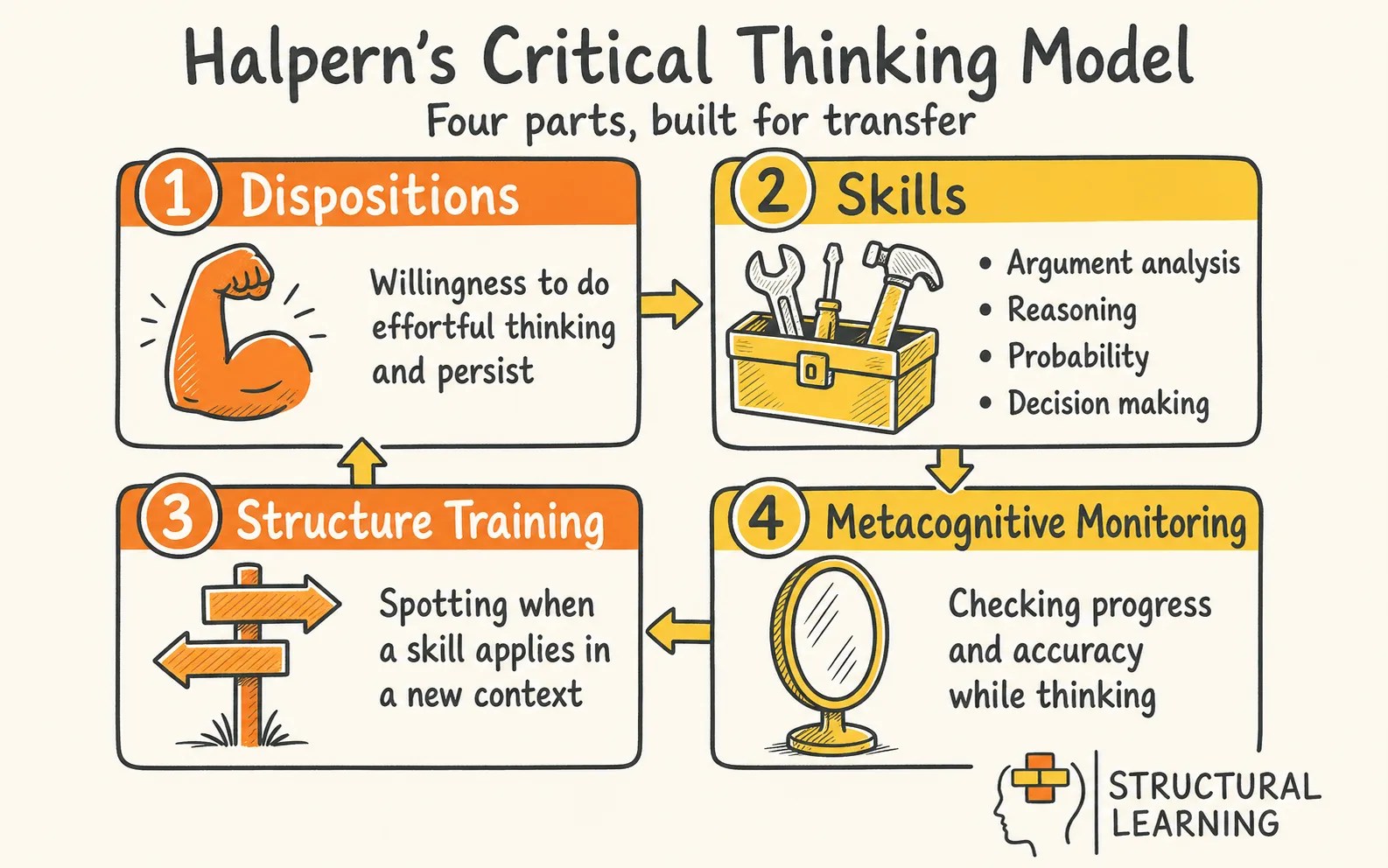
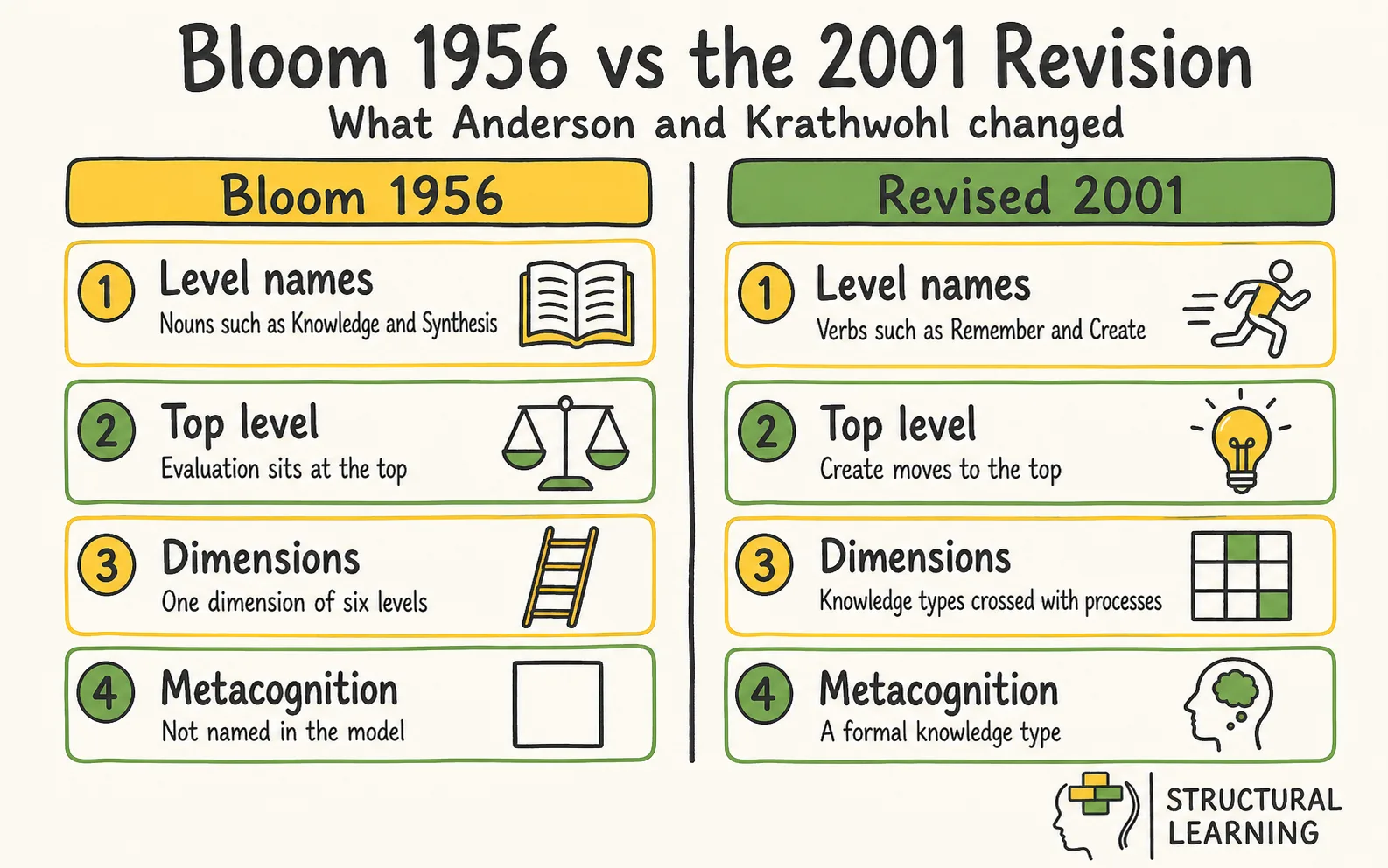
Anderson and Krathwohl's revision earns its place through the knowledge dimension. It lets teachers plan what learners should know about their own thinking, not just the content they should master. Halpern's model treats critical thinking as skills you can teach plus habits you can grow. Her four-question checklist transfers across subjects.
Pintrich's framework completes the set by describing how learners plan, monitor and evaluate their own learning. The EEF's guidance on metacognition now covers this ground in depth. It remains the highest-impact layer for most schools. Our guides to thinking skills assessments and higher-order questioning show what these three look like in practice.
The 2005 review predates several tools that now dominate classroom practice. Webb's Depth of Knowledge reframes demand around the complexity of the task rather than the verb, which makes it a sharper audit tool than Bloom for assessment design. Visible thinking routines from Project Zero turn single thinking moves into repeatable classroom habits.
Costa and Kallick's Habits of Mind shifted attention from skills to dispositions, and whole-school approaches now treat frameworks as shared language for learning theory rather than as posters. The direction of travel since the handbook is clear: fewer frameworks, used more deliberately, with metacognition doing the heavy lifting.
Four more models earn a place in that modern toolkit, and we cover each in its own guide. Guy Claxton's Building Learning Power turns dispositions into a whole-school language. Fink's taxonomy of significant learning replaces the ladder with six interacting categories. Sandra Kaplan's depth and complexity prompts give teachers a practical route into harder thinking on any topic. John Biggs' constructive alignment ties outcomes, activities and assessment into one design discipline.
Thinking frameworks attract three recurring criticisms. First, hierarchy creep: models such as Bloom's get read as strict ladders. The levels were never meant to be climbed in order, and knowledge ends up undervalued. Second, labels can harden into ceilings. Stage models describe learners; they should never cap them.
Third, the evidence base is uneven. The handbook itself judged most of the 42 frameworks weakly evidenced for classroom impact. Feuerstein's programme shows limited transfer, De Bono's tools rest heavily on anecdote, and Gardner's intelligences are routinely misapplied as learning styles. Frameworks describe thinking; they do not replace subject knowledge, retrieval or deliberate practice.
A 2005 review also cannot speak to today's questions. Cognitive load theory, generative AI and the evidence movement have reshaped how schools think about thinking. Treat the map in this guide as a starting inventory, then test any framework you adopt against your own assessment data.
Anderson, L. W., & Krathwohl, D. R. (Eds.). (2001). A taxonomy for learning, teaching, and assessing: A revision of Bloom's taxonomy of educational objectives. Longman.
Biggs, J. B., & Collis, K. F. (1982). Evaluating the quality of learning: The SOLO taxonomy. Academic Press.
Bloom, B. S. (Ed.). (1956). Taxonomy of educational objectives: The classification of educational goals. Handbook I: Cognitive domain. David McKay.
De Bono, E. (1985). Six thinking hats. Little, Brown.
Ennis, R. H. (1987). A taxonomy of critical thinking dispositions and abilities. In J. B. Baron & R. J. Sternberg (Eds.), Teaching thinking skills: Theory and practice. W. H. Freeman.
Feuerstein, R. (1980). Instrumental enrichment: An intervention programme for cognitive modifiability. University Park Press.
Gardner, H. (1983). Frames of mind: The theory of multiple intelligences. Basic Books.
Halpern, D. F. (1998). Teaching critical thinking for transfer across domains. American Psychologist, 53(4), 449-455.
Marzano, R. J., & Kendall, J. S. (2007). The new taxonomy of educational objectives (2nd ed.). Corwin Press.
Moseley, D., Baumfield, V., Elliott, J., Gregson, M., Higgins, S., Miller, J., & Newton, D. P. (2005). Frameworks for thinking: A handbook for teaching and learning. Cambridge University Press.
Piaget, J. (1952). The origins of intelligence in children. International Universities Press.
Pintrich, P. R. (2000). The role of goal orientation in self-regulated learning. In M. Boekaerts, P. R. Pintrich, & M. Zeidner (Eds.), Handbook of self-regulation. Academic Press.
Sternberg, R. J. (1998). Abilities are forms of developing expertise. Educational Researcher, 27(3), 11-20.
Wallace, B., & Adams, H. B. (1993). TASC: Thinking Actively in a Social Context. AB Academic Publishers.