Updated on
October 7, 2026
Feuerstein's Mediated Learning: A Guide for Teachers
Feuerstein's method explained for teachers: structural cognitive modifiability, mediated learning, dynamic assessment and SEND classroom moves.

Updated on
October 7, 2026
Feuerstein's method explained for teachers: structural cognitive modifiability, mediated learning, dynamic assessment and SEND classroom moves.
The Feuerstein method is a family of approaches to teaching thinking, built on the belief that intelligence can be changed rather than simply measured. Reuven Feuerstein, an Israeli psychologist, developed it while working with children who had survived trauma and displacement after the Second World War (Feuerstein et al., 1980). He refused to accept that a low test score fixed a child's ceiling for life. For example, a Year 3 learner who freezes at a comparison task can learn the underlying strategy when an adult mediates it step by step.
At its heart sits one strong claim: with the right adult help, almost any learner can become a more effective thinker. This guide explains structural cognitive modifiability, walks through the mediated learning experience and its core criteria, and covers the Instrumental Enrichment programme and dynamic assessment. It then shows why these ideas matter so much for SEND practice, and offers mediation moves any teacher can try tomorrow.
The Feuerstein method is a set of tools for teaching learners how to think, not just what to know. It combines a theory of changeable intelligence, a teaching approach called mediated learning, a cognitive programme named Instrumental Enrichment, and a way of testing potential called dynamic assessment. The aim is lasting cognitive change.
The four parts hang together. The theory says the mind can be reshaped at any age. The teaching approach describes how an adult does the reshaping.
The programme gives structured practice, and the assessment reveals how much a learner can grow. Each part rests on the same refusal to treat ability as fixed.
Feuerstein built the whole system from practice, not theory alone. He spent decades with learners whom the system had written off, and watched many of them make gains that standard testing had ruled out. That experience shaped a method aimed squarely at the learners other approaches tend to give up on.
Structural cognitive modifiability is Feuerstein's core belief that the structure of the mind can change at any age. He argued that intelligence is not a fixed trait but a set of processes that good teaching can improve. A low starting point never settles the final destination, and no single score should close the door.
Feuerstein watched children rebuild their thinking after profound disruption, and drew a bold conclusion. The brain stays open to change, given the right conditions (Feuerstein et al., 2006). This claim sits behind everything else in his work. If the mind is modifiable, then the teacher's job is to cause change, not to sort learners by ability.
The idea challenges a deficit view of difficulty. A learner who struggles is not showing a permanent limit. They are showing a gap in the thinking tools they have been helped to build. That reframing carries real weight in special education, where fixed labels can quietly lower expectations for years.
A mediated learning experience is what happens when a caring adult steps between the learner and the world, and shapes how the learner takes it in. Instead of leaving a child to meet raw experience alone, the mediator selects, frames and interprets that experience, so the learner builds stronger thinking tools from it.
Feuerstein separated two ways of learning. Direct exposure is learning by bumping into the world unaided. Mediated learning experience is learning through a person who filters and enriches that world (Feuerstein et al., 1980). Both matter, but the second is what builds the mental habits that transfer to new tasks.
Picture a parent and toddler at a supermarket. The parent names the fruit, points out the colours, and asks the child to find the round ones. The same trip in silence gives the child far less. The mediator has turned a walk down an aisle into a lesson in sorting, naming and comparing.
Feuerstein believed that thin or absent mediation, not low innate ability, explains much underachievement. When adults do not mediate, learners miss the running commentary that builds concepts. The good news follows directly. Rich mediation can be supplied later, which is why the approach refuses to write anyone off.
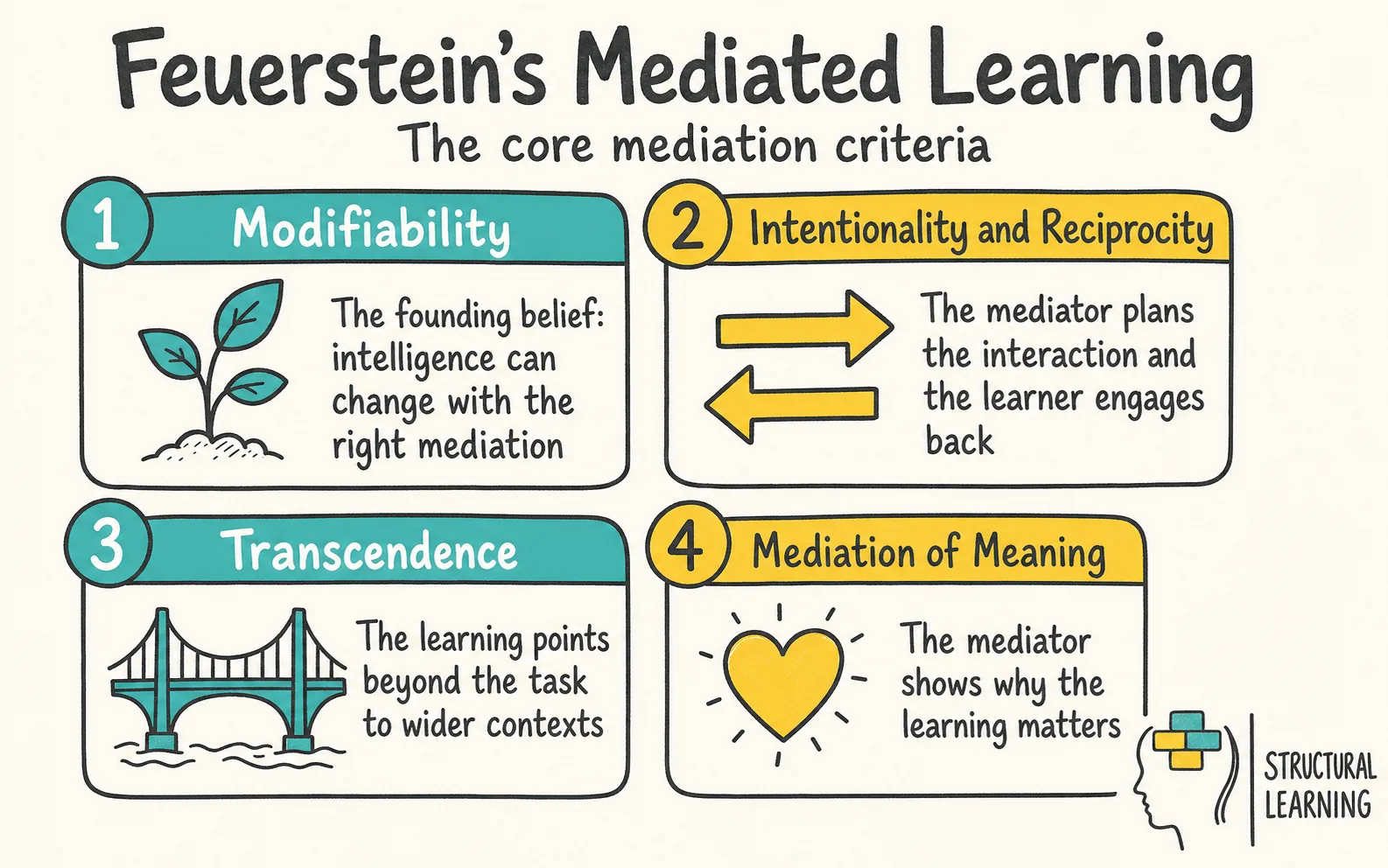
Not every helpful interaction counts as mediation. Feuerstein set out criteria that separate genuine cognitive teaching from ordinary assistance. Three of them appear in every true mediated learning experience: intentionality and reciprocity, transcendence, and mediation of meaning. Further criteria matter too, but they depend on the situation and the learner.
The first criterion is intentionality and reciprocity. The adult sets out to teach something specific, makes that intention obvious, and works until the learner engages back. Mediation is a two-way loop, not a broadcast. The teacher pushes, the learner responds, and the exchange keeps going.
The second is transcendence. A good mediator reaches past the task in front of them to a wider principle. Sorting buttons today becomes a rule about classifying anything. The learner can then carry that rule into science, maths or daily life, which is where real transfer begins.
The third is mediation of meaning. The adult gives the task value and emotion, explaining why it is worth doing. Meaning is the fuel. Without it a learner may complete the steps yet never care enough to remember them, and the thinking fades once the lesson ends.
| Mediation criterion | What it means | What it sounds like in class |
|---|---|---|
| Intentionality and reciprocity. | The adult sets a clear teaching purpose, makes it obvious, and works until the learner responds. | Say, look at this part with me, then wait until the learner is ready. |
| Transcendence. | The interaction reaches beyond the task to a rule the learner can reuse elsewhere. | Ask where else this way of sorting things could help them. |
| Mediation of meaning. | The adult gives the task value and emotion, explaining why it is worth the effort. | Explain that this matters because it builds planning, and say you know they can do it. |
These three travel together. Strip out transcendence and you get drilling. Strip out meaning and you get compliance. The skill lies in holding all three at once, which is why mediation takes practice and cannot be reduced to a worksheet or a script.
Instrumental Enrichment is Feuerstein's structured programme for building thinking directly. It uses a series of paper-and-pencil tasks, called instruments, that target specific cognitive functions such as comparison, orientation in space and precise use of language. The content is deliberately abstract, so the focus stays on the thinking, not the subject matter.
Each instrument works on a named weakness, from vague perception to impulsive answering (Feuerstein et al., 1980). Learners work through puzzles about dots, shapes and relationships, then a trained teacher mediates the reasoning behind them. The abstract puzzles are only a vehicle. The real product is a thinking habit that can travel to other work.
The programme is not a quick fix. A full course runs across years, needs trained mediators, and depends heavily on the quality of the mediation rather than the worksheets themselves (Feuerstein et al., 2006). A later version adds materials for younger children, yet the logic stays the same. The instruments are a stage for mediation, nothing more.
Dynamic assessment measures how a learner responds to teaching, not just what they can already do alone. A standard test takes a static snapshot of current performance. Dynamic assessment adds a teaching phase in the middle, then checks how much the learner gains, which reveals learning potential rather than past opportunity.
The pattern is test, teach, retest. First the assessor sees what the learner manages unaided. Then the assessor mediates, offering hints and strategies.
Finally they measure the improvement (Tzuriel, 2001). A large jump signals strong learning potential that a single static score would have hidden completely.
This distinction is not academic. A static test often measures a learner's history of mediation as much as their capacity. Two children with the same low score can have very different ceilings, and only a dynamic approach tells them apart. For SEND learners, that difference can shape a placement or a target.
For special educational needs practice, the Feuerstein method offers a powerful reframing. It replaces the deficit question, what is wrong with this child, with a modifiability question, what thinking has this child not yet been helped to build. That shift protects high expectations for neurodivergent learners and those with learning difficulties.
Labels can harden into ceilings. When a diagnosis quietly lowers what adults expect, learners receive less demanding mediation and fall further behind. Feuerstein's stance pushes the other way.
It insists that high expectations and rich mediation belong with every learner. Our guide to metacognition for SEND and neurodivergent learners develops this in detail.
The approach also fits how good special education already works. Careful scaffolding, thinking made visible, and support gradually withdrawn all echo Feuerstein's mediation. Reducing demands on working memory matters too, as our piece on cognitive load in the resource room explains. Technology can extend the mediator's reach, a theme we cover in AI metacognitive scaffolds for SEND.
Feuerstein's mediator is a close cousin of Vygotsky's more knowledgeable other. Both thinkers argued that higher thinking grows first between people, then inside the individual. The adult works within a zone where the learner can succeed with help, and gradually hands the thinking over as competence grows.
Vygotsky described a zone of proximal development, the gap between what a learner can do alone and what they can do with support (Vygotsky, 1978). Feuerstein's mediated learning experience lives inside that gap. The mediator lends the thinking the learner cannot yet manage, then withdraws as the learner takes over. Our guide to Vygotsky's theory break down the zone in full.
The two frameworks are not identical. Vygotsky stressed culture, language and social context. Feuerstein focused on the mechanics of the interaction and the criteria that make it work. Read together, they give teachers both the why and the how, and both sit within the wider family of thinking frameworks that shape classroom practice.
You do not need the full programme to teach like a mediator. The criteria translate into small, repeatable moves. Announce your thinking intention, reach beyond the task to a rule, and name why the work matters. Done consistently, these habits turn everyday lessons into cognitive teaching for every learner.
Start by making your intention visible. Tell learners what thinking you want, not just what task to finish. A line such as, today we are practising how to compare, primes the mind before the content lands. The learner then knows what the lesson is really training.
These moves cost no money and little time. They pair naturally with routines for building independent thinking, such as those in our guide to developing metacognition and the dialogue habits described in sustained shared thinking. The aim stays the same throughout: teach the thinking, and let the content carry it.
Mediation also builds self-monitoring. Our guide on how to develop metacognition explores that territory in depth.
The Feuerstein method is inspiring, yet the evidence is more modest than the claims. Meta-analytic reviews of Instrumental Enrichment report small and inconsistent effects on general cognitive outcomes. The approach is also time-intensive, depends on well-trained mediators, and makes some claims that outrun the trial evidence that supports them.
The clearest caution comes from meta-analysis. Romney and Samuels pooled the Instrumental Enrichment studies and found gains that were real but small, and highly variable across settings (Romney & Samuels, 2001). Effects on core reasoning were weaker than early enthusiasm had promised, and transfer to school attainment was hard to pin down.
Wider reviews of thinking-skills programmes tell a similar story. The EPPI synthesis found that outcomes depend heavily on how well a programme is delivered, with results ranging from strong to negligible (Higgins et al., 2005). In short, the mediation matters more than the materials, and poor delivery yields very little.
Two practical limits follow. First, the programme demands years of committed teaching and trained mediators, which many schools cannot resource. Second, some of Feuerstein's stronger claims about transforming intelligence sit ahead of what controlled trials can confirm. The sensible reading keeps the mindset and the mediation moves while staying honest about the ceiling on effects.
Feuerstein, R., Rand, Y., Hoffman, M. B., & Miller, R. (1980). Instrumental enrichment: An intervention programme for cognitive modifiability. University Park Press.
Feuerstein, R., Feuerstein, R. S., Falik, L. H., & Rand, Y. (2006).
Creating and enhancing cognitive modifiability: The Feuerstein Instrumental Enrichment programme. ICELP Press.
Higgins, S., Hall, E., Baumfield, V., & Moseley, D. (2005). A meta-analysis of the impact of the implementation of thinking skills approaches on pupils. EPPI-Centre, University of London.
Romney, D. M., & Samuels, M. T. (2001). A meta-analytic evaluation of Feuerstein's Instrumental Enrichment programme. Educational and Child Psychology, 18(4), 19-34.
Tzuriel, D. (2001). Dynamic assessment of young children. Kluwer Academic.
Vygotsky, L. S. (1978). Mind in society: The development of higher psychological processes. Harvard University Press.