Updated on
October 7, 2026
Constructive Alignment: A Teacher's Guide to Biggs' Model
Constructive alignment made simple: align learning outcomes, teaching and assessment with Biggs' model. Includes a worked example and SOLO-based verbs.

Updated on
October 7, 2026
Constructive alignment made simple: align learning outcomes, teaching and assessment with Biggs' model. Includes a worked example and SOLO-based verbs.
Constructive alignment is a course design principle that ties three things together: what you want learners to learn, how they learn it, and how you check that they have. John Biggs introduced the idea in 1996, and it has since become one of the most cited frameworks in higher education teaching (Biggs, 1996). The word "constructive" comes from constructivist learning theory, which holds that learners build their own understanding through the activities they do.
The word "alignment" describes the design job: making outcomes, teaching and assessment all point the same way. For example, a science department can write an outcome asking learners to explain energy transfer, then check the end-of-unit test really demands explanation rather than recall.
When alignment is strong, the assessment rewards exactly the learning the outcomes describe, and the classroom activities rehearse it. When it is weak, learners can pass without learning what mattered, or grind away on tasks the exam never checks. This guide explains the three components, shows how to write good outcomes, works through a backwards designed example, compares the model with backward design and Bloom's, and translates it for UK schools.
Constructive alignment is a method for designing courses so that intended outcomes, teaching activities and assessment all support the same learning. Biggs coined the term in 1996, combining constructivist theory, which says learners build understanding through activity, with aligned instructional design, which keeps every part of the course pulling in one direction (Biggs, 1996).
The idea sounds obvious, yet courses drift out of alignment all the time. A module lists ambitious outcomes about critical analysis, then assesses them with a multiple-choice test that rewards recall. Learners are rational: they study for the test, not the outcome. Alignment removes that gap by making the assessment a direct sample of the outcome.
Biggs built the principle on a simple claim from constructivism. Learners construct meaning through what they do, so the activities a course sets are the real curriculum. If the activities and the assessment both demand deep engagement, most learners rise to it. Biggs and Tang (Biggs & Tang, 2011) later turned this insight into a full design method for universities (Biggs & Tang, 2011).
The constructivist foundation is the theory that learners actively build knowledge rather than receive it. Constructive alignment takes this seriously by treating teaching and learning activities as the engine of understanding. If learners learn by doing, then the design task is to set the activities that produce the target learning, not merely to deliver content.
This is why Biggs puts the verb at the centre of planning. An outcome such as "understand supply and demand" is hard to teach or assess, because "understand" names a state, not an action. Rewriting it as "explain how a price change shifts demand" names something a learner can do, rehearse, and be judged on.
Constructivism also explains why passive teaching underperforms. A lecture transmits information, but understanding forms when the learner does something with it: applies it, argues it, or tests it against a problem. Well-aligned activities give every learner that active work, which is the point the model keeps returning to.
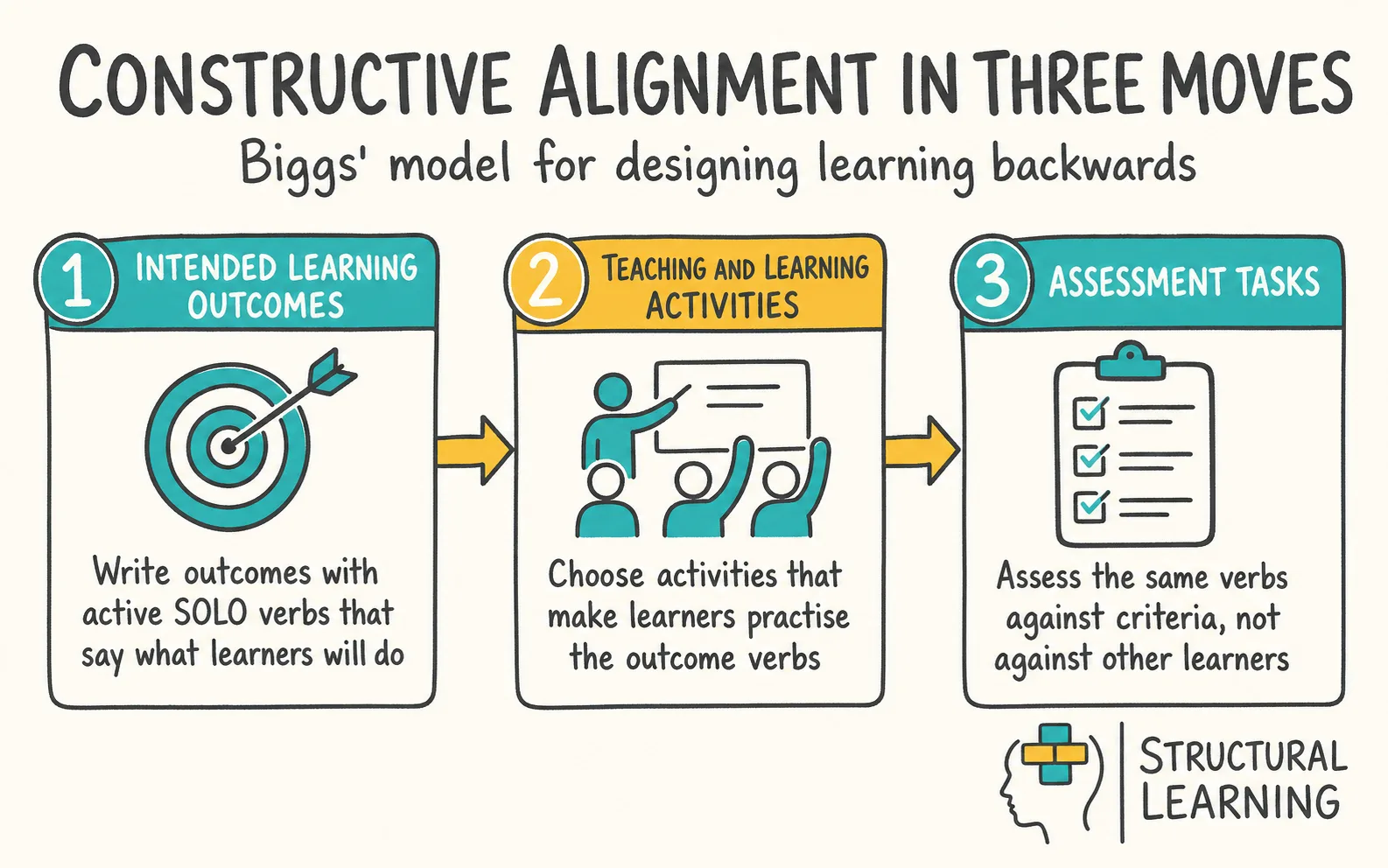
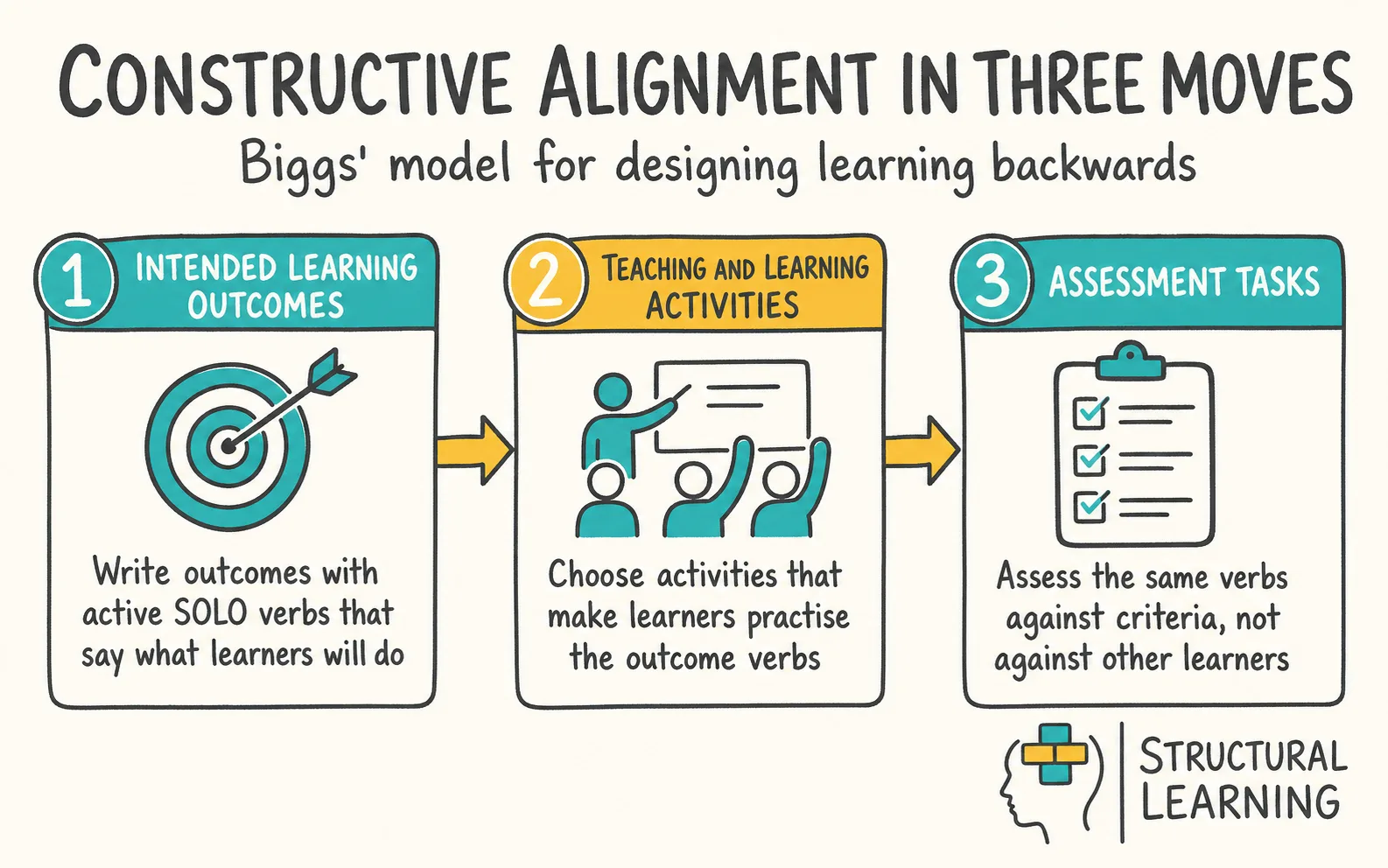
Constructive alignment has three moving parts: intended learning outcomes, teaching and learning activities, and assessment tasks. The outcomes state what learners should be able to do, the activities give them practice at doing it, and the assessment checks whether they can. Alignment means all three describe the same performance.
The intended learning outcomes, or ILOs, are the anchor. They are written as verbs a learner performs, at a stated level of complexity. Everything else is designed to serve them, which is why the model is often called an outcomes-first or backwards design approach.
The teaching and learning activities, or TLAs, are chosen to make learners rehearse the outcome verb. If the ILO asks them to analyse a case, the lesson has them analysing cases, not watching someone else do it. The assessment tasks, or ATs, then present the same verb under conditions that let learners show they have reached the standard.
When the ILO verb, the TLA verb and the AT verb match, the course is aligned. This matching is where alignment does the heavy lifting, because it closes the gap between what is taught and what is tested.
| Component | Guiding question | Worked example: a statistics module |
|---|---|---|
| Intended learning outcome (ILO). | What should learners be able to do? | Interpret a regression output and judge whether its conclusions hold. |
| Teaching and learning activity (TLA). | How do learners rehearse that? | Pairs critique real regression outputs and rewrite the flawed claims. |
| Assessment task (AT). | How do we check they have reached it? | Learners critique an unseen output against published criteria. |
Read across each row and the logic is visible. The verb "critique" appears in the outcome, the activity and the assessment, so a learner who does the activities is directly preparing for the assessment, and the assessment measures the stated outcome. Misalignment shows up as a verb that quietly changes from one column to the next.
Good intended learning outcomes use a single active verb that names an observable performance at a chosen level of difficulty. Biggs drew many of these verbs from the SOLO taxonomy, the framework he co-created with Kevin Collis to grade how complex a learner response is (Biggs & Collis, 1982).
SOLO stands for the Structure of the Observed Learning Outcome. It describes five stages, from knowing nothing relevant, through one idea, several ideas, related ideas, to ideas extended into new contexts. Each stage suggests verbs. "Identify" and "name" sit low, "explain" and "compare" sit in the middle, and "theorise" or "reflect" sit at the top.
Choosing the verb sets the standard. An outcome that asks learners to list the causes of a war expects less than one that asks them to evaluate which cause mattered most. Writing outcomes at the intended SOLO level stops a course quietly slipping into low-level recall, and it gives assessors a shared language for what counts as depth. Teachers who want to probe that depth in lessons can pair the verbs with higher-order questioning.
Constructive alignment depends on criterion-referenced assessment, which judges each learner against the stated outcome rather than against other learners. A norm-referenced approach ranks learners on a curve, so a grade describes position in a cohort. Criterion referencing asks a different question: has this learner met the standard the outcome sets?
The distinction matters because norm-referencing breaks alignment. If grades are fixed to a curve, a learner's mark depends partly on how the rest of the class performed, not only on whether they met the outcome. That severs the link between the outcome and the result, which is the very link the model is built to protect.
A criterion-referenced scheme keeps the outcome in charge. The assessor writes criteria that describe what a passing, good or excellent performance of the outcome looks like, then judges each piece of work against them. Biggs and Tang argue that this is the only assessment logic consistent with alignment, because it lets every learner, in principle, reach the top standard by meeting the criteria (Biggs & Tang, 2011). Schools designing their own tasks can borrow this thinking from work on thinking skills assessments.
Designing backwards means starting from the outcome and working towards the activities, the reverse of the usual content-first habit. You first decide what learners must be able to do, then design the assessment that would prove it, and only then plan the lessons that build up to that performance.
Take a first-year module on academic writing. The outcome is set first: construct a referenced argument that weighs competing evidence. That verb, construct, sits high on the SOLO scale, so the whole module now has a clear and demanding target to aim at.
Next comes the assessment, and it is designed backwards from that outcome. Because the outcome is to construct an argument, the assessment is a written argument marked against criteria for structure, use of evidence and referencing. A multiple-choice quiz would break alignment, because it never asks the learner to construct anything.
Only now are the activities planned, and each one rehearses part of the outcome. Learners analyse model arguments, practise integrating two sources, and draft paragraphs that they peer-review against the criteria. By the time the assessment arrives, they have performed the outcome verb many times. The lessons, the marking scheme and the outcome all describe the same act of constructing an argument, which is alignment working as intended.
Constructive alignment shares its logic with backward design, set out by Grant Wiggins and Jay McTighe, which also starts from desired results and plans assessment before activities (Wiggins & McTighe, 2005). The difference is emphasis. Biggs foregrounds constructivist theory and the matching of verbs, while backward design foregrounds enduring understanding and evidence.
Both models reject the content-first habit of choosing topics, teaching them, then writing a test at the end. Wiggins and McTighe (Wiggins & McTighe, 2005) call that coverage, and both frameworks treat it as the main enemy of deep learning. In practice, a teacher can use backward design and constructive alignment together without any friction, since they solve the same problem from slightly different angles.
Bloom's taxonomy plays a different role. The revised version by Anderson and Krathwohl gives a ladder of cognitive processes, from remember to create, that is useful for pitching the verb in an outcome (Anderson & Krathwohl, 2001). Where Biggs supplies the alignment discipline, Bloom's supplies a vocabulary for cognitive demand. Many teachers reach for our guide to Bloom's taxonomy for exactly this.
Other frameworks sharpen the same idea. Webb's Depth of Knowledge grades how deeply a task makes learners think, and Marzano's New Taxonomy adds motivation and self-regulation to the picture. All of them can supply the verbs that constructive alignment then locks across outcomes, activities and assessment.
In UK schools, constructive alignment offers a way to check whether intended outcomes, teaching and assessment fit together. Ofsted's 2019 framework used the headings intent, implementation and impact. Its framework for inspections from November 2025 instead lists 'curriculum and teaching' and 'achievement' as school evaluation areas. In this planning comparison, intent names the outcomes a department wants, implementation is the teaching and activities, and impact is the assessed result. Alignment asks whether the three genuinely match.
The parallel is close enough to be useful. A department that states its intent, implementation and impact as one connected chain has built an aligned curriculum in Biggs's sense: clear outcomes, teaching that rehearses them, and assessment that samples the same outcomes. Where a curriculum feels incoherent, misalignment is often the cause, because the stated intent and the assessed impact describe different things.
For schools, the practical move is the same as for universities. Write the department's outcomes as observable verbs, sequence activities that make learners practise those verbs, and design assessments that sample them directly. Because this is a schools context, plan for every learner to reach the criteria, not to be ranked against peers. The wider family of thinking frameworks offers the verbs and levels that make those outcomes precise.
Aligned design also supports learning how to learn. Our guide to developing metacognition covers the monitoring skills that alignment assumes learners bring.
Constructive alignment has real critics, and the sharpest come from within higher education. Loughlin, Lygo-Baker and Lindberg-Sand argue that the model is widely misread: it was meant as a design heuristic for teachers, but quality-assurance systems have turned it into an audit and compliance tool (Loughlin et al., 2021).
That distortion matters. When alignment becomes a box-ticking exercise for validators, the creative design act Biggs intended shrinks into paperwork, and outcomes get written to satisfy an audit rather than to guide learning. The critics want the model reclaimed for teachers, not administrators.
A second worry is narrowing. Outcome-led design works best for learning that is easy to specify, so it can quietly push a course towards what fits neatly on an outcome line and away from the open-ended learning that resists a single verb. Goals such as curiosity or scholarly judgement are hard to pin to a criterion, and may fade if only the specifiable survives.
There are also evidential limits. The constructivist theory underneath the model is asserted more often than it is tested, and the evidence that alignment raises attainment is mostly indirect, drawn from satisfaction and coherence rather than controlled comparison. The honest position is that constructive alignment is a strong design discipline whose benefits are plausible and widely reported, not a proven route to higher marks. Treat it as a tool to be checked against your own assessment evidence.
Anderson, L. W., & Krathwohl, D. R. (Eds.). (2001). A taxonomy for learning, teaching, and assessing: A revision of Bloom's taxonomy of educational objectives. Longman.
Biggs, J. (1996). Enhancing teaching through constructive alignment. Higher Education, 32(3), 347-364.
Biggs, J., & Collis, K. (1982). Evaluating the quality of learning: The SOLO taxonomy. Academic Press.
Biggs, J., & Tang, C. (2011). Teaching for quality learning at university (4th ed.). Open University Press.
Loughlin, C., Lygo-Baker, S., & Lindberg-Sand, Å. (2021). Reclaiming constructive alignment. European Journal of Higher Education, 11(2), 119-136.
Wiggins, G., & McTighe, J. (2005). Understanding by design (2nd ed.). ASCD.