Updated on
September 30, 2026
Metacognition in the Classroom: Modelling and Examples
Teach metacognition through a complete classroom lesson, with an EEF seven-step model, think-aloud script, working wall and checks for independence.

Updated on
September 30, 2026
Teach metacognition through a complete classroom lesson, with an EEF seven-step model, think-aloud script, working wall and checks for independence.
Metacognition in the classroom looks like a teacher naming the decisions inside a task aloud, including uncertainty, a mistake and its correction, then setting a similar problem with less support. Progress shows in what a learner does on a later task, not in confident reflection.
Metacognition in the classroom is the deliberate teaching of how learners plan, monitor and evaluate their thinking during subject work (Flavell, 1979). It becomes useful when those hidden decisions are made visible, modelled and gradually handed over. In a history lesson, the teacher says, “I chose this cause first, but this evidence does not fit.” A learner revises a causal map, explains why the first plan changed and then applies the same check with fewer prompts.
Metacognition combines knowledge about thinking with control of thinking (Flavell, 1979). In a lesson, that means a learner can say what the task needs and can steer their own work towards it.
This distinction matters because cognition and metacognition are connected but different. Cognition does the history thinking, such as weighing evidence. Metacognition directs that thinking by choosing, checking and changing an approach. A fuller comparison appears in our guide to metacognition and cognition.
Consider a learner preparing an explanation about the Great Fire of London. They recall facts, sort evidence and write a judgement. They also notice that their first claim ignores the wind, then revise their plan.
This guide concentrates on one complete episode. Our guide on how to develop metacognition sets out the wider picture across a school. Teachers seeking a first sequence can use our guide to getting started with metacognition.
Researchers sort metacognition into two types. The first, metacognitive knowledge, is what a learner understands about how they learn. The second, metacognitive regulation, is the set of choices that steer a task while it is under way (Education Endowment Foundation, 2018).
Flavell split metacognitive knowledge into three kinds: knowledge of yourself as a learner, of the task and of strategies. The EEF guidance uses the same three and turns each into questions learners can ask during a demanding task (Education Endowment Foundation, 2018). Here is how each kind sounds in the Great Fire lesson used throughout this guide.
Knowledge of self. The learner knows their own strengths, gaps and habits. In the Great Fire lesson it sounds like: “I know the causes, but I usually forget to check them against the evidence.”
Knowledge of the task. The learner knows what this task demands and where it is hard. It sounds like: “Most means I have to compare the causes, not just list them.”
Knowledge of strategies. The learner knows which approaches fit the task, and when they would not. It sounds like: “A causal map will show importance. A timeline would only show order.”
Regulation is the other half. It covers planning, monitoring and evaluating, the three phases in the next section. A learner who can name a strategy still has to choose it, check it and change it during the work. Our guide to self-regulation of learning covers the wider cycle that regulation sits inside.
Both types show up in ordinary lessons. In a study of 40 middle-school maths classrooms, teachers in the 20 high-growth rooms gave more talk that supported learners’ self-knowledge, monitoring and evaluating than teachers in the 20 low-growth rooms (Zepeda et al., 2019). The study observed lessons rather than testing an intervention, so it shows an association, not a cause. It does suggest what to listen for: talk about the learner and the check, not only the method.
The three regulation phases describe what a learner controls. Planning means interpreting the task, activating relevant knowledge and selecting a strategy. Monitoring means checking progress and changing course when the evidence demands it.
One history task, three phases, and what the learner says at each point.
Evaluation happens after a meaningful attempt. Learners judge both the outcome and the strategy that produced it. These phases can overlap, because monitoring may send a learner back to planning (Zimmerman, 2002).
In the lesson episode below, a learner plans with a causal map. During writing, they monitor whether each claim has evidence. Afterwards, they evaluate which prompt helped and what they will do on the next explanation.
The Education Endowment Foundation model describes how teaching support can shift towards independence. It is a scaffolding framework across one or several lessons. It is not a prescribed lesson plan or a sequence that must fit one hour (Education Endowment Foundation, 2018).
The EEF’s updated guidance names step four check understanding of strategy (Education Endowment Foundation, 2025). The 2018 version used “memorisation of strategy”. The updated label asks whether learners understand the strategy, not whether they can repeat its name.
On a smaller screen, swipe across to read all columns.
| EEF step | What the teacher does | What the learner produces |
|---|---|---|
| 1. Activating prior knowledge | Retrieves known causes and checks essential vocabulary. | A quick cause list with one uncertainty marked. |
| 2. Explicit strategy instruction | Explains how a causal map supports a comparative judgement. | A named strategy and a reason for using it. |
| 3. Modelling of learned strategy | Thinks aloud while ranking causes and checking evidence. | Notes showing the modelled decision points. |
| 4. Check understanding of strategy | Asks when the map helps and when it would not. | An explanation of the strategy's purpose. |
| 5. Guided practice | Pauses the class at planned points and prompts a check. | A revised map and a justified change. |
| 6. Independent practice | Removes the spoken prompts on a later task. | A new explanation with self-initiated checks. |
| 7. Structured reflection | Compares the plan, finished work and next target. | One evidenced judgement and one next action. |
A teacher can spread these steps across two history lessons. The first lesson can activate knowledge, teach the map and model its use. Guided and independent practice can follow once learners understand why the strategy helps.
The same guidance report also makes seven recommendations to schools (Education Endowment Foundation, 2018). They are not a lesson sequence; they describe what a department has in place when metacognition is taught rather than hoped for. Each row names the section of this page that shows it in practice.
On a smaller screen, swipe across to read all columns.
| EEF recommendation | What it asks for | Where it is on this page | The Monday move |
|---|---|---|---|
| 1. Teachers understand metacognition | The staff know what planning, monitoring and evaluating look like in their subject. | What metacognition looks like in the classroom; What the evidence supports | Pick one recurring task and name the three phases in it before Monday. |
| 2. Teach strategies explicitly | Learners are taught how to plan, monitor and evaluate, not left to infer it. | Plan, monitor and evaluate learning | Say the strategy name, why it fits this task, and when it would not. |
| 3. Model your own thinking | The teacher thinks aloud, including the wrong turns. | A complete think-aloud lesson script | Script one decision point and one correction, then say them out loud. |
| 4. Set the right level of challenge | The task is hard enough to need a strategy, not so hard that it needs rescue. | Adapt prompts without lowering the thinking demand | Cut the number of prompts, never the thinking they ask for. |
| 5. Promote metacognitive talk | Learners talk about how they are working, not only what they got. | What to say to a stuck learner | Replace "have you finished?" with "what did you check?" |
| 6. Teach independent organisation | Learners run the routine without the teacher's voice. | Move from guided to independent practice; Build a working wall learners actually use | Remove one spoken prompt on the next task and watch who still does it. |
| 7. Schools support teachers | Leaders give the time and expect the routine to be used. | Evaluate growth on a later task; Where this approach falls short | Bring one learner's before-and-after to the next department meeting. |
This episode uses the question, “Which factor most helped the Great Fire of London spread?” Learners already know about wooden buildings, narrow streets, dry weather and strong wind. The strategy is a causal map that ranks factors before a paragraph is drafted.
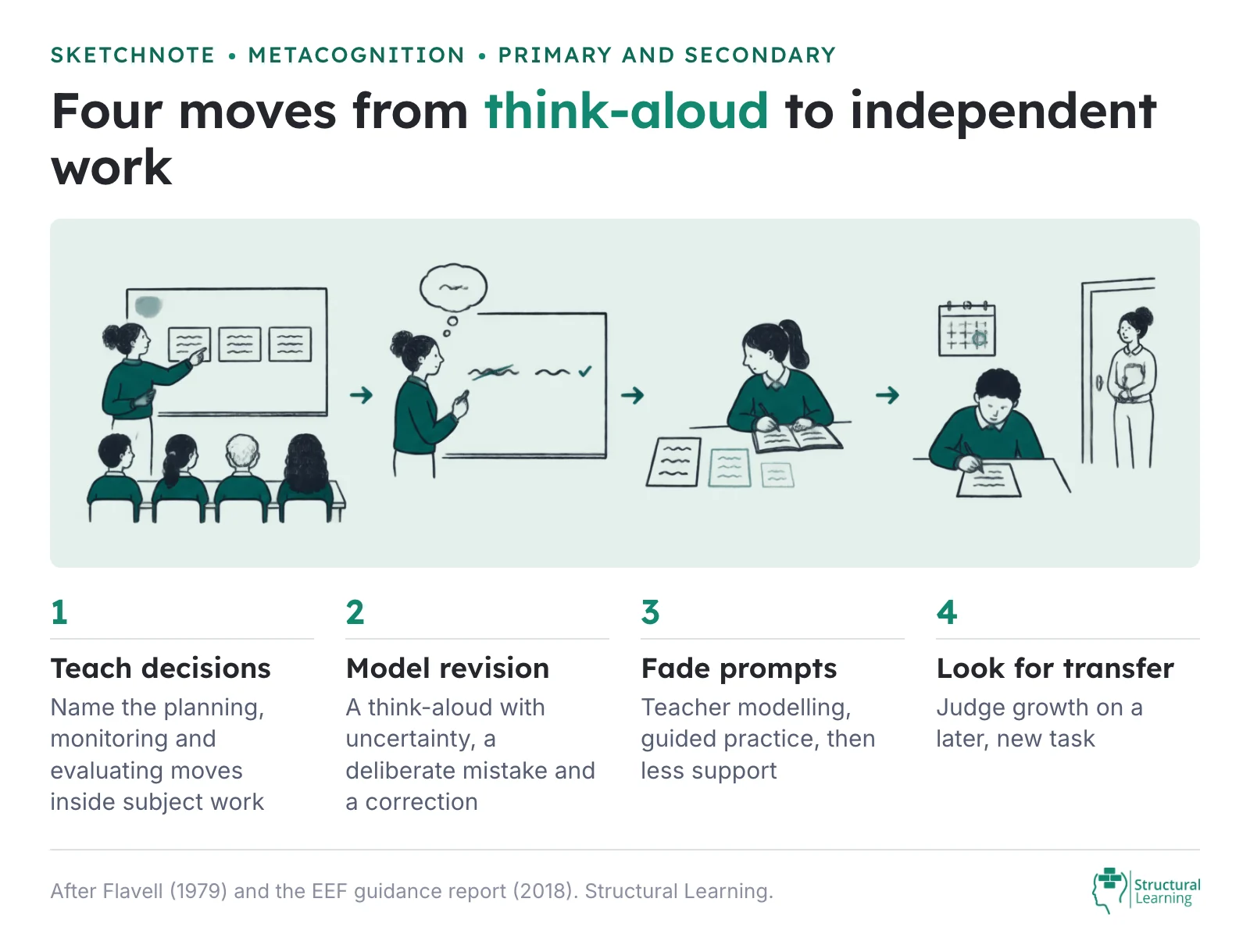
The pauses are planned because a think-aloud can become a polished performance. Learners need to hear how a strategy changes when evidence conflicts with the first idea. Making this monitoring visible is more useful than simply narrating every thought (Veenman, Van Hout-Wolters and Afflerbach, 2006).
The prompts stay focused on task interpretation, strategy choice and checking. The subject knowledge and representation must change.
Teachers online make the same point about keeping the model clean. Nathan Burns, @MrMetacognition, writes: “Too often we interrupt a model with questions”. In reply, @jon_hutchinson_ wrote: “Yes! I hardly ever see I do we do you do. It’s almost always we do we do we do.” The planned pauses are where the class joins in. Between them, the teacher models without interruption, as our guide to modelling learning describes.
The history script above is one episode. The eight pauses do not belong to history; they belong to the shape of the task. Here is what the same sequence looks like in three other subjects, with the strategy and the representation changed and the pauses kept.
Maths, Year 8, percentage change. The retrieval pause asks for two ways to find 15 per cent. The read-the-task pause catches the word decrease. The strategy pause chooses a bar model over a formula because the class has not yet met multipliers.
The deliberate mistake is adding 15 per cent instead of subtracting it, and the check is a second method. Guided practice is one question with a two-minute stop to name the check used, then three questions alone with the bar model available but not required.
Science, Year 10, a required practical. Retrieval asks for the variables before the method is read. Read-the-task catches the command word evaluate in the write-up question. The strategy is a results table drawn before any measurement, so anomalies can be seen as they happen.
The deliberate mistake is recording a reading without units, and the check is a learner spotting it against the table headings. Reflection asks which check caught a problem during the practical, not whether the practical was enjoyable.
Languages, Year 9, a written description. Retrieval asks for three verbs in the past tense from memory. Read-the-task catches that the question asks for opinions as well as facts.
The strategy is a plan in English of what each sentence will do before any French is written. The deliberate mistake is a present-tense verb in a past-tense sentence, and the check is a tense tick against each verb. The fade is a shorter planning box on the next task.
In each case the prompt words change. "Does all evidence fit?" becomes "Does a second method agree?", "Are the units there?" and "Is the tense right?" What stays the same is the sequence: retrieve, read the task, choose, model a mistake, guide, check understanding, draft alone, reflect.
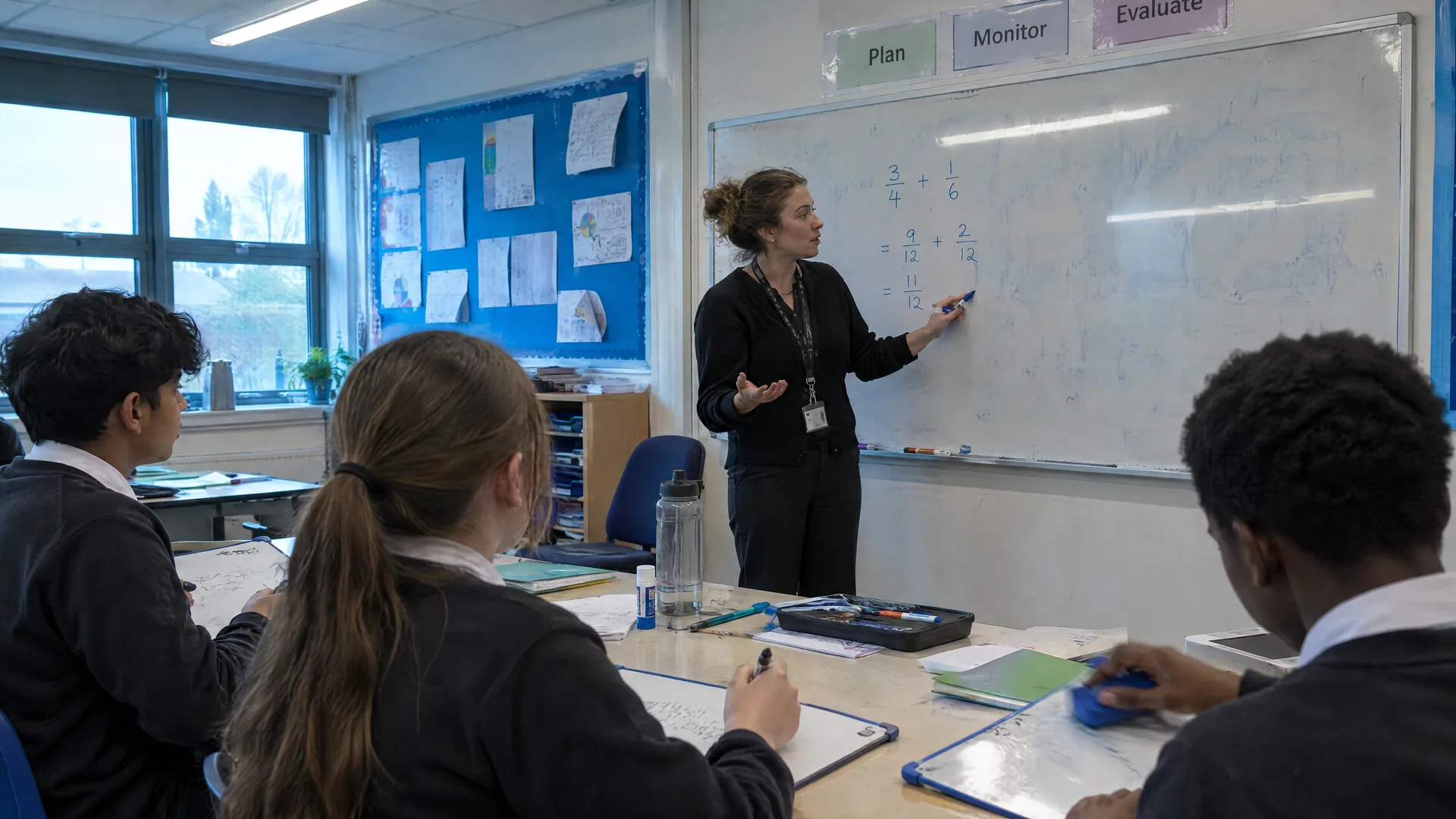
A metacognitive wall should support decisions during learning. Divide it into Plan, Monitor and Evaluate columns. Add moveable strategy cards rather than permanent slogans.
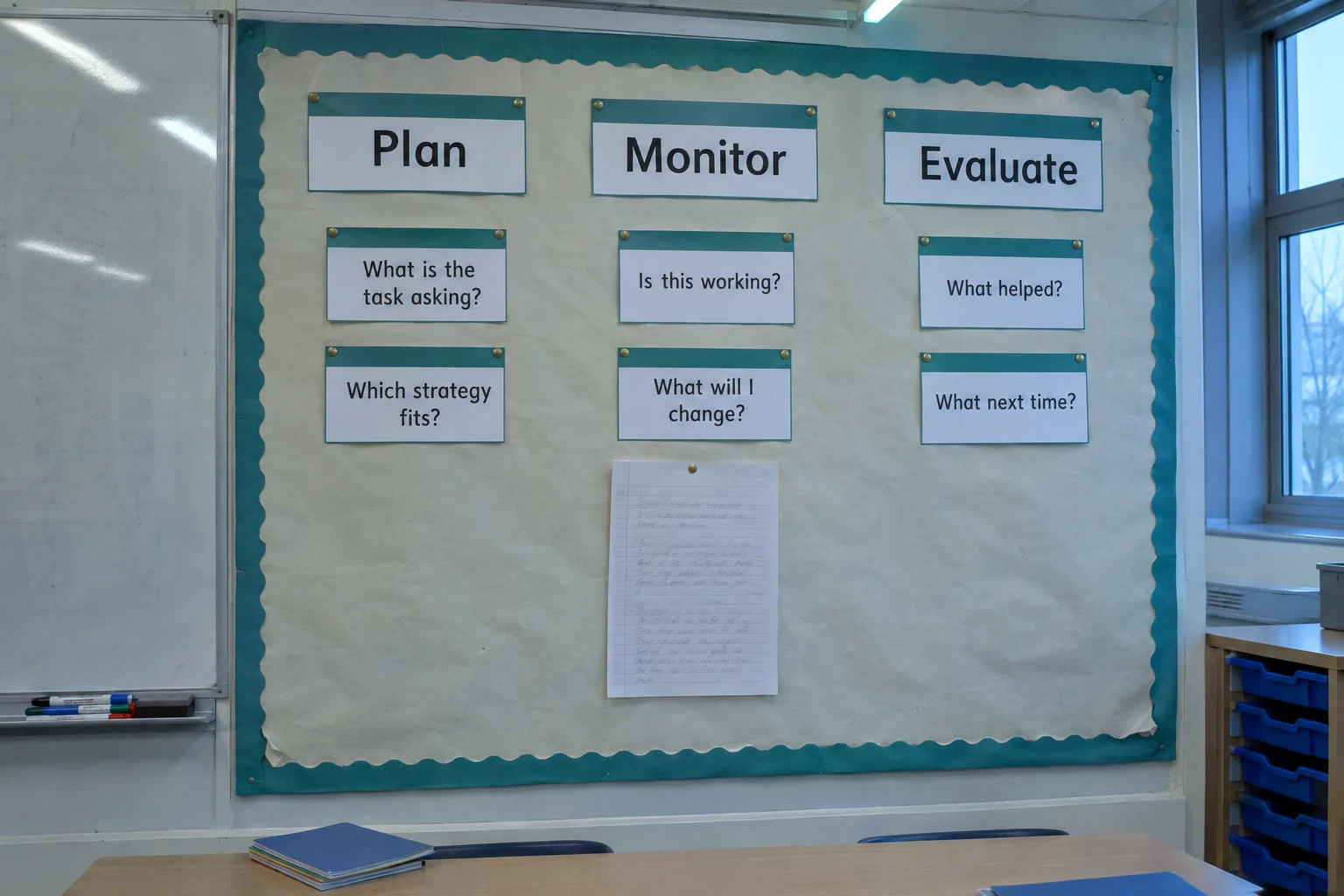
For this episode, Plan holds retrieve facts, read the command word and choose a representation. Monitor holds does all evidence fit?, have I compared? and change the claim. Evaluate holds compare plan with outcome and name the next check.
At Pause 2, the teacher moves read the command word beside the displayed question. At Pause 4, learners take does all evidence fit? to their tables. At Pause 8, the class returns revised cards to Evaluate and explains which one changed the work.
The wall therefore records thinking in use. It does not cause better learning by being visible. Its value comes from the teacher modelling when to select a card, then expecting learners to select cards without prompting.
Teachers online say the same about walls that never change. Replying to a post that doubted classroom displays, @mandyjwilding wrote: “If you use them as wallpaper and don't change them they'll treat them as wallpaper, hence the term WORKING walls.” Our guide to building a working wall shows how to keep one moving across a unit.
Nine routines teachers described on social media.
| Routine, as teachers describe it | What you would notice | What the evidence says |
|---|---|---|
| Think-aloud in the I do Self-reflective questions during explicit modelling, so the class hears the decision, not only the method.
|
An I do slide that pairs modelling with metacognitive language, in a Year 5 class. | The EEF Toolkit, last updated May 2025, says teachers can promote metacognition by modelling their thinking aloud. This row is one teacher’s account of doing that. |
| Scripted maths think-aloud, then the next item Script the thinking for a percentage-discount question, check with a second method, then hand the next question to the class.
|
I language at the board. A second method used as a check. “Can you now apply this approach to the next question?” on the Bradford page. | EEF: model thinking aloud on a curriculum task, not in a thinking-skills lesson. The Bradford page is a worked script teachers can adapt. Bradford Research School, 20 Mar 2025. |
| PCR outdoors, in the task Plan, check, review used on a den construction, not as a plenary chant.
|
The plan, check and review steps go outside with the den build. Learners check a construction, not a feeling, in a Welsh primary school. | EEF: teach plan, monitor and evaluate inside the usual curriculum. PCR is this school’s own name for that cycle. |
| Board-to-paper encoding Think-aloud at the board, while learners write the steps down on paper.
|
Elementary maths books showing steps, not a copied final line. | EEF: in effective studies, teachers often model the explicit use of a strategy during a task. |
| Close: what still needs revision After retrieval and a how/why, learners rank the part of the concept that still needs time. Not a new-content lecture.
|
A ranked gap on a mini-whiteboard, not a smiley face on a slip. | EEF: provide opportunities to reflect, monitor strengths and plan how to overcome current difficulties. |
| Unpack an I can, then self-assess US elementary: unpack the learning target with the class, then self-assess on a proficiency scale. UK rooms keep the command word; they do not need the US scale.
|
Kindergarten learners rating themselves against a target they helped to unpack. | EEF Toolkit: impact is similar across age groups, including the early years. |
| Cheap imitation: posters, tickets, learning-to-learn CPD objection A school implements the lookalike: laminated plan-monitor-evaluate posters, exit tickets, and a learning-to-learn INSET.
|
The poster on the wall. The slip at the door. No think-aloud in the subject. Few teachers in the replies disagreed. | EEF’s own caveat: the +8 months figure is a Toolkit mean across 355 studies, and “it can be difficult to realise this impact in practice.” Hendrick’s reading matches the page. Donker et al. (2014) found strategy instruction can raise attainment; that is not a finding about posters. |
| Exit tickets as admin theatre objection A written ticket at the end that does not change instruction. Mini-whiteboards used for teaching instead.
|
A fourth-grade teacher replying in a consultant’s thread. A slip collected for a walkthrough, not read in the room. | Replies disagree on tickets: @mrshowell24 still wants one sharp check; @MrMetacognition has fallen out of love with them. Veenman, Van Hout-Wolters and Afflerbach (2006) review methods of measuring metacognition and their limits. A ticket marked after the lesson sits in that gap. |
| One clear question, not vague reflection End with one question that can change tomorrow, not a feeling slip.
|
A strategy judgement everyone shows at once, suggested by a school leader. | The EEF Toolkit, last updated May 2025, says teachers might use reflection questions, knowledge organisers, worked examples or success criteria. That is closer to this than a vague ticket. |
"I don't know" is the moment metacognitive teaching either happens or does not. The instinct is to re-explain, which hands the monitoring back to you. The alternative is a short set of responses that send the learner back to plan, check or change, without giving the answer. Use the same four or five every time, so the class learns them as a routine.
"What is the task asking you to do?" Most stuck moments start with a task that was never read properly. Ask the learner to say the task in their own words. If they cannot, that is the problem, and it is a planning problem, not a knowledge problem.
"What do you know so far?" Ask for the facts they are sure of before the ones they are not. In the history episode this is the four causes from memory. A learner who can list three of them has a place to start, and usually finds the fourth while talking.
"What have you tried, and what happened?" This is the monitoring question. It asks the learner to report on a strategy, not on a feeling. "I tried a timeline and it showed order but not importance" is a learner monitoring. "It's too hard" is a learner who has not yet looked.
"Which card would help?" Point at the working wall or the desk strip. The learner chooses a prompt and applies it while you watch. If they choose well, say nothing and move on. If they choose badly, ask what the card is for, not why they chose it.
"Show me the bit you are sure of." When nothing else works, shrink the task. A learner who can point to one correct step has something to build from, and you have found the exact place the teaching needs to go.
That is the point at which the strip on the desk can start to fade.
Metacognitive prompts are scaffolds, so they should become lighter as learners gain control. Strategy instruction tends to work best when it is explicit, embedded in subject content and followed by practice (Donker et al., 2014). Removing every prompt at once can hide whether learners understood the strategy.
Use a three-stage fade. First, the teacher names each pause and models the decision. Next, learners use a short prompt strip and explain one choice to a partner. Finally, only the task and success criteria remain.
For learners who need more support, keep the decision visible while shortening the language. A card can say, “What is the task?”, “What will I try?” and “Is it working?” This approach is consistent with careful classroom scaffolding.
Do not treat a positive reflection as proof that metacognition improved. Self-reports can differ from behaviour during a task (Veenman, Van Hout-Wolters and Afflerbach, 2006). Look for a learner selecting, checking and revising a strategy when the teacher says less.
Two lessons later, set a new question: “Which factor most helped the Roman army succeed?” Provide the evidence and success criteria, but remove the spoken pauses. Leave three small symbols for Plan, Monitor and Evaluate in the margin.
Record whether the learner interprets most, chooses a comparative representation and changes a claim after checking evidence. Then compare the first plan, the finished answer and the learner's explanation. Hattie (2009) identified feedback as an influential classroom practice. Feedback should identify the next controllable action rather than offer general praise (Hattie and Timperley, 2007).
A useful prompt is, “Your evidence check caught a claim that was too broad. On the next task, start that check before drafting.” This makes assessment formative because it changes the next learning move (Wiliam, 2011). Our guide to metacognitive monitoring gives further examples.
Prompt quantity should respond to what learners can already control. In primary classrooms, a teacher can model one decision with concrete materials. In secondary classrooms, the same phase can be attached to a subject-specific representation.
For a learner who still needs the prompts, offer three cards: choose, check and change. The learner points to Check, highlights the evidence that conflicts and explains the revision aloud. The teacher then removes one card when the learner starts that check independently.
During reading, the same cards can cue a prediction, a meaning check and a repair. Keep them tied to the text, as shown in these reading comprehension strategies.
Once the routine has been modelled, learners need the prompts in front of them for a while. The composer below builds a printable desk strip for your age band and subject, with a fading version for when the questions are nearly automatic.
Mini app · Build It · Metacognition
Choose the age band and subject, tick up to three prompts for each phase, and you get a printable desk strip with cut lines plus a fading version with one prompt per phase. The prompts support a routine you have modelled; they do not replace the modelling.
Desk strip
PrimaryAny subjectCut along the dashed line. One strip per desk, or one per pair.
Cut here
Plan
Before you start
Monitor
While you work
Evaluate
When you finish
Fading strip
PrimaryAny subjectOne prompt per phase, for when the routine is nearly automatic.
Cut here
Plan
Before you start
Monitor
While you work
Evaluate
When you finish
Plan, Monitor, Evaluate follows the EEF model of self-regulated learning. Structural Learning.
Fading
Start with the full strip while the routine is new. When learners reach for the prompts without being told, swap to the fading strip, and then to nothing. The aim is that the questions end up in their heads, not on the desk.
Three prompts per phase is a ceiling, not a target: one good prompt learners actually use beats three they ignore.
The strip carries the questions. The Structural Learning app builds the scaffolded lesson those questions sit inside, for your topic and year group. Try it on a free account, no card needed.
A strip only matters if a teacher has modelled the decision it names. The five drawings below are teachers' own accounts of that modelling, redrawn from what they described: the room, the move in order, and what the class did next.
Five classroom examples show teachers modelling how to plan, check and adapt during a task.
1 · Process
1 · I do phase think aloud
2 · self reflective questions
3 · We do then You do
Chloe Barstow put self reflective questions into the I do, not a plenary. The same week’s CPD was We do then You do.
2 · Process
1 · Plan the den
2 · Check it holds
3 · Review the build
Dosbarth Lido used PCR on a den construction, not a worksheet.
3 · Process
1 · Teacher think-aloud
2 · Board-to-paper modeling
3 · Learners encoding steps
Mrs Koonce’s lesson left the steps on the board while learners wrote them down.
4 · Process
1 · I read the whole question first Think-aloud · 25% of £80
2 · I check with a second method
3 · Now you apply this to the next one
Jennifer Green scripts a 25 percent discount on £80, checks with a second method, then hands the next item to the class.
The Bradford page carries two worked think-alouds and a downloadable EEF planning tool: How to Plan a Think Aloud in Maths.
5 · Cause and effect
Cause · Same method new place a tennis ball stuck in a gutter
Effect · Does this still work here?
Ross McGill’s worked example takes Pythagoras to a tennis ball in a gutter.
McGill’s next step: take one task, change it, and ask what you did differently and why. Read it in Metacognition in the Classroom: What It Really Looks Like.
Research supports explicit metacognitive and learning-strategy instruction, but effects vary across interventions. A meta-analysis found positive academic outcomes across different forms of strategy teaching (Donker et al., 2014). Later reviews found that some effects persisted beyond immediate post-tests (de Boer et al., 2018).
These findings do not prove that any reflection sheet will work. Learners need a worthwhile subject task, enough knowledge and a strategy that fits the task. Bjork (1994) distinguished conditions that improve immediate performance from those that support durable learning. Bjork, Dunlosky and Kornell (2013) also warn that feelings of fluency can mislead learners about what they know.
In the history episode, progress is not the learner saying the map felt helpful. It is the learner using evidence to correct a claim, then initiating the same check later. That behaviour connects the research claim to something a teacher can inspect.
Not every teacher is persuaded, and the sharpest doubts are worth hearing before the limitations below. The questions that follow were posted by teachers when the idea met their classrooms, each with a short answer grounded in the replies and the evidence.
Use the questions below to choose metacognitive routines that change what teachers or learners do during the task.
question
“Nobody implements "metacognition". They implement something they take on trust to be metacognition, usually the cheapest and most superficially looking version”
What the replies and the evidence say. The same post names the lookalike: exit tickets, laminated plan-monitor-evaluate posters, and a learning-to-learn CPD session. Few classroom teachers in the replies disagreed with him. The move that works is a think-aloud tied to the subject (Barstow, Bradford, Sandfields), not a poster.
question
“"Metacognition and self regulation, + eight months" is not a finding, it is a mean drawn across 100s of studies of different interventions”
What the replies and the evidence say. @dylanwiliam replied the same day that effect sizes are justifiable only when they are unnecessary. The EEF Toolkit page states the +8 months figure as an average across 355 studies and adds that it can be difficult to realise this impact in practice. Cite the recommendation to model thinking in the subject, not the number.
question
“Disappointed to see that this fascinating subject is an AI post, with an AI poster.”
What the replies and the evidence say. @helenrey is replying to a think-aloud thread she judged to be AI-written. The answer to a generic post is a specific move: model one in-the-moment decision on a real task, such as waiting, asking again or changing the model.
question
“I find that I don't adjust my instruction based on exit tickets and only use them for dog & pony shows for admin.”
What the replies and the evidence say. Teachers split on whether exit tickets inform the next teaching move or mainly serve observers. She is answering @MrMetacognition, who has fallen out of love with tickets because they are slow to make and do not give instant feedback. @mrshowell24 still wants one sharp check, not vague reflection. Keep a question you will read in the room. Drop the slip you collect for a walkthrough.
question
“if every teacher adopted this method, might the DAILY cognitive load become too great?”
What the replies and the evidence say. The writer adds: I know for my special needs student, that would have been the case.
Treat the load as a real constraint: one modelled decision in the subject, then a fade, not a daily extra product in every lesson. The EEF already says teach the strategies in the curriculum, not as a bolt-on.
Metacognition is not a substitute for subject knowledge. A learner cannot monitor the accuracy of a historical claim without facts and criteria. Teaching broad prompts without curriculum content can produce fluent talk but weak reasoning (Veenman, Van Hout-Wolters and Afflerbach, 2006).
Prompting can also become excessive. If every sentence requires a written reflection, the routine competes with the task. Teachers should watch whether a scaffold reveals thinking or merely adds paperwork.
Evidence reviews combine programmes that differ in age, subject, duration and teaching quality. Average effects do not guarantee the same result in every classroom (Donker et al., 2014; de Boer et al., 2018). Judge the approach through later independent work, not a single successful lesson.
Subject teams often ask who owns this work. The answer is the subject, not a separate lesson. The planning and checking questions change their wording in a maths lesson and keep the same purpose, which is why departments get further when they write the prompts together than when each teacher writes their own. Our guide to developing metacognition across a school sets out how leaders can support that shared work.
Plan your next lesson around one demanding question and mark three pauses on the plan: one to read the task, one to pick the strategy, one to check a claim against the evidence. Model one deliberate mistake at the second pause. Then remove one prompt before learners make their final attempt.
A learner in a history lesson plans a paragraph with a causal map, notices while writing that the topic sentence claims one cause acted alone, checks the map, and revises the sentence before continuing. That is metacognition: a plan, a check against evidence and a change of course, all inside the subject work. The same shape appears in maths when a learner checks an answer against the question, or in reading when a learner rereads a sentence that stopped making sense. The tell is a change made without the teacher asking for it.
Six strategies carry most of the work on this page. A think-aloud with a deliberate mistake shows learners how an expert checks. Self-questioning prompts, such as “Does all evidence fit?”, give learners the check in words. A causal map or a bar model is a planning strategy chosen to fit the task.
A working wall keeps the prompts in view while learners still need them. Asking a stuck learner what they have tried turns a feeling into a report on a strategy. A later task with fewer prompts shows whether the strategy has transferred. The EEF Toolkit lists similar supports, including reflection questions, worked examples and success criteria.
Say it as two jobs. One part of you does the work: reads, adds, writes. Another part watches the work and asks whether it is going well and what to try next. With younger learners, use a picture they know, such as a driver who keeps glancing in the mirror while driving.
Then show it rather than define it: think aloud on a real task, include a wobble, and say out loud what you did about it. The word metacognition can wait. Children copy the routine, not the label.
Not quite. Learning to learn usually means a standalone course of study skills taught away from subject content, and that version has a poor record, because the prompts have nothing to bite on without subject knowledge. Metacognition, as this guide uses it, is the planning, monitoring and evaluating a learner does inside a subject task.
It is not a pedagogy on its own either. It is a layer on top of good explanation and practice. The EEF guidance is explicit that the strategies should be taught within the curriculum, not as a separate lesson (Education Endowment Foundation, 2018).
Because the decisions being monitored are different. In history the check is whether every claim has evidence and whether causes have been compared, not just listed. In maths it is whether the answer fits the question and whether a second method agrees.
In reading it is whether the sentence still makes sense and what to do when it does not. The three phases, plan, monitor and evaluate, stay the same. The strategy, the representation and the words on the prompt card change with the subject, which is why a generic poster rarely changes anything.
Meta-analyses of strategy instruction report positive effects on academic performance, and some effects persist beyond the immediate post-test (Donker et al., 2014; de Boer et al., 2018). Treat those results as averages across very different programmes, not a promise for your classroom.
The EEF guidance recommends explicit teaching of the strategies inside the curriculum for that reason (Education Endowment Foundation, 2018). The effect in a given room depends on three things. Is the strategy modelled in the subject? Do learners practise it while the prompt fades? Do you judge it on a later independent task rather than a confident reflection?
No. They do different jobs and neither works without the other. Cognition is the subject thinking: recalling the causes of the fire, weighing the evidence, writing the judgement. Metacognition directs that thinking by choosing an approach, checking it and changing it.
A learner with strong monitoring and no knowledge has nothing to monitor. A learner with knowledge and no monitoring writes the first idea down and moves on. Teach the content first, then the check on it, and expect the check to be as subject-specific as the content.
Bjork, R. A. (1994). Memory and metamemory considerations in the training of human beings. In J. Metcalfe and A. P. Shimamura (eds), Metacognition: Knowing About Knowing (pp. 185 to 205). MIT Press.
Bjork, R. A., Dunlosky, J. and Kornell, N. (2013). Self-regulated learning: Beliefs, techniques, and illusions. Annual Review of Psychology, 64, 417 to 444.
de Boer, H., Donker, A. S., Kostons, D. D. N. M. and van der Werf, G. P. C. (2018). Long-term effects of metacognitive strategy instruction on student academic performance: A meta-analysis. Educational Research Review, 24, 98 to 115.
Donker, A. S., de Boer, H., Kostons, D., Dignath van Ewijk, C. C. and van der Werf, M. P. C. (2014). Effectiveness of learning strategy instruction on academic performance: A meta-analysis. Educational Research Review, 11, 1 to 26.
Education Endowment Foundation (2018). Metacognition and Self-Regulated Learning: Guidance Report. Education Endowment Foundation.
Education Endowment Foundation (2025). Metacognition and Self-Regulated Learning: Guidance Report (updated edition). Education Endowment Foundation.
Flavell, J. H. (1979). Metacognition and cognitive monitoring: A new area of cognitive-developmental inquiry. American Psychologist, 34(10), 906 to 911.
Hattie, J. (2009). Visible Learning: A Synthesis of Over 800 Meta-Analyses Relating to Achievement. Routledge.
Hattie, J. and Timperley, H. (2007). The power of feedback. Review of Educational Research, 77(1), 81 to 112.
Veenman, M. V. J., Van Hout-Wolters, B. H. A. M. and Afflerbach, P. (2006). Metacognition and learning: conceptual and methodological considerations. Metacognition and Learning, 1(1), 3 to 14.
Wiliam, D. (2011). What is assessment for learning? Studies in Educational Evaluation, 37(1), 3 to 14.
Zepeda, C. D., Hlutkowsky, C. O., Partika, A. C. and Nokes-Malach, T. J. (2019). Identifying teachers’ supports of metacognition through classroom talk and its relation to growth in conceptual learning. Journal of Educational Psychology, 111(3), 522 to 541.
Zimmerman, B. J. (2002). Becoming a self-regulated learner: An overview. Theory Into Practice, 41(2), 64 to 70.