Updated on
October 12, 2026
Worked examples: how to design and fade support
Design a complete worked example, a completion task and an independent check. Use learner reasoning to decide which steps to remove or restore.

Updated on
October 12, 2026
Design a complete worked example, a completion task and an independent check. Use learner reasoning to decide which steps to remove or restore.
How do teachers design and fade worked examples?
A worked example shows a problem, the steps used to solve it and the result. A useful example also explains the decisions between those steps. To reduce support, turn a related example into a completion task, then check a fresh problem without supplied solution steps. Choose what to remove by the reasoning you want to see. Keep support when a missing prerequisite prevents that reasoning. Renkl et al. (2002) studied the transition from example study to problem solving. The sequence below shows how to make those decisions alongside your school's existing method.
Start with one procedure and one intended decision. In a Year 7 algebra lesson, the decision is how to isolate an unknown while preserving equality. Before the example, check whether learners can divide a whole number and understand the equals sign. Otherwise, an error later could come from either prerequisite.
Write the reason beside the operation it explains. A final answer tells learners where the solution ends. It does not show why the route is valid. A page of calculations without explanations leaves that route for the learner to infer.
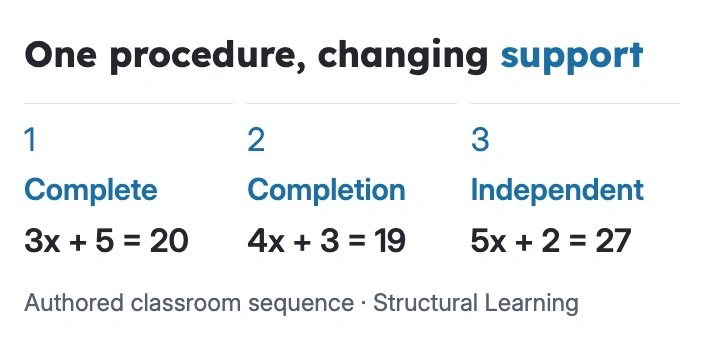
Here is an authored classroom illustration. The equations and prompts are examples for planning, rather than materials tested in the cited studies.
Solve 3x + 5 = 20.
Ask: “Why do we subtract 5 from both sides?” Listen for the equality relationship, rather than the phrase “move the five”. If learners use that shortcut, ask them to show the operations behind it.
Keep the explanation close to its step. An unrelated story, a second method and extra terminology can all wait if they obscure the decision being taught. Once the procedure is secure, comparing valid methods becomes a different task.
For advice on demonstrating a process aloud, use our guide to modelling learning. Here the focus is the example itself and the work you ask learners to supply.
These formats allocate different parts of the solution to the learner. They are choices within a lesson, rather than three compulsory phases with fixed timings.
| Format | What you provide | What learners supply |
|---|---|---|
| Complete example | The problem, solution and reasons | An explanation of a decision |
| Completion task | The problem and selected solution steps | A missing step and its reason |
| Independent problem | A fresh problem without solution steps | The method, solution and check |
Keep the first completion task close enough to the example for the intended procedure to remain visible. For instance, after 3x + 5 = 20, give 4x + 3 = 19. Supply the first operation and ask learners to finish:
“Subtract 3 from both sides: 4x = 16. Write the next operation and explain why it preserves equality. Then check your value in the original equation.”
The expected continuation is division of both sides by 4, giving x = 4. Dividing both sides by the same non-zero number preserves equality and isolates x. The check is 4 × 4 + 3 = 19. A learner who writes 4 without the operation has supplied the result, but has not yet shown the requested reasoning.
Next, offer 5x + 2 = 27 without solution steps. Ask learners to solve it, explain their first operation and check the result. Here x = 5, because subtracting 2 gives 5x = 25. Substitution gives 5 × 5 + 2 = 27.
Mark the supplied steps clearly. Otherwise, a finished page can disguise how much of the solution the learner produced. When reviewing books, distinguish the teacher's model from the learner's own attempt.

Choose the omission before you make the worksheet. Ask: “What decision will this gap let me observe?” Removing an arbitrary line can make a task harder without making the evidence more useful.
In the completion task above, the first operation is supplied. The learner decides how to go from 4x = 16 to x = 4. That is appropriate if division is the target. It tells you less about whether the learner can choose the first operation.
If preserving equality is the target, change the gap. Show 4x + 3 = 19, leave the first transformation blank, and supply the later line x = 4. Ask the learner to write the operation that produces 4x = 16 and explain why it is valid. The supplied answer means this is still a completion task, rather than an independent solution.
One studied approach is backward fading: remove later solution steps before earlier ones as learners move from examples towards problems. Renkl and colleagues (2002) examined fading in a school electricity study and university laboratory studies. Their findings support a carefully bounded case for fading, especially on near-transfer tasks. They do not establish that every teacher must always remove the final line first.
Use the studied approach as an option, then judge the gap against your lesson's target. If the final line is only an arithmetic answer, removing it may check calculation rather than the decision you intended. You can ask for the reason as well as the missing line.
Give feedback on that decision. If a learner divides only one side, return to the equality relationship with a short complete example. If both sides are divided correctly but the division is wrong, address the calculation. The same incorrect answer can need different support.
Remove another step when the attempt justifies it. Restore a smaller piece of guidance when it does not. Neither move requires changing the learner's permanent group or labelling them as a novice.
A correct copied solution is a record of what was shown. It is not evidence that the learner could construct the solution. Use a response that requires a decision the example has not already supplied.
After the complete example, cover the explanations and ask: “What makes the first operation valid?” Then give the completion task. Finally, use the fresh problem without visible steps. Each response answers a different question.
| Response | What it helps you check | What remains uncertain |
|---|---|---|
| Explains a supplied step | Understanding of that decision | Choosing the step independently |
| Completes a missing step | Acting with partial support | Constructing the whole solution |
| Solves a fresh problem | Performance without supplied steps | Retention and broader transfer |
A fluent explanation can coexist with a weak independent attempt. Equally, a brief spoken answer may reflect difficulty expressing the reasoning. Ask the learner to show the operation as well as describe it, rather than treating eloquence as your success criterion.
You can also use an incorrect transformation as a diagnostic prompt. Write 4x + 3 = 19 → 4x = 19 and ask what operation was applied to each side. The intended response is that removing 3 only on the left changes the equality. This is an authored check, not a claim that error examples always improve learning.
Keep an independent problem for a later lesson too. Immediate success tells you what the learner can do now. It cannot, by itself, settle what they retain after a delay.
Relevant knowledge is specific to the task. A learner can be confident with one-step equations and still need help with a new equation structure. “Novice” describes that relationship to the content, rather than a fixed ability category.
Kalyuga and colleagues (2001) studied changing instructional effectiveness as mechanical trade apprentices acquired expertise. The relevant point is that guidance useful at one stage may become less useful as knowledge grows. This is part of the research behind the expertise reversal effect. It is not a timetable for withdrawing help from every Year 7 class.
In the algebra lesson, offer a brief independent attempt before deciding who needs the complete explanation again. A learner who solves the equation and explains both operations has different needs from someone who changes only one side. Let the observed response guide the next task.
Avoid removing every support at once. If you want to check choosing an operation, keep the vocabulary and layout familiar. Introducing unfamiliar notation, awkward numbers and a new instruction format together makes the cause of an error harder to identify.
For the wider account of working memory and instructional demands, see our cognitive load theory guide. For planning a lesson's changes in responsibility, use I Do, We Do, You Do. A worked example can sit within those approaches without turning them into a fixed fading schedule.
For a wider account of selecting classroom approaches, see our pedagogy guide.
Renkl, Atkinson, Maier and Staley (2002) investigated the transition from example study to problem solving. Their article includes a German ninth-grade electricity quasi-experiment and university laboratory studies. The school study compared existing classes, and its teacher was also an author. That limits how confidently we can isolate fading as the cause of the result.
Across the three studies, fading produced better near-transfer performance than alternating complete examples with problems. Near transfer means applying the learned procedure to a similar problem. Far-transfer findings were mixed, so they do not justify a general promise about substantially different problems or subjects.
Changing 3x + 5 = 20 to 5x + 2 = 27 keeps the same equation structure. Success is useful evidence of applying that procedure. It does not demonstrate that learners can handle every equation, choose a method in an unfamiliar context or use the idea in extended writing.
Kalyuga, Chandler, Tuovinen and Sweller (2001) provides a second lesson about prior knowledge and guidance. Examples helped inexperienced mechanical trade apprentices, while problem solving became more useful with greater domain experience. This finding concerns knowledge within a domain, rather than confidence or a permanent ability label.
Use the research to frame a decision: make the procedure visible, reduce supplied steps deliberately and check the learner's response. Treat the classroom equations here as illustrations of that decision. They are not a tested programme or a guaranteed route to higher attainment.
These posts raise practical questions about guidance and task design. They are opinions rather than research findings.
“The point of worked examples is not to create permanent dependence.”
Check a fresh problem without supplied steps before deciding what support to remove.
“The examples don’t align, not enough practice problems, too much spiral in the homework.”
This post concerns a scheme the author uses. Keep your example and first completion task on the same procedure, then check the independent problem yourself.
Yes, when that step is the decision you need to check. Make the remaining support explicit. A supplied later answer changes what you can infer from the completed task.
Check their relevant knowledge with an attempt. Confidence alone is insufficient. If the procedure and reasoning are secure, use a task that requires more independent choices.
It shows whether the learner can apply the procedure to that related problem. It provides limited evidence about substantially different tasks. Name what changed before deciding what the response proves.
There is no fixed count established by the sources used here. Look for accurate decisions across related tasks. If success depends on visible steps, keep or restore the needed guidance.
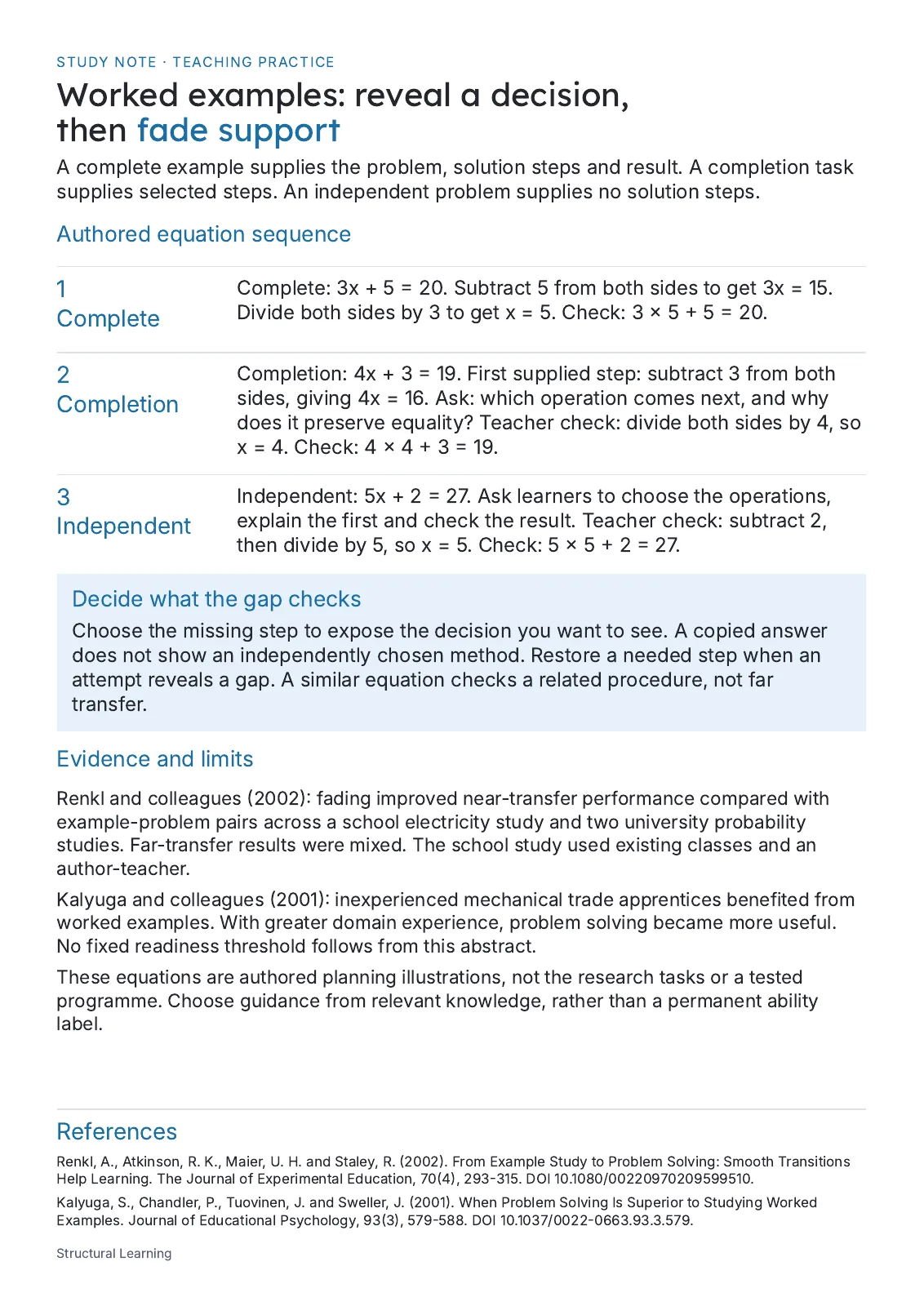
Use this A4 note to revisit the three task formats, check the authored equations and retain the research limits. Teacher answers are visible. A text version follows the image.
Download the A4 study note (PDF)
Study note · teaching practice
A complete example supplies the problem, solution steps and result. A completion task supplies selected steps. An independent problem supplies no solution steps.
Complete: 3x + 5 = 20. Subtract 5 from both sides to get 3x = 15. Divide both sides by 3 to get x = 5. Check: 3 × 5 + 5 = 20.
Completion: 4x + 3 = 19. First supplied step: subtract 3 from both sides, giving 4x = 16. Ask: which operation comes next, and why does it preserve equality? Teacher check: divide both sides by 4, so x = 4. Check: 4 × 4 + 3 = 19.
Independent: 5x + 2 = 27. Ask learners to choose the operations, explain the first and check the result. Teacher check: subtract 2, then divide by 5, so x = 5. Check: 5 × 5 + 2 = 27.
Choose the missing step to expose the decision you want to see. A copied answer does not show an independently chosen method. Restore a needed step when an attempt reveals a gap. A similar equation checks a related procedure, not far transfer.
Renkl and colleagues (2002): fading improved near-transfer performance compared with example-problem pairs across a school electricity study and two university probability studies. Far-transfer results were mixed. The school study used existing classes and an author-teacher.
Kalyuga and colleagues (2001): inexperienced mechanical trade apprentices benefited from worked examples. With greater domain experience, problem solving became more useful. No fixed readiness threshold follows from this abstract.
These equations are authored planning illustrations, not the research tasks or a tested programme. Choose guidance from relevant knowledge, rather than a permanent ability label.
Renkl, A., Atkinson, R. K., Maier, U. H. and Staley, R. (2002). From Example Study to Problem Solving: Smooth Transitions Help Learning. The Journal of Experimental Education, 70(4), 293-315. DOI 10.1080/00220970209599510.
Kalyuga, S., Chandler, P., Tuovinen, J. and Sweller, J. (2001). When Problem Solving Is Superior to Studying Worked Examples. Journal of Educational Psychology, 93(3), 579-588. DOI 10.1037/0022-0663.93.3.579.
Keep the equation sequence, the decision check and the research limits beside your planning notes.
Enter your first name and email to get the image download. Read our Privacy Policy. The PDF and text version are also available in this article.
Choose a procedure from your existing scheme. Write one complete example with a reason beside each operation. Make a related completion task with a gap that reveals your target decision. Prepare a fresh problem without supplied steps and a short route back to support.
Before the lesson, check that the numbers work and the omitted step has a clear purpose. During the lesson, record which operation learners can choose and justify. Next lesson, remove one solution step only after checking the reasoning it will require.