Updated on
October 9, 2026
Paul-Elder Framework: 8 Elements, 9 Intellectual Standards
The Paul-Elder critical thinking framework explained: the eight elements of reasoning, nine intellectual standards, eight traits, and classroom routines.

Updated on
October 9, 2026
The Paul-Elder critical thinking framework explained: the eight elements of reasoning, nine intellectual standards, eight traits, and classroom routines.
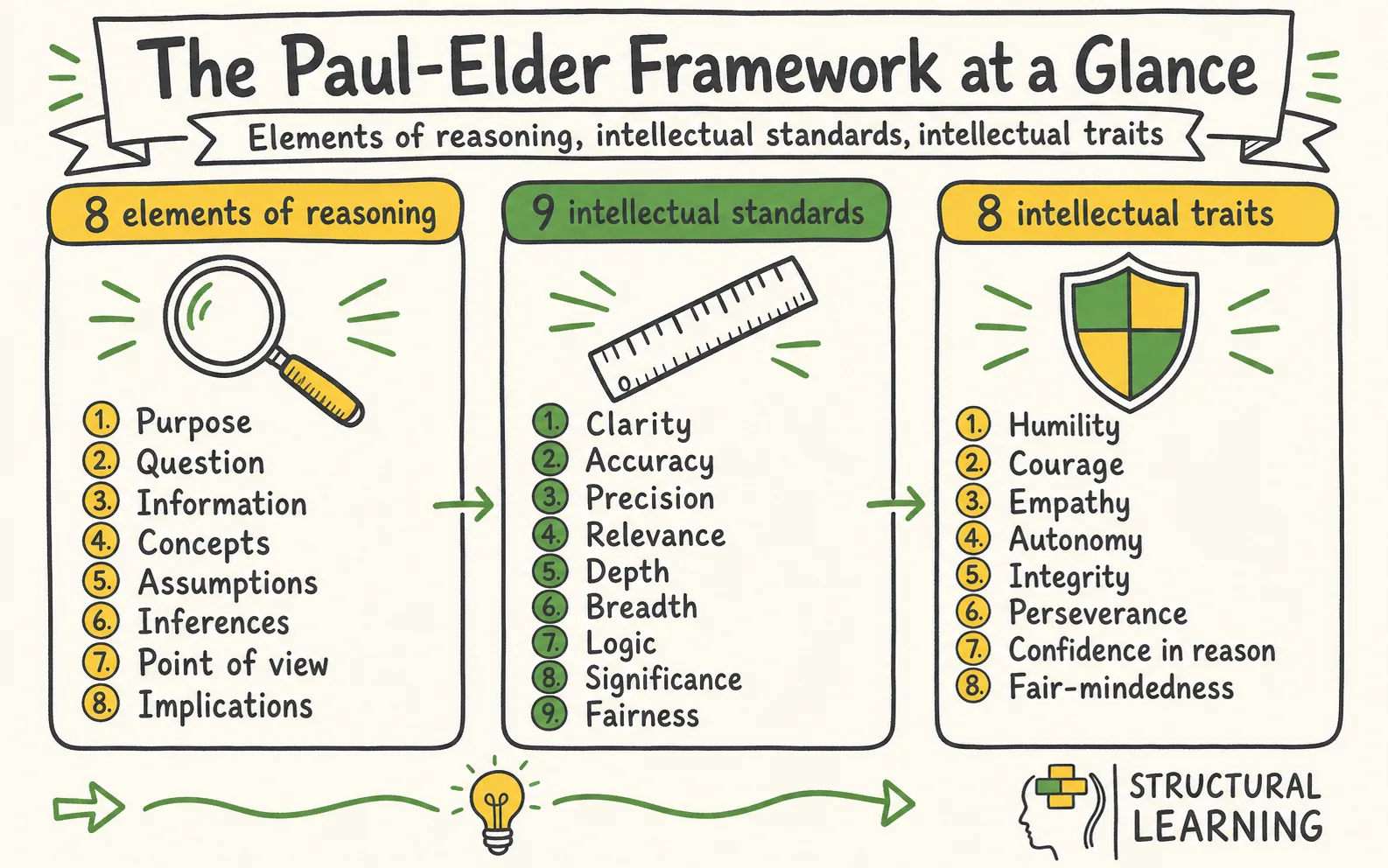
The Paul-Elder framework is a model of critical thinking built from three parts: the elements of reasoning, the intellectual standards used to judge them, and the intellectual traits that grow from practising both. Richard Paul and Linda Elder developed it through the Foundation for Critical Thinking, and it has become one of the most widely adopted approaches to teaching reasoning in schools and universities (Paul & Elder, 2001). Moseley and colleagues judged Paul's model applicable to any subject and any level in their review of thinking frameworks (Moseley et al., 2005).
The framework's appeal is its completeness. Where many models list skills, Paul-Elder connects the anatomy of an argument to the quality checks a thinker should run and the habits of mind that make those checks routine. This guide explains all three layers, shows how the model compares with other thinking frameworks, and sets out classroom routines that make the standards stick.
The Paul-Elder framework defines critical thinking as the art of analysing and evaluating thinking with a view to improving it. It gives that art a structure: thinkers take apart reasoning using eight elements, test each part against nine intellectual standards, and through repeated practice develop eight intellectual traits such as intellectual humility and fair-mindedness.
The model treats critical thinking as self-directed rather than teacher-directed. The goal is not learners who can dismantle other people's arguments on demand, but learners who routinely question their own purposes, assumptions and inferences. That emphasis distinguishes it from checklist approaches to critical thinking that stop at evaluating sources.
Universities have adopted the framework at scale, and it underpins whole-institution quality initiatives as well as single courses. In schools it works best as a shared language for reasoning across subjects, in the same way a taxonomy provides a shared language for objectives.
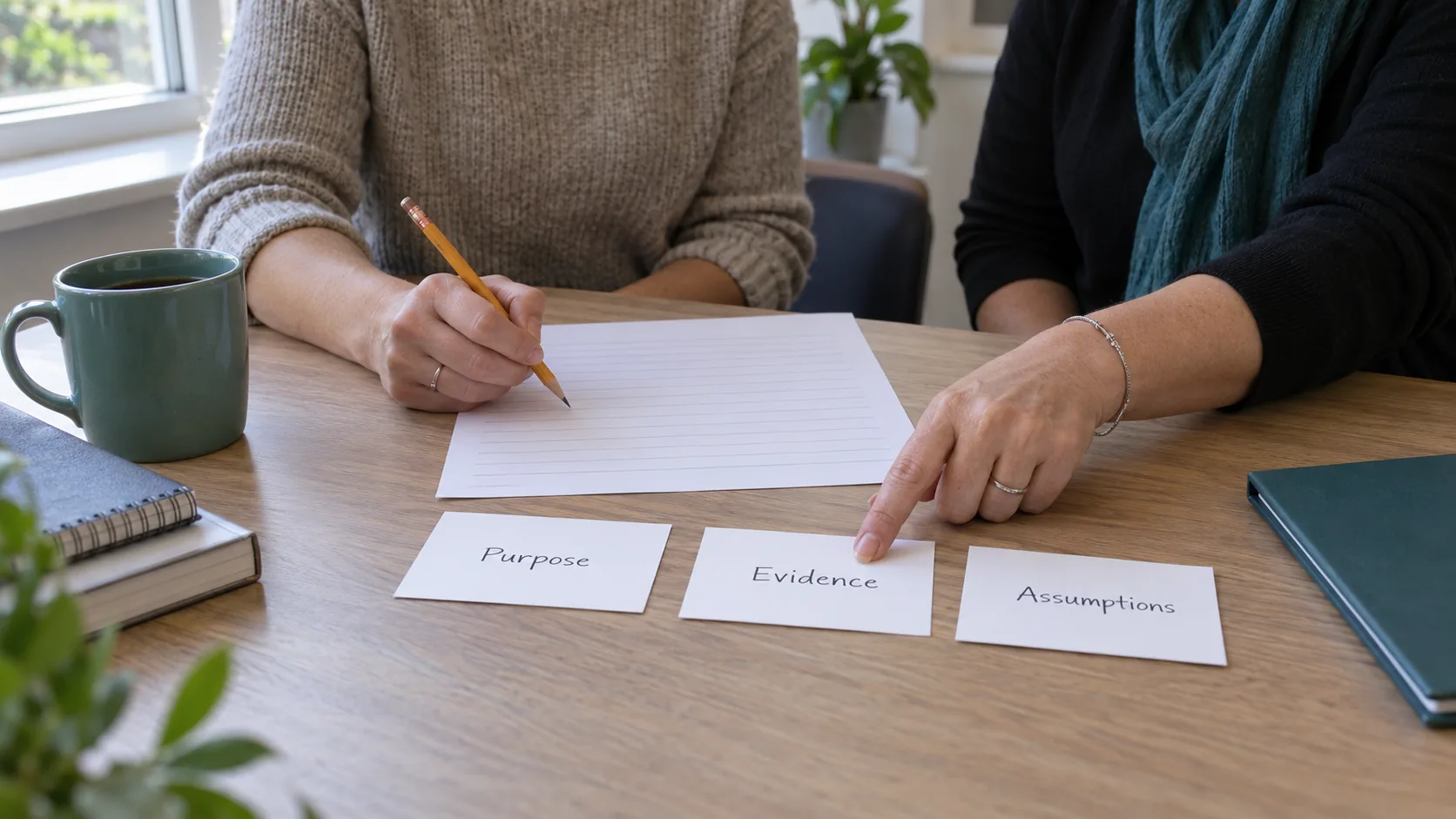
The elements are the anatomy of any piece of thinking. Every act of reasoning has a purpose, asks a question, rests on information, uses concepts, makes assumptions, draws inferences, adopts a point of view and carries implications. Name the eight parts and you can take apart an essay, an experiment plan or a historical argument.
In the classroom the elements become analysis prompts. What is this author's purpose?
What question is the experiment really asking? What information would change this conclusion? What is being assumed here?
Teachers who already use strong questioning will recognise most of these moves; the framework's contribution is to make the set complete and teachable.
The elements also travel across subjects. A source evaluation in history, a hypothesis test in science and a persuasive essay in English all decompose into the same eight parts, which is why departments can share the vocabulary without sharing content.
The standards are the quality checks: clarity, accuracy, precision, relevance, depth, breadth, logic, significance and fairness. Learners apply them to the elements.
Is my purpose clear? Is this information accurate? Is my inference logical? Is my point of view fair to the strongest opposing case?
Standards turn vague feedback into precise feedback. "Explain in more detail" becomes "your answer is clear but not precise: add the figures". "Be more balanced" becomes "your breadth is thin: what would the other side say?" Learners can run the same checks on their own drafts, which links the standards directly to metacognition and to classroom self-monitoring routines.
Most schools that adopt the framework start here. Two standards used relentlessly beat nine used occasionally, and clarity plus accuracy are the usual starting pair.
The traits describe what repeated, standards-driven reasoning produces: intellectual humility, courage, empathy, autonomy, integrity, perseverance, confidence in reason and fair-mindedness. They are dispositions rather than skills, closer to character education than to a mark scheme.
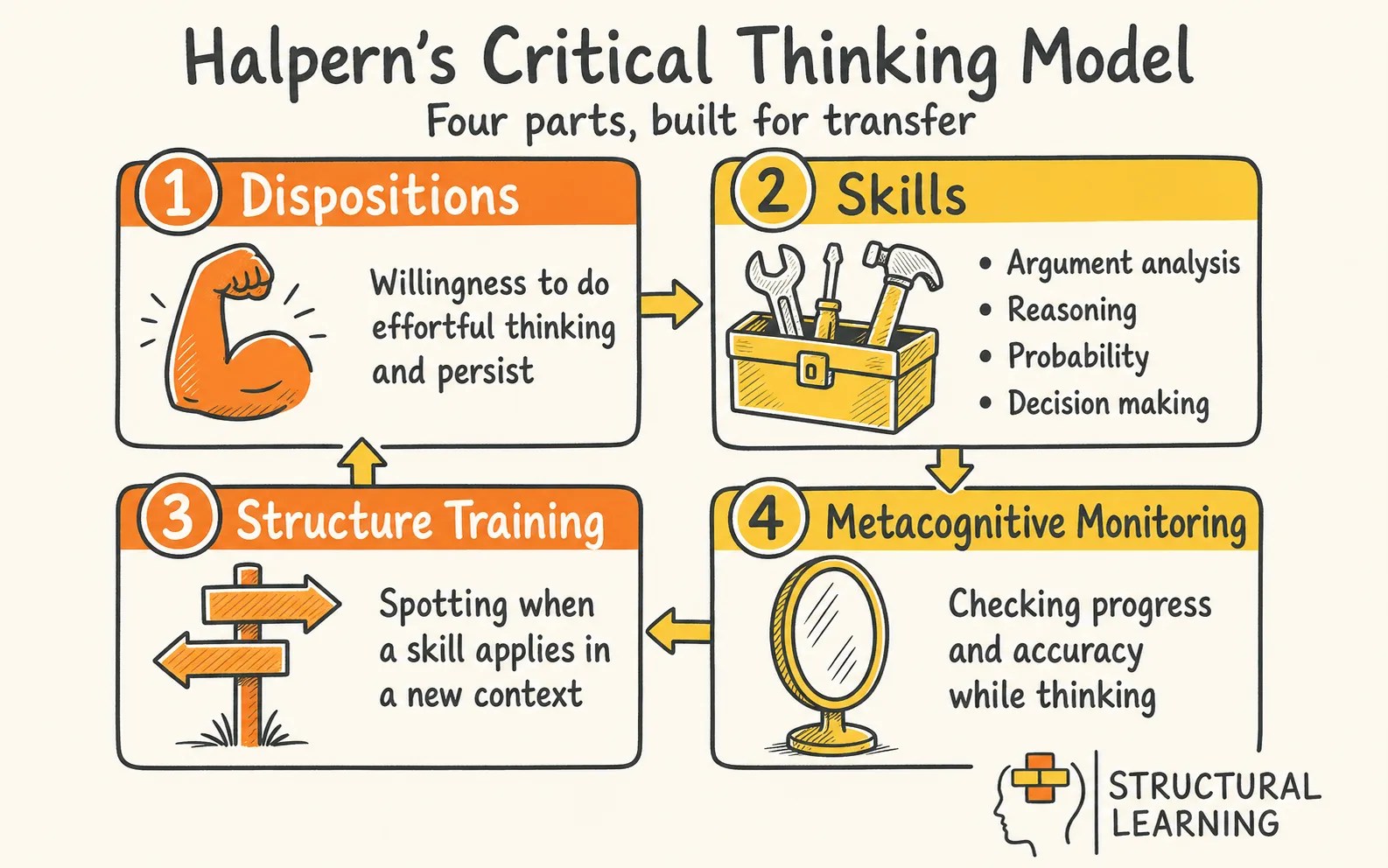
The traits matter because skills alone do not make a good thinker. Research on critical thinking dispositions makes the same point: the ability to evaluate arguments only pays off when a person is inclined to use it (Ennis, 1987). Halpern's work adds that dispositions plus explicit metacognitive monitoring are what make thinking transfer beyond the classroom (Halpern, 1998).
Paul and Elder's most useful distinction sits here. Weak-sense critical thinkers deploy the elements and standards to win arguments they already believe. Strong-sense critical thinkers turn the same tools on their own reasoning first (Paul & Elder, 2014). Classroom debate formats that require learners to argue the opposing side are the most direct way to practise the strong sense.
Weak-sense critical thinking uses the tools of reasoning to defend positions a person already holds, while strong-sense critical thinking applies the same standards to one's own beliefs first. Paul and Elder treat the distinction as the heart of the framework, because skilled but one-sided reasoning is more dangerous than unskilled reasoning, not less.
The classroom implication is uncomfortable and useful. A debating champion can be a weak-sense thinker. A learner who changes their mind in the face of better evidence is showing the stronger skill, even if their argument was less polished. Assessment that only rewards well-defended conclusions quietly trains the weak sense.
Two routines target the strong sense directly. Ask learners to write the best possible case against their own conclusion before submitting work. In discussion, require a fair summary of the opposing view, checked by the opponent, before any rebuttal is allowed. Both make fair-mindedness a procedure rather than a poster.
In a Year 6 unit on plastic pollution, the elements structure the enquiry. Purpose: decide whether the school should ban single-use bottles. Question: what would change if we did? Learners gather information, surface the assumption that bottled water is necessary, and test their inference against the accuracy and relevance standards before presenting a recommendation.
In GCSE history, a source question becomes an elements analysis. Whose point of view does the source carry? What is its purpose? What does it assume its audience already believes?
The standards then drive the evaluation: the source is clear and vivid, but is it accurate, and is the inference it invites logical? The same pattern fits A-level science evaluation questions almost unchanged.
Marking benefits too. A department that phrases written feedback as standards questions rather than instructions finds learners can act on it independently, which is the framework doing exactly what it was designed for: shifting the quality control from teacher to learner.
Introduce one layer at a time, and anchor each layer in routines rather than posters. The sequence that works in most schools runs standards first, elements second, traits last, over a term or longer. Meaningful classroom talk is the vehicle: structured discussion is where standards get applied in real time, as our guide to critical thinking through classroom talk shows.
The evidence backs this explicit, dialogue-heavy approach. Abrami and colleagues' meta-analysis of 341 effect sizes found the largest gains for critical thinking when explicit instruction was combined with structured dialogue and authentic problems, exactly the combination the routines above build (Abrami et al., 2015).
For staff development, model the framework on adult problems before classroom ones. A department meeting that runs a curriculum decision through the elements, then checks it against three standards, teaches the model faster than any briefing. Teachers who have felt the standards bite on their own reasoning use them far more naturally with learners, and the shared vocabulary starts to appear in feedback, planning and moderation without being mandated.
Choose the model by the job. Ennis offers the fullest taxonomy of critical thinking abilities for curriculum audit. Halpern offers the strongest account of transfer and everyday reasoning.
De Bono's Six Thinking Hats structures group idea generation. Paul-Elder's advantage is coherence: one model that runs from analysis through quality control to character.
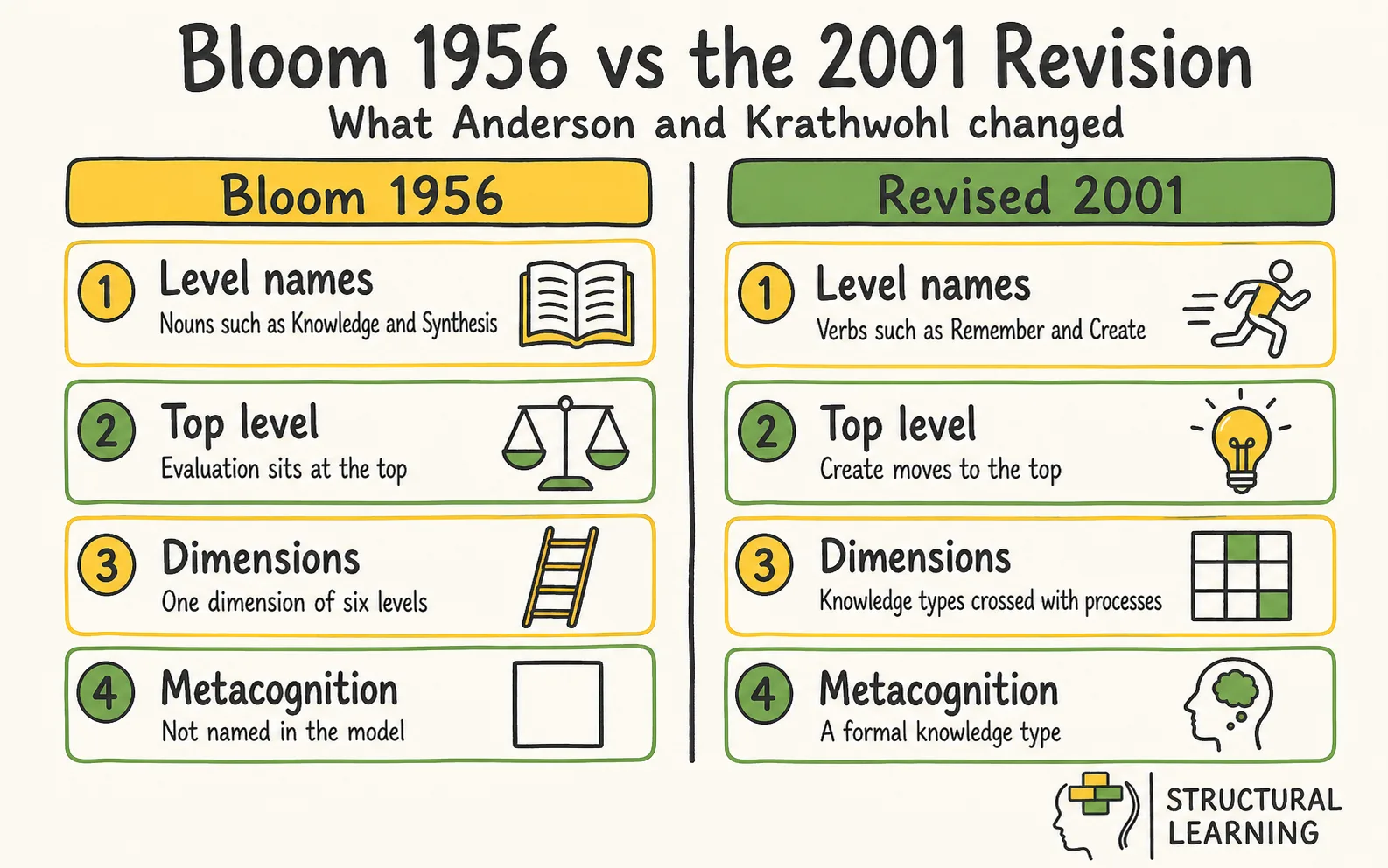
Against taxonomies of objectives such as Bloom's or SOLO, the comparison is not either-or. A taxonomy grades what learners produce; Paul-Elder describes how they should reason while producing it. Departments commonly plan tasks with a taxonomy and coach the reasoning with the standards, alongside broader work on higher-order thinking skills.
The framework has real weaknesses. Its research base is thinner than its reach: the model grew from philosophy rather than empirical psychology, and direct trials of Paul-Elder as a package are scarce, even though its components align with what the meta-analytic evidence supports. Schools should treat it as a well-structured vocabulary, not a proven intervention.
It is also demanding. Nine standards, eight elements and eight traits is a lot of moving vocabulary for a busy classroom, and half-implemented versions collapse into wall displays. The weak-sense trap applies to teachers too: it is easy to use the standards on learners' reasoning and never on the curriculum's own claims.
Finally, critics note that generic reasoning tools underplay knowledge. Thinking critically about vaccination or the causes of a war requires domain knowledge first, a point the wider evidence on thinking skills keeps confirming. The framework works when it rides on secure subject teaching, not instead of it.
For UK schools, the practical fit is strongest where reasoning is already visible in the curriculum: oracy programmes, disciplinary literacy work and sixth-form extended projects. The standards give talk rules a quality dimension, and the elements give project supervisors a shared analysis tool. Used that way, Paul-Elder strengthens what a school already does rather than competing with it. It also gives middle leaders a common review language when they compare reasoning demands across subjects and key stages.
Abrami, P. C., Bernard, R. M., Borokhovski, E., Waddington, D. I., Wade, C. A., & Persson, T. (2015).
Strategies for teaching students to think critically: A meta-analysis. Review of Educational Research, 85(2), 275-314.
Ennis, R. H. (1987). A taxonomy of critical thinking dispositions and abilities. In J. B. Baron & R. J. Sternberg (Eds.), Teaching thinking skills: Theory and practice. W. H. Freeman.
Facione, P. A. (1990). Critical thinking: A statement of expert consensus for purposes of educational assessment and instruction. The California Academic Press.
Halpern, D. F. (1998). Teaching critical thinking for transfer across domains. American Psychologist, 53(4), 449-455.
Moseley, D., Baumfield, V., Elliott, J., Gregson, M., Higgins, S., Miller, J., & Newton, D. P. (2005).
Frameworks for thinking: A handbook for teaching and learning. Cambridge University Press.
Paul, R., & Elder, L. (2001). Critical thinking: Tools for taking charge of your learning and your life. Prentice Hall.
Paul, R., & Elder, L. (2014). The miniature guide to critical thinking: Concepts and tools (7th ed.). Foundation for Critical Thinking.