Updated on
October 7, 2026
The TASC Wheel: Thinking Actively in a Social Context
The TASC Wheel explained for primary teachers: the eight thinking segments, a worked KS2 example, and how to run a full problem-solving cycle.

Updated on
October 7, 2026
The TASC Wheel explained for primary teachers: the eight thinking segments, a worked KS2 example, and how to run a full problem-solving cycle.
The TASC Wheel is a problem-solving framework that guides learners through eight stages of thinking, from gathering information to reflecting on what they have learned. Belle Wallace and Harvey Adams designed it so that thinking skills are taught inside real, shared tasks rather than as isolated drills (Wallace & Adams, 1993). The wheel sits at the centre of a lesson or a whole topic, and a class moves around it together. For example, a Year 4 class planning a school garden can work around the full wheel in a single half term, from gathering what they know to presenting their design.
TASC stands for Thinking Actively in a Social Context, and each word earns its place. Thinking is the aim, action makes it visible, and the social context is where the learning happens. This guide explains the eight segments, the principles beneath them, and how to run a full cycle in a primary classroom. It also looks at how TASC stretches able learners, how it fits with other thinking approaches, and where its evidence base is thin.
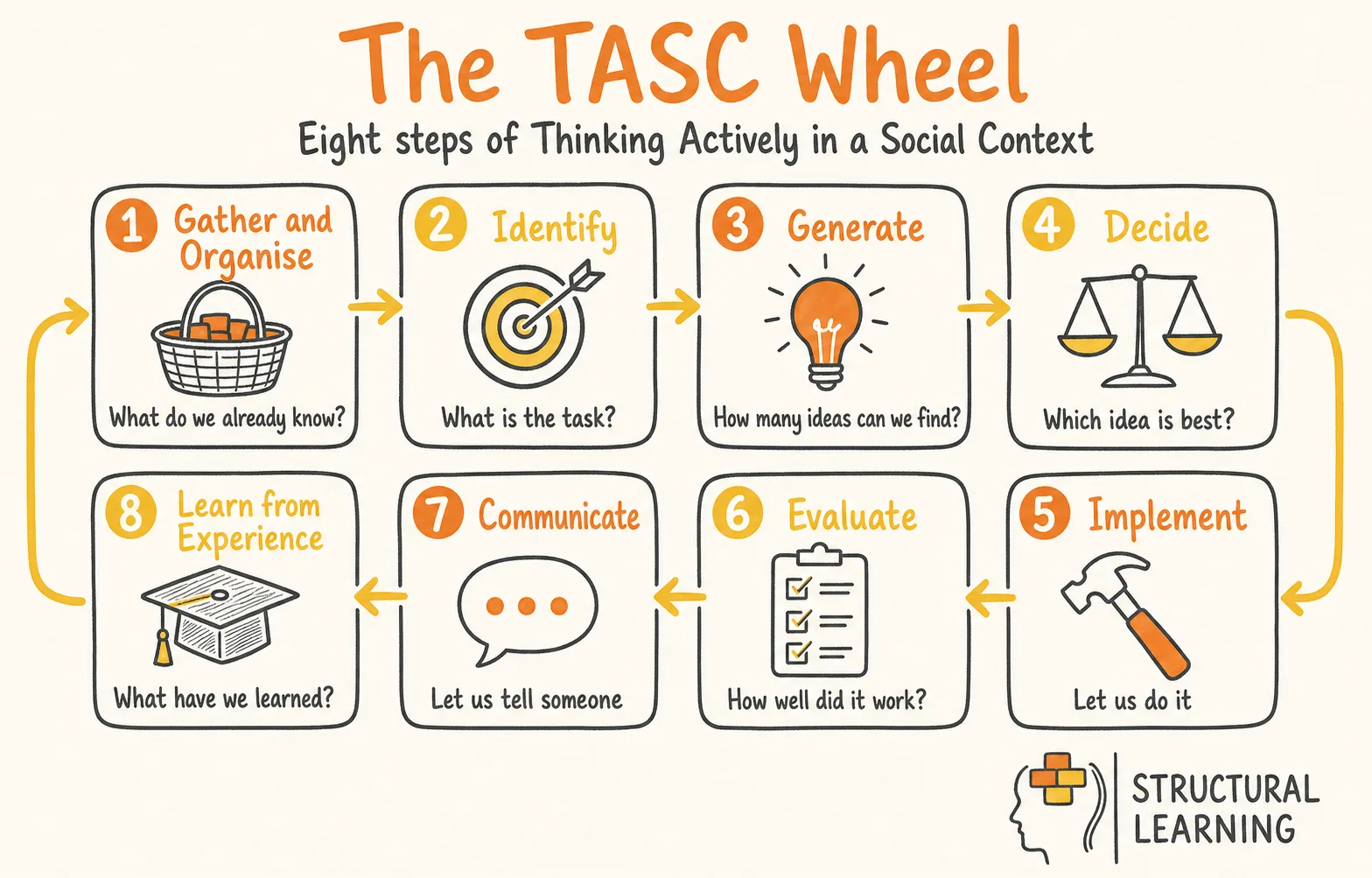
The TASC Wheel is a visual problem-solving framework with eight linked stages arranged around a circle. Learners move through it to tackle an open task, from gathering what they know to sharing a result and reflecting. Belle Wallace and Harvey Adams created it to teach thinking inside real, social work (Wallace & Adams, 1993).
The word wheel is deliberate. A wheel has no fixed start or finish, so a class can enter at any point and loop back when a task demands it. In most primary lessons, though, teachers work round it in order, at least at first.
Each segment names a kind of thinking. Gathering, identifying, generating, deciding, implementing, evaluating, communicating and learning from experience are all made explicit. Because the stages are shared and visible, learners begin to name their own thinking, which is the first step towards metacognition in primary classrooms.
In practice the wheel is often drawn large and displayed on the classroom wall. Teachers point to the current segment as the class works, so learners always know which kind of thinking is expected. That shared reference point is part of the appeal. It gives a mixed class a common language for a process that usually stays hidden.
The TASC Wheel grew out of Belle Wallace and Harvey Adams' work with teachers in the 1980s and 1990s (Wallace & Adams, 1993). It draws on two big ideas: Vygotsky's view that thinking develops through social interaction, and Sternberg's argument that practical, usable intelligence matters as much as test scores.
Vygotsky argued that children first solve problems with others, then internalise the strategies to use alone (Vygotsky, 1978). The social context in TASC is not decoration. It is the mechanism. Talk, modelling and shared struggle are how the thinking gets learned.
Sternberg added a second idea. His theory of successful intelligence values the ability to solve real problems, not only to recall facts (Sternberg, 1997). TASC turns that belief into a routine, giving every learner a repeatable method for tackling open tasks.
Wallace then developed the model across the whole primary curriculum (Wallace, 2001). Later work with Maker, Cave and Chandler set out an explicitly inclusive version, designed for the full range of learners in a class (Wallace et al., 2004).
These roots explain the design. If thinking is social, learners need to work together and hear strategies modelled. If practical intelligence matters, they need real problems worth solving. The wheel simply packages both claims into a routine any primary teacher can run without special training or expensive resources.
The wheel has eight segments, worked in order: gather and organise, identify, generate, decide, implement, evaluate, communicate, and learn from experience. Each names one move in solving a problem. Together they take a class from first questions to a finished result and a moment of honest reflection.
The table below shows each segment, the question that drives it, and a simple KS2 example. Notice how the guiding questions do most of the work. Strong higher-order questioning is what moves learners round the wheel.
| Segment | Guiding question | KS2 example |
|---|---|---|
| Gather and organise. | What do we already know? | Learners map what they know about healthy eating. |
| Identify. | What is the task? | The class agrees the goal: design a balanced lunch menu. |
| Generate. | How many ideas can we think of? | Groups brainstorm as many menu options as they can. |
| Decide. | Which idea is best? | Learners weigh cost, taste and nutrition to pick one menu. |
| Implement. | Let us do it. | Each group builds its menu as a labelled poster. |
| Evaluate. | How well did we do? | Learners check each menu against the balanced-plate guidance. |
| Communicate. | Let us tell someone. | Groups present their menu to the school cook. |
| Learn from experience. | What have we learned? | Learners note one thing they would do differently next time. |
The examples above use one topic, but any open task fits the frame. The point is not to race round the wheel. It is to slow thinking down enough that learners notice each move.
It also helps to name the segments out loud. When a learner says they are still generating, or ready to decide, they are describing their own thinking. That running commentary is the point. The eight labels give young learners the vocabulary to plan, monitor and review, long before those words appear in any assessment.
Three principles hold the wheel together. Thinking is taught through a shared social context, so strategy is modelled and talked about, not just set. Learners own the process, choosing and judging their own approach. And the method is transferable, giving learners one problem-solving routine they can carry across every subject.
Take the social context first. Learners work in pairs and groups, and the teacher thinks aloud to model each stage (Wallace & Adams, 1993). This is Vygotsky's idea in action: the strategy lives in the group before it lives in the individual head.
Ownership is the second principle. Learners are not told which idea to pick or how to judge success. They decide, using the guiding questions as prompts. That habit of self-direction is what the framework is really building, and it can start early, as our guide to thinking skills in the early years shows.
The third principle is transfer. Because the wheel is the same in maths, history or science, learners meet one routine again and again. Over time the stages become a mental tool they reach for without prompting.
None of this happens by accident. The teacher has to model each stage, protect time for talk, and resist jumping in with the answer. The wheel is a scaffold, not a script. Handled that way, it slowly hands the thinking back to the learners, which is the whole point.
To run a full cycle, pick one rich, open task and spread the eight stages across a topic rather than a single lesson. A KS2 class designing a school garden might spend a week gathering ideas and deciding, another building and evaluating, then a final session communicating and reflecting on what worked.
Start with gather and organise. Learners share what they know about plants, seasons and space, and record it on a class chart. Then they identify the real task: to design a garden the whole school can use. A clear, shared goal keeps the later stages focused.
Next comes generate, then decide. Groups produce as many design ideas as they can, from sensory beds to a wildlife corner. They then weigh the ideas against space, cost and time, and choose one. Implement follows: learners draw plans, cost the plants and plant a first bed.
The cycle finishes with evaluate, communicate and learn from experience. Learners judge the garden against their goal, present the plan to the head teacher, and note what they would change. That last stage matters most. It turns a nice project into a lesson in how to think.
Timing is flexible. Some classes gallop round the wheel in an afternoon, while others take a fortnight over a rich enquiry. A local history project, for instance, might spend days gathering old maps and photographs before a single idea is generated. The framework bends to fit the task, not the other way round.
TASC was built to stretch every learner, not only the most able. Because the task is open, able learners can push ideas further while others still take part fully. Wallace designed the inclusive version deliberately, arguing that a rich, shared problem lets a mixed class work at many levels at once (Wallace et al., 2004).
The framework began partly in gifted education, but Wallace was clear that the same tools help all learners (Wallace, 2001). An open task has no ceiling, so the most able are never held back by a worksheet. It also has a low floor, so every learner can gather ideas and take a role.
For teachers, the wheel doubles as an assessment lens. Watching who plans, who monitors and who reflects tells you more than a test score can. Our guide to thinking skills assessments shows how to capture that evidence without heavy marking.
Roles help here too. In a mixed group, one learner might lead the gathering while another records or reports back. Every child contributes, and the teacher can nudge each one towards a harder role next time. The structure makes differentiation feel natural rather than bolted on.
TASC sits comfortably beside other talk-rich approaches. Philosophy for Children builds the reasoning and dialogue that power the generate and decide stages, while sustained shared thinking describes the adult-child talk that moves learners round the wheel. Used together, they strengthen the social context that makes TASC work.
Philosophy for Children, or P4C, trains learners to question, reason and build on each other's ideas. Those are exactly the skills the wheel demands when a group generates options and decides between them. Our guide to P4C sets out the enquiry routine in full.
Sustained shared thinking works at a smaller scale. It is the back-and-forth between an adult and a learner that extends an idea rather than closing it down. A teacher using the wheel leans on it at every stage, and our guide to sustained shared thinking explains the moves.
None of these approaches competes with TASC. They feed it.
There is a simple sequencing point too. A short P4C enquiry can warm up the generate stage, loosening ideas before groups commit to a plan. A burst of sustained shared thinking can rescue a group that has stalled at decide. Teachers who already use these approaches lose nothing by folding them into the wheel.
For more classroom routines that build independent thinking, our guide to thinking strategies offers a practical menu to draw from.
The TASC Wheel has real limits. Its evidence base is mostly practitioner case studies, not controlled trials, so claims about impact should stay modest. The wheel can also become a wall poster rather than a live practice, and eight fixed stages can feel mechanical if a class follows them too rigidly.
Start with the evidence. Most support for TASC comes from teacher accounts and small case studies, which are useful but not the same as trials. The wider research on thinking-skills programmes is more cautious. A large review found real but uneven effects, and warned that impact depends heavily on how well an approach is taught (Higgins et al., 2005).
That implementation caveat matters here. The wheel is only as good as the talk and modelling around it. Printed on a poster and left there, it does nothing. There is also a risk of ritual: a class can march round eight stages without ever thinking hard, ticking segments like a checklist.
Used well, though, these are manageable risks. Keep the routine light, vary the entry point, and hold on to the guiding questions rather than the diagram. Treat TASC as one useful map among several, best read alongside the wider field of thinking frameworks, and check its promises against your own class.
Higgins, S., Hall, E., Baumfield, V., & Moseley, D. (2005). A meta-analysis of the impact of the implementation of thinking skills approaches on pupils. EPPI-Centre, University of London.
Sternberg, R. J. (1997). Successful intelligence. Plume.
Vygotsky, L. S. (1978). Mind in society: The development of higher psychological processes. Harvard University Press.
Wallace, B. (2001). Teaching thinking skills across the primary curriculum. David Fulton.
Wallace, B., & Adams, H. B. (1993). TASC: Thinking actively in a social context. AB Academic Publishers.
Wallace, B., Maker, C. J., Cave, D., & Chandler, S. (2004). Thinking skills and problem-solving: An inclusive approach. David Fulton.