Updated on
October 9, 2026
Anderson and Krathwohl: Revised Bloom’s Taxonomy Guide
Explore Anderson and Krathwohl’s revision of Bloom’s taxonomy, with thinking verbs, knowledge types and examples for planning and assessing classroom learning.

Updated on
October 9, 2026
Explore Anderson and Krathwohl’s revision of Bloom’s taxonomy, with thinking verbs, knowledge types and examples for planning and assessing classroom learning.
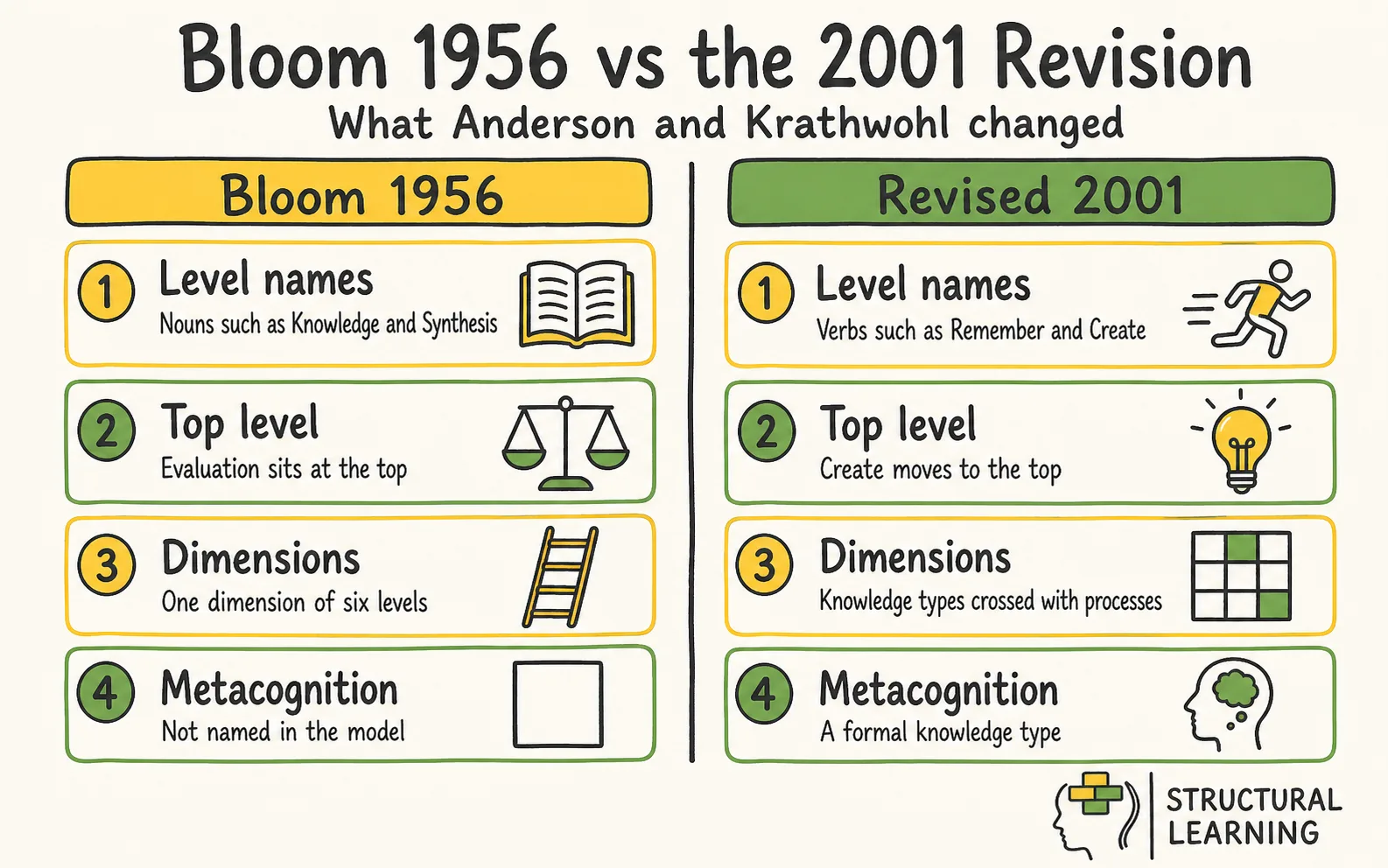
Anderson and Krathwohl's revised taxonomy is a 2001 update of Bloom's original 1956 framework for classifying educational objectives. A team led by Lorin Anderson and David Krathwohl rebuilt the model, and several authors from the original 1956 handbook joined them (Anderson & Krathwohl, 2001). They changed the six thinking levels from nouns into verbs, and they added a second axis for the type of knowledge being taught. The result is a two-dimensional grid, not a single ladder.
Most guides to Bloom's taxonomy stop at the six levels. This one starts where the revision actually changed things. We cover the levels themselves in our alternative guide to Bloom's taxonomy, so here we focus on the revision: who changed what, why the knowledge dimension matters, and how to use the taxonomy table to plan and assess. It sits inside the wider family of thinking frameworks that teachers can draw on.
Anderson and Krathwohl's revised taxonomy is the 2001 update of Bloom's 1956 framework. It keeps six cognitive levels but renames them as verbs, moves creating to the top, and adds a second dimension for four types of knowledge. Together these form a grid for classifying learning objectives (Anderson & Krathwohl, 2001).
The original handbook was written in 1956 by Benjamin Bloom and colleagues (Bloom et al., 1956). It gave teachers a shared language for objectives, but it had known flaws. The single ladder rarely held up, and it mixed the act of thinking with the material being thought about.
The revision fixed this by splitting those two ideas apart. One axis now describes the mental process, from remember to create. The other describes the knowledge, from simple facts to self-awareness. David Krathwohl, who worked on both editions, set out the logic in a short overview for teachers (Krathwohl, 2002).
Lorin Anderson, a former student of Bloom, led the revision with David Krathwohl, a co-author of the 1956 original. Their team of psychologists, curriculum specialists and assessment experts worked through the late 1990s. They wanted a model that matched modern cognition and helped teachers align objectives, instruction and assessment (Krathwohl, 2002).
The mix of people mattered. Anderson brought classroom research, Krathwohl brought continuity with the 1956 work, and cognitive psychologists brought three decades of new evidence about memory and learning. The group kept the parts of Bloom's model that worked, and repaired the parts that did not.
Their stated aim was practical. They wanted a framework that helped teachers write clear objectives, choose matching activities, and design assessments that measured the same thing they taught. This idea of alignment, teaching and testing the same objective, runs through the whole revision (Krathwohl, 2002).
It helped that the revision was a family affair. Several contributors to the 1956 handbook took part again, which kept faith with the original while updating it. Krathwohl himself had co-written the first version, so the 2001 edition reads as a considered second draft rather than a rival product.
The revision made three headline changes. First, the level names became verbs, so knowledge became remember and comprehension became understand. Second, synthesis was renamed create and moved above evaluate to the top spot. Third, the model gained a second dimension describing the type of knowledge involved (Anderson & Krathwohl, 2001).
The switch to verbs sounds cosmetic but changes practice. Objectives now describe what learners do, so "understand the water cycle" becomes an action you can plan and check. These action words are the same ones many teachers already borrow from Bloom's taxonomy verbs lists, and they now sit at the heart of the model.
Moving create to the top was a deliberate judgement. The authors argued that making something new, a plan, a product or an argument, demands more than judging existing work. So creating outranks evaluating, reversing the order many teachers had first learned.
The third change is the biggest and the most overlooked. Bloom's original model treated knowledge as a single thing. The revision splits it into four types and gives each objective a second dimension. This is what turns a ladder into a grid.
The knowledge dimension names what learners actually know. The revision sorts it into four types: factual, conceptual, procedural and metacognitive knowledge. Factual is the basic facts, conceptual is how those facts connect, procedural is how to do things, and metacognitive is awareness of your own thinking (Anderson & Krathwohl, 2001).
This axis is the revision's real innovation, and most Bloom's guides skip it. Each type is learned and assessed differently. A quiz can check facts, but concepts need explanation, procedures need practice, and metacognition needs reflection. The table below defines each type with a classroom example.
| Knowledge type | Definition | Classroom example |
|---|---|---|
| Factual knowledge. | The basic elements learners must know: terms, facts and details. | Naming the parts of a plant cell. |
| Conceptual knowledge. | How the elements fit together: categories, principles, models and theories. | Explaining how supply and demand set a price. |
| Procedural knowledge. | How to do something: methods, skills and the criteria for using them. | Carrying out long division or a titration. |
| Metacognitive knowledge. | Awareness of one's own thinking: strategies, task demands and self-knowledge. | Choosing a revision method and judging whether it worked. |
Naming the knowledge type stops a common planning error. A teacher can ask learners to analyse in a task, but analysis of a fact is very different from analysis of a procedure. The knowledge dimension makes that difference visible before the lesson is written.
The taxonomy table is a grid with the four knowledge types down the side and the six cognitive processes across the top. Any objective sits in one cell, where a process meets a knowledge type. Reading an objective this way names both what learners think about and how they think (Krathwohl, 2002).
Take a simple objective: learners will remember the dates of key battles. The process is remember. The knowledge is factual.
It lands in the top-left cell. Now take: learners will design a fair test. The process is create.
The knowledge is procedural. It lands far across and down the grid.
Placing objectives like this does three useful jobs. It classifies each objective without argument. It shows, at a glance, where a unit clusters and where it has gaps.
And it lets you line up each assessment question with the exact cell it is meant to test. Strong higher-order questioning can then target the cells a unit has ignored.
To use the matrix, plot every objective, activity and test item in its cell. Clusters show where teaching is heavy, and empty rows or columns show what is missing. Most schemes crowd into remember and understand factual knowledge, and leave create and metacognitive knowledge almost empty (Krathwohl, 2002).
The gap analysis is the payoff. If a unit fills only the top-left corner, learners are memorising facts and little else. The empty cells become a to-do list. They tell you which activities and which questions to add, and they do it in the model's own language.
A worked case makes this concrete. A Year 8 history unit might list ten objectives, and nine of them sit in remember or understand. The grid shows the missing corner at once. Adding one create task, such as writing a museum label from sources, fills it without redesigning the whole unit.
Alignment is the second win. When an objective, its lesson and its exam question share a cell, teaching and testing match. When they drift into different cells, learners are assessed on something they were never taught. Some teachers now use these categories to write AI prompts for Bloom's taxonomy that generate questions at a chosen cell.
Metacognitive knowledge matters because the revision treats it as content, not a soft extra. It names strategies, task awareness and self-knowledge as things learners can be taught and assessed. Giving it a formal cell tells teachers to plan for it, and the evidence for teaching it is strong (EEF, 2021).
Bloom's 1956 model had no room for this. Thinking about your own thinking simply was not in the picture. By adding metacognitive knowledge, the revision caught up with research showing that learners who plan, monitor and review their work tend to achieve more.
The Education Endowment Foundation rates metacognition and self-regulation among its highest-impact, low-cost approaches (EEF, 2021). The taxonomy gives that evidence a home. A unit can now carry an explicit metacognitive objective, such as choosing and justifying a revision strategy, and mark it like any other.
There is a planning benefit too. Once metacognition has its own cell, it stops being an afterthought squeezed into a plenary. Teachers can build a short reflection into each lesson, and leaders can look for it when they review a scheme of work.
Anderson and Krathwohl revised Bloom's model from the inside. Marzano and Kendall replaced it from the outside. The 2001 revision keeps six familiar levels and adds a knowledge axis. Marzano's version rebuilds everything around three systems of thinking and the degree of conscious control a task demands (Marzano & Kendall, 2007).
Both models answer the same complaint: Bloom's ladder was never a true hierarchy. They answer it differently. The revision stays close to home, so schools can adopt it with little retraining. Marzano's model, covered in our guide to Marzano's New Taxonomy, is broader but heavier to learn.
| Feature | Anderson and Krathwohl (2001) | Marzano and Kendall (2007) |
|---|---|---|
| Starting point. | A direct revision of Bloom's six levels. | A fresh model built to replace Bloom's. |
| Organising principle. | Cognitive process crossed with knowledge type. | Degree of conscious control across three systems. |
| Metacognition. | One of four knowledge types. | A full system of its own. |
| Motivation. | Largely outside the model. | Built in as the self-system. |
| Main strength. | Familiar, easy to adopt and strong for planning. | A broader theory of engagement and self-regulation. |
For most departments the choice is pragmatic. The revision wins on familiarity and ease, because it still looks like the Bloom's model teachers know. Marzano wins when the real problem is motivation or self-regulation. A third option, the SOLO taxonomy, judges the quality of a response rather than the type of objective.
Neither model is a rival to be crowned. The revision and Marzano's version can be used side by side, and many teachers dip into both. The point is to choose the tool that fits the problem in front of you, then check it against your own assessment evidence.
The revision gave metacognitive knowledge formal status. Our guide on how to develop metacognition turns that category into classroom practice.
The revision has real limits. Its levels still assume a rough hierarchy, and the evidence for that order remains weak. The grid can turn into a box-ticking exercise. And the verb lists, meant as a guide, are often treated as fixed rules the authors never intended (Moseley et al., 2005).
The hierarchy assumption is the deepest problem. Researchers who reviewed thinking frameworks found little firm proof that the levels form a true ladder (Moseley et al., 2005). A create task is not always harder than an analyse task. Teachers should treat the order as a rough guide, not a law.
The compliance risk is practical. A grid invites managers to demand a tidy spread of cells, as if coverage equalled quality. That was never the point. Anderson and Krathwohl designed the table to support judgement, not to score lesson plans.
The verb-list problem follows from this. Lists of action words help teachers write objectives, but a verb does not fix the level of a task. The word describe can be shallow or deep, depending on what is asked. The model works best when teachers use it to think, not to file work into boxes.
Anderson, L. W., & Krathwohl, D. R. (Eds.). (2001). A taxonomy for learning, teaching, and assessing: A revision of Bloom's taxonomy of educational objectives. Longman.
Bloom, B. S., Engelhart, M. D., Furst, E. J. , Hill, W. H., & Krathwohl, D. R. (1956). Taxonomy of educational objectives: The classification of educational goals. Handbook I: Cognitive domain. Longmans.
Education Endowment Foundation. (2021). Metacognition and self-regulation: Teaching and learning toolkit. EEF.
Krathwohl, D. R. (2002). A revision of Bloom's taxonomy: An overview. Theory Into Practice, 41(4), 212-218.
Marzano, R. J., & Kendall, J. S. (2007). The new taxonomy of educational objectives (2nd ed.). Corwin Press.
Moseley, D., Baumfield, V., Elliott, J., Gregson, M., Higgins, S., Miller, J., & Newton, D. P. (2005). Frameworks for thinking: A handbook for teaching and learning. Cambridge University Press.