Updated on
October 7, 2026
Depth and Complexity: Kaplan's 11 Thinking Prompts
Depth and Complexity explained: Kaplan's eleven prompts, the icons, and how to layer them to challenge learners within your UK greater-depth curriculum.


Updated on
October 7, 2026
Depth and Complexity explained: Kaplan's eleven prompts, the icons, and how to layer them to challenge learners within your UK greater-depth curriculum.
Depth and Complexity is a framework of eleven thinking prompts designed by Sandra Kaplan at the University of Southern California. It gives learners a set of lenses for examining any topic more deeply. The framework began in gifted education.
Teachers there needed a way to stretch able learners without simply piling on more work. Kaplan's answer was practical. Eight prompts drive depth, and three drive complexity.
Each one turns a surface task into a harder question about the same content (Kaplan, 2005). For example, a Year 5 class studying rivers can move from listing details to judging the ethics of flood defence spending.
Today the framework is used well beyond gifted programmes. Many teachers use the prompts with a whole class, differentiating by how far each learner takes them. This guide explains all eleven prompts with classroom examples, shows how the icons work as visual cues, and translates the model into the language of the UK curriculum and greater depth. It sits alongside the wider family of thinking frameworks that teachers already use.
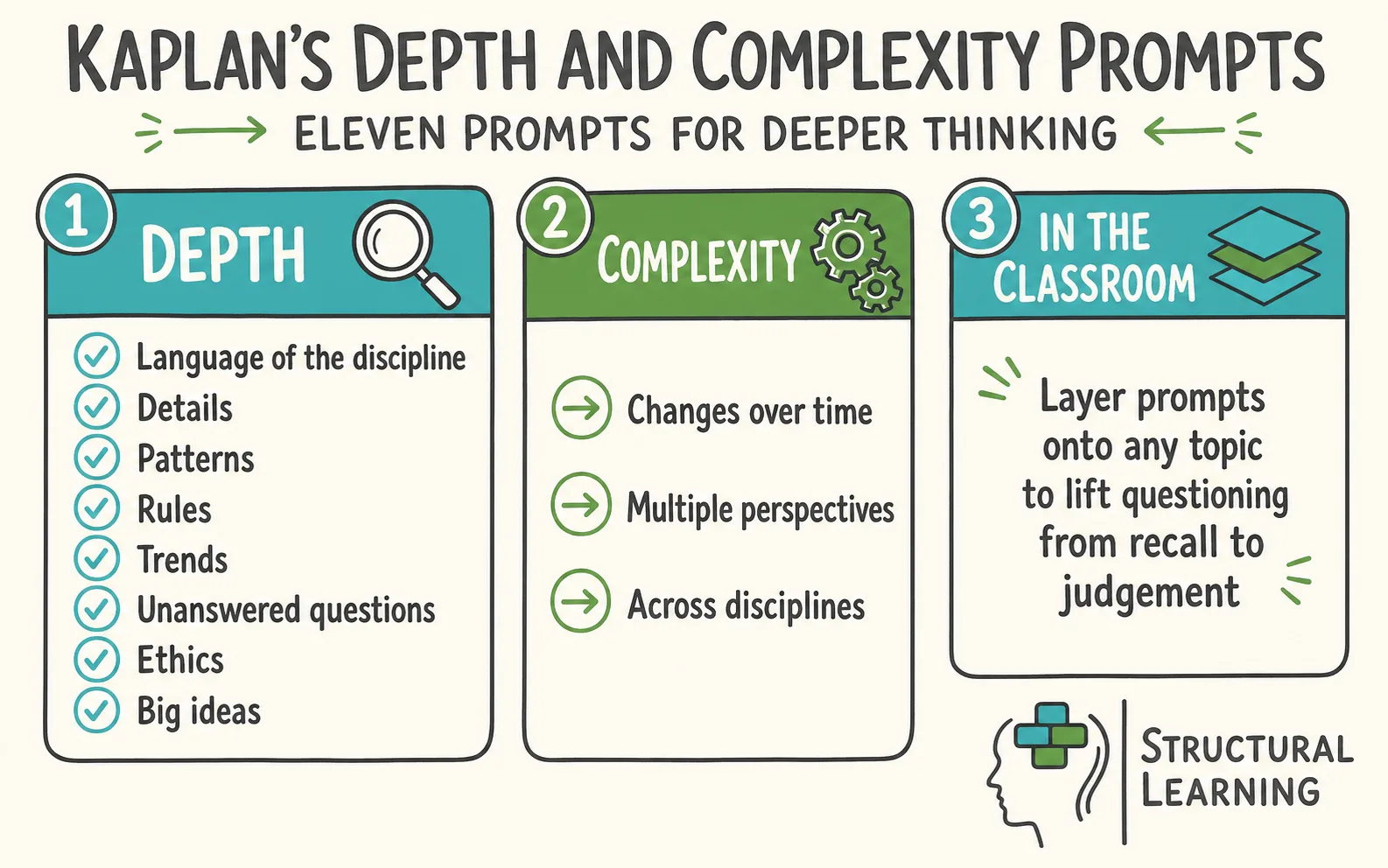
Depth and Complexity is a set of eleven prompts that push learners past surface answers. Sandra Kaplan built it so teachers could deepen a task rather than accelerate it. Eight depth prompts open up the detail and structure of a topic, while three complexity prompts connect it across time, viewpoints and subjects.
Kaplan developed the framework at the University of Southern California, working with gifted and talented programmes. Her aim was simple. Bright learners often finished early and were handed more of the same.
The prompts gave teachers a different move: keep the content, raise the thinking. VanTassel-Baska and Stambaugh (2006) place the approach firmly in this gifted-curriculum tradition.
The model has two halves. Depth asks learners to look inside a topic, examining its details, patterns, rules and ethics. Complexity asks them to look outward, tracing how the topic changes over time and how it connects to other people and subjects. Used together, the prompts build a habit of interrogation that transfers across the curriculum.
The eight depth prompts dig into a single topic. They are language of the discipline, details, patterns, rules, trends, unanswered questions, ethics and big ideas. Each one asks a different question about the same material, moving from concrete features towards abstract principles and moral dilemmas (Kaplan, 2005).
The first four prompts stay close to the material. Language of the discipline asks learners to use the words an expert would use, so a scientist says variable rather than thing. Details name the parts, attributes and factors.
Patterns look for what repeats and what can be predicted. Rules uncover the structure and order that govern how something works.
The next four reach further. Trends track the forces that push a topic in a direction, such as social or economic pressure. Unanswered questions surface what is still unknown or unclear.
Ethics raises the dilemmas, bias and competing values inside a topic. Big ideas name the overarching principle, the sentence that would still be true in another context. A quick example for ethics might be, what is the fairest decision here, and who loses out?
The three complexity prompts connect a topic outward. Changes over time asks how something has shifted across history. Multiple perspectives asks how different people would see it.
Across the disciplines asks where the same idea appears in other subjects. Together they stop a topic sitting in isolation.
These prompts add breadth to the depth work. A history class studying the vote can ask how suffrage changed over two centuries, whose perspective is missing from the textbook, and how the idea of representation shows up in maths, art or science. The complexity prompts are where cross-curricular links stop being decoration and start doing real cognitive work. Because there are only three, they are easy to remember and quick to model, so most teachers begin here before adding the eight depth prompts one at a time.
The table below sets out all eleven prompts, what each one asks, and a ready-to-use question. Teachers often print it as a planning grid and pick two or three prompts per lesson rather than trying to use them all at once.
| Prompt | Type | What it asks | Example question |
|---|---|---|---|
| Language of the discipline. | Depth. | The expert vocabulary, tools and symbols. | What words would a specialist use here? |
| Details. | Depth. | The parts, attributes and factors. | What are the defining features of this? |
| Patterns. | Depth. | What repeats and can be predicted. | What keeps happening, and what comes next? |
| Rules. | Depth. | The structure and order that govern it. | What rules make this work the way it does? |
| Trends. | Depth. | The forces pushing it in a direction. | What is driving this to change? |
| Unanswered questions. | Depth. | What is still unknown or unclear. | What do we still not know here? |
| Ethics. | Depth. | The dilemmas, bias and values. | What is the moral dilemma in this? |
| Big ideas. | Depth. | The overarching principle or theory. | What big idea does this example prove? |
| Changes over time. | Complexity. | How it has shifted across history. | How has this changed over time? |
| Multiple perspectives. | Complexity. | How different people view it. | Who would disagree, and why? |
| Across the disciplines. | Complexity. | Where the idea appears in other subjects. | Where else does this idea appear? |
Each prompt comes with a small icon, a simple picture that stands for the kind of thinking it asks for. Ethics is a set of scales, patterns is a repeating motif, and details is a magnifying glass. The icons let teachers cue a prompt without words, which suits younger learners well.
The icons do more than decorate a display. They work as dual-coding cues. When learners see the magnifying glass, they know to hunt for details before they write.
Over time the symbol and the thinking fuse, so the prompt becomes automatic. Teachers often laminate icon cards, stick them on task sheets, or point to a wall poster mid-lesson to redirect thinking.
Because the icons carry the meaning, the framework travels across ages and abilities. A Year 2 class can look for patterns with the same symbol a sixth form uses, even if the content is worlds apart. This visual shorthand is a large part of why the model spread from gifted programmes into mainstream classrooms.
The content imperatives are a second, smaller set of lenses that sharpen the depth prompts. They are origin, convergence, parallels, paradox, contribution and significance. Kaplan added them to push able learners past description towards judgement, asking not just what a topic contains but why it matters.
In practice teachers layer an imperative onto a prompt. Paired with details, significance asks which detail matters most and why. Paired with patterns, paradox asks where the pattern breaks.
The imperatives are the framework's most demanding move, so many teachers introduce them only once the eleven prompts are secure. Treat them as an extension, not a starting point.
Layering is how the framework differentiates without separate tasks. Every learner studies the same content, but the teacher varies which prompts they use. Beginners start with details and patterns, which are concrete and quick to grasp. Confident learners build towards ethics and big ideas, the prompts that demand abstraction and judgement (Kaplan, 2005).
This design solves a familiar problem. High attainers no longer need a different worksheet that quietly signals a two-tier classroom. They stay on the same content and simply go deeper, which protects both challenge and belonging. A single well-chosen prompt often stretches a class further than a whole extra activity.
A simple sequence helps. Open with details so everyone has purchase on the material. Move to patterns and rules to build structure.
Then offer ethics, unanswered questions and big ideas as the deep end, the prompts that draw most on higher-order thinking skills. The prompts are not a ladder everyone must climb in order, but this progression gives a reliable default.
In England, depth already has a formal meaning. Working at greater depth describes learners who reason, justify and apply knowledge in unfamiliar contexts, rather than moving on to the next year's content. Kaplan's depth prompts give teachers a practical language for reaching that standard within the same task.
The distinction matters because deeper is not the same as further ahead. A Year 5 learner working at greater depth in maths does not start the Year 6 curriculum. They tackle richer problems using Year 5 content, explaining their reasoning and spotting where a rule breaks. That is exactly what the ethics, patterns and unanswered questions prompts ask for.
This mirrors Webb's Depth of Knowledge, another American model that separates the depth of a task from its difficulty (Webb, 1997). Both frameworks warn against confusing more content with harder thinking. For UK teachers, the practical payoff is a shared vocabulary. Instead of vague requests to stretch the top table, a department can agree that greater depth means the ethics and big ideas prompts applied to the core task.
Used this way, the model supports challenge for high attainers without separate worksheets. The same starting task carries every learner, and the prompts decide how far each one travels. That protects the mixed-attainment classroom while still giving able learners somewhere demanding to go. It also keeps marking manageable, because one shared success criterion can hold a range of responses at different depths.
Each prompt suggests its own question stems, which makes the framework easy to drop into existing planning. Details asks what the parts are, patterns asks what repeats, and ethics asks who benefits and who loses. These stems turn the icons into spoken questions and keep talk focused on one kind of thinking at a time.
The stems pair well with tools teachers already trust. The verbs in Bloom's taxonomy verbs supply the action, while the prompt supplies the lens, so classify becomes classify these by pattern or classify these by ethical stance. The revised Bloom's framework maps the same cognitive territory (Anderson & Krathwohl, 2001), which is why the two combine so easily.
Good stems also drive dialogue, not just written answers. Strong higher-order questioning uses the complexity prompts to open debate: whose perspective is missing, and how has this changed over time? For teachers auditing where their questions land, our guide to thinking skills assessments and the SOLO taxonomy both help judge the depth of the responses learners actually give.
Our guide to questioning in teaching shows how to fold these prompts into everyday lessons without new worksheets.
The framework has real weaknesses. It grew from gifted-education advocacy rather than learning science, so it is a design heuristic, not a tested theory of how learning works. Peer-reviewed evidence for its effect on attainment is thin, and the icons can slide into surface-level labelling if teachers are not careful.
Start with the evidence. The strongest controlled trials in gifted education test other models, not this one. Callahan and colleagues found gains from a separate integrated curriculum built for able learners (Callahan et al., 2015), and the widely used Schoolwide Enrichment Model has its own research base (Renzulli & Reis, 2014). Depth and Complexity is popular and plausible, but direct effectiveness data for the prompts themselves is scarce.
The second risk is shallow use. An icon on a worksheet does not guarantee deep thinking. Learners can label a task with the ethics symbol and add nothing thoughtful, so the prompt becomes decoration. The framework only works when the icon triggers a real question and a real answer, which takes modelling and follow-up.
Finally, much of what the prompts do overlaps with plain good questioning. A skilled teacher already asks about patterns, perspectives and consequences without a named framework. The prompts add a shared vocabulary and a memory aid more than new cognitive ground, and honest schools weigh that modest gain against the training time. Treat the model as a tool to be checked against your own results, not a guarantee of deeper learning.
Anderson, L. W., & Krathwohl, D. R. (Eds.). (2001). A taxonomy for learning, teaching, and assessing. Longman.
Callahan, C. M., Moon, T. R., Oh, S., Azano, A. P., & Hailey, E. P. (2015). What works in gifted education: Documenting the effects of an integrated curricular and instructional model. American Educational Research Journal, 52(1), 137-167.
Kaplan, S. N. (2005). Layering differentiated curricula for the gifted and talented. In F. A. Karnes & S. M. Bean (Eds.), Methods and materials for teaching the gifted. Prufrock Press.
Renzulli, J. S., & Reis, S. M. (2014). The schoolwide enrichment model (3rd ed.). Prufrock Press.
VanTassel-Baska, J., & Stambaugh, T. (2006). Comprehensive curriculum for gifted learners (3rd ed.). Pearson.
Webb, N. L. (1997). Criteria for alignment of expectations and assessments in mathematics and science education. Council of Chief State School Officers.