Updated on
October 7, 2026
Fink's Taxonomy of Significant Learning: A Teacher's Guide
Fink's taxonomy of significant learning explained for teachers: the six categories, how it differs from Bloom's, and how to plan units that stick.


Updated on
October 7, 2026
Fink's taxonomy of significant learning explained for teachers: the six categories, how it differs from Bloom's, and how to plan units that stick.
Fink's taxonomy of significant learning is a model that sorts learning into six kinds, from foundational knowledge to learning how to learn. L. Dee Fink built it for university course design, first in 2003 and again in an expanded second edition (Fink, 2013). Unlike a ladder of difficulty, its six categories work together. A rich lesson usually touches several at once.
This guide explains the six categories with classroom examples, shows why the model is relational rather than a hierarchy, and sets out how to design significant learning experiences using backward design. It also places Fink alongside Bloom and SOLO, two other thinking frameworks teachers use to plan for depth, and it is honest about the model's limits in schools.
Fink's taxonomy of significant learning is a framework that names six kinds of learning worth designing for. L. Dee Fink created it to help university teachers plan courses that change how learners think, act and feel, not just what they can recall in an exam.
Fink first set out the model in 2003 and expanded it in a second edition (Fink, 2013). He was not trying to replace Bloom's taxonomy. He wanted a fuller picture of what a course can achieve.
Exams test recall well. They rarely capture whether a learner grew as a person or began to care about the subject. Fink wanted a language for those wider gains.
The word significant is doing real work. Fink defines significant learning as change that lasts after a course ends. A learner who can still apply an idea a year later, or who chose a path because of a topic, has learned something significant.
The six categories name the kinds of change worth planning for. Fink's question to teachers is simple. A year from now, what do you want this learning to have made possible?
The six categories are foundational knowledge, application, integration, the human dimension, caring and learning how to learn. Each names a different result worth aiming for. Fink argues that the richest lessons pursue several at once, so the categories reinforce each other rather than sit in a fixed order.
Foundational knowledge is the base. Learners understand and remember key facts and ideas. In a history unit, that means recalling the main causes of the First World War and explaining them in their own words. Without this base, the other five categories have nothing to build on.
Application is about doing. Learners use skills and different kinds of thinking, whether critical, creative or practical. A science class designing a fair test, or an English class crafting a persuasive speech, works in this category.
Integration then asks learners to connect ideas. A project that links graph work in maths to trends in geography helps learners see knowledge as joined up, not boxed by subject.
The human dimension is about people. Learners discover something about themselves or others, such as how a character's choice mirrors one they once faced. Caring is the shift in feeling.
A data project on local air quality can move a class from indifference to real concern. Learning how to learn completes the set, building learners who can direct their own study. No single category is the goal on its own.
The power comes from weaving several together.
| Category | What it asks learners to do | One assessment idea |
|---|---|---|
| Foundational knowledge. | Understand and remember key facts and ideas. | A low-stakes quiz or concept map. |
| Application. | Use skills and thinking to act on the knowledge. | A practical task or problem set. |
| Integration. | Connect ideas across topics, subjects or life. | A cross-topic synthesis piece. |
| Human dimension. | Learn something about themselves or other people. | A reflective log or peer interview. |
| Caring. | Develop new interests, feelings or values. | A before-and-after attitude reflection. |
| Learning how to learn. | Become better at studying and self-direction. | A revision plan plus a review of its results. |
Notice that only the first two categories map neatly onto a traditional exam. The other four are where Fink adds the most, and where careful assessment design matters most. They are also the parts a hurried scheme of work tends to drop first.
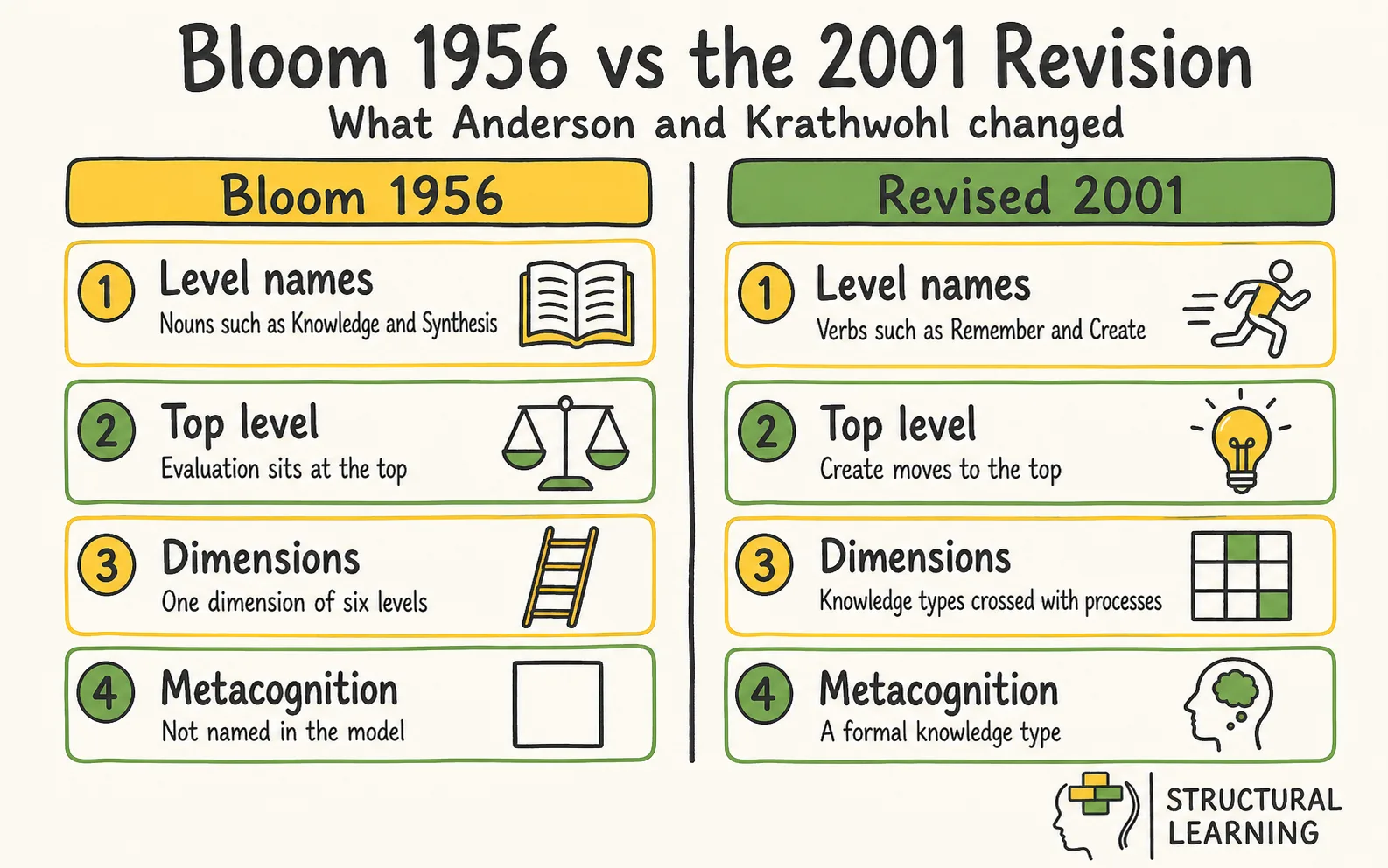
The crucial difference from Bloom's is shape. Bloom's levels stack from lower to higher order thinking. Fink's categories do not stack at all.
They are relational, so growth in one often drives growth in another. Caring can spark deeper knowledge, and new knowledge can deepen caring.
This relational shape is the model's big idea. On a hierarchy, you climb one rung at a time. On Fink's map, the categories feed each other.
A learner who starts to care about climate science will chase foundational knowledge harder. Deeper knowledge, in turn, can strengthen that caring. The gains loop rather than stack.
That has a practical payoff. If a class is stuck, you do not only add harder content. You might lift the human dimension or caring instead, and watch engagement pull the knowledge up with it.
A hierarchy cannot suggest that move, because it only points upward. Fink's non-linear structure makes the sideways option visible. That single insight is why many teachers keep the model even after they set the rest aside.
Fink pairs the taxonomy with backward design. Teachers start with situational factors, then set learning goals across the six categories, then plan feedback and assessment, and only then choose teaching activities. Building the parts in that order keeps assessment honest and stops activities from becoming busy work.
Backward design means planning from the end. Fink's first step is to study the situational factors: the learners, the setting, the subject and why the course matters. A sixth-form group retaking a qualification needs a different design from a mixed Year 8 class, even on the same topic.
Next come the learning goals. Here teachers write a goal for each category that fits, not just for knowledge. Then they plan feedback and assessment, deciding how learners will show growth in, say, caring or integration.
Only then do they choose teaching activities. Fink calls a design strong when goals, assessment and activities all point the same way (Fink, 2013).
The order guards against a common trap. When teachers start from activities, lessons can look busy while assessing very little. Starting from goals and assessment keeps every activity earning its place.
It is a discipline any department can borrow without new paperwork. The goal is a lesson where the assessment and the activity are clearly the same thing.
Learning how to learn is the category that turns a lesson into lasting independence. It asks learners to notice how they study, plan their next steps and judge their own progress. That is metacognition in practice, and the evidence for teaching it well is strong (Education Endowment Foundation, 2021).
This category is where Fink meets modern classroom research. Teaching learners to plan, monitor and evaluate their own work is exactly what it means to develop metacognition. The habits overlap almost completely, so a teacher working on learning how to learn is really teaching metacognitive skill.
It also links to self-regulation. When learners set a goal, choose a strategy and check the result, they practise the cycle at the heart of self-regulation. The Education Endowment Foundation rates this kind of teaching as high impact for relatively low cost (Education Endowment Foundation, 2021).
In practice, a short routine does the job. Ask learners to name their goal before a task, flag the trickiest step during it, and rate their own understanding after. Done in the same words each lesson, this builds the habit without new resources. Over a term, learners begin to run the checks for themselves.
Three frameworks are often confused. Bloom's taxonomy ranks cognitive processes, the SOLO taxonomy judges how complex a learner's response is, and Fink's taxonomy maps the whole significant learning experience. They answer different questions, so most departments find room for all three rather than picking a single winner.
It helps to see the three side by side. Bloom's revised taxonomy sorts thinking from remembering up to creating (Anderson & Krathwohl, 2001), and Krathwohl's overview is the clearest short account of that revision (Krathwohl, 2002). The SOLO taxonomy, by contrast, grades a single response from one idea to many linked ideas (Biggs & Collis, 1982).
| Feature | Fink's taxonomy | Bloom's revised taxonomy | SOLO taxonomy |
|---|---|---|---|
| Organising idea. | Six kinds of learning that interact. | A hierarchy of cognitive processes. | Levels of response complexity. |
| Structure. | Relational, non-hierarchical categories. | Six levels from remember to create. | Five levels from one idea to extended abstract. |
| Main focus. | The whole significant learning experience. | Cognitive objectives by type. | The quality of a single response. |
| Feelings and values. | Built in through caring and the human dimension. | Mostly outside the cognitive model. | Not addressed directly. |
| Best classroom use. | Designing rich units and courses. | Writing objectives and question stems. | Judging the depth of an answer. |
| Origin. | Higher-education course design. | Schools worldwide for decades. | Research on learner responses. |
Each tool suits a different job. Reach for Bloom's verbs when you are writing objectives and question stems. Reach for the SOLO taxonomy when you are judging the depth of an answer.
Reach for Fink when you are designing a whole unit and want it to change learners, not just inform them. Marzano's New Taxonomy offers a fourth lens, built around systems of thinking. The point is not to crown a winner.
It is to pick the tool that fits the question in front of you.
Fink built the model for university course design, so schools should translate it, not import it whole. It works best for unit planning, enrichment weeks and sixth-form study skills, where teachers have room to design for caring and integration. For a single lesson, one or two categories is plenty.
Start with the biggest units, not single lessons. A half-term scheme or an enrichment week gives enough room to design for integration, the human dimension and caring, which need time to show. A one-off lesson rarely does.
Picking one or two extra categories per unit is a realistic target. Trying to hit all six in every lesson only spreads the design too thin.
Sixth form is a natural fit. Independent study demands exactly the learning-how-to-learn skills Fink names, so a study-skills programme built on his categories translates cleanly. Younger classes gain more from the diagnostic use: when a topic falls flat, ask which category was missing rather than only reteaching the facts.
Be honest about the ceiling. Fink wrote for semester-long university courses with a lot of designer freedom. School teachers work to a national curriculum and tight timetables. The model earns its keep as a planning and reflection tool, not as a scheme to follow to the letter.
To build these categories into daily practice, our guide to higher-order questioning pairs well with the application and integration categories.
Fink's taxonomy has real weaknesses. It was built for higher education, so its school-phase evidence is thin. Caring is hard to assess reliably. Interacting categories also make progress harder to track than a neat hierarchy, and much of the support comes from course-redesign case studies rather than controlled trials (Fallahi, 2008).
The evidence base is the first caveat. Most support for the model comes from higher-education redesigns, such as Fallahi's rebuild of a life-span development course, which reported gains but was a single case rather than a controlled trial (Fallahi, 2008). Robust school-phase studies remain scarce.
Assessment is the second. Caring and the human dimension matter, yet they resist reliable marking. A learner can perform the right feelings on cue, and self-reported interest is easy to fake. Teachers should treat these categories as things to nurture and notice, not to grade with false precision.
The relational structure carries a cost too. Because the categories interact rather than climb, tracking progress is harder than with a hierarchy. There is no obvious next rung. Used alongside a clear knowledge sequence, though, Fink's taxonomy still gives teachers a richer target than content coverage alone.
Anderson, L. W., & Krathwohl, D. R. (Eds.). (2001). A taxonomy for learning, teaching, and assessing: A revision of Bloom's taxonomy of educational objectives. Longman.
Biggs, J., & Collis, K. (1982). Evaluating the quality of learning: The SOLO taxonomy. Academic Press.
Education Endowment Foundation. (2021). Metacognition and self-regulation: Teaching and learning toolkit. Education Endowment Foundation.
Fallahi, C. R. (2008). Redesign of a life span development course using Fink's taxonomy. Teaching of Psychology, 35(3), 169-175.
Fink, L. D. (2013). Creating significant learning experiences: An integrated approach to designing college courses (2nd ed.). Jossey-Bass.
Krathwohl, D. R. (2002). A revision of Bloom's taxonomy: An overview. Theory Into Practice, 41(4), 212-218.