Updated on
October 9, 2026
Marzano's New Taxonomy: A Teacher's Guide
Marzano's New Taxonomy explained for teachers: the three systems, six levels of processing, how it differs from Bloom's taxonomy, and classroom examples.

Updated on
October 9, 2026
Marzano's New Taxonomy explained for teachers: the three systems, six levels of processing, how it differs from Bloom's taxonomy, and classroom examples.
Marzano's New Taxonomy is a model of educational objectives built around three systems of thinking: the self-system, the metacognitive system and the cognitive system, working on a domain of knowledge. Robert Marzano and John Kendall designed it as a successor to Bloom's taxonomy, and they built it to fix two long-standing problems (Marzano & Kendall, 2007). Bloom's levels never behaved like a true hierarchy in research, and the original model said little about attitude, motivation or self-knowledge.
The New Taxonomy answers both. It orders its six levels by how much conscious control they demand, not by how hard they feel. It also gives motivation and metacognition formal places in the model rather than leaving them outside the door. This guide explains the three systems and six levels, shows how the model differs from Bloom's taxonomy, and offers practical ways to use it for objectives, questioning and assessment.
Marzano's New Taxonomy, published with John Kendall in 2007, classifies educational objectives across three systems of thinking and a knowledge domain. The self-system governs motivation, the metacognitive system governs planning and monitoring, and the cognitive system handles retrieval, comprehension, analysis and knowledge use. Together they describe six levels of mental processing.
The model grew out of a practical failure. Decades of research showed that learners did not find Bloom's higher levels consistently harder than the lower ones, so the ladder metaphor kept breaking. Marzano and Kendall rebuilt the hierarchy on a different principle: how much conscious, deliberate control a mental operation demands.
That shift matters for teachers. It explains why a well-drilled analysis task can feel easier than an unfamiliar recall task, and it turns metacognition from an add-on into a formal layer of planning and assessment. Marzano had sketched the redesign years earlier (Marzano, 2000), and the 2007 edition with Kendall completed it.
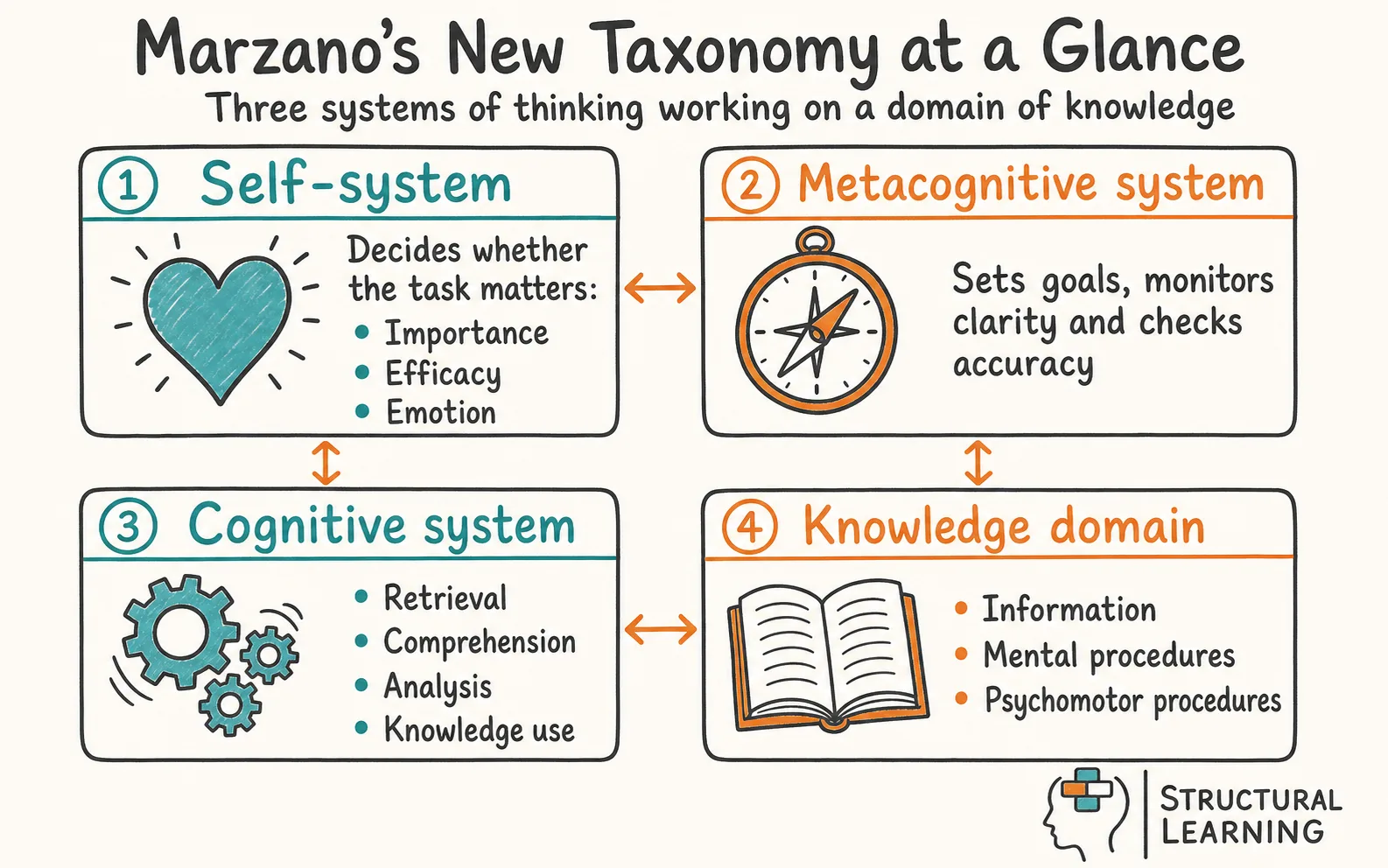
Every new task passes through the three systems in order. The self-system decides whether the task matters enough to engage with, the metacognitive system sets goals and chooses strategies, and the cognitive system does the processing. Learning stalls when any one of the three fails, not just the cognitive one.
The self-system weighs importance, efficacy and emotional response. A learner who believes the task is pointless, or believes they cannot do it, disengages before any content is processed. This is the layer classroom motivation work actually targets, and it connects directly to what research says about self-regulated learning (Pintrich, 2000).
The metacognitive system specifies goals, monitors clarity and checks accuracy. It is the internal project manager, and it can be taught explicitly through goal-setting, success criteria and structured reflection. The cognitive system then works through four levels of processing, from retrieval to knowledge utilisation, supported by the executive functions that control attention and working memory.
The three systems always operate on knowledge, and the model splits that knowledge into three types: information, mental procedures and psychomotor procedures. Information covers facts, ideas and principles. Mental procedures cover skills such as long division or essay planning. Psychomotor procedures cover physical skills, from handwriting to a badminton serve.
This split does real work in planning. Declarative knowledge is learned through exposure, organisation and practice at retrieval, while procedures are learned through modelling, shaping and spaced practice until they become automatic (Marzano & Kendall, 2008). A revision lesson that treats an essay technique like a set of facts, or a fact base like a skill, mismatches the teaching to the knowledge type.
The knowledge domain is also where the New Taxonomy quietly agrees with modern cognitive science. Automating procedures frees working memory for higher-level processing, which is the same logic that drives explicit instruction and deliberate practice in today's evidence-informed classrooms.
The six levels combine the cognitive system's four operations with the metacognitive and self-systems above them. Retrieval recognises and recalls information, comprehension integrates and symbolises it, analysis examines it, and knowledge utilisation puts it to work in decisions, problems and investigations. Levels five and six add self-monitoring and motivation.
| Level | System | What learners do | Question stem |
|---|---|---|---|
| 1. Retrieval | Cognitive | Recognise, recall, execute | What do you remember about...? |
| 2. Comprehension | Cognitive | Integrate and symbolise ideas | How would you summarise...? |
| 3. Analysis | Cognitive | Match, classify, find errors, generalise | What patterns can you see in...? |
| 4. Knowledge utilisation | Cognitive | Decide, solve, investigate, experiment | How would you use this to...? |
| 5. Metacognition | Metacognitive | Set goals, monitor process and clarity | How well is your approach working? |
| 6. Self-system thinking | Self | Examine importance, efficacy and emotion | Why does this matter to you? |
Notice the direction of travel. The levels climb from automatic processing towards conscious self-examination, so the top of the model is not harder content but greater self-awareness. Strong higher-order questioning can reach levels five and six in any subject and any year group.
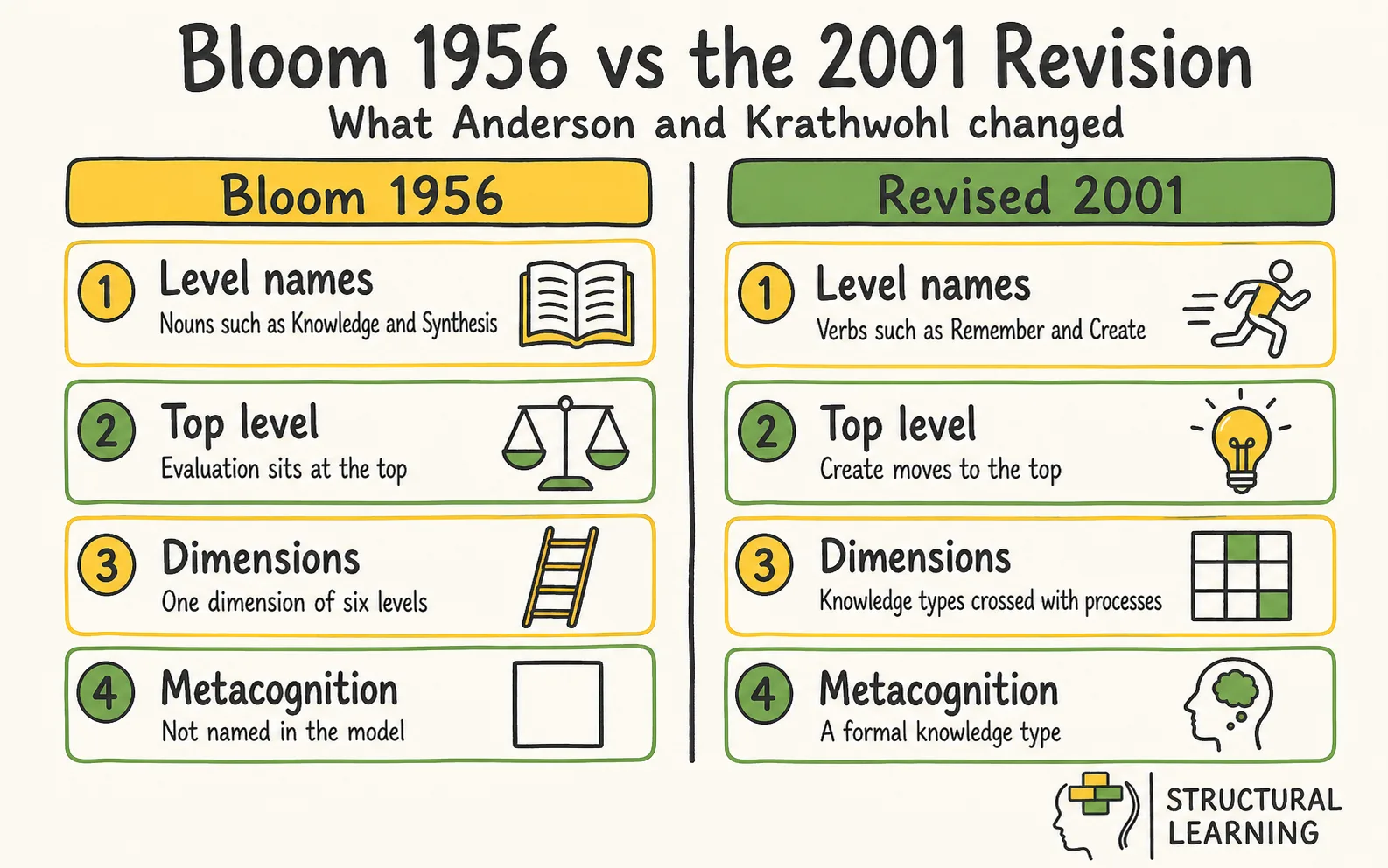
The two taxonomies differ on structure, scope and purpose. Bloom's model (Bloom, 1956), including the later revision (Anderson & Krathwohl, 2001), classifies cognitive objectives by type. Marzano's model maps the whole act of engaging with a task, from the decision to bother through to using knowledge. One is a planning vocabulary; the other is a theory of how learning happens.
| Feature | Bloom's taxonomy | Marzano's New Taxonomy |
|---|---|---|
| Organising principle | Complexity of thinking | Degree of conscious control |
| Motivation | Outside the model | Self-system, level six |
| Metacognition | One knowledge type in the 2001 revision | A full system, level five |
| Structure | Six levels | Three systems and six levels on a knowledge domain |
| Best classroom use | Writing objectives and question stems | Diagnosing engagement, self-regulation and transfer |
| Evidence base | Vast familiarity, weak hierarchy evidence | Built on research syntheses; less classroom-tested |
In practice the models are complements. Keep Bloom's verbs for lesson objectives and questioning, and reach for Marzano when the problem is engagement, independence or transfer rather than task design. The SOLO taxonomy offers a third lens, judging the quality of responses; our SOLO guide covers when to prefer it.
Start with the diagnosis the model makes possible. When a class underperforms, ask which system failed: did learners not care (self-system), not plan or notice confusion (metacognitive system), or not have the knowledge and skills (cognitive system)? Each failure calls for a different response, and mixing them up wastes teaching effort.
For planning, write objectives at a named level: retrieval starters, comprehension summaries, analysis tasks that classify or find errors, and knowledge-utilisation projects that force a decision. For assessment, pair each unit with at least one level-five prompt, such as asking learners to rate the clarity of their own understanding and justify the rating. Our guide to metacognition in the classroom gives ready-made routines for that layer.
For engagement, use level six deliberately. Two minutes spent connecting a topic to learners' goals, or surfacing and addressing low efficacy, buys more processing than another worked example. The model's practical message is blunt: teach the thinking systems, not just the content.
Two worked examples show the range. In a Year 4 rivers unit, a retrieval starter names the parts of a river, a comprehension task turns the water cycle into a diagram, an analysis task sorts local rivers by feature, and a knowledge-utilisation task asks where a new bridge should go. The teacher then adds a level-five prompt: which step of your reasoning are you least sure about?

An adult teacher holds a small wooden bridge piece above a fictional unlabelled river map beside a blank planning sheet. The materials support preparation of the article river-and-bridge task. No geographic scale, chosen correct location or tested answer is claimed.
In GCSE science, the same ladder might run from recalling the definition of resistance, through explaining it in a circuit diagram, to analysing anomalous results and designing an investigation. The level-six move comes first, not last: thirty seconds on why electricians, engineers and gamers all care about this idea primes the self-system before the content arrives.
Each level of the New Taxonomy suggests its own verbs and question stems, which makes the model easy to fold into existing planning formats. Retrieval verbs include recall, name and execute. Comprehension uses summarise, represent and illustrate. Analysis uses classify, compare and critique, while knowledge utilisation uses decide, solve, test and investigate.
The distinctive stems sit at the top of the model. Metacognitive prompts ask learners to set a goal for the task, monitor how clearly they understand, and judge the accuracy of their work. Self-system prompts ask how important the topic feels, how confident learners are, and why. Teams that already plan with Bloom's verbs can simply add these two rows to their existing question banks.
A department can trial the New Taxonomy in a half term without changing its planning documents. The aim is to borrow the model's diagnostic power first and decide later whether any wholesale adoption is worth it. Start small, gather evidence from books and assessment data, then review as a team.
The New Taxonomy has attracted three main criticisms. First, the sharp split between the self-system and the metacognitive system is theoretically neat but hard to verify; Moseley and colleagues called it speculative in their review of thinking frameworks (Moseley et al., 2005). Second, the model says little about creative thinking, which sits awkwardly across its levels.
Third, adoption costs are real. Bloom's taxonomy survives in schools partly because it is simple, shared and everywhere. Marzano's model is richer but heavier, and a whole-school switch rarely repays the training time. Most departments get the benefit by borrowing the three-systems diagnosis and the level-five and level-six prompts while keeping their existing planning language.
It is also worth remembering what kind of claim a taxonomy makes. It organises objectives; it does not prove that teaching to its levels raises attainment. Treat it as a design tool to be checked against your own assessment evidence, alongside the wider map in our guide to thinking frameworks.
Anderson, L. W., & Krathwohl, D. R. (Eds.). (2001). A taxonomy for learning, teaching, and assessing: A revision of Bloom's taxonomy of educational objectives. Longman.
Bloom, B. S. (Ed.). (1956). Taxonomy of educational objectives: The classification of educational goals. Handbook I: Cognitive domain. David McKay.
Marzano, R. J. (2000). Designing a new taxonomy of educational objectives. Corwin Press.
Marzano, R. J., & Kendall, J. S. (2007). The new taxonomy of educational objectives (2nd ed.). Corwin Press.
Marzano, R. J., & Kendall, J. S. (2008). Designing and assessing educational objectives: Applying the new taxonomy. Corwin Press.
Moseley, D., Baumfield, V., Elliott, J., Gregson, M., Higgins, S., Miller, J., & Newton, D. P. (2005). Frameworks for thinking: A handbook for teaching and learning. Cambridge University Press.
Pintrich, P. R. (2000). The role of goal orientation in self-regulated learning. In M. Boekaerts, P. R. Pintrich, & M. Zeidner (Eds.), Handbook of self-regulation. Academic Press.