Updated on
September 24, 2026
Metacognition vs Cognition: Meaning, Differences, Examples
Cognition does the task; metacognition steers it. The difference in one classroom example, what the EEF’s eight months really means, and every guide we have.


Updated on
September 24, 2026
Cognition does the task; metacognition steers it. The difference in one classroom example, what the EEF’s eight months really means, and every guide we have.
Cognition is the mental work: attending, remembering, reading, calculating. Metacognition sits above it, choosing the approach, checking whether it is working and adjusting when it is not. Both are taught inside normal subject teaching, and a learner's confidence is not proof of understanding.
Metacognition is awareness and control of your own thinking. Flavell (1979) described two connected parts: knowledge of cognition and regulation of cognition. Cognition does the mental work, while metacognition guides that work. The term describes a structured process for turning evidence into a classroom decision, not a label on its own.
In a maths lesson, the teacher asks, "How will you check this method?" A learner tests one step, spots an error and changes strategy. The calculation becomes more accurate because the learner directs their thinking.
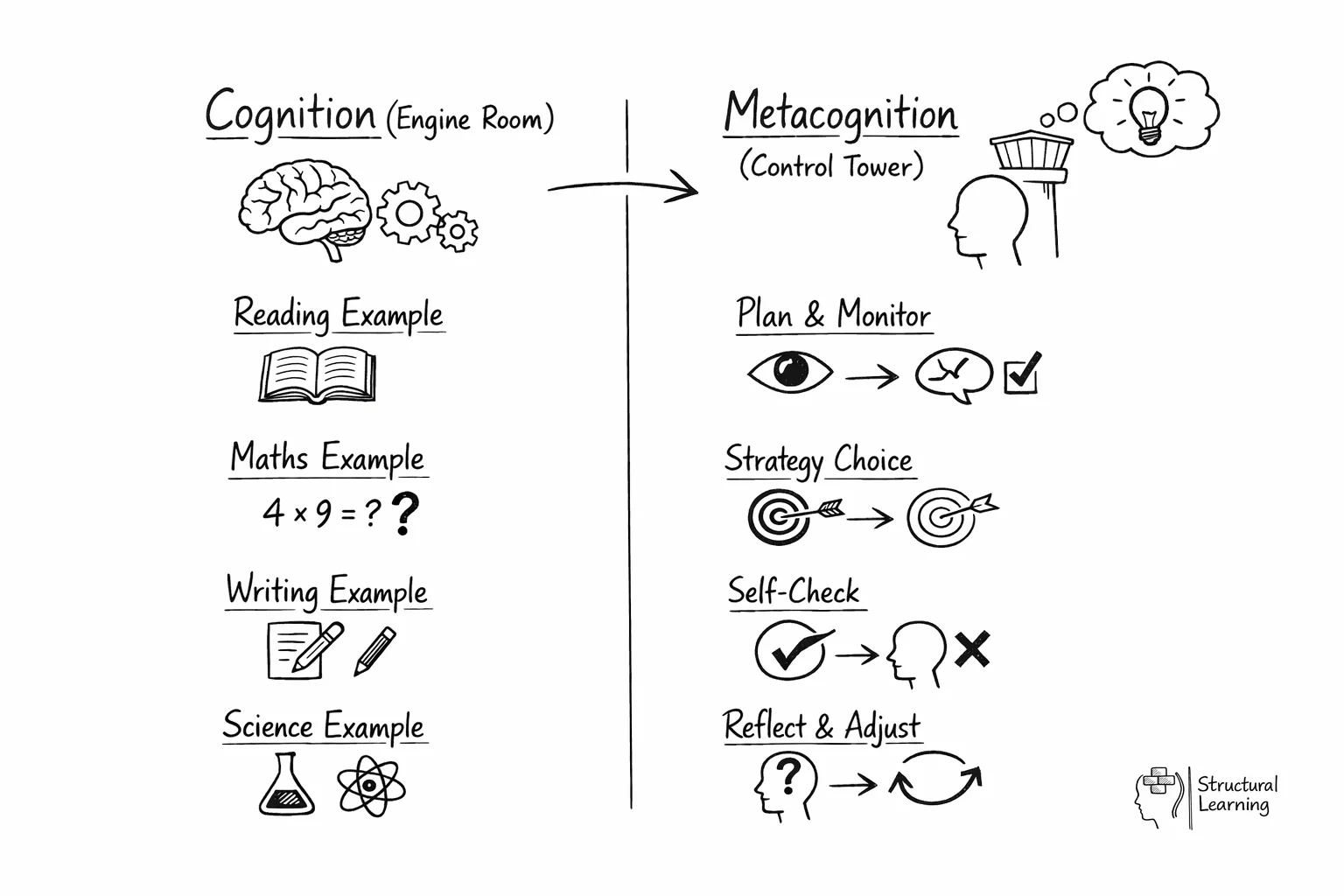
Cognition includes attention, memory, reasoning and problem solving. Metacognition means noticing and guiding those processes (Flavell, 1979). The distinction helps. But the two work together. They are not in separate parts of the mind.
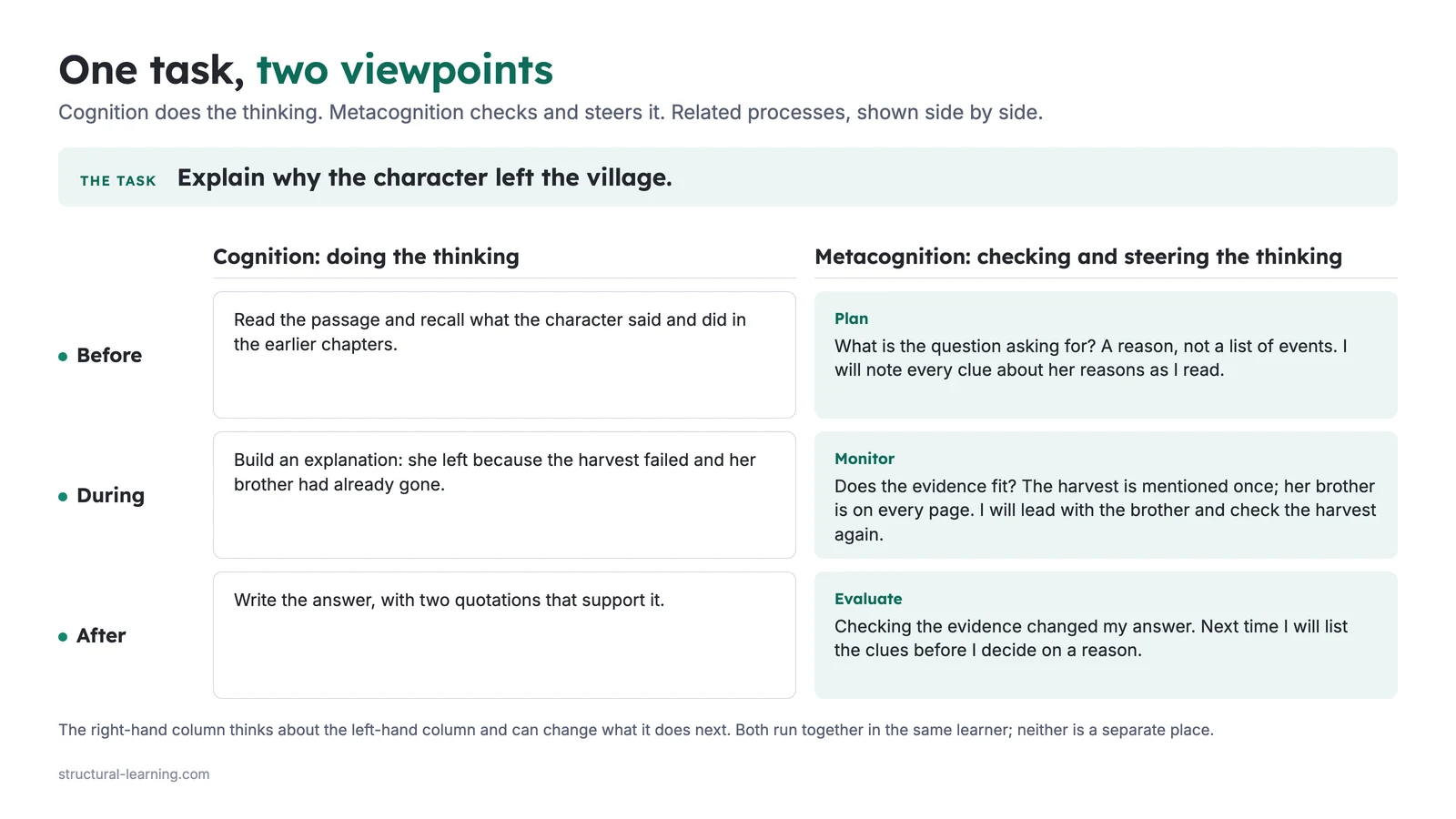
Take a shared task. Find the area of a rectangle that is eight centimetres by five. Recalling the formula and multiplying the numbers are cognitive actions. Choosing the formula and checking the units are metacognitive actions. So is deciding whether 40 square centimetres is a sensible answer.
| Point in the task | Cognition | Metacognition |
|---|---|---|
| Before | Recall what area means and retrieve the formula. | Identify what the question asks and select a suitable method. |
| During | Multiply eight by five and record 40. | Check that both measurements were used and track the units. |
| After | Read the completed calculation. | Estimate the answer, find an omitted unit and correct it. |
The teacher can say, "Tell me what your brain is doing, then tell me how you are checking it." The learner names multiplication as the action and estimation as the check. The teacher then asks for the missing unit, making the difference visible without turning it into a slogan.
Metacognition is sometimes described as thinking about thinking. This phrase captures awareness, but it does not fully explain the control involved. Monitoring must guide a decision. For example, a learner might continue, seek help or change their method (Veenman, Van Hout-Wolters and Afflerbach, 2006).
Try the sorter below on something a learner said. Pick an example or type what you heard, and it gives you the label, the phase it belongs to (planning, monitoring or evaluating) and one thing to say next. It sorts a moment, not a learner.
Mini app · Build It · Metacognition
Cognition is doing the task. Metacognition is choosing, watching and changing how the task is done. Pick something a learner said, or type what you heard, and you get the label, the process it belongs to (planning, monitoring or evaluating) and one thing to say next. Typed text is matched on a few key words, and the app tells you when it cannot tell.
What to listen for
This app sorts examples and suggests one move. It is not a diagnostic tool: one sentence is a moment in a lesson, not a profile of a learner, and typed text is matched on a handful of key words rather than understood.
Building the planning, checking and reviewing prompts into a lesson is the slow part. The Structural Learning app writes them into the tasks for your topic and year group. Try it on a free account, no card needed.
Metacognitive knowledge covers the learner, the task and the strategies available. It includes factual knowledge about a strategy. It also includes procedural knowledge of how to use it and conditional knowledge of when it fits. Schraw and Dennison (1994) distinguished this knowledge from the regulation of cognition.
Knowledge of self should stay specific and changeable. "I lose track when a paragraph contains several unfamiliar terms" is useful. "I am bad at science" is a fixed label that offers no next action.
Task knowledge concerns the demands of the work. Comparing two sources requires different thinking from recalling a definition. Strategy knowledge supplies possible responses, such as annotating a text, drawing a model or attempting a short retrieval check.
Conditional strategy knowledge connects these parts. A learner may know how to draw a diagram but still need to recognise when it will reveal a relationship. Teachers can make that decision rule explicit.
Knowledge answers, "What do I know about myself, this task and these strategies?" Regulation answers, "What will I do, is it working and what should change?" Knowledge can guide regulation. Experience, in turn, can refine what the learner knows about future tasks.
During reading, the teacher asks, "What usually tells you that meaning has broken down?" The learner answers, "I can read the words but cannot explain the paragraph." The teacher then asks the learner to reread one sentence. The next steps are to define a key term and check the explanation again.
This exchange turns a vague feeling into observable evidence and a response. A broader guide to metacognitive monitoring can help teachers diagnose weak checks. The aim is not to classify the learner, but to improve the next decision.
Planning, monitoring and evaluating form a practical cycle for regulation. These phases do not form a fixed staircase. A learner may check early evidence, return to the plan and choose a better strategy before continuing (Zimmerman, 2002).
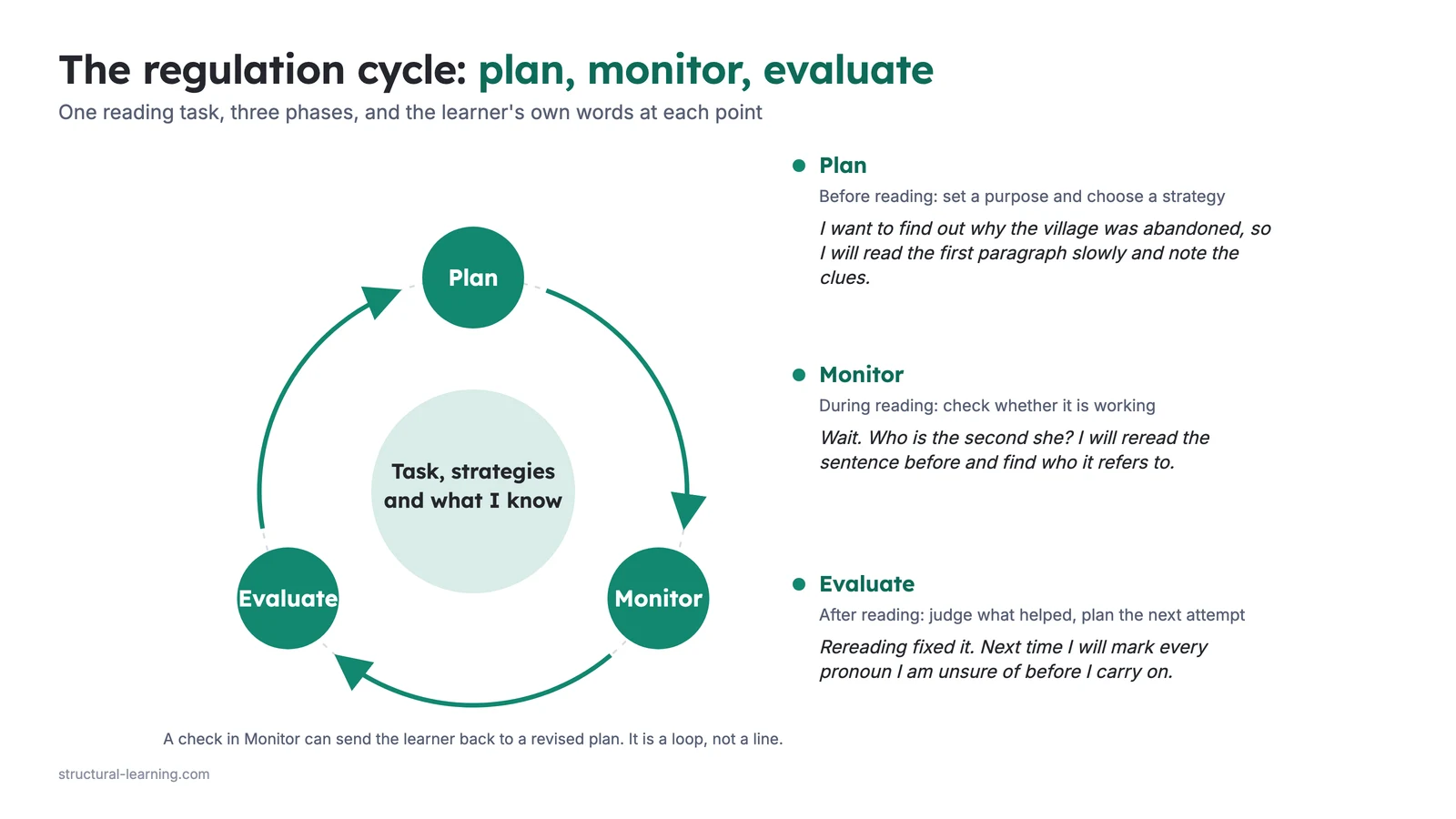
Useful prompts refer to the task, not a general feeling. Ask, "Which sentence supports your inference?" rather than, "Do you understand?" Specific feedback helps learners compare current work with a goal and decide what to do next (Hattie and Timperley, 2007).
In history, the teacher says, "Plan one claim and the evidence it needs." A learner chooses a claim, then notices that the selected quotation describes events without explaining cause. The teacher asks, "What evidence would test the causal link?" and the learner replaces the quotation.
At the end, the learner writes, "My second source explained motive, so it supported the claim better." That evaluation joins outcome and method. It is more useful than "I worked hard" because it can inform the next essay.
The cycle should be part of subject teaching. That is what the Education Endowment Foundation (2018) recommends: teach metacognitive strategies through curriculum content. It means modelling, guided practice and reflection. Teachers can adapt the steps with this metacognition strategy guide.
The builder below turns the cycle into a printable worksheet for one task. Name the task, pick up to six strategies, and you get two prompts for each phase with space for learners to write. Nothing is stored.
Mini app · Build It · Metacognition
Name the task, choose up to six strategies, and you get a printable sheet with two prompts for each phase and space for learners to write. Nothing is stored and nothing is sent anywhere.
Plan, Monitor, Evaluate worksheet
Task: Work out how the character feels at the end of the chapter, using clues from the text
Strategies: Unpack the task · Predict, then check
Plan
Before you start
Read the question before the text, so you know what to look for.
Monitor
While you work
If you lose the thread, reread the sentence before and carry on.
Evaluate
When you finish
Point to the words in the text that back up your answer.
Plan, Monitor, Evaluate follows the EEF model of self-regulated learning. Structural Learning.
How to use it
Model the Plan prompts out loud before learners write anything. The sheet supports a routine you have taught; it does not replace the modelling.
The phases come from the EEF's model of self-regulated learning. Prompts are worded for the subject and strategies you chose; they are starting points, not a script, so cut any that do not fit the task.
The worksheet asks learners to plan, check and judge their own work. The Structural Learning app builds the scaffolded version of the lesson itself for your topic and year group. Try it on a free account, no card needed.
A Year 7 class is solving a ratio problem: red and blue counters are in a ratio of three to five. There are 32 counters altogether. Learners must find the number of each colour and explain their method.
The teacher first activates subject knowledge. "What does each part of the ratio represent?" One learner explains that eight equal parts make the whole. The teacher confirms this before asking for a plan, because reflection cannot replace the mathematical idea.
The learner chooses to divide 32 by eight, then multiply by three and five. The teacher asks, "What will you check after the first calculation?" The learner plans to confirm that both final amounts add to 32.
During the calculation, the learner writes 32 divided by eight equals six. The check fails because three lots of six plus five lots of six gives 48. The learner notices the mismatch and returns to the division.
Rather than naming the error, the teacher asks, "Which line conflicts with the total?" The learner recalculates 32 divided by eight as four. The final amounts, 12 and 20, now add to 32 and preserve the ratio.
The learner evaluates both answer and method: "Splitting the total into eight equal parts worked. Adding the two amounts exposed my division error." The teacher records that sentence as a model, then gives a new ratio problem without the check prompt.
This sequence combines cognition with regulation. The learner needs number facts and ratio knowledge, but also a planned check and a reason to change approach. Research on metacognitive questioning in mathematics supports prompts that connect reasoning, strategy choice and checking within the task (Kramarski and Mevarech, 2003).
Removing the final prompt step by step is important. It tests whether the learner can manage the new task with less support. This move towards independent control links metacognition with self-regulated learning. The immediate focus remains on mathematical decisions.
| Routine, as teachers describe it | What you would notice | What the evidence says |
|---|---|---|
| A change in conditions Treat metacognition as adapting a known method in a new setting, not a reflection slip after the fact.
|
The same Pythagoras item, moved to a gutter. Learners asking whether the method still works here. | EEF Toolkit: teach strategies on usual curriculum content, not in a thinking-skills lesson. The gutter task is a worked example on the linked page, not a trial. Metacognition in the Classroom: What It Really Looks Like. |
| Name the decisions, not every thought Model only the reusable decisions: what you notice, which knowledge, what first, and how you will check.
|
I language at the board. A check, not a full inner monologue. | EEF Toolkit: teachers can promote metacognition by modelling their thinking aloud. This post is a script for that move, not a trial of this classroom. |
| Conferring as the check Sit with one learner on words, numbers, texts or problems and listen for how they are steering, not only for the answer.
|
US classroom language. The teacher hears the strategy. UK rooms keep conferring as a conversation, not a US proficiency scale. | EEF: give chances to reflect and monitor during the work. Conferring is reported, not trialled. |
| No discrete science-of-learning lesson objection Keep any standalone explanation short. Put retrieval inside the subject instead of a learning-to-learn slot.
|
No extra thinking lesson on the timetable. Retrieval in the subject. | EEF Toolkit: strategies should be taught and applied to usual curriculum content, rather than taught discretely through thinking-skills lessons. The 20-minute cap is his claim, not a trial. |
| Mini whiteboards, not the ticket objection Check in the lesson on boards. Drop the exit ticket collected for a walkthrough.
|
US 4th grade, named in the post. Boards in the body of the lesson. A slip at the door that does not change instruction. | EEF: monitor during the work. A ticket marked after the lesson sits after the decision. |
| Let them hear you get stuck Think aloud the stuck moment: I do not understand this, I reread, then I find help.
|
The model includes getting stuck, not only the fluent read. US think-aloud language. | EEF Toolkit: model thinking aloud. A US teacher's account, not a UK classroom trial. |
| Use the flashcards, do not only make them In exam season, check that Year 11s retrieve from the cards, not only produce them.
|
I made flashcards as the revision story, with no practice. | From a reply in Boxer's thread. EEF: strategies are more effective when embedded in a subject lesson. Unused cards are the learner-facing version of a poster. |
| Subject-embedded, or it is not the evidence objection Refuse a generic metacognition programme. Put the check inside the subject task.
|
A plan, monitor, evaluate poster with no think-aloud in the subject. | EEF Toolkit (May 2025): more effective when embedded in a specific subject lesson. This is a researcher claim about implementation, not a photo of a named classroom. |
Explicit teaching makes hidden decisions observable. Start by teaching the subject strategy, then model how to choose and check it. Schraw (1998) argued for instruction that builds both metacognitive knowledge and regulation.
A science teacher models drawing a particle diagram to explain diffusion. She says, "The question asks for movement and distribution, so a diagram can show both." She checks whether the diagram explains the concentration change rather than merely decorating the answer.
During guided practice, the teacher asks, "Which feature must your diagram show?" A learner replies, "Particles spreading from a crowded area." On the next question, the teacher removes the prompt. The check is whether the learner picks the representation without help.
Strategy instruction rests on firmer ground when it is explicit and tied to academic content (Donker et al., 2014). Longer-term effects are possible. But they depend on teaching quality, context and continued use (de Boer et al., 2018). A practical guide to classroom metacognition offers more routines.
Learners with SEND may benefit from explicit, visual and shorter prompt sequences (Education Endowment Foundation, 2018). For example, show three cards labelled plan, check and review, then ask one question at a time. The learner points to "check", explains one mismatch and the teacher reduces the visual support when it is no longer needed.
The same principle holds in every age phase. But the examples and the words should fit the curriculum. Guidance for primary metacognition can use clear, concrete prompts. Guidance for secondary metacognition can cover longer tasks and the conventions of each subject.
General prompts only become useful when they meet subject knowledge. "Check your work" means something different in reading, mathematics and science. Each subject supplies its own standards, evidence and likely points of failure.
| Subject and task | Learner's metacognitive move | Teacher's next prompt |
|---|---|---|
| Reading comprehension strategies: explain an inference. | Notices that the answer relies on prior knowledge but lacks textual evidence. | "Which words make that inference plausible?" |
| Metacognition in mathematics: solve a fraction problem. | Compares the calculated answer with an estimate and detects an impossible value. | "Which representation will help you locate the error?" |
| Metacognition in science: evaluate a conclusion. | Checks whether repeated measurements support the claim and notices an outlier. | "Would the conclusion change without that result?" |
Reading shows why cognition still comes first. Learners need decoding and language comprehension to understand a text (Gough and Tunmer, 1986). Monitoring can spot a loss of meaning, but the learner must then address the cause, such as by rereading the syntax or clarifying vocabulary.
In mathematics, a learner needs sound concepts and methods before they can judge a strategy. In science, they need to know what counts as reliable evidence before they can evaluate their work. A general reflection sheet cannot provide missing subject knowledge.
The teacher can compare the three examples and ask, "What changed when the subject changed?" A learner notes that every task used checking, but the evidence differed. The teacher then asks the class to write one subject-specific check for tomorrow's task.
Retrieval can also correct misleading feelings of familiarity. After rereading notes, a learner may think they remember them, yet struggle to produce the idea without help. Short retrieval checks give stronger evidence of learning than how easy study feels (Roediger and Karpicke, 2006).
Four classrooms below show the cycle in use, described on social media. One modelled expert thinking under a visualiser before learners worked alone. One laminated a stuck checklist for every desk. One harvested what the class thought it knew. One taught how learning works first.
Four rooms, drawn as a process. What they did, then what you would notice.
1 · Process
1 · Live model under the visualiser
2 · Expert thinking step by step
3 · Then apply independently
A GCSE RE lesson put expert thinking under the visualiser, step by step, before learners applied it alone.
2 · Process
1 · Laminate the class set
2 · Dry-wipe on the desk
3 · Read twice highlight key facts
4 · Estimate then check it
Laminated class sets, written on with dry-wipe pens. The useful bit is the problem-solving checklist: read twice, highlight, decide the operation, estimate, check it makes sense.
The sheet adds a five-step checklist a learner can write on. Additional Help Sheet.
3 · Process
1 · Ask what they think they know
2 · Keep it up right or wrong
3 · Check and correct as you go
Start a unit by asking what they think they know. Keep it up, right or wrong, and go back to check and correct as you study.
4 · Process
1 · How learning works at the start of the year
2 · Common language for the room
3 · Then strategies plan, monitor, evaluate
A start-of-year lesson on how learning works, so the class had a common language, then the strategies. Declarative first, then procedural.
The page sets out the two halves: knowing how we learn, then knowing which strategies to use. Metacognition: thinking about thinking twice.
The Education Endowment Foundation's Teaching and Learning Toolkit rates metacognition and self-regulation as high impact for very low cost. Across 355 studies, the average gain is eight months of additional progress over a year. The review was last updated in May 2025.
The same page carries a warning that matters more than the headline figure. The EEF says it can be difficult to realise this impact in practice. The gain comes when strategies are taught inside the usual curriculum, not through separate thinking-skills lessons. Teachers model their own thinking aloud, and learners get enough challenge to need a strategy without being overwhelmed by the task.
The evidence also shows high effects in early years, primary and secondary studies. Approaches in maths have done very well. The effect on reading is also high. Disadvantaged learners are less likely to use these strategies unless they are taught explicitly. That is why the advice is explicit teaching, not a poster.
These are the objections we hear most often in staffrooms. Each answer points to the part of this guide, or a related guide, that deals with it.
| They say | We answer |
|---|---|
| "It is just thinking about thinking." | That slogan hides two things: the three kinds of knowledge (about yourself, the task and the strategies) and the plan, monitor, evaluate cycle. A learner can think about thinking and still choose the wrong strategy. |
| "I already do plenaries." | A plenary is evaluation only. Planning and monitoring, where most errors happen, are the missing two phases. Add one planning question before the task and one check during it. |
| "There is no time in the curriculum." | Three minutes inside the subject beats an extra lesson. The EEF's own finding is that the strategies work when applied to usual curriculum content, not as a separate course. |
| "Our school cannot apply it across departments." | That is the real gap, and it is an implementation problem rather than a knowledge problem. Start with one department and one recurring task. Our ten metacognitive strategies guide gives the department-level plan. |
| "The EEF overclaims." | Say the three facts together: 355 studies, an average of eight months, and the EEF's own caution that the gain is hard to realise in practice. The evidence is strong; the implementation is the hard part. |
| "They are too young for this." | The EEF found high effects in early years studies as well as primary and secondary. Start with a carpet-time think-aloud. Our primary metacognition guide shows what that looks like. |
The table above gives the staffroom objections. The questions below are the sharper ones teachers raised on social media. Does anyone implement more than a poster? Is eight months a finding or a mean? Should a teacher who knows the answer hover?
Use the questions below to separate the thinking required for a task from how learners plan, monitor and evaluate that thinking.
Question
“Nobody implements "metacognition". They implement something they take on trust to be metacognition, usually the cheapest and most superficially looking version…”
What the replies and the evidence say. The same post names the lookalike: exit tickets, laminated plan, monitor, evaluate posters, and a learning-to-learn CPD session. The EEF Toolkit says the strategies are more effective when embedded in a specific subject lesson, which is the opposite of that poster.
Question
“"Metacognition and self regulation, + eight months" is not a finding, it is a mean drawn across 100s of studies of different interventions…”
What the replies and the evidence say. The EEF Toolkit page, still prints +8 months across 355 studies, last updated May 2025, and adds that it can be difficult to realise this impact in practice. Cite the recommendation to model thinking in the subject, not the number.
Question
“I've never bought into the whole "teach them about meta-cognition" package either. It always felt too much like growth mindset or Learning to Learn.”
What the replies and the evidence say. This is a reply to Adam Boxer's 20-minute cap. Replies in that thread split: some want a short language block in exam season, others say understanding the science of learning is an us thing, not a them thing. The EEF's own finding is that the strategies work when applied to usual curriculum content, not as a separate course.
Question
“Disappointed to see that this fascinating subject is an AI post, with an AI poster.”
What the replies and the evidence say. This is a reply to Anoara Mughal's teacher-metacognition thread. It is the only sharp reply in that sample, and Anoara did not answer in the replies. If we write think-aloud stems, write the in-the-moment decisions. Do not ship an AI-looking graphic of teacher metacognition.
Question
“If you know something your students do not know, your job is not to coyly hover nearby while they figure it out.”
What the replies and the evidence say. Replies to the stuck-routines posts split between teach them and let them struggle. Three-before-me is still named, but serving teachers use it for directions, not for content that was never taught. Independence after a modelled check is the defensible version. Independence instead of teaching is the version this post is attacking.
Two current voices, quoted exactly and dated, because the conversation in schools has moved on from definitions to the hard part.
The more I read about it, and the more I reflect on it, the more I believe that the key metacognitive process we need to work on is monitoring. I've said for a while now that it is the most difficult area to improve.
That is Nathan Burns (@MrMetacognition, X, 7 September 2026). Burns is a former head of maths and has written several books on metacognition in schools. Our guide to metacognitive monitoring takes that claim as its starting point.
Teachers are generally confident in their own classroom practice. However, many believe their institutions struggle to apply these ideas consistently across departments and subjects.
Ross Morrison McGill (@TeacherToolkit, X, 21 June 2026), reporting a year of survey responses from teachers and school leaders on the science of learning. The gap he names is the one the objection table above is built around.
What teachers said, in their own words.
It's "knowing enough to spot obvious errors." Or at least "knowing enough to know you should probably check."
A model answer shows pupils the destination. Modelling the thinking shows them the route.
This is like spending an hour explaining the concept of a pub quiz instead of just asking the questions.
Active leaners know when they know and know when they don't know... and know what to do about it.
I am engaging in metacognition … if I think to ask someone about E to see if I have it right.
Teachers need to consider these limits and concerns when they interpret a learner's reflection.
Metacognition cannot make up for missing subject knowledge. A learner cannot choose a sound algebraic method if they cannot recall a suitable one. Teaching must build the cognitive resources that learners can use when they plan and monitor their work.
Self-judgements can also miss the mark. Ease, familiarity and quick recall can breed confidence without durable learning (Bjork, Dunlosky and Kornell, 2013). A questionnaire may describe what learners believe they do. Their work may show something else (Veenman, Van Hout-Wolters and Afflerbach, 2006).
Too many prompts can divide attention and turn a short task into a long interrogation. The teacher should ask only the question needed at that point, then fade it. A guide to working memory limits can help when planning the amount of support.
Transfer is not automatic. Learners may use a checking routine in mathematics but fail to recognise its purpose in science. Reviews of school practice warn against treating metacognition as a context-free set of thinking skills (Perry, Lundie and Golder, 2019).
For example, a learner predicts high performance after rereading a page. The teacher says, "Close the page and explain the idea from memory." The learner omits the central relationship, so the teacher replaces more rereading with a short retrieval and feedback cycle.
The result is not a judgement about a fixed ability. It is better evidence for the next study decision. Teachers should compare what learners say with explanations, choices, errors and later performance.
Start with one recurring task where learners already have enough subject knowledge. Choose a decision point that often causes difficulty, then write one planning prompt, one monitoring check and one evaluation question. Keep the routine brief enough to use repeatedly.
For the staffroom wall, download the A4 poster, Cognition or metacognition: what to listen for. It lists what learners say when they are doing the task and what they say when they are steering their thinking, grouped by planning, monitoring and evaluating, with one question to ask under each.
For example, before an explanation paragraph, say, "Name the claim and the evidence you will use." During writing, ask, "Does this evidence support the claim?" Afterwards, ask, "Which sentence needs changing, and why?"
The learner underlines an unsupported claim and adds evidence. The teacher notes whether the learner uses the same check on the next paragraph without prompting. That observation decides whether to keep, reduce or remove the scaffold.
Use the getting started guide for a small first routine. The detailed strategy guide can support you later, when you expand. Subject pages supply examples for each discipline. For adaptation, see metacognition and SEND.
Try this next lesson: choose one task, model one check aloud, then ask learners to use that check once without your prompt.
Each guide below answers one question, so you can go straight to the one that matches your lesson, phase or subject.
Print the A4 poster from the practical next step section and keep it where you plan. Then pick one recurring task this week: say one planning prompt before it, ask one monitoring check during it and one evaluation question after. Note which of the three a learner repeated without you. That note is your evidence, and it decides what you fade next.
Cognition is the thinking that does the task: remembering, reasoning, calculating, reading. Metacognition is the thinking that steers it: choosing a strategy, checking whether it is working and changing course. Flavell (1979) called the two parts knowledge of cognition and regulation of cognition.
A learner solving a ratio problem says, "That total does not make 32, so I have shared it the wrong way," and goes back to the bar model. Noticing the mismatch and changing method is metacognition. The arithmetic itself is cognition.
No. Self-regulated learning is the wider process of managing motivation, behaviour and thinking towards a goal. Metacognition is the thinking part of it. Our self-regulated learning guide sets out the three phases.
No. Metacognition is a taught skill, not a trait. Learners with lower prior attainment are the least likely to use these strategies unprompted, which is why the advice is explicit teaching for every class rather than a poster for the able.
The strategies still apply, but the scaffolds differ and the detail needs care. Our guide to metacognition for neurodivergent learners covers this separately.
Bjork, R. A., Dunlosky, J. and Kornell, N. (2013). Self-regulated learning: Beliefs, techniques, and illusions. Annual Review of Psychology, 64, 417 to 444.
de Boer, H., Donker, A. S., Kostons, D. D. N. M. and van der Werf, G. P. C. (2018). Long-term effects of metacognitive strategy instruction on student academic performance: A meta-analysis. Educational Research Review, 24, 98 to 115.
Donker, A. S., de Boer, H., Kostons, D., Dignath van Ewijk, C. C. and van der Werf, M. P. C. (2014). Effectiveness of learning strategy instruction on academic performance: A meta-analysis. Educational Research Review, 11, 1 to 26.
Education Endowment Foundation (2018). Metacognition and Self-Regulated Learning: Guidance Report. Education Endowment Foundation.
Flavell, J. H. (1979). Metacognition and cognitive monitoring: A new area of cognitive-developmental inquiry. American Psychologist, 34(10), 906 to 911.
Gough, P. B. and Tunmer, W. E. (1986). Decoding, reading, and reading disability. Remedial and Special Education, 7(1), 6 to 10.
Hattie, J. and Timperley, H. (2007). The power of feedback. Review of Educational Research, 77(1), 81 to 112.
Kramarski, B. and Mevarech, Z. R. (2003). Enhancing mathematical reasoning in the classroom: The effects of cooperative learning and metacognitive training. American Educational Research Journal, 40(1), 281 to 310.
Perry, J., Lundie, D. and Golder, G. (2019). Metacognition in schools: what does the literature suggest about the effectiveness of teaching metacognition in schools? Educational Review, 71(4), 483 to 500.
Roediger, H. L. and Karpicke, J. D. (2006). Test-enhanced learning: Taking memory tests improves long-term retention. Psychological Science, 17(3), 249 to 255.
Schraw, G. (1998). Promoting general metacognitive awareness. Instructional Science, 26(1-2), 113 to 125.
Schraw, G. and Dennison, R. S. (1994). Assessing metacognitive awareness. Contemporary Educational Psychology, 19(4), 460 to 475.
Veenman, M. V. J., Van Hout-Wolters, B. H. A. M. and Afflerbach, P. (2006). Metacognition and learning: conceptual and methodological considerations. Metacognition and Learning, 1(1), 3 to 14.
Zimmerman, B. J. (2002). Becoming a self-regulated learner: An overview. Theory Into Practice, 41(2), 64 to 70.