Updated on
October 12, 2026
Variation theory: choosing examples for your classroom
Use variation theory to choose examples, identify critical aspects and check what learners notice, with classroom comparisons and research limits.

Updated on
October 12, 2026
Use variation theory to choose examples, identify critical aspects and check what learners notice, with classroom comparisons and research limits.
How can teachers choose examples using variation theory?
Variation theory explains learning through the differences and constants a learner can notice. Its four patterns are contrast, separation, generalisation and fusion. In an authored UK Year 5 area example, compare rectangles with one side fixed, then ask learners to explain the change. Check what they noticed before choosing the next comparison. (Marton and Pang, 2006)

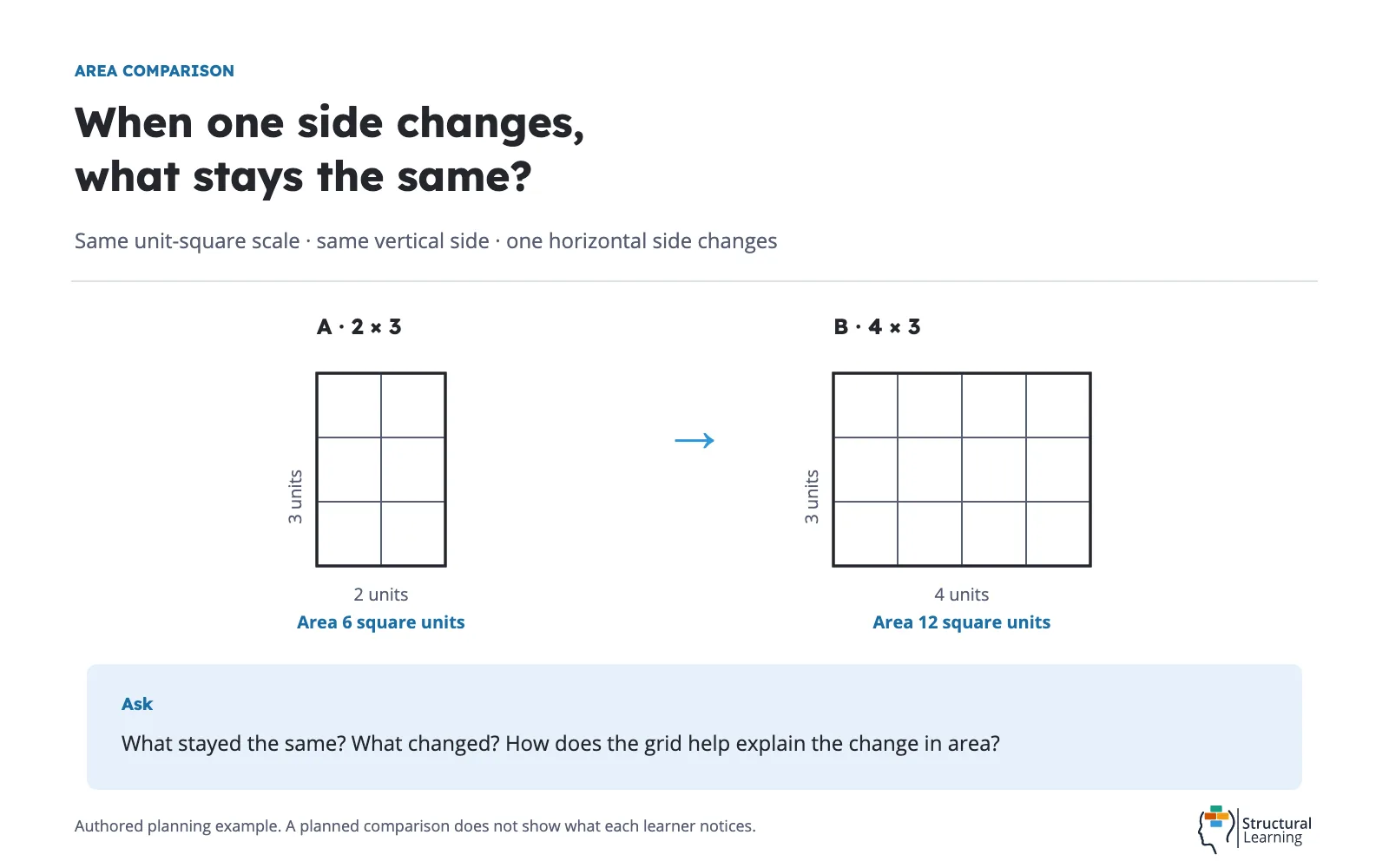
Rectangle A: 2 by 3, area 6 square units. Rectangle B: 4 by 3, area 12 square units. The vertical side stays at 3 units. Ask what stayed the same, what changed and how the grid explains the change in area.
A different example is useful when its difference reveals the concept. This guide illustrates that planning choice through area and regular plurals.
A critical aspect is something a learner needs to discern, meaning notice and distinguish, for the intended capability. Invariance means staying constant across the comparison. (Marton and Pang, 2006) Start with what you want the learner to be able to explain or do. “Complete these area questions” leaves you with a different planning task from “Explain how both side lengths affect a rectangle’s area.”
Ask what learners can already explain. A teacher may see a clear relationship between two examples while a learner attends to a different feature. Marton and Pang distinguish the intended object of learning, the enacted object made available during teaching, and the lived object the learner actually experiences. (Marton and Pang, 2006) That is a useful reason to look at explanations as well as completed answers.
Write the intended understanding before choosing your pair: “Changing either side length can change the area.” Ask for an explanation of both dimensions alongside the calculation.
Start with a short response that lets you inspect the understanding you need. For the area lesson, you could show a rectangle on a unit grid and ask: “What does the multiplication count?” Listen to the explanation and look at where the learner points.
A learner might calculate correctly and explain the rows of unit squares. Another might repeat the multiplication rule without connecting it to the grid. Those responses give you different questions to pursue. Ask for a further example or allow another response format before deciding what the learner understood.
Write the intended change in understanding in concrete terms. For example: “Explain why changing either side can affect the number of unit squares covered.” Then select examples that give the learner a useful comparison. In this case, the labelled sides, grid scale and covered squares all need to be clear.
Check prerequisites such as unit squares and the multiplication method. Plan any necessary teaching alongside the comparison. Keep the response that informed your choice to revisit after the lesson.
These terms describe different relationships to make available for learners to notice. The short definitions below follow Marton and Pang’s account on page 199. (Marton and Pang, 2006) Use the planning questions to explain your choices. The table is not a required four-stage lesson timetable.
| Pattern | Relationship to make visible | Planning question |
|---|---|---|
| Contrast | A relevant difference between qualities | Which difference do I want the learner to identify? |
| Separation | A dimension varies while other dimensions stay constant or vary at a different rate | What can I hold steady so this dimension is easier to distinguish? |
| Generalisation | A relevant value stays constant while other dimensions change | What remains true across these different cases? |
| Fusion | Relevant dimensions vary together so their simultaneous relationship can be experienced | Which dimensions must the learner consider together? |
A label does not decide whether an example is useful. Be specific about the aspect, the values and the intended understanding. The same pair of examples can invite more than one comparison. Your question and the learner’s response help you see which comparison is being made.
For arranging examples and non-examples on one page, our Frayer Model guide offers a familiar format. Choose the format after deciding what the comparison needs to reveal.
Consider an authored Year 5 example. The intended understanding is that a rectangle’s area depends on both side lengths. Learners already know how to count unit squares and use the multiplication method taught by their school. Keep the units and the grid scale the same throughout.
Draw the rectangles or provide accurate squared-paper diagrams. Label the horizontal and vertical side lengths consistently. The table records the two side lengths and the area; it does not replace the diagrams or the explanation.
| Rectangle | First side, units | Second side, units | Area, square units |
|---|---|---|---|
| A | 2 | 3 | 6 |
| B | 4 | 3 | 12 |
| C | 4 | 5 | 20 |
| D | 6 | 2 | 12 |
| E | 5 | 6 | 30 |
Compare A and B first. One side stays at 3 units while the other changes from 2 to 4. Ask: “What stayed the same? What changed? How does the grid help explain the change in area?” You are using a controlled comparison to draw attention to one dimension.
Then compare B and C. The first side stays at 4 units while the second changes from 3 to 5. Ask learners to identify the changed dimension before calculating. Listen for whether they use both side lengths in their explanation.
B and D have the same area, although their side lengths differ. Put them side by side and ask: “How can both cover 12 unit squares when they have different shapes?” Here, the area value stays constant while the dimensions change. This illustrates a generalisation comparison.
Finally, compare D and E. The first side becomes shorter, from 6 to 5, but the second becomes longer, from 2 to 6. The area increases from 12 to 30 square units. Ask: “Can the first side alone tell us which rectangle has the greater area?” The explanation needs to consider both dimensions together.
Adapt these authored pairings to your school’s representations and teaching method. Our mastery in maths guide places variation within a wider account of maths teaching.

The plate shows the A/B, B/C, B/D and D/E comparisons described in the two tables above. All use the same unit-square scale. The first side is horizontal and the second is vertical.
For the area example, prepare the diagrams before the lesson and check every label and square count. Decide which pair you will show together. If the purpose is to examine the changed dimensions, you can initially cover the area column and ask learners to predict what will happen. Then reveal the values and ask them to account for the result.
Give learners a moment to inspect the pair and prepare an explanation. You could ask them to mark the changed side on a copy of the diagrams or discuss the pair with a partner. Use your established representations and response supports.
When you bring the discussion together, ask for the reason behind an answer. “The area doubled” tells you the result. “There are twice as many columns, with the same three squares in each column” connects that result to the grid in A and B. Model the connection if the class needs it, then ask for another explanation using B and C.
Choose timing and grouping to fit your class. Keep the discussion on the mathematical relationship, using the theoretical names to explain your planning.
In an authored UK Year 2 primary English example, the focus is the relationship between a regular noun’s singular and plural forms. The class has already met nouns and uses spoken examples before looking at the written pairs.
Place “one dog” beside “two dogs”. Ask learners what changes at the end of the noun and what difference that makes to its meaning. Both the number word and the noun ending change, so direct the discussion to their relationship. Merely spotting that the sentences look different would leave the intended feature unclear.
Next compare “one cat” with “two cats”, and “one bird” with “two birds”. Ask: “What is the same about the change in each pair?” The noun changes across the pairs while the regular plural ending remains visible. Keep the examples short enough for learners to compare them directly.
For a further check, ask a learner to write the phrase for more than one tree and explain the noun ending. This set only covers regular plurals ending in “s”. Teach other plural forms through further examples when appropriate; do not present this small set as a rule for every noun.
A correct plural may still leave the relationship unexplained. Ask the learner to connect the ending to its meaning.
In his 2018 explanation of variationtheory.com, maths teacher Craig Barton describes a “reflect, expect, check” process. Learners compare a question with the preceding one, form an expectation and check it. He reports benefits in his own teaching while acknowledging that variation theory extends beyond the examples and exercises on the site. (Barton, 2018)
Jayne Webster, in an account published by the National Centre for Excellence in the Teaching of Mathematics (NCETM) on 31 July 2020, describes choosing standard and non-standard examples and considering misconceptions. In a ratio task, she keeps the ratio and the number 15 visible while changing the role that 15 plays. Her question is what she wants learners to notice. This is a teacher’s account of her practice, rather than a controlled test of this guide’s examples. (Webster, 2020)
Christian Moore-Anderson offers a useful caution in his practitioner introduction: the theory concerns learning, so a lesson need not always begin with difference and then move to similarity. He discusses drawing on what learners already know when deciding the starting point. (Moore-Anderson, updated 2026) Treat that as a prompt to inspect your class’s understanding, rather than filling four labelled boxes regardless of the task.
Marton and Pang’s 2013 study examined a specific conjecture about differences and sameness. It involved 78 primary learners in Grade 4, the school’s year-group label, from four classes in one Hong Kong school, randomly assigned within each class. They worked independently on a computer auction involving supply, demand and price for approximately 90 minutes. The authors reported different post-test distributions between the conditions. (Marton and Pang, 2013)
That study did not test the rectangle or language examples in this guide. Its task, population and assessment matter when interpreting the findings. It does not establish lasting gains across every subject or guarantee that a particular sequence will produce the intended understanding.
The authors also distinguish a pattern designed into an activity from the pattern a learner experiences. (Marton and Pang, 2013) Use the theory to explain an example choice, then gather evidence from the lesson. A polished sequence on your planning sheet cannot supply the learner’s explanation.
Prepare a question that requires the intended relationship. In the area example, show a 2-by-8 rectangle and a 4-by-5 rectangle on the same unit grid. Their areas are 16 and 20 square units. Ask which has the greater area and why looking at one side length could mislead someone.
Collect a response from each learner. Allow the supports normally used in the classroom. A drawing, labelled grid or spoken explanation can give you something to examine alongside the calculation. Look for the connection between the side lengths and the covered unit squares.
If a learner gives the right answer but cannot explain the relationship, ask a further question before deciding what they understood. If the explanation follows an irrelevant feature, revisit the comparison. For example, “The longer-looking one must be bigger” needs a response to that inference, not another page of similar calculations.
You can also ask learners to state a general idea and relate it to a fresh case. Our semantic waves guide explores connections between specific cases and general ideas through another framework. Our formative assessment guide offers further ways to examine learner explanations.
Use a response as a starting point for a further question. A wrong answer, a short answer or a pause may leave several possibilities open. Check what the learner was attending to and how they interpreted the question before choosing your next example.
Choose the relevant row as an observation checklist. Record the learner’s explanation and whether it connects the features named in the last column. The responses below are fictional illustrations, not observed learners or a validated assessment scale.
| Possible response | Further question or teacher move | What you want to inspect |
|---|---|---|
| “E has the greater area because it has a 6.” | Ask the learner to locate the 6 in both D and E, then explain what the other side length contributes. | Whether the explanation accounts for both dimensions. |
| “B and D are the same rectangle because both areas are 12.” | Compare three rows of four squares with two rows of six. Ask how the outlines and side lengths differ. | Whether equal area is being confused with an identical shape. |
| “I can see an s in dogs, cats and birds.” | Ask the learner to connect each written form to one animal and more than one, using the spoken or pictured examples. | Whether the ending is linked to plural meaning, beyond spotting a letter. |
If your question made the task unclear, improve the question. If the diagram drew attention to an irrelevant feature, revise the diagram. If a further explanation shows that the relevant idea is insecure, model it and give another suitable comparison.
Record the connection you heard or saw. “Used both side lengths and explained the covered squares” is more useful for your next planning decision than “understood variation”. You can then choose a later example that lets you inspect the same understanding again.
Record the intended understanding, what learners can already explain, the examples you will compare, and the aspects that change or stay constant. Add the likely wrong inference and the question that will help you recognise it. Finish with the further example or response you will collect.
For the area lesson, your note could say: “Learners may judge area from one side alone. Compare rectangles D and E, keeping the grid scale fixed. Ask them to account for both dimensions. Then use the 2-by-8 and 4-by-5 pair to inspect their explanation.”
Check that revised diagrams still show the intended comparison. Use learners’ responses to refine the next example.
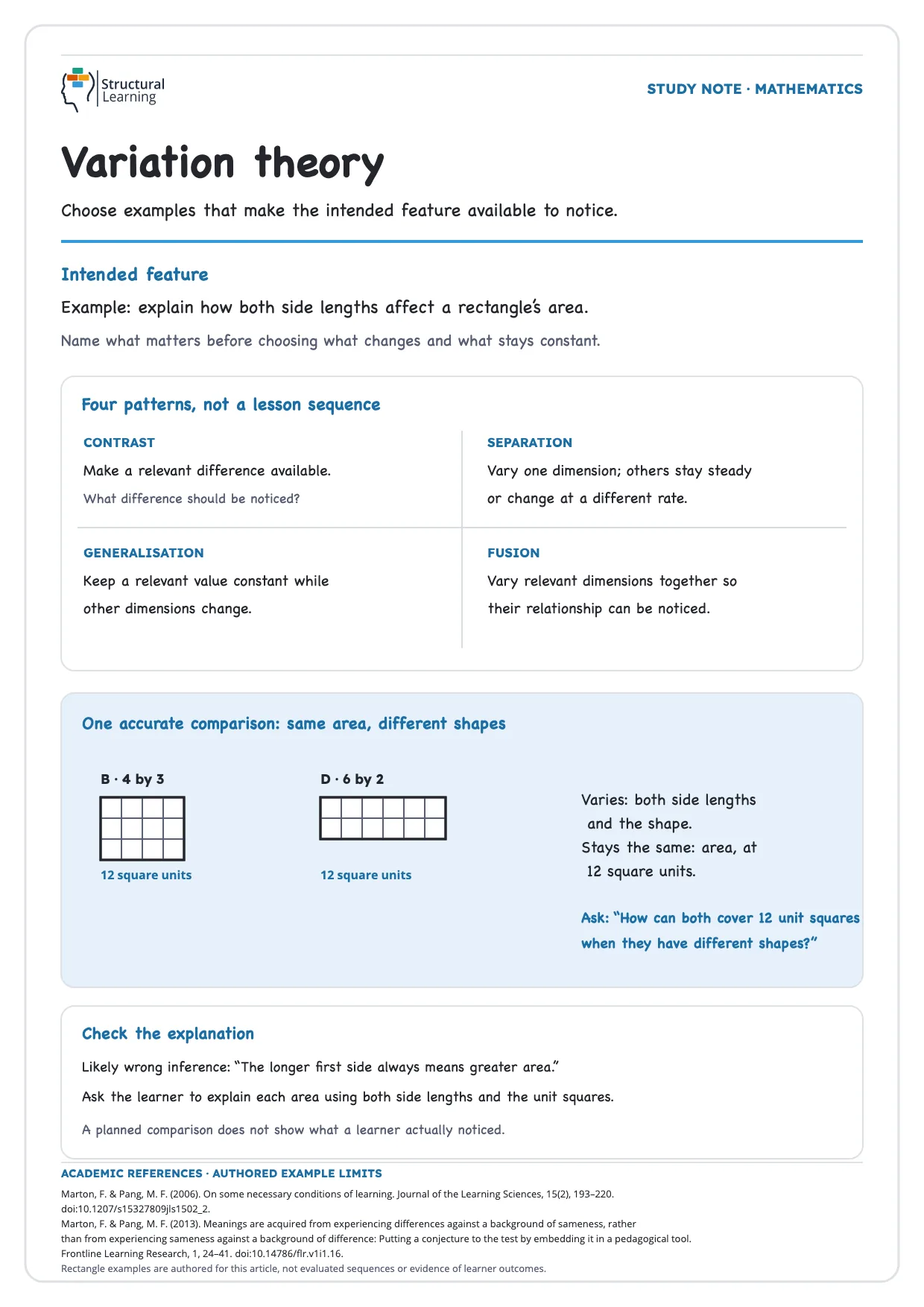
Use this one-page A4 note to revisit the four patterns, compare equal-area rectangles and prepare an explanation check. An expandable text version follows the image.
STUDY NOTE · MATHEMATICS
Variation theory
Choose examples that make the intended feature available to notice.
Intended feature
Example: explain how both side lengths affect a rectangle’s area.
Name what matters before choosing what changes and what stays constant.
Four patterns, not a lesson sequence
CONTRAST
Make a relevant difference available.
What difference should be noticed?
SEPARATION
Vary one dimension; others stay steady
or change at a different rate.
GENERALISATION
Keep a relevant value constant while
other dimensions change.
FUSION
Vary relevant dimensions together so
their relationship can be noticed.
One accurate comparison: same area, different shapes
B · 4 by 3
D · 6 by 2
12 square units
12 square units
Varies: both side lengths and the shape.
Stays the same: area, at 12 square units.
Ask: “How can both cover 12 unit squares
when they have different shapes?”
Check the explanation
Likely wrong inference: “The longer first side always means greater area.”
Ask the learner to explain each area using both side lengths and the unit squares.
A planned comparison does not show what a learner actually noticed.
ACADEMIC REFERENCES · AUTHORED EXAMPLE LIMITS
Marton, F. & Pang, M. F. (2006). On some necessary conditions of learning. Journal of the Learning Sciences, 15(2), 193–220.
doi:10.1207/s15327809jls1502_2.
Marton, F. & Pang, M. F. (2013). Meanings are acquired from experiencing differences against a background of sameness, rather
than from experiencing sameness against a background of difference: Putting a conjecture to the test by embedding it in a pedagogical tool.
Frontline Learning Research, 1, 24–41. doi:10.14786/flr.v1i1.16.
Rectangle examples are authored for this article, not evaluated sequences or evidence of learner outcomes.
Download the variation theory study note (one-page A4 PDF)
Keep the four patterns, an equal-area comparison and an explanation check beside your planning notes.
Enter your first name and email to get the image download. Read our Privacy Policy. The PDF and text version are also available in this article.
Take the actual examples to the planning conversation. Ask your colleague what they would expect a learner to notice in the pair, then compare that interpretation with your intended understanding. If they attend to a different feature, consider whether the material or question needs clarification.
For the area sequence, discuss why B and D have been paired. The intended comparison concerns equal area across different dimensions. A colleague might also identify an opportunity to discuss the two outlines. Decide which relationship belongs in this lesson and which you will leave for another point in the sequence.
After teaching, review anonymised explanations or observation notes with your colleague, following your school’s information rules. Use them to refine the next comparison and its question.
No. Holding other aspects steady is useful when you want to distinguish a dimension. Fusion concerns dimensions varying together. (Marton and Pang, 2006) Decide which relationship matters for the intended understanding and make your reason explicit.
This guide starts with the concept and what learners can currently discern. It does not assign a fixed learning type to a learner. The planning decision is about the examples and the understanding you want to examine.
Prepare enough for the comparison you need, with time to discuss the relationship. Inspect learners’ responses before adding more. A large set of exercises does not itself show that the intended feature was noticed.
Read the sequence and work through it yourself. Identify what changes, what stays constant and what understanding each comparison is meant to reveal. Check its fit with your class’s prior learning and your school’s method before using it.