Updated on
October 7, 2026
Halpern's Critical Thinking Framework: A Teacher's Guide
Halpern's critical thinking framework explained for teachers: the four parts, why transfer is hard, and classroom moves that make thinking skills stick.

Updated on
October 7, 2026
Halpern's critical thinking framework explained for teachers: the four parts, why transfer is hard, and classroom moves that make thinking skills stick.
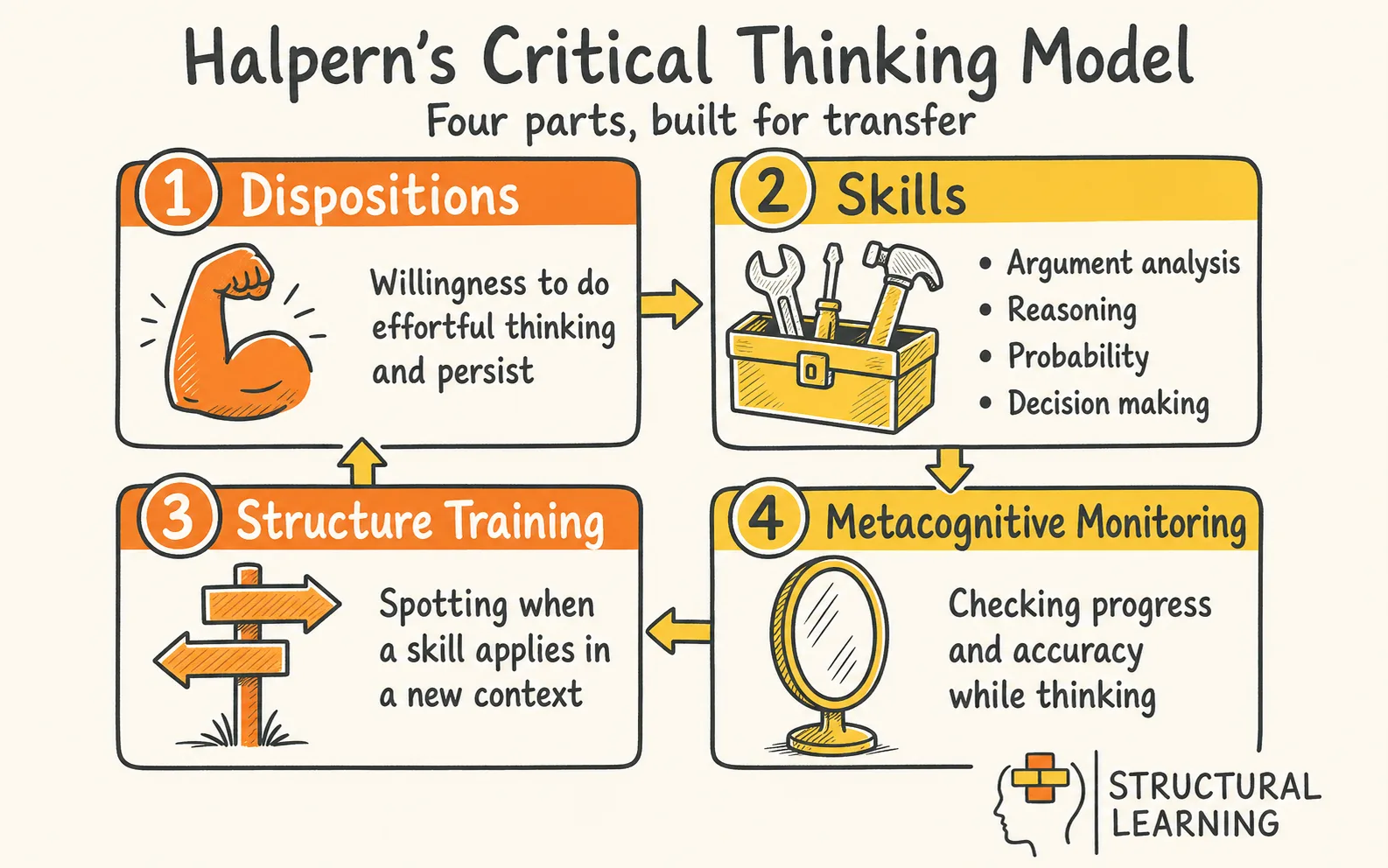
Halpern's critical thinking framework is a four-part model for teaching thinking skills that learners can carry into new subjects, not just the lesson where they first met them. Diane Halpern set it out in a 1998 paper in American Psychologist, and she built it around one stubborn problem: skills taught in one context rarely transfer to another (Halpern, 1998). Her answer combines disposition, explicit skills, structure training and metacognitive monitoring.
Most critical thinking teaching fails at transfer. A learner analyses a poem well on Monday, then accepts a dubious science claim on Tuesday, because nothing told them the same thinking applied. Halpern's model treats transfer as the goal, not a hopeful side effect.
This guide explains the four parts, shows how the framework answers the transfer problem, and offers classroom moves you can use this term. It sits inside the wider map in our guide to thinking frameworks, and pairs well with our overview of what critical thinking is.
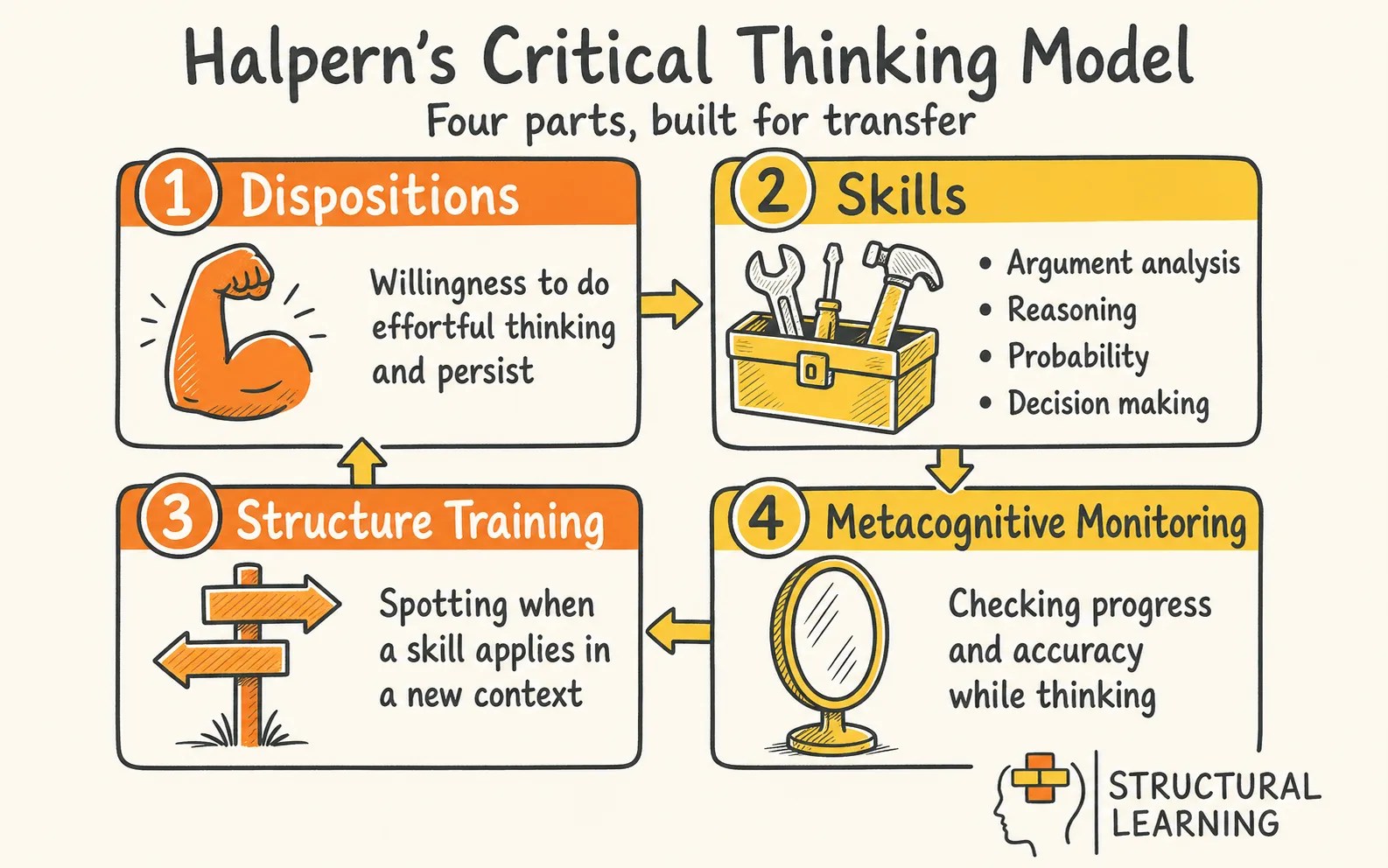
Halpern's critical thinking framework is a model for teaching thinking so it transfers across subjects. Published in 1998, it combines four elements: a disposition to think hard, instruction in specific skills, structure training that helps learners spot when a skill applies, and metacognitive monitoring of their own reasoning (Halpern, 1998).
The framework grew from a practical frustration. Schools spend a lot of time on thinking, yet the skills often stay stuck to the lesson that taught them. Halpern wanted a design that made critical thinking portable, so a skill learned in science would still fire in a history debate or a shopping decision.
Her definition of critical thinking is deliberately practical. It is the kind of thinking that raises the odds of a good outcome: reasoning that is purposeful, reasoned and goal-directed (Halpern, 2014). On this view, critical thinking is a set of skills and habits that can be taught, not a talent some learners simply have.
The four parts are not a sequence to work through. They run together in every good thinking lesson. A learner needs the will to think, the skills to think with, the structure sense to know when to use them, and the monitoring to check how it is going.
Transfer is the hard problem because thinking skills tend to stay stuck to the context that taught them. A learner may reason carefully about a history source, then accept a weak advertising claim minutes later. Halpern argued that critical thinking teaching only counts if the skills reach new, unfamiliar situations (Halpern, 1998).
Psychologists have studied this transfer problem for a century. Learners often fail to use a skill outside the narrow setting where they learned it, even when the new task needs exactly that skill. The reason is that they store the skill together with its surface features. A probability lesson feels like a maths lesson, so its logic never surfaces when a health scare appears in the news.
Halpern (2014) separates two kinds of transfer. Near transfer moves a skill to a similar task, which is relatively easy. Far transfer moves it to a very different domain, which is the real prize and the real difficulty. Most classroom thinking work produces near transfer at best.
The stakes are practical. We want a young person who spots a weak argument in a science story, a political speech and a sales pitch alike. That needs far transfer, and far transfer does not happen by accident. It has to be taught for directly, which is the whole point of Halpern's model.
Halpern's model has four parts that work together. First, a disposition to engage in effortful thinking. Second, instruction in specific skills such as argument analysis and probability.
Third, structure training that helps learners recognise when a skill applies. Fourth, metacognitive monitoring of their own reasoning (Halpern, 1998).
Each part fixes a different reason critical thinking fails. Skills without disposition go unused, because a learner who cannot be bothered will not deploy them. Disposition without skills produces effort but poor reasoning.
Skills without structure training stay locked to one subject. And none of it lasts without monitoring, the habit of checking your own thinking.
The dispositional component is the willingness to think hard when a quick answer would do. Halpern builds on earlier work here. Ennis (1987) listed dispositions such as seeking reasons and staying open-minded, and Facione (1990) reported a similar expert consensus. A disposition is a tendency, not a mood, and it can be modelled and rewarded over time.
The skills component names what to teach: verbal reasoning, argument analysis, hypothesis testing, judging likelihood and probability, and decision making and problem solving (Halpern, 1998). These are teachable and assessable, unlike the vague instruction to think critically. Structure training and metacognitive monitoring carry most of the weight, so they get their own sections below.
| Component | What it means | One classroom move |
|---|---|---|
| Disposition. | The willingness to engage in effortful, careful thinking. | Praise the reasoning process, not just the right answer. |
| Skills. | Specific abilities such as argument analysis and probability. | Teach one named skill explicitly, then practise it. |
| Structure training. | Recognising the deep structure that shows when a skill applies. | Compare two problems that share a hidden structure. |
| Metacognitive monitoring. | Checking and steering your own reasoning as you go. | Ask learners to rate their confidence and justify it. |
Structure training teaches learners to see past the surface of a problem to its underlying shape. A probability question about lottery tickets and one about medical tests look different but share the same logic. When learners practise spotting that shared structure, the skill travels into new domains (Halpern, 1998).
This is Halpern's central move, and it attacks the transfer problem head on. Learners fail to transfer because they store a skill with its surface details. Structure training strips those details away. It asks a simple question: what kind of problem is this, really, underneath the topic?
The method is comparison. Show two problems that look unrelated but share a deep structure, and ask learners to find the match. Over time they build a library of structures, such as this is a base-rate problem or this is a correlation-is-not-causation problem. Once a structure is named and recognised, the matching skill can be retrieved in any subject.
Halpern (2014) uses worked pairs and contrasting cases for exactly this. A weather forecast, a medical screen and a betting question all reduce to the same probability structure. Practising across such varied surfaces is what builds the recognition. The learner is trained to ask a transfer question by habit: where else have I seen this shape of problem?
Structure spotting also leans on metacognition, because recognising a structure means monitoring your own first impression and overriding it when it points the wrong way.
The framework names five skill clusters to teach directly: verbal reasoning, argument analysis, hypothesis testing, likelihood and probability, and decision making and problem solving. Each is specific enough to model, practise and assess, which is what separates Halpern's approach from vague appeals to think harder (Halpern, 1998).
Argument analysis is often the best place to start. Learners identify the claim, the reasons and the assumptions, then judge whether the reasons actually support the claim. Argument mapping, where the parts of an argument are drawn as a diagram, makes this visible and gives weaker readers a foothold.
Probability and likelihood deserve special attention, because everyday reasoning leans on them constantly. Halpern (2014) shows how small language shifts help. Asking how likely, out of a hundred? turns a vague hunch into a number learners can defend or revise. This probability language belongs in every subject, not just maths.
Hypothesis testing and decision making round out the set. Learners generate alternatives, weigh evidence and choose, then review the outcome. Taught together, these are what most teachers mean by higher-order thinking skills, and they gain their power only when learners can call on them outside the lesson that introduced them.
To use the framework, teach one named skill at a time, train structure with contrasting cases, and build metacognitive habits through routine questions. Add short prompts that reward careful thinking. The aim is not a new subject on the timetable but a thinking layer folded into the lessons you already teach (Halpern, 1998).
Start with everyday transfer prompts. After teaching a skill, ask where else it applies: we just tested that claim in science, where else this week could you use the same test? The question is small, but it does the transfer work the model demands.
Use probability language across the timetable. In history, ask how likely a source is to be biassed and why. In PE, ask which tactic gives the better odds. The skill is the same, only the surface changes, which is exactly the variety that structure training needs.
Build monitoring into ordinary routines. A confidence rating before and after a task, a quick which step are you least sure of?, or a short reflection all count. The Education Endowment Foundation reports that metacognition and self-regulation approaches are high-impact and low-cost (EEF, 2021), and Halpern's monitoring component points at the same lever.
Finally, protect disposition. Praise the effort and the method, not the speed. A class that learns careful thinking goes unrewarded will quietly stop doing it.
Halpern's framework overlaps with other critical thinking models but stresses transfer more than most. The Paul-Elder framework focuses on the elements and standards of reasoning, while talk-based approaches build thinking through dialogue. Halpern's contribution is the explicit machinery for making any of these skills cross into new domains (Halpern, 1998).
The Paul-Elder critical thinking framework offers a detailed anatomy of reasoning: the elements of thought and the intellectual standards that judge them. It is strong on what good thinking looks like. Halpern is stronger on how to make that thinking portable. The two fit together well, with Paul-Elder supplying the criteria and Halpern the transfer strategy.
Talk-based approaches add the social dimension. Reasoning out loud, challenging a peer and defending a position all exercise the skills Halpern lists, and dialogue is one of the ingredients the evidence favours. Our guide to critical thinking through classroom talk sets out the routines, and the wider oracy and critical thinking hub connects them to spoken language development.
None of these models competes with Halpern's. Disposition echoes Ennis (1987) and Facione (1990), and the skills overlap with most taxonomies. What Halpern adds is the insistence that transfer be designed in, not hoped for.
The best evidence comes from a large meta-analysis of critical thinking instruction. Abrami and colleagues found that thinking skills can be taught, and that mixed methods work best: explicit skill instruction, authentic problems and dialogue combined outperform any single approach (Abrami et al., 2015). The effects are real but moderate.
Abrami et al. (2015) reviewed hundreds of studies and drew two clear conclusions. First, critical thinking is teachable, and the effect of instruction is positive and reliable. Second, the how matters. The largest gains came when teachers made the skills explicit and gave learners real problems and structured dialogue, rather than relying on one method alone.
This maps neatly onto Halpern's framework. Explicit skills, authentic problems that demand transfer, and talk that surfaces reasoning are the same ingredients her model prescribes. The meta-analysis gives empirical backing to a design she argued for on theoretical grounds.
The caution is scale. Effects are moderate, not transformative, and the strongest are often near transfer. Far transfer, the goal Halpern set, remains the hardest thing to show.
The evidence supports teaching critical thinking deliberately. It does not promise that a term of lessons will remake how learners reason everywhere.
Transfer prompts live or die by the quality of questioning. Our guide to questioning in teaching pairs well with Halpern's structure training.
The framework faces three honest limitations. Far transfer effects stay modest even in careful trials. Dispositions are hard to measure reliably, so we cannot easily tell whether they have grown. And most of the supporting evidence comes from higher-education samples, which limits confidence about younger learners (Abrami et al., 2015).
Transfer remains the sticking point. Halpern designed the model to produce far transfer, yet trials show that even structure-trained learners often fail to apply skills in genuinely new settings. The model diagnoses the problem clearly. It does not fully solve it, and no framework yet does.
Measurement is the second issue. Skills can be assessed with tasks, but disposition is a tendency that shows up over time and across situations. A learner may know how to think critically and simply choose not to, which is hard to capture in any single test.
Third, the evidence base skews towards university students. Much of the research, including parts of Abrami et al. (2015), draws on higher-education samples, so claims about primary and secondary classrooms rest on weaker ground. Teachers should treat the framework as a well-argued design to test against their own assessment evidence, not a guaranteed programme.
Abrami, P. C., Bernard, R. M., Borokhovski, E., Waddington, D. I. , Wade, C. A., & Persson, T. (2015). Strategies for teaching students to think critically: A meta-analysis. Review of Educational Research, 85(2), 275-314.
Education Endowment Foundation. (2021). Metacognition and self-regulation: Teaching and learning toolkit. EEF.
Ennis, R. H. (1987). A taxonomy of critical thinking dispositions and abilities. In J. B. Baron & R. J. Sternberg (Eds.), Teaching thinking skills: Theory and practice. Freeman.
Facione, P. A. (1990). Critical thinking: A statement of expert consensus for purposes of educational assessment and instruction. California Academic Press.
Halpern, D. F. (1998). Teaching critical thinking for transfer across domains: Disposition, skills, structure training, and metacognitive monitoring. American Psychologist, 53(4), 449-455.
Halpern, D. F. (2014). Thought and knowledge: An introduction to critical thinking (5th ed.). Psychology Press.