Blooms Taxonomy Verbs
Discover how Bloom's Taxonomy verbs help teachers design effective learning objectives and develop students' critical thinking skills across all cognitive levels.


Discover how Bloom's Taxonomy verbs help teachers design effective learning objectives and develop students' critical thinking skills across all cognitive levels.
| Taxonomy Level | Original (1956) | Key Characteristics | Criticisms/Issues |
|---|---|---|---|
| Knowledge | Level 1 | Basic recall and recognition of facts | Too blunt and straightforward according to Stedman (1973) |
| Comprehension | Level 2 | Understanding meaning and interpretation | Order questioned, understanding may come through application first |
| Application | Level 3 | Using knowledge in new situations | May actually precede understanding in real learning |
| Analysis | Level 4 | Breaking down information into parts | Overlapping classifications, students may reach same behaviour differently |
| Synthesis | Level 5 | Combining elements to form new patterns | 47 different verb lists across UK institutions with no consensus |
| Evaluation | Level 6 | Making judgments based on criteria | Two students with identical performance may have different understanding levels |
Select a thinking level to see appropriate verbs for writing learning objectives. Click any verb to build your objective.
From Structural Learning — structural-learning.com
Bloom's Taxonomy verbs are a well-known concept for understanding and framing learning intentions which dates back to 1956. It has become a common structure used in schools and universities to teach and assess students. The structure uses a tier of verbs to clarify educational objectives, these are typically aligned constructively to summative assessments. A recent analysis was carried out on Bloom's Taxonomy throughout UK Higher Education Institutions to measure if there was consensus. The research eventually narrowed down forty-seven verb lists. The verb lists had very little agreement but it still remains one of the most popular ways to conceptualise knowledge and learning.
The learning outcomes originated from Bloom's Taxonomy verbs in 1956 (Bloom et al.). The concept was later revised by Krathwohl 2002. Taxonomy was invented to define the learning process and assessment in a manner that can be observed and measured. How the infamous blooms taxonomy list of learning verbs can be put into action and provide some of examples of verbs being used to achieve deeper learning experiences. We will also introduce a new thinking framework designed to enhance learning tasks. As well as this, we will touch upon another framework for promoting 21st-century learning skills.

Bloom's Taxonomy verbs are action words used to define and measure observable learning objectives, first developed by Benjamin Bloom and colleagues in 1956. The framework was later revised by Krathwohl in 2002 to better reflect modern educational practices. These verbs help educators create clear learning outcomes that can be assessed through student performance.
Creating learning objectives involves using verbs that can be measured and assessed. For example, when learning involves a subject, let's say history. The research could be focused on listing the main research methods in history instead of analysing the main research methods in history. The taxonomy dictates that a learner will undergo the following steps: knowledge, comprehension, application, analysis, synthesis and evaluation. This progression supports working memory by building understanding systematically. Effective lesson planning requires careful consideration of these cognitive levels to ensure appropriate challenge and support for all learners, including those with special educational needs. The framework helps develop higher-order thinking skills through structured progression. Teachers can enhance this approach by incorporating thinking strategies and utilising knowledge organisers to support student understanding. Regular formative assessment throughout the process helps track student progress. For complex tasks, project-based learning approaches can effectively integrate multiple taxonomy levels, while thoughtful marking strategies provide meaningful feedback on student achievement across all cognitive domains.s.
The key to effectively applying Bloom's Taxonomy verbs lies in understanding the cognitive processes associated with each level. Here are some practical examples:
When constructing a curriculum, consider the progression through Bloom's levels. Start with basic knowledge and comprehension, then move towards application, analysis, synthesis, and evaluation. Scaffolding learning in this way can greatly enhance student understanding and motivation.
Successful implementation of Bloom's taxonomy verbs requires systematic planning across lesson activities, assessments, and learning objectives. Begin by examining your current teaching materials and identifying the cognitive level demanded by existing tasks. Many educators discover their activities cluster around lower-order thinking skills, creating opportunities to introduce more challenging cognitive demands.
Start lesson planning by selecting appropriate verbs for your learning objectives. For introductory content, use remembering and understanding verbs such as 'list', 'describe', or 'explain'. As students develop confidence, progress to application verbs like 'demonstrate', 'solve', or 'implement'. Higher-order thinking emerges through analysis verbs ('compare', 'contrast', 'examine'), synthesis verbs ('create', 'design', 'propose'), and evaluation verbs ('justify', 'critique', 'recommend').
Practical classroom strategies include creating question stems using taxonomy verbs, designing tiered assignments that progress through cognitive levels, and developing rubrics that explicitly reference the thinking skills students must demonstrate. Consider establishing 'thinking routines' where students regularly engage with questions formatted around specific taxonomy verbs, building their metacognitive awareness of different thinking processes.
While Bloom's Taxonomy is valuable, it is beneficial to use other thinking frameworks to boost the learning experience for students. The SOLO Taxonomy (Structure of Observed Learning Outcomes) offers another perspective on assessing learning depth. It focuses on the complexity of student understanding, moving from simple to complex. The levels are:
By combining Bloom's Taxonomy and SOLO Taxonomy, educators can create more nuanced and effective learning experiences.
Bloom's Taxonomy verbs and frameworks like SOLO Taxonomy provide valuable tools for educators aiming to create meaningful and measurable learning experiences. By carefully selecting verbs that align with specific cognitive levels, teachers can design activities and assessments that promote deep understanding and critical thinking. While there may be debates and variations in verb lists, the core principles of Bloom's Taxonomy remain a cornerstone of effective instructional design.
Remember that the effective use of Bloom's Taxonomy isn't about rigidly adhering to a hierarchy, but about understanding the cognitive processes involved in learning and tailoring instruction to meet students where they are. Experiment with different verbs and activities, observe student responses, and adapt your approach to maximise learning outcomes.
Ultimately, the goal is to helps students to become active, engaged, and critical thinkers. By intentionally incorporating Bloom's Taxonomy verbs into your teaching practice, you can help students develop the skills and knowledge they need to succeed in the 21st century.
Cognitive domain classification
| Cognitive Level | Definition | Action Verbs | Question Stems |
|---|---|---|---|
| 1. Remember | Retrieve relevant knowledge from long-term memory | list, name, identify, recall, define, recognise, match, label, state, select, locate | What is.? Who was.? Where did.? When did.? List the.? Name the.? |
| 2. Understand | Construct meaning from instructional messages | explain, summarise, interpret, paraphrase, classify, describe, discuss, illustrate, compare | Explain how.? Summarise.? What does this mean.? Describe in your own words.? |
| 3. Apply | Carry out or use a procedure in a given situation | apply, use, solve, demonstrate, implement, execute, calculate, show, complete, illustrate | How would you use.? Apply this to.? Solve using.? What would happen if.? |
| 4. Analyse | Break material into parts and determine relationships | analyse, compare, contrast, distinguish, examine, categorise, deconstruct, differentiate, organise | What are the parts.? How does this compare.? What is the relationship.? Why did.? |
| 5. Evaluate | Make judgements based on criteria and standards | evaluate, judge, justify, critique, assess, argue, defend, prioritise, recommend, rate | Do you agree that.? What is your opinion.? Which is most important.? Justify your answer. |
| 6. Create | Put elements together to form a coherent whole | create, design, construct, develop, compose, produce, generate, plan, invent, formulate | Design a.? Create a new.? What would you propose.? How would you improve.? |
Based on the revised Bloom's Taxonomy (Anderson & Krathwohl, 2001). Use these verbs to write measurable learning objectives and design progressively challenging assessments.
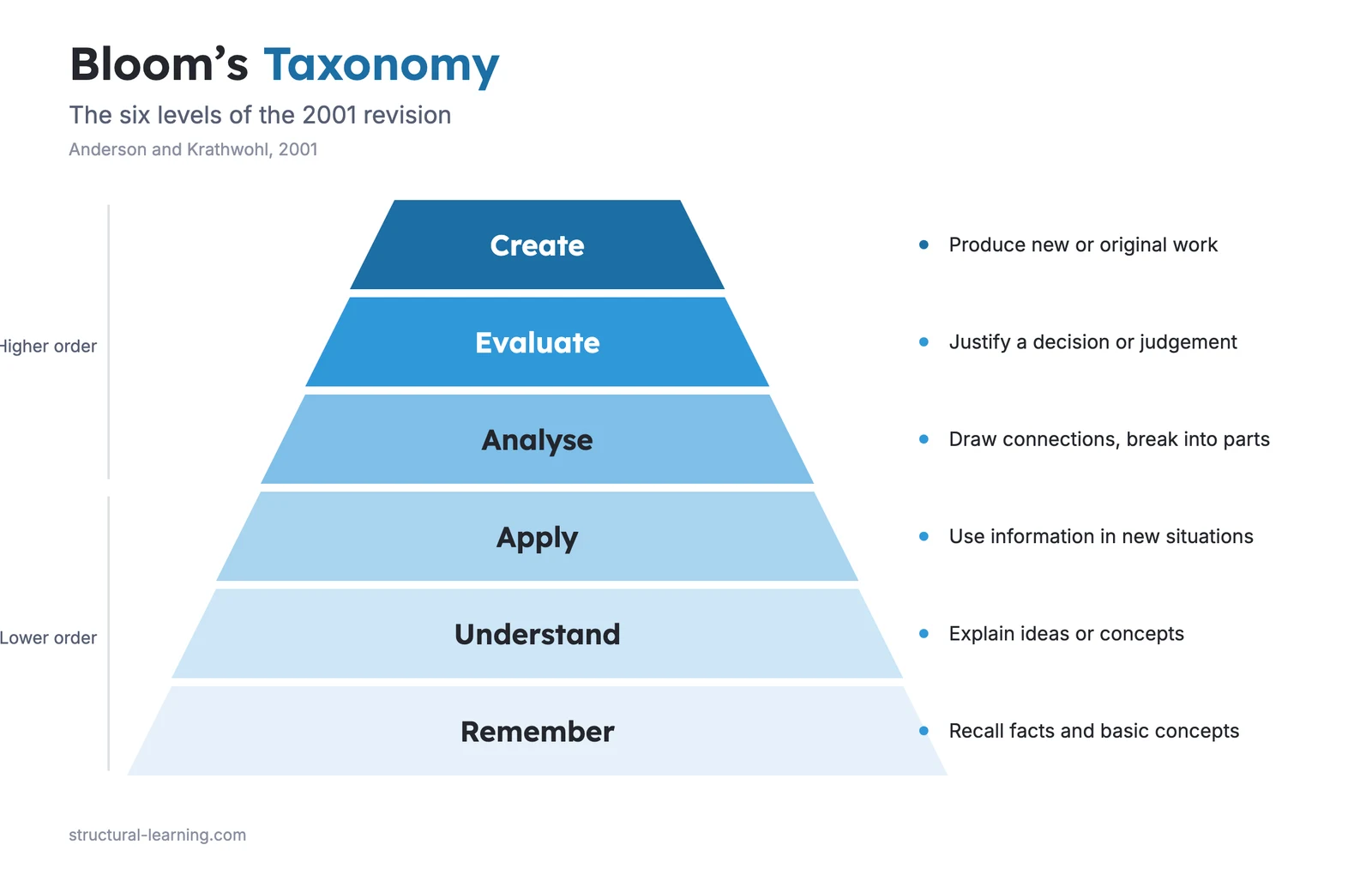
Understanding the specific verbs associated with each cognitive level in Bloom's taxonomy enables educators to craft precise learning objectives that target distinct thinking skills. Remember level verbs include define, list, recall, and identify, whilst Understand level activities utilise explain, summarise, classify, and interpret. Moving up the hierarchy, Apply level tasks employ demonstrate, solve, use, and implement, followed by Analyse level verbs such as compare, contrast, examine, and categorise.
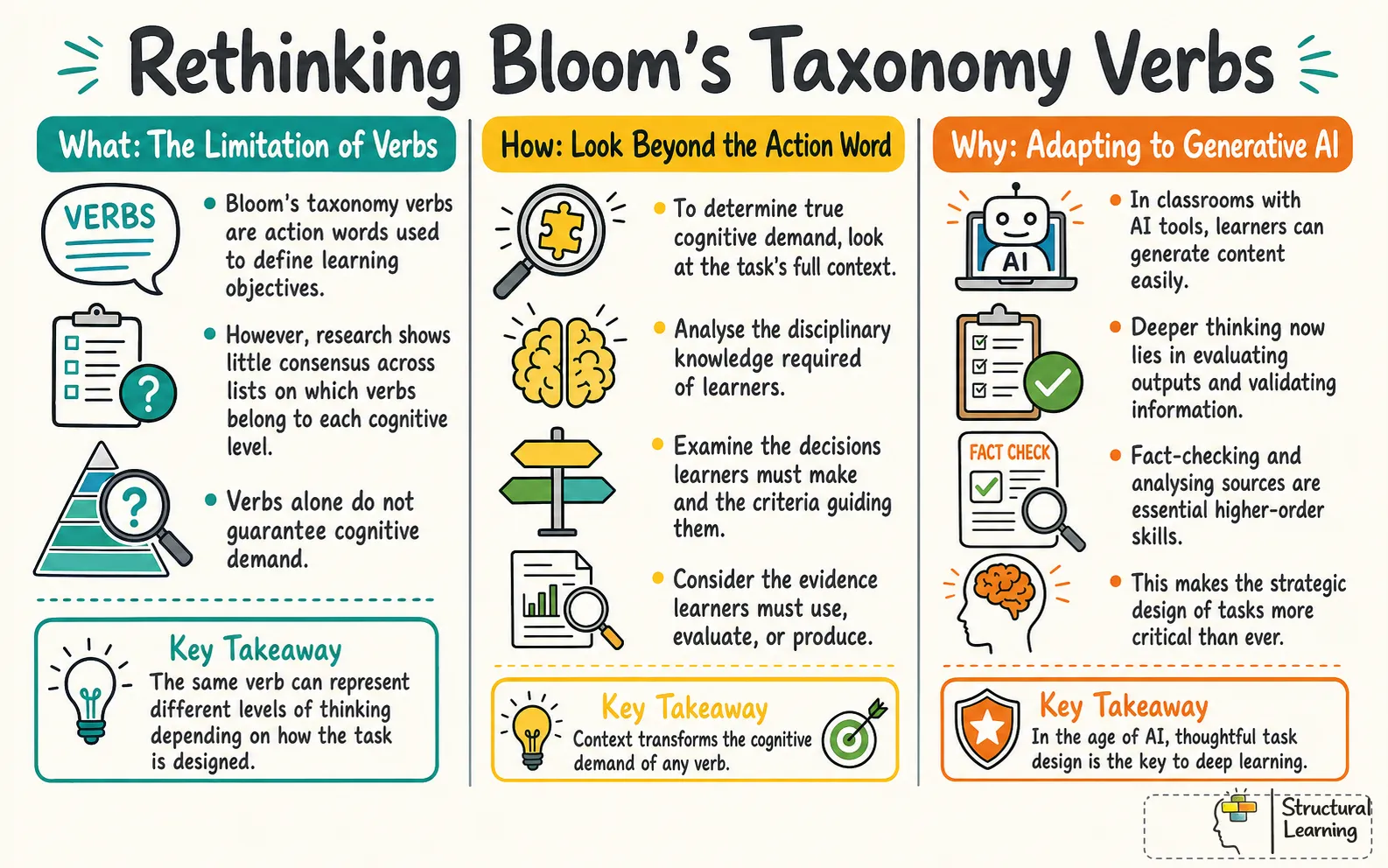
The higher-order thinking skills require more sophisticated verb choices to accurately reflect cognitive complexity. Evaluate level objectives incorporate judge, critique, assess, and defend, whilst Create level tasks utilise design, construct, develop, and formulate. Anderson and Krathwohl's revised taxonomy emphasises that these verbs must align with the intended cognitive process, as selecting inappropriate verbs can mislead both educators and learners about the actual thinking demands of an activity.
When designing lesson objectives, select verbs that authentically match your educational intent rather than simply choosing higher-level verbs for perceived rigour. A well-crafted "explain" objective may prove more valuable than a poorly constructed "evaluate" task that lacks genuine analytical demand.
Effective assessment and questioning strategies begin with deliberately selecting verbs that align with your intended cognitive level. When crafting questions for remembering and understanding, use verbs like "list," "describe," or "explain" to gauge foundational knowledge. For higher-order thinking, incorporate verbs such as "analyse," "evaluate," or "create" to challenge students beyond surface-level comprehension. This strategic verb selection ensures your assessments truly measure the depth of learning you intend to evaluate.
Progressive questioning sequences prove particularly powerful in classroom discussions. Start with lower-order questions using verbs like "identify" or "summarise," then build complexity by asking students to "compare," "critique," or "design" solutions. This scaffolded approach, supported by research on cognitive load theory, allows students to construct understanding systematically whilst preventing c ognitive overload that can hinder learning.
For practical implementation, create question banks organised by taxonomic levels, ensuring each verb appears in authentic contexts relevant to your subject area. Rather than asking "What is photosynthesis?" try "How would you modify the photosynthesis process to improve plant growth in low-light conditions?" This transformation from remembering to creating fundamentally changes the cognitive demands whilst maintaining curriculum relevance.
These practical activities help teachers apply Bloom's Taxonomy across all cognitive levels, moving students from basic recall to higher-order thinking and creative synthesis. Each activity targets specific cognitive processes for deeper learning.
Effective use of Bloom's Taxonomy means deliberately planning activities across all cognitive levels rather than defaulting to lower-order tasks. Start lessons with remembering and understanding activities to activate prior knowledge, then progress to applying, analysing, evaluating, and creating as students demonstrate readiness. The taxonomy is a planning tool, not a rigid sequence - sometimes creative tasks actually precede full understanding, particularly in enquiry-based approaches.
Effective learning objectives begin with carefully selected action verbs that precisely define what students should accomplish at each cognitive level. Rather than vague terms like "understand" or "know," measurable verbs from Bloom's taxonomy create clear expectations for both educators and learners. For instance, "Students will analyse the causes of World War I" provides more specific direction than "Students will learn about World War I," enabling teachers to design appropriate assessments and learning activities.
When crafting objectives across cognitive levels, consider the logical progression from foundational knowledge to higher-order thinking skills. Beginning lessons might use verbs like "identify" or "describe" before advancing to "evaluate" or "create." This scaffolded approach aligns with cognitive load theory principles, ensuring students develop necessary prerequisite skills before tackling complex analytical tasks. Avoid mixing cognitive levels within single objectives, as this can create confusion about expected performance standards.
Practical application involves matching assessment methods to your chosen taxonomy verbs. If students must "compare and contrast," provide opportunities for side-by-side analysis rather than simple recall exercises. Similarly, objectives using "synthesise" or "design" require open-ended tasks that demonstrate creative thinking. This alignment between objectives, instruction, and assessment creates coherent learning experiences that support meaningful skill development across all cognitive levels.
| Taxonomy Level | Original (1956) | Key Characteristics | Criticisms/Issues |
|---|---|---|---|
| Knowledge | Level 1 | Basic recall and recognition of facts | Too blunt and straightforward according to Stedman (1973) |
| Comprehension | Level 2 | Understanding meaning and interpretation | Order questioned, understanding may come through application first |
| Application | Level 3 | Using knowledge in new situations | May actually precede understanding in real learning |
| Analysis | Level 4 | Breaking down information into parts | Overlapping classifications, students may reach same behaviour differently |
| Synthesis | Level 5 | Combining elements to form new patterns | 47 different verb lists across UK institutions with no consensus |
| Evaluation | Level 6 | Making judgments based on criteria | Two students with identical performance may have different understanding levels |
Select a thinking level to see appropriate verbs for writing learning objectives. Click any verb to build your objective.
From Structural Learning — structural-learning.com
Bloom's Taxonomy verbs are a well-known concept for understanding and framing learning intentions which dates back to 1956. It has become a common structure used in schools and universities to teach and assess students. The structure uses a tier of verbs to clarify educational objectives, these are typically aligned constructively to summative assessments. A recent analysis was carried out on Bloom's Taxonomy throughout UK Higher Education Institutions to measure if there was consensus. The research eventually narrowed down forty-seven verb lists. The verb lists had very little agreement but it still remains one of the most popular ways to conceptualise knowledge and learning.
The learning outcomes originated from Bloom's Taxonomy verbs in 1956 (Bloom et al.). The concept was later revised by Krathwohl 2002. Taxonomy was invented to define the learning process and assessment in a manner that can be observed and measured. How the infamous blooms taxonomy list of learning verbs can be put into action and provide some of examples of verbs being used to achieve deeper learning experiences. We will also introduce a new thinking framework designed to enhance learning tasks. As well as this, we will touch upon another framework for promoting 21st-century learning skills.

Bloom's Taxonomy verbs are action words used to define and measure observable learning objectives, first developed by Benjamin Bloom and colleagues in 1956. The framework was later revised by Krathwohl in 2002 to better reflect modern educational practices. These verbs help educators create clear learning outcomes that can be assessed through student performance.
Creating learning objectives involves using verbs that can be measured and assessed. For example, when learning involves a subject, let's say history. The research could be focused on listing the main research methods in history instead of analysing the main research methods in history. The taxonomy dictates that a learner will undergo the following steps: knowledge, comprehension, application, analysis, synthesis and evaluation. This progression supports working memory by building understanding systematically. Effective lesson planning requires careful consideration of these cognitive levels to ensure appropriate challenge and support for all learners, including those with special educational needs. The framework helps develop higher-order thinking skills through structured progression. Teachers can enhance this approach by incorporating thinking strategies and utilising knowledge organisers to support student understanding. Regular formative assessment throughout the process helps track student progress. For complex tasks, project-based learning approaches can effectively integrate multiple taxonomy levels, while thoughtful marking strategies provide meaningful feedback on student achievement across all cognitive domains.s.
The key to effectively applying Bloom's Taxonomy verbs lies in understanding the cognitive processes associated with each level. Here are some practical examples:
When constructing a curriculum, consider the progression through Bloom's levels. Start with basic knowledge and comprehension, then move towards application, analysis, synthesis, and evaluation. Scaffolding learning in this way can greatly enhance student understanding and motivation.
Successful implementation of Bloom's taxonomy verbs requires systematic planning across lesson activities, assessments, and learning objectives. Begin by examining your current teaching materials and identifying the cognitive level demanded by existing tasks. Many educators discover their activities cluster around lower-order thinking skills, creating opportunities to introduce more challenging cognitive demands.
Start lesson planning by selecting appropriate verbs for your learning objectives. For introductory content, use remembering and understanding verbs such as 'list', 'describe', or 'explain'. As students develop confidence, progress to application verbs like 'demonstrate', 'solve', or 'implement'. Higher-order thinking emerges through analysis verbs ('compare', 'contrast', 'examine'), synthesis verbs ('create', 'design', 'propose'), and evaluation verbs ('justify', 'critique', 'recommend').
Practical classroom strategies include creating question stems using taxonomy verbs, designing tiered assignments that progress through cognitive levels, and developing rubrics that explicitly reference the thinking skills students must demonstrate. Consider establishing 'thinking routines' where students regularly engage with questions formatted around specific taxonomy verbs, building their metacognitive awareness of different thinking processes.
While Bloom's Taxonomy is valuable, it is beneficial to use other thinking frameworks to boost the learning experience for students. The SOLO Taxonomy (Structure of Observed Learning Outcomes) offers another perspective on assessing learning depth. It focuses on the complexity of student understanding, moving from simple to complex. The levels are:
By combining Bloom's Taxonomy and SOLO Taxonomy, educators can create more nuanced and effective learning experiences.
Bloom's Taxonomy verbs and frameworks like SOLO Taxonomy provide valuable tools for educators aiming to create meaningful and measurable learning experiences. By carefully selecting verbs that align with specific cognitive levels, teachers can design activities and assessments that promote deep understanding and critical thinking. While there may be debates and variations in verb lists, the core principles of Bloom's Taxonomy remain a cornerstone of effective instructional design.
Remember that the effective use of Bloom's Taxonomy isn't about rigidly adhering to a hierarchy, but about understanding the cognitive processes involved in learning and tailoring instruction to meet students where they are. Experiment with different verbs and activities, observe student responses, and adapt your approach to maximise learning outcomes.
Ultimately, the goal is to helps students to become active, engaged, and critical thinkers. By intentionally incorporating Bloom's Taxonomy verbs into your teaching practice, you can help students develop the skills and knowledge they need to succeed in the 21st century.
Cognitive domain classification
| Cognitive Level | Definition | Action Verbs | Question Stems |
|---|---|---|---|
| 1. Remember | Retrieve relevant knowledge from long-term memory | list, name, identify, recall, define, recognise, match, label, state, select, locate | What is.? Who was.? Where did.? When did.? List the.? Name the.? |
| 2. Understand | Construct meaning from instructional messages | explain, summarise, interpret, paraphrase, classify, describe, discuss, illustrate, compare | Explain how.? Summarise.? What does this mean.? Describe in your own words.? |
| 3. Apply | Carry out or use a procedure in a given situation | apply, use, solve, demonstrate, implement, execute, calculate, show, complete, illustrate | How would you use.? Apply this to.? Solve using.? What would happen if.? |
| 4. Analyse | Break material into parts and determine relationships | analyse, compare, contrast, distinguish, examine, categorise, deconstruct, differentiate, organise | What are the parts.? How does this compare.? What is the relationship.? Why did.? |
| 5. Evaluate | Make judgements based on criteria and standards | evaluate, judge, justify, critique, assess, argue, defend, prioritise, recommend, rate | Do you agree that.? What is your opinion.? Which is most important.? Justify your answer. |
| 6. Create | Put elements together to form a coherent whole | create, design, construct, develop, compose, produce, generate, plan, invent, formulate | Design a.? Create a new.? What would you propose.? How would you improve.? |
Based on the revised Bloom's Taxonomy (Anderson & Krathwohl, 2001). Use these verbs to write measurable learning objectives and design progressively challenging assessments.
Understanding the specific verbs associated with each cognitive level in Bloom's taxonomy enables educators to craft precise learning objectives that target distinct thinking skills. Remember level verbs include define, list, recall, and identify, whilst Understand level activities utilise explain, summarise, classify, and interpret. Moving up the hierarchy, Apply level tasks employ demonstrate, solve, use, and implement, followed by Analyse level verbs such as compare, contrast, examine, and categorise.
The higher-order thinking skills require more sophisticated verb choices to accurately reflect cognitive complexity. Evaluate level objectives incorporate judge, critique, assess, and defend, whilst Create level tasks utilise design, construct, develop, and formulate. Anderson and Krathwohl's revised taxonomy emphasises that these verbs must align with the intended cognitive process, as selecting inappropriate verbs can mislead both educators and learners about the actual thinking demands of an activity.
When designing lesson objectives, select verbs that authentically match your educational intent rather than simply choosing higher-level verbs for perceived rigour. A well-crafted "explain" objective may prove more valuable than a poorly constructed "evaluate" task that lacks genuine analytical demand.
Effective assessment and questioning strategies begin with deliberately selecting verbs that align with your intended cognitive level. When crafting questions for remembering and understanding, use verbs like "list," "describe," or "explain" to gauge foundational knowledge. For higher-order thinking, incorporate verbs such as "analyse," "evaluate," or "create" to challenge students beyond surface-level comprehension. This strategic verb selection ensures your assessments truly measure the depth of learning you intend to evaluate.
Progressive questioning sequences prove particularly powerful in classroom discussions. Start with lower-order questions using verbs like "identify" or "summarise," then build complexity by asking students to "compare," "critique," or "design" solutions. This scaffolded approach, supported by research on cognitive load theory, allows students to construct understanding systematically whilst preventing c ognitive overload that can hinder learning.
For practical implementation, create question banks organised by taxonomic levels, ensuring each verb appears in authentic contexts relevant to your subject area. Rather than asking "What is photosynthesis?" try "How would you modify the photosynthesis process to improve plant growth in low-light conditions?" This transformation from remembering to creating fundamentally changes the cognitive demands whilst maintaining curriculum relevance.
These practical activities help teachers apply Bloom's Taxonomy across all cognitive levels, moving students from basic recall to higher-order thinking and creative synthesis. Each activity targets specific cognitive processes for deeper learning.
Effective use of Bloom's Taxonomy means deliberately planning activities across all cognitive levels rather than defaulting to lower-order tasks. Start lessons with remembering and understanding activities to activate prior knowledge, then progress to applying, analysing, evaluating, and creating as students demonstrate readiness. The taxonomy is a planning tool, not a rigid sequence - sometimes creative tasks actually precede full understanding, particularly in enquiry-based approaches.
Effective learning objectives begin with carefully selected action verbs that precisely define what students should accomplish at each cognitive level. Rather than vague terms like "understand" or "know," measurable verbs from Bloom's taxonomy create clear expectations for both educators and learners. For instance, "Students will analyse the causes of World War I" provides more specific direction than "Students will learn about World War I," enabling teachers to design appropriate assessments and learning activities.
When crafting objectives across cognitive levels, consider the logical progression from foundational knowledge to higher-order thinking skills. Beginning lessons might use verbs like "identify" or "describe" before advancing to "evaluate" or "create." This scaffolded approach aligns with cognitive load theory principles, ensuring students develop necessary prerequisite skills before tackling complex analytical tasks. Avoid mixing cognitive levels within single objectives, as this can create confusion about expected performance standards.
Practical application involves matching assessment methods to your chosen taxonomy verbs. If students must "compare and contrast," provide opportunities for side-by-side analysis rather than simple recall exercises. Similarly, objectives using "synthesise" or "design" require open-ended tasks that demonstrate creative thinking. This alignment between objectives, instruction, and assessment creates coherent learning experiences that support meaningful skill development across all cognitive levels.
{"@context":"https://schema.org","@graph":[{"@type":"Article","@id":"https://www.structural-learning.com/post/blooms-taxonomy-verbs#article","headline":"Blooms Taxonomy Verbs","description":"How can teachers utilise the infamous Bloom's Taxonomy learning verb list to boost cognitive thinking skills?","datePublished":"2022-05-20T16:17:25.157Z","dateModified":"2026-01-26T10:09:32.212Z","author":{"@type":"Person","name":"Paul Main","url":"https://www.structural-learning.com/team/paulmain","jobTitle":"Founder & Educational Consultant"},"publisher":{"@type":"Organization","name":"Structural Learning","url":"https://www.structural-learning.com","logo":{"@type":"ImageObject","url":"https://cdn.prod.website-files.com/5b69a01ba2e409e5d5e055c6/6040bf0426cb415ba2fc7882_newlogoblue.svg"}},"mainEntityOfPage":{"@type":"WebPage","@id":"https://www.structural-learning.com/post/blooms-taxonomy-verbs"},"image":"https://cdn.prod.website-files.com/5b69a01ba2e409501de055d1/6967cdc7a4c01013e246bf7f_6967cda542170bf42a0be53a_blooms-taxonomy-diagram.webp","wordCount":2926},{"@type":"BreadcrumbList","@id":"https://www.structural-learning.com/post/blooms-taxonomy-verbs#breadcrumb","itemListElement":[{"@type":"ListItem","position":1,"name":"Home","item":"https://www.structural-learning.com/"},{"@type":"ListItem","position":2,"name":"Blog","item":"https://www.structural-learning.com/blog"},{"@type":"ListItem","position":3,"name":"Blooms Taxonomy Verbs","item":"https://www.structural-learning.com/post/blooms-taxonomy-verbs"}]}]}