Updated on
September 9, 2026
Complex Sentences
Complex Sentences: A teacher's guide to introducing sentence comprehension tasks in the classroom, from research into practice.

Updated on
September 9, 2026
Complex Sentences: A teacher's guide to introducing sentence comprehension tasks in the classroom, from research into practice.
What is a complex sentence?
A complex sentence is a sentence that contains one independent clause (a complete thought) and at least one dependent clause (which cannot stand alone), joined by a subordinating conjunction such as because or although. For teachers, showing how the clauses combine helps learners write with more detail, variety, and precise meaning.
A complex sentence contains both an independent clause (complete thought) and a dependent clause (incomplete thought that cannot stand alone). Teachers explain them by showing how these clauses work together, such as 'Stay outside until it rains,' where 'stay outside' is independent and 'until it rains' is dependent. The key is helping students identify which part can stand alone as a complete sentence.
Grammar is key in the English curriculum. Learners need vocabulary to discuss writing conventions. This article defines terms like subordinate clauses. It aims to make complex sentence teaching more engaging. Writing connects thoughts expressed through speech. Encoding text follows verbalisation. Classroom talk aids reading and writing. Language acquisition involves mental sentence processing. It's a visual and neural activity.
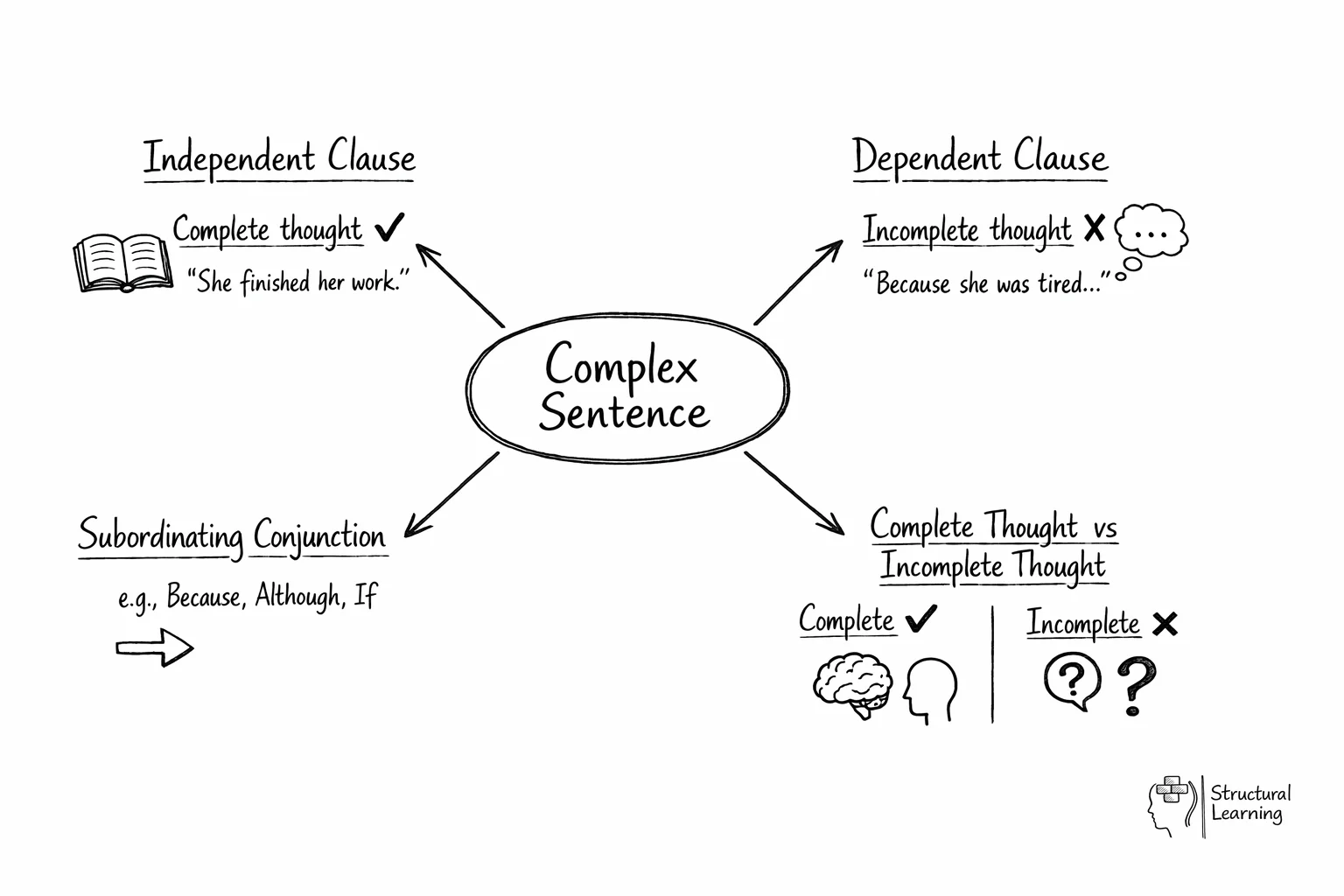
A complex sentence contains both a dependent clause and an independent clause. The independent clause is a complete thought such as 'stay outside'. The dependent clause cannot stand alone and does not make sense by itself for example 'until it rains'. These types of sentences can work either way round, 'stay outside until it rains' or 'until it rains, stay outside.' We can also use subordinating conjunctions to make a complete sentence. For example, 'The dog barks because it was scared' (because being the subordinating conjunction. Again this sentence type can work either way round, for example, 'Because it was scared, the dog barked'. We will look at how these simple grammar rules can be developed with Writer's Block later in the article. We will also look at the range of sentence types including, compound-complex sentences and multi-clause sentences.
Before we dive deeper, a few clarifications:
Learners enjoy sentence games. Index cards and colour-coding help them match clauses (Christison, 1998). Pair clauses in memory games for fun (DeKeyser, 2007). Verbal activities should link to grammar (Harmer, 2015). These games make grammar learning active (Thornbury, 1999).
Complex Sentences are easy when they are taught in the best way. Whether the main reason is lack of effort, or lack of understanding; it can be challenging to encourage a child to write a complex sentence (Montag & MacDonald, 2015).
Simple sentences are easy to write; they have one clause and show one idea. (Hunt, 1965). Learners cannot easily show ideas or creativity using them (Christison, 1998).
Writing one independent clause like, "She has never performed so smartly because she didn't receive proper guidance in the past," boosts learner creativity. Teachers can directly show these sentence structures.
Writing is a language task, beginning with speaking, then writing. Teachers should start with verbal exercises where learners combine thoughts aloud. Next, learners write down these thought combinations. This spoken-to-written link is vital. Encoding text comes after speaking it (Bereiter & Scardamalia, 1987).
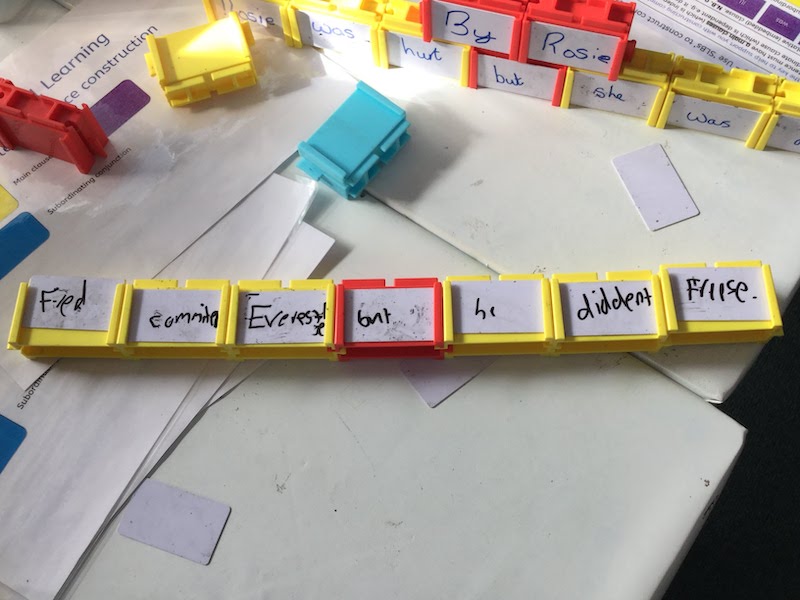
A complex sentence contains one independent clause and at least one dependent (subordinate) clause. These sentences are also called multi-clause sentences. In order to understand compound-complex sentences, recall complex sentences and compound sentences. A compound sentence contains multiple independent clauses and no dependent clauses; conjunctions are one joining method, not the only possible one. A complex sentence contains a simple sentence and a subordinate or dependent clause (includes a verb and a subject but does not show a complete thought).
Explicit instruction in grammatical meta-language is foundational for building complex sentences (Myhill, Jones & Watson, 2013), and active learning approaches make grammar lessons more engaging than rote drilling (Graham & Perin, 2007).
A compound-complex sentence has multiple independent clauses and at least one dependent clause. One can say, Complex Compound Sentence is a compound sentence that has a subordinate or dependent clause.
Following are some of the examples of Compound Complex Sentences:
These are a few suggestions you can use for your writing teaching methods.
Writer's block, or dysgraphia, can be a challenging issue for children to overcome. Using the Writers Block teaching method can help to overcome this. These include:
These four pillars can help a child to overcome any complex sentence comprehension issues.
Teachers use sentence combining, stems, and feedback to boost complex writing. Modelling and practise build learners' confidence (Kellogg, 1994; Bereiter & Scardamalia, 1987). This helps learners write complex sentences more easily (Christie & Derewianka, 2008).

One technique is to provide students with a simple sentence and then ask them to add details to it using dependent clauses. For example, starting with "The dog barked," students could add "because it was scared" or "when the mailman arrived." This helps them see how dependent clauses can add depth and complexity to their writing. Another approach is to use sentence stems, such as "Although.." or "Because..", to guide students in creating their own complex sentences.
Teachers should encourage learners to use conjunctions to connect clauses. Model their use and provide lists. Offer regular practice of complex sentences, with feedback. Feedback should cover sentence structure and content.
Learners need complex sentences for good writing. Teachers guide learners to understand and use them. Activities and feedback build confidence (Kellogg, 2008). This helps learners express ideas clearly (Christie & Derewianka, 2008). Practise makes perfect, say Graham and Perin (2007).
Teachers can use sentence combining or stems (Hunt, 1965; Saddler, 2005). Explain conjunctions clearly; this helps learners enjoy complex sentences. Writing complex sentences makes learners better thinkers and communicators (Vygotsky, 1978). This prepares them for future success.
AI writing assistants like ChatGPT and Claude now provide teachers with powerful tools for analysing and teaching complex sentence structures in real time. These platforms can instantly parse sentences, identify dependent and independent clauses, and generate targeted examples for specific grammatical concepts. Teachers can use prompt engineering to create customised grammar exercises, asking AI tools to generate ten complex sentences using temporal subordinating conjunctions or to analyse student writing for clause boundary errors.
Automated parsing tools offer immediate digital scaffolding that supports both teacher instruction and student self-assessment. When a Year 6 learner writes "Because the rain was heavy the football match was cancelled," grammar AI can instantly identify the missing comma after the dependent clause and explain why it's needed. This real-time feedback allows teachers to address misconceptions immediately rather than waiting for marked homework to reveal common errors.
However, automated analysis tools require careful integration with explicit grammatical instruction rather than replacement of teacher expertise. When learners use AI grammar support without prior meta-linguistic knowledge they often accept corrections without understanding the underlying principles, which is why meta-language teaching is so important in the first place (Myhill, Jones & Watson, 2013). Teachers must therefore use these tools to reinforce rather than substitute direct instruction in clause identification and sentence construction.
The most effective classroom practice involves teachers demonstrating AI tools during whole-class instruction, showing learners how to interrogate automated feedback and verify suggestions against grammatical rules. This approach builds critical evaluation skills whilst harnessing the immediate analytical power that digital platforms provide for complex sentence instruction.
Understanding the different types of complex sentences equips teachers to offer targeted instruction and feedback. Complex sentences can be categorised by the function of their dependent clause: adverbial, relative (adjective), and noun clauses. Each type serves a distinct purpose in enriching meaning and establishing relationships between ideas. When teachers can identify these variations, they can better support learners in selecting appropriate structures for their writing purposes.
Adverbial clauses, introduced by subordinating conjunctions like 'because', 'although', and 'when', add information about time, reason, condition, or contrast. For instance, 'The children played inside because it was raining' shows cause and effect. Teachers can use sorting activities where learners match sentence beginnings with appropriate adverbial clauses, helping them understand how these clauses modify the main action. This practical approach allows learners to experiment with positioning; moving 'because it was raining' to the beginning creates emphasis and variety in their writing.
Relative clauses, beginning with pronouns like 'who', 'which', or 'that', provide extra detail about nouns. Teaching the distinction between defining clauses ('The book that I borrowed is excellent') and non-defining clauses ('My favourite book, which has a blue cover, is excellent') helps learners understand punctuation choices and meaning differences. Classroom activities might include expanding simple sentences by adding relative clauses to create more descriptive writing, particularly useful in narrative and descriptive texts.
Noun clauses function as subjects or objects within sentences, often starting with 'that', 'what', or question words. Examples include 'What she said surprised everyone' or 'I believe that practice improves writing'. Teachers can demonstrate these through substitution exercises, showing how noun clauses can replace simple nouns whilst maintaining grammatical sense. This understanding proves particularly valuable when teaching reported speech and expressing opinions in persuasive writing.
Teachers often request ready-made examples of complex sentences to support their grammar lessons. Having a comprehensive bank of sentences allows for differentiated practise, quick starter activities, and targeted intervention work. The examples below are organised by subordinating conjunction type, making it simple to select appropriate sentences for specific learning objectives.
When introducing time-based complex sentences, begin with familiar conjunctions like 'when', 'after', and 'before'. For instance: 'The children lined up quietly after the bell rang' or 'Before you start writing, plan your ideas carefully.' These examples connect directly to classroom routines, helping learners recognise complex structures in everyday instructions. Progress to more sophisticated temporal markers such as 'whilst', 'until', and 'as soon as', which appear frequently in narrative writing.
Causal and conditional sentences prove particularly useful for developing analytical writing across the curriculum. Examples like 'Because the water evaporated quickly, the salt crystals formed' support science explanations, whilst 'If we reduce plastic usage, marine life will benefit' works well in persuasive texts. Teachers should encourage learners to experiment with clause positioning; moving the dependent clause creates variety and emphasis in their writing.
Contrast and concession conjunctions challenge more confident writers to express nuanced ideas. Sentences such as 'Although the experiment failed, we learnt valuable lessons' or 'The Romans built straight roads, whereas the Celts followed natural pathways' demonstrate sophisticated thinking. Create classroom displays featuring these examples, grouped by purpose rather than just grammatical structure, to help learners select appropriate conjunctions for their writing intentions.
Subordinate conjunctions serve as the linguistic bridges that connect dependent clauses to independent ones, making their identification crucial for understanding complex sentences. These words, including 'because', 'although', 'when', 'if', and 'unless', signal to readers that additional information follows which cannot stand alone. Teaching students to recognise these conjunctions provides them with a concrete starting point for analysing sentence structure.
A practical approach involves creating a classroom display of common subordinate conjunctions grouped by function: time (when, while, after), cause (because, since), condition (if, unless), and contrast (although, whereas). Students can use highlighters to mark these words in texts, building pattern recognition through repeated exposure. This visual strategy helps learners spot the junction points where clauses connect, making abstract grammatical concepts more tangible.
The 'Conjunction Hunt' activity engages students in finding subordinate conjunctions within their reading materials. Working in pairs, learners identify and categorise conjunctions, then discuss how each one changes the relationship between clauses. For instance, comparing 'I went to school because it was Monday' with 'I went to school although I felt ill' demonstrates how conjunctions shape meaning. This collaborative exploration helps students understand that subordinate conjunctions do more than join; they establish logical relationships.
Regular practice with sentence combining exercises reinforces conjunction recognition. Teachers provide two simple sentences and challenge students to connect them using different subordinate conjunctions, observing how each choice alters the meaning. This approach, supported by research on sentence combining effectiveness (Andrews et al., 2006), moves students from passive recognition to active application, preparing them to use complex structures purposefully in their own writing.
A complex sentence consists of one independent clause and at least one dependent clause. The independent clause can stand alone as a complete thought, whereas the dependent clause requires the rest of the sentence to make sense. Teachers often describe these as multi-clause sentences where a subordinating conjunction joins the parts together.
Active learning, like card matching, helps learners see structure. Colour-coding clauses works too. Memory games linking clauses are also effective. Verbal exercises first let learners articulate ideas before writing (Vygotsky, 1978).
Showing learners more complex sentences expands their ideas (Bereiter & Scardamalia, 1985). They can be more creative with writing after this transition. By giving them the tools to expand thoughts, confidence grows (Vygotsky, 1978). If learned early, learners avoid basic, repetitive writing (Christenbury & Kelly, 1983).
Writing links closely to verbal skills, research shows. Classroom talk greatly helps learners write well. Many learners find complex sentence structures hard (Hunt, 1965), and direct teaching with worked models helps them build these structures (Myhill, Jones & Watson, 2013; Christie & Derewianka, 2008).
Learners often mix up complex and compound sentences. Compound sentences use "and" or "but" to link clauses. Verbal preparation is key before writing tasks. Teachers, help learners spot conjunctions and independent clauses (Halliday, 2004; Jones & Smith, 2019).
A complex sentence contains one independent and one dependent clause, while a compound-complex sentence is more intricate. It consists of at least two independent clauses joined by a coordinating conjunction, with at least one of those clauses being complex. Students must have a firm grasp of both basic types before they can successfully construct these multi-layered sentences.